NVBA NEWS BLOG
Welcome to the blog for Northern Virginia Bird Alliance, a wealth of resources about northern Virginia birds, wildlife, habitat conservation and restoration, native plants, wildlife-friendly gardening, advocacy and more.
Board Notes: Think Beyond Your Back Yard
While we’re hunkered down inside during the cold winter months, it’s also a good time to support habitat creation beyond the boundaries of our backyards.
Photo: Tern Colony, VA DWR
Betsy Martin
It’s cold as I write this, and more snow is expected. It’s no time to venture outdoors for planting or even invasive weed-pulling. It’s time for keeping feeders full and watching the birds from inside a warm house. See this month’s Wildlife Sanctuary Almanac for some tips on using bird feeders and maintaining a fresh, unfrozen water supply.
While we’re hunkered down inside during the cold winter months, it’s also a good time to support habitat creation beyond the boundaries of our backyards. Virginia’s legislative session began in January, and your representatives will consider a number of bills that would conserve or create habitat for wildlife. Here are two examples:
Virginia’s Great Outdoors Act (House Bill 2059), sponsored by Delegate Paul Krizek (D-Fairfax), would dedicate $230 million in annual funding toward protecting vulnerable natural lands and waters, working farms and forests, drinking water resources, and historic and cultural sites. It would expand habitat for birds and other wildlife and also improve public access and promote outdoor recreation by developing new trails, parks, and other public lands.
In 2020, Virginia’s largest colony of nesting seabirds was displaced by a construction project at the Hampton Roads Bridge-Tunnel. The Virginia Department of Wildlife Resources created temporary nesting habitat for the birds by filling barges with sand and gravel to create an artificial floating island. In this year’s session, representatives will vote on the Governor’s proposal to commit $4,431,141 as Virginia’s share to fund construction of permanent habitat for the colony by the U.S. Army Corps of Engineers (this is one of many proposed amendments included in SB800 and HB1600).
Passing bills such as these can create wildlife sanctuaries on a grander scale than we can do individually on our own properties (as important as our individual efforts are).
If you think you’d like to advocate for wildlife and conservation but are new to the idea, you might consider joining NVBA’s Advocacy Committee. Send an email to advocacy@nvbirdalliance.org to join a team of volunteers who advocate for these and other conservation measures. See the Committee’s issue positions here.
Board Notes
Meet Eileen Ellsworth, NVBA board member, secretary and chair of the fundraising committee.
Photo: Pileated Woodpecker, Pamela Underhill-Karaz
Eileen Ellsworth
I was 19 years old when I signed up for an ornithology class that was required for the BS in biology I was pursuing. However, I foolishly took the class in the spring instead of the fall semester of my sophomore year. Big mistake. Dr. Bongiorno was famous for his weekly four-hour-long, attendance-required bird walks. It was February in Connecticut, frigid and dark at 6:00 am. I remember standing in the university parking lot that first morning, shivering and miserable, wishing I had majored in anything else and wondering if I could see it all through.
We drove to a bird sanctuary in Fairfield. Ten minutes into the walk one of my classmates spotted a Pileated Woodpecker. I had never seen one, and it was something to behold. Strangely large for a woodpecker and resembling a pterodactyl for goodness’ sake, the animal instantly struck me as powerful, ancient, and whole. It is hard to overstate my reaction at the time. I wasn’t just seeing a bird. I was seeing another nation I did not know existed. It was a complete revelation.
From that point forward, many weekend trips and vacations were chosen for birding potential. Bird feeders were purchased and tended. Family members and friends were converted. Books and field guides were acquired. What had started as an ornithology lesson in bird behavior became a massive and immediate change in my own.
Over the years birds have taught me something important about being human on the planet. They have helped me develop a more right-brained worldview that sees the connections between things. While I have spent time watching birds, I can’t help but feel that they are watching us, too, that we somehow participate with and influence each other. They seem possessed of a knowing that modern humans have lost, and yet we share a common awareness. Their lives are a simple and moving lesson in just being. To this day, particularly when I see a bird I haven’t seen lately, I feel a part of something bigger than myself.
I recently retired from a long career that ended up having nothing to do with biology or birds, but my interest in everyday nature has never faded. I became an avid gardener 20+ years ago and spend many hours these days in an ever-expanding pollinator garden filled with native plants. I became a certified Virginia Master Naturalist this spring through the Fairfax chapter. I volunteer with Plant NOVA Natives and help them with monthly updates and their website. I became a board member of the Northern Virginia Bird Alliance in July, currently acting as board secretary and chair of the fundraising committee.
It is an honor to help advance the mission of these first-class regional organizations. Through them I have met several people who also find meaning in the work of conserving and supporting native habitats and the birds that live there. Together, we are making a difference, and that is a wonderful feeling.
Board Notes
Meet Ron Grimes, NVBA board member and treasurer.
Photo: Bald Eagles, Ron Grimes
Ron Grimes
As a kid I always enjoyed spending time in nature, which led me to major in Biology at the College of William and Mary in the early 1980s. As part of my studies, I took an Ornithology course with Dr. Byrd, a well-respected professor who spearheaded recovery efforts for Bald Eagles and Peregrine Falcons. Science classes generally had labs, and the Ornithology lab consisted primarily of bird watching trips in the Tidewater region of Virginia.
Bald Eagles, Ron Grimes
During one trip, I found myself hiking in the woods around some worn dirt fortifications from the civil war. We were looking for a Bald Eagle’s nest. At the time, the population was low and just beginning to improve after DDT was banned. A pair of adult Bald Eagles finally appeared, and I remember being awed by their size and majesty. I loved how bird watching got me to such a cool place and provided such a great experience.
After graduation I started a family and a career in federal law enforcement. In 2014, as I was nearing retirement, I looked for things I could do to contribute to my community. I became a Virginia certified master naturalist in Fairfax and volunteered for various citizen science and stewardship projects. I found myself drawn to “bird projects” like the Christmas bird count and winter waterfowl count.
During one of those counts, Karl Kikuchi, who at the time was the president of the Audubon Society of Northern Virginia, now the Northern Virginia Bird Alliance (NVBA), asked me if I could help conduct a year-long series of bird counts at a new park being developed by Prince William County. I thought it would be fun and said, “Sure.” That park was the Cockpit Point Civil War Park, part of the Lower Potomac Important Bird Area.
For the next year Phil Silas and I conducted numerous counts at the park. Phil is an excellent birder, and he patiently helped me improve my birding skills. I looked forward to every visit. One day I realized I had come full circle from college as I was hiking in the woods in the park around some worn dirt fortifications from the civil war while taking in some breathtaking views of Bald Eagles.
I decided to devote more time to conservation efforts and joined the Board. I also took up photography a couple of years ago to augment my bird identification skills. I “accidentally” took a couple of photos that turned out surprisingly well. That has led me to spend more effort (and money) trying to get better photos of the birds.
It has been fulfilling to support NVBA as a Board member and treasurer. I fully support our mission to engage all Northern Virginia communities in enjoying, conserving, and restoring nature for the benefit of birds, other wildlife, and people.
Board Notes
The next week signals the start of a massive surge of migration into Northern Virginia. Each spring, 3.5 billion birds and 350 species cross the southern border of the United States on their way to nesting grounds in the northern states and Canada.
Photo: Prothonotary Warbler, Kyle Dunbar/Audubon Photography Awards
Migrants Are Coming
Tom Blackburn
The next week signals the start of a massive surge of migration into Northern Virginia. Each spring, 3.5 billion birds and 350 species cross the southern border of the United States on their way to nesting grounds in the northern states and Canada. Each fall, 4.7 billion birds, their numbers swelled from successful breeding, move south to their wintering grounds in Central and South America. Many of the birds have already crossed the border and are making their way northward in stages. The first Purple Martins, flying from Brazil, are already here according to reports from eBird. And our winter migrants – Dark-eyed Juncos, White-throated Sparrows and others – are heading north, to return in October and November.
The distances birds travel during migration are little short of unbelievable. Ruby-throated Hummingbirds, weighing 1/8 of an ounce, fly 500 miles nonstop across the Gulf of Mexico. Bar-headed Geese have been observed flying at an altitude of 23,500 feet in the Himalayas, where humans have difficulty walking without oxygen. A Bar-tailed Godwit was recorded flying 8,400 miles without stopping on its 11-day journey from Alaska to Tasmania, Australia. And Arctic Terns, the champion long-distance migrants, fly 18,000 miles round-trip every year.
Long-distance migrants’ physical adaptations to accomplish their journeys are also little short of amazing. The Bar-tailed Godwits are perhaps the champions at modifying their bodies for migration. They double their body weight from 1 pound to 2 pounds, largely in fat to be used in their flight, while shrinking their gizzard, kidneys, liver and gut to make room for the extra fat supplies. Many birds also shrink their reproductive organs to 1% of their breeding season size when they are not needed.
How the birds accomplish their migration is astonishing and still being figured out by scientists. A bird can use landmarks to guide its way, but many first-year birds migrate alone, without any memory of the correct route to take. Birds can use the sun as a guide, but many birds migrate at night. Using the stars also helps, but to do that a bird has to take into consideration the changing position of the stars relative to the earth as the earth rotates on its axis. Some birds can sense the earth’s magnetic field and can use minute changes in the field to help keep them on the right course. That sense can be critical when winds sweep the birds far off their intended path.
The hazards of migration are substantial. Many of them such as predators and severe weather are unavoidable, but we humans can reduce bird deaths in one critical area: collisions with buildings and disorientation from lights. Birds flying at night can be confused and disoriented by bright lights on tall buildings. Last fall, more than 1,000 birds were killed in a single night when they flew into the side of the McCormick Place Convention Center in Chicago. More than 1 billion birds are killed each year in the United States as a result of flying into buildings. Many of these deaths can be avoided by reducing building lighting during the spring and fall migration seasons. Even more deaths can be avoided by following the Five Principles for Outdoor Lighting promoted by DarkSky International. April 2-8 is International Dark Sky Week, timed to coincide with the spring bird migration season.
How can you experience the wonders of bird migration? Birdcast uses weather radar, meteorological changes, and years of data compilation to predict periods of high migration and show the numbers of migrating birds in real time. On the night of October 6, 2023, Birdcast recorded a record-high 1.2 billion birds in flight in the United States. If you would like to experience bird migration first-hand, instead of via computer, a prime spot to look for warblers is Monticello Park in Alexandria. You can learn about the park, as well as read predictions of what species of birds are most likely to be at the park each day during migration season, at MPNature, a website created by local birders Bill Young and Ashley Bradford. If you are willing to travel, Magee Marsh in northwest Ohio is renowned for the numbers of warblers who stop there to rest and refuel before crossing Lake Erie. You can learn about it and a 10-day birding festival on Cornell’s All About birds website. Of course, you can also go to any local park, bring your binoculars and keep your eyes peeled. The next seven weeks are the best time of year to go birding since birds are dressed in their best, brightest breeding plumage.
Board Notes
I ended up on the board of the ASNV because I was seduced by a creek.
Photo: Tiger Swallowtail, Betsy Martin
Betsy Martin
I ended up on the board of the ASNV because I was seduced by a creek.
In 1994 my husband Paul and I moved to Fairfax County from the District. We moved to a house that sits directly across the street from Little Hunting Creek, a freshwater tidal creek that flows into the Potomac River and was once part of George Washington’s Mount Vernon estate. In fact, he called his estate his “Plantation on Little Hunting Creek.”
I began noticing all the beautiful, blooming wetland plants and the birds that lived and nested in the marshland, and trying to figure out what they all were. When I came home from work, I’d sit on a bench overlooking the creek. If I watched long enough, I’d see something that I’d never seen before—an aerial battle between an eagle and an osprey, or a mother wood duck and 16 ducklings darting out from the shoreline and making a beeline for the cover of the spadderdock. I began my own little restoration project along our shoreline, replacing the scraggly lawn with the native plants and trees and grasses I was learning about. We put a conservation easement on the parcel across the street so that it would remain habitat for wildlife instead of someday becoming a house for humans.
When I retired from the Census Bureau in 2007, I enrolled in the inaugural Fairfax Virginia Master Naturalist training class. This wonderful program further opened my eyes to nature and how its interdependent parts fit together. It also introduced me to people, knowledge, and activities far from my experience. Before long I got involved with Audubon at Home (AAH), which aims to help property owners create habitat for birds and other wildlife in their own yards. I certified our yard as a Wildlife Sanctuary in 2011. Certification requires adopting healthy yard practices and observing 10 Sanctuary Species using a yard to forage, breed, and nest.
But I didn’t stop with my own yard. I signed up to be an AAH Ambassador. Ambassadors visit properties at the request of homeowners to advise them on native plantings and other habitat improvements, and to certify properties as Wildlife Sanctuaries. Later I volunteered to serve as coordinator for Fairfax County, and eventually became AAH co-director (with Barbara Tuset). In 2020 I joined the ASNV board, which offers opportunities for broader involvement in environmental advocacy, habitat stewardship, and advancing conservation goals in northern Virginia.
Tiger Swallowtail, Betsy Martin
For me, AAH has been a personal journey of discovery, from learning about native plants, wildlife, and their habitat needs, to creating natural habitat and then watching birds, butterflies, and frogs show up in my own yard, to helping homeowners engage with the nature in their yards and experience the delight of gardening for wildlife. During the pandemic, when people couldn’t travel and tried to restrict their in-person contact with others, our yards and the outdoors became a source of respite and relief. And requests for AAH assistance grew. Many people in our rapidly urbanizing area became newly aware of how much they needed nature.
I love to visit people, walk their yards, and help them figure out how to turn their yards into better habitat. I can see when the light goes on and people get it and are inspired by what they can do. In these dark times, it is comforting and empowering to be able to act on a small scale to achieve something good, even if it doesn’t solve the world’s problems.
AAH is going strong, almost entirely driven by the commitment and determination of volunteers. Since 2010, we have certified 8,631 acres as Wildlife Sanctuaries in all kinds of places including residences, schools, churches, retirement communities, stormwater ponds, and Homeowner Association common areas. Last year, we certified our 1,000th property. ASNV’s AAH has expanded to six counties: Arlington/Alexandria, Fairfax, Prince William, Rappahannock, Fauquier, and Loudoun (run by partner Loudoun Wildlife Conservancy).
I hope that if you haven’t done so already you will let AAH open the door to stewardship and engagement with nature in your own backyard by requesting a home visit from one of our Ambassadors.
Board Notes
I’ve asked myself on occasion what makes us birders?
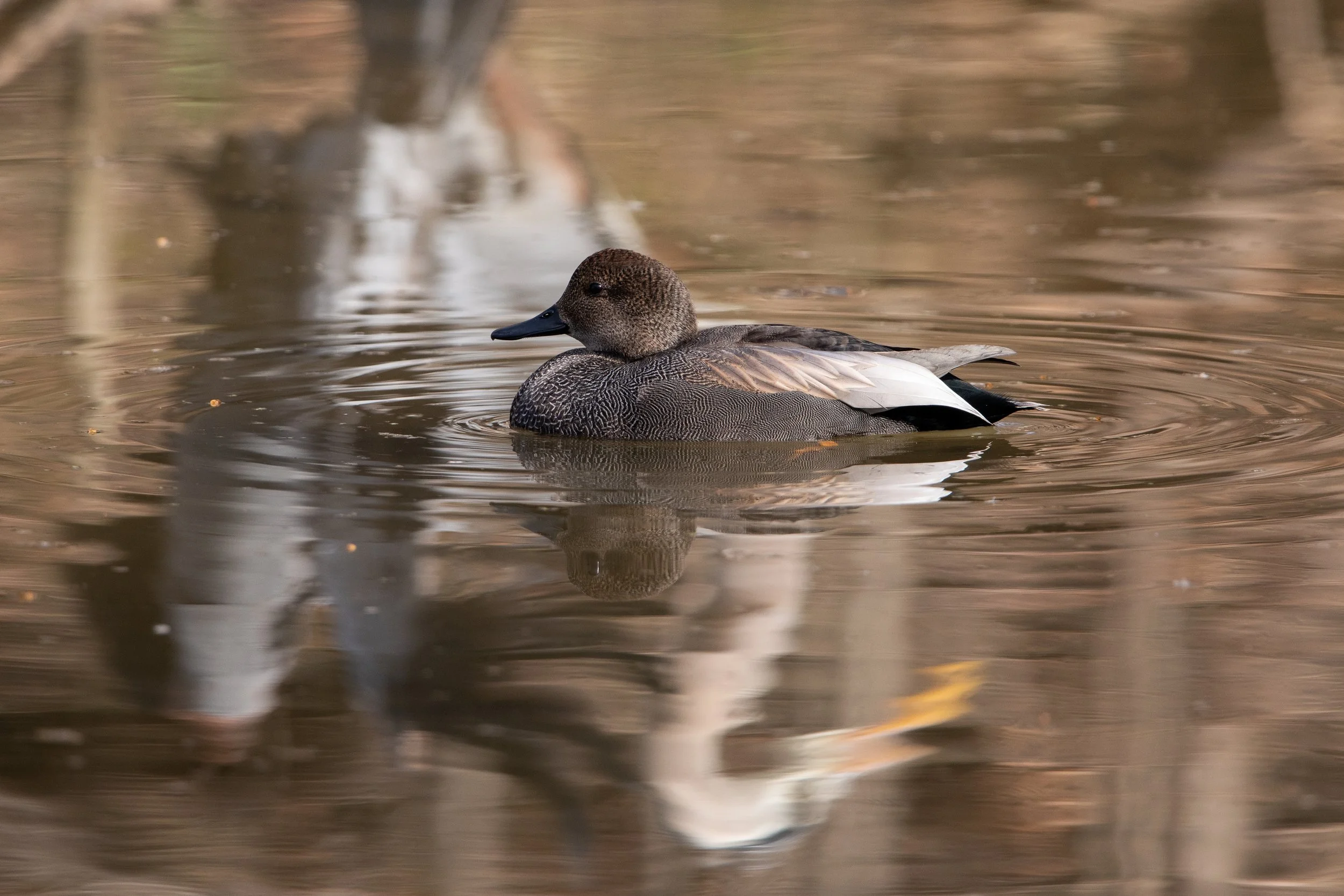
Photo: Gadwall, Gary Robinette/Audubon Photography AWards
Andreas Seiter
I’ve asked myself on occasion what makes us birders? Are we introverts, struggling with occasional bouts of misanthropy? Seekers after a connection with our spiritual ancestors through the voices of birds? Outdoor enthusiasts giving our hours in the field a purpose by documenting what we hear and see during our explorations? Conservationists with a mission to leverage the appeal of birds for an urgent and noble cause? Or just stressed modern urbanites, who found a simple and only moderately addictive way to boost our mental health? In my case, I’d say it’s a little bit of each.
Young Andreas going birding
I started out birding early. Our parents took me and my sister on Sunday morning bird walks, organized by the community college in my German hometown. They wanted us to get fresh air and some exercise, and we quickly learned to make the walks a treasure hunt, seeking to impress by being the first who saw the rare bird. So, I got a good grounding in bird identification and appreciation, but as an adult that early interest was sidelined by other demands of work and family. Nevertheless, I kept birding in a "mental drawer" to be taken out again once there was more time, the kids were grown up, the job less demanding.
That “drawer” opened a bit after I moved to the United States in 2004. I couldn't stop wondering what birds were singing in the trees and bushes around me. It took a few more years until I discovered the local birder community and joined their walks at least occasionally. I was still busy with two young children and a job that required me to travel a lot. An advantage of my job was that I saw many countries that are not tourist destinations. I was able to squeeze in a day of birding here and there, helping me grow my life list, sometimes by just exploring the hotel grounds or a local botanical garden.
I loved my work, but most of the time it kept me indoors in the office, conference rooms, airports, and hotels. But my parents’ early training held, making me an outdoors person, so I told everyone who wanted to hear that, once I retired, I wanted to be something like a volunteer park ranger. Upon retirement in 2022, I started volunteering at the new Occoquan Bay National Wildlife Center Visitors’ Center and used my free time to attend as many bird walks in the region as possible.
Some birding friends suggested I sign up for the Fairfax Virginia Master Naturalist training as a way to broaden my appreciation of the outdoors. I attended the class in spring 2023 and can recommend the program wholeheartedly. It has been an eye-opener for me, making me realize how interconnected all the different aspects of life on our planet are. It also helped me grow a network of like-minded people working in different fields and institutions, so that I now have more than enough options to get outdoors and do something purposeful. Of course, I always carry my binoculars with me. You don't have to go birding to go birding!
So, how did I join the ASNV board? I was talking with Libby Lyons, ASNV’s current president, one day during a bird walk, and she asked me whether I would like to join the ASNV board. I accepted because I appreciated ASNV’s integrated approach to conservation, which focuses not just on birds but also on other wildlife and the habitat they all need to thrive. I also saw that it was a group that had good ideas and the resources to implement them. Even in urbanizing northern Virginia we have opportunities for growth by expanding our group of active volunteers and collaborating with partners. By spreading our love for birds, we can win more advocates for intelligent approaches to protecting our natural environment.
Board Notes
It’s not all about the birds for me. My connection is with nature in general, an all-encompassing love and passion for Pachamama, Mother Earth in the Aymara language of my ancestors.
Photo: Yellow-rumped Cacique, Ad Konings via iNaturalist
Rita Peralta
It’s not all about the birds for me. My connection is with nature in general, an all-encompassing love and passion for Pachamama, Mother Earth in the Aymara language of my ancestors.
I spent my early childhood sheltered from the dry, harsh climate in the high plateau of El Alto, Bolivia, escaping on weekend family trips to the lush lowlands of Los Yungas and valleys of Cochabamba. My brother and I would release our energy running around making the large hibiscus shrubs, vines, and irrigation fields filled with toads our playground. My mother pointed out the leaf-cutter ants marching on the forest floor, which she told us she followed as a child, in awe of their soldierly efficiency.
Yellow-rumped Cacique, Ad Konings via iNaturalist
The beautiful bird songs in the early morning were our wake-up call, a new day to explore! My mom would point to the ‘wichi’ bird that would visit the fruit trees in the backyard, telling us about its beautiful songs and intricate nests. Recently, I found out the ‘wichi’ is the yellow-rumped cacique, an excellent weaver, building hanging, pouch-shaped nests.
My time before leaving Bolivia was brief but rich with connection to nature. I recall the sweet and complex tastes of ripe fruit in season: cherimoya, prickly pear, banana passionfruit, pacay, and many others. For a time, we depended on rain for water and learned about stormwater management through necessity. When we set roots in Virginia my family continued to seek ways to find nature. We enjoyed picnics in parks, camping trips, and hikes.
Nature is not apart, but a part of who I am and how I was raised. It is that understanding that has steered me to a career in nature and preserving it, because that’s how we preserve our own life history. ASNV champions these ideals with programs like Audubon at Home and advocating for the recognition of nature, through birds, in the laws that are passed. So, when I was asked to join the board, I knew that I had to say yes. It’s not easy: I have a full-time job and many other responsibilities within my family and community, but it is important to share my voice and perspective with an established community of conservationists.
I’ve now been part of the board for more than a year and am involved with the Community Engagement committee, serving as interim chair since June 2023. This is an exciting time to be part of ASNV. As we work to ‘Stretch our Parks’ I can’t help but think of a time when we all might see ourselves as a part of nature.
Board Notes
The bird that sent me to the store for my first pair of binoculars and a field guide is the Yellow-crowned Night Heron.
Photo: Yellow-crowned Night Heron, Barbara Saffir/Audubon Photography Awards
Connie Ericson
The bird that sent me to the store for my first pair of binoculars and a field guide is the Yellow-crowned Night Heron. I lived in Houston and would take my cool-down walk after a run along the oak- and pine-shaded entry to the Rice University campus. One day I spotted large, brown-speckled birds with huge beaks and big yellow-orange eyes hunkered down under the azalea bushes that also lined the entry. Then I spotted some big, gray, punk-looking birds in the trees. New binoculars and field guide in hand, I figured out what the birds were. They had a rookery on the campus, which is across the street from Houston’s Hermann Park, a good source of food. This was over 30 years ago, and I was hooked.
Yellow-crowned Night Heron, Jerry amEnde/Audubon Photography Awards
I wish I could say that time has made me an expert birdwatcher, but that is not the case. Although I have loved watching birds since those herons first caught my attention, I’m pretty lazy. I don’t study and I don’t keep a list, although I have vivid memories of some first-time sightings: a Rose-breasted Grosbeak in a city park on Galveston Island, a Vermillion Flycatcher at Brazos Bend State Park, a Green Jay at a highway rest stop on the way to Brownsville, an American Bittern crossing the road at Anahuac National Wildlife Refuge (and stopping to make itself look like a reed in the middle of the road), and a pair of American Redstarts in Smith Woods on High Island. I also remember a frustrating 45 minutes at Anahuac struggling with my field guide to identify a female Red-winged Blackbird. I called it the “bad attitude brown bird.”
I do some foreign travel and marvel at the diversity of species, but most of my bird-watching is here in northern Virginia, my home now for over 20 years, where I can observe the changing population throughout the year. And much of the fun of birdwatching for me is seeing familiar birds in action. I have enjoyed seeing Pileated Woodpeckers from my back yard excavating a nest hole and confronting other birds investigating the inviting cavity; day-old Wood Ducks piling out of a nest box at Huntley Meadows Park; a Red-shouldered Hawk apparently stealing a branch from another bird’s nest; a Hermit Thrush foot-trembling at Burke Lake; and a Great-crested Flycatcher taking down a House Sparrow in my backyard, probably following a nest hole incursion by the sparrow. In recent years I have been able to watch Barred Owls and Common Ravens raising young in nests along the W&OD Trail in Arlington, and in the past week I spotted my “bad attitude brown bird” on a nest at Huntley Meadows.
Yellow-crowned Night Heron, Georgia Wilson/Audubon Photography Awards
I appreciate the opportunities ASNV provides me to learn more about birds through its classes and to lobby for birds and the environment through its advocacy committee. Just this past year I started editing ASNV’s Potomac Flier, and I have learned a lot from the talented writers who have contributed articles. All of this is by way of saying that you don’t have to be a scientist or expert to help ASNV help the birds. Everyone, even a lazy birdwatcher, can make a contribution. I hope you join us.
Board Notes
I have been on the ASNV board for exactly one year, chairing the Citizen Science committee and participating in conservation initiatives. A year in I am impressed by the dedication and hard work of my fellow board members and our incredible partners, volunteers, and supporters.
Photo: Black Skimmers, Irina Pigman/Audubon Photography Awards
A new feature, alternating with the President’s Corner, to introduce some of our board members, coordinators, and friends
Jerry Touval
I have been on the ASNV board for exactly one year, chairing the Citizen Science committee and participating in conservation initiatives. A year in I am impressed by the dedication and hard work of my fellow board members and our incredible partners, volunteers, and supporters. The work of ASNV is making an impact on bettering the habitat available for our northern Virginia birds. And I am especially enthused about our new initiative, Stretch Our Parks. It is the kind of project that attracted me to ASNV in the first place.
Black Skimmer, Matt Felperin
My interest in nature and my commitment to conservation started when I was a teenager. One day, as a 15-year-old kid in suburban New Jersey, I looked out into my backyard and really noticed for the first time that there were a lot of different-looking birds. Intrigued, I bought a copy of a Roger Tory Peterson field guide, which I still have. Two years later, as a high school junior, I helped organize the very first Earth Day at my school. We planned a full day of presentations, discussions, and entertainment.
But it wasn’t until I was a college freshman at George Washington University that I learned that my interests could lead to a career. One sunny spring day, I walked through the E Street entrance of the Department of Interior building and picked up a brochure called “Careers in Wildlife Management” that showed a ranger in a hat sitting on a hilltop, looking though binoculars at the field below. I knew right then I wanted a career in wildlife management.
To pursue that goal, I left George Washington and enrolled at Rutgers University’s College of Agriculture and Environmental Science which offered a degree in Forestry and Wildlife. Unfortunately, when I graduated a few years later, it seemed as if everyone was looking for jobs in natural resource management. We were among the first graduates after Earth Day inspired many to get degrees in environmental sciences. Competition for employment was fierce.
So, I joined the Peace Corps and spent two years in Honduras doing land use and land cover surveys for 10 watersheds. The Peace Corps is everything they say it is – the toughest job you’ll ever love. Plus, the Peace Corps experience led to my goal of a career in wildlife management, netting me a job as a wildlife biologist for the Eastern Regional Office of the US Bureau of Land Management. I can’t describe the exhilaration I felt walking back through Interior’s E Street entrance, now as the wildlife biologist I had dreamed of becoming. And, after several years with BLM, I was able to return to conservation work in Latin America with the U.S. Fish and Wildlife Service. My work focused on issues related to migratory bird treaties.
After a number of years with USFWS, I enrolled in the Conservation Biology and Sustainable Development master’s degree program at the University of Maryland. With my new degree in hand, I moved to The Nature Conservancy’s Latin America Regional Program, where I spent the next 27 years. I was incredibly fortunate to have worked in the cloud forests of southern Mexico and Central America, the high Andes of Colombia, the Brazilian Amazon, the Atacama Desert in Chile, and the Patagonian Steppe in Argentina. They were experiences I never could have imagined while growing up in New Jersey and watching the birds in my suburban backyard.
A note on the photos with this article. The Black Skimmer is my favorite bird. In the US they are coastal residents, but they have a wider range in Latin America. I’ve enjoyed seeing them in North America, Central America and South America.
I retired in early 2022. After forty-plus years working on international conservation, my goal in retirement was to contribute to conservation in my own backyard, northern Virginia. So, joining the ASNV board was a perfect fit. In the coming year I’m looking forward to working with all of you ASNV members as we collectively pitch in to make northern Virginia a great place for birds, and a great place for people to be able to enjoy the benefits that nature provides.