TUFTED TITMOUSE
A Wildlife Sanctuary Program Sanctuary Species
Photo by Jocelyn Anderson - Audubon
Tufted Titmouse (Baeolophus bicolor)
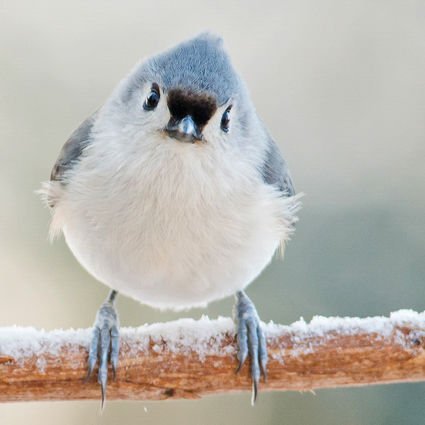
Tufted Titmouse head-on. Photo by Catherine McEntee - Audubon
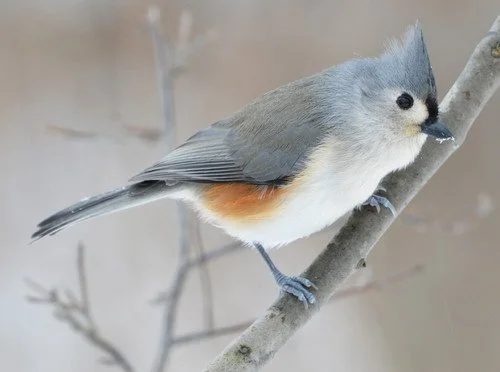
This sparrow-sized bird, about six inches long, has gray feathers above, a white breast and belly, with rust-colored sides. Its gray pointed crest is flat, or erect when curious or aroused. It has a small black patch on its forehead and striking large black eyes.
Titmice are year-round residents in most of the eastern half of the United States, where they favor swampy or moist woodlands, areas with shade trees in parks and suburban areas.
To learn more about ID, range, breeding, and voice (often “Peter, Peter, Peter”), visit Cornell’s All About Birds
| What Tufted Titmouse Need | How Can We Help |
|---|---|
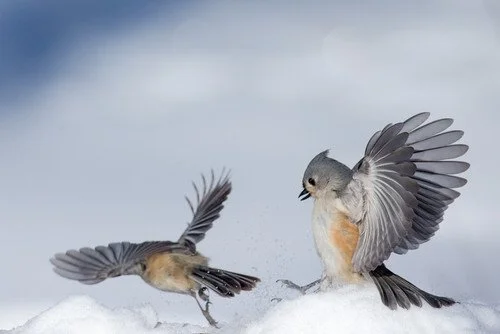
| Food and Water: Caterpillars form about 40 percent of the bird's diet followed by 17 percent insects, with the rest being wild fruit, seeds, and mast from oak or beech trees. They cache food in fall and winter. In winter Titmice may forage with Chickadees and other species in mixed flocks. These flocks often include Titmice parents and offspring from the prior spring. |
|
| Shelter: During the breeding season, females sleep in the nesting cavity, while males sleep on nearby sheltered branches in trees, vines, or shrubs. When not breeding, birds sleep individually on sheltered branches or, especially when cold, in tree cavities. |
|
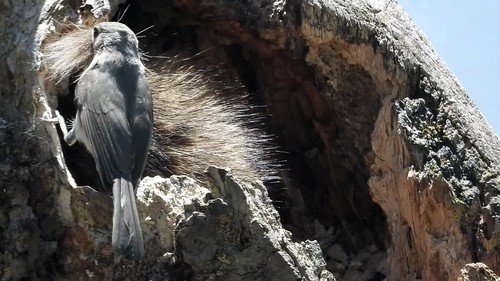
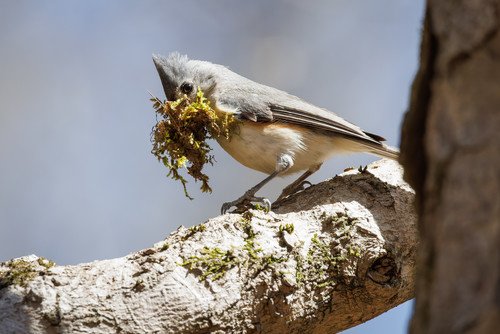
| Nesting: Titmice prefer nesting in natural tree cavities, such as abandoned woodpecker holes, from three to 90 feet above ground. The cup-shaped nest is completed entirely by the female with animal fur, fibrous bark strips and moss and lined with bark strips, grass and leaves. The female lays four to eight brown-speckled white eggs, and incubates them about two weeks. During that time the male calls the female out of the nest to feed her. She covers the eggs before leaving to eat. Both parents feed the nestlings, who fledge in about 18 days. Young Titmice may stay with their parents after fledging, joining them in mixed foraging flocks the following winter. |
|
| Other Threats: Titmice, especially nestlings and young birds, may fall victim to roaming house cats, black snakes,
wrens, hawks, and other predators.
|
|
Check out Tufted Titmouse activity near you:
Find sightings using eBird Data: Narrow the view by entering your county in the “DATA FOR:” filter