NVBA NEWS BLOG

Welcome to the blog for Northern Virginia Bird Alliance, a wealth of resources about northern Virginia birds, wildlife, habitat conservation and restoration, native plants, wildlife-friendly gardening, advocacy and more.

News Jess Michetti News Jess Michetti

Barred Owl Fledgling Leaves its Nest

Reston resident Dorli Bokel doesn’t consider herself a birder, but she loves the Barred Owls that she often hears nearby – especially the young ones.
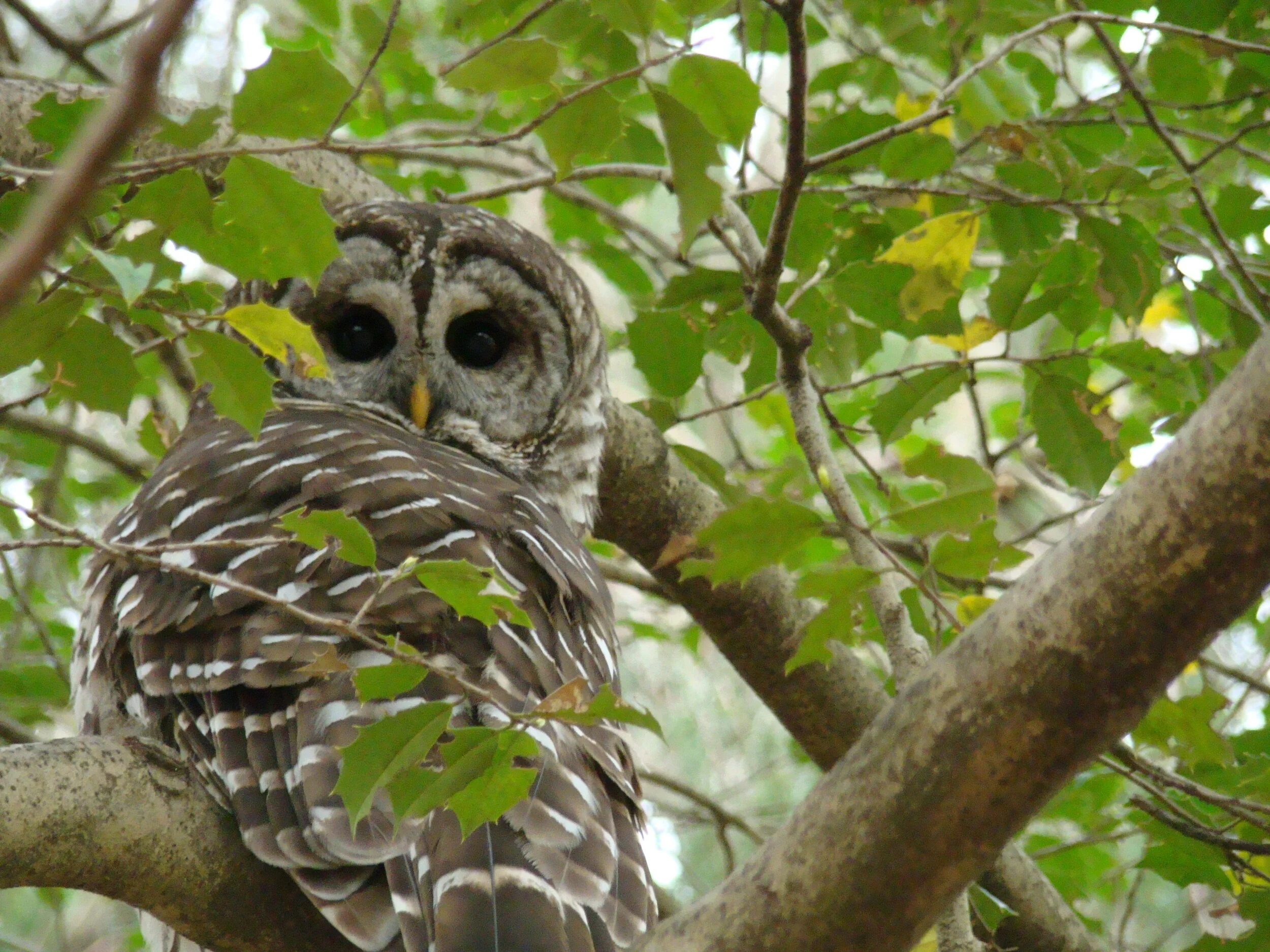
Photo: Barred Owl fledglings, Dorli Bokel

Lisa Mackem

Barred Owlet, Dorli Bokel

Reston resident Dorli Bokel doesn’t consider herself a birder, but she loves the Barred Owls that she often hears nearby – especially the young ones. “I love watching them turn their heads – almost like it’s on a rotation axel. The fuzzy babies are adorable.” Recently, she saw one of the owlets fledge, right on her deck railing. “I just looked outside, and the owlet was just sitting there. It started turning around, trying to get its footing…timidly walked for a bit, turned, and walked more. We were mesmerized.” Dorli estimates that the owlet spent five hours on her deck, then returned two days later. She took this video on the first day and additional pictures on the following days.

Unlike most young birds, Barred Owl chicks fledge before they can fly. They leave their nest when they are 4-8 weeks old but don’t master flight until they are up to 12 weeks old. Dorli doesn’t know how the owlet in her video got to her deck railing, where she says there is nothing to climb on, and the trees surrounding it are very high. However, Barred owlets are known to climb out of their nest using their beaks or talons to sit on branches, and hop to nearby limbs or other surfaces, climbing up to 15 feet.

Dorli noticed early this spring that the owls hooted during the day. Now she only hears them at night. This pattern matches the Barred Owl mating season, with courtship activities beginning in February and breeding between March – August. 

Barred Owls mate for life, and usually have a single clutch of 2-3 white eggs each year. The incubation period lasts 28-33 days. After they hatch, young Barred Owls can stay near the nest for up to 6 months, rarely straying from each other and often sitting side by side. Adults care for their young for up to four months – much longer than many owl species. Most Barred Owls remain close to their birthplace and their nest sites can be maintained for years.

Northern Virginia residents hear Barred Owls often, and sightings are not uncommon. Dorli hopes that someone else will share her unique experience of watching an owlet fledge. 

More than a century ago, Harriet Tubman used her knowledge of the natural world, including the call of the Barred Owl, in her efforts to guide people to freedom. Read the full story from Audubon.

Read More
News Jess Michetti News Jess Michetti

Barred Owls in Reston

Barred Owls are some of our most intriguing local birds. Most people will recognize their hoot-sequence call that sounds like, “Who cooks for you, who cooks for you all?” Unlike many other owls, they are semi-nocturnal. Their name comes from their striped plumage, or “bars.” They are the only eastern owls with deep brown eyes, which can appear blue-black in certain light. Females are larger than males, and only females incubate chicks, or owlets.
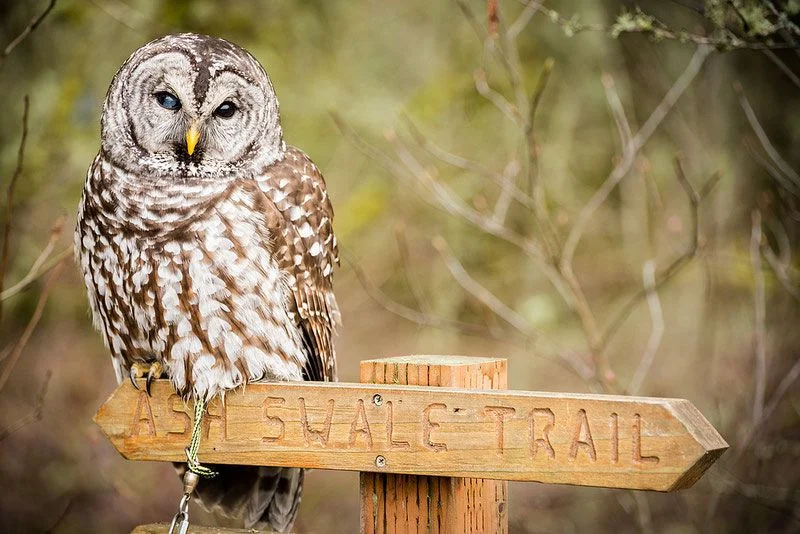
Photo: Barred Owls, Lisa Mackem

By Lisa Mackem

Barred Owls are some of our most intriguing local birds. Most people will recognize their hoot-sequence call that sounds like, “Who cooks for you, who cooks for you all?”  Unlike many other owls, they are semi-nocturnal. Their name comes from their striped plumage, or “bars.” They are the only eastern owls with deep brown eyes, which can appear blue-black in certain light. Females are larger than males, and only females incubate chicks, or owlets.

I often see Barred Owls near my home – usually when they are quietly perched in trees, and once when one was sitting on the ground. Barred Owls have distinct personalities. They watch people  intently, but with different levels of tolerance. When I take pictures of them, some of these owls change positions as if striking various poses. They aren’t disturbed when I stand near or directly under their perch. Others hoot with apparent annoyance or anger and fly to a more distant perch.  

The varied behavior described above might be related to the presence of other birds in the area. Small songbirds recognize Barred Owls as a threat, and sometimes band together to harass or “mob” them. Crows especially have a long-standing animosity towards owls. They frequently mob Barred Owls, chasing them from perches and potential prey. The owls will sometimes attack and eat individual crows, or other small birds (although birds are not their preferred prey), but they will retreat from a mob. 

As Leigh Clavez wrote in The Hidden Lives of Owls, Barred Owls are the opportunists of the owl world, easily adapting to varied habitats, including mixed forests and disturbed areas. Although they prefer tree cavities, they will also use the nests of Red-shouldered Hawks, crows or ravens. They eat a variety of small mammals and birds, amphibians, reptiles and invertebrates but they cannot catch cats and dogs. 

Great Horned Owls are the Barred Owls’ only natural enemy, but these owls are not seen frequently in Reston. Sadly, Barred Owls are often hit by cars when they swoop down to capture prey along a road. If the prey has been attracted by food people discarded out of a car window, the encounter can become deadly for the owl. I have seen some of these owl casualties along Lawyers Road in Reston. 

Barred Owl courtship begins in February and breeding is from March – August. They will lay 2-4 eggs, and the incubation period is 28-33 days. Owlets fledge at 35-40 days, but adults care for their young for at least 4 months – much longer than other owls. Young owls call for their parents with a distinctive screeching hiss. They have a fuzzy appearance until they are fully mature. Barred Owls often use the same nest sites, and can occupy territories for 2-3 decades, suggesting strong site fidelity over time. They do not migrate. Captive Barred Owls can live to their early 20’s, and wild owls live for 10-20 years. They mate for life, but if a mate dies, the survivor will likely mate again. 

Watch here to follow a pair of Barred Owls through their nesting.  

Read More
News Jess Michetti News Jess Michetti

Bird of the Month: The “Sparred” Owl

The Spotted Owl just can’t get a break. Endemic to old-growth forests in the Pacific North west, the endangered owl’s population was already declining due to deforestation, but now they have been forced to accommodate an inconsiderate guest: Barred Owls. Native to the eastern half of North America, the Barred Owl’s territory has been expanding westward since the turn of the last century.

By Elise Brosnan

The Spotted Owl just can’t get a break. Endemic to old-growth forests in the Pacific North west, the endangered owl’s population was already declining due to deforestation, but now they have been forced to accommodate an inconsiderate guest: Barred Owls. Native to the eastern half of North America, the Barred Owl’s territory has been expanding westward since the turn of the last century. By the 1990s, Barred Owls have become a permanent fixture throughout much of the Spotted Owl’s historic range. Larger, more aggressive, and more opportunistic than Spotted Owls, Barred Owls have been identified as a significant new factor driving the Spotted Owl’s population collapse.

However, Spotted Owls hold no apparent ill will towards Barred Owls. The two species occasionally hybridize, or mate, producing an offspring that is half spotted and half barred. As you might expect, “Sparred Owls” look like both of their parents. They have the Barred Owl’s larger size, but the Spotted Owl’s darker coloring. Their breast plumage is a mixture of spots and bars, described as looking like a checkerboard pattern. Their call also reflects their mixed heritage; a series of staccato Spotted Owl-like “hoos” followed by a Barred Owl-like “hoo-ah,” described by a biologist as “sort of like a Spotted Owl being strangled.”

Morgan, a Sparred Owl, is help in captivity at Chintimini Wildlife Center in Corvallis, Oregon. Photo courtesy of Chintimini Wildlife Center

Morgan, a Sparred Owl, is help in captivity at Chintimini Wildlife Center in Corvallis, Oregon. Photo courtesy of Chintimini Wildlife Center

Hybridization is surprisingly common in birds. Up to ten percent of birds are suspected to hybridize with other species, at least occasionally. However, hybridization may be increasing as the historic range of many bird species changes. As we lose grassland in the Great Plains states, eastern forest birds are interacting with western forest birds in a way that has never been seen before. Because of climate change, both western and eastern species are finding northern territories more hospitable. The Barred Owl made its way west by colonizing Canadian forests at the very north of its range, before looping south into Spotted Owl territory.

Great Plains hybridization has threatened species before. The Midwestern Blue-winged Warbler is expanding its range eastward, where it outcompetes and hybridizes with the Golden-winged Warbler.  (However, some biologists argue that Golden-winged and Blue-winged Warblers are two variants of the same species, and, by definition, cannot be under threat from itself.)

Therefore, what should be done about Barred Owls? Experimental cullings have occurred, with moderate success. However, some environmentalists argue that the arrival of the Barred Owl has provided a convenient scapegoat for another enemy of Spotted Owls: the logging industry. “Competition from Barred Owls may well need to be addressed on an interim basis until Spotted Owls’ populations can be returned to health,” says Bob Sallinger, conservation director of the Audubon Society of Portland, Oregon, “but unless critical habitat needs are adequately addressed, Barred Owl control will be nothing more than a sad and pathetic footnote on the road to Spotted Owl extinction.”


Sources:

Axelson, G. (2016) Golden-winged and Blue-winged Warblers Are 99.97 Alike Genetically. Living Bird Magazine. Cornell Lab of Ornithology, Ithaca, NY, USA. Retrieved from https://www.allaboutbirds.org/mixed-wing-warblers-golden-wings-and-blue-wings-are-99-97-percent-alike-genetically/

Read More