NVBA NEWS BLOG

Welcome to the blog for Northern Virginia Bird Alliance, a wealth of resources about northern Virginia birds, wildlife, habitat conservation and restoration, native plants, wildlife-friendly gardening, advocacy and more.

News Jess Michetti News Jess Michetti

Bird Banding at Occoquan Bay National Wildlife Refuge

During spring migration’s height, in April and May, from 6 a.m. to noon, volunteers catch and band birds in the Occoquan Bay National Wildlife Refuge near Marumsco Creek three mornings a week, a project undertaken there every spring since 2001, except 2020, the “covid year.”

Photo: Female Northern Cardinal with a bander, Glenda Booth

Glenda C. Booth, originally published in the Connection Newspapers

The 1.4-ounce female Northern Cardinal was squawking and squirming between Brian Rademacher’s fingers and then bit his hand, leaving a red mark, as he prepared to release her after putting a tiny metal band on her leg.

Brian Rademacher uses the bander’s grip to hold this female northern cardinal. Photo: Glenda Booth

“The bite was like a severe pinch,” Rademacher said calmly. The agitated bird was what he called a “recapture.” She had been caught and banded there three weeks ago.

During spring migration’s height, in April and May, from 6 a.m. to noon, volunteers catch and band birds in the Occoquan Bay National Wildlife Refuge near Marumsco Creek three mornings a week, a project undertaken there every spring since 2001, except 2020, the “covid year.”

They typically catch on average 20 to 30 birds in mist nets per six-hour stint, 500 per season. Their most commonly-banded bird is the White-throated Sparrow.

Birdcast.info shows that by April 27, 45 million birds had crossed the region since early March. Birds migrate to find food and favorable climates, and to breed.

Factors like weather, wind, human disturbances and habitat, including conditions in their wintering grounds, can affect the numbers. “A calm, cold night without rain or a big headwind is ideal for migration,” said Suzanne Miller, the project’s leader. “Songbirds migrate at night, up high. Hawks migrate on thermals.”

Next Steps: Recording Data

The team follows Monitoring Avian Productivity and Survivorship protocols. They do not use seeds or audio lures. They check the black, very fine, barely visible nets every 30 minutes and, if a bird is snared, carefully extract it. “It comes out of the side it went in on,” explained Miller, “to prevent breaking a wing or leg.

Once in hand, they put the bird in a cloth bag and take it to the banding station where they measure the wings and tail length, weigh it and determine age and sex. The goal is to process the bird in around five minutes to minimize stress on the bird.

Banders blow on birds’ bellies to study their anatomy. Photo: Glenda Booth

One step is to blow on the bird’s breast and belly to check three things, Paul Napier explained: (1) the brood patch where naked skin indicates the stage of the egg incubation cycle; (2) a cloacal protuberance that indicates breeding condition; and (3) fat, a sign of energy reserves.

The cloaca is the rear orifice or vent for the digestive, reproduction and urinary tracts. In male birds, if it is bulging like a pimple, the bird is in breeding condition. If a female has a protuberance, she likely has eggs. Minimal fat in birds could mean they spent a lot of energy traveling. Fat accumulation could indicate a healthy habitat, abundant in insects, grubs and inchworms, for example.

Among other data, volunteers record recaptures. Miller said that, since 2001, out of 652 cardinals, they have recaptured 74 or 11.3 percent. Cardinals are non-migratory, resident birds in northern Virginia. 

“They don’t go far from where they hatched,” Miller said. The recapture statistics can help determine a bird’s age. All data go to the U.S. Geological Survey Bird Banding Laboratory. Scientists use data to analyze bird behavior, population, distribution, survival rates and other factors.

Napier, a Falls Church resident, heads the Cape May (New Jersey) Raptor Banding Project and says that every time he bands a bird he learns something new. He has banded raptors since 1988 and songbirds since 2005.

Beverly Arnold drives up from Fredericksburg to band. “It’s a labor of love. I’m contributing to citizen science,” she said.

Janet Martin from Springfield said, “It’s so cool.”

The banding station. Photo: Glenda Booth

Banding is controlled by federal and state laws that require permits because it involves capturing and handling birds. All of this team’s banding, marking and sampling is conducted under a federally-authorized bird banding permit issued by the U.S. Geological Survey. The refuge also has a Virginia and U.S. Fish and Wildlife Service permit.

The one-square-mile Occoquan Bay National Wildlife Refuge at the mouth of the Occoquan River on Belmont Bay has tidal marshes, grassland and forest, and four miles of trails. Observers have documented over 650 plant and 200 bird species.

The banding station is open to the public from 7 a.m. to 12 noon until Memorial Day weekend. Groups larger than 10 people need a permit. Visit https://www.fws.gov/refuge/occoquan-bay/about-us.

To learn how many birds migrated through an area last night, visit https://birdcast.info/.

Read More
News Jess Michetti News Jess Michetti

Efforts to Protect South Island Birds Continue

Governor Northam’s commitment to help the 25,000 migratory birds whose nesting area on the South Island was displaced by the expansion of the Hampton Roads Bridge Tunnel has resulted in significant action in the past few weeks.

Photo: Banded Tern, Virginia Society of Ornithology

How Birders Can Help

Governor Northam’s commitment to help the 25,000 migratory birds whose nesting area on the South Island was displaced by the expansion of the Hampton Roads Bridge Tunnel has resulted in significant action in the past few weeks.  Creation of an alternate nesting area at Rip Raps Island (also known as Ft. Wool) is proceeding, as trees have been cut down, a contract to eradicate pests has been executed and the sand and gravel to build the new nesting area are on their way.  Acquisition of barges to serve as supplemental nesting areas is underway, and the Virginia Secretary of Natural Resources is consulting with National Audubon Society and American Bird Conservancy on the best ways to attract birds to the new site.  Long-term, a portion of the South Island will be returned to a nesting area after construction is complete, and the Northam Administration is committed to construction of a new artificial island.  

Despite the efforts to protect the birds, it is inevitable that some of the birds will be displaced by the construction.  The Virginia Department of Game and Inland Fisheries and Virginia Tech banded about 5000 of the nesting birds in the last two breeding seasons. They have asked birders to be on the lookout for banded Royal Terns, Gull-Billed Terns, Common Terns, Laughing Gulls, Sandwich Terns, and Black Skimmers and to forward the information to a central data collection point.  You can learn more about what information to collect and where to send it on the Virginia Society of Ornithology’s Website

Read More
News Jess Michetti News Jess Michetti

Bringing Peregrine Falcons Back to Virginia’s Mountains

A team brings at-risk Peregrine Falcon chicks from bridge nest sites in eastern Virginia to Virginia’s mountains, once part of their historic range. They hope the birds will imprint on the park's cliffs and return as breeding adults.
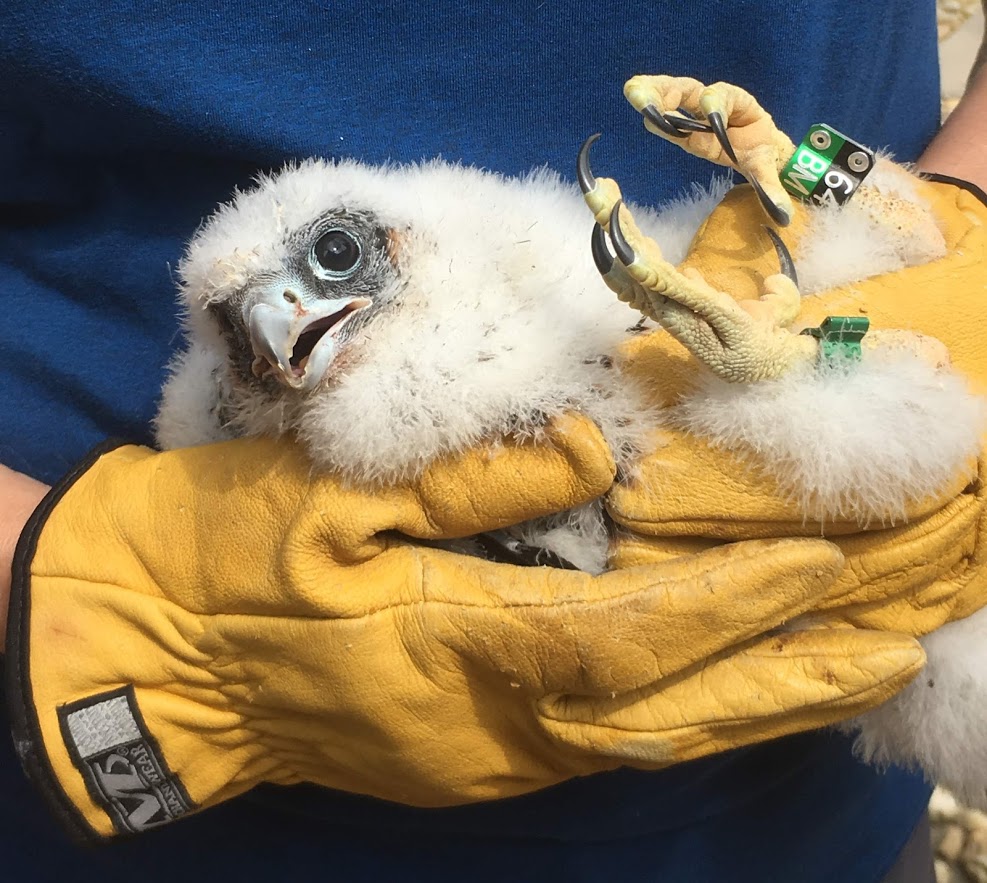
Photo: Peregrine Falcon, Richard Derevan/Audubon Photography Awards

National Park Service biologist, Rolf Gubler, will give a talk on March 1, 2020 at 2:00 PM about the Peregrine Falcon restoration project at Shenandoah National Park.  

Rolf Gubler, National Park Service biologist, with a Peregrine Falcon. Photo courtesty of Friends of Dyke Marsh

Rolf Gubler, National Park Service biologist, with a Peregrine Falcon. Photo courtesty of Friends of Dyke Marsh

A team brings at-risk Peregrine Falcon chicks from bridge nest sites in eastern Virginia to Virginia’s mountains, once part of their historic range. They hope the birds will imprint on the park's cliffs and return as breeding adults. This project boosts mountain peregrine populations and aids in the survival of bridge nest peregrine chicks where fledging is often difficult due to insufficient updrafts.

Peregrine Falcons were used for hunting or falconry as early as 2000 B.C. in China and Egypt and in World War II, both the British/U.S. and the German armies had a falcon corps to intercept their opponent’s homing pigeons.  Peregrines are found in rural and urban environments and on every continent except Antarctica.

This free, public meeting will be at the Mount Vernon Government Center 2511 Parkers Lane, Alexandria, near U.S. 1 and a mile from the George Washington Memorial Parkway.

The Friends of Dyke Marsh are sponsoring the program.  Cosponsors are the Audubon Society of Northern Virginia and the Northern Virginia Bird Club. This is a free program and registration is not required.

Read More
News Jess Michetti News Jess Michetti

Recovery of the Peregrine Falcon – A Conservation Success Story

In July, 2015, two Peregrine Falcon chicks were found on Market Street in Reston Town Center (RTC). They were taken to the Raptor Conservancy of Virginia and safely released into the wild.  No one realized Peregrine Falcons nested in Reston but the chicks prompted a discovery that two adult peregrines were nesting in RTC.

Photo: Banding Peregrine Falcon Chicks, Robin Duska

by Lisa Mackem

In July, 2015, two Peregrine Falcon chicks were found on Market Street in Reston Town Center (RTC). They were taken to the Raptor Conservancy of Virginia and safely released into the wild.  No one realized Peregrine Falcons nested in Reston but the chicks prompted a discovery that two adult peregrines were nesting in RTC. The pair has continued to nest there for five years. 

The Reston Town Center peregrines have perhaps found an ideal environment for a nest site: inaccessible, protected from rain and harsh sun, and facing south. The surrounding area is full of prey all year, while tall building roofs nearby provide safe landing areas for fledglings.

The Center for Conservation Biology in Williamsburg, VA monitors Virginia’s Peregrine Falcon population. Last year, the center’s director, Dr. Bryan Watts, and Reston resident and raptor biologist Steve Potts banded the four RTC peregrines’ offspring, assisted by a team of volunteers. Boston Properties, which owns the building with the nest, allowed access for the banding. They allowed access again this year, when four more chicks were banded.

Peregrine Falcon chicks, Robin Duska

Peregrine Falcon chicks, Robin Duska

Peregrine and other raptor and avian banding is a management tool and the United States Geological Survey licenses master banders. Virginia peregrines receive green bands with alpha numeric coding that identifies the birds. Both banding and satellite tracking allow study of the peregrines’ migratory status. Approximately half of the Virginia peregrines migrate south to establish winter territories ranging from North Carolina to Colombia, South America. Remaining birds establish winter territories within the mid-Atlantic region of the U.S. from Virginia through New York. 

The Peregrine Falcon was almost extinct in the eastern U.S. and listed as endangered in 1970. In 1975, The U.S. Fish and Wildlife Service appointed an Eastern Peregrine Falcon Recovery Team to develop and implement a recovery plan. A key part of the recovery strategy was the production and release of captive-reared falcons. (Cade and Fyfe 1978, Cade 2003.) From 1975 - 1985, 307 captive reared birds were released from sites on the Virginia Coastal Plain, as well as Maryland, Delaware, and New Jersey. Additional birds were released in Washington, DC and coastal North Carolina. This breeding population helped populate the eastern peregrine population so much that they were removed from the U.S. Federal List of Endangered and Threatened Wildlife (Mesta 1999).  

The historic population of Virginia peregrines nested in the mountains, but modern birds depend primarily on man-made structures for nesting. Peregrines usually nest in towers, but are also found on bridges and buildings. Less common structures include abandoned shacks, water towers, military ships, and active smokestacks at coal-fired power plants. Peregrines are vulnerable to expected risk factors in urban areas, but the Virginia peregrine population has consistently prospered since the first successful breeding between 1979-1982. In 2018, Virginia supported 32 known peregrine breeding pairs – the highest peregrine population recorded in the state. The population continues to grow at an 8% annual rate. Ongoing management activities might partially explain the increase in reproductive rates observed over time. Artificial management structures include added gravel, nest trays, nest boxes, and predator guards. Peregrine pairs nesting within boxes or on trays produced more than twice as many young as pairs that did not. The peregrines’ health can also be monitored. If a young falcon shows signs of disease that can easily be treated, it can be cured, and returned to the nest. Birds of prey suffer mortality rates of up to 70%, so all available monitoring is extremely helpful.

Peregrines are often reported to be the fastest bird in the world, increasing their average cruising flight speed of 24 to 33 mph to 67 mph when in pursuit of prey. When stooping, or dropping on prey with their wings closed, it's been calculated that Peregrine Falcons can achieve speeds of 238 mph. 

Dr. Carla Dove, Program Manager at the Feather Identification Lab at the Smithsonian Museum of Natural History, analyzed bird remains found in the RTC nests in 2018 and 2019 and identified 12 prey species: Blue Jays, Common Grackle, European Starling, Mourning Dove, Red-bellied Woodpecker, Yellow-billed Cuckoo, House Sparrow, American Robin, Cedar Waxwing, Eastern Bluebird, and American Woodcock. 

For more information about the peregrine falcon, see:
https://www.allaboutbirds.org/guide/Peregrine_Falcon/id

Read More