NVBA NEWS BLOG

Welcome to the blog for Northern Virginia Bird Alliance, a wealth of resources about northern Virginia birds, wildlife, habitat conservation and restoration, native plants, wildlife-friendly gardening, advocacy and more.
News Jess Michetti News Jess Michetti

Recovery of the Peregrine Falcon – A Conservation Success Story

In July, 2015, two Peregrine Falcon chicks were found on Market Street in Reston Town Center (RTC). They were taken to the Raptor Conservancy of Virginia and safely released into the wild.  No one realized Peregrine Falcons nested in Reston but the chicks prompted a discovery that two adult peregrines were nesting in RTC.

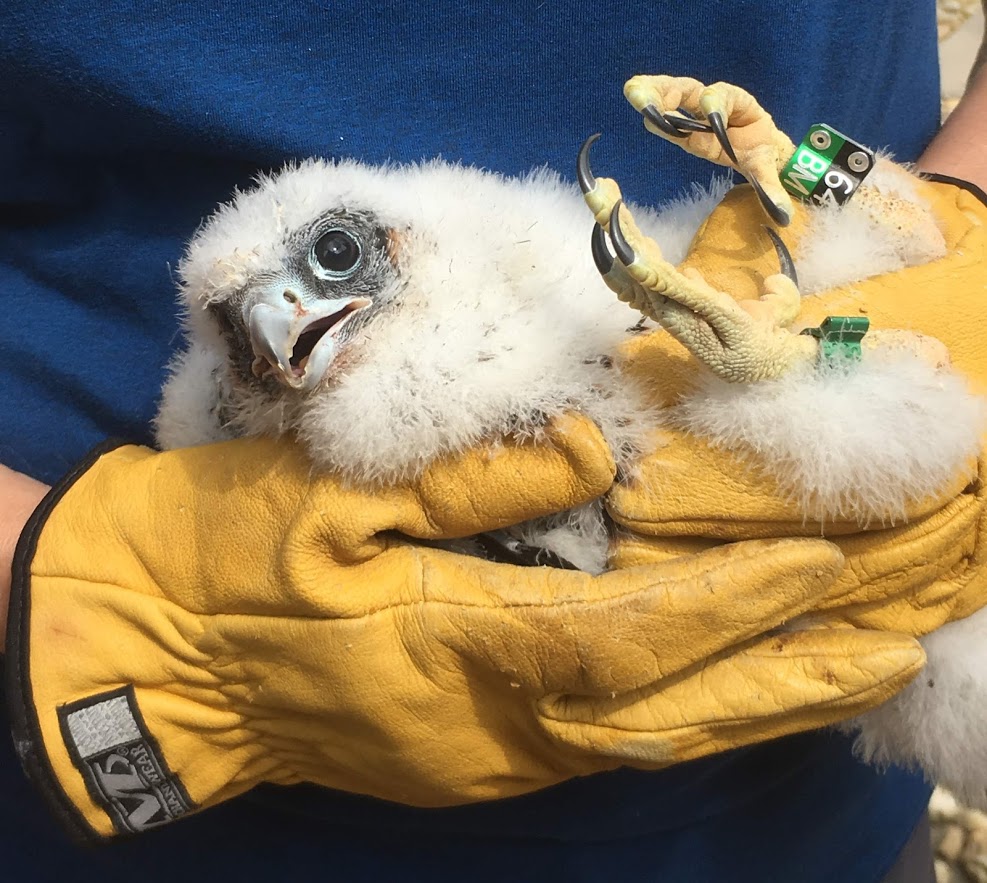
Photo: Banding Peregrine Falcon Chicks, Robin Duska

by Lisa Mackem

In July, 2015, two Peregrine Falcon chicks were found on Market Street in Reston Town Center (RTC). They were taken to the Raptor Conservancy of Virginia and safely released into the wild.  No one realized Peregrine Falcons nested in Reston but the chicks prompted a discovery that two adult peregrines were nesting in RTC. The pair has continued to nest there for five years. 

The Reston Town Center peregrines have perhaps found an ideal environment for a nest site: inaccessible, protected from rain and harsh sun, and facing south. The surrounding area is full of prey all year, while tall building roofs nearby provide safe landing areas for fledglings.

The Center for Conservation Biology in Williamsburg, VA monitors Virginia’s Peregrine Falcon population. Last year, the center’s director, Dr. Bryan Watts, and Reston resident and raptor biologist Steve Potts banded the four RTC peregrines’ offspring, assisted by a team of volunteers. Boston Properties, which owns the building with the nest, allowed access for the banding. They allowed access again this year, when four more chicks were banded.

Peregrine Falcon chicks, Robin Duska

Peregrine Falcon chicks, Robin Duska

Peregrine and other raptor and avian banding is a management tool and the United States Geological Survey licenses master banders. Virginia peregrines receive green bands with alpha numeric coding that identifies the birds. Both banding and satellite tracking allow study of the peregrines’ migratory status. Approximately half of the Virginia peregrines migrate south to establish winter territories ranging from North Carolina to Colombia, South America. Remaining birds establish winter territories within the mid-Atlantic region of the U.S. from Virginia through New York. 

The Peregrine Falcon was almost extinct in the eastern U.S. and listed as endangered in 1970. In 1975, The U.S. Fish and Wildlife Service appointed an Eastern Peregrine Falcon Recovery Team to develop and implement a recovery plan. A key part of the recovery strategy was the production and release of captive-reared falcons. (Cade and Fyfe 1978, Cade 2003.) From 1975 - 1985, 307 captive reared birds were released from sites on the Virginia Coastal Plain, as well as Maryland, Delaware, and New Jersey. Additional birds were released in Washington, DC and coastal North Carolina. This breeding population helped populate the eastern peregrine population so much that they were removed from the U.S. Federal List of Endangered and Threatened Wildlife (Mesta 1999).  

The historic population of Virginia peregrines nested in the mountains, but modern birds depend primarily on man-made structures for nesting. Peregrines usually nest in towers, but are also found on bridges and buildings. Less common structures include abandoned shacks, water towers, military ships, and active smokestacks at coal-fired power plants. Peregrines are vulnerable to expected risk factors in urban areas, but the Virginia peregrine population has consistently prospered since the first successful breeding between 1979-1982. In 2018, Virginia supported 32 known peregrine breeding pairs – the highest peregrine population recorded in the state. The population continues to grow at an 8% annual rate. Ongoing management activities might partially explain the increase in reproductive rates observed over time. Artificial management structures include added gravel, nest trays, nest boxes, and predator guards. Peregrine pairs nesting within boxes or on trays produced more than twice as many young as pairs that did not. The peregrines’ health can also be monitored. If a young falcon shows signs of disease that can easily be treated, it can be cured, and returned to the nest. Birds of prey suffer mortality rates of up to 70%, so all available monitoring is extremely helpful.

Peregrines are often reported to be the fastest bird in the world, increasing their average cruising flight speed of 24 to 33 mph to 67 mph when in pursuit of prey. When stooping, or dropping on prey with their wings closed, it's been calculated that Peregrine Falcons can achieve speeds of 238 mph. 

Dr. Carla Dove, Program Manager at the Feather Identification Lab at the Smithsonian Museum of Natural History, analyzed bird remains found in the RTC nests in 2018 and 2019 and identified 12 prey species: Blue Jays, Common Grackle, European Starling, Mourning Dove, Red-bellied Woodpecker, Yellow-billed Cuckoo, House Sparrow, American Robin, Cedar Waxwing, Eastern Bluebird, and American Woodcock. 

For more information about the peregrine falcon, see:
https://www.allaboutbirds.org/guide/Peregrine_Falcon/id

Read More
News Jess Michetti News Jess Michetti

Bird of the Month: Turkey Vulture

Turkey vultures, also known as turkey buzzards, are a common sight throughout the state of Virginia. As one of the most widespread birds in the western hemisphere, their range extends west to California and south to the tip of South America. Turkey vultures are often seen gliding on thermals, buoyed by a wingspan that can reach up to seven feet.

Photo: Turkey Vulture, Kevin Juberg/Audubon Photography Awards

By Elise Brosnan

Turkey vultures, also known as turkey buzzards, are a common sight throughout the state of Virginia. As one of the most widespread birds in the western hemisphere, their range extends west to California and south to the tip of South America. Turkey vultures are often seen gliding on thermals, buoyed by a wingspan that can reach up to seven feet.

Turkey Vulture, Michelle Maani/Audubon Photography Awards

Turkey Vulture, Michelle Maani/Audubon Photography Awards

Most birds have no sense of smell, which makes turkey vultures extremely unusual, as they rely entirely on their noses to detect prey. They do so by detecting a byproduct of carrion called ethyl mercaptan. This same compound is commonly added to petroleum gas, causing confused turkey vultures to congregate around gas leaks.

While most birders are acquainted with turkey vultures, they may not know the important role that they play in the ecosystem. Like all vultures, turkey vultures are equipped with a powerful digestive system that is capable of killing harmful bacteria, such as the bacteria responsible for anthrax. In fact, when vulture numbers decline, rates of human diseases go up. In India, falling vulture populations correlated with higher rates of both anthrax and rabies.

Turkey vultures have no natural predators, but they face one significant man-made threat: contamination from lead bullets. When game is shot with lead, the bullets break apart and contaminate the meat, making it toxic for both human and vulture consumption. California Condors, turkey vultures’ larger cousins, have to be regularly treated for lead poisoning to prevent species collapse.

Vultures are the sanitation workers of our ecosystem, disposing of carrion and keeping diseases in check. Therefore, the next time you see a turkey vulture, you should give it thanks. After all, it’s a dirty job but someone’s got to do it.

Source:
Haskell, David George. The Forest Unseen: A Years Watch in Nature. NY, NY, U.S.A.: Penguin Books, 2013.

Read More