NVBA NEWS BLOG
Welcome to the blog for Northern Virginia Bird Alliance, a wealth of resources about northern Virginia birds, wildlife, habitat conservation and restoration, native plants, wildlife-friendly gardening, advocacy and more.
Flyways and Freedom: A Black Birder's Reflection
Black Birders Week changed my life. It changed the way I see myself in environmental spaces. It was the reason I joined the Northern Virginia Bird Alliance board and gave me the opportunity to meet Black birders, photographers, artists, conservation leaders, and other Black nature enthusiasts.
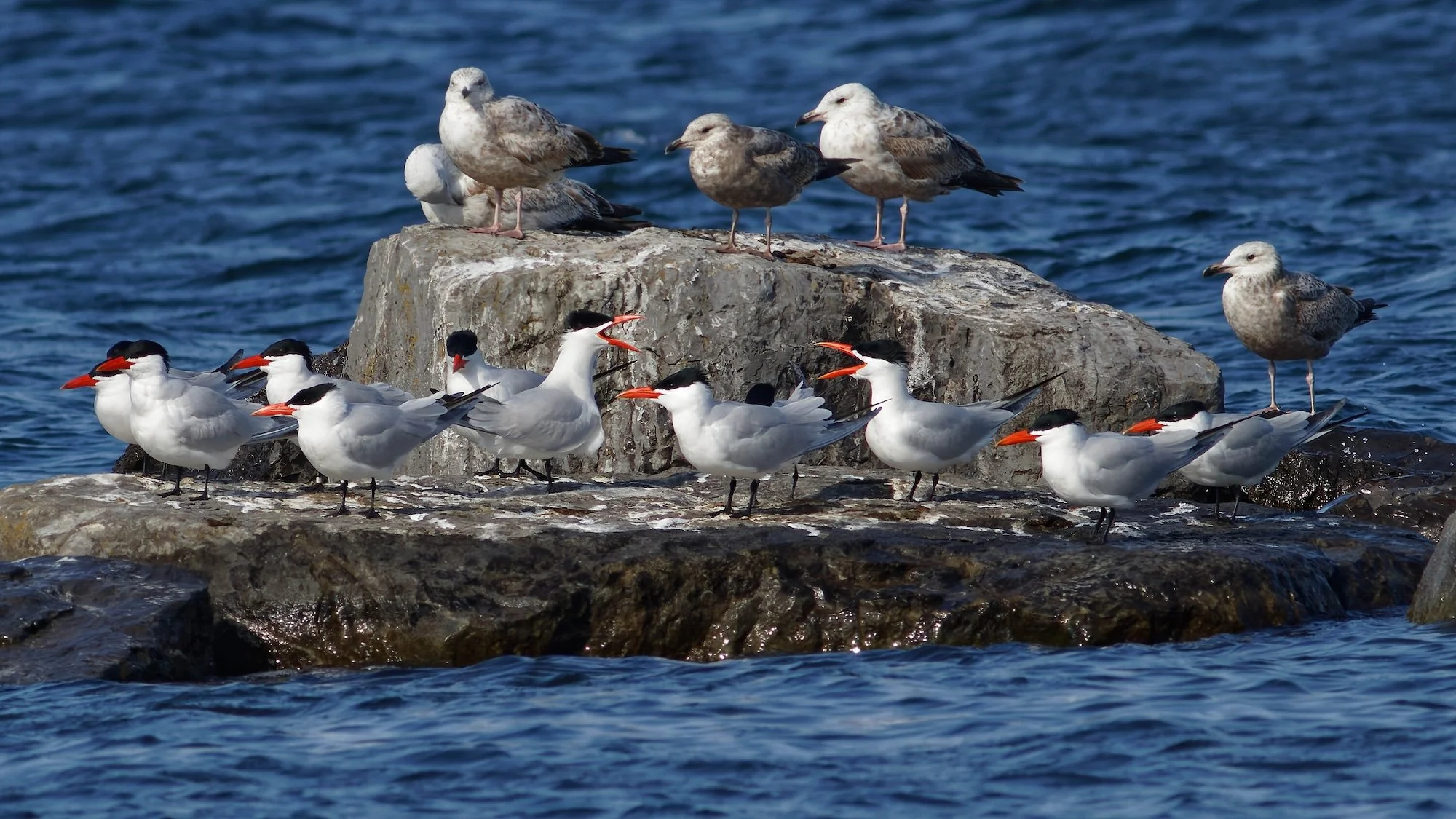
Photo: Caspian Terns and Herring Gulls, Kenneth Haas/Audubon Photography Awards
Ajani Simmons
“Black Birders Week is more than birding...it’s a movement for liberation, healing, and the transformative power of nature as a force for resistance and reclamation.”
— Black AF in STEM
Black Birders Week changed my life. It changed the way I see myself in environmental spaces. It was the reason I joined the Northern Virginia Bird Alliance board and gave me the opportunity to meet Black birders, photographers, artists, conservation leaders, and other Black nature enthusiasts.
Ajani Simmons, self-portrait.
Even as a black Master Naturalist, I hadn’t spent much time thinking about how Black people fit into birding spaces until I attended Black Birders Week events.
It was a reminder that Black people have always belonged in environmental spaces.
Gull. Photo: Ajani Simmons
This year’s Black Birders Week theme is “Flyways and Freedom: Advocacy, Action, and the Future,” and the spotlight is on the Laridae family: gulls, terns, skimmers, and noddies, birds shaped by wind, water, and migration.
The theme feels especially meaningful right now.
Birds have long been symbols of freedom because they belong to the sky. But they have to land. And what happens on the ground determines whether they survive.
That truth has stayed with me while thinking about both conservation and community here in northern Virginia.
Queen City was a thriving Black neighborhood in Arlington for decades before residents were displaced to build road infrastructure connected to the Pentagon. Communities were uprooted, and landscapes changed with them.
The same kinds of development pressures that fragment habitats and disrupt migration corridors can also erase the places where people once felt rooted and connected.
In many ways, flyways are about more than birds.
They’re also about connection, safety, and the ability to move through the world and still find places where you belong.
I remember standing near the water one evening in Occoquan Bay watching gulls ride the wind with almost no effort. There was a sense of peace in its stillness. It struck me how much migration depends on trust that there will be safety and space to return to.
That’s part of why Black Birders Week matters to me.
Yes, it’s a celebration of Black birders and Black joy outdoors. It’s also a reminder that environmental spaces become stronger when more people feel welcomed into them.
Building that kind of community doesn’t happen automatically. It takes intention. It takes listening. It takes creating spaces where people feel safe showing up as themselves, whether they’re lifelong birders or simply curious about the natural world.
For myself and many others, Black Birders Week opened a door into community, conservation, and a deeper sense of belonging.
I hope you also find meaning and impact in the upcoming events.
Black Birders Week is May 24 through May 30. The following events are brought to you by the Northern Virginia Birding Alliance:
On Tuesday, May 26, join us for a free virtual presentation with Jason Hall, founder of the In Color Birding Club and co-host of the Bird Joy Podcast, as he explores how birding can be a joyful and inclusive space right now.
Both events are free and open to everyone.
The flyway is something we build together. Come be part of it.
Birding is for Every Body: Birdability Week, October 20-26
Have you ever paused to think about how many people might want to join us in birding but can’t?
Photo: Birdwatching from a wheelchair, USFWS Headquarters, Public domain, via Wikimedia Commons
Jo Doumbia
Have you ever paused to think about how many people might want to join us in birding but can’t? Not because they lack interest, but because the trail is too rough for a wheelchair, the signage is too small for someone with limited vision, or the group atmosphere doesn’t feel welcoming to someone living with anxiety. That’s where Birdability comes in.
Founded by Virginia Rose, a birder and wheelchair user, Birdability is a nonprofit with a powerful vision: birding should be welcoming, inclusive, safe, and accessible for everybody and every body. Its mission goes far beyond removing barriers on trails. It’s about creating community, dignity, and joy for people of all abilities.
Birding is often seen as one of the most accessible hobbies: you can do it anywhere, at any age, with very little equipment. But in reality many opportunities are closed to people living with mobility challenges, sensory disabilities, chronic illness, or neurodivergence. That means a vast number of potential birders and future conservation allies are left out.
When we design programs with accessibility in mind, we don’t just help others: we strengthen our own community. Accessible trails and viewing platforms mean families can bird together. Clear communication and welcoming environments make first-time birders feel at home. Inclusion helps us live out the truth that birds belong to everyone.
Birdability offers tools to make this possible. Its crowdsourced Birdability Map, created by National Audubon Society in association with Birdability, helps birders of all abilities know what to expect at birding sites. Resource documents on Birdability’s website guide leaders on inclusive practices and respectful communication. And each October, Birdability Week shines a light on accessible birding with events, workshops, and celebrations across the country.
As birders, we can be part of this change. We can start by noticing where barriers exist, sharing reviews of our favorite spots, and experimenting with accessible outings. Most of all, we can open our doors wider and welcome people who may not have thought birding was for them.
Accessibility isn’t just a checklist: it’s a mindset. It’s choosing to see birding not as an exclusive hobby, but as a shared language of wonder and joy that everyone deserves to speak. By embracing Birdability’s vision, we can open the door to new members, new friends, and new advocates for the birds and habitats we cherish.
Let’s make sure birding is truly for everybody.
Hispanic Heritage Month and the World of Birds
From September 15 to October 15, Hispanic Heritage Month celebrates the histories, cultures, and contributions of Hispanic and Latino communities in the United States.
Photo: Resplendent Quetzal, Charles Gangas/Audubon Photography Awards
Josefina (Jo) Doumbia
From September 15 to October 15, Hispanic Heritage Month celebrates the histories, cultures, and contributions of Hispanic and Latino communities in the United States. For bird enthusiasts, it’s also a chance to honor the deep connections between these cultures and the avian world, connections that stretch from ancient traditions to modern conservation efforts.
Hispanic cultures across the Americas long have recognized birds as symbols of beauty, resilience and freedom. In the Andean regions, the Andean Condor soars as a national emblem and a messenger in Indigenous lore. In Mexico, the Resplendent Quetzal has inspired art, mythology, and conservation movements. Along the Caribbean coasts, colorful species like the Cuban Tody or the Puerto Rican Parrot hold both ecological and cultural significance.
These birds, and countless others, rely on the same flyways and ecosystems that link the Americas. Many species that breed in the U.S. migrate south each year, passing through or wintering in Latin American countries. Protecting their habitats is a shared responsibility that transcends borders.
Nowhere is this richness more evident than in Colombia, home to over 1,900 bird species, making it the second most bird-diverse country on Earth. From tiny hummingbirds in cloud forests to flocks of Scarlet Ibises in coastal mangroves, Colombia’s landscapes are a living showcase of avian beauty and biodiversity. Its conservation challenges and successes are directly tied to the health of migratory bird populations that also grace North American skies.
Hispanic Heritage Month also is a time to recognize the many Hispanic scientists, educators and community leaders who advance bird conservation. From field researchers in the tropics to grassroots advocates restoring wetlands, their work strengthens global efforts to protect avian biodiversity.
By celebrating cultural heritage and natural heritage together, we deepen our shared commitment to ensuring that future generations, across all the Americas can continue to experience the wonder of birds in the wild.
Please take a few minutes to watch this video to learn more about the partnership between NVBA and Casa Chiralagua in Alexandria, and consider volunteering to help us strengthen links with our local Hispanic community.
President's Corner
ASNV is adopting a proactive approach to our mission of engaging all northern Virginia communities in enjoying, conserving, and restoring nature for the benefit of birds, other wildlife, and people.
Photo: Tundra Swan illustration, John James Audubon
Libby Lyons
Looking back across the last year, I saw ASNV came out of the pandemic energized and ready to take on some big challenges. To counter the threat of continued massive losses of birds from North America (estimated at 3 billion, or one in four, since 1970), of rapid urban development in northern Virginia, and of climate change, we have developed our Stretch Our Parks initiative.
We also are adopting a proactive approach to our mission of engaging all northern Virginia communities in enjoying, conserving, and restoring nature for the benefit of birds, other wildlife, and people. Our recently hired Volunteer Coordinator is increasing our volunteer engagement, we are reaching younger audiences with our NextGen Birders for Conservation events, and we continue to reach out to all communities in our chapter territory through our diversity and inclusion initiatives, which are now featured on our website.
It is in this context of how we fulfill our mission, today and for years to come, that we now consider whether to change our organization’s name. John James Audubon’s vast contributions to American ornithology are well known. In recent years, however, it has come to light that, like some others of his era, he was a slave owner and collected skulls for another’s eugenics research, practices that are now universally condemned. He also copied another artist’s drawing of a bird that did not exist, using it to promote his own publication -- scientific fraud by any era’s standards.
ASNV, like many other Audubon chapters, has embarked on a process to decide whether to keep the Audubon name. The National Audubon Society in March of this year decided not to change its name, but is allowing its many chapters to decide for themselves.
Our Board of Directors will make this decision – and it is a complex one. More background information is available in this essay on the Audubon Name, and in this series of Frequently Asked Questions. On the one hand, some feel that changing the name will help remove the taint of racism associated with Audubon. And as Christian Cooper wrote in the Washington Post, we can’t adequately protect birds and other wildlife from the immense challenges ahead without the participation of non-Whites, a large and growing part of the population. Having a name that honors Audubon could deter such participation; this is especially relevant for northern Virginia, a part of the country that has recently become a majority-minority region.
On the other hand, Audubon did make significant contributions to ornithology, art, and natural history. Changing our name could weaken the Audubon “brand recognition.” A name change could alienate some members and also would be expensive, draining funds away from important conservation work.
Because we are a membership organization and have long benefited from your generous involvement and support, we are now in a listening and learning phase. We ask for your input – please use this link to take our brief survey. We also will consult other groups in northern Virginia communities that are not well-represented in our membership and other Audubon chapters around the country.
We look forward to hearing from you – about the name change issue – and about other suggestions that you have to help us protect the birds and nature that we all treasure.
Committing to Diversity, Inclusion, and Access
The COVID pandemic and our resultant programmatic pause allowed ASNV to reflect and act on how we engage with all communities in Northern Virginia.
Photo: Outdoor Afro and ASNV at Huntley Meadows, Antonio Simmons
The COVID pandemic and our resultant programmatic pause allowed ASNV to reflect and act on how we engage with all communities in Northern Virginia. In particular, the Spring 2020 murder of George Floyd and the incident in Central Park involving NYC Audubon board member Christian Cooper brought into focus that racism is still present in our country and organizations.
There are multiple reasons to consider our organizational diversity and inclusion. First, and most important, it’s the right thing to do. ASNV’s mission is to serve all of the communities of Northern Virginia, providing all of them with access to nature and conserving nature to meet their needs. Second, if we are to address successfully the overwhelming problems of climate change, the stunning loss of 2.9 billion birds from the U.S. and Canada since 1970, and the challenges of rapid urbanization and habitat loss in our area, we need the involvement of all northern Virginia communities.
Where to start to solidify and improve our diversity efforts? Some believe that the first priority should be renaming our organization, thereby acknowledging John James Audubon’s racism. National Audubon Society, of which ASNV is a chapter, is considering that question now, but its decision is still pending. So far, ASNV has tentatively decided to await that outcome.
What could not wait was taking positive action to effect change in our own organization to become more inclusive. In planning how to move forward, we took to heart the words of Black American ornithologist Dr. J. Drew Lanham in his discussion of John James Audubon’s racism: “[M]any blind spots remain in the wake of a legacy that can either be ignored to a fate of stagnancy and decline or be learned from to move, with eyes wider open, toward a more equitable, just, and inclusive conservation future.”
Here are some highlights of what we have done since 2020 to move forward, “with eyes wider open”:
Formed a Diversity and Inclusion Committee to integrate and energize our efforts.
Expanded our Board of Directors to include members from diverse groups and perspectives.
Cultivated partnerships with like-minded groups for joint programming. Here are just two examples: We partnered with NOVA Parks and NAACP/Arlington to establish an ongoing, award-winning Black and Latin/Hispanic Bird and Nature Walks series at Upton Hill Regional Park. We partnered with the Public Education and Outreach Committee of the Arlington Regional Master Naturalists to operate programs to reach underserved, low-income families.
Improved outreach by engaging a variety of groups already connecting to diverse communities in ongoing activities. Examples include partnerships with NAACP/Arlington, NAACP/Fairfax, Black Women Hike, Outdoor Afro, and Asian-American seniors in HUD housing, with ASNV providing support and volunteers for regular walks, outings, and community events. We also developed and translated into Spanish materials that we used in events such as those during Latino Conservation Week.
Reached out to different age groups by enlisting volunteers in our programs, including Scouts, and, through our new program, NextGen Birders for Conservation, younger adults.
Improved inclusion in all of our programs: For example, our college interns in 2022, who came from or work with underserved communities, helped us develop materials for Spanish speakers, people on the autism disorder spectrum, and American Sign Language users.
Improved access for appreciating birds and other natural resources. For example, our members contributed over 80 entries to the crowd-sourced Birdability map, which describes the accessibility features of birding locations all over the world; provided links to public transportation to over a dozen eBird hotspots; promoted COVID-inspired Zoom programming to communities that had never participated in our events, reaching new audiences; and adding closed captioning to all of our virtual programs.
So, what’s next? We plan to expand on our efforts with our current partners; ensure that all of our program committees, from advocacy to citizen science and conservation are actively involved in diversity, inclusion, and access; expand the geographic range of our programs; and expand our work with youth and families.
We need help with all of these efforts. Please consider volunteering. It’s important and lots of fun.