NVBA NEWS BLOG
Welcome to the blog for Northern Virginia Bird Alliance, a wealth of resources about northern Virginia birds, wildlife, habitat conservation and restoration, native plants, wildlife-friendly gardening, advocacy and more.
Calling all Birders: It’s time to get ready for Birdathon 2022!
Last year’s winning team saw 89 species in 24 hours! Wow! Can you beat it? Find out how to register your team here.
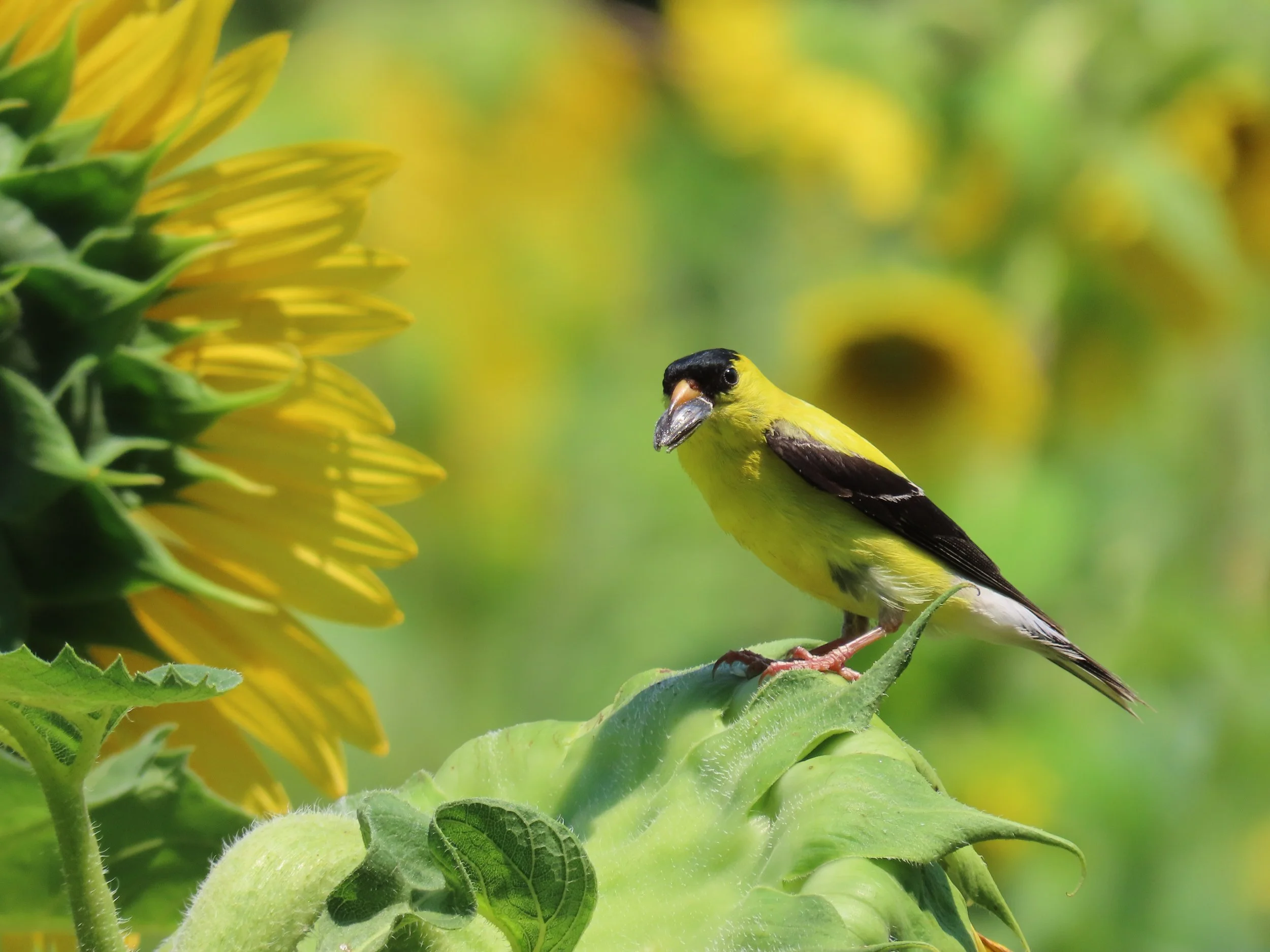
Photo: Camilla Cerea
How does it work? Like a walk-a-thon, Birdathon participants collect pledges from friends and family via our website. Then participants record how many species they can identify during any 24-hour period between April 16 and May 22. The more species they identify, the more funds they raise!
Last year’s winning team saw 89 species in 24 hours! Wow! Can you beat it?
Birdathon helps ASNV continue to support outdoor education, citizen science and habitat conservation, and encourages people to plant native plants and foster native wildlife. Birdathon also helps ornithologists better understand spring migration by reporting sightings through eBird, an online database of bird observations run by the Cornell Lab of Ornithology.
All birding levels are welcome. Participants can bird alone or form teams of up to five. All team members donate and/or secure pledges. Participants solicit general donations or ask for pledges based on the number of species or the number of individual birds sighted. Sightings and donations are due no later than June 3, 2022. Report your Birdathon sightings on eBird and email your list to info@audubonva.org.
Ready to get started? Register your team here and check out our Birdathon rules . Now go out and have a great day birding!
All participants and their supporters are invited to join us at our Audubon Afternoon in June for our Annual Meeting, where we’ll announce the winners of the “Most Species Counted,” “Most Money Raised” and “Youth Birder” competitions.
A Year of Birding “Centuries”
As 2021 began, I was feeling listless – in a general sense and in the bird-list sense. So, I challenged myself to see 100 bird species each month, a “century” challenge, because I wanted to get out of the house and be more active, see more birding friends, and become more purposeful in my birding.
Photo: American Goldfinch on sunflowers, Sycamore Landing, MD, Libby Lyons
Libby Lyons
As 2021 began, I was feeling listless – in a general sense and in the bird-list sense. So, I challenged myself to see 100 bird species each month, a “century” challenge, because I wanted to get out of the house and be more active, see more birding friends, and become more purposeful in my birding.
I can now report success!! From my first bird, the Painted Bunting on the C&O Canal (MD), to my last, an Audubon’s Oriole (TX), I saw 400 species in 2021– and at least 100 per month!! But I was rewarded with so much more than just a count of birds – here’s what I learned:
For me it’s as much about the people as the birds! I loved meeting and befriending so many folks with the same love of birds and nature. I went with them on trips far and near including the ASNV Birdathon and many Northern Virginia Bird Club trips. And I found I still get immense joy in sharing my passion – even with total strangers, e.g., showing my Painted Bunting photo to passersby wondering what all the fuss was about, and pointing out a perfectly camouflaged Wilson’s Snipe at Huntley Meadows and being called a “snipe whisperer.”
Piping Plover chick, Moonstone Beach, Trustom Pond NWR, Rhode Island, Libby Lyons
Birdwatch wherever you go! The pandemic kept me stateside, so I redoubled my efforts to bird more while visiting family. In a Rhode Island wildlife area on a balmy, buggy evening in May I was transfixed by the plaintive call of an Eastern Whip-poor-will, and then just down the road, by the dueling calls of two Chuck-will’s-widows. On my next trip, I delighted in a handful of little brown and white fluffballs, juvenile Piping Plovers, at Moonstone Beach (RI). When we retreated with our grown children to the cool of the West Virginia mountains in early August, I twice trekked off to Cranberry Glades bog, where I was rewarded with 9 species of warblers and 4 species of vireos so easily seen on their breeding grounds! In Olympic National Park in late August, it was a treat to join my brother as he led a boat tour of Lake Quinault and to revel in our shared love of natural history. From Washington I drove through smoky Oregon to stay with family friends and compiled a bird list for their yard among the Northern California redwoods, then headed to Point Reyes Bird Observatory, a birdwatcher’s mecca, which I had not visited in four decades. It is easy to forget how large and variable our country’s habitat is – there was almost no overlap between the West Coast birds I saw and those I had seen back East!
Mourning Warbler, Cranberry Glades Botanical Area, WV, Libby Lyons
Birdwatch all year! Another pleasant surprise was summer birding. I do not handle Virginia’s heat and humidity well, so had birded infrequently from mid-June to late August. I had rarely seen or heard fledglings, with their stubby tails, often murky plumage, and muddled songs! The summer foliage was also a pleasure – swaths of sunflowers in full bloom, replete with American Goldfinches and Indigo Buntings at Sycamore Landing (MD). And the wetlands at Huntley Meadows was transformed by the huge white flowers of the native hibiscus called Swamp Rose-mallow.
Photo: American Goldfinch on sunflowers, Sycamore Landing, MD, Libby Lyons
Even new birders can surprise you! Near November‘s end, I was still far short of my target. I was in a migration void – the passerines had flown south and the waterfowl had yet to arrive. I headed to the coast with my adult son, who is not a birder. He is a serious fisherman – observant, patient, and nature-loving – perfect skills for birdwatching. He not only spied a Black Skimmer (“That bird can’t keep its head up!”) at India River Inlet (DE), but he also spotted a sandbar harboring American Oystercatchers and Brants. As we chatted about why we loved our respective hobbies – he framed birdwatching in a way novel to me, perhaps due to his years studying economics. One reason birders are so friendly, he noted, is that sharing information about a target species doesn’t deplete the resource the way it might for fishing. Not only that, sharing makes you feel good, it helps the other person, and it increases the chances that they might share information back.
LeConte’s Sparrow, Sully Woodlands Park, VA, Libby Lyons
Be opportunistic and persistent! I took advantage of “lost” birds last year. There seemed so many – was it because so many of us were out birding, or just because the birds were roving farther afield? Certainly, the Green-tailed Towhee in Sky Meadows State Park (VA) and the Kirtland’s Warbler in Baltimore (MD) were far from their usual stomping grounds (West Coast and Michigan, respectively). And I was persistent – it took two attempts each to see that Green-tailed Towhee and the skulking, well-camouflaged LeConte’s Sparrow at Sully Woodlands, and three trips to see my nemesis bird, another skulker, the Connecticut Warbler, in Rock Creek Park (DC). Alas, it is valuable to temper persistence with common sense; it was a lot easier to spot a Ross’s Goose (white, slightly smaller than a Snow Goose) among a few Canada Geese at Mount Trashmore Park (VA) than among 4,000 white Snow Geese on a Delmarva field!
What next? I am not sure whether I will continue with the challenge in 2022. I hope to travel farther afield when COVID allows. But as the climate crisis looms, I am also trying to birdwatch with a smaller environmental footprint. I think this will mean more carpooling, not making long trips just to get the last few birds for the month, and exploring new places to birdwatch close to home. I don’t think I will ever tire of the Sandhill Cranes at Algonkian, the warblers at Monticello Park, the woodcock at Huntley Meadows, nor the rafts of winter waterfowl off Mason’s Neck. Join me!
Calling all Birders: It’s time to get ready for Birdathon 2021!
Birdathon helps ASNV continue to support outdoor education, citizen science and habitat conservation, and encourage people to plant native plants and foster native wildlife.
How does it work? Like a walk-a-thon, Birdathon participants collect pledges from friends and family via our website. Then participants record how many species they can identify during any 24-hour period between April 16 and May 16. The more species they identify, the more funds they raise!
Birdathon helps ASNV continue to support outdoor education, citizen science and habitat conservation, and encourage people to plant native plants and foster native wildlife. Birdathon also helps ornithologists better understand spring migration by reporting sightings through eBird, an online database of bird observations run by the Cornell Lab of Ornithology.
All birding levels are welcome. Participants can bird alone or form teams of up to five. All team members donate and/or secure pledges. Participants solicit general donations or ask for pledges based on the number of species or the number of individual birds sighted. Sightings and donations are due no later than June 3, 2021. Report your Birdathon sightings on eBird and email your list to info@audubonva.org.
Ready to get started? Register your team here LINK and check out our Birdathon rules here LINK. Now go out and have a great day birding!
All participants and their supporters are invited to join us via Zoom on Sunday, June 6 at 2:30 PM for our Annual Meeting, where we’ll announce the winners of the “Most Species Counted,” “Most Money Raised” and “Youth Birder” competitions. Our speaker that day will be Dr. David Luther of George Mason University, who will speak about the impact of noise on bird song.
Birdathon 2021: When is Peak Landbird Migration in NoVA and DC?
More and more information exists to help determine the peak of migration in any given place. However, in Northern Virginia, we have a golden gem of a resource that highlights anything you might want to know about spring migration of landbirds – it’s a website called MPNature.
Photo: Yellow-throated Warbler, Lorraine Minns/Audubon Photography Awards
Greg Butcher
Audubon Society of Northern Virginia sponsors a Birdathon every spring. We send out a bunch of teams whose goal is to see as many species as possible in a 24-hour period and to raise money for our programs.
Here are the 4 main tricks to seeing the maximum number of species in a 24-hour period:
Trick #1 is to get up before dawn and bird all day long (and into the night for owls).
Trick #2 is to visit a wide variety of habitat types.
Trick #3 is to find the best birders with good eyes, good ears and good knowledge of the local birds (especially their songs).
Trick #4, especially in the Washington DC region, is to go at the peak of migration.
More and more information exists to help determine the peak of migration in any given place. There is a ton of information on eBird, the website maintained by Cornell Lab of Ornithology that records all birds encountered by eBirders every day at every birding spot in the world. The data are summarized in a variety of easy-to-understand formats, but I haven’t yet figured out the easiest way to study peak migration for species diversity using eBird.
However, in Northern Virginia, we have a golden gem of a resource that highlights anything you might want to know about spring migration of landbirds – it’s a website called MPNature. MPNature has a limitation that you might think minimizes its usefulness – it is focused on the birds (and plants) of one of the smallest and most suburban parks in Northern Virginia – Monticello Park.
But Monticello Park has three advantages that make it a wonderful barometer of the state of landbird migration in Northern Virginia and Washington DC:
It is an amazing magnet for birds, with 124 species.
Its spring birds have been meticulously documented since 2005 by Tom Albright and a host of other birders.
And, of course, it has an amazing website, beautifully and purposefully created by Bill Young, Ashley Bradford and their friends.
I should probably have written an article about the beauty of the website. Ten different photographers have contributed gorgeous stills and videos of the birds, the plants and views from within the park. But that’s a different article!
Under the “Daily Checklist” tab is a list for each day of April and May of all the birds that have been seen on that date between 2005 and 2018 divided into 4 groups: resident birds, migrants that averaged more than 2 individuals on that date, migrants that averaged between 1 and 2 individuals, and migrants that have been seen in the park on that date, but not every year.
If you are interested in a particular migratory species, there is another section of the website with photos and the earliest, latest and best dates to find that species in the park. The park is a woodland with a stream running through it, so you can’t learn much about waterbirds or grassland birds, but it does have information about 35 species of warblers!
But I had a single goal in mind – I wanted to know THE best date for spring migration in our area, so I reduced all of Tom Albright’s species-specific information to numbers, and here’s what I found out:
The website’s report of expected species begins on April 1, and for the first 24 days in April, you can expect 4 common migrant species that average more than 2 individuals per day. In addition, you have the chance to see about 11 other less predictable migrants on any of those 24 days.
Everything starts to pick up on April 25. All of a sudden, there are 7 common migrants and 14 additional possible species.
The good news is that peak migration lasts for 15 days: May 1 through 15. On any one of those days, you can expect 17-21 common migrants with a possible total of 33-37 migratory species, plus up to 23 of the park’s resident species.
The next week – May 16-22 – isn’t too bad, with 16 common migrants expected on the 16th, dropping to 11 on the 22nd and a possible total of 26-32 migratory species each day.
After May 23, migration drops off sharply, with only 7 or 8 migratory species expected on May 30 or 31.
A few caveats: every day is different! The above numbers are averaged over 14 years, creating great uniformity, but migration depends on the weather. On a beautiful clear night with strong southerly wings, all the migrants might pass us by. Better conditions (for seeing a lot of migrants) are rainy nights with northerly winds that keep migrants from flying too far too fast. But the only way to find out if tomorrow is a great day to see migrants is to get outside and look for yourself.
If you want to see the most landbird migrants in Northern Virginia on a single outing, I suggest you plan to bird between May 1 and May 15, so if you participate in ASNV’s Birdathon, this would be the best time to choose your 24-hour count day. If you just want to see as many spring migrants as possible, you should go out on as many of these days as you can, because some species are early migrants and others are later – and I still have never seen all the expected species on a single day. (Maybe this year!)
Good luck and happy birding!