NVBA NEWS BLOG
Welcome to the blog for Northern Virginia Bird Alliance, a wealth of resources about northern Virginia birds, wildlife, habitat conservation and restoration, native plants, wildlife-friendly gardening, advocacy and more.
Take This Survey on Invasive Plants!
This survey will allow us to demonstrate how important the issue of invasive plants is to Virginians and allow us to collect contact information from people who can help reach out to their legislators.
Photo: English Ivy on trees, N. Chadwick, CC BY-SA 2.0, via Wikimedia Commons
Please take this survey and share it as widely across Virginia as you possibly can.
We scored some modest environmental wins in the 2024 Virginia General Assembly, but we lost on some important initiatives. Governor Youngkin vetoed a bill allowing local governments to prohibit the sale of English Ivy after it had passed the Virginia House and Senate. Governor Youngkin also vetoed a bill passed by the House and Senate that would have allowed local governments to require plant retailers to post warning signs next to plants on Virginia’s invasive plant list.
If we are going to succeed in having legislation adopted that will help to rein in the devastating impact of invasive plants on our ecosystems, we need to do much more work to convince legislators and Governor Youngkin’s office of the importance of passing invasive plant legislation.
This survey, from Blue Ridge PRISM, is Phase One of planning for next year’s legislative session. It will allow us to demonstrate how important the issue of invasive plants is to Virginians and allow us to collect contact information from people who can help reach out to their legislators.
Here's the link to the survey: Virginia Invasive Plant Survey. Please complete it today!
Controlling English Ivy Saves Trees and Combats Climate Change
Unfortunately, many people think English Ivy is a benign plant that grows in the shade where nothing else grows.
Photo: English Ivy via Wikimedia Commons
Elaine Kolish
English Ivy is everywhere, in our neighborhoods, along our roads, and in our parks. It climbs over fences, covers sheds, and carpets forest floors. Unfortunately, many people think English Ivy is a benign plant that grows in the shade where nothing else grows.
The truth is English Ivy is harmful in many ways. Even if well-manicured and contained on the ground, English Ivy provides a resting spot for mosquitos on hot days or hides puddles where they can breed, and who wants that! More importantly, when it covers forest floors it displaces native plants and eliminates needed and productive biodiversity. When it climbs trees, it harms and eventually kills them. It eliminates the important environmental benefits trees provide as wildlife habitat as well as preventing stormwater from entering streams, cooling our environment, and combatting climate change.
Trees are one of our best tools for capturing carbon dioxide, which is necessary to fight global warming. According to the U.S. Forest Service, America’s forests sequester about 16% of the annual emissions from the United States. Because trees are such excellent carbon sinks, large-scale reforestation efforts are underway. President Biden’s Bipartisan Infrastructure Plan calls for more than one billion new trees to be planted over the next 10 years. In addition, the government’s experts know that controlling invasive species that kill trees is an important strategy for enhancing carbon capture.
We as individuals also have an important role to play in controlling English Ivy at home and in our natural areas. Otherwise, it covers everything in its path, and, when left unchecked, English Ivy grows vertically (by rootlets on the stem). On trees, the weight of the vine weakens and breaks limbs, which can make trees more susceptible to infections, and over time the vines cover trees so totally that they die. But that’s not all. When English Ivy goes vertical it matures. It then will flower and set fruit. Birds then eat and disperse the fruit, spreading the English Ivy invasion.
English Ivy cut to save trees, Margaret Fisher
Homeowners can protect their costly landscaping and help the environment by eliminating English Ivy from their gardens or, at a minimum, by keeping it from growing up trees. Wearing gloves, cut all the vines on a tree about two feet up and again at ground level. There is no need to pull the vines off the tree. Deprived of water and nutrients from the soil, the vines will wither. You will have to repeat this occasionally if you do not remove all the ivy. Hand pulling after a rain softens the soil is the best way to get rid of English Ivy. The debris should go in the trash. Do not compost it or put it out with the brush collection as it will continue to grow and spread in these locations.
The good news is that there are lots of alternative native ground covers that will support pollinators and our environment. You can find excellent suggestions in the Native Plants for Northern Virginia guide, such as Virginia Creeper and ferns. You also can consult Alyssa Morel’s column on replacing English Ivy.
Beyond work in your own yard, you can help our neighborhoods, forests, and parks by becoming a Tree Rescuer, or by working with organizations that do invasive management, including pulling ivy. Working together, we can ensure the health of our wonderful trees and improve our environment. The work also increases our personal well-being, by increasing the time we spend in nature.
Plant This, Not That: Replacing Liriope
One extremely popular plant that has recently been showing its invasive qualities and is on invasive lists in various northern Virginia jurisdictions is Liriope, commonly called Monkey Grass or Lilyturf.
Photo: Liriope spicata, Alyssa Morel
Alyssa Ford Morel
Almost every gardener in the U.S. has planted or nurtured at least one invasive plant. They may have even loved it without realizing the problems it poses. Until fairly recently there wasn’t even a good definition of what an invasive plant or animal was. Executive Order 13112, signed in 1999, finally codified the fact that invasives are (1) not native where they are occurring, (2) able to escape cultivation, and (3) capable of causing harm in the wild to human health, the economy, or the environment.
Embracing that definition and opening our eyes to the problems of invasives can be a rude awakening and hard to accept. Worse, acting on it can be a lot of work. But taking action in our own yards can also be an empowering act of hope for the future of our environment.
One extremely popular plant that has recently been showing its invasive qualities and is on invasive lists in various northern Virginia jurisdictions is Liriope, commonly called Monkey Grass or Lilyturf. There are several varieties of Liriope, including clumping Liriope muscari and spreading Liriope spicata, and while Liriope spicata’s running habit is particularly difficult to control, both are increasingly showing up in wild spaces, crowding out native plants that wildlife depend on.
Liriope muscari, which clumps. Alyssa Morel
Liriope spicata, which spreads. Alyssa Morel
Liriope was introduced to the United States from Asia more than 200 years ago. It is a hardy, evergreen member of the asparagus family, often used for edging or as a ground cover. It has purple-blue spring flowers and sets blackish berries in fall. Liriope can be dug out, though it is rarely a one-and-done process. Roots, rhizomes and dropped seeds that hide can sprout and must be dug again. Take heart, repeated effort for two or three years will remove it all.
Fortunately, there are great native plants that support biodiversity and can fill the garden roles played by Liriope. Like Liriope, all three of these choices are evergreen.
Plantain-leaved Sedge or Seersucker Sedge (Carex plantaginea), Elaine Mills
Carex plantaginea (Plantain-leaved Sedge or Seersucker Sedge) has strappy, rippled leaves. Its bright lime-green color and the maroon and green stripes of its spring inflorescence stalks make it a standout in its preferred shady habitat. Other environmental pluses are that it serves as a larval host for butterflies, birds eat its seeds, and it helps control erosion on banks.
Moss Phlox (Phlox subulata), Elaine Mills
Phlox subulata (Moss Phlox) is a standout in sunny areas in spring with bright masses of flowers in shades of pink, purple and white. An American native that has long been available in the nursery trade, this hardy performer stands up to drought, erosion, air pollution and salt. It attracts bees, butterflies and hummingbirds.
Golden Alexander (Zizia area), Elaine Mills
Zizia aurea (Golden Alexander) shares the dark green color of Liriope, and can take either sun or shade. It’s a member of the parsley family and serves as a host of Black Swallowtail butterflies. It has lacy yellow flowers in spring, and is an important support to native bees. It happily spreads by seeds if you need to fill an area from which you have removed Liriope spicata.
NOTE: A version of this article also appears in the Glencarlyn Village View and on the mgnv.org website.
Plant This, Not That: Replacing English Ivy
English ivy is one of America’s foremost invasives, taking over natural areas especially along both coasts.
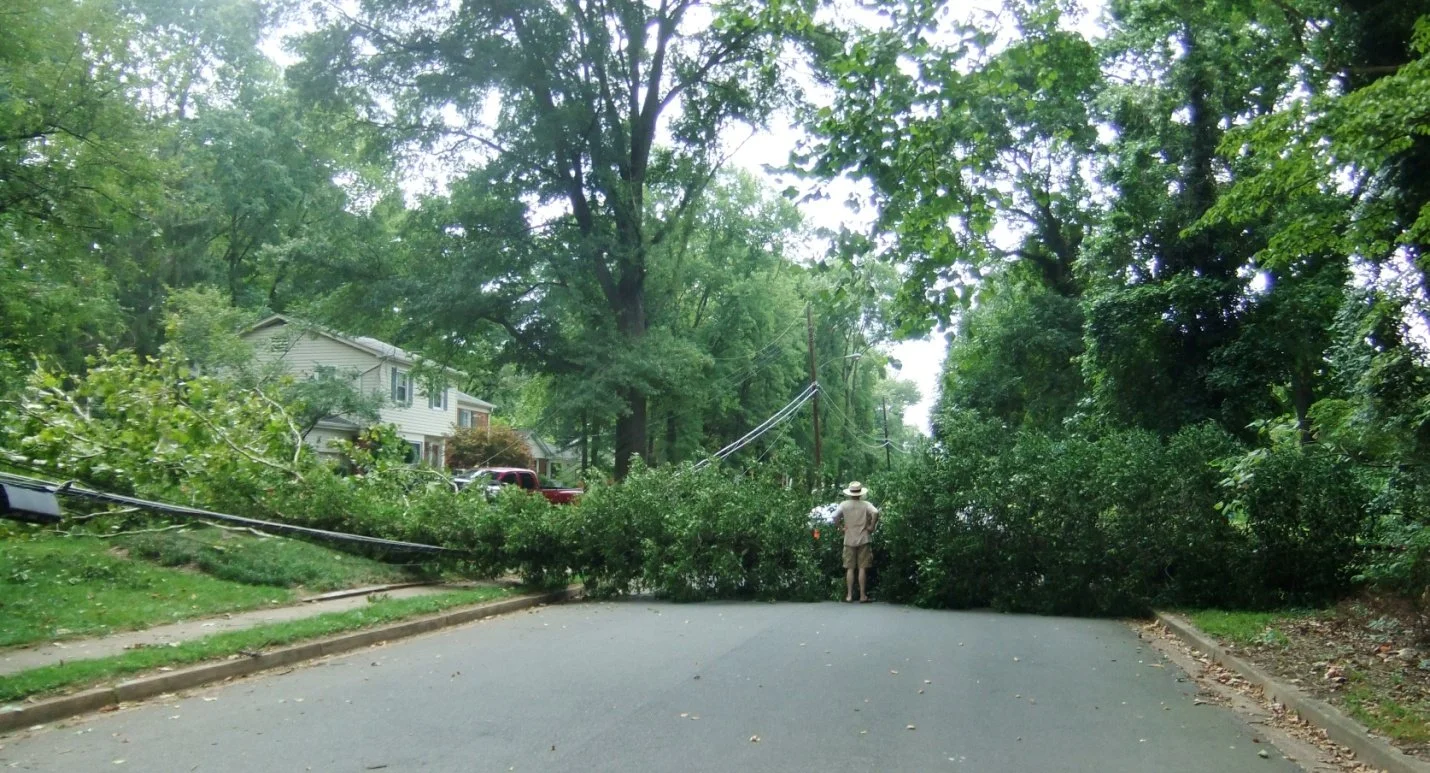
Photo: Christmas Fern, Alyssa Ford Morel
Alyssa Ford Morel
Few plants are more recognizable even to non-gardeners than English Ivy (Hedera helix). Americans have had a long time to get acquainted with it since early colonists introduced this European and Asian native to North America in 1727. We kept planting it, and it started spreading, both by vining and by birds who eat the berries, then poop them out elsewhere. Records show that it was spreading without human effort by the 1870s.
Compared to how long ivy has spread in America, conservation biology and our understanding of the damage that non-native, invasive plants wreak on local biodiversity is recent. In 1999, President Clinton signed Executive Order 13112 (amended in 2016 by President Obama) defining invasive plants and animals as being non-native to the area in which they are occurring and causing “economic or environmental harm, or harm to human, animal or plant health.”
English Ivy, Alyssa Morel
English ivy is one of America’s foremost invasives, taking over natural areas especially along both coasts. It aggressively colonizes both the ground level and the tree canopy, where it reaches sexual maturity, setting berries. Ivy on a tree blocks sunlight, impeding photosynthesis, and adds weight that can topple a weakened tree.
Besides being invasive, ivy also hosts the Xylella fastidiosa pathogen, which is a threat to Oak, Elm, Maple and Sweetgum trees, among other plants. While ivy does not support many native creatures, it does support rats, mosquitos and ticks. People mistakenly think that ivy is good for erosion control, but, in fact, ivy’s shallow roots do little to stabilize banks.
Nonetheless, our eyes are used to ivy and many homeowners cite its hardy evergreen nature as essential. The good news is that there are excellent native choices to replace it.
Golden Ragwort, Alyssa Morel
Like ivy, Golden Ragwort (Packera aurea) is evergreen and takes either sun or shade. This aggressive spreader has yellow daisy-like flowers each spring. Homeowners on a budget can clear a small space in their ivy, and plant Golden Ragwort in it. The following year, the ragwort will have spread, and some can be dug up and transplanted to another space. Keep repeating until the ivy is gone!
Christmas Fern, Alyssa Morel
Christmas Fern (Polystichum acrostichoides) is an elegant choice for shade, with leathery fronds growing in arching clusters. Plants are between a half foot and two feet tall, and increase in size over time. Unlike ivy, Christmas Fern does prevent soil erosion, especially on slopes. Though the fronds look fairly ratty by late winter, pristine new fronds will emerge in spring, and the old ones will slowly decay, helping build the soil.
Hairy Alumroot, Alyssa Morel
Hairy Alumroot (Heuchera villosa) is a semi-evergreen plant native to southwestern Virginia that can take sun or some shade. It puts up beautiful feathery flower plumes in late summer that support pollinators. It spreads both by expanding clumps and by seed.
All three of these beautiful native plants will make themselves at home in your yard, and be an environmental asset instead of a creeping problem.
Note: A version of this article was originally printed in the Glencarlyn Village View and on the Master Gardeners of Northern Virginia website.
Ivy Kills!
Ivy is an invasive exotic species that destroys trees and natural habitat. Please, do not allow English ivy to grow up trees on your property, and if it has done so, take steps to remove it.
Photo: Betsy Martin
Betsy Martin
One hot August night several years ago, a Sycamore tree fell across the street a block from my house. It took out a pole as well as power, telephone, and cable lines. The street was blocked for a day, and many residents were without power for hours. For some residents, it was days before their services were restored.
Fallen Sycamore, Betsy Martin
Luckily, the tree was relatively young (about 40 years old, according to the tree service) and had not reached its mature size, so it did not fall on a house across the street in which four young children and their mother were sleeping. Because it was late at night, the streets were empty and no one was hurt by the falling tree or the downed power lines.
The tree was not dead or diseased. There was no storm or big wind. According to employees of the tree service, the tree was brought down by the weight of English ivy that had grown almost to the top of the tree. (You can see it in the photo above.)
English ivy destroys trees and creates hazards. Its weight can bring a tree down, as happened in this case. In a storm, the ivy acts as a sail to uproot a tree, and ivy becomes even heavier with water trapped in its dense foliage. Ivy also traps moisture next to the tree’s trunk, and causes disease which creates habitat conducive to rats, and the spread of West Nile virus. It then displaces native plants that benefit wildlife, and creates a food desert—native insects cannot eat it and so birds cannot find caterpillars to feed their young in a forest smothered by ivy.
Ivy is an invasive exotic species that destroys trees and natural habitat.
Please, do not allow English ivy to grow up trees on your property, and if it has done so, take steps to remove it. (See below for guidance on removing ivy from trees.) The beauty of the numerous mature trees in our Northern Virginia neighborhoods depends on your interest in taking care of them.
Preventing ivy from growing up your trees is probably the single most important thing you can do to keep trees healthy—and safe.
If you’re concerned about ivy growing up your trees, first be sure it’s English ivy. Ivy is evergreen (stays green all winter) and has distinctive three-lobed leaves like this:
English Ivy leaf
Removing ivy from trees is simpler than you might think. You can get rid of the ivy in three fairly easy steps:
With big loppers, cut the ivy stems that are growing up the tree trunk. Cut them near the ground. For very thick stems, it may take a hand saw. Be careful not to damage the tree or its bark with the saw.
Next, cut the ivy stems about three feet above the ground. Make sure to cut all the ivy stems—don’t leave any growing up between the ground and the second set of cuts you’ve made.
The last step is to wait. The ivy will die, turn brown, and eventually fall from the tree. Don’t try to pull the ivy down—that is a lot of work, and can be harmful to the tree and dangerous to you, especially if you’re dealing with a large mass of ivy.
Eliminating ivy from around trees is the most helpful action you can take, because even if it is removed from trees, a stand of ivy near trees will eventually grow up. Ivy needs to grow vertically to set seed, and when it does, birds eat the berries and spread new ivy plants far and wide.
In addition to liberating your own mature trees from English ivy and other invasive vines, please consider joining up with other Tree Rescuers as part of the Plant NOVA Trees campaign. (The Tree Rescuers link has lots of good information about what to do about invasive vines, and how you can help your neighborhood preserve its trees.)
So much depends on the preservation of our native tree canopy. Native trees clean the air and water, store carbon, create shade that mitigates intensifying heat, beautify our yards and neighborhoods, and provide critical habitat for birds and other wildlife. It is at least as important to save the native trees we have as to plant new ones.