NVBA NEWS BLOG

Welcome to the blog for Northern Virginia Bird Alliance, a wealth of resources about northern Virginia birds, wildlife, habitat conservation and restoration, native plants, wildlife-friendly gardening, advocacy and more.

News Jess Michetti News Jess Michetti

The I-95 Landfill’s Becoming ‘Birdy’

Few people find visiting a landfill enticing, but some of our avian friends do. Grassland and other birds are using a closed portion of the I-95 landfill, according to a recently released Fairfax County report.  
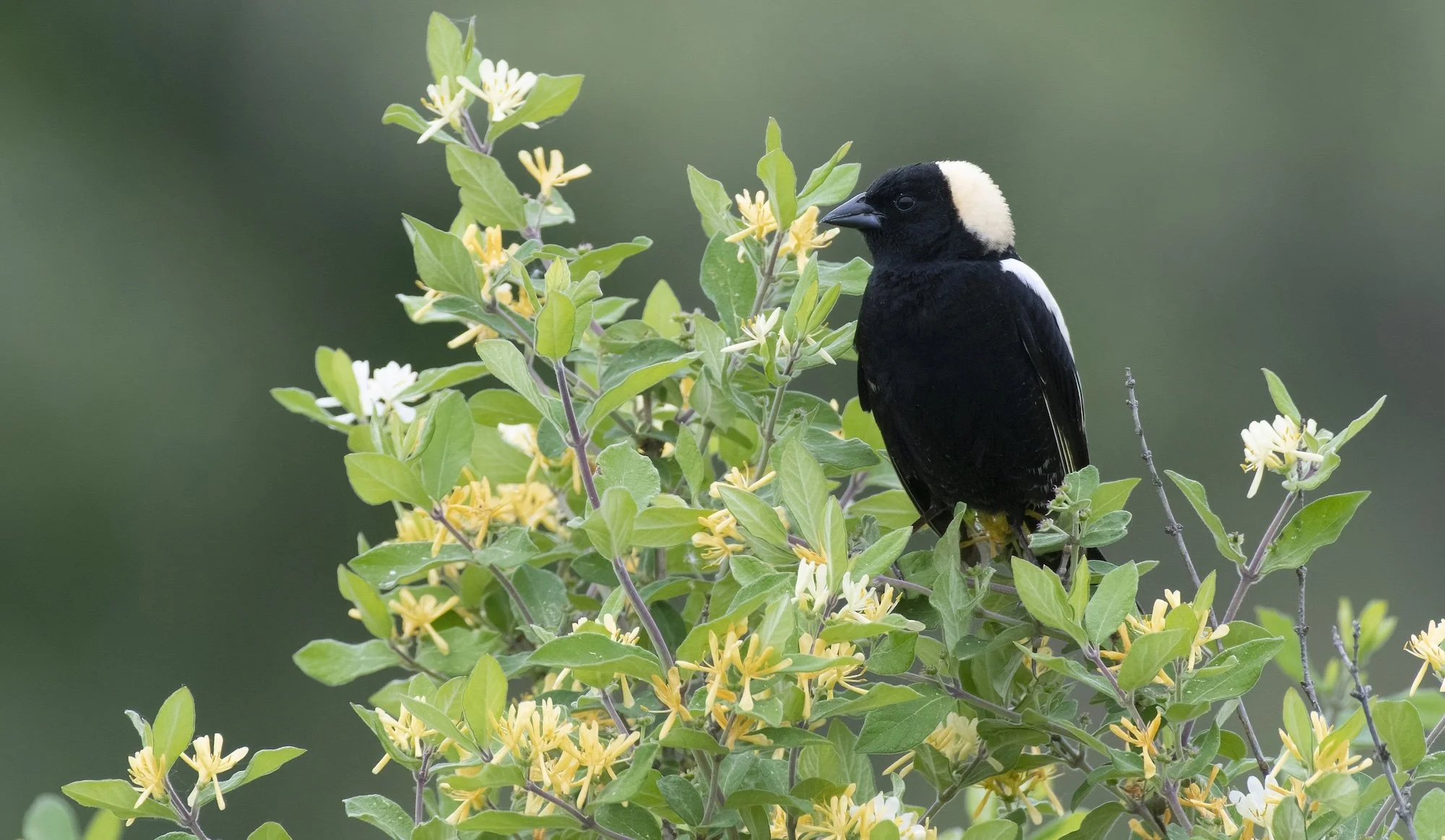
Photo: No-mow Area, Glenda Booth

By Glenda C. Booth
Reprinted with Permission of the Connection Newspapers

50-acre no-mow grassland provides sanctuary for some bird species of concern.

Few people find visiting a landfill enticing, but some of our avian friends do.

Grassland and other birds are using a closed portion of the I-95 landfill, according to a recently released Fairfax County report.  

In 2024, at the urging of the Northern Virginia Bird Alliance and with the Board of Supervisors’ support, landfill managers designated 50 closed acres of the 500-acre landfill as a “no-mow” zone. The managers agreed to avoid mowing during grassland birds’ nesting season and to raise mower blades to an eight-inch height when they did mow.

The no-mow zone continues to provide critical habitat during the peak breeding and nesting season, attracting birds like the Eastern Meadowlark, above, and Grasshopper Sparrow. Photo Courtesy of Fairfax County Department of Public Works. 

County officials concluded, based on 2024 and 2025 surveys, that “overall observations confirm that the no-mow zone continues to provide critical habitat during the peak breeding and nesting season.” County staffer Kimberly Lewis wrote, “The eastern meadowlark and grasshopper sparrow, among other species, are thriving on a 50-acre meadowland atop the landfill.”

By modifying and reducing mowing, the area is in effect a grassland, albeit not a natural one. The project sought to determine which grassland birds are using the area and how.

In 2025, Blair Evancho, a county intern, staffers and volunteers conducted weekly bird surveys from May 1 to July 12 and recorded all bird species observed. They confirmed 40 bird species in this area in 2025, including four species of regional or continental concern: chimney swift, grasshopper sparrow, eastern meadowlark and bobolink. “Notably, the grasshopper sparrow, a grassland nester experiencing regional population declines, was the most detected species,” notes the county’s report. In 2024, surveyors confirmed 29 bird species.

“The County’s monitoring efforts show that the I-95 Landfill Complex continues to provide meaningful habitat for grassland birds, including several species of conservation interest,” commented Duane Wright, Director, Solid Waste Management Program. “These findings reflect our commitment to thoughtful land management that supports both environmental stewardship and long-term site care.” 

“On survey days, at least one Northern Virginia Bird Alliance (NVBA) volunteer helped,” NVBA President Libby Lyons said. “We commend the County for this approach and hope this project can serve as a role model for other landfills in taking such important conservation steps,” she said.

According to the 2025 report, one glitch was “unanticipated mowing on three days in June during work on a new solar field next to the no-mow zone, which created “a noticeable decline in bird activity on those dates.” The report indicates that this mowing “conflicted with the established protocol, which prohibits mowing in the no-mow zone during the April-September breeding season, except when required for access to monitoring wells.”

No-mow area. Photo: Glenda Booth

Grassland Birds

Grassland birds rely on grassland habitats for nesting and many species have seen marked drops in numbers. Since 1970, grassland birds have declined by 43 percent, concluded the 2025 State of the Birds report by the North American Bird Conservation Initiative. The main driver is habitat loss.

Most of the eastern United States’ natural grasslands are gone. These birds typically do not use other habitats. In Virginia, since the European colonists’ arrival in the 1600s, only a fraction of the state’s grasslands remains. “It may be less than .0001 percent,” according to biologist Justin Folks, quoted on the Virginia Outdoors Foundation’s website.

“The landfill has the largest patch of grassland in eastern Fairfax County,” ornithologist Greg Butcher said in our 2024 Connection article. Landfill managers usually put a cover on closed landfills and plant grasses to stabilize the surface.

Wright concluded, “By maintaining a clearly defined seasonal no-mow period, the County is able to support important nesting and foraging activity while also ensuring the landfill remains well maintained and protective of the environment. This balanced approach allows us to responsibly manage closed landfill areas while recognizing their value as part of the region’s broader ecosystem.”

Read More
News Jess Michetti News Jess Michetti

The Bobolink

The Bobolink, Dolichonyx oryaivorus, also called the rice bird or rice bunting, is yet another migrating songbird that has declined in population over the last fifty years.

Photo: Bobolink, Calvin Borgmann/Audubon Photography Awards

Evelyn Novins

The Bobolink, Dolichonyx oryaivorus, also called the rice bird or rice bunting, is yet another migrating songbird that has declined in population over the last fifty years. People have trapped and sold them as pets in South America, collected them as food in Jamaica and shot them in the US as agricultural pests. The primary reason for the species’ decline, however, is changes in land use, particularly the disappearance of useful habitat in many areas of its historic range. 

The Bobolink, as a ground-nesting bird, looks for large areas dominated by grasses without woody plants or trees. With the loss of prairie land due to development and agriculture, the Bobolink has adjusted to smaller, often flower-rich open meadows and hayfields. In urbanizing areas, of course, that kind of habitat also is disappearing.

The threats are not news to most birdwatchers, but before going into too much detail on the dire circumstances (and some hopeful moves toward conservation), let’s look at the special bird in question. 

The Bobolink is a seed-eater. It passes through northern Virginia in migration, breeds in more northern North America and winters in South America. During their long migration, mostly through Florida and the West Indies although a few migrate through Mexico and Central America, they stop in marshes and rice and other grain fields. In years past when the Bobolink was very abundant, flocks of birds might strip rice fields of seeds, behavior that gave it its common rice bird or rice bunting name and its scientific name “orvaivorus”, which means rice-eater. Once considered a pest, hunting the bird was a common practice. 

Although John James Audubon’s Birds of America was limited to the plates, a separate, companion publication written by Audubon and Scottish naturalist and ornithologist William MacGillivray provides observations on the birds’ migration as well as the damage they caused to crops along the way. See the text for Audubon’s Plate 54, the Rice Bird. It’s interesting to compare their observations with the information in current field guides.

Male Bobolink in breeding plumage, Calvin Borgmann/Audubon Photography Awards

The breeding male Bobolink is easily identified by his stunning black and white “reverse tuxedo” plumage (black below with white above) and his straw-colored nape. The nonbreeding male and female have a yellow/buffy nape and bold, brown stripes on the wings. The breeding female is paler. Many birders, however, recognize the bird by its bubbly call, which some say gave it its name, that is, they hear “Bob O’Lincoln” as part of the song. Listen to the recording on the American Bird Conservancy's website to see if you can hear the name.

Bobolink with nonbreeding plumage, Matt Felperin

After migrating in the spring, the males arrive in the breeding ground first. Females arrive later, choosing a nest site within a male’s territory. The female scratches a depression in the soil and then builds an outer wall of dead grass and weed stems. She lines the inside of the nest with fine grasses and sedges placed directly on the soil about 2-1/2 inches deep and 2 inches across for a clutch of 3-7 eggs.  

Bobolinks are truly social birds. Males mate with several females per breeding season and the eggs in a female’s clutch may represent multiple fathers. Both parents feed the young, and families from several nests form forage flocks. The adults eat seeds, but the nestlings are fed invertebrates exclusively. The young leave the nest unable to fly and hide in the underbrush until their flight feathers emerge fully. Outside the nesting season Bobolinks continue to flock, and the males molt adopting a drabber plumage as they begin their migration to the South American wintering ground. The males molt again on their wintering ground.

The 2025 State of the Birds report lists the Bobolink as an Orange Alert Tipping Point species, a classification that means it has lost more than 50% of its population in the last 50 years, and its decline has accelerated in the past 10 years. The US Geological Survey’s North American Breeding Bird Survey indicates that grassland bird populations have fallen 53%, and Partners in Flight also acknowledges the imperiled status of the Bobolink. 

Conservation efforts focus on maintaining the birds’ breeding ground by refraining from mowing fields until after the young have fledged. Using prescribed burns in natural prairie habitat also prevents encroachments by trees and other woody plants. Locally, Fairfax County has implemented a timed mowing schedule at several capped mounds at the I-95 Landfill Complex. Birders spotted Boblinks there this spring as they made their way north to breed. Because of the dearth of natural, open meadows in an urbanizing area like northern Virginia, managing landfills for these (and other) imperiled birds may be the birds’ best chance for finding a resting and feeding stop on their migrations.

Read More
News Jess Michetti News Jess Michetti

Good News at the I-95 Landfill to Help Offset Some Bad News

First, the bad news: The U.S North American Bird Conservation Initiative just released its State of the Birds 2025 report, and the birds with the most dire losses continue to be grassland birds, a 43% decline since 1970.

Photo: Bobolink, Gerald Sneegas/Audubon Photography Awards

Eastern Meadowlarks, Haoyu Li/Audubon Photography Awards

First, the bad news: The U.S North American Bird Conservation Initiative just released its State of the Birds 2025 report, and the birds with the most dire losses continue to be grassland birds, a 43% decline since 1970. The report calls out the need for proactive conservation initiatives, particularly across the Midwest and Great Plains, where conversion of grasslands for row-crop agriculture, woody plant invasion, and drought are causing collapse of a crucial resource. The report cites some positive actions, including a National Audubon Society initiative, the Conservation Ranching program, which is creating partnerships to convert marginal cropland to grassland.

Grasshopper Sparrow, Susan Ward/Audubon Photography Awards

Now, the good news: Although urbanization in northern Virginia has eliminated most grassland habitat in our area, Fairfax County’s I-95 Landfill has taken steps to protect grassland birds by adjusting mowing procedures at the landfill. NVBA had suggested that the Department of Public Works and Environmental Services (DPWES) find a way to protect grassland birds at the closed landfill while still complying with regulatory mowing requirements that ensure adequate landfill monitoring. In response, in February 2024, the Board of Supervisors directed DPWES to identify a no-mow area for the bird nesting season and develop a pilot plan for landfill procedures that could protect grassland birds. 

Blair Evancho, a DPWES intern, then organized a survey conducted between August 22 and October 17, 2024, and produced the I-95 Landfill Complex Grassland Habitat Program Pilot Study Report, which identified 39 bird species in the study area, including three of regional or continental concern: Eastern Meadowlark, Bobolink, and Grasshopper Sparrow. The most recorded birds were Grasshopper Sparrow, Savannah Sparrow, American Kestrel, and Eastern Meadowlark, all of which are experiencing population declines. The study confirmed that grassland birds were using the habitat provided by the no-mow area.

The study outlines a bird-friendly standard operating procedure for the landfill:

  1. Annual mowing in the no-mow area only between September 15 and April 1, except where required to maintain methane well access

  2. If feasible, annual mowing scheduled to take place only between February 15 and April 1

  3. Setting blades for mowers and bushhogs to eight inches or higher

  4. A staff survey around the methane well mowing path before turning the blade on

  5. No more than two mowers and/or bushhogs active at the same time in the no-mow area

The study includes some further recommendations for conservation: long-term monitoring at the landfill, identifying and monitoring the locations of nests in the no-mow area, installation of additional American Kestrel nest boxes inside and outside of the no-mow area, planting native grasses and forbs to replace the predominant non-native grasses, and additional public education. To learn more about the study and the landfill listen to Fairfax County’s EnviroPod Episode 52.

NVBA is truly grateful that Fairfax County developed and implemented a plan to protect grassland birds within its jurisdiction. We hope this initiative can serve as a model for other closed landfills, creating islands of valuable habitat for grassland birds.

Read More
News Jess Michetti News Jess Michetti

A New View of the Landfill

A landfill can be more than a garbage dump. It can be a place of ecological renewal. The latest example at Fairfax County’s I-95 landfill is a plan to protect some of the landfill’s grassland habitat for ground-nesting birds and other wildlife.

Photo: Dickcissel, Russel Smith/Audubon Photography Awards

Grassland at the I-95 landfill provides habitat for ground-nesting birds and other wildlife.

Glenda C. Booth, Connection Newspapers

A landfill can be more than a garbage dump. It can be a place of ecological renewal. The latest example at Fairfax County’s I-95 landfill is a plan to protect some of the landfill’s grassland habitat for ground-nesting birds and other wildlife.

On February 20, the Board of Supervisors directed the county staff to identify a no-mow area and develop a plan to avoid mowing during grassland birds’ ground-nesting season, generally between April 1 and mid-July. Supervisors Dan Storck, James Walkinshaw and Jeff McKay proposed the initiative or “board matter,” recommended by the Audubon Society of Northern Virginia. Supervisor Storck offered, “I was pleased to bring this Board matter to my colleagues and received unanimous support. The County continues to lead on environmental and climate issues, and becoming a leader in landfill grassland management to protect ground-nesting birds is just another example.”

The directive recognizes that some mowing is needed for inspecting the landfill cap, accessing gas wells and accommodating stormwater drainage. The Virginia Department of Environmental Quality requires mowing at least once a year. Managers seek to discourage trees from taking root and disrupting landfill caps. 

“We are looking forward to developing a mowing schedule that helps protect nesting habitat for grassland species at the I-95 landfill complex,” explained Eric Forbes, deputy director, Department of Public Works and Environmental Services. “For the mowing schedule change, we will be doing a pilot to see how we can manage the landfill functions at the site and evaluate any potential operational issues.”

Grasslands Are Rare

Of the United States’ historical 550 million acres of grasslands, fewer than 40 percent exist today. Justin Folks, with the Natural Resources Conservation Service, has noted that much of today’s Virginia croplands were grasslands before European colonization and now grassland acreage in the state may be less than .0001 percent. 

Part of Fairfax County’s 250-acre-closed, I-95 landfill, though created by people, is in effect a grassland, a rare habitat in Fairfax County. The landfill’s meadow and grassland and other habitats support over 126 bird species according to ebird.org, including grassland specialists like bobolinks, dickcissels and grasshopper sparrows, plus other wildlife species found nowhere else in Northern Virginia. In Virginia, over 50 bird species rely on grasslands. 

Grassland Birds Declining

Grassland birds are among the most imperiled group of birds, reports the National Audubon Society. Their population has dropped by 53 percent since 1970, according to the Virginia Grassland Bird Initiative.

Local bird watchers have especially delighted in seeing bobolinks and dickcissels, two ground-nesting birds, among others, at the landfill. 

Male (left) and female Bobolink, Ruhikanta Meetei/Audubon Photography Awards

Bobolinks fly up to 12,500 miles roundtrip to and from South America every year and seek out fields of tall grasses. Sporting a bright yellow “cap,” the male perches on the grasses, flutters and sings. The female bobolink makes a depression in the soil and builds a nest on the ground. 

Dickcissels also come north in the spring from the tropics and find grassy fields. These sparrow-like birds also build nests on or near the ground, well concealed in dense vegetation. “Male dickcissels are aggressive defenders of their primary territory, keeping a close eye on their immediate neighbors by confronting each other at territorial boundaries,” reports All about Birds.

Dickcissel, Russel Smith/Audubon Photography Awards

Auduboner Greg Butcher, an ornithologist, commented, “The I-95 landfill provides the biggest patch of grass in eastern Fairfax County. The birds have found it and breed there in good numbers. By mowing less, we can keep grassland birds in eastern Fairfax County.”

More “Greening” of the Landfill

Toward the end of 2024, the county will install a five-megawatt solar field with pollinator-friendly, native vegetation under the panels and energy production beginning mid-2025. 

The county started a honeybee and pollinator habitat project in 2017, converting five acres of turf into native meadow habitat. George Mason University installed 24 European honeybee hives at the landfill, led by Director Germán Perilla. The project’s website cites as the purpose “to assess the connections between honeybees and their local environment, specifically with regard to the pollen resources they use and contaminants that they might introduce to and accumulate within their hives.” 


More Information

* Fairfax County Landfills 

* GMU Honeybee Hives

* Smithsonian Guidelines for Grassland and Shrubland Birds

* Audubon Grassland Birds Report

Read More