NVBA NEWS BLOG

Welcome to the blog for Northern Virginia Bird Alliance, a wealth of resources about northern Virginia birds, wildlife, habitat conservation and restoration, native plants, wildlife-friendly gardening, advocacy and more.
News Jess Michetti News Jess Michetti

The Bobolink

The Bobolink, Dolichonyx oryaivorus, also called the rice bird or rice bunting, is yet another migrating songbird that has declined in population over the last fifty years.

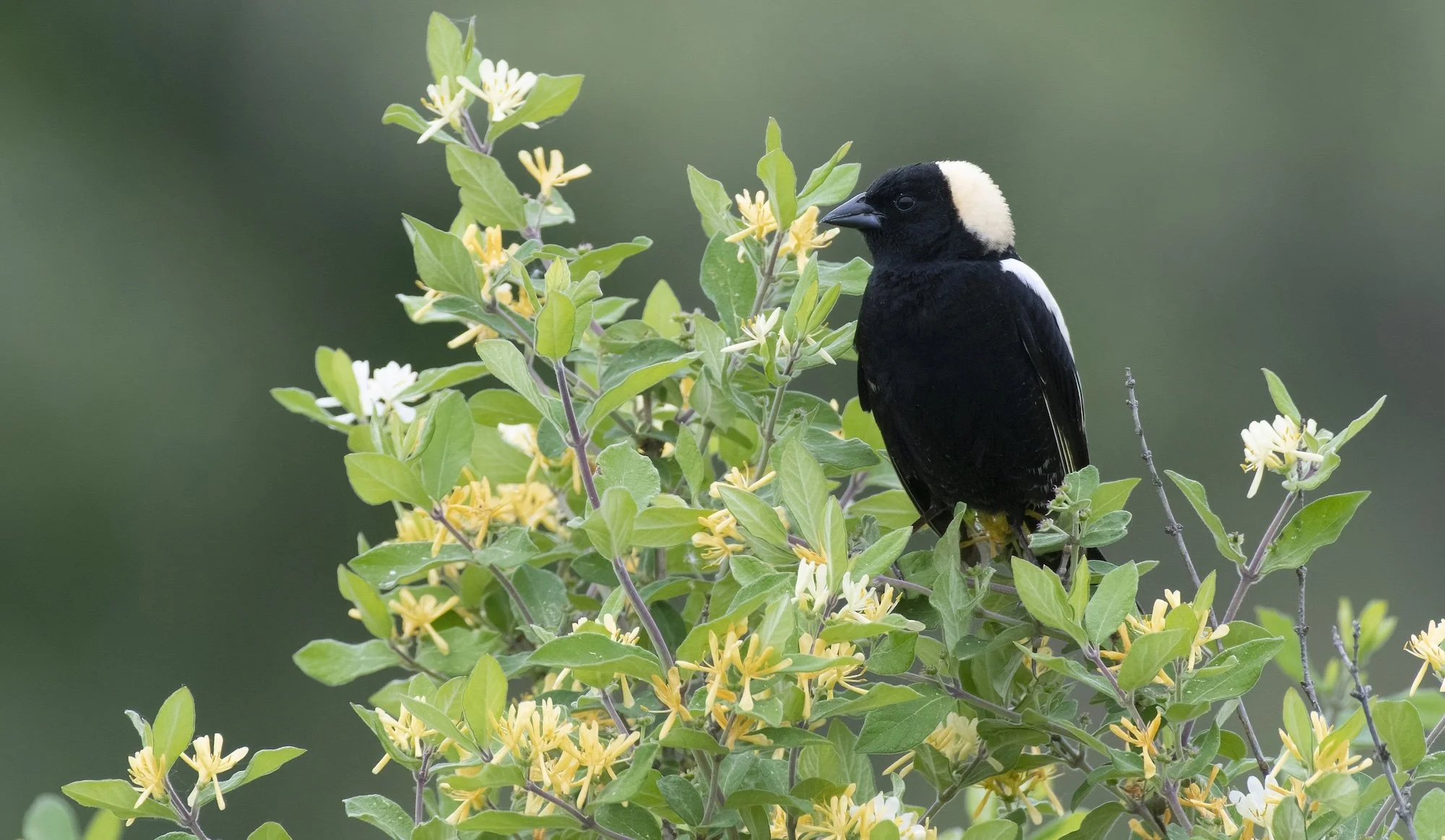
Photo: Bobolink, Calvin Borgmann/Audubon Photography Awards

Evelyn Novins

The Bobolink, Dolichonyx oryaivorus, also called the rice bird or rice bunting, is yet another migrating songbird that has declined in population over the last fifty years. People have trapped and sold them as pets in South America, collected them as food in Jamaica and shot them in the US as agricultural pests. The primary reason for the species’ decline, however, is changes in land use, particularly the disappearance of useful habitat in many areas of its historic range. 

The Bobolink, as a ground-nesting bird, looks for large areas dominated by grasses without woody plants or trees. With the loss of prairie land due to development and agriculture, the Bobolink has adjusted to smaller, often flower-rich open meadows and hayfields. In urbanizing areas, of course, that kind of habitat also is disappearing.

The threats are not news to most birdwatchers, but before going into too much detail on the dire circumstances (and some hopeful moves toward conservation), let’s look at the special bird in question. 

The Bobolink is a seed-eater. It passes through northern Virginia in migration, breeds in more northern North America and winters in South America. During their long migration, mostly through Florida and the West Indies although a few migrate through Mexico and Central America, they stop in marshes and rice and other grain fields. In years past when the Bobolink was very abundant, flocks of birds might strip rice fields of seeds, behavior that gave it its common rice bird or rice bunting name and its scientific name “orvaivorus”, which means rice-eater. Once considered a pest, hunting the bird was a common practice. 

Although John James Audubon’s Birds of America was limited to the plates, a separate, companion publication written by Audubon and Scottish naturalist and ornithologist William MacGillivray provides observations on the birds’ migration as well as the damage they caused to crops along the way. See the text for Audubon’s Plate 54, the Rice Bird. It’s interesting to compare their observations with the information in current field guides.

Male Bobolink in breeding plumage, Calvin Borgmann/Audubon Photography Awards

The breeding male Bobolink is easily identified by his stunning black and white “reverse tuxedo” plumage (black below with white above) and his straw-colored nape. The nonbreeding male and female have a yellow/buffy nape and bold, brown stripes on the wings. The breeding female is paler. Many birders, however, recognize the bird by its bubbly call, which some say gave it its name, that is, they hear “Bob O’Lincoln” as part of the song. Listen to the recording on the American Bird Conservancy's website to see if you can hear the name.

Bobolink with nonbreeding plumage, Matt Felperin

After migrating in the spring, the males arrive in the breeding ground first. Females arrive later, choosing a nest site within a male’s territory. The female scratches a depression in the soil and then builds an outer wall of dead grass and weed stems. She lines the inside of the nest with fine grasses and sedges placed directly on the soil about 2-1/2 inches deep and 2 inches across for a clutch of 3-7 eggs.  

Bobolinks are truly social birds. Males mate with several females per breeding season and the eggs in a female’s clutch may represent multiple fathers. Both parents feed the young, and families from several nests form forage flocks. The adults eat seeds, but the nestlings are fed invertebrates exclusively. The young leave the nest unable to fly and hide in the underbrush until their flight feathers emerge fully. Outside the nesting season Bobolinks continue to flock, and the males molt adopting a drabber plumage as they begin their migration to the South American wintering ground. The males molt again on their wintering ground.

The 2025 State of the Birds report lists the Bobolink as an Orange Alert Tipping Point species, a classification that means it has lost more than 50% of its population in the last 50 years, and its decline has accelerated in the past 10 years. The US Geological Survey’s North American Breeding Bird Survey indicates that grassland bird populations have fallen 53%, and Partners in Flight also acknowledges the imperiled status of the Bobolink. 

Conservation efforts focus on maintaining the birds’ breeding ground by refraining from mowing fields until after the young have fledged. Using prescribed burns in natural prairie habitat also prevents encroachments by trees and other woody plants. Locally, Fairfax County has implemented a timed mowing schedule at several capped mounds at the I-95 Landfill Complex. Birders spotted Boblinks there this spring as they made their way north to breed. Because of the dearth of natural, open meadows in an urbanizing area like northern Virginia, managing landfills for these (and other) imperiled birds may be the birds’ best chance for finding a resting and feeding stop on their migrations.

Read More
News Jess Michetti News Jess Michetti

The Prairie Warbler

There are more than 50 species to see and hear at this time of year. Most migrants pass through, but the Prairie Warbler, Setophaga discolor, breeds in northern Virginia. 

Photo: Prairie Warbler, Matt Felperin

Evelyn Novins

It’s that time of year again. The warblers will be migrating through our area from their winter habitats in the far south to reach their breeding grounds in North America, making spring an exciting time for birdwatchers. There are more than 50 species to see and hear at this time of year. Most migrants pass through, but the Prairie Warbler, Setophaga discolor, breeds in northern Virginia. 

Unfortunately, the Prairie Warbler faces challenges. It is one of the five species of birds that breed in our area that the U.S. Northern American Bird Initiative has designated as at the “tipping point,” that is, a bird that has lost two-thirds of its population in the past 50 years and is on track to lose another 50 percent in the next 50 years. 

Prairie Warbler at Occoquan Bay NWR, Matt Felperin

Prairie Warbler at Occoquan Bay NWR, Matt Felperin

Like most warblers, it’s a beautiful little bird. The male Prairie Warbler is a bright yellow with black streaking on his sides. The defining features are the black eyeline and black semicircle under the eye, along with a chestnut patch on its back. The unique face pattern with the semi-circle of black, differentiates it from other warblers although it takes good skill with binoculars to spot this! The female’s streaks are blurry on the side and the face pattern is gray with the signature semi-circle under the eye a darker gray.

Of course, with many warblers it is often their songs that alert us to their presence. The Prairie Warbler does not disappoint. The male has two songs, one for the female and one for his territory. The first is a rising series of buzzy notes from low to high. The second generally consists of several long, clear notes followed by several harsh, raspy notes. In either instance the male appears to love to perch at the highest tree top while singing. He also makes a chek contact call and a tsip alarm call. You can hear Prairie Warbler calls on Cornell’s All About Birds site.

The Prairie Warbler’s habitat here is generally in second growth forests such as overgrown pastures, regenerating woodlands or power line cuts. It thrives in brushy areas growing up after clearing or fires. As the forest matures, the Prairie Warbler disappears. Because the habitat can be temporary, its breeding site can change from year to year. The Florida paludicola subspecies lives in the mangrove forests.

Migrating birds need supportive habitat all through their annual life cycle which includes their breeding grounds, stopovers during migration, and the overwintering area. They are insectivores, so each habitat must be rich in insects to supply these tiny birds with food for themselves and their young, as well as fuel for their long journeys. They eat large quantities of caterpillars, moths, beetles, ants, and flies, as well as spiders, millipedes and mollusks. They forage near the ground, grabbing prey from leaves and branches while moving through the underbrush, pumping their tails all the while.

Prairie Warbler at Piney Grove Preserve, Matt Felperin

In northern Virginia, Prairie Warbler decline generally is attributed to the loss of habitat and a diminishing food supply from use of insecticides. Urbanization is not, however, always the culprit in habitat loss. Good forest management is necessary to combat habitat loss. For example, the Virginia Department of Wildlife Resources (DWR) actively collaborates with many organizations to promote forest management that allows for a range of forest habitats, including both old growth and early successional habitat areas with young and regrowing vegetation that benefit species like the Prairie Warbler. You can read about DWR’s efforts here.

Conservation initiatives also can benefit several struggling species at the same time. Projects to support the Golden-winged Warbler also benefit Prairie Warblers, because they rely on similar habitat. Nature Conservancy’s maintenance of habitat to benefit the Red-cockaded Woodpecker in Piney Grove Preserve in southern Virginia also benefits Prairie Warblers. Conservation initiatives that support grassland birds also can benefit Prairie Warblers because they encourage a diversity of land types, including shrublands bordering grasslands and meadowlands. A good example is the Virginia Grassland Bird Initiative, a collaboration of Smithsonian’s Virginia Working Landscapes, Piedmont Environmental Council, American Farmland Trust, and Quail Forever. The organizations worked with the American Bird Conservancy to designate the Northern Virginia Piedmont and Shenandoah Valley BirdScape as a conservation area.

In our area, you can see the Prairie Warbler at Occoquan Bay National Wildlife Refuge, the Laurel Hill Equestrian Center, Sulley Woodlands and Huntley Meadows as early as April and May. Remember to first listen for its song before searching the brush for that spot of yellow!

Read More