
NVBA NEWS BLOG
Welcome to the blog for Northern Virginia Bird Alliance, a wealth of resources about northern Virginia birds, wildlife, habitat conservation and restoration, native plants, wildlife-friendly gardening, advocacy and more.

Huntley Meadows Park Celebrates 50 Years!
Some history and background on a favorite birdwatching locale for many northern Virginians as Huntley Meadows celebrates its 50th year.
Photo: Hooded Merganser, Parameswaran Ponnudurai/Audubon Photography Awards
Huntley Meadows Park, a favorite birdwatching locale for many northern Virginians, is celebrating 50 years. The park’s walking trails and boardwalk provide a good view of waterbirds, shorebirds, and songbirds throughout the year. The boardwalk and woods also attract a steady stream of photographers, many of them winning awards in the annual Audubon Photography Awards competition. The Friends of Huntley Meadows Park invite birders to join them every Monday morning for an informal birdwalk (there’s no leader), which attracts experienced and new birders alike. Make sure you check out the series of interviews with walk participants posted to the Friends’ website.

Great Blue Heron, Kimberly Sharp/Audubon Photography Awards
So, a little history of this 1,500-acre+ natural reserve in the middle of an area of intense urban development: the parkland has been farmland and a dairy, and an entrepreneur in the 1920s dreamed of making the area’s dairy farms a dirigible base. That didn’t work out, and the federal government acquired the land. In the 1940s the Bureau of Public Roads tested asphalt road surfaces at the site, and in the 1950s the Virginia National Guard’s Battery D, 125th Gun Battalion, used the land to protect the nation’s capital from air assault. Then the U.S. Navy conducted classified radio communication research.
Fairfax County started exploring possible uses of the property in the 1960s, while local residents used the area to walk, explore and ride motorcycles. There even was a popular racetrack in the southern part of the property. In 1971 the Navy and the Fairfax County Park Authority (FCPA) signed an agreement allowing citizens to use 400 acres of the property for recreation.
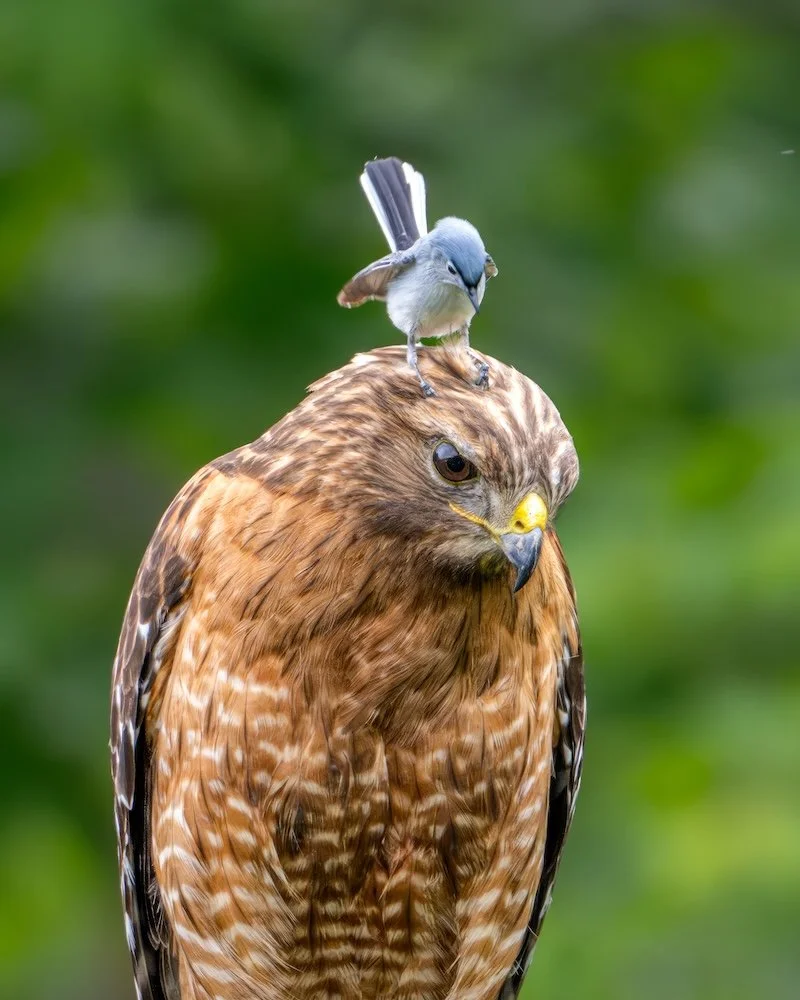
Red-shouldered Hawk and Blue-gray Gnatcatcher, Dale Ward/Audubon Photography Awards
In 1971, President Nixon initiated the Legacy of Parks Program that allowed the federal government to transfer surplus land to state and local governments for natural, cultural, and recreational use. Fairfax County acquired the property in 1975. In 1992, FCPA acquired an additional 165 acres of adjacent wetland and upland with the assistance of Ducks Unlimited.
Work to make the park the natural reserve it is today took many years. Even in the 1970s, the meanders of the Potomac River and industrious beavers started to transform a portion of the property from meadow to wetlands. There was open water by 1981. Work in the 1980s removed much of the evidence of past federal use, including buildings and antennae. Grants paid for construction of trails, and the 1980s saw addition of a boardwalk and observation tower. The boardwalk was rebuilt in 1994 and renovated in 2011. The Navy’s access road became the Hike-Bike Trail.
Huntley Meadows Park is hosting a series of educational and volunteer events to celebrate its anniversary. The park’s website has additional information.

Red-headed Woodpecker: A Species at the Tipping Point
The State of the Birds report identified five species of birds that breed in northern Virginia as at a tipping point. One of the birds at the tipping point is the Red-headed Woodpecker, a year-round resident of northern Virginia that is considered uncommon during every season.
Photo: Red-headed Woodpecker, Matt Felperin
Evelyn Novins
In 2022, the North American Bird Conservation Initiative, a forum of government agencies and private bird initiatives, compiled a State of the Birds Report, which shows a steep population decline of many bird populations. The report identifies 70 species as birds that have lost two-thirds of their population over the last 50 years and are projected to lose 50% of their population over the next 50 years. These birds are deemed at a “tipping point” for extinction. Without consequential intervention they are likely to become threatened or endangered or extinct. Like a canary in a coal mine, the birds are warning us that the environment cannot sustain life.
The State of the Birds report identified five species of birds that breed in northern Virginia as at a tipping point. One of the birds at the tipping point is the Red-headed Woodpecker, a year-round resident of northern Virginia that is considered uncommon during every season.
The Red-headed Woodpecker requires a habitat with open areas of trees, typically oak or beech trees, with little vegetation on the ground. They prefer areas with mature trees and minimal understory but can be found in woodlands and mixed forests, and along rivers and streams where there are plenty of snags. Good examples of supportive habitat are in Fairfax County at Huntley Meadows Park and Bull Run Regional Park, and in Prince William County at Conway Robinson State Forest.

Red-headed Woodpecker at Huntley Meadows, Seth Honig
So why are snags important? Snags are standing dead and dying trees. They occur because of natural disasters such as lightning strikes or animal damage, disease, too much shade, not enough rain, or even old age. In Huntley Meadows the snags are created by flooding from beavers. Red-headed Woodpeckers are cavity nesters and snags are the perfect medium for creating a nest. The woodpeckers use dead trees or dead parts of live trees where they drill a gourd-shaped cavity in the tree or natural cavity. The nest will measure about 3-6 inches across and 8-16 inches deep with an entrance of just 2 inches in diameter. Drilling out a nest cavity can take from 12 to 17 days, and the birds may use a cavity for more than one year. Smooth snags which have lost their bark can provide protection from snakes, a common predator. Snags and dead trees also provide abundant areas for food storage, foraging, roosting, and perching.
The Red-headed Woodpecker eats primarily nut cops such as acorns and beech nuts, caching extras in wood for later. But they also eat fruit and are adept at catching insects in the air, which is not true of all woodpeckers. They sometimes also visit feeders. In spite of its seemingly wide variety of food choices, its essential habitat has suffered in an urbanizing area like northern Virginia because of development and habitat fragmentation.
So, it’s essential to protect areas of intact woodlands like Huntley Meadows, Bull Run Regional Park and Conway Robinson State Forest. They are protected areas, but threatened encroachments occur from time to time. ASNV has had to respond at least twice in the last five years to threats to Huntley Meadows Park (a bike path and an adjacent development). So, let’s appreciate these areas and take steps to protect them whenever threats arise. And, if you live near a woodland that is so fortunate as to host these stunning birds, by all means consider welcoming them to a backyard bird feeder with seeds, corn or suet!

Local Teen Wins National Audubon Society Photo Award
James Fatemi, a junior at Mclean High School, won the Youth Honorable Mention Award in the National Audubon Society’s 2023 Photography Contest.
Photo: Green-winged Teals, James Fatemi/Audubon Photography Awards
Tom Blackburn
Green-winged Teals, James Fatemi/Audubon Photography Awards

James Fatemi
James Fatemi, a junior at McLean High School, won the Youth Honorable Mention Award in the National Audubon Society’s 2023 Photography Contest. James’s photograph of Green-winged Teals mating during a snowfall at Huntley Meadows Park impressed the judges, one of whom praised his decision to take the photo in adverse weather and stated, “The colors on the male pop beautifully against the overall muted color palette.”
James is no stranger to photo contests. His photo of an American Toad titled “King of His Domain” won first prize in both the Youth and Overall divisions in the 2021 Friends of Huntley Meadows Park photo contest when James was just 14. He also won first prize in the Youth category for the Friends’ 2020 contest.

“King of His Domain,” James Fatemi
James learned the basics of photography about four years ago from his father, Fredrik, who said, “It wasn’t long before James began teaching me things.” His first important photo was of a Scarlet Tanager that he took for his grandmother, who had only ever seen one. James recently has developed an interest in macro photography and enjoys taking pictures of insects as well as birds and other wildlife. You can see more of James’s photos here and here. You can see all of the National Audubon Society’s 2023 award winners here.

See a National Audubon Society Award-Winning Photograph by a Local Birder
Please join us at the Huntley Meadows Park Visitor Center on Saturday to view the winning photographs and videos from National Audubon Society’s 2022 photo contest.
Photo: Greater Prairie Chicken, Amiel Hopkins/Audubon Photography Awards
Saturday, March 4, 1-3 PM
Greater Prairie Chicken, Amiel Hopkins/Audubon Photography Awards
Please join us at the Huntley Meadows Park Visitor Center on Saturday to view the winning photographs and videos from National Audubon Society’s 2022 photo contest. Among the photos you’ll see is an image of a Greater Prairie-Chicken, pictured above, taken by Amiel Hopkins, a member of the NoVA Teen Birding Club. Amiel’s photo won the Youth Honorable Mention award. ASNV will lead bird walks through Huntley’s stunning wetlands at 1:30 and 2:30, and refreshments will be served.
Huntley Meadows Park is located at 3701 Lockheed Boulevard in Alexandria.

The Importance of Wetlands
Wetland ecosystems protect and improve water quality, offer habitats, provide flood protection and erosion control, maintain surface water flow during dry periods, and present opportunities for recreation and aesthetic appreciation.
Photo: Mason Neck Park wetlands, Stephen Tzikas
Stephen Tzikas
My first exposure to wetlands was when I was a child in the 1960s. I frequently saw the inlet of the Raritan River filled with thousands of cattails while sitting in the backseat as my parents drove over the Victory Bridge connecting Perth Amboy and South Amboy, NJ. Much of those wetlands and floodplain around the river contained clay deposits that fueled a large terracotta industry in the 19th and 20th centuries. Some of the most interesting geological finds of these clay areas included gem grade amber with prehistoric insect inclusions.
Later in life, as an engineer, I had some peripheral experiences with wetlands in engineering reviews of Federal construction. That took me to unique environments and terrains such as extreme cold regions, hot deserts, dams, and wetlands. But wetlands also caught my interest because of environmental concerns, which made up a significant portion of my early career. Wetlands are protected and regulated. Many are found here in Fairfax County and local trails will bring you to them and the unique birds found within their boundaries. But before we note wetland birds, something should be said about the history behind protecting wetlands.
Wetland ecosystems protect and improve water quality, offer habitats, provide flood protection and erosion control, maintain surface water flow during dry periods, and present opportunities for recreation and aesthetic appreciation. By the way, those cattails I used to see so frequently are an iconic wetland plant found worldwide in a variety of aquatic ecosystems such as marshes, ponds, lakes, and riparian areas.
Wetlands were considered an obstacle to development. They were often drained for farm land and construction. In the early 20th century, largely due to declining populations of ducks and geese, and the political pressure exerted by hunters, the federal government started protecting habitats for birds. The 1977 Clean Water Act was a big step forward for wetland protection. It protected waterways that resulted in protecting the wetlands that fed into them. Also in 1977, executive orders ended federal assistance for the draining and filling of wetlands. A federal policy of “no net loss” of wetlands became the norm.

Munsell soil test kit, Stephen Tzikas
Rutgers University has a regularly recurring one-day continuing education course at their wetlands location: the Environmental Education Center at Lord Sterling Park in Basking Ridge. The Introduction to Wetland Identification course teaches the use of Munsell soil test kits for wetlands. Although an online version of the course exists, the in-person version is better for the practical experience it delivers. Wetland soils are often grey (reduced) or dark brown to black. Use of the Munsell color system assures consistent classification. The course also makes use of dichotomous keys to identify wetland plants.
The eBird website posts bird sightings at wetlands throughout Fairfax County. Recently, as part of the Fall 2021 Fairfax Master Naturalist class, our field trip to Huntley Meadows wetlands in Alexandria recorded birds along a trail that was just under 2 miles. Birds spotted included: Canada Geese, Mallards, yellowlegs, herons, vultures, eagles, Belted Kingfishers, Northern Flickers, European Starlings, Red-winged Blackbirds, Northern Rough-winged Swallows, Ruby-crowned Kinglets and several types of hawks, woodpeckers, and sparrows. More common birds included Blue Jays, Carolina Chickadees, American Robins, Eastern Bluebirds, Carolina Wrens, crows, Tufted Titmice, and Northern Cardinals. In fact, Fairfax County Parks have documented more than 200 bird species in Huntley Meadows Park.

Huntley Meadows Wetlands, Stephen Tzikas
On another Master Naturalist field trip, we explored a different wetland at Elizabeth Hartwell Mason Neck National Wildlife Refuge. While we didn’t keep count of birds on this trip, it is known to have many types of birds throughout the year including Tundra Swans, Black Ducks, Northern Pintails, Mallards, and many others. High tide is the best time to go because the birds are closer to the shore and will be feeding more actively.
Mason Neck Wetlands, Stephen Tzakis

ASNV Board Member Cathy Ledec Receives Environmental Award
Cathy Ledec, who joined the ASNV Board of Directors a year ago, has received Fairfax County’s 2020 Sally Ormsby Environmental Stewardship Award.
Photo: Huntley Meadows Park in Autumn, Larry Meade

Cathy Ledec
Cathy Ledec, who joined the ASNV Board of Directors a year ago, has received Fairfax County’s 2020 Sally Ormsby Environmental Stewardship Award. Cathy received the award in recognition of her 17 years of volunteer service at Huntley Meadows Park and for the Fairfax County Park Authority. Cathy is President of the Friends of Huntley Meadows Park, a Site Leader for FCPS’s Invasive Management Area Program, Chair of the Fairfax County Tree Commission and a member of County Supervisor Dan Storck’s Environment Advisory Committee.

National Audubon Photography Award Winners Show comes to Northern Virginia
In celebration of the natural connection between birding and photography, Audubon Society of Northern Virginia will co-host the 2019 Audubon Photography Awards Traveling Exhibition with Walker Nature Center in Reston between February 5 and February 26, 2020 and again with Huntley Meadows Park in Alexandria between March 4 and March 25, 2020.
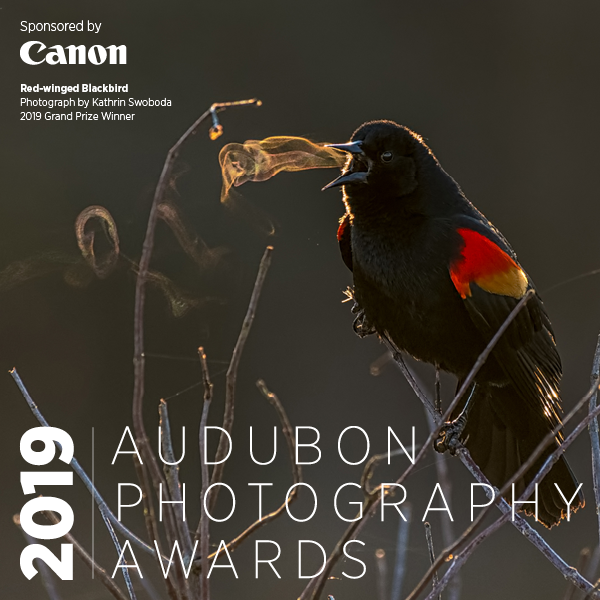
Photo: Red-winged Blackbird, Kathrin Swoboda/Audubon Photography Awards 2019 Grand Prize Winner
Join ASNV at Walker Nature Center in February and Huntley Meadows Park in March for the best avian photography of 2019.
In celebration of the natural connection between birding and photography, Audubon Society of Northern Virginia will co-host the 2019 Audubon Photography Awards Traveling Exhibition with Walker Nature Center in Reston between February 5 and February 26, 2020 and again with Huntley Meadows Park in Alexandria between March 4 and March 25, 2020. Visitors of all ages will enjoy a display of the winning photos and learn more about our local birdlife in Northern Virginia.
In the 10th year of the contest, winning photos and honorable mentions were selected from 2,253 entrants from all 50 states, Washington D.C. and 10 Canadian provinces and territories. The 2019 Grand Prize Winner is a photograph of a Red-winged Blackbird taken by Kathrin Swoboda in Huntley Meadows Park.
New this year, the judges introduced the Plants for Birds Prize and the Fisher Prize. The Plants for Birds Prize was awarded to the highest scoring photograph submitted in the Plants for Birds Division, featuring birds and plants native to the area the photo was taken. The Fisher Prize was awarded to the photograph depicting the most creative approach to bird photography across all divisions: Professional, Amateur, Youth and Plants for Birds.
Walker Nature Center will host an Open House on Sunday, February 9, 2020 from 1:00 – 3:00 PM. Visitors can view the exhibition, watch birds from inside the nature house or outside on guided bird walks and take part in bird-related activities for all ages. The center will also host an environmental film on Friday, February 21, 2020 from 7:00 – 9:00 PM.
Huntley Meadows Park will host an Open House on Sunday March 8, 2020 from 1:00 – 3:00 PM with activities in the Visitor’s Center and guided bird walks in the park.

Blowing Smoke for a Prize-winning Shot
This year’s annual Audubon Photography Awards contest attracted 2,253 entrants from throughout the U.S. and Canada. Kathrin (“Kathy”) Swoboda, of Vienna, VA, won the grand prize for her photo of a Red-winged Blackbird seeming to blow smoke rings.
Photo: Red-winged Blackbird, Katharin Swoboda/Audubon Photography Awards
Local Photographer takes Grand Prize Photo in Huntley Meadows Park
By Lisa Mackem
This year’s annual Audubon Photography Awards contest attracted 2,253 entrants from throughout the U.S. and Canada. Kathrin (“Kathy”) Swoboda, of Vienna, VA, won the grand prize for her photo of a Red-winged Blackbird seeming to blow smoke rings. Kathy is an amateur photographer who started photographing birds about seven years ago in her backyard, which is beside a park. Her son created a professional-looking photography website for her, but she has never sold her photographs. Kathy originally did not plan to enter her prize-winning photo in the 2019 Audubon Photography Awards contest. Instead, she posted the picture on the Facebook site “Birds of Eastern US”, where someone suggested that she enter.
Kathy took her picture in Huntley Meadows Park, which she visits every year. She wanted to capture a bird’s backlit breath on a cold, sunny, early spring morning. The park is a 40-minute drive from her home, but “Huntley Meadows is fantastic,” says Kathy. “In the spring and summer, they have lots of birds, birdwatchers, and people taking pictures. The birds are probably tamer there than in other places because they’re used to seeing more people up and down the boardwalks.” Kathy arrived at the park at 7 am on the March morning when she took her winning photo. She slowly walked along the boardwalk, taking pictures of Red-winged Blackbirds. “A particular bird was very vocal – singing hard and long,” said Kathy. She focused on that bird, and for the first time, she saw the smoke rings. She took 26 shots of that bird, continually trying to get a better one. When the sun rose over the trees, Kathy could backlight the blackbird’s breath. The shadow of the woods behind the bird was an effective backdrop.
Initially, Kathy took photos with consumer-grade cameras. As she learned more about photography, she bought her current camera – a Nikon D500 with Nikon 200-500mm f/5.6E ED VR lens. She explained that its features, including fast focus and large buffer, are ideal for bird photography, and let her shoot many images without pausing. “You can just keep going and going,” she says. She finds her subject and just lets the camera shoot. The camera took 30 shots for her winning photo. Kathy joined a camera club and entered a club competition to hone her photography skills. She is active on social media and at National Audubon’s request, is doing an Audubon takeover on Instagram. “Watch birds, learn all you can about them,” she says. “Focus on one bird or species and know their nature story. That makes for a better picture.”
A retired physician, married with three grown children, Kathy loves all birds.