NVBA NEWS BLOG
Welcome to the blog for Northern Virginia Bird Alliance, a wealth of resources about northern Virginia birds, wildlife, habitat conservation and restoration, native plants, wildlife-friendly gardening, advocacy and more.
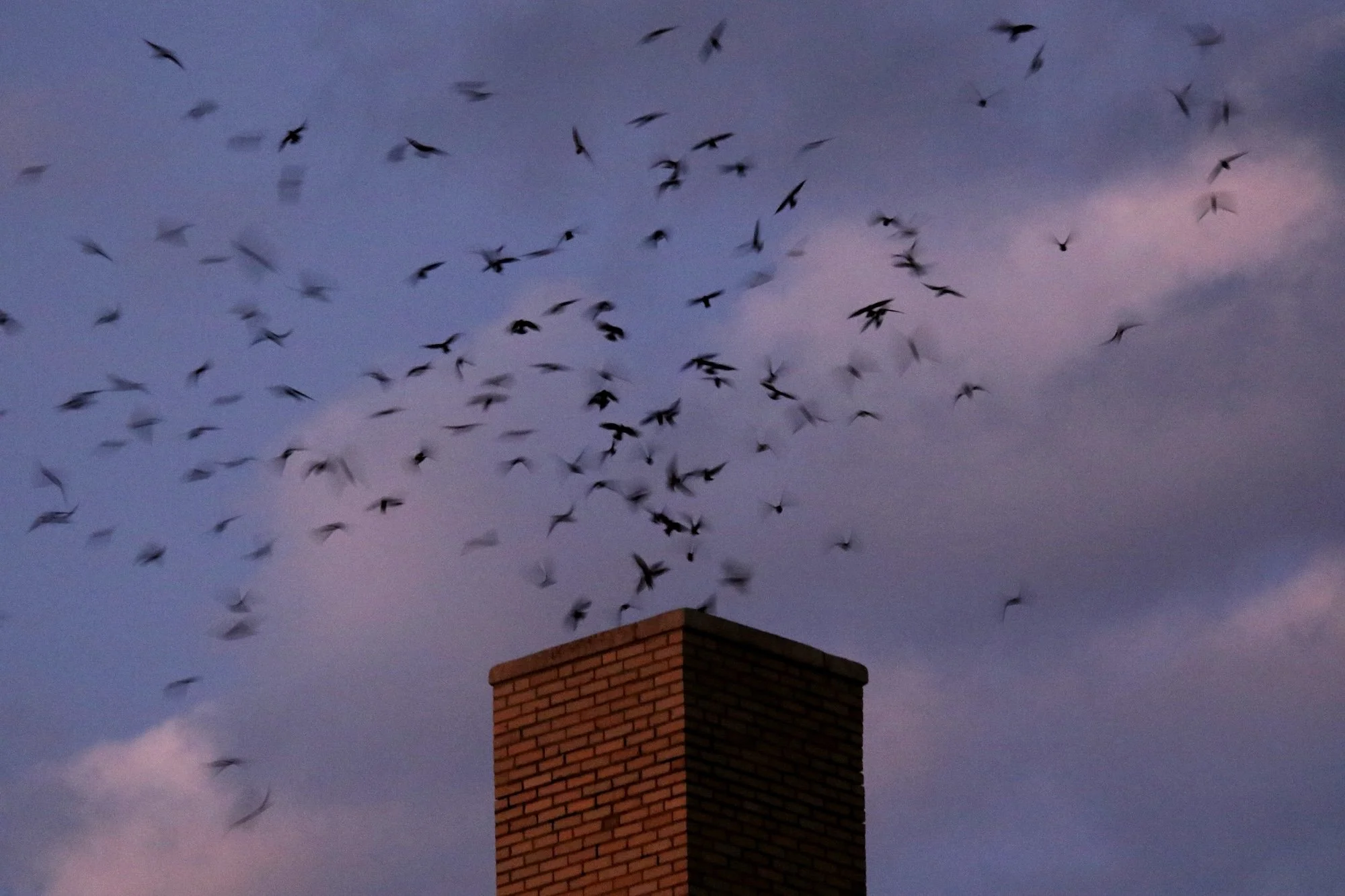
The Chimney Swift
Did you know that until the mid-19th century the Chimney Swift (Chaetura pelagica) was called the American Swift?
Photo: Chimney Swifts, Ben Cvengros/Audubon Photography Awards
Evelyn Novins
Did you know that until the mid-19th century the Chimney Swift (Chaetura pelagica) was called the American Swift? In the past the Chimney Swift commonly built its nest in abandoned woodpecker holes. As settlers moved west in the Americas they destroyed many trees but built chimneys, and the birds easily transitioned into these upright structures.
They are having a harder time adapting in our urbanizing areas. The Chimney Swift is one of the five birds that breeds in northern Virginia that the North American Bird Conservation Initiative defines as at the tipping point for survival. This means that the bird has lost two-thirds of its population in the past 50 years and is on track to lose another 50% in the next 50 years. The Virginia Department of Wildlife Resources lists it as a bird of greatest conservation need as well.
American Swift, John James Audubon
The chimney swift has a tiny slender body (5 inches) with long, narrow, curved wings (12-inch span). The head is round with a short neck, and the bird’s bill is so short that it is difficult to spot. The tail is short as well and squared off. Birders often say it looks like a flying cigar, and it often looks totally black against the sky despite its gray/brown color and a paler chest. For this reason, it is most easily recognized against the sky from its silhouette: its wings look like a boomerang. Check out its snappy wingbeats in a video on Cornell’s All About Birds site.
The Chimney Swift spends its day flying and capturing insects, not perching. Actually, the chimney swift cannot perch horizontally like most songbirds, only vertically as with all swifts. Its long forward-facing claws act like grappling hooks, clinging to the walls of chimneys and other vertical surfaces.
Both the male and the female make the nest. It is made of small twigs and branches that they break from trees with their feet as they are flying. Securing the twigs in their mouth, they return to the nest site. The twigs are loosely woven together and stuck with saliva to the vertical wall of an abandoned woodpecker hole, chimney or man-made tower. The completed nest measures 2–3 inches from front to back, 4 inches wide, and 1 inch deep. The clutch size is generally from 3-5 eggs and they can have two clutches per season.
The chimney swift’s diet consists of airborne insects. Its food includes wasps, bees, flies, mayflies, stoneflies, beetles, fleas, craneflies, and more. The little ones go right down the throat as it is flying. It grabs larger insects first in its short bill. They can get insects from branch tips and have been reported to flush out prey from ground foliage. They can be seen foraging over urban and residential areas as well as fields, shrublands, forests and marshes. They are considered diurnal foragers; however, they sometimes hunt for insects around lights at night. Chimney Swifts are incredible aerial insectivores, spending most of their lives in the air, even drinking and bathing by skimming over the water.
As a migratory species, the Chimney Swifts are in North America during the spring and summer to breed. In the fall, they flock and migrate, wintering in eastern Peru and elsewhere in the Amazon Basin of South America.
The Migratory Bird Treaty Act prevents you from removing a Chimney Swift nest from your chimney without a permit until breeding season is over and the birds have abandoned the nest completely. But that protection is not enough to prevent its current decline in population, the causes of which are largely unclear and manyfold. Contemporary chimney designs with covered, narrow or metal flues interfere with nesting and roosting opportunities. Widespread pesticide use decreases the population of insects, the bird’s dietary staple. In addition, death from window collisions is not uncommon, including cases of mass fatalities. The birds cannot see glass or they mistake reflections for open air. The effects of climate change also affect Chimney Swifts. The severity of hurricanes over their migratory route reportedly has caused mass fatalities.
Conservation efforts need to focus on educating the public about the devastating effects of overuse of pesticides, such as broadcast spraying for mosquitoes, preventing destruction of nesting and roosting sites, installing and monitoring new nesting and roosting structures, and encouraging bird-safe building design. Cape Henry Audubon has an active project to conserve Chimney Swifts, and NVBA works in our area to encourage bird-friendly building design and lighting through Bird Safe NOVA.
Chimney Swifts arrive in our area during spring migration in March/April. They select nest sites, often returning to previous sites. Mating pairs will allow non-mating swifts to roost in their nesting areas and they often help with raising the young. Chimney Swift towers are helpful in providing nest and roosting sites. Plans for towers are available on the Chimney Swift Conservation Association’s website.
David Lawlor, ecologist from Fairfax County, reports that there are Chimney Swift towers at Runnymeade Park in Herndon and Cub Run Rec Center in Chantilly. The Northern Virginia Bird Club holds a Chimney Swift Watch event each fall at a local roost site. The spectacle of the birds returning to their roost site after spending the day bulking up on insects to fuel their fall migration is mesmerizing. Watch for the announcement of a walk this fall in the bird club’s newsletter, The Siskin, typically in its August issue. The bird club’s walks also are available from a link on the NVBA website.
ASNV Leads Virginia Audubon Chapters in Support of Regulations to Protect Birds
ASNV, National Audubon Society and the other five Audubon chapters in Virginia have submitted a letter to the Virginia Department of Game and Inland Fisheries (DGIF) supporting a discussion draft of regulations to implement Migratory Bird Treaty Act (MBTA) protections for birds in Virginia.
Photo: American Oystercatcher, Robert Blanchart/Audubon Photography Awards
ASNV, National Audubon Society and the other five Audubon chapters in Virginia have submitted a letter to the Virginia Department of Game and Inland Fisheries (DGIF) supporting a discussion draft of regulations to implement Migratory Bird Treaty Act (MBTA) protections for birds in Virginia. The regulations are necessary because the Trump administration has upended decades of protection for birds by reinterpreting the MBTA to not protect birds from “incidental take,” or unintentional harm, resulting from development activity.
The DGIF’s discussion draft of the regulations would, if implemented, make Virginia the nationwide leader in offering state-wide protection to migratory birds. The regulations would create a permitting process for incidental take of birds and also require the mitigation of habitat loss associated with development.
ASNV drafted a letter supporting the proposed regulations and a markup of the proposed regulatory language with input from the National Audubon Society. ASNV also solicited the support of the Cape Henry, Northern Neck of Virginia, North Shenandoah Valley, Richmond and Virginia Beach chapters of the National Audubon Society. All five chapters and National Audubon Society joined ASNV in signing the letter, which you can read here.
The National Audubon Society is scheduling an on-line meeting with ASNV and DGIF officials to discuss how we can best support the development of the regulations.
Bird of the Month: Northern Mockingbird
A few years ago, while I was at the dentist’s, I looked out the window and saw a welcome distraction: a Northern Mockingbird landed on a telephone pole, jumped a few feet in the air, and then gracefully fluttered back down. It repeated this behavior for several minutes.
Photo: Northern Mockingbird, Anthony Goldman/Audubon Photography Awards
By Elise Brosnan
A few years ago, while I was at the dentist’s, I looked out the window and saw a welcome distraction: a Northern Mockingbird landed on a telephone pole, jumped a few feet in the air, and then gracefully fluttered back down. It repeated this behavior for several minutes.
What was this bird doing? If I had seen the whole story, I might have figured it out: Bald Eagles engage in aerial combat, Mallards tussle on the ground, and Northern Mockingbirds have dance battles. In what an academic paper delightfully terms “hostile dancing,” mockingbirds “dance” to proclaim the boundaries of their territory and intimidate would-be usurpers.
Northern Mockingbird, Steven Kersting/Flickr CC
Of course, mockingbirds’ dancing is not nearly as renowned as their singing. Northern Mockingbirds famously copy bird calls and other environmental sounds to create long and complicated songs of their own. Readers may be familiar with the old American lullaby “Hush Little Baby,” where a child is promised a singing mockingbird if he or she behaves. This is not an empty promise or artistic license: because of their ability to learn new songs, mockingbirds were often kept as pets throughout the 18th and 19th centuries. The birds were routinely poached from the wild, and populations suffered as a result. Mockingbirds rebounded after the passage of the Migratory Bird Treaty Act of 1918, which outlawed the capture and sale of native migratory birds.
Mockingbirds were a favorite pet of Thomas Jefferson, who owned many of them throughout his life. He kept at least four during his time as president, making Northern Mockingbirds the first birds to live inside the White House.
Sources:
https://www.monticello.org/site/research-and-collections/mockingbirds
https://sora.unm.edu/sites/default/files/journals/condor/v062n06/p0464-p0468.pdf