
NVBA NEWS BLOG
Welcome to the blog for Northern Virginia Bird Alliance, a wealth of resources about northern Virginia birds, wildlife, habitat conservation and restoration, native plants, wildlife-friendly gardening, advocacy and more.

Local Volunteers Boost Bluebirds, Monitor Nestboxes
Amid what seems like never-ending doom-and-gloom reports about climate change, biodiversity loss, deforestation and species declines and extinctions, the Eastern Bluebird is a comeback story and some Northern Virginians are helping tell the story.
Photo: Eastern Bluebirds, Michael Thomas/Audubon Photography Awards
Glenda C. Booth
Connection Newspapers
A little one-ounce blue, orange and white bird is a good news environmental story, for a change. Amid what seems like never-ending doom-and-gloom reports about climate change, biodiversity loss, deforestation and species declines and extinctions, the Eastern Bluebird is a comeback story and some Northern Virginians are helping tell the story.
In the early 20th century, Eastern Bluebird populations fell in North America, but since 1966, they have been rising, according to the North American Breeding Bird Survey. Experts credit human-installed nest boxes as a major factor in the birds’ rebound.
Eastern Bluebirds are cavity nesters. Females typically build nests in natural cavities like old woodpecker tree holes. Pairs raise two to three broods in the spring and early summer.
Local Volunteers
Since 1982, volunteers have maintained and monitored around 25 bluebird boxes at Huntley Meadows Park. The park’s most recent nestbox data show that in 2022 the bluebirds there laid 42 eggs and the success rate was 79 percent, meaning 79 percent of the young birds born fledged, grew up to leave the nest. This year, ten volunteers check the boxes weekly.
“The bluebirds are not having a problem around here. It’s certainly working well at Huntley Meadows,” said Brooks Long, the park’s Natural Resources Assistant.
AHS’s New Bluebird Trail

Eastern Bluebird, Hazel Erikson/Audubon Photography Awards
The American Horticultural Society (AHS) this year created its first bluebird trail at its Mount Vernon headquarters with eight boxes. Nestbox volunteers were encouraged when on April 9 in one nest box they found five bluebird eggs and the next week, three eggs and two young. On May 3, Donna Stauffer and Jerry Nissley with the Fairfax County Master Naturalists, in doing their weekly check, found one side of that box unscrewed and open and nothing inside. “It looks like a human predator,” said a dejected Nissley.
No one is certain what happened or when. On May 11, volunteers found four bluebird eggs in one box and are hopeful the bluebird will lay a fifth in this nest.
AHS and volunteers are trying to prevent non-native house sparrows and European starlings from using the boxes so before nest-building begins again, they are stuffing a cloth plug in the boxes’ openings. The house sparrow was introduced to New York, in 1850, according to the Sibley Guide to Birds. People brought the European starling in 1890. Both have spread all over North America, sometimes displacing native cavity nesting birds like bluebirds.
Raccoons, snakes and opossums are also threats if they can get into or reach inside the boxes. Metal stovepipe and skirt baffles can block access by many animal predators. A wire mesh device around the box entrance called a “noel guard” also stops some predators from reaching inside.
“We are trying to restore native plants and wildlife, to help key species lost from our area recover,” said Stauffer. “This helps the whole ecosystem.” For her, helping bluebirds is an extension of Care for Creation, a program of Good Shepherd Catholic Church.
Regrouping
Since this is AHS’s first year managing bluebird boxes, some trial and error is inevitable, says Nissley. Virginia Bluebird Society (VBS) experts have helped volunteers reposition some of the boxes. Cornell University’s NestWatch website says that boxes should face east toward open habitat, be four to six feet high and 300 feet apart. VBS donated the boxes to AHS and staff installed them over the winter.
“Environmental stewardship stands as one of the American Horticultural Society’s four pillars” explained Katie Tukey, AHS Director of Development and Engagement. “The thriving wildlife at River Farm serves as a testament to our commitment to responsibly care for the land.”
Bluebird Facts
Eastern Bluebirds like open fields with scattered trees and sparse ground cover, like pastures, agricultural fields, suburban parks and golf courses. They often perch on wires and fence posts.
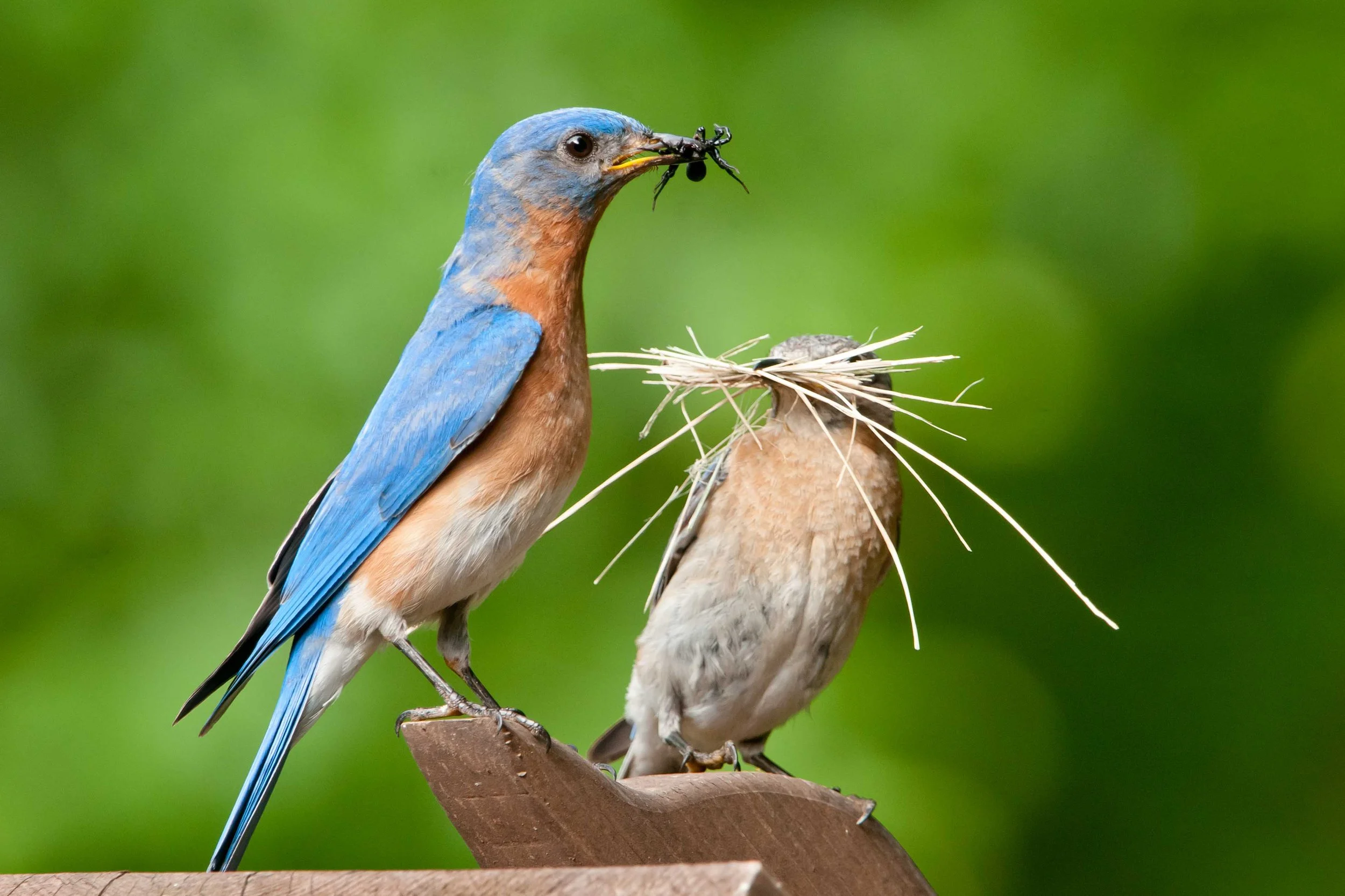
Eastern Bluebird pair, Mark Boyd/Audubon Photography Awards
Female bluebirds build the nests and lay two to seven blue eggs. The incubation period is 11 to 19 days and the young usually fledge within 21 days.
Bluebirds eat insects and in fall and in winter eat fruit, including the berries of mistletoe, black cherry, dogwoods, pokeweed, juniper and other plants.
North America also has two other species of bluebird, a western and a mountain bluebird.
More Information
Bluebird Conservation, https://www.nabluebirdsociety.org/
Bluebird nestbox basics, https://nestwatch.org/ and https://www.audubon.org/news/how-build-bluebird-nest-box

New Barn Owl Box Installed in Northern Virginia
The ASNV Conservation Committee is excited to announce the successful installation of a new barn owl nesting box in an unused silo in a park near Leesburg.
Photo: Barn Owl, Michael Phillips/Audubon Photography Awards
Tina Dudley
Barn Owl, Michael Phillips/Audubon Photography Awards
The ASNV Conservation Committee is excited to announce the successful installation of a new barn owl nesting box in an unused silo in a park near Leesburg. This project was implemented by our friend and raptor advisor, Liz Dennison, in partnership with NOVA Parks.
Liz Dennison, president of Secret Garden Birds & Bees, a nonprofit, also worked with the Conservation Committee to help us install two Kestrel nesting boxes at the Lorton Landfill in 2022.
The effort to find a suitable location to install the barn owl box began at the end of last year. We investigated a few siloes close to the Lorton Landfill, but each silo proved to be problematic for different reasons. Several were completely inaccessible, welded shut in fact. Another was accessible but, due to poor drainage, had several inches of water in the bottom. This was a problem because when young barn owls fledge, they often fall from their nest as part of the process of learning to fly. We did not want to risk the fledglings drowning accidentally.
We found the perfect silo by posting a question to Reddit’s NOVA community - asking if anyone happened to know about a silo that might be suitable. One commenter replied that it was a strangely specific question to post. Luckily, one reader in the thread happened to be an employee of NOVA Parks, who contacted us with a lead on a good location.
This park, which we are not identifying to prevent harassment to any future nesting owls, is the perfect site. It has ample grassland nearby to provide a bounty of mice and voles. Barn owls have in fact been spotted in and near that park by NOVA Parks staff. The silo also is in a part of the park that is closed to the public.
Although Barn Owls prefer to nest in barns, they will use a silo because the silo helps protect the owls from the elements. Liz shared a memory of the first time she and Dave installed a barn owl box in a silo on her own property. “I did not have high expectations because I did not think we were in good barn owl territory. But I was wrong. Just a few weeks after installing the box, I stuck my cell phone through one of the silo doors and snapped a picture of the box. And there was a beautiful barn owl face looking down at me! The owls are still here and still using the box to raise their young.”

Nest box in the silo, Liz Dennison
It was Liz’s brave friend Dave Cazenas who actually climbed high up into the silo to install the box. He also brought his drone and was able to capture this great image of the silo and the surrounding habitat.
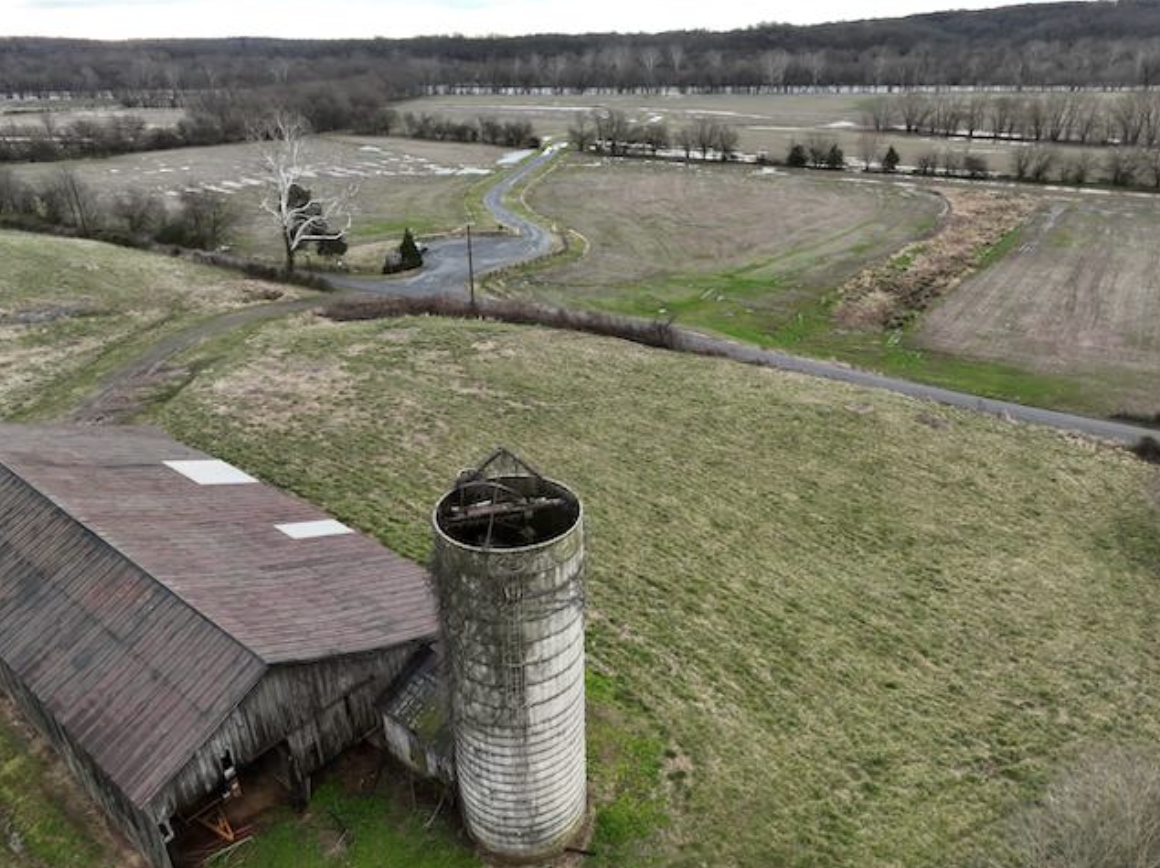
The chosen silo, Dave Cazenas
Liz explains why this location is ideal: “This silo in the park is perfect. The silo, despite missing a roof, is in good structural condition, which made installation safe. The surrounding area is perfect for hunting mice and voles. It’s quiet and away from people. And young barn owls will have plenty of sheltered places to roost as they master their flying and hunting skills. Without disturbing them, we will check for signs of the owls – owl pellets (bits of indigestible bone and fur regurgitated by the owls) and molted feathers.”
She also asks for public cooperation: “If anyone recognizes this place from the photos, please keep your distance from the silo and other structures. We want the owls to feel safe exploring the site and choosing it for their nest. It could take some time – or it could take just a few weeks. But I’m confident that a pair of barn owls will eventually make it their home.”
Many thanks to Liz and Dave, and to Emily Johnson from NOVA Parks, who suggested this location and coordinated with our volunteers who installed the nest box.
We hope to have good news of a nesting pair to report back soon!
If you know of a silo that might be suitable for another nesting box, you can contact us at info@audubonva.org with your suggestion.
We would not be able to do projects like this without the help of our donors. Thank you for your support. To contribute, you can make a donation online at https://www.audubonva.org/donate.