NVBA NEWS BLOG
Welcome to the blog for Northern Virginia Bird Alliance, a wealth of resources about northern Virginia birds, wildlife, habitat conservation and restoration, native plants, wildlife-friendly gardening, advocacy and more.
Use your Birding Skills for Science
Want to bird for science? Consider participating in the Northern Virginia Bird Survey, ASNV’s long-running survey of breeding birds in our region!
Photo: Prairie Warbler, Dixie Sommers
Want to bird for science? Consider participating in the Northern Virginia Bird Survey, ASNV’s long-running survey of breeding birds in our region!
We are busy getting ready for the 2022 survey which will take place in June. We are contacting volunteers from prior surveys and recruiting additional volunteers.
Acadian Flycatcher, Dixie Sommers
The NVBS is a point-count survey. The survey team counts all birds heard and seen during a 5-minute period at each assigned point. Because this survey relies mostly on auditory observation, we need survey participants who can recognize our common birds by sound and can hear a range of calls, including our sometimes difficult to hear species such as Cedar Waxwings. Surveyors should also be able to identify birds by sight with the use of binoculars. If you are an experienced birder and want to participate, please contact Elizabeth Krone at citizenscience@audubonva.org by May 23, 2022.
The NVBS started in 1994 and provides information on trends for breeding birds in our area. Many of these species have declined over the last 25 years, although some have fared well and others have recovered from population crashes, such as Bald Eagles and American Crows. Continuing to document these birds helps us understand the state of the birds in Northern Virginia and inform decisions about habitat protection.
Wood Thrush, Dixie Sommers
Bird of the Month: Brown-headed Cowbird
Brown-headed Cowbirds love cows. True to their name, they can often be found alongside herds of cattle or horses, eating insects that much larger animals flush from the grass. Historically, Brown-headed Cowbirds followed bison herds across the Great Plains, but the spread of livestock farming has expanded their range across North America.
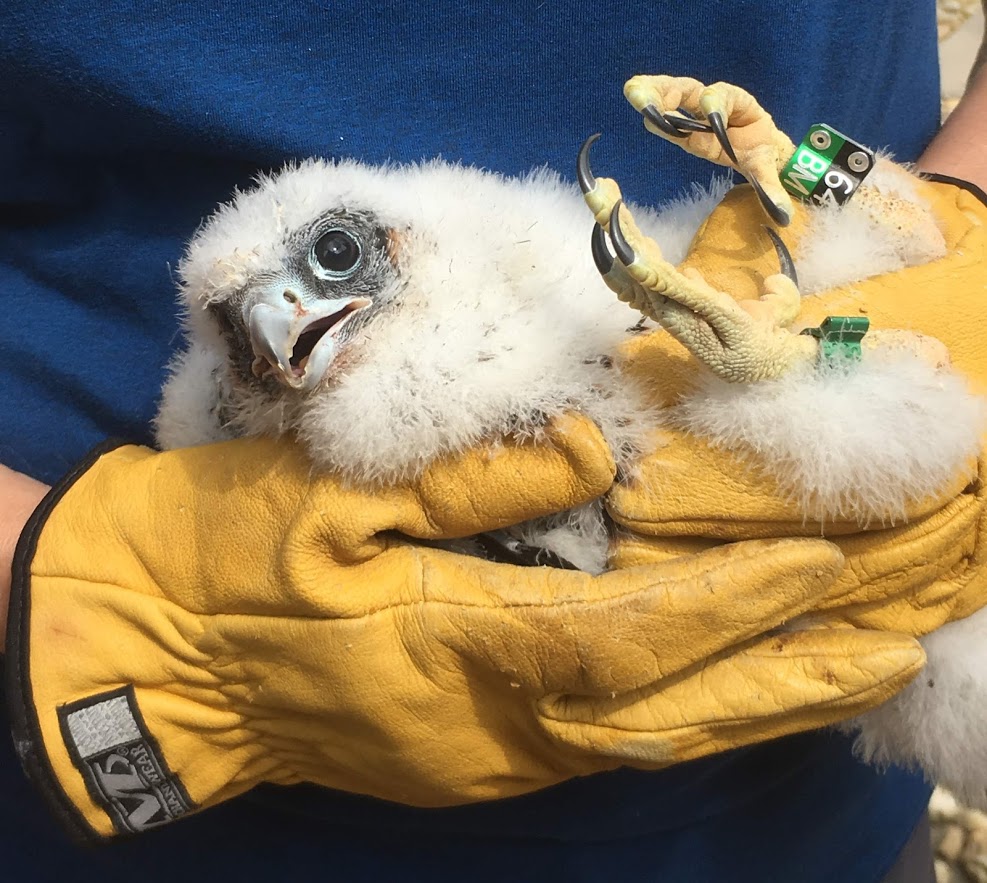
Photo: Brown-headed Cowbird, Allison Farrand/Black River Audubon Society
by Elise Brosnan
Brown-headed Cowbirds love cows. True to their name, they can often be found alongside herds of cattle or horses, eating insects that much larger animals flush from the grass. Historically, Brown-headed Cowbirds followed bison herds across the Great Plains, but the spread of livestock farming has expanded their range across North America.
Their arrival has been unfortunate news for many species of birds. Brown-headed Cowbirds reproduce by being brood parasites; instead of nesting and raising their own young, they lay their eggs in the nests of other bird species, which the hosts then raise until adulthood.
Most brood parasites are specialists, meaning they lay their eggs in the nest of only one other bird species. These eggs closely mimic the hosts’ eggs, and their hatchlings closely mimic the hosts’ hatchlings. Because their young make for convincing changelings, the hosts are tricked into caring for them.
Female Brown-headed Cowbird, Doug Ritenburg/Audubon Photography Awards
However, Brown-headed Cowbirds are generalists and are known to have parasitized over 200 species of birds. Most of these birds have young that look nothing like Brown-headed Cowbirds, so why do they choose to raise offspring that are clearly not their own? It turns out that Brown-headed Cowbirds are even bigger bullies than previously thought.
In what researchers call “mafia behavior,” birds that eject Brown-headed Cowbird eggs may be subject to retaliation. In one study, researchers identified several hundred Prothonotary Warbler nests, some of which had been parasitized by Brown-headed Cowbirds. They removed the cowbird egg from some of these parasitized nests, and then protected some of the nests from harassment by cowbirds.
When a cowbird egg was removed from an unprotected nest, the nest had a 56 percent chance of being destroyed, including any eggs or nesting chicks. When the cowbird egg stayed in place, an unprotected nest had only a 6 percent chance of being destroyed. All of the protected nests were undisturbed. Because of this behavior, Prothonotary Warblers that raised a Brown-headed Cowbird had 60 percent more reproductive success than Prothonotary Warblers that had a cowbird egg removed from their nests. Brown-headed Cowbirds are unwelcome guests, but kicking them out may make them even worse.
Sources:
https://www.ncbi.nlm.nih.gov/pmc/articles/PMC1838626/
https://www.audubon.org/field-guide/bird/brown-headed-cowbird#
Recovery of the Peregrine Falcon – A Conservation Success Story
In July, 2015, two Peregrine Falcon chicks were found on Market Street in Reston Town Center (RTC). They were taken to the Raptor Conservancy of Virginia and safely released into the wild. No one realized Peregrine Falcons nested in Reston but the chicks prompted a discovery that two adult peregrines were nesting in RTC.
Photo: Banding Peregrine Falcon Chicks, Robin Duska
by Lisa Mackem
In July, 2015, two Peregrine Falcon chicks were found on Market Street in Reston Town Center (RTC). They were taken to the Raptor Conservancy of Virginia and safely released into the wild. No one realized Peregrine Falcons nested in Reston but the chicks prompted a discovery that two adult peregrines were nesting in RTC. The pair has continued to nest there for five years.
The Reston Town Center peregrines have perhaps found an ideal environment for a nest site: inaccessible, protected from rain and harsh sun, and facing south. The surrounding area is full of prey all year, while tall building roofs nearby provide safe landing areas for fledglings.
The Center for Conservation Biology in Williamsburg, VA monitors Virginia’s Peregrine Falcon population. Last year, the center’s director, Dr. Bryan Watts, and Reston resident and raptor biologist Steve Potts banded the four RTC peregrines’ offspring, assisted by a team of volunteers. Boston Properties, which owns the building with the nest, allowed access for the banding. They allowed access again this year, when four more chicks were banded.
Peregrine Falcon chicks, Robin Duska
Peregrine and other raptor and avian banding is a management tool and the United States Geological Survey licenses master banders. Virginia peregrines receive green bands with alpha numeric coding that identifies the birds. Both banding and satellite tracking allow study of the peregrines’ migratory status. Approximately half of the Virginia peregrines migrate south to establish winter territories ranging from North Carolina to Colombia, South America. Remaining birds establish winter territories within the mid-Atlantic region of the U.S. from Virginia through New York.
The Peregrine Falcon was almost extinct in the eastern U.S. and listed as endangered in 1970. In 1975, The U.S. Fish and Wildlife Service appointed an Eastern Peregrine Falcon Recovery Team to develop and implement a recovery plan. A key part of the recovery strategy was the production and release of captive-reared falcons. (Cade and Fyfe 1978, Cade 2003.) From 1975 - 1985, 307 captive reared birds were released from sites on the Virginia Coastal Plain, as well as Maryland, Delaware, and New Jersey. Additional birds were released in Washington, DC and coastal North Carolina. This breeding population helped populate the eastern peregrine population so much that they were removed from the U.S. Federal List of Endangered and Threatened Wildlife (Mesta 1999).
The historic population of Virginia peregrines nested in the mountains, but modern birds depend primarily on man-made structures for nesting. Peregrines usually nest in towers, but are also found on bridges and buildings. Less common structures include abandoned shacks, water towers, military ships, and active smokestacks at coal-fired power plants. Peregrines are vulnerable to expected risk factors in urban areas, but the Virginia peregrine population has consistently prospered since the first successful breeding between 1979-1982. In 2018, Virginia supported 32 known peregrine breeding pairs – the highest peregrine population recorded in the state. The population continues to grow at an 8% annual rate. Ongoing management activities might partially explain the increase in reproductive rates observed over time. Artificial management structures include added gravel, nest trays, nest boxes, and predator guards. Peregrine pairs nesting within boxes or on trays produced more than twice as many young as pairs that did not. The peregrines’ health can also be monitored. If a young falcon shows signs of disease that can easily be treated, it can be cured, and returned to the nest. Birds of prey suffer mortality rates of up to 70%, so all available monitoring is extremely helpful.
Peregrines are often reported to be the fastest bird in the world, increasing their average cruising flight speed of 24 to 33 mph to 67 mph when in pursuit of prey. When stooping, or dropping on prey with their wings closed, it's been calculated that Peregrine Falcons can achieve speeds of 238 mph.
Dr. Carla Dove, Program Manager at the Feather Identification Lab at the Smithsonian Museum of Natural History, analyzed bird remains found in the RTC nests in 2018 and 2019 and identified 12 prey species: Blue Jays, Common Grackle, European Starling, Mourning Dove, Red-bellied Woodpecker, Yellow-billed Cuckoo, House Sparrow, American Robin, Cedar Waxwing, Eastern Bluebird, and American Woodcock.
For more information about the peregrine falcon, see:
https://www.allaboutbirds.org/guide/Peregrine_Falcon/id