NVBA NEWS BLOG
Welcome to the blog for Northern Virginia Bird Alliance, a wealth of resources about northern Virginia birds, wildlife, habitat conservation and restoration, native plants, wildlife-friendly gardening, advocacy and more.
New Barn Owl Box Installed in Northern Virginia
The ASNV Conservation Committee is excited to announce the successful installation of a new barn owl nesting box in an unused silo in a park near Leesburg.
Photo: Barn Owl, Michael Phillips/Audubon Photography Awards
Tina Dudley
Barn Owl, Michael Phillips/Audubon Photography Awards
The ASNV Conservation Committee is excited to announce the successful installation of a new barn owl nesting box in an unused silo in a park near Leesburg. This project was implemented by our friend and raptor advisor, Liz Dennison, in partnership with NOVA Parks.
Liz Dennison, president of Secret Garden Birds & Bees, a nonprofit, also worked with the Conservation Committee to help us install two Kestrel nesting boxes at the Lorton Landfill in 2022.
The effort to find a suitable location to install the barn owl box began at the end of last year. We investigated a few siloes close to the Lorton Landfill, but each silo proved to be problematic for different reasons. Several were completely inaccessible, welded shut in fact. Another was accessible but, due to poor drainage, had several inches of water in the bottom. This was a problem because when young barn owls fledge, they often fall from their nest as part of the process of learning to fly. We did not want to risk the fledglings drowning accidentally.
We found the perfect silo by posting a question to Reddit’s NOVA community - asking if anyone happened to know about a silo that might be suitable. One commenter replied that it was a strangely specific question to post. Luckily, one reader in the thread happened to be an employee of NOVA Parks, who contacted us with a lead on a good location.
This park, which we are not identifying to prevent harassment to any future nesting owls, is the perfect site. It has ample grassland nearby to provide a bounty of mice and voles. Barn owls have in fact been spotted in and near that park by NOVA Parks staff. The silo also is in a part of the park that is closed to the public.
Although Barn Owls prefer to nest in barns, they will use a silo because the silo helps protect the owls from the elements. Liz shared a memory of the first time she and Dave installed a barn owl box in a silo on her own property. “I did not have high expectations because I did not think we were in good barn owl territory. But I was wrong. Just a few weeks after installing the box, I stuck my cell phone through one of the silo doors and snapped a picture of the box. And there was a beautiful barn owl face looking down at me! The owls are still here and still using the box to raise their young.”
Nest box in the silo, Liz Dennison
It was Liz’s brave friend Dave Cazenas who actually climbed high up into the silo to install the box. He also brought his drone and was able to capture this great image of the silo and the surrounding habitat.
The chosen silo, Dave Cazenas
Liz explains why this location is ideal: “This silo in the park is perfect. The silo, despite missing a roof, is in good structural condition, which made installation safe. The surrounding area is perfect for hunting mice and voles. It’s quiet and away from people. And young barn owls will have plenty of sheltered places to roost as they master their flying and hunting skills. Without disturbing them, we will check for signs of the owls – owl pellets (bits of indigestible bone and fur regurgitated by the owls) and molted feathers.”
She also asks for public cooperation: “If anyone recognizes this place from the photos, please keep your distance from the silo and other structures. We want the owls to feel safe exploring the site and choosing it for their nest. It could take some time – or it could take just a few weeks. But I’m confident that a pair of barn owls will eventually make it their home.”
Many thanks to Liz and Dave, and to Emily Johnson from NOVA Parks, who suggested this location and coordinated with our volunteers who installed the nest box.
We hope to have good news of a nesting pair to report back soon!
If you know of a silo that might be suitable for another nesting box, you can contact us at info@audubonva.org with your suggestion.
We would not be able to do projects like this without the help of our donors. Thank you for your support. To contribute, you can make a donation online at https://www.audubonva.org/donate.
If You Build It, They Will Come, Maybe
I am captivated by Eastern Screech Owls. They have the qualities noted above, and they come in two colors – gray and red. They are robin-sized with cute ear tufts. But most important for me, they love nest boxes, suburban areas, and mixed woods, so that creating an environment for them is doable. If you build it, they will come!
Photo: Eastern Screech Owl, Jen St. Louis/Audubon Photography Awards
Evelyn Novins
Owls have fascinated people in many cultures and over time. They appear in folklore representing wisdom to witchcraft. Variously despised and admired, people write about them often. The owl recently has even become a messenger to wizards! They fascinate because they are elusive, and their appearance is eye-catching and a bit eerie. The rounded body, enlarged eyes, and the 270-degree rotating head, coupled with nocturnal behavior and silent flight, make them mysterious creatures.
Eastern Screech Owl, Randy Streufert
I am captivated by Eastern Screech Owls. They have the qualities noted above, and they come in two colors – gray and red. They are robin-sized with cute ear tufts. But most important for me, they love nest boxes, suburban areas, and mixed woods, so that creating an environment for them is doable. If you build it, they will come!
The first step is the nest box. I purchased one from Owl Reach out of Texas – a place with many screech owls and screech owl studies. I followed the directions, but squatters entered the nest before the end of the season. In addition, I found a few things that may have deterred screech owls from moving in. More research gave me the parameters that I needed to try again.
In researching box design, I found several resources: Margaret Barker’s Audubon Birdhouse Book and Carol Henderson’s Woodworking for Wildlife: Homes for Birds and Animals. I decided to modify the Texas design and move toward a more universal one, following guidelines from National Audubon Society. That done, I made and followed this checklist of essentials:
Location - The box should be solidly anchored to a tree 10 to 30 feet above the ground, facing away from the prevailing winds and preferably toward the south, to keep them warm. The box should have an open flight path to its entrance. Although the box can be set up at any time, screech owls begin looking for a home early in the season, so up by January gives you an edge.
Perching Spot - A perching spot is necessary near the box and in near-by trees. Owls like to perch to rest, preen, save energy and watch for prey.
Large Bird Bath - Owls do not need much water, getting much of what they need from their prey; however, they do enjoy a bath. It’s suggested to have one made with a sloping edge so they can ease in.
Brush Pile - A brush pile nearby to help supply food is a must. The pile can include sticks, grass trimmings, root balls, and fallen branches. Small rodents and insects inhabit these piles providing abundant food for the owls. The screech owl eats many large insects such beetles and crickets and a variety of small mammals such as shrews, voles, moles and sometimes bats. In addition, lizards, frogs, earthworms, and crayfish are part of their natural diet.
Things To Avoid – Remove netting of any sort (such as a soccer goal or basketball hoop) from the nest-box area to prevent entanglement. Turn off or dim heavy outdoor lighting, particularly seasonal lighting. Do not use recorded screech owl calls to attract the birds. It creates stress on the listening owls and may attract predators, thus discouraging the owl you want to invite and alarming other birds unnecessarily.
Once you have attracted owls, there are some additional rules to follow:
Avoid helping them eat by putting out food or releasing caged mice – they will not survive. The owl must hunt live prey - so do not offer dead rodents.
Longer lawns provide an environment for small rodents, an essential food source - so mow less. Moles, mice, shrews, and voles thrive in longer grass providing a smorgasbord for the owl.
It’s critical to avoid rat poisons and pesticides. If owls eat poisoned prey they can suffer neurological damage leading to debilitation. This secondary poisoning or secondary toxicity is a problem for all wildlife.
I have satisfied all the items on my checklist, but no luck this year so far. Plus, it’s late to hope to attract a screech owl this year. I have not heard the signature whinny or other distinctive calls of the screech owl, but I am not giving up hope.
If you are interested in your own backyard project, here are a few links for materials that may help:
Autumn Acoustics and Great Horned Owls
Autumn is in full swing. November and December are the best times to enjoy the beautiful sound of hooting, especially from Great Horned Owls (Bubo virginianus).
Photo: Great Horned Owl, Michael Rosenbaum/Audubon Photography Awards
Deidre Bryant
Autumn is in full swing. November and December are the best times to enjoy the beautiful sound of hooting, especially from Great Horned Owls (Bubo virginianus). Although they call a variety of wilder environments home, they can live among us on farms and in small woodlots and city and suburban parks. We can hear them most effectively now because the end of our calendar year is courting and territory setting time for Great Horned Owls, and late fall weather creates conditions that allow us to hear the birds’ calls better.
Great Horned Owl, Michael Rosenbaum/Audubon Photography Awards
The Great Horned Owl is probably one of the most recognizable birds in the Americas, with its large fluffy feathers, pointed tufts on its head, and unmistakable low, but soft call. A common hooting pattern is a longer “hooooooot,” followed by three or four shorter hoots. During a duet, females will reply to a male with a raspy hoot in a higher pitch. Great Horned Owls have a range of other vocalizations, too, some of which sound like a screeching cat. Despite their notable appearance and recognizable calls, they are not always easy to locate because of their nocturnal habits and preference for places with little to no light pollution.
Nevertheless, at the right location, and especially at this time of the year, you can hear a chorus of hoots piercing the night and providing an enchanting soundtrack from dusk till dawn. That’s because in November, male Great Horned Owls begin scouting and claiming vast territories (an average of about 1.5 square miles) around their nests. Come January, mating will already be underway and a pair will begin settling in their home. They do not build nests, instead typically taking over nests previously used by squirrels, red-tailed hawks, or other arboreal animals.
When I was much younger, I used to think owls only called during the cooler months and at night. Owls will actually hoot throughout the year and quite often, even when the sun is up. But, in many ways, it’s much easier to hear them on crisp, cold nights. If you’ve ever been to a night football game and listened to a marching band during halftime or when they’re in the stands, you’ll know exactly what I’m talking about. Sound doesn’t get louder as the air gets colder, but it travels farther.
Sound is carried by the collision of vibrating molecules in a longitudinal wave, and sound waves travel faster in warm air because warm air molecules are more energetic than cold air molecules. Faster moving molecules mean sound waves will, in fact, travel faster. Relative humidity also affects sound. Because increasing humidity lowers the density of air and its ability to absorb sound, sound waves move faster in high humidity than in low humidity. On the other hand, fall and winter conditions carry sound farther, even though it may travel more slowly. A number of fall conditions can cause this effect.
Temperature inversion. Sound moves in all directions from its source, including up. During cooler months, a layer of cold air sits under a layer of warm air, and the boundary between them refracts or bends the sound waves, redirecting them toward the ground. (Think of how a prism affects light.) When the sound waves oscillate, or move back and forth, between the cold and warm air layers, they are amplified and can be heard over a greater distance.
Leaf fall. The absence of leaves from deciduous trees and shrubs prevents sound from being dampened, allowing sound to travel farther.
Windy conditions. The wind on breezy days and nights also can refract or bend sound waves. Wind moves faster at greater heights because it encounters fewer obstacles. The difference in speed of the wind causes sound waves to bend towards the ground and travel farther when they travel with the wind (but upwards if they’re travelling against the wind). When an owl is hooting on a windy day, its hoots travel farther downwind than on a still day.
The fall acoustics help owls claim and hold nesting territory. The distance sound travels in some fall conditions allows hooting to be more effective in alerting intruders who enter a claimed territory or in signaling the presence of a threat to other owls. Better acoustics also facilitate courtship displays over long distances.
Of course, even without the assistance of fall conditions, territorial hooting, because it is generally very low-pitched, can travel farther without significant reduction. So why does low-pitched or deep sound travel farther? Pitch refers to frequency, and low frequency sound is from a sound wave that oscillates fewer times per second. Low frequency waves travel farther than high frequency waves because there is less energy from oscillation transferred to the medium (in this case, it’s air) allowing them to have relatively more energy left over to travel longer distances. Think of a fog horn, which produces a low-pitched sound.
If you’re interested in more than territorial hooting, here’s a link to an interesting article on the variety of owl vocalizations.
As with many birds, great acoustics are paramount in acquiring a mate and claiming territory. However, it’s quite fascinating how Great Horned Owls are able to take advantage of their cold, dark environment while other birds, who breed in the spring and summer, have migrated elsewhere. And, anthropomorphizing just a little, isn’t their calling out to a long-term (maybe life) mate over the miles just a little romantic?
Happy hooting season!
Barred Owl Fledgling Leaves its Nest
Reston resident Dorli Bokel doesn’t consider herself a birder, but she loves the Barred Owls that she often hears nearby – especially the young ones.
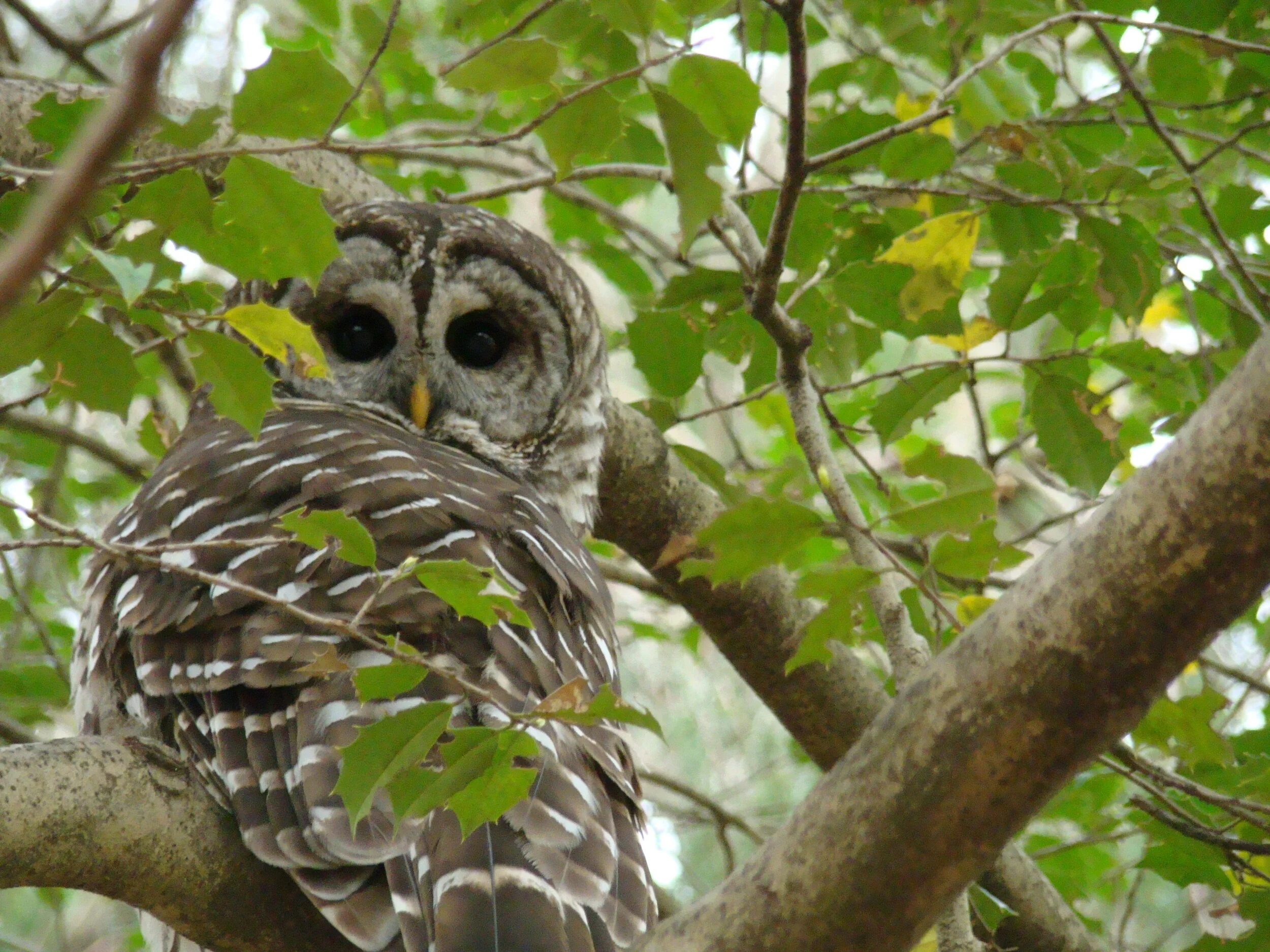
Photo: Barred Owl fledglings, Dorli Bokel
Lisa Mackem
Barred Owlet, Dorli Bokel
Reston resident Dorli Bokel doesn’t consider herself a birder, but she loves the Barred Owls that she often hears nearby – especially the young ones. “I love watching them turn their heads – almost like it’s on a rotation axel. The fuzzy babies are adorable.” Recently, she saw one of the owlets fledge, right on her deck railing. “I just looked outside, and the owlet was just sitting there. It started turning around, trying to get its footing…timidly walked for a bit, turned, and walked more. We were mesmerized.” Dorli estimates that the owlet spent five hours on her deck, then returned two days later. She took this video on the first day and additional pictures on the following days.
Unlike most young birds, Barred Owl chicks fledge before they can fly. They leave their nest when they are 4-8 weeks old but don’t master flight until they are up to 12 weeks old. Dorli doesn’t know how the owlet in her video got to her deck railing, where she says there is nothing to climb on, and the trees surrounding it are very high. However, Barred owlets are known to climb out of their nest using their beaks or talons to sit on branches, and hop to nearby limbs or other surfaces, climbing up to 15 feet.
Dorli noticed early this spring that the owls hooted during the day. Now she only hears them at night. This pattern matches the Barred Owl mating season, with courtship activities beginning in February and breeding between March – August.
Barred Owls mate for life, and usually have a single clutch of 2-3 white eggs each year. The incubation period lasts 28-33 days. After they hatch, young Barred Owls can stay near the nest for up to 6 months, rarely straying from each other and often sitting side by side. Adults care for their young for up to four months – much longer than many owl species. Most Barred Owls remain close to their birthplace and their nest sites can be maintained for years.
Northern Virginia residents hear Barred Owls often, and sightings are not uncommon. Dorli hopes that someone else will share her unique experience of watching an owlet fledge.
More than a century ago, Harriet Tubman used her knowledge of the natural world, including the call of the Barred Owl, in her efforts to guide people to freedom. Read the full story from Audubon.
Barred Owls in Reston
Barred Owls are some of our most intriguing local birds. Most people will recognize their hoot-sequence call that sounds like, “Who cooks for you, who cooks for you all?” Unlike many other owls, they are semi-nocturnal. Their name comes from their striped plumage, or “bars.” They are the only eastern owls with deep brown eyes, which can appear blue-black in certain light. Females are larger than males, and only females incubate chicks, or owlets.
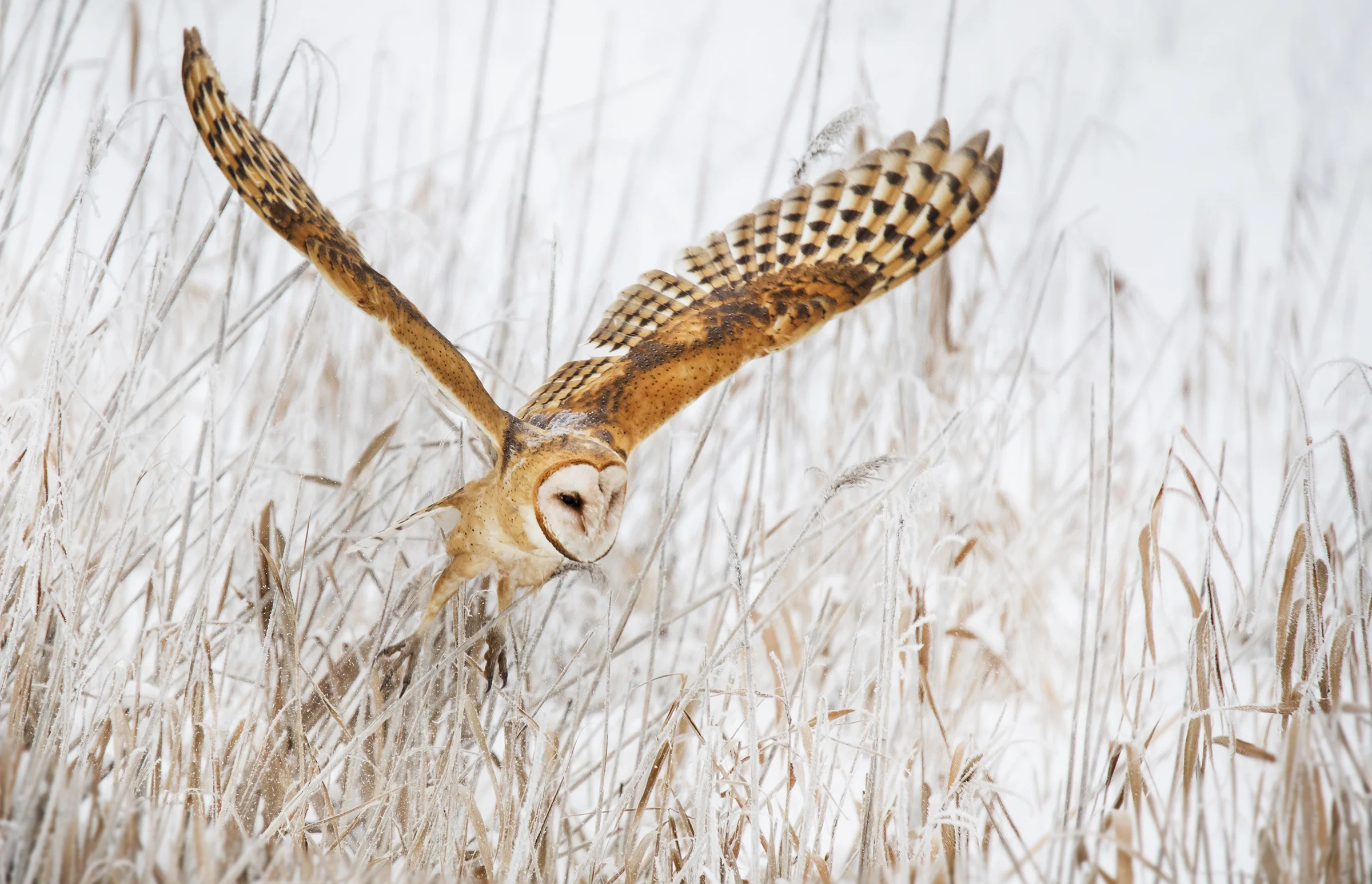
Photo: Barred Owls, Lisa Mackem
By Lisa Mackem
Barred Owls are some of our most intriguing local birds. Most people will recognize their hoot-sequence call that sounds like, “Who cooks for you, who cooks for you all?” Unlike many other owls, they are semi-nocturnal. Their name comes from their striped plumage, or “bars.” They are the only eastern owls with deep brown eyes, which can appear blue-black in certain light. Females are larger than males, and only females incubate chicks, or owlets.
I often see Barred Owls near my home – usually when they are quietly perched in trees, and once when one was sitting on the ground. Barred Owls have distinct personalities. They watch people intently, but with different levels of tolerance. When I take pictures of them, some of these owls change positions as if striking various poses. They aren’t disturbed when I stand near or directly under their perch. Others hoot with apparent annoyance or anger and fly to a more distant perch.
The varied behavior described above might be related to the presence of other birds in the area. Small songbirds recognize Barred Owls as a threat, and sometimes band together to harass or “mob” them. Crows especially have a long-standing animosity towards owls. They frequently mob Barred Owls, chasing them from perches and potential prey. The owls will sometimes attack and eat individual crows, or other small birds (although birds are not their preferred prey), but they will retreat from a mob.
As Leigh Clavez wrote in The Hidden Lives of Owls, Barred Owls are the opportunists of the owl world, easily adapting to varied habitats, including mixed forests and disturbed areas. Although they prefer tree cavities, they will also use the nests of Red-shouldered Hawks, crows or ravens. They eat a variety of small mammals and birds, amphibians, reptiles and invertebrates but they cannot catch cats and dogs.
Great Horned Owls are the Barred Owls’ only natural enemy, but these owls are not seen frequently in Reston. Sadly, Barred Owls are often hit by cars when they swoop down to capture prey along a road. If the prey has been attracted by food people discarded out of a car window, the encounter can become deadly for the owl. I have seen some of these owl casualties along Lawyers Road in Reston.
Barred Owl courtship begins in February and breeding is from March – August. They will lay 2-4 eggs, and the incubation period is 28-33 days. Owlets fledge at 35-40 days, but adults care for their young for at least 4 months – much longer than other owls. Young owls call for their parents with a distinctive screeching hiss. They have a fuzzy appearance until they are fully mature. Barred Owls often use the same nest sites, and can occupy territories for 2-3 decades, suggesting strong site fidelity over time. They do not migrate. Captive Barred Owls can live to their early 20’s, and wild owls live for 10-20 years. They mate for life, but if a mate dies, the survivor will likely mate again.
Watch here to follow a pair of Barred Owls through their nesting.
Twelve Things You Should Know About Owls
Owls are our nocturnal neighbors, leading secretive lives in woods and fields around us. Rarely seen during the day, they can be hard to spot at night. Here are 12 things to know about these elusive birds.
Photo: Barn Owl, Stacy Howell/Audubon Photography Awards
Roger DiSilvestro
Burrowing Owls, Ann Kramer/Audubon Photography Awards
Owls are our nocturnal neighbors, leading secretive lives in woods and fields around us. Rarely seen during the day, they can be hard to spot at night. Here are 12 things to know about these elusive birds:
The fossil record indicates that owls originated more than 60 million years ago, probably about the time dinosaurs went extinct.
The world is home to 220 to 225 living owl species, depending on which taxonomist you ask.
Most owls feed on small birds and mammals, though some are specialists at preying on fish.
A nesting pair of Barn Owls may consume some 3,000 rodents while raising their young.
Males catch food for themselves, their offspring, and their mates, which stay on nests while incubating eggs and caring for young; if food is scarce, however, the male eats first.
Most owls are active at night (nocturnal) but some are active by day (diurnal). One diurnal owl is the Burrowing Owl, often associated with prairie dog towns in the West, where they can be seen bowing politely to one another on the mounds surrounding prairie dog holes.
Night-hunting owls are the stealth bombers of the bird world, equipped with large eyes specially adapted to seeing in darkness, and with ears structured to pick up the slightest sound, giving them advantages over their less acutely equipped prey.
The feathered disks around the eyes of owls help to funnel sound to the ears, and owls can move the feathers to accentuate sounds.
The eyes of owls are placed side by side in the skull, giving the birds excellent depth perception highly useful for zeroing in on prey.
Adaptations in the neck bones allow owls to turn their heads 270 degrees, giving them a wide field of view.
Owl flight feathers have fringe-like or serrated edges that muffle the sound of flying owls, allowing them to sneak up on prey.
Owls regurgitate indigestible parts of their prey, such as bones and teeth, in pellets that biologists can use to study owl eating habits.
Bonus Fact
The world’s smallest owl is the Elf Owl, about 5 inches long and weighing 1 ounce. Two species are rivals for largest species: the Eurasian Eagle-Owl and Blakiston’s Fish Owl, both of which can measure up to 28 inches long and weigh in excess of 9 pounds; however, the great gray owl is longer, at up to 33 inches, so some birders contend that it is the largest owl species, though it is roughly half the weight of the other two.
Great Gray Owl, Ken Shults/Audubon Photography Awards