NVBA NEWS BLOG
Welcome to the blog for Northern Virginia Bird Alliance, a wealth of resources about northern Virginia birds, wildlife, habitat conservation and restoration, native plants, wildlife-friendly gardening, advocacy and more.
“Junk Trees” and the Native Understory
Berries that grow on native trees and shrubs are wildlife powerhouses. Despite that, some of the best producers are labeled “junk trees” in today’s gardening and landscaping industries because they aren’t someone’s idea of what a yard tree should look like.
Photo: Closeup of the flowers of Devil’s Walking-stick, USGS Bee Inventory and Monitoring Lab from Beltsville, Maryland, USA, Public domain, via Wikimedia Commons
Eileen Ellsworth
Take a moment to stand in the scaly shoes of a migrating songbird along the Atlantic Flyway this fall. Passing through Virginia, you will still have a long way to go before reaching your southern wintering grounds. Imagine your relief when, after an entire night of flying, you find a stopover habitat to rest and refuel before the next leg of the journey. And what is your favorite food from the on-site offerings? Berries that grow on native trees and shrubs, all of which are wildlife powerhouses. Despite that, some of the best producers are labeled “junk trees” in today’s gardening and landscaping industries because they aren’t someone’s idea of what a yard tree should look like.
To show how far afield we have drifted in our plant-think, consider the results of this 2022 study by the Center for Conservation Biology (CCB). Researchers working on the eastern shore of Virginia analyzed the nutritional content of several native plant berries to discover which ones provide the biggest energy boost for migrating birds. Next, they measured levels of berry removal from plants during the fall migration to determine which berries were most preferred. Considerable overlap existed between the most nutritious and the most popular native plant berries, as follows:
The most nutritious native tree berries, starting with the best, were
Sassafras
Bayberry
Virginia Creeper
Pokeweed
Devil’s Walking-stick
American Beautyberry
Hackberry
Wild grapes.
The most preferred native plant berries, starting with the most popular, were
Sassafras
Devil’s Walking-stick
Pokeweed
Virginia Creeper
American Beautyberry
Bayberry
Hackberry
American Holly.
These plants are not just profuse berry producers. They are classic native understory shrubs and trees that have been disappearing from our landscapes in modern times. White-tailed deer have over-browsed the understory. Non-native invasives outcompete the natives. Plant diseases proliferate as the climate warms. And humans persist in calling some native plants “junk” and discourage their purchase. It is a perfect storm of destructive pressures and wrong thinking. At least the thinking part is something we can reverse along with the behavior that flows from it.
Let us ditch the “junk tree” label and take a closer look at three rock star “treasure trees” included in the CCB study.
Sassafras: Sassafras berries were rated #1 in the study for both nutritional value and bird popularity. Who knew? Woodpeckers, mockingbirds, catbirds, flycatchers, phoebes, vireos, Wild Turkeys, and Yellow-throated Warblers all enjoy the feast. The tree also provides excellent support for squirrels, rabbits, and other mammals and hosts some very cool moth species such as the Imperial, Promethea, Cecropia, and Io moths as well as the remarkably handsome Spicebush Swallowtail caterpillar.
Sassafras grows very fast and reaches heights of 30-60 feet in ideal conditions. You’ll need to plant more than one if you want berries, as only the female trees produce them. White-tailed deer relentlessly browse the tree, so some fencing is recommended for the first few years. Flower and berry production begins at ten years, and the abundant clusters of yellow flowers in April and May are simply spectacular. The fruit ripens in September, just in time for the fall migrations. The berry’s appearance has been likened to a blue-black egg sitting atop a bright red golf tee. Its leaves are just as unique. Three distinct leaf shapes - the mitten, the three-lobe, and the oval - all grow on the same tree and turn bright yellow, orange, and red in the fall.
Its wildlife value and unique features say it all.
Devil’s Walking-stick berries. Photo: GlacierNPS, Public domain, via Wikimedia Commons
Devil’s walking-stick: The CCB study rated Devil’s Walking-stick berries as #5 for nutritional value and #2 in popularity. Cedar Waxwings, Wood Thrushes, White-throated Sparrows, Swainson's Thrush, American Robins, Gray Catbirds, Northern Mockingbirds, Rose-breasted Grosbeaks, Dark-eyed Juncos, and various migrating warblers are all avid consumers.
The distinctive red berries of Devil’s Walking-stick. Photo: Margaret Fisher
Another fast grower, the tree/shrub reaches heights of 10-30 feet, making it ideal for yards and gardens where larger canopy trees can’t fit. It also reproduces quickly by suckering roots and often forms colonies in open fields, wood margins, and moist woods. You only need to purchase and plant one specimen to set fruit, and berries appear as early as year three or four.
Devil’s Walking-stick is a native plant that looks positively exotic. Spot it once and you will never forget it. Prominent thorns grow along the trunk, stems, and leaf stalks (thus, the label “junk”). The thorns give the plant its name while also discouraging most deer browse. Small white or creamy white flowers appear in mid-to-late summer and form showy, fragrant canopies above the huge compound leaves, attracting many pollinators. When dark purple berries appear in the fall, they hang on stalks that have turned a vivid burgundy or lacy red.
This plant is just plain crazy beautiful.
American Beautyberry: We mention this even though it is native further south but not in northern Virginia, because we would like to warn people not to buy the wrong species by mistake, which happens commonly. The CCB study rates American beautyberry #6 for berry nutrition and #5 for bird popularity. While Sassafras and Devil’s Walking-stick rarely appear on landscaping plans, American Beautyberry is a frequent choice and never designated “junk” in anyone’s book.
In spring and summer, the plant looks ordinary with unremarkable leaves and inconspicuous flowers. Come the fall, however, the plant transforms itself as tight clusters of bright purple berries ripen along the entire length of the stem. Those berries last for weeks, but their taste improves as they age and ferment on the stems, making them a fan favorite for migrating birds. American Robins, mockingbirds, cardinals, towhees, thrashers, Gray Catbirds, and finches are known customers among 40 species relying on the tree for late season food.
American Beautyberry also grows fast to reach a mature size of up to about 8 feet. Deer eat it, so fencing is recommended until it is well established.
Here is the warning. When purchasing American Beautyberry, be aware that Asian cultivars are often sold under the name “Beautyberry” and can be confused with the straight native. Only purchase Callicarpa americana. Mislabeling is common even then. Devil's Walking-stick (Aralia spinosa) also has an invasive look-alike (Aralia elata).
When we label a native plant as “junk,” it is often because of thorns, poor-quality wood, or aggressive growth and spread. But the label also reflects our severed connection with nature. A “junk" tree or "brush" shrub may or may not please us, but it is a migrating bird’s vital food source, an uncommon moth’s host plant, and a native bee’s essential nectar source. For more suggestions, see the Plant NOVA Trees website.
One person’s junk has always been another’s treasure. Let’s value what matters.
The Magic of Winter Trees: Making a Deeper Connection
Dreams of warmer days are lovely, but if you have trees in your yard or if they are in a nearby park, winter might also be the time to learn how to appreciate and protect their incredible beauty.
Photo: Winter trees, Rusty Moran
Cindy Speas
Winter is a lovely time to get to know your trees better. Many folks spend some of the colder days of January and February planning their spring gardens, winter sowing, or putting in nursery orders for spring delivery of native plants. Dreams of warmer days are lovely, but if you have trees in your yard or if they are in a nearby park, winter might also be the time to learn how to appreciate and protect their incredible beauty.
Trees in winter, David Howell
When trees are bare of leaves, you can visualize more clearly their beautiful shapes, identify some species characteristics, and assess their health. There are several local organizations that provide educational winter hikes or webinars to examine and learn about our forests, including ASNV, Nature Forward, Virginia Native Plant Society, Potowmack Chapter, Capital Nature, Loudoun Wildlife Conservancy, Prince William Conservation Alliance, and others.
If you haven’t taken a long walk or hike in the winter before, it’s time to bundle up and head out on the trail. Even if you aren’t an experienced birder, it’s often easier at this time of year to observe hawks, owls, or other raptors at work. You can spot smaller birds searching tree bark or leaf litter for insects and berries, and mammals looking for food also may appear in the distance. Native evergreens or the lovely marcescent (persistent) leaves on oaks and beeches provide beautiful color among the gray tree trunks.
While you may not want to linger for contemplation, if you walk gently, there is a type of forest bathing you can experience surrounded by the still, silent trees in the chilly air. One of the loveliest things you can see in a winter forest is found by looking up to the sky. It is in this season that you can see how the tree canopy develops: the trees grow side-by-side leaving a path around each canopy’s branches so that sunlight may reach down to the forest floor. This is called canopy shyness. While more common in rain forests, you can sometimes see these fascinating patterns of sky and crown branching the same tree species, and they are spectacular.
If you love to undertake vigorous outdoor work in the winter, now is the time to protect your trees by starting to pull, dig, or hack and treat the invasives in your yard, or to volunteer for similar ongoing activities in your community. With the exception of a few native evergreens, almost all the large swaths of green you see in your neighborhood and along the roads are invasive, non-native plants: Wintergreen, Vinca, English Ivy, Privet, non-native Holly species, and Bamboo. You can find organizations with volunteer opportunities on the Plant NOVA Trees website. Invasive plants displace the tree seedlings that are essential for our future forests, and some of them directly kill the larger trees.
So, if you want to learn about trees, to more closely observe nature, to find quiet time for spiritual reflection, or to get rid of tree enemies, winter is a magical time to spend outside in the stillness and beauty of the forest.
Help Trees Thrive: Tear Up Some Turf
It’s fairly common in residential neighborhoods to see trees surrounded by grass or by small mulch beds, often heaped high like a volcano. But did you know that your trees would be healthier and grow faster if you replaced that turf and those mulch volcanos with a 2-4” deep ring of mulch that extends out to the tree’s drip line or even beyond?
Photo: Tree surrounded by native shade plants, courtesy of Plant NOVA Natives
Elaine Kolish
It’s fairly common in residential neighborhoods to see trees surrounded by grass or by small mulch beds, often heaped high like a volcano. But did you know that your trees would be healthier and grow faster if you replaced that turf and those mulch volcanos with a 2-4” deep ring of mulch that extends out to the tree’s drip line or even beyond? Let’s look at why this is.
Tree roots are not as deep underground as you might think. Instead, they generally are fairly shallow, in the upper six inches of the soil, which is where turf grass roots grow. This means trees and turf are competing for the same water and nutrients in the soil. The grass generally wins. And of course, as trees become more established, the shade they cast doesn’t do the turf any favors. Turf grass does best with lots of sunlight, and dense shade significantly affects grass growth and quality. Another factor to consider is that exposed tree roots in your lawn can be a tripping hazard that you can avoid if the root area is part of a mulched bed. In addition, when you mow over the grass that is around tree roots, you could be damaging the tree roots, both with the mower blades and by compacting the soil.
If you wonder how much difference turf under trees can make, one study reported that trees in turf grow at half the rate of trees that are not dealing with that competition. So, if you want vigorous tree growth, no turf or less turf under them is best.
Tree surrounded by native shade plants, courtesy of Plant NOVA Natives
Another wonderful benefit from eliminating or reducing turf is the improvement in the survival rate of the caterpillars that turn into butterflies and moths that in turn bring beauty into our lives and environmental benefits. According to Doug Tallamy, a famous professor of entomology and wildlife ecology, a hard-packed lawn underneath a tree does not provide adequate pupation sites for caterpillars that may have been feeding on your native tree, such as an oak. The caterpillar may find no leaf litter (because the lawn has been cleaned up) in which to spin a cocoon, or if it is a species that burrows into the soil, it won’t find any loose soil if there is only turf under the tree. And we need these insects, not just for their beauty, but for their roles as pollinators and as food for other wildlife. As E.O. Wilson, the eminent ecologist, famously said, insects are “the little things that run the world.”
So, consider eliminating the turf under your trees or combining various smaller mulched areas into a bigger area. Your trees will be happier (and you will have less lawn to mow and maintain)! But, remember, don’t let the mulch touch the trees—stay one to two inches away from the trunk to avoid bark rot. Too deep a mulch layer will keep water from reaching the soil – two to four inches is ideal. Best of all is to use arborist wood chips (which you can get for free from Chip Drop or from any tree company that needs to dispose of the chips after felling a tree), as they don’t mat down the way standard bagged mulch may.
Once you have wider rings around the trees, you will have the opportunity to create more biodiversity and habitat by under-planting with native plants including shrubs, flowers and ground covers that thrive in shade or part shade. Think ferns and wild ginger. Native plants have different root depths compared to turf grass, so you won’t have the same unhealthy competition for water and nutrients that you did with turf. You can find details about these plants on the Plant NOVA Natives website.
Pushing back the turf is a project you can do before the ground freezes, or you can start planning your beds now, while other garden tasks are on hold, for spring.
After a Long Hot Summer, It’s Time to Plant Trees!
Autumn is a perfect time for trees to go in the ground. Instead of facing a long, hot summer, trees have time to get acclimated to their new space, and then they cheerfully spend the winter in a dormant state.
Photo: Sweetgum Tree, Nancy Vehrs
Cindy Speas, Chair, Fairfax County Tree Commission
Preserving trees and planting new native trees are major goals of the Plant NOVA Trees campaign. In April I wrote about how to plan for spring and fall tree planting seasons, in the summer about the dangers of non-native trees, and last month about celebrating October as Native Tree Month in Virginia. You likely already realize I’m going to write now about planting trees.
Autumn is a perfect time for trees to go in the ground. Instead of facing a long, hot summer, trees have time to get acclimated to their new space, and then they cheerfully spend the winter in a dormant state. Those who plant in the fall not only find the temperatures invigorating for physical labor, but can also look forward to budding and blooming in the spring, when the days get longer. It’s a win-win!
Sweetgum Tree, Nancy Vehrs
Christina Hester recently described in Casey Trees’ blog “The Leaflet” all the reasons newly planted trees do so well in cooler temperatures. In Fall is for Planting, she says cool weather means less stress on the trees and higher rates of survival. There’s more water available for their roots, because water evaporates more quickly when it’s hot. Cooler air also reduces the threat of damage from pests or disease. Of course, there’s the same chance of rain or drought as in spring and summer, so in all seasons, newly installed trees need watering to thrive. Details on the watering schedule, which depends on the size of the tree, can be found on the Plant Nova Trees website. In the fall, other deciduous trees in your yard can provide lovely, free mulch when they shed their leaves. All the newly planted seedlings or young trees can benefit from the soil around them being enhanced with leaves. If you use leaves for mulch, just remember to leave space around the tree trunk to reduce damage to the young sapling’s sensitive outer bark.
Planting new, native trees is essential for our urban forest. Trees can be lost to development, disease, or invasive vines. Our urban forest needs other healthy trees of all sizes and ages coming along behind to take the place of dead or dying trees. Maintaining and preserving the saplings planted each season serves the goal of developing healthier ecosystems and a healthier planet.
Perhaps this autumn you might ask a child to help you—because every child that plants a tree is a part of that tree’s history, and the tree will surely find a place in that child’s heart. Searching for the right place to dig, gently spreading out a sapling’s roots in the ground, patting down the warm soil, smelling the earth after the first watering—this experience can turn a child into a plant and planet lover for life. And what we love can also become a part of an ethical journey towards caring for the whole earth that supports that one tree.
Autumn is not just a great time to plant trees, but also to reflect on the bigger picture. Doug Tallamy, famous for his research on oak trees, has started a Homegrown National Park project. The effort “has no political, religious, cultural or geographic boundaries because everyone—every human being on this planet—needs diverse, highly productive ecosystems to survive.” And, I might add, also to thrive. Tallamy says planting native trees and plants in our own backyards will increase the biodiversity of North America, one plant at a time. Such a grand ecological vision can take root in the one act of a child helping you to plant a tree.
Celebrate native trees in October!
This year, the entire month of October is Native Tree Month across Virginia!
Photo: Fall trees, Margaret Fisher
Cindy Speas
Chair, Fairfax County Tree Commission
Fall trees, Margaret Fisher
September may have given us a hot blast of 90-100-degree temperatures and little rain, but autumn is just around the corner, with its clear blue skies, sunny days and crisp temperatures! All of us will cheer the emerging fall color changes around us, with reds and golds and maroons permeating the tree canopy above and the shrubs and plants below. Many who have hibernated during the heat of the summer will come out to play, hike, and work in the yard—for it is now the best tree planting season of the year, lasting right through November or early December, frosty weather permitting.
This year, the entire month of October is Native Tree Month across Virginia! It is important to plant native trees, as well as other plants, because they are highly adapted to local soil and weather conditions, easy to maintain, and generally need less water and zero fertilizer to thrive. Local pollinators and other insects must have them for nutrition, so that they in turn can become food for birds and small animals. Critically, the food web is not supported by non-native plants. Sometimes you may see bees on a non-native plant or tree (think crape myrtle or butterfly bush), but the insect is getting only a quick sugar water drink, instead of the healthy, complex food it needs from the native plants it grew up with.
Why should we include shrubs and other smaller plants when October is a celebration of native trees? It’s because they partner to play a critical role in keeping our urban forest ecologically healthy. They work together like a family to provide a home and food for native insects, birds, and small animals. A healthy urban forest reduces stormwater run-off, lowers energy costs for residences and businesses, sequesters greenhouse gases in its wood, roots and surrounding soil, and improves the health of humans and other species by filtering airborne pollutants from nearby roads and industrial areas. For a summary of the ecological and other benefits of native landscaping, you’ll enjoy reading this article from the National Audubon Society.
Many local plant nurseries are joining in this October celebration to highlight native trees, shrubs and understory plants, and some are offering discounts as well! The Plant Nova Trees website has information about where to buy natives nearby this October as well how to find tree walks and tree planting events. If you need details or reminders about how to plant a tree or woody shrub, download the Fairfax Tree Commission’s popular Tree Basics booklet. Planting is not too onerous a task when fall weather conditions are usually so cheerful.
And finally, make sure the trees and woody stems you plant in October are counted! Go to this page to record your special efforts to enhance and expand our urban forest.
Tree-of-Heaven is not heavenly!
Ailanthus (Tree of Heaven) was imported from China and widely distributed in the United States as an ornamental in the late 1700s and 1800s. Its behavior, though, is far from heavenly.
Photo: Tree of Heaven, Margaret Fisher
Cindy Speas, Chair
Fairfax County Tree Commission
In summer many folks travel to the Shenandoah Valley and beyond for recreational opportunities. Driving in any direction from northern Virginia in the growing season, you will see an attractive-looking tree everywhere along the highways and byways. The dramatic clusters of seeds are so large they look like giant flowers among the leaves. It’s not native walnut or native sumac—it is Ailanthus altissima, commonly called Tree-of-Heaven. Disturbed areas and rights-of-way along roads are perfect locations for this opportunistic pest to colonize. Ailanthus is popping up in suburbia as well, and even tree-loving experts are calling for us to remove these attractive and fast-growing specimens from our properties as soon as possible.
Tree of Heaven with Spotted Lanternfly inset, Margaret Fisher
Ailanthus was imported from China and widely distributed in the United States as an ornamental in the late 1700s and 1800s. Its behavior, though, is far from heavenly—it spreads aggressively through root sprouting and huge seed production; it grows to maturity rapidly with a very long taproot; it is characterized by its terrible odor; and it poisons the ground around its roots with chemicals, in a process called allelopathy. This prevents native trees and plants from growing nearby, allowing Ailanthus to spread quickly and dominate our landscape.
Even worse, Ailanthus is the preferred food source for a new invasive insect—the Spotted Lanternfly (SLF). In spite of state quarantines, this destructive pest has been found in Fairfax County. It is a major threat to some of Virginia’s agricultural areas, especially our vineyards, peach orchards, and hops fields. It also is a threat to native tree species like oaks and maples that thrive in our yards. Forest Pest Branch asks all residents to report Ailanthus following the instructions in this brochure and report Spotted Lanternfly sightings here.
Some may still ask why these non-native trees should be removed—don’t they at least provide shade and shelter in a warming world? They certainly can, but they crowd out our native oaks, beeches, hickories and maples, as well as fail to provide the critical food resources that native insects and other animals need to live and reproduce in a fully functioning, healthy ecosystem. If a plant like this is killing off or threatening major parts of our local natural food web, the entire system will eventually collapse. And we will lose our native tree canopy along the way.
How can we stop the spread of this nasty invasive? First, of course, do not purchase it! So be sure to learn how to identify it. You can become familiar with the iNaturalist app on your smartphone or use other online resources to name the plant. When in doubt, try crushing a leaf and smelling it: the odor is similar to rancid peanut butter. Second, remove the tree if it is growing on your land. This pest, however, thrives when simply cut down, so you will have to kill the root system right away. There are some very useful resources to help landowners eliminate this threat safely and efficiently. Blue Ridge Prism has excellent fact sheets with details about herbicide use for this and other invasive species.
Visit Plant Nova Natives for more information about invasives and their destructive roles in our native environment. It would be truly heavenly if we could eliminate a threat like the Tree-of-Heaven.
Shopping for the birds
Warm weather has many of us headed to the garden center, where lovely blooms await. Did you know that those shopping trips can double as one of the most effective ways to contribute to a healthier environment?
Photo: Native plant tag, Margaret Fisher
Margaret Fisher
With a little planning, our plant choices can make the difference between a community that supports the birds and butterflies and a community that completely displaces them. The key is to pick native plants, the ones that evolved right here with those critters and provide them the food they need to survive. Native trees and shrubs are especially important, but even the tiniest plants play an important role in the ecosystem.
Native plant tag, Margaret Fisher
How do you tell if a plant is native to our area? A simple way is to look for the red “Northern Virginia Native” stickers at participating nurseries. Over fifty volunteers from the Plant NOVA Natives campaign have been labeling the natives in those garden centers. The trees get hang tags, and the other plants get red stickers. You won’t find the stickers in the annuals sections, though, since those plants are purely ornamental and not locally native. Since turnover is rapid this time of year, making it hard for volunteers to keep up with the labeling, you might want to take along a copy of the Native Plants for Northern Virginia guide, or use the online pdf or search app.
Any even simpler way to guarantee that a plant is native is to buy it from someone who only sells native plants. There are four garden centers in Northern Virginia that do just that. In addition, periodic native plant sale events are held around the region in the spring and the fall.
Spring planting for many people consists primarily of filling pots with colorful flowers. The absence of annuals might seem like a problem until you learn that native plants make excellent container specimens as well, with the added advantage that they only need to be planted once, since they will overwinter in the pot and provide the fun of watching their tender leaves emerge in the spring. Visits to the blooms from butterflies and hummingbirds add even more enjoyment. The Plant NOVA Natives website has plant suggestions for container gardening, but almost any native can be used for this purpose if the container is big enough.
Five Myths About Trees
It’s no myth that trees hold a special place in our collective psyche. Trees play a prominent role in myths, often symbolizing life and rebirth. Unfortunately, some of the stories about them are just plain wrong.
Photo: Sara Holtz
Margaret Fisher
It’s no myth that trees hold a special place in our collective psyche. Trees play a prominent role in myths, often symbolizing life and rebirth. Unfortunately, some of today’s stories about them are just plain wrong.
What not to do, Sara Holtz
1. Trees need big piles of mulch. Or perhaps we should call this The Myth of the Angry Volcano Gods, who are appeased by stuffing trees down their maws. It’s hard to know how this harmful practice got started, but we are seeing it everywhere. Trees should be planted with the top of their roots level to the ground, just as in nature. Mulch should never be allowed to touch the trunk, as it causes bark rot. Shredded mulch can form a barrier to water when it mats down, so arborist wood chips are preferred – assuming mulch is needed at all – and no more than 2-4 inches deep. The Fairfax County Tree Basics booklet, which you can download for free, shows proper tree planting and care practices and is available in multiple languages.
2. Tree wounds need dressing. Trees cannot heal the way we do after they are cut, which is one reason why topping a tree is such a bad idea. A broken limb should be trimmed back to just beyond the branch cuff then left alone to try to close over, which, with luck, it may accomplish before fungi set in. Painting tar on the surface just encourages rot.
3. All leaning trees are dangerous. It is normal for trees to grow toward the light. They reinforce their wood to make themselves stable. If you are worried that a tree may become hazardous, you can get an opinion from a consulting arborist who is certified by the International Society of Arborists (ISA) and who has no financial interest in cutting it down.
4. Trees litter. Well, trees do create leaf “litter,” but that’s an unfriendly word to use to describe feeding the soil and providing habitat for fireflies and wintering grounds for butterflies. The best thing you can do for a tree and the ecosystem is leave the leaves underneath where they fall. If you are afraid that they will smother the grass, you can chop them up with a lawn mower so they at least add organic matter to the soil, a practice that is good for the trees and the grass (but hard on the critters).
5. One tree is as good as another. Not so! All trees can provide shade and capture stormwater, but only native trees support biodiversity. In fact, native trees are the very backbone of our local ecosystem, providing the majority of the leaves upon which our native caterpillars feed, which in turn provide the diet required by baby songbirds. In fact, not only do some non-native trees do nothing to feed the birds, they are actually invasive, taking over and destroying what is left of our remnant woods and starting to threaten our bigger forests as well. With few exceptions, there are native trees to serve any landscaping need. Find out all about them on the Plant NOVA Trees website.
Save a Sapling: Pull Invasives
One of the most satisfying moments of invasive plant management comes when you pull the last vine off a struggling native sapling, freeing it to claim its full share of sunlight and grow without restraint.
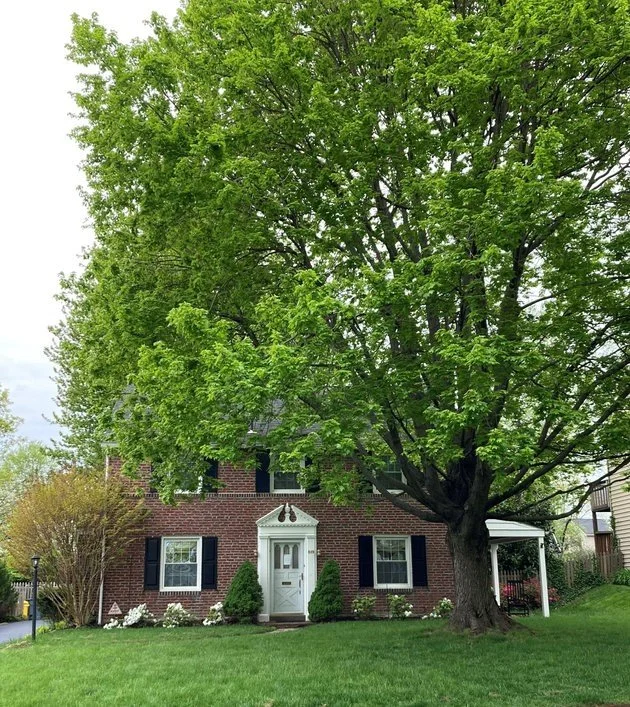
Photo: Rescued Sapling, Laura Handley
Laura Handley
One of the most satisfying moments of invasive plant management comes when you pull the last vine off a struggling native sapling, freeing it to claim its full share of sunlight and grow without restraint.
Volunteers with Fairfax County's Invasive Management Area (IMA) program get to do just that twice a month at Idylwood Park in Dunn Loring. In a series of workdays, primarily on Saturday mornings, these volunteers have worked to clear invasives from a meadow along the park's driveway. A wide range of people has participated so far, from scout troops to high-school students seeking service hours to venerable Virginia Master Naturalists. Several have brought family or friends to chat with as they work, taking advantage of the chance to socialize outdoors.
Bags of invasive vines, Laura Handley
According to Patricia Greenberg and Gloria Medina, the coordinators of the IMA program, several of the saplings the volunteers have uncovered (including black walnuts, multiple species of oaks, and a large Honey Locust) were planted by the park service in the late 2000s. But the area around the saplings was left unmowed and unmonitored, allowing invasive vines to creep in from adjacent areas. By the time the volunteers started working, those invasives dominated the meadow.
Rescued saplings, Laura Handley
The volunteers' first challenge was to clear a path to the trees, which were blocked not just by the invasives but also by Poison Ivy and thorn-covered blackberry canes (both of which are native plants but which were blocking the way). Next came the delicate operation of untangling the vines from the young trees' branches. Any vines growing out of reach were left to hang on the trees, where they will eventually die and fall down on their own. The final challenge has been maintenance: keeping the vines from re-growing to cover the trees again. After repeatedly cutting them to the ground failed to do the trick, Greenberg and Medina joined site leader Laura Handley one morning this fall to apply herbicide to the vines' stumps. This targeted application should (it is hoped) finish off the vines while leaving the surrounding vegetation unharmed. The rescued trees are often oddly shaped, their crowns pulled sideways and their trunks wrapped with spiraling vine-scars. But as they grow, now free of obstructions, they should straighten up and fill out. And by rescuing existing trees rather than clear-cutting the area, the volunteers have given the meadow a ten-year head start on the process of returning to a mature forest.
Once the meadow is clear of invasives, the group plans to spread seeds for native wildflowers over the ground they've bared -- that is, if any of the ground stays bare. In the two years they've been working on the site, several native species have reappeared or expanded their footprint, including Common Milkweed, Canada Goldenrod, Wingstem, Foxglove Beardtongue, and New England Aster. This robust layer of herbaceous plants will help keep invasives from returning to the site and will serve as food and habitat for many native insects, birds, and other critters—and, as the saplings grow, they'll start to do the same.
Winter is a great time to rescue trees, because it is easier to get at them, and cold temperatures are good for working. The winter workdays for this site will soon be posted to the IMA program calendar, and similar volunteer events in locations throughout Northern Virginia can be found on the Plant NOVA Trees website.
Solar Panels vs. Trees – How to Choose?
Residents who are interested in installing solar panels often face a dilemma. Which is better for the environment, solar panels or shade trees?
Photo: Shade tree, Margaret Fisher
Margaret Fisher
Residents who are interested in installing solar panels often face a dilemma. Which is better for the environment, solar panels or shade trees? After all, climate change due to burning fossil fuels is threatening the very existence of trees, not to mention human beings, and the timeline for preventing catastrophic temperature rise is short. Before we get out the chainsaw, though, there are several other things to consider.
One of the main reasons to try to limit temperature rise is to prevent ecosystem collapse. The native trees in our yards are as much a part of that ecosystem as the ones in the Amazon, providing food, shelter and nesting places not only for birds and mammals but for a myriad of invertebrates that are a critical part of the web of life. If we do not even protect the environment where we live, we can hardly expect people in the Amazon to take more of an interest.
Sunny rooftops are an ideal place to put solar panels, because that real estate is already built upon, and because decentralizing the grid helps build resilience. The land use anticipated for solar farms and new transmission lines is so massive, and the willingness of companies to replace forests with them so counterproductive and disheartening, that the more we use our own rooftops, the better.
But solar energy is neither the only way to reduce fossil fuel use nor the most efficient of the various options for homeowners. The first step should always be to reduce energy consumption, by weatherizing and taking other steps to reduce waste. For those ready to make a big investment, an alternative to consider is a heat pump or even a geothermal system for heating and air conditioning. As is true for solar panels, the cost of installation can be partially offset by a significant tax credit. Some utility companies, including Dominion, allow customers to choose a renewable energy option. “Renewable” is not always the same as “clean” (It can include burning chopped down trees, for example.), but much of the renewable electricity is generated by wind and solar farms.
It will take considerable effort and broad participation for our community to meet its climate goals, but not everyone has to do everything themselves on their own property. Those with sunny roofs can contribute solar energy. Those with trees can take care of them.
Shade tree, Margaret Fisher
Trees themselves are what are known as a “natural climate solution.” They provide benefits that mitigate the effect of climate change. Trees improve the energy efficiency of houses. In the winter, they reduce heating costs by blocking the wind. In the summer, they reduce air conditioning costs, because roofs and walls in the shade are often twenty degrees cooler than those in the sun. In addition, trees improve air quality and sequester carbon dioxide. Their ability to capture stormwater is particularly important in flood-prone suburban and urban areas with their excess of impervious surfaces. The leaves of the trees capture much of the rain before it even reaches the ground. Once it does reach the ground, transpiration by canopy trees sucks thousands of gallons of water from the ground, thus enabling the soil to control flooding.
Try using the National Tree Benefit Calculator at the bottom of the Plant NOVA Natives web page to see what you save in monetary terms by preserving a few mature trees, strategically located around your property. For the birds and other critters that depend on them, the native trees are priceless.
Managing larger properties for birds, butterflies, and people
The outdoor space on larger properties in Northern Virginia, whether residential or commercial, is typically divided into formal landscaping close to buildings and natural areas at the periphery.
Photo: Courtesy of Plant NoVA Trees
By Margaret Fisher
The outdoor space on larger properties in Northern Virginia, whether residential or commercial, is typically divided into formal landscaping close to buildings and natural areas at the periphery. New practices are emerging on how to manage both areas, practices that protect the ecosystem and support the birds and the butterflies while better satisfying human needs.
The natural areas between properties are an important amenity, providing visual barriers and sound buffers while capturing stormwater and reducing flooding. Looking around, it is evident that those natural areas are often being left to take care of themselves. The result is that they are steadily degrading as the native trees are displaced by invasive non-native trees and directly killed by invasive vines. The shrubs and ground layers are equally damaged by invasive species at those levels. Many of these invasive plants originate from the landscaped areas where they had been planted before people knew to do otherwise. Preserving trees and habitat in both areas requires taking out the invasives and replacing them with native species, of which numerous options are available.
Some other tweaking is also needed to common landscaping practices. To name a few examples, piling mulch against the trunks of trees causes the bark to rot. Blowing the fallen leaves out from under trees destroys the cover where fireflies and many butterflies overwinter. Leaf blowers with two-stroke engines pour pollution into the air and are loud enough to damage workers’ ears. Outdoor lighting can adversely affect birds, insects and plants. Spraying insecticides kills the bees and caterpillars even more than the mosquitoes they are intended to target. Simple solutions are available to mitigate all these problems.
Professional property managers and community managers negotiate the contracts with landscaping companies and can work with them to adjust their services. Details of the various options for both landscaped and natural areas can be found on the Plant NOVA Trees website in a section specifically for professionals. www.plantnovatrees.org/property-managers Please spread the word to the managers of any properties where you live or work.
Keeping our wooded areas beautiful
If your community owns some wooded common land, or if you yourself own a wooded property, you may have noticed that the woods around here have been slowly changing, and not for the better.
Photo: Healthy woods, Margaret Fisher
Margaret Fisher
If your community owns some wooded common land, or if you yourself own a wooded property, you may have noticed that the woods around here have been slowly changing, and not for the better. They may still look green, but the devil is in the details: much of that “green” is now made up of invasive, non-native plants that damage the ecosystem and bring down the trees.
Margaret Fisher
Natural wooded areas are a beautiful and invaluable resource for any landowner or community. Unlike most material assets, they appreciate over time. They capture stormwater and keep our basements from flooding. They provide soundproofing and a visual barrier between properties as well as a place for us to walk and enjoy nature. They block the wind and lower heating costs in the winter. And, of course, they are the home to birds and other wondrous beings, who will need our help if their homes are not to disappear completely.
In the past, the woods managed themselves nicely. In present-day northern Virginia, at least some care is needed to keep the woods from degrading, turning an asset into an increasingly expensive problem. It is wise to make a forest management plan that looks ahead for twenty or twenty-five years. You can do this on your own, or you can call in a consultant to help you evaluate the situation and map out solutions to any problems. Professional assistance is available, as are volunteers from various programs including Tree Stewards, Master Naturalists, and Audubon-at-Home ambassadors.
The two biggest threats to our woods are invasive, non-native plants and browsing by deer. In many places, the deer have taken away everything except the mature trees and the invasive plants, not even leaving the seedlings that should be there to become the next generation of trees. Removing the invasives and protecting native plants from deer are the highest priority in most areas.
Some of our attempts to “improve” the woods may have the opposite effect. Woods do not need to be cleaned! The dead leaves and fallen trees are essential components of a healthy ecosystem. (Dumping extra leaves from your lawn damages that ecosystem, though.) Standing dead trees provide perches for birds of prey, nesting sites for songbirds, shelters for mammals, and food for thousands of species of insects. They are also becoming increasingly rare in our human-managed environment. Try to leave them standing, or, if they pose a hazard, just cut off the top and leave as much as you can standing.
For information about how to manage your woods, and how to help your community develop a long-term plan, see the Plant NOVA Trees website.
Plant NOVA Trees – One Year On
September marks the first anniversary of the launch of Plant NOVA Trees, a regionwide effort by over a hundred local organizations and thousands of individuals to promote native trees and shrubs in Northern Virginia.
Photo: Peggychoucair via Pixabay
Margret Fisher
September marks the first anniversary of the launch of Plant NOVA Trees, a regionwide effort by over a hundred local organizations and thousands of individuals to promote native trees and shrubs in Northern Virginia. There is no regional tree planting agency that can do the job for us. Rather, it is up to each individual to look around to see how they can contribute, at home, at work, or on common land. Plant NOVA Trees connects people to the resources they need to do that.
There are many ways to participate. The simplest is to identify every appropriate site and plant young trees or shrubs there now, preferably canopy trees if there is room. They may not look like much the first couple years, but soon they will grow and provide shade and cooling for humans as well as shelter and food for our birds and butterflies. Information on how to choose and plant a native tree or shrub is available on the Plant NOVA Trees website. Fifty volunteers have visited local garden centers to hang thousands of tags on the native trees, making them easy to identify. (The same volunteers have been putting red stickers on all the native plants in those garden centers for several years.)
Each of our local jurisdictions and park services has tree planting plans for public lands. For example, the Prince William Soil and Conservation District has been working with 3rd and 4th graders to plant trees on school grounds. Kudos go especially to Purcellville, which planted 118,100 trees last year on former farmland that is owned by the town.
Members of local communities have also gotten together to plant trees in their common areas and to help residents plant on their own properties. So far, residents have self-reported 7,850 trees and shrubs on the Plant NOVA Trees website form. The Virginia Department of Forestry is collecting these figures as it works to meet its goal of 600,000 trees planted in Northern Virginia by 2025. This number is intended to help our region meet its obligation to protect the Chesapeake Bay, since runoff from roofs, roads and empty lawns is causing damage downstream, and trees are nature’s tool for capturing water. Those who appreciate our waterways should give careful thought to how they can contain stormwater on their own properties before it rushes off to erode our streams and dump sediment and pollutants into the Bay.
Despite all these efforts, Northern Virginia is gradually losing tree canopy. Multiple factors contribute to tree death. Some are hard to change on a local level, such as the stress on trees from climate change. Others are absolutely within our control, such as poor planting and mulching practices or the sacrifice of trees for more roads, buildings, and park amenities. Each native tree lost is one less home for birds and other wildlife as our local ecosystem suffers its death from a thousand cuts.
Invasive vines (as opposed to the beneficial native vines) pose another important threat to trees, and this has become one of the foci of the Plant NOVA Trees campaign. Volunteers for the new Tree Rescuers program spot trees that are at risk from English Ivy, Asian Wisteria, or other invasive non-native vines and drop off literature with the owners to alert them to the easily-mitigated problem. While they are at it, the volunteers count the trees at risk so we can get a more precise handle on where resources should be concentrated. So far, over two hundred volunteers have alerted 799 residents to 3,491 trees at risk in 4.2 square miles of residential properties. In addition, they have counted almost 22,000 trees at risk in 3.3 square miles of non-residential areas. The data collection is too preliminary to make an accurate extrapolation, but it would appear that the total number of trees in need of rescue in Northern Virginia’s 1,300 square miles may be in the millions.
There are numerous opportunities around Northern Virginia to help control these invasive vines by cutting them near the ground. Over 3500 trees have been reported as saved so far. Besides saving the trees on their own properties, volunteers can organize the work on common land within their communities or join the invasives management programs of the various park services, listed on the Plant NOVA Trees “Rescuing Trees” page. Residents and communities can obtain a permit to clip the vines on VDOT property. In general, though, the resources to control invasives on government-owned land and easements will need to come from the governments themselves (and ultimately from the taxpayers.) It is also critical that everyone stop planting invasive plants to begin with, not only the invasive vines but all the other invasive non-native landscaping plants such as Bradford Pears and Burning Bush that escape from our properties into natural areas.
Businesses have been helping with the regional tree campaign in several ways. Local garden centers are promoting native trees and shrubs in honor of Celebrate Native Trees Week (Sept 26-Oct 2). Landscaping companies are increasingly choosing native species, and a few have started to offer invasive plant removal services. Any company could educate its employees and customers and provide financial support to neighborhoods that need help with their open spaces. Those businesses that control property can plant and preserve native trees there, which in some places may mean tearing up concrete to make room.
So, what can you do to support the native tree campaign? Plant NOVA Trees is essentially an educational organization. The success of this initiative depends on the individual efforts of residents across the region. There is no shortage of ideas on how to get involved, whether where you live or work, or on a wider scale. Find these ideas on the Plant NOVA Trees website.
Plant NOVA Natives is the joint marketing campaign of a grand coalition of non-profit, governmental, and private groups, including ASNV, plus hundreds of individuals, all working to reverse the decline of native plants and wildlife in Northern Virginia. Our strategy is to encourage residents as well as public and commercial entities to install native plants as the first step toward creating wildlife habitat and functioning ecosystems on their own properties. All are welcome to participate in this collective action movement!
Plant NOVA Trees is a focused drive of the Plant NOVA Natives campaign to increase native tree canopy in Northern Virginia by encouraging residents and businesses to plant new trees and preserve the ones we already have.
Be Nice to your Trees
We all try to stay in the shade in hot weather, competing for the parking spaces under trees. What we may not realize is that tree-lined neighborhoods are cooler not just because of the shade but because the trees themselves act as air conditioners.
Photo: Felix Mittermeier via Pixabay
Margaret Fisher
Temperature comparison, Margaret Fisher
On a recent day, driving out of the sun into a wooded community resulted in a temperature drop from 91 to 86 degrees. We all try to stay in the shade in hot weather, competing for the parking spaces under trees. What we may not realize is that tree-lined neighborhoods are cooler not just because of the shade but because the trees themselves act as air conditioners. The basic concept is that it takes energy to turn a liquid into a gas – we see that when boiling water. When a tree sucks up water through its roots and releases it as a gas through its leaves, a process known as transpiration, the energy that causes the water to evaporate is absorbed from the surroundings in the form of heat, and the result is a lower air temperature. This principle of physics also explains why sweating cools our bodies.
Newly planted trees are particularly vulnerable to high heat, so the most basic care needed from us is to provide enough water until they are well established. Seedlings establish quickly, but a landscaper-sized tree needs several years for its root to grow out of the planting hole into the surrounding soil. Our torrential summer storms can fool us into thinking we are getting enough rain, but many of them are brief and don’t even budge the rain gauge. A young tree with brown leaves is a very sad sight. At the same time, overwatering any plant can be worse than underwatering, by depriving the roots of oxygen, so we need to be careful to follow instructions in that regard and allow the soil to dry out between waterings.
Once a native tree gets established, though, little if any care may be required for the next twenty years or so. Our oaks and other native trees evolved here and are accustomed to the local soils and our variable temperatures and rainfall, although those 91-degree days are adding to the stress of living in an urban or suburban environment. Because older trees may start to develop issues, it is wise to have those that are near houses inspected every two years by an independent consulting arborist, meaning one who has no financial incentive to sell tree care services. They can recommend procedures that may prevent a tree from becoming hazardous. Even better, they may be able to provide reassurance, for instance, that a tree that is leaning a little may be quite stable, despite the dire warnings of a marketing rep from a tree company that is eager to keep its crew busy. Always use the services of arborists certified by the ISA (International Society of Arboriculture.)
When future residents are facing temperatures even higher than today’s, a five-degree lower temperature may make a life-or-death difference. Consider what hundred-degree weather does to the human body when a prolonged blackout shuts down everyone’s air conditioning. It pays to take good care of our trees. Find out how on the Plant NOVA Trees website.
Free trees for communities
As community associations around Northern Virginia ramp up their native tree planting efforts, they are looking around to find ways to make it affordable.
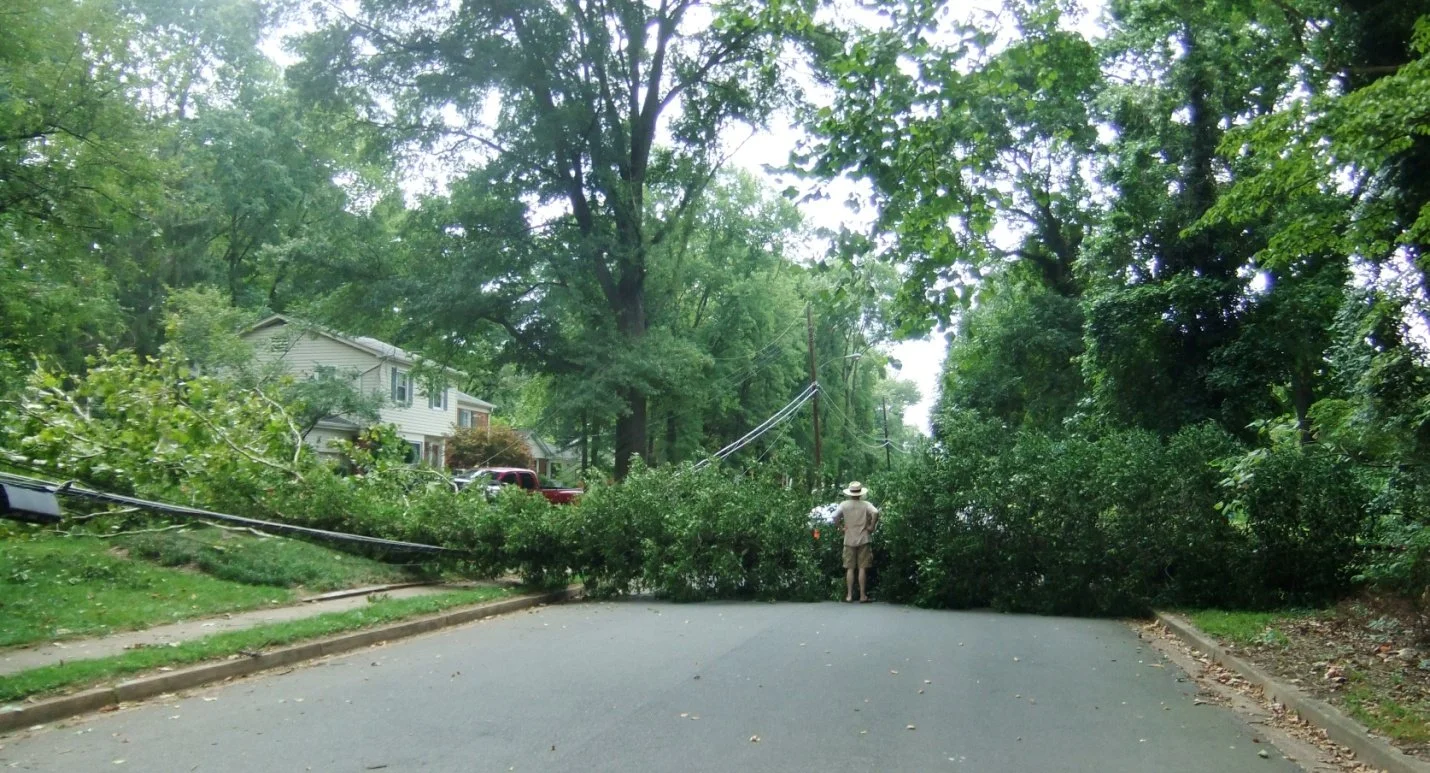
Photo: Ann Hathaway
Margaret Fisher
As community associations around Northern Virginia ramp up their native tree planting efforts, they are looking around to find ways to make it affordable. Burke Centre resident Craig Willett has solved that problem for his neighbors: all they have to do is fill out a simple form to get a free tree. A member of Burke Centre Conservancy’s volunteer Open Space Committee, Craig has organized a system both for private property and for common land. On private land, residents pick up seedlings from Craig’s house and plant them themselves. On common land, the Trustees of the various clusters put in a request, and Craig and his colleagues will install trees or shrubs either to replace ones that have died or to reforest open areas. You can see him pictured here with fellow volunteer Mike Hathaway, in red.
Newly planted tree. Photo: Ann Hathaway
Trees grow slowly, and they also die slowly. Many neighborhoods around Northern Virginia have been losing their canopy coverage, bit by bit, so that once pleasantly shaded yards and streets where neighbors and children could gather are gradually becoming intolerable as our summer temperatures rise. Communities that wish to reverse this trend are most likely to succeed if they build a long-term routine for tree care and tree replacement into their master plans. Where there is no community association, residents will need to step forward to help each other make a plan.
Burke Centre Conservancy obtains its tree seedlings from Fairfax ReLeaf, a non-profit organization of volunteers who plant and preserve native trees on public and common lands in Northern Virginia. Individual landowners may also request seedlings from Fairfax ReLeaf.
Any community in Fairfax County that owns open space may also apply for free trees from the Fairfax Tree Preservation and Planting Fund. It is not necessary to be a 501(c)3 organization to apply as long as the open space is commonly owned. This is a solid funding source for organizations that want to plant either seedlings or larger trees. The application process looks a little intimidating at first glance because of the long list of requirements, but in fact the required steps are all ones that any organization would take anyway when planting trees.
Programs for obtaining free native trees are also available to communities in Arlington and Falls Church. And although not free, there are numerous ways to obtain native trees for a very low price. For example, the Virginia Department of Forestry sells tree and shrub seedlings for $2.00 apiece for orders of ten or more. Our local native plant garden centers all sell medium-sized trees in containers at reasonable prices. Those trees may look a little small when first planted, but they will rapidly catch up to trees that were planted when larger, since older trees suffer more transplant shock. Two wholesalers of larger trees offer their trees at wholesale cost to people who are organizing community plantings. Links to all these programs can be found on the Plant NOVA Trees website.
Since 2018, Burke Centre Conservancy has planted over 600 bare root seedlings, which is in keeping with the nature-centered philosophy of this community with its extensive network of trails through the woods. More details about their process can be found on this web page.
Ivy Kills!
Ivy is an invasive exotic species that destroys trees and natural habitat. Please, do not allow English ivy to grow up trees on your property, and if it has done so, take steps to remove it.
Photo: Betsy Martin
Betsy Martin
One hot August night several years ago, a Sycamore tree fell across the street a block from my house. It took out a pole as well as power, telephone, and cable lines. The street was blocked for a day, and many residents were without power for hours. For some residents, it was days before their services were restored.
Fallen Sycamore, Betsy Martin
Luckily, the tree was relatively young (about 40 years old, according to the tree service) and had not reached its mature size, so it did not fall on a house across the street in which four young children and their mother were sleeping. Because it was late at night, the streets were empty and no one was hurt by the falling tree or the downed power lines.
The tree was not dead or diseased. There was no storm or big wind. According to employees of the tree service, the tree was brought down by the weight of English ivy that had grown almost to the top of the tree. (You can see it in the photo above.)
English ivy destroys trees and creates hazards. Its weight can bring a tree down, as happened in this case. In a storm, the ivy acts as a sail to uproot a tree, and ivy becomes even heavier with water trapped in its dense foliage. Ivy also traps moisture next to the tree’s trunk, and causes disease which creates habitat conducive to rats, and the spread of West Nile virus. It then displaces native plants that benefit wildlife, and creates a food desert—native insects cannot eat it and so birds cannot find caterpillars to feed their young in a forest smothered by ivy.
Ivy is an invasive exotic species that destroys trees and natural habitat.
Please, do not allow English ivy to grow up trees on your property, and if it has done so, take steps to remove it. (See below for guidance on removing ivy from trees.) The beauty of the numerous mature trees in our Northern Virginia neighborhoods depends on your interest in taking care of them.
Preventing ivy from growing up your trees is probably the single most important thing you can do to keep trees healthy—and safe.
If you’re concerned about ivy growing up your trees, first be sure it’s English ivy. Ivy is evergreen (stays green all winter) and has distinctive three-lobed leaves like this:
English Ivy leaf
Removing ivy from trees is simpler than you might think. You can get rid of the ivy in three fairly easy steps:
With big loppers, cut the ivy stems that are growing up the tree trunk. Cut them near the ground. For very thick stems, it may take a hand saw. Be careful not to damage the tree or its bark with the saw.
Next, cut the ivy stems about three feet above the ground. Make sure to cut all the ivy stems—don’t leave any growing up between the ground and the second set of cuts you’ve made.
The last step is to wait. The ivy will die, turn brown, and eventually fall from the tree. Don’t try to pull the ivy down—that is a lot of work, and can be harmful to the tree and dangerous to you, especially if you’re dealing with a large mass of ivy.
Eliminating ivy from around trees is the most helpful action you can take, because even if it is removed from trees, a stand of ivy near trees will eventually grow up. Ivy needs to grow vertically to set seed, and when it does, birds eat the berries and spread new ivy plants far and wide.
In addition to liberating your own mature trees from English ivy and other invasive vines, please consider joining up with other Tree Rescuers as part of the Plant NOVA Trees campaign. (The Tree Rescuers link has lots of good information about what to do about invasive vines, and how you can help your neighborhood preserve its trees.)
So much depends on the preservation of our native tree canopy. Native trees clean the air and water, store carbon, create shade that mitigates intensifying heat, beautify our yards and neighborhoods, and provide critical habitat for birds and other wildlife. It is at least as important to save the native trees we have as to plant new ones.
Native Groundcovers and Trees: The perfect pairing!
Native groundcovers are becoming increasingly popular, for good reason: even if they have minimal time for gardening, people want to use native plants to support our local birds and butterflies.
Photo: Native groundcovers, Margaret Fisher
Plant NoVA Natives
Native groundcovers are becoming increasingly popular, for good reason: even if they have minimal time for gardening, people want to use native plants to support our local birds and butterflies. To avoid invasive non-native groundcovers such as English Ivy, Vinca, Yellow Archangel, and Japanese Pachysandra, they turn to native plants for the same landscaping benefits without the damage to our trees and the rest of the environment.
Equally popular among time-pressed residents are native trees, which are similarly easy to install and which have benefits that far exceed those of any other plants. Not only does the great mass of tree leaves and roots provide food and homes for birds, soak up stormwater, and cool the air, the insects that evolved with native plants are adapted to the chemical make-up of those plants and are able to co-exist peacefully with them. An American Beech tree, for example, is the host plant to 126 species of lepidoptera (butterflies and moths), Hickory to 200 species, Black Cherry around 450 species, and native oaks over 500 species. (The numbers for non-native trees are in the single digits or even zero.)
Over 30 species of locally native plants make excellent groundcovers, with options available for any growing condition. Several are evergreen, and many have the bonus of a month or two of colorful flowers. Some form a tight mat on the ground, while others such as ferns and White Wood Aster provide a taller look. Native sedges provide even more options. Some sedges make a beautiful substitute for the invasive Liriope, some look more like a grass that never needs mowing, and still others sport spiky seed heads that add a touch of quirkiness to the garden. Our local conventional garden centers are starting to carry some of these plants, and many more can be found at native plant garden centers.
Encircling native trees with native groundcovers makes eminent sense. Turf grass does poorly under trees because of the limited light. Trees do not appreciate lawn chemicals, not to mention the risk of injury from lawnmowers and string trimmers. A harmful but common practice, especially in commercial areas, is to pile layer after layer of mulch in a “mulch volcano” around trees and spray it with herbicides to prevent grass and weed growth. Not only does this poison the soil, but mulch that is touching the trunk will rot the bark, and compacted mulch prevents rainwater from reaching the roots. Arborist wood chips, which allow the water to run through, are an improvement over shredded bark mulch if applied properly and can protect the tree as it gets established. But in the long run, why not use nature’s alternative to a toxic mulch bed, which is to allow the fallen leaves to remain in place and add a “green mulch” made up of native plants? The trees and the soil will thank you for it.
Do You Have Room for a Shade Tree?
If your yard sits in the blazing sun in the summer, it may have already occurred to you that a native shade tree would benefit you tremendously. But even if your yard is already graced by one or more mature trees, you should give some serious thought as to whether it is time to start the next generation.
Photo: Margaret Fisher
Plant NoVA Natives
Mt. Vernon Tulip Poplar, Margaret Fisher
If your yard sits in the blazing sun in the summer, it may have already occurred to you that a native shade tree would benefit you tremendously. But even if your yard is already graced by one or more mature trees, you should give some serious thought as to whether it is time to start the next generation. Trees in natural areas can live many hundreds of years, but urban and suburban conditions present stresses that may cause premature decline, a problem that can be seen in many of our older neighborhoods. If you wait until a tree dies, it will be a long time before a seedling can grow to full size. Very likely, the time to plant a replacement is now.
There is an unfortunate tendency to replace tall canopy trees with short ornamentals. This does a disservice to the people who will come after us and who will have to contend with even hotter summers and more torrential downpours than we have now. The larger a tree’s canopy, the more benefits it provides in terms of cooling the environment and controlling stormwater, not to mention sequestering carbon, sheltering birds and other critters, and providing food for the caterpillars that are needed to feed baby birds (which only native trees support in noticeable quantities.)
Shorter native trees and shrubs are appropriate for many situations, such as under a power line or in a small yard. There are specific recommendations on the Plant NOVA Trees website about how far from obstacles to plant your trees and how large a soil area to allow. The roots of trees can overlap, though, so you can plant them as close as fifteen feet apart and within five feet of shrubs.
Trees produce shade, but most canopy trees cannot grow in the shade. (The understory is the space where shorter native trees such as Flowering Dogwood and Redbuds thrive.) It is easy to overestimate the available sun. The number of hours of direct sun per day should be measured when the nearby trees have already leafed out. Good choices for planting under existing shade trees include oaks, American Holly and Black Gum, which will grow slowly but steadily in those conditions then rapidly take off if the overstory lightens up in the future. Native oaks hold the place of honor as the most valuable of trees – the reasons for this are outlined in Doug Tallamy’s most recent book The Nature of Oaks – but any native tree provides major ecological benefits.
There is deep gratification to be had from planting and nurturing a little native tree, even if we ourselves may not be around later to sit under it. How fortunate that George Washington had the foresight to plant the pictured Tulip Poplar that thrives at Mount Vernon today! It is a simple act, easily accomplished. To find out how easily, see the Plant NOVA Trees website.
Millions of Trees at Risk in Northern Virginia? Introducing Tree Rescuers!
Northern Virginia’s oldest and best-loved trees are in danger, and the threat is in plain sight – and yet there are few who can see it.
Photo: Invasive vines enveloping trees, Margaret Fisher
Plant NOVA Trees
Northern Virginia’s oldest and best-loved trees are in danger, and the threat is in plain sight – and yet there are few who can see it.
But help is on the way! Tree Rescuers – a new community education and outreach program – is shining a light on non-native invasive vines, which pose a mortal threat to millions of mature trees in Northern Virginia.
Mature tree enveloped in invasive vines, Margaret Fisher
More than 130 people from neighborhoods across Northern Virginia have already volunteered with Tree Rescuers, a new campaign sponsored by Plant NOVA Trees and aimed at preserving our area’s mature trees.
“We were amazed at how many people were ready to do something like this for the trees but didn’t know how to get started,” said Margaret Fisher, one of the coordinators of Plant NOVA Trees. “This is a great time to start, since the leaves are down and the vines can be seen more easily.”
As many as three million trees in Northern Virginia may be at risk, said Fisher.
Many people are unaware that invasive vines like English Ivy can eventually make a tree hazardous (and expensive to remove). Tree Rescuer’s volunteers learn how to identify problematic vines, then walk their neighborhoods spotting trees that need help.
The Tree Rescuers don’t remove any vines themselves, but they warn landowners by dropping off a brochure explaining the problem and ways to fix it.
Data gathered by Tree Rescuers will also help improve knowledge of the actual number of trees at risk, since the collected data is being aggregated and mapped. A map of neighborhoods surveyed can be viewed here.
Tree Rescuers is part of Plant NOVA Trees, a five-year campaign by local governments and nonprofit organizations to increase tree cover in Northern Virginia. Native trees are a key part of the solution to many community problems, from extreme weather and air and water quality to the health of birds, wildlife, and the Chesapeake Bay.
For more details about Tree Rescuers, or to volunteer, click here.
Landscaping with Nature
In the winter, as you drive across the American Legion Bridge or across many of our creeks, you may be startled to see large numbers of trees with bright white trunks and branches.
Photo: American Sycamore trees, Margaret Fisher
American Sycamore trees, “Ghosts of the Woods,” Margaret Fisher
In the winter, as you drive across the American Legion Bridge or across many of our creeks, you may be startled to see large numbers of trees with bright white trunks and branches. You may worry that climate change has struck and left them bleached. Worry no more: those are American Sycamore trees, sometimes known as the Ghosts of the Woods, whose bark normally peels as the trees get taller, leaving a white and brown pattern that shows best once the leaves have fallen. These congregations of sycamores help us notice that our seventy or so locally native tree species are not randomly distributed throughout the woods but rather are living in natural plant communities. As our region ramps up the Plant NOVA Trees campaign, understanding natural communities can help us design our landscaped environments to better support our local ecosystem.
Sycamores and other trees that live in wet soil can survive there because their roots can tolerate low oxygen conditions. They don't necessarily need a lot of water and can thrive in the low oxygen conditions of many of our dry, compacted lawns. Unlike non-natives, these native trees will provide food for vast numbers of caterpillars and thus for the birds and other critters that eat insects. The contributions of native trees to the food web, combined with the increasing numbers of beautiful species available for sale, are why they are the default choice in all but the harshest of our built environments. Planting any native tree is a very good way to contribute to our region’s effort to expand the tree canopy.
Having said that, though, is it possible for us to do even better by taking plant communities into account? Again, trees are not randomly distributed in the woods, and neither are the birds and other critters that depend on combinations of specific plants. It is not within our power to fully restore the ecosystems which we have destroyed, but we might at least nudge them in the right direction by grouping plant species that would naturally live together on the terrain we have occupied.
If your yard has wet or compacted soil, an American Sycamore could be a great choice. But what if you live on a dry hillside and your soil is not compacted? In that case, you might prefer to choose trees and accompanying understory plants that are more representative of a hillside natural community. For example, Mockernut Hickory, Flowering Dogwood and Maple-leafed Viburnum underplanted with Virginia Creeper and Blue-Stemmed Goldenrod would give you the start of an Acidic Oak-Hickory Forest, a very common plant community around here.
Woodland plant community, Arlington Public Library
Dozens of plant communities have been identified in Northern Virginia, but only a few of them are very common. How can you tell which is most appropriate for your property? This is no easy task, even for experts, not only because it is highly technical but because humans have altered the landscape in many places beyond recognition. However, you might be able to make a reasonable guess based on the elevation of your yard in relation to the nearest creek. You can then look at a plant list for the relevant community and decide which ones you might like to add to your property, given its current light, soil and moisture conditions. Just as in nature, as your trees grow and shade out the understory, sun loving plants will give way to shade tolerant ones, providing future residents with a haven from the heat, far more useful than a sun-scorched lawn in this warming world.
Details about the plant community concept (and about how you can find someone to help you implement it) can be found on the Plant NOVA Natives website. Even if you have no planting plans, if you have a passing familiarity with our native trees and other plants, reading about our natural communities can add to your pleasure as you walk through our woods and notice the patterns.