
NVBA NEWS BLOG
Welcome to the blog for Northern Virginia Bird Alliance, a wealth of resources about northern Virginia birds, wildlife, habitat conservation and restoration, native plants, wildlife-friendly gardening, advocacy and more.
Your Yard Can Help Save Our Streams
Northern Virginia’s stream and river water quality is not great. Although agriculture is the largest contributor by far of nutrient and sediment loads in Virginia’s streams, rivers, and the Chesapeake Bay, urban and suburban stormwater runoff is the second-largest and the fastest-growing contributor to these pollutants.
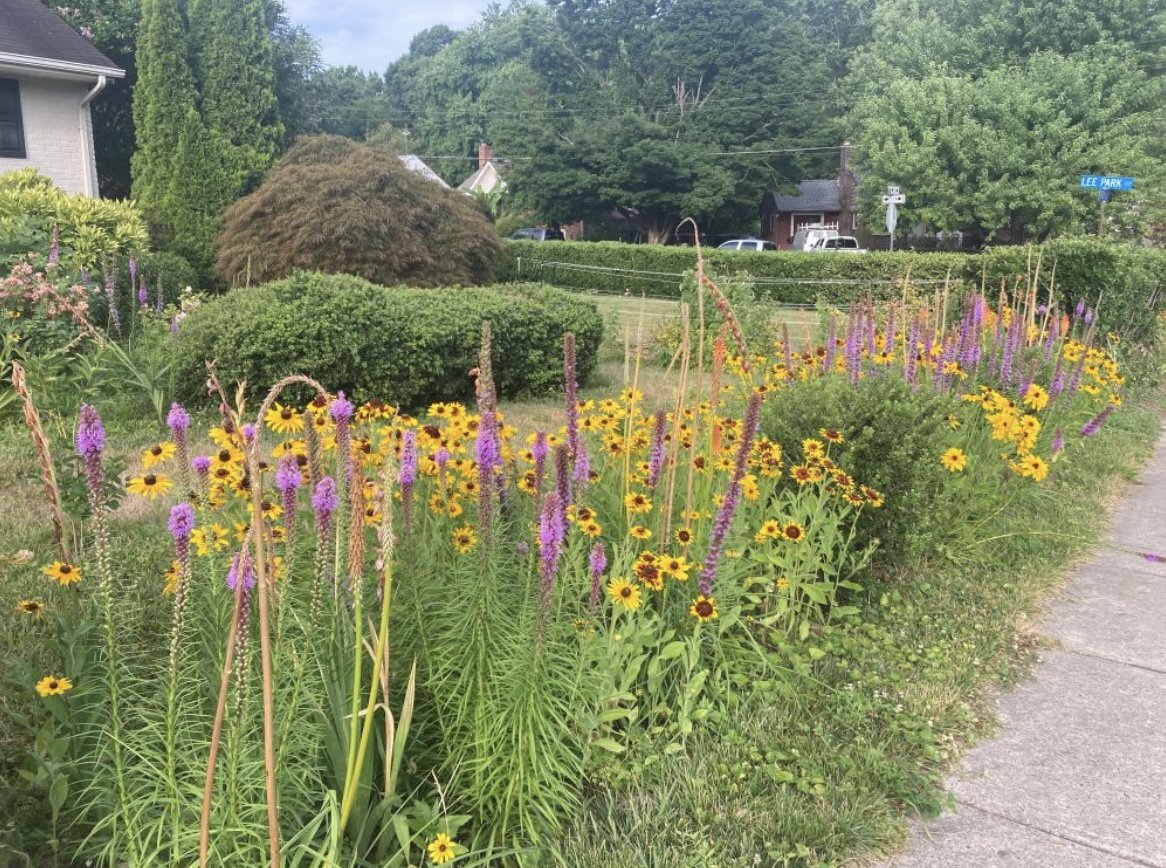
Photo: Dense plantings of native plants capture stormwater, Margaret Fisher
Plant NOVA Natives
Northern Virginia’s stream and river water quality is not great. Although agriculture is the largest contributor by far of nutrient and sediment loads in Virginia’s streams, rivers, and the Chesapeake Bay, urban and suburban stormwater runoff is the second-largest and the fastest-growing contributor of these pollutants.
Consider, for example, the 52-square-mile Accotink Creek watershed in Fairfax. For several years, the U. S. Geological Survey and Fairfax County have partnered to monitor pollutants in 20 watersheds across the County, including Accotink Creek. The good news is that nitrogen levels have generally dropped. But phosphorus concentrations have remained exceptionally high. Why? Because 87% of the Accotink Creek watershed is developed with 27% of the land covered in impervious surfaces. Such intensely developed regions produce large loads of sediment from stormwater runoff, and phosphorus is bound to sediment. Reduce the sediment levels in our local streams, and you will lessen the phosphorus pollution.
Dense plantings of native plants capture stormwater. Photo: Margaret Fisher
Both the Virginia Department of Conservation and Recreation and the Virginia Department of Environmental Quality have announced focused efforts during 2026 to reduce nutrient-based pollutants and sediment loads in our water. By December of 2025 we had met 100% of our sediment reduction targets, which is excellent news. But we met only 80% of the nitrogen and 62% of the phosphorus reduction goals.
This is a compelling call to action for all property owners in northern Virginia. Below are several strategies to reduce nutrient pollution and sediment loads in our waterways.
Plant more native plants, especially where stormwater tends to flow. Their deep roots stabilize the soil and absorb far more harmful nutrients than turfgrass lawns. Notice where stormwater tends to flow on your property along swales or slopes and plant there first.
Plant a street-side garden. Remember the underused strips of your property next to the street or sidewalk. These are ideal spots to add native plants, as their roots will catch stormwater overflow before it hits the pavement. Take care, however, to avoid underground lines, pipes, and overhead wires. And please consider whether your plantings impact people’s access to their cars, mailboxes, or safe crossing to the sidewalk. See Plant NOVA Natives’ comprehensive list of considerations for street-side gardens before you begin to dig.
Use organic compost. Ditching commercial fertilizers and using organic compost is always the best option to enrich the soil. But if you must use fertilizers, choose only phosphorus-free or low-phosphorus brands and use them sparingly.
Pick up pet waste: Nitrogen, phosphorus, bacteria like E. coli and Salmonella, parasites, and ammonia can all be found in pet waste! While pet owners often remember to pick up pet waste in public areas, remember to do so on your own property as well for the sake of our streams and rivers.
Compost and mulch yard waste: Composting and mulching are two strategies that effectively return nutrients to the soil and keep them out of stormwater. Grass clippings should be composted or mulched back into the lawn. Leaves are best left in non-lawn areas, but those that fall on the lawn can also be mulched or raked up and added to your compost pile. Keep lawn debris out of the street and away from storm drains.
Create a rain garden: Rain gardens are landscaped areas constructed to capture and hold stormwater so that it seeps into the soil instead of running off our property. A link to a step by step guide on how to build a rain garden can be found here on the Plant NOVA Natives website.
Use rain barrels: If you can capture water from downspouts and use it later to water your plants, this greatly reduces stormwater runoff caused by our roofs.
Redirect downspouts to vegetated areas rather than paved impervious surfaces: When rain barrels are not an option, try to redirect downspout water flow away from sidewalks and driveways and towards the more vegetated areas of your property.
Reduce impervious surfaces: Replacing asphalt with gravel or permeable pavers will capture and keep more stormwater on your property. But reducing the lawn by converting parts of it to native plant gardens is also highly effective. Turf grass, while green, behaves more like concrete when it comes to water absorption.
Maintain septic systems: Regularly inspect and pump septic systems to prevent nutrient leaching into groundwater.
Wash cars responsibly: Either use a commercial car wash or wash your car on grass to filter soapy water before it enters the ground.
Additional strategies to capture stormwater are discussed here on the Plant NOVA Natives website, along with a discussion of planting and maintaining riparian borders. Finally, here is a link to a Fairfax County Soil and Water Conservation District manual with instructions on how to build and maintain rainwater gardens, green roofs, and more.
The corporate world embraces native plants
Most corporate properties have pretty “standard” landscaping, meaning the plants do very little if anything to support the local ecosystem. More and more, though, we are seeing innovative landscape designs on commercial properties that demonstrate the potential for corporations to be leaders in the effort to save the natural world, starting on their own land.
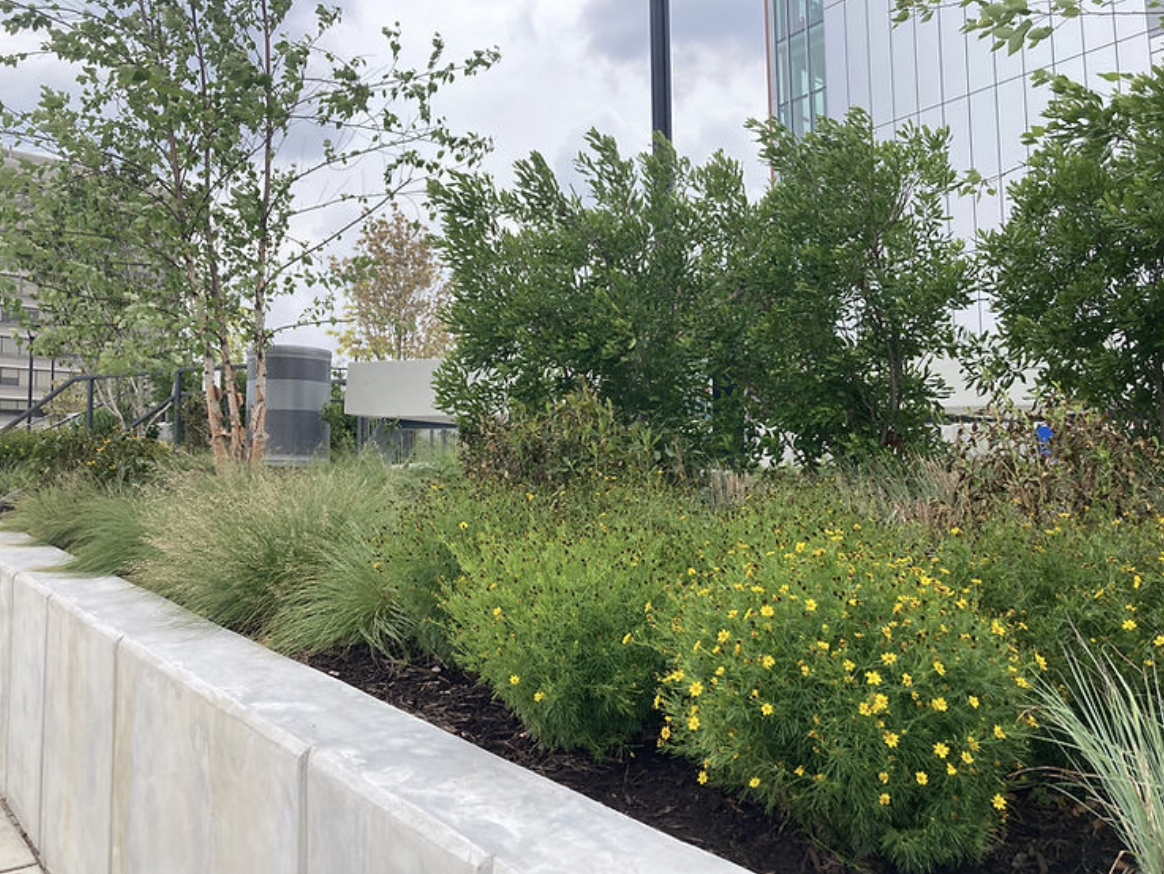
Photo: Corporate landscaping with native plants, Margaret Fisher
Margaret Fisher
Most corporate properties have pretty “standard” landscaping, meaning the plants do very little if anything to support the local ecosystem. More and more, though, we are seeing innovative landscape designs on commercial properties that demonstrate the potential for corporations to be leaders in the effort to save the natural world, starting on their own land. While they are at it, they are creating beautiful and welcoming spaces for their clients and employees.
One example of this approach is the work done at the recently-opened Kaiser Permanente medical centers in Springfield and Woodbridge (Caton Hill). Both properties are richly landscaped with trees, shrubs, grasses and perennials that are almost entirely native to Northern Virginia. The few exceptions are non-invasive.
Native plants at Kaiser Permanente. Photo: Margaret Fisher
Alton Millwood, Director of Planning, Design and Construction at Kaiser Permanente Mid-Atlantic, described the thinking behind the design:
The landscape design at Caton Hill Medical Center focused on allowing the natural environment to be a part of the community’s wellness plan. There is an abundance of research showing that exposure to nature can lower . . . [the] heart rate, alleviate mental distress, speed recovery rates, and even alleviate symptoms of mental disorders. This is why Kaiser Permanente felt it was important to keep natural woodland areas on the project site and invite people into those . . . [spaces] with trails and areas to sit and relax. Additionally, the native plants used on the site help to create a healthier environment by providing food and habitat for birds and other wildlife, conserving water, and reducing noise and pollution associated with mowing. It only made sense that if we were going to involve the natural environment for our own health that we would do what we could to improve the health of the environment.
Another goal of the project was to help the region meet its stormwater goals in order to protect the local streams and the Chesapeake Bay. The planting beds and the meadow roof decrease the amount of runoff from impervious surfaces. Design considerations included using a variety of native plant species to provide four-season interest, using low-maintenance plants that will not require long-term watering, and choosing species that will grow to the appropriate size for their locations so that important sight lines remain open and safe.
The reaction of employees and patients alike has been extremely positive. Millwood reports, “Many members and staff have taken advantage of the outside seating, walked through the Gardens and Health Park to immerse themselves in nature and its healing benefits, and observed the rooftop meadow flowers in full bloom, with birds and pollinators busy in their tasks.”
Asked what would be his advice to other corporations, Millwood replied, “Using sustainable design practices such as planting native plants is good for people and the environment – it is a win-win. For corporations, sustainable design can impact their bottom line, too. Native plants are more likely to live long and thrive in our environment. They require less maintenance, less fertilizer and pesticides, and less water. All this adds up to savings for the owner. Hiring . . . like-minded design professionals can help you create places like Caton Hill Medical Center that help benefit our community and the local ecosystem.”
More photos of this and other corporate or small business landscaping projects can be found on the Commercial Landscaping page on the Plant NOVA Natives website.