NVBA NEWS BLOG
Welcome to the blog for Northern Virginia Bird Alliance, a wealth of resources about northern Virginia birds, wildlife, habitat conservation and restoration, native plants, wildlife-friendly gardening, advocacy and more.
Attracting Pollinators to Upton Hill Park
Starting in 2020, I worked with volunteers to move some of the native plant bounty from my yard into Upton Hill Regional Park, in Arlington. What started as an isolated project has evolved into one element of a larger ASNV program, Stretch Our Parks.
Photo: Pollinator Garden, Musa Murawih
Musa Murawih
Starting in 2020, I worked with volunteers to move some of the native plant bounty from my yard into Upton Hill Regional Park, in Arlington. What started as an isolated project has evolved into one element of a larger ASNV program, Stretch Our Parks. The program brings ASNV together with parks, partners, volunteers, and the communities surrounding the parks to increase valuable native habitat. But let’s back up and review how I got here.
My first memory of connecting with birds was when I was 6 years old. My brother and I were walking among sunt trees (Prickly Acacia, Vachellia nilotica) on the edge of the Diwaimi wadi in the desert of North Kordofan, Sudan. A male of what was likely a Nile Valley Sunbird was feeding on nectar of the abundant yellow flowers, jumping from branch to branch as it sang. It flashed its wings and long tail feathers showing the stunning yellow, green, blue, and other iridescent colors. I was immediately enchanted. When my dad came back from work, I told him I wanted a shirt as pretty as the sunbird!
Birds enchant us for many reasons. It is not just their central role in supporting life on this planet. They are the very embodiment of some of the ideals we cherish most: beauty and freedom.
The sunt trees in the valley were sort of our backyard. I say that only figuratively because our home was a wool tent, and we only stayed there for the summer season, before moving to higher grounds in anticipation of the rain. The birds, the animals, and my community all shared the trees. Our tent was pitched under a group of them for extra shade. Their gum was our candy. We used their fruits to heal ailments or tan animal skins. For us to survive, they needed to survive.
Many years and places have passed since that childhood memory. My home is no longer North Kordofan, but northern Virginia. My camel is a Subaru Forester. The wool tent is a home in suburbia. Yet the basics remain: regardless of where we reside and what passport we carry, we need to share this planet with other creatures, and trees and other plants are front and center in this resource-sharing equation.
The author planting his pollinator garden, Houda Karrar
That is why ASNV, on whose Board I sit, is currently embarking on an exciting endeavor that is close to my heart. The Stretch Our Parks collaborative project is intended to link some of the existing area parks with the neighborhoods and backyards around them. Audubon is working with management, stewards, and neighbors of those parks to improve habitat so that birds and wildlife can also find refuge in our neighborhoods. As an immigrant who came to America seeking refuge, I can certainly relate.
We can all help in this effort, and no help is too small. We can hang a bird feeder in our property or put a birdbath in the yard. We can stop using harmful pesticides on our lawns. We can remove invasives at our homes. We can choose to plant a native tree next time we want to plant one.
My pollinator garden, Musa Murawih
On my end, I removed a three-foot wide strip of lawn along the wall of my townhouse and replaced it with a native pollinator garden. The project was so successful that I did not know what to do with my excess flowers. Then, as I was teaming up with other volunteers to remove invasives at Upton Hill Regional Park, I had a small eureka moment: why don’t I transplant some of my flowers to Upton Hill? So I did. With the help of Upton Hill’s manager Evan McGurrin, Park Steward Jill Barker, my fellow ASNV Board member Joan Haffey, and a team of park volunteers, we cleared three small areas where I began to transplant flowers starting in the fall of 2020.
Cleared area for plantings at Upton Hill Regional Park, Musa Murawih
The beds are now in their third season. My goal is to make these pollinator gardens self-sustaining, and I am hopeful they will be in the next couple of seasons.
The Stretch Our Parks work shows how important it is to see habitat and wildlife as one thing. When I think back about that sunbird childhood memory today, I don’t only see the sunbirds; I also see the row of sunt trees, the habitat that fed and supported them.
The author with Showy Goldenrod in its second season, Jill Barker
ASNV Citizen Science Needs YOU!
As an important part of our citizen science work, we’re looking to establish some baseline bird abundance data for a pair of parks, specifically for Upton Hill Park in Arlington and Four Mile Run Park in Alexandria.
Photo: Camilla Cerea/Audubon
Jerry Touval
As an important part of our citizen science work, we’re looking to establish some baseline bird abundance data for a pair of parks, specifically for Upton Hill Park in Arlington and Four Mile Run Park in Alexandria. We’d like to hold a number of bird walks in those two parks this spring, but we need walk leaders. For Upton Hill, we’d like to enlist bird walk leaders for each weekend in May, and for Four Mile Run we’re looking to have a minimum of one walk per month for April, May and June (and more than one would be better!).
If you’re interested and available to lead any of these walks, we’ve set up a Google sign-up sheet that you can access here, or send a message to Jerry Touval.
Please consider helping out with this important citizen science work!
Migrants at Upton Hill Regional Park
What few people know is that there is a lot of natural habitat at Upton Hill, and that habitat attracts a lot of migratory birds. In that sense, Upton Hill is a microcosm of northern Virginia – we have lots of people and lots of development, but we also have lots of birds, especially in spring and fall.
Photo: Brown Thrasher, Will Stuart/Audubon Photography Awards
Greg Butcher
What is the most popular activity at Upton Hill Regional Park in Arlington? Is it the waterpark? The huge climbing apparatus? Mini-golf? Batting cages?
What few people know is that there is a lot of natural habitat at Upton Hill, and that habitat attracts a lot of migratory birds. In that sense, Upton Hill is a microcosm of northern Virginia – we have lots of people and lots of development, but we also have lots of birds, especially in spring and fall.
Northern Parula, Linda Steele/Audubon Photography Awards
For most people, warblers create the most excitement in spring. Roger Tory Peterson called them “the butterflies of the bird world” because they are small, colorful, and active! In most springs, Upton Hill hosts 30 or 31 species of warblers. If you count Yellow-rumped Warblers (that might spend the winter here), warbler migration has already begun. The next expected species is Palm Warbler, then Louisiana Waterthrush and Northern Parula, all possible in early April. Any of the 31 species can be expected during the first week of May.
Red-eyed Vireo, Greg Pasek/Audubon Photography Awards
Blue-headed Vireo, Doug DeNeve/Audubon Photography Awards
Other highlights of spring migration include vireos, thrushes, and flycatchers. Upton Hill features five species of vireos (including Red-eyed Vireos that stick around to breed), five species of thrushes (including Hermit that spends the winter and Wood that breeds nearby), and six species of flycatchers (all of which breed in our area). Eastern Phoebe is the earliest arrival, during the first week of March. Next is Blue-headed Vireo at the beginning of April. The latest and rarest of the group is Gray-cheeked Thrush that sneaks through in mid-May, heading for the boreal forest of Canada.
Baltimore Oriole, Mark Boyd/Audubon Photography Awards
There are a number of other special migrants to look for at Upton Hill: Baltimore Oriole, Scarlet Tanager, and Rose-breasted Grosbeak. And many birds that breed in our area are easiest to see from late April to late May when they first arrive and sing and display to set up territories and attract mates. Upton Hill has Blue-gray Gnatcatcher and Brown Thrasher as early arrivals. Red-eyed Vireo will arrive in late April and sing all summer long.
Brown Thrasher, Will Stuart/Audubon Photography Awards
Because of the great opportunities to see songbirds during migration, ASNV and Upton Hill Regional Park plan to co-host a birdwalk every weekend in April and May. Watch the listings on our website for more information.
To view a bar chart of the comings and goings of Upton Hill Regional Park, click here.
Partnerships Mean Success—Upton Hill Regional Park
In November 2020, ASNV became part of an Upton Hill Regional Park support team that has worked together to improve both habitat restoration and activities welcoming to underserved groups.
Photo: Lindsay Clark, THINK Global School via Flickr
Joan Haffey
In November 2020, ASNV became part of an Upton Hill Regional Park support team that has worked together to improve both habitat restoration and activities welcoming to underserved groups.
Stag antler rubbing, Joan Haffey
Work by the partnership includes the Black and Latin/Hispanic Bird and Nature Walk series that continues in various forms. In its latest iteration, children from Falls Church’s Culmore Branch of the Boys and Girls Clubs of Greater Washington come repeatedly to the park to learn about nature, meet live animals, and explore the park’s wooded areas. The photo at right shows one of the participants identifying correctly a stag antler rubbing at the park. Partners for this series include NOVA Parks, National Association for the Advancement of Colored People (NAACP)/Arlington, Arlington Regional Master Naturalists (ARMN), and ASNV.
Last spring, Paul Gilbert, NOVA Parks Director, and various Arlington County leaders presided over a public ceremony where volunteer walk leaders and supporters from all partner agencies won NOVA Parks awards for their efforts. In a separate ceremony on December 8, 2022, Paul Gilbert presented a new award to Evan McGurrin, Park Manager, acknowledging the NOVA Parks employee making the most notable contribution to achievement of the agency’s five-year strategic plan. You can read about the partnership and the event here and in a separate article in the Sun Gazette.
Under the able leadership of McGurrin and Jill Barker, ARMN Park Steward, ASNV also participates actively in habitat restoration in the park, with ASNV board members taking part in regular invasive plant removals and donating native plants for the restoration. ASNV also provided the park one of its conservation grants. Other partners in the restoration have included ARMN members and youth from the Church of Jesus Christ of Latter Day Saints, among others.
ASNV has begun discussions with Upton Hill Regional Park to develop even more connections with the surrounding community for projects both within the park and, potentially, on adjoining properties to expand and improve native habitat for the benefit of native birds and other wildlife. We will report regularly on progress in these efforts in the future. Stay tuned!
Volunteers at Upton Hill Regional Park Honored
An urban park with a mini-golf course, a waterpark, and a ropes course might not be the first place you’d visit for birdwatching and nature exploration but if you passed it by, you’d be missing a rare habitat.
This article is a corrected version of one that originally appeared in the November 2021 Potomac Flyer.
An urban park with mini-golf, a waterpark, and ropes course might not be the first place you’d visit for birdwatching but if you passed it by you’d miss a rare habitat.
Upton Hill, a Northern Virginia Regional Park in Arlington, is a gem for nature lovers. The park’s 26 acres encompass a high ridge with hills of mixed woodlands, small meadows, a stream, and wetlands. It’s a miniature ecosystem in the middle of a much larger one – a densely developed neighborhood filled with people of varied races, ethnicities, and ages.
Connecting these two ecosystems is Upton Hill’s challenge and relies on a dedicated cadre of volunteers to achieve this goal. With guidance from Park Manager, Evan McGurrin and Arlington Master Naturalist Park Steward, Jill Barker plus lots of encouragement from the park crew leader, Stewart Miller, park volunteers have made real progress removing masses of invasive plants choking out the native species. They have also welcomed the broader community to explore undeveloped sections of the park through bird and nature walks led by experienced trip leaders.
On October 15, 2021 Northern Virginia Regional Park Authority honored leaders of the Upton Hill Black and Latin/Hispanic Birder and Naturalist Series at the one-year anniversary of this successful program. The series is a partnership between NOVA Parks, Arlington Chapter of the NAACP, Audubon Society of Northern Virginia, and Arlington Master Naturalists. Honorees included Jill Barker, Gabrielle Cantor, Joan Haffey, Melody Starya Mobley, Musa Murawih, and Yolanda Villacampa.
Upton Hill Honorees: Jill Barker, Joan Haffey, Musa Murawih, (Paul A. Gilbert - NOVA Parks Exec. Director,) Melody Starya Mobley. Not pictured – Gabrielle Cantor and Yolanda Villacampa
Two of the honorees, Joan Haffey and Musa Murawih, are ASNV board members. Musa began his volunteer work as a co-leader of the Black and Latin/Hispanic Bird and Nature walks with Melody Starya Mobley and Yolanda Villacampa. At the same time, he joined Joan Haffey, Jill Barker, and many volunteers as they removed invasives. Joan feels that the success of the invasive species pulls put the park ahead of its multi-year plan for habitat restoration and surely influenced NOVA Park’s commitment to significantly fund the next phase of addressing invasives. In spring 2021, ASNV awarded the park a Conservation Grant to continue their habitat restoration work.
Musa also worked with the team to build two pollinator gardens with native wildflower seedlings from his home garden. He’s been tending them and planning to see them through their first few seasons.
Musa Murawih with Native Plant Garden
Joan engaged one of ASNV’s Birdability volunteers to complete a Birdability assessment of the park which is now on the Birdability map. She also assists the bird and nature walk leaders by helping participants use ASNV’s loaner binoculars and guides.
Joan developed a relationship with the Elmwood/Lockwood senior housing complex adjacent to the park that serves primarily Asian-American seniors. With the assistance of a Vietnamese interpreter, she led an enthusiastic walk for residents before shutting down the walk series when the Delta variant of Covid emerged. Upton Hill plans to resume these walks in the future.
Musa and Joan stress that partnerships, especially those with new communities, need care and feeding. “We need to listen and build on areas where our goals and aspirations align while keeping in mind the constraints on our partners and the communities we all serve.” Together with partners, they hope to make Upton Hill Park proof that urban parks can be transformed into natural, native, and biodiverse habitats welcoming to all communities.
Black and Latin/Hispanic Bird and Nature Walks Resume at Upton Hill Park
Northern Virginia Regional Parks and Arlington NAACP have resumed their popular nature walk series.
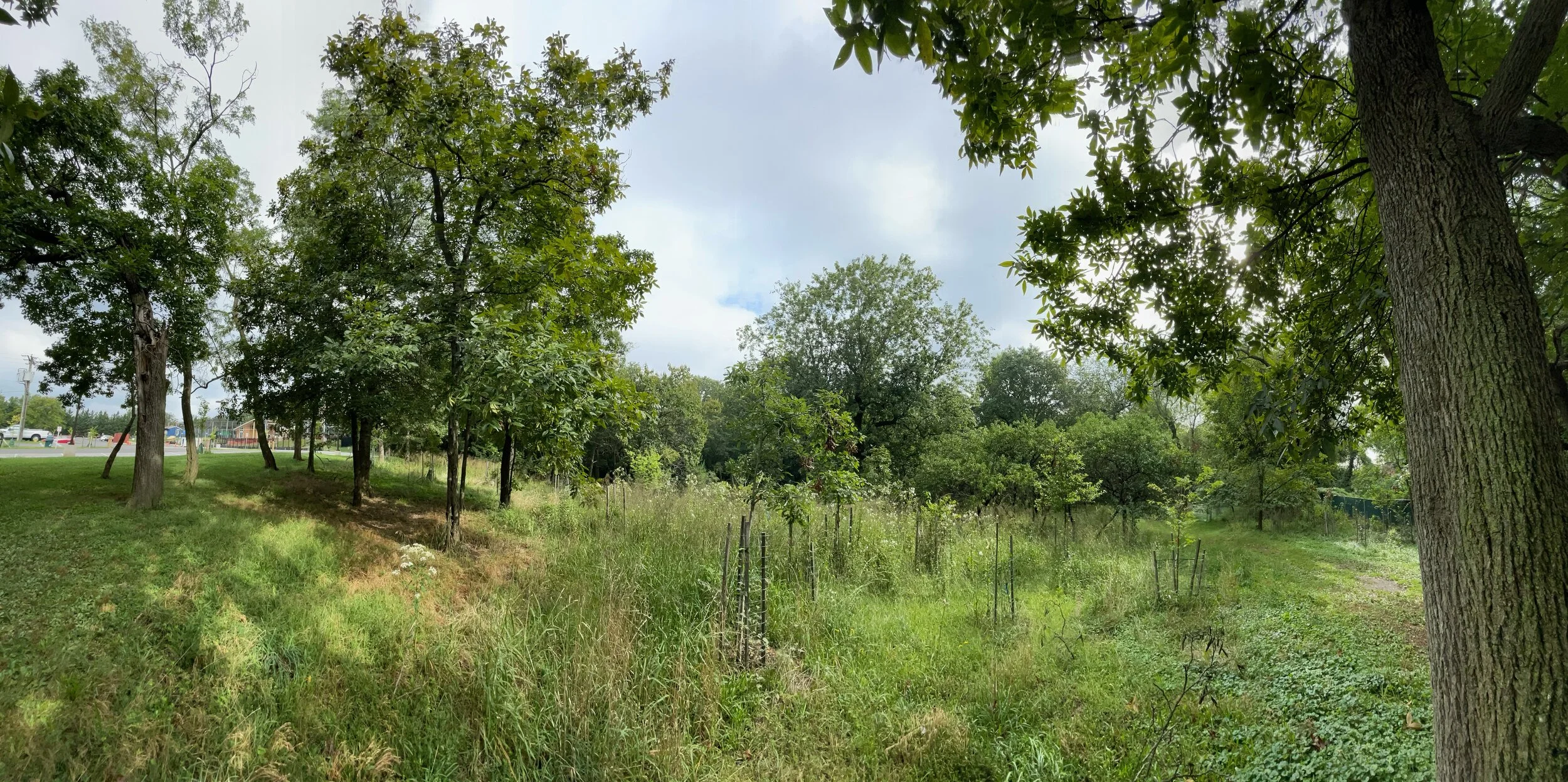
Photo: Upton Hill Restoration Area, Musa Murawih
NOVA Regional Parks and Arlington NAACP
Northern Virginia Regional Parks and Arlington NAACP are resuming their popular nature walk series in September. Audubon Society of Northern Virginia (ASNV) and Arlington Regional Master Naturalists are collaborating with the park to support the walks scheduled for:
Saturday, October 30, Noon
Saturday, November 6, 8:00 – 10:00 AM
See the program flier with registration information in English and Spanish here.
For information visit the park website or call the park: 703-534-3437.