NVBA NEWS BLOG
Welcome to the blog for Northern Virginia Bird Alliance, a wealth of resources about northern Virginia birds, wildlife, habitat conservation and restoration, native plants, wildlife-friendly gardening, advocacy and more.
Memories from the Wildlife Center of Virginia
On January 19th, ASNV is hosting a virtual event featuring Ed Clark of the Wildlife Center of Virginia. He will discuss the Center’s life-saving work and what plans the Center has for the future as it celebrates its 40th anniversary!
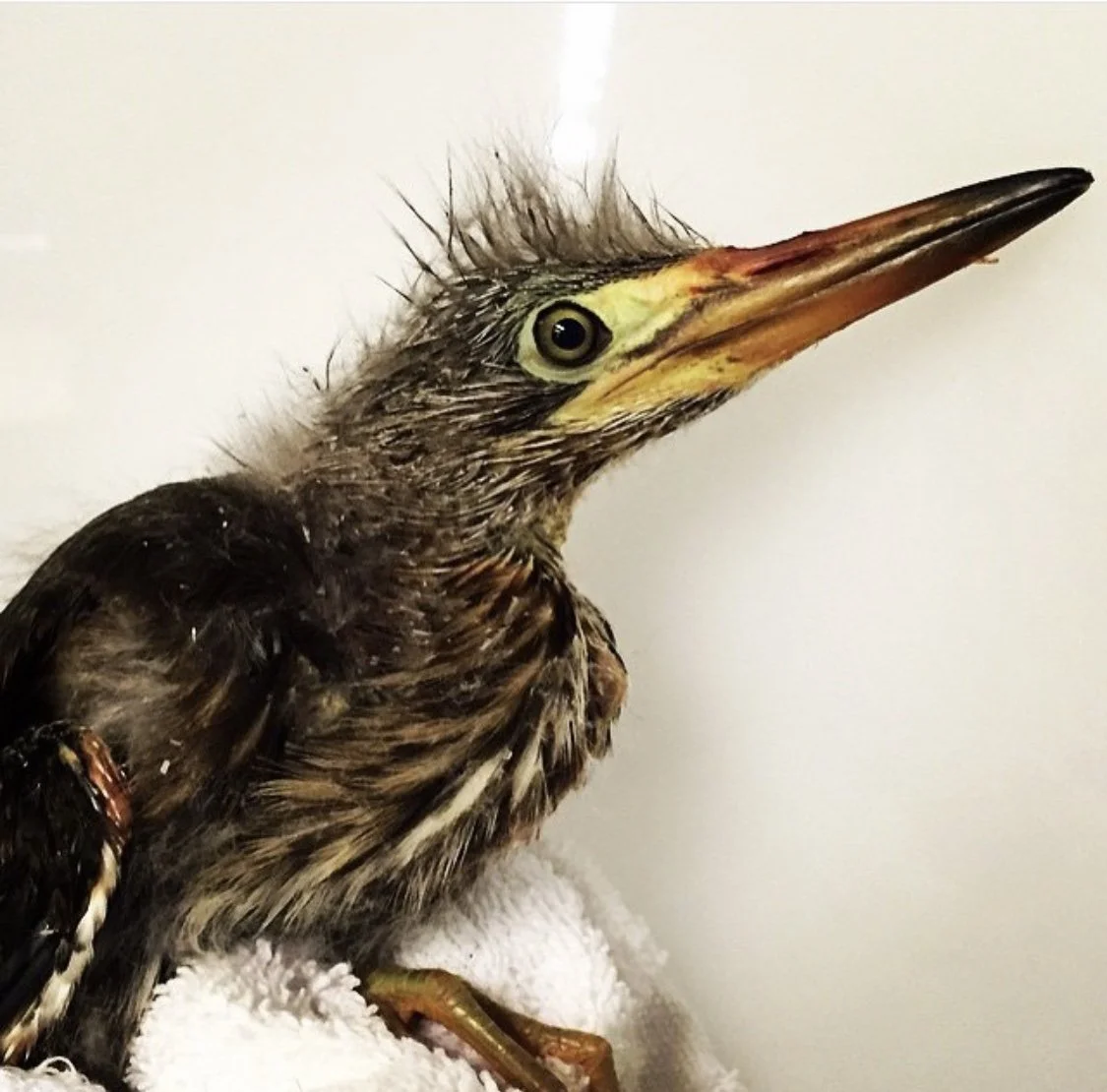
Photo: Fledgling Green Heron, Deidra Bryant
Deidra Bryant
On January 19th, ASNV is hosting a virtual event featuring Ed Clark of the Wildlife Center of Virginia. He will discuss the Center’s life-saving work and what plans the Center has for the future as it celebrates its 40th anniversary! Several years ago, I worked there as a wildlife rehabilitation extern. Notice of the class reminded me how much I enjoyed learning how to help different types of birds--including waterfowl, passerines, and raptors--grow or regain their strength so that they could be released back into the wild.
Fledgling Green Heron, Deidra Bryant
Flight school was probably my favorite feature of the facility. The staff had built long, tall, rectangular pens, and, with veterinarian approval, we would assess raptors for necessary survival skills like stamina (how many passes they could make flying back and forth in the pen), stealth (quietness in flight), landing, perching, flying upwards, and vision. The flight school sessions also help the birds build wing and grip strength. The sessions in the facility pen typically were reserved for owls, vultures, and eagles.
Flight school also included creancing, which was a lot of fun, but also a useful assessment tool and another way for a bird to build back strength. Creancing involves transporting a bird to a large, but secluded, area, attaching leather straps (jesses) to the bird’s lower legs, and then attaching these jesses to a very long line (up to 300 feet in length). The birds are then able to fly in the open for an additional test of their rehabilitation. The activity gives rehabbers a better idea of the bird’s flying ability, and it allows caregivers to see how the patient handles outdoor conditions like open space and wind. Because this activity can be more strenuous than pen exercise, veterinary clearance is essential.
The Center also included swimming pools for waterfowl like loons and ducks. The pools give the birds a chance to practice normal behavior (and do what they like to do), and helps the rehabbers determine if patients are able to swim properly. When the birds are in the water, we can also check them for buoyancy, preening behavior, and, when vegetation is added to the pool, effectiveness at feeding. When I was there, there was one giant pool exclusively for a loon, which it enjoyed zooming around in.
For gulls, geese, and ducks with bumblefoot (a common bacterial infection and inflammatory reaction that occurs on the feet of birds, rodents, and rabbits) we placed special padding on the ground to make walking easier and less painful. In addition to providing for comfort, we needed to create environments in small enclosures that mimicked our patients’ natural habitat. For gulls, geese, and ducks we included small pools in their enclosures so they could swim. There are more examples of enclosure “decorating” in this article, which I wrote for the Center at the end of my externship.
The author with a patient (crow)
We cared for younger birds and birds that required more observation in the Intensive Care Unit (ICU). We usually housed songbirds like robins, bluebirds, mourning doves, and finches there, but the ICU also sometimes included a few larger birds such as crows, like the one I am holding in the photo. The birds’ charts listed their specialized diets and feeding schedules. Each bird’s diet reflected what it would eat in the wild, so our larder included earthworms and mealworms for the insectivores, as well as seeds and a variety of fresh fruit for the non-insectivores. When caring for a few ducklings, we put shredded leafy greens in a large water bowl so that they could feed naturally while splashing around. They were … very … messy.
To feed the baby birds we had to mimic mother birds, feeding the babies with small tweezers or syringes when the patient was too young to feed itself. We also kept records of how much and when the patients ate, and observations on overall condition: Were they lively? perching? playing with toys or enrichment items? Has their body mass increased?
The Center also has ambassadors that do outreach programs. An ambassador paying a visit to a school or other venue usually brings along an ambassador bird, that is, a bird that cannot ever be released in the wild due to medical conditions or imprinting. The ambassador can then talk about the natural history and biology of the ambassador bird while also discussing the Center’s work and what it is able to do thanks to generous donations!
If you have any questions, or are curious about more of the goings on at the Wildlife Center of Virginia, make sure you register for the virtual event on the 19th. Even though I spent time there, I plan to tune in!
Wildlife Rescue
Do you know what to do if you find an injured wild animal? When ASNV receives calls about injured or orphaned birds, we refer the calls to the Wildlife Rescue League.
Photo: Rescued Barred Owlet, Jill Spohn
Jill Spohn
Do you know what to do if you find an injured wild animal? When ASNV receives calls about injured or orphaned birds, we refer the calls to the Wildlife Rescue League (WRL), a non-profit organization operating in Northern Virginia that is dedicated to providing care for sick, injured and orphaned wildlife, with the intent of releasing them back into their native habitat.
Rescued Barred Owlet, Jill Spohn
If you find an animal that you believe is orphaned or in distress, first check WRL’s Animal Help Tips page to help determine whether to call WRL. WRL has a network of partner veterinarians and permitted wildlife rehabilitators, along with other volunteers who answer the helpline (703-440-0800) and transport wildlife. When a call comes into the helpline, a volunteer takes the call and assesses the situation, sometimes providing advice on reuniting orphans with parents or, at other times, locating care for an injured animal or resolving a wildlife conflict. If an animal does need help, the typical first step is to have the caller, often the person who found the animal, transport it to a wildlife veterinarian for assessment.
If the prognosis is good, the helpline volunteer then looks for a rehabilitator that works with that type of animal. The helpline volunteer then arranges for a volunteer transporter to pick up the animal and drive it to the available rehabilitator. Rehabilitators are permitted by the Virginia Department of Wildlife Resources. There are various categories of permits, including for apprentices and care providers. It typically takes years to become trained and permitted at the highest level. Rehabilitators are not funded in any way by the state, but do accept donations. A volunteer transporter does not need an individual permit but has to operate under the authority of a permitted organization or hospital.
I am a volunteer Ambassador with the ASNV’s Audubon at Home Program, and I also volunteer with WRL as a transporter. Another organization in the area that I work with is Animal Education and Rescue Organization (AERO), founded by Olivia LoBalbo. In cases where someone who has found an animal needs assistance in capturing it for transport, I have worked with Mark Khosravi with the K2C Wildlife Encounters organization. There also are several specialized wildlife centers in Virginia. The closest one to Northern Virginia is the Blue Ridge Wildlife Center in Boyce, VA, a wildlife teaching hospital.
A spoiler alert here: for those of you who despise Snapping Turtles (Chelydra serpentina) because they sometimes eat ducklings (as do raptors), I suggest you read no further. If you are willing to accept that these fearsome turtles are part of our natural environment in Northern Virginia and want to know what a volunteer transporter does, please read on.
During a recent WRL transport shift, I took a snapper from the Blue Ridge Wildlife Center to where it had been found, along Russell Road on the Quantico Marine Corp Base (QMCB). The entire operation took almost six hours. The Wildlife Center veterinarian put the turtle’s large box into my car and pointed out the release location written on top. All turtles must be released where they were found. I could read some of the words, but not all. I asked how to release the turtle, ever mindful of the snapper’s big, powerful bite. The veterinarian suggested tilting the box slowly and letting the turtle adjust. She assured me that when the turtle saw freedom it would move in that direction and not turn around to bite me!
After driving 170 miles through several hair-raising thunderstorm cells, I arrived with the turtle at the QMBC commissary gate. After giving up my driver’s license, returning to the visitor center for a pass and back to the gate again, it was finally time to release the turtle—but where? QMBC is huge. I asked for hints on the release location, and the guards deciphered the words on the box as the Raymond Davis Center (RDC). Although they were in charge of security, they did not ask me to open the box so they could verify its contents. They, too, were aware of the snapper’s reputation.
There was no water body to be seen at the RDC parking lot, but I saw a large body of water south of Russell Road and headed that way. I parked near an embankment leading towards the water. Thankful the rain had stopped, boxed turtle in hand, I walked several hundred yards on a gravel path to find a flat, happy-snapper spot only 20 yards from water. I put on my elbow-length, leather gloves even though the veterinarian assured me my cargo would just break for the water. And it did! Mission accomplished. You can see the evidence from the photos: turtle in the box, turtle on the ground.
Rescued Snapping Turtle, Jill Spohn
Rescued Snapping Turtle released, Jill Spohn
Transporting the Snapping Turtle is just one of my most recent missions. Over the last few years, I have also transported a heron, owls, hawks, osprey, a vulture, crows, many passerines, box turtles, a red-bellied turtle, many snakes, many squirrels, a chipmunk, rabbits, raccoons, and even mice.
I find volunteering to assist injured wildlife very rewarding. I have met wonderful people who give their time, energy, and financial resources to provide wildlife a second chance within our shared habitats and dwindling natural areas. If you are interested in volunteering or donating, please go to https://www.wildliferescueleague.org/ or https://aeroanimalrescue.org/.