
NVBA NEWS BLOG
Welcome to the blog for Northern Virginia Bird Alliance, a wealth of resources about northern Virginia birds, wildlife, habitat conservation and restoration, native plants, wildlife-friendly gardening, advocacy and more.
Plant the Slant: Tips for Gardening on Slopes
Depending on its position and angle, planting a slope isn’t always easy. But the rewards can be considerable.
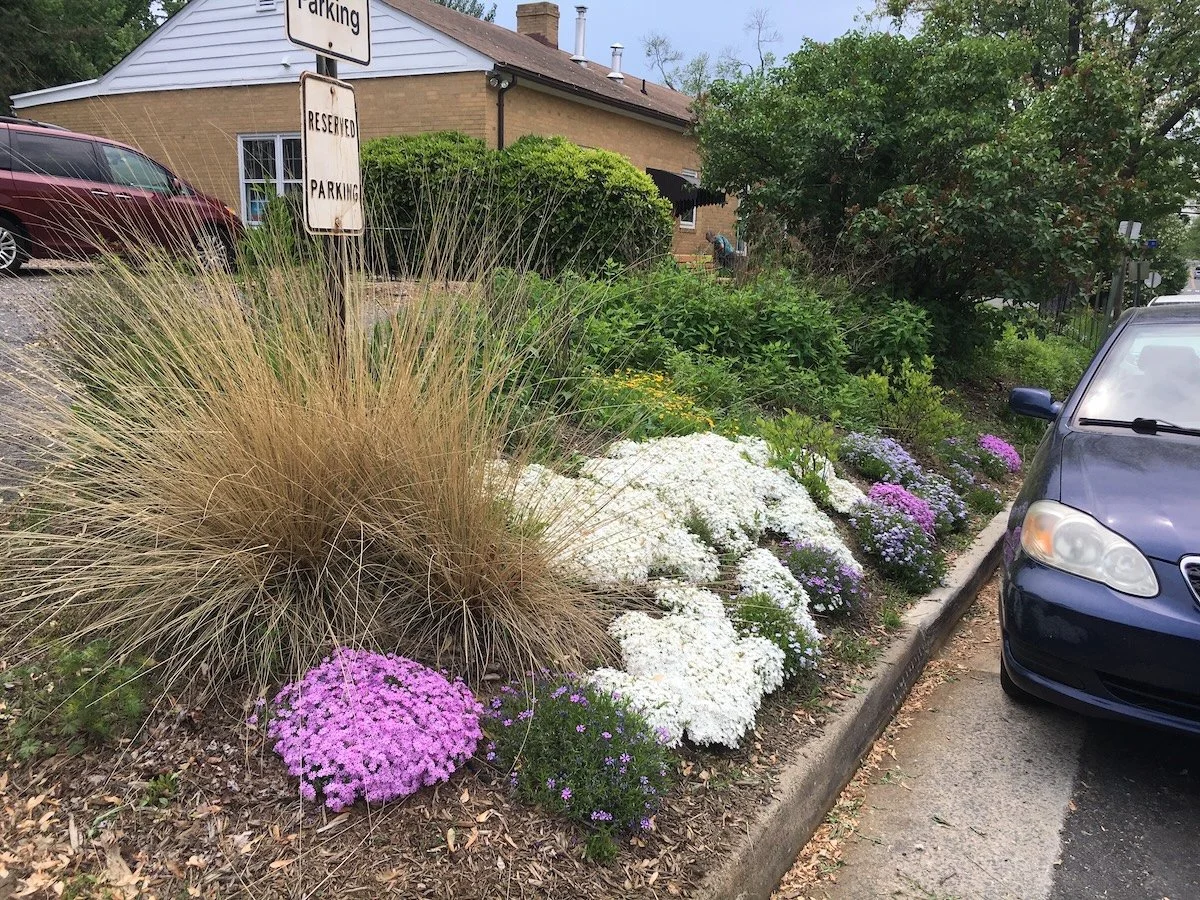
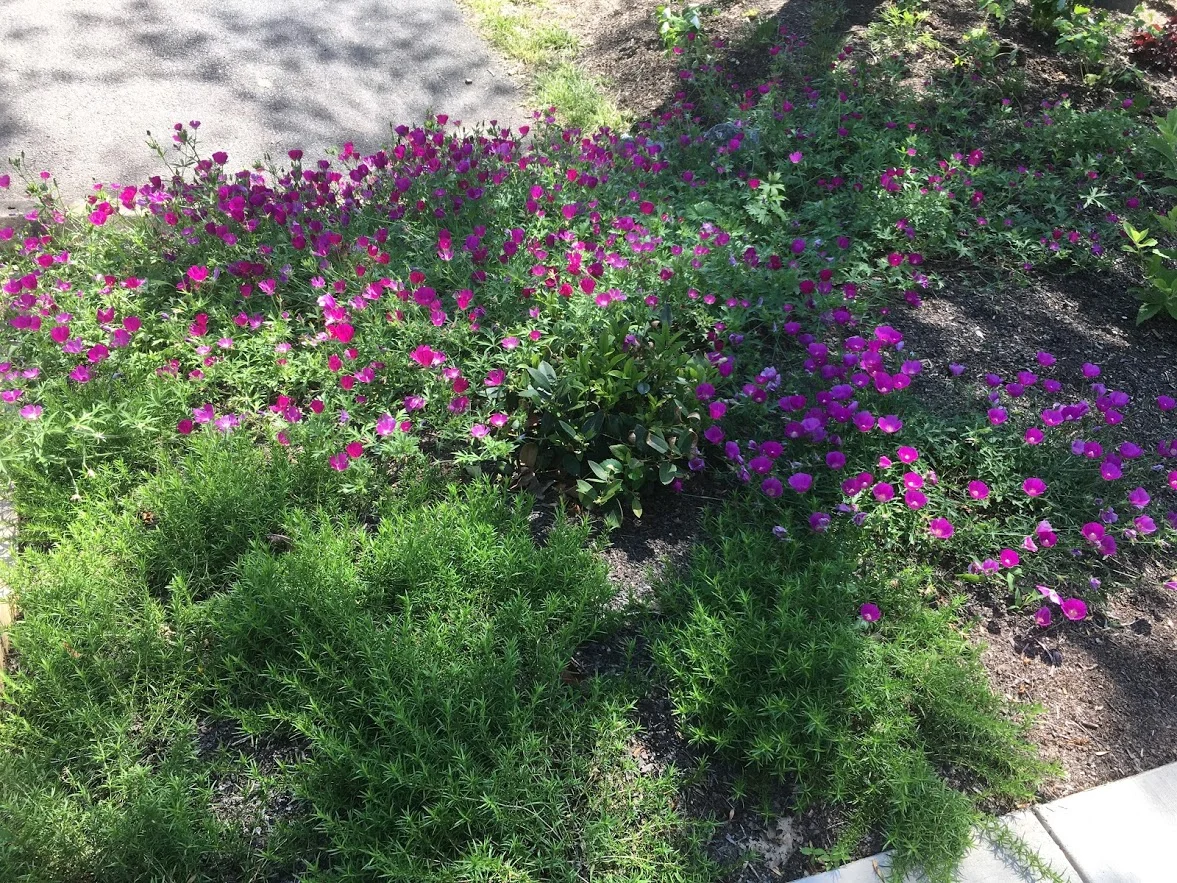
Photo: Creeping Phlox, Margaret Fisher
Eileen Ellsworth
Depending on its position and angle, planting a slope isn’t always easy. But the rewards can be considerable. When your work is done and your slope face is filled with new, colorful, water-absorbing, soil-retaining natives, it’s a tremendous feeling of pride and accomplishment. Your garden will display like a picture on a wall.
Erosion is, of course, the main issue. There’s no such thing as a “one-size-fits-all” plan for slope gardening. Slope contours, angles, sun exposure, water flow, and soil health all differ. And for sharply angled slopes, landscape engineering strategies like check dams and terracing may be necessary for erosion control. But for most slopes, native plants are all that are needed. Their deep and extensive root systems interrupt the chain of events that causes erosion, and, once established, they attract local wildlife to boot.
Creeping Phlox (Phlox subulata) planted on a slope. Photo: Margaret Fisher
Remember there is no need to tackle the entire slope at once. Get started on just one section and see how it goes with these steps:
Identify the existing native trees, shrubs, and plants on your slope, and leave them be. Use iNaturalist, Picture This, or some other tool to help you. You will plant around and between them, which is helpful. Their existing structure offers a frame to fill, and their shade will help the new plants establish themselves and better survive the summer heat.
Identify the non-natives and remove them, then amend the soil with some compost and perhaps new topsoil depending on the extent of erosion.
Purchase new native plants. For best results, choose plants that spread quickly, have broad leaves to catch the rain, and a strong winter presence. Also, slopes are drier than flat plots because of their drainage, and moisture down a slope occurs at a gradient. They tend to be drier at the top and moister towards the bottom, so consider some drought-tolerant plants in your purchase.
Plant everything and then mulch. While mulching is never ideal in that it tamps down native plant spread as well as weeds, natives take their time getting established. First year they “sleep,” next year they “creep,” and the third year they “leap.” Mulch will help protect your plants until they “leap” sufficiently to cover the ground and grip the soil.
Water your plants frequently, especially in July and August. They won’t make it through the first year without enough water. A soaker hose is one way to keep the water from just running off.
As the season progresses, revisit your plan. Perhaps add duplicates of plants in early autumn that did especially well.
Here are some additional resources for your consideration:
The Northern Virginia Soil and Water Conservation District provides an excellent list of erosion control plants.
Plant NOVA Natives has a webpage dedicated to erosion control and suggested plants here.
Request a free site visit from NVBA’s Wildlife Sanctuary Program and ask for suggestions.

Protect The Wildlife You Attract
Elements of the landscape may pose serious hazards to the very wildlife that we’ve attracted. Are we drawing them closer, only to have them harmed by an avoidable threat to their health and wellbeing?
Photo: Northern Cardinals, Donald Wuori/Audubon Photography Awards
By Plant NOVA Natives
Market demand for native plants in our region has clearly risen in the past ten years. This is a very positive trend, fueled by an increased awareness of the benefits that native plants offer. It is also a sheer delight to see wildlife respond to our efforts, enjoying the food and shelter that a healthier environment offers.
However, a word of caution is in order. Elements of the landscape may pose serious hazards to the very wildlife that we’ve attracted. Are we drawing them closer, only to have them harmed by an avoidable threat to their health and wellbeing? In some cases, the answer is clearly yes. Here are some suggestions for identifying and addressing some of the more common threats.
Cats: The biggest threat to birds is habitat loss, but the second biggest is domestic cats. When allowed outdoors, they devastate populations of birds - an estimated 2.4 billion are killed by cats every year in the United States alone. But they also kill other small critters such as frogs, voles, and lizards. Domestic cats are an introduced species that have no place in our landscape.
Window strikes: The American Bird Conservancy estimates that window collisions kill up to 1 billion birds each year. The victims are not limited to migratory species striking large glass buildings in cities. They include our local backyard birds as they fly back and forth. The American Bird Conservancy has tested some inexpensive deterrents and discusses them on their website. One featured example is “Feather Friendly”® decals, adhesive dots that make the glass more visible to birds. Note that whatever product you choose, it is better to apply it to the exterior of the window. Internally-installed products are less effective when reflections on the glass are strong.
Outdoor lighting: Bright outdoor lighting is a life-threatening hazard to birds that migrate at night, disorienting them and disrupting their sense of direction to the point of exhaustion and death. Outdoor lighting also devastates fireflies, moths, and other nocturnal animals. As much as possible, turn off outdoor lighting, especially during peak migration periods (March 1 to June 15 and August 15 to November 30). Before 11 pm, turn off any lighting that may be directed upward, or at least consider adding a down-shield. Swap out light bulbs for warm spectrum LED (3000 K or less) to make them less attractive to insects.
Mosquito spraying: It is impossible to spray for mosquitoes without killing other insects as well, including bees, butterflies, caterpillars, ladybugs, and dragonflies. The residual effects of the pesticide will last for weeks, yet the intended effect is rather short lived, as mosquitoes can fly up to 2 miles and quickly repopulate the treated areas. Several less harmful tactics can keep them at bay. Mosquitoes are weak fliers, so turn on an electric fan on your deck to blow them away. Use mosquito repellents such as DEET. Most importantly, search your property for places that accumulate water where mosquitoes can breed, such as buckets, toys, downspouts, or the saucers under plant pots.
Rat poison: Rat poison is designed to smell and taste good to mice and rats, but it can be just as appealing to other mammals as well. Even if placed inside, the poison can be carried outside by the mice and rats to where other wild animals can find it. But most cases of wildlife poisoning do not occur from direct consumption. Rather, poisoning occurs secondarily when a raptor eats a poisoned animal. The poison then accumulates in the raptor’s body, leading to the same kind of slow and agonizing death for the bird as it does for the mammal. More environmentally-friendly ways to keep rats and mice out of your home include sealing all entry points, securing food resources such as birdseed, pet food, and trash, making sure rodent nesting materials such as shredded paper or fabric are not available, or adding nest boxes for raptors to attract them to your yard. One barn owl can consume a thousand mice in a year, and that is a conservative estimate.
Nandina berries: Nandina is native to eastern Asia but has been a landscaping favorite across our region for a long time, mostly due to the profuse red berries it produces in late fall that persist through winter. Nandina berries, however, contain cyanide and other alkaloids that are deadly to birds when consumed in large volumes. There are many beautiful native substitutes for the invasive nandina, such as Winterberry and Red Chokeberry.
The NVBA website has more details on avoiding these and other human-made hazards.
As always, awareness is everything. When viewed more holistically, native plants are one piece in the larger puzzle of ecosystem restoration. Other factors complete the picture, including soil health, animals, favorable climate conditions, and fewer environmental risks, with each piece interdependent upon the other.
Dominion Grants to Beautify Neighborhood Entrances with Native Plants
Audubon at Home partnered with Plant NOVA Natives to invite homeowners’ and civic associations to apply for funds to beautify their neighborhood entrances using low maintenance native plants.
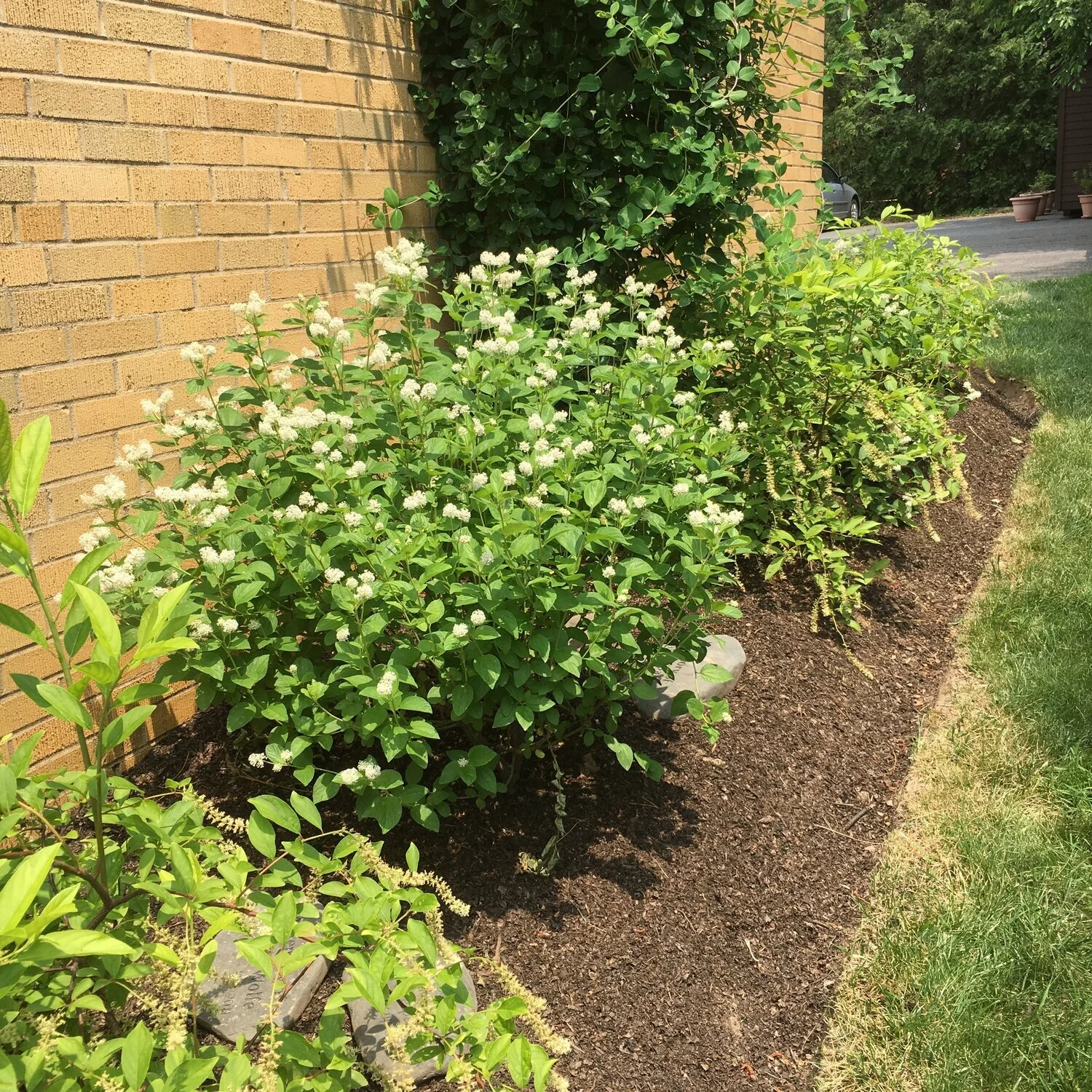
Photo: Margaret Fisher
Audubon at Home partnered with Plant NOVA Natives to invite homeowners’ and civic associations to apply for funds to beautify their neighborhood entrances using low maintenance native plants. The mini-grant program was funded by Dominion Energy Charitable Foundation’s Environmental Education and Stewardship Grants Program.

AAH and Plant NOVA Natives received applications from 35 community associations and made their decisions based on the number of residents, ability to communicate with those residents, and the visibility of their new plantings. Six matching grants of $2,350 apiece were awarded to Auburn Village Condo in Arlington, Park Glen Heights HOA in Annandale, Civic Association of Hollin Hills in Alexandria, Water’s Edge at Fair Lakes HOA in Fairfax, Cascades Community Association in Loudoun, and Dominion Valley Owner’s Association in Prince William.
Congratulations to the winners! We look forward to working with you to design a low-maintenance, wildlife-friendly, and beautifully landscaped entrance planting. Completed installations will receive a high-quality sign that says, “Native plants support birds and other wildlife.”
The funds will go toward costs of a landscape designer to create a design and recommend native plants; purchasing and installing the plants; and removal of any invasive plants such as English ivy, Japanese Barberry, Periwinkle, etc. Each community is responsible for matching funds and/or sweat equity to cover the remaining costs. Additionally, the communities are expected to conduct educational outreach with their residents on the habitat value of native plants, and commit to maintaining the plantings for five years.
We were heartened by the number of neighborhood associations responding to our invitation to apply for funds to support their entrance beautification projects. And, we hope those who did not win a mini-grant will continue their efforts by inviting an Audubon at Home Ambassador to visit the site and provide advice on suitable, low maintenance native plantings. Residents of Arlington/Alexandria, Fairfax, Fauquier, Loudoun, Prince William, and Rappahannock counties may submit a consultation request here.
Hosting Cavity Nesting Birds in your Yard
Encouraging cavity nesting birds in suburban yards requires knowledge of birds and insects and how to support them. Larry Cartwright shared his knowledge with AAH Ambassadors in February.
Annual Audubon At Home Ambassador’s Brunch features Larry Cartwright

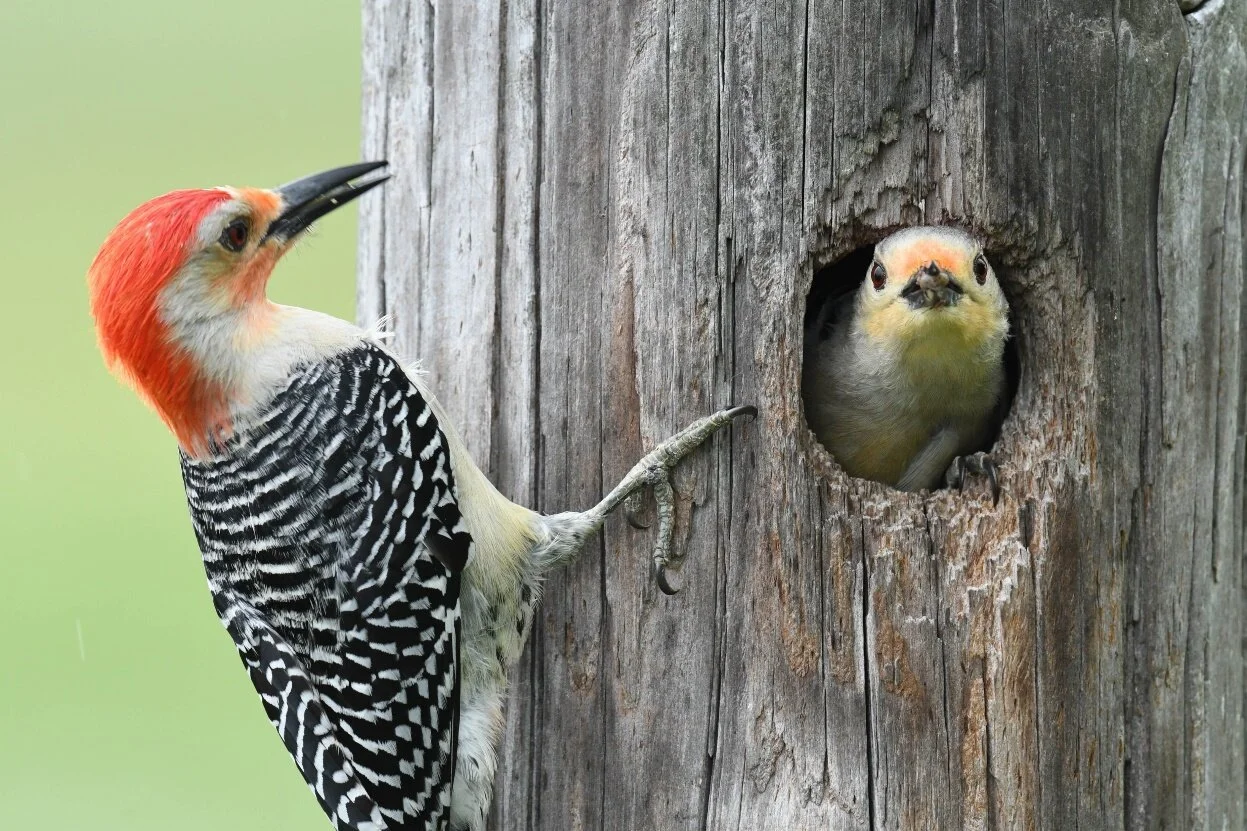
Red-bellied Woodpeckers, Larry Cartwright
Encouraging cavity nesting birds in suburban yards requires knowledge of birds and insects and how to support them. Audubon at Home Ambassadors invited Larry Cartwright to share his expertise on February 20th at their Annual Brunch. AAH Ambassadors are a trained group of volunteers who make personal visits within our region to anyone who asks for advice about how to make their property more wildlife friendly.
Although Larry Cartwright was formally trained in Russian history, he has been a nature lover most of his life, with a special fondness for birds and bats. In addition, he is the compiler for the DC Christmas Bird Count, ASNV’s Winter Waterfowl Count, the Dyke Marsh Breeding Bird Survey and the Huntley Meadows Eastern Bluebird Nest Box Program. At home, he uses his own suburban yard as a case study in how to transform property to attract nesting birds and other wildlife. Among the lessons he’s learned:
Avoid manicured monocultures in open spaces by planting a diversity of native plants that attract insects which in turn will attract birds. Reducing the use of pesticides is essential to encouraging a heathy balance of plants, insects and birds.

Native Plantings, Larry Cartwright
Don’t be Overly Tidy and instead, leave the leaves and dead plants for winter foraging, shelter and spring nesting materials. Adding a water source and a brush pile will attract even more birds. Sometimes neighbors or HOAs complain about naturalized landscapes they perceive as unkept. Larry’s solution is to plant colorful flowers, like Zinnias facing the street and talk with his neighbors about the purpose of his yard – to improve habitat. Loss of habitat is the most serious threat facing birds today.

Couded Sulpher with Zinnia, Larry Cartwright
Snags are essential to a healthy habitat. A snag is a dead tree or dead parts of an upright living tree. They are used by cavity nesting birds and many other animals such as Raccoons, Flying Squirrels and Big Brown Bats. Snags also attract insects, mosses and fungi when they decompose. Taller snags are especially useful to raptors such as Red-tailed Hawks as look-outs for prey and to attract potential mates.
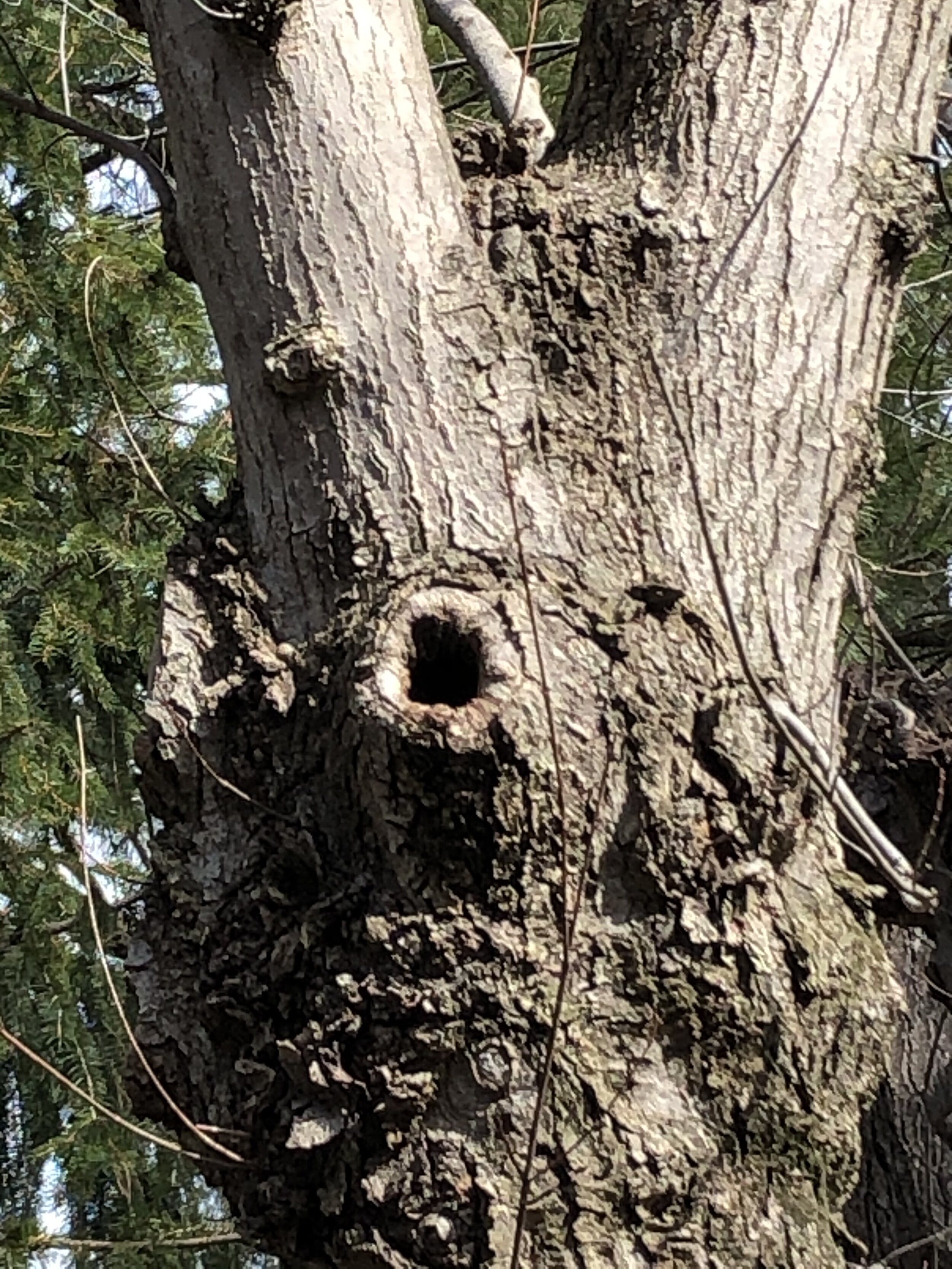
Cavities, Larry Cartwright
Learn how to maintain snags by only removing them if they threaten homes or harbor a disease or infestation that could spread. If they do fall to the ground in a wooded area they will return nutrients to the soil which aids the growth of new plants. Even if you must remove a dead tree, you can leave the stump for ground foraging cavity nesters like Pileated Woodpeckers and Northern Flickers. Larry recommends having at least 3 snags per acre.
Understand the two groups of cavity nesting birds. In the U.S. and Canada there are over 85 avian species that use cavities for food, shelter and nesting and 25 of them can be found in Northern Virginia.
Primary cavity nesters, including all woodpeckers, excavate their own cavities. Some smaller birds such as Carolina Chickadees and White-breasted Nuthatches can enlarge existing holes if the wood is rotten enough.

Pileated Woodpeckers, Larry Cartwright
Secondary cavity nesters do not excavate their own cavities but rely on broken off limbs or those created by other birds. Larry’s backyard favorites are the Great Crested Flycatchers who use dried plant material and snakeskins in their nests. The snakeskins are probably used to deter predators. Barred Owls have found homes in his neighborhood too, but not Eastern Screech-Owls even though they are also secondary cavity nesters. Wood Ducks and Hooded Mergansers use cavities but they need to live near water. Another cavity nester that prefers water is the Prothonotary Warbler. They nest along the Potomac, larger tributaries and inland marshes. Other species you might attract if you have enough open space are Eastern Bluebirds and Tree Swallows.

Great Crested Flycatcher, Gary Rasmussen/Audubon Photography Awards
Using nest boxes to attract birds requires the right habitat. Most residential areas do not offer enough foraging areas for birds that need open spaces and often there is severe competition from introduced species like House Sparrows. Larry’s yard does not have enough open space for blue birds and swallows but he does host nesting House Wrens and Mason Bees.
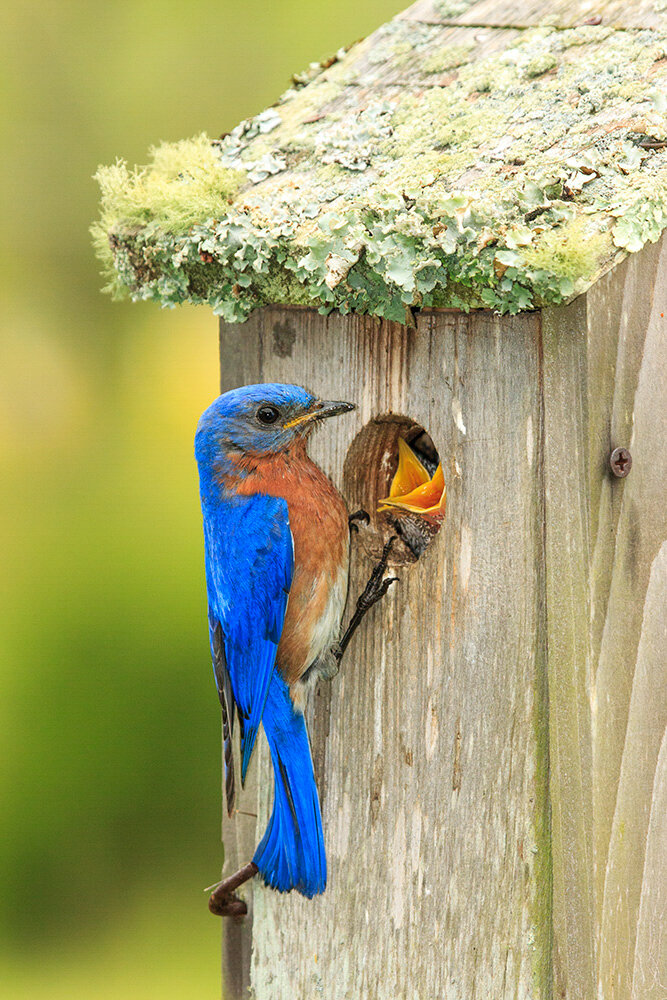
Eastern Bluebird, Hazel Erikson/Audubon Photography Awards
Be aware of what your habitat will support and the challenges for you and the birds. Northern Virginia is a rich home for numerous cavity nesting birds but it is also overrun with non-native plants like Porcelain Berry and English Ivy that degrade habitat. Learning about these invasive plants and removing them is an ongoing effort in Larry’s yard.
After habitat loss, the 2nd most serious threat to birds is free-roaming cats which kill about 2.4 billion birds per year in the U.S. Discussing your concerns with neighbors is a good beginning.
The effect of deer browsing on tree seedlings has degraded our woodlands. If seedlings do not grow then there will be no replacement oaks and other large trees to support cavity nesters in the future.
Read more about Larry’s talk and the value of dead wood in this article by Glenda Booth.
Do you want to make your yard more wildlife friendly and attract to cavity-nesting birds? Visit our Audubon at Home page and request a consultation with an Ambassador.

Audubon at Home Invites Grant Applications
We are very pleased to announce that ASNV’s Audubon at Home Program, in partnership with the Plant NOVA Natives campaign, has been awarded a grant of $15,000 to demonstrate the concept that native plantsan fit nicely into a conventional suburban aesthetic.
Photo: Native Plantings, Margaret Fisher
We are very pleased to announce that ASNV’s Audubon at Home Program, in partnership with the Plant NOVA Natives campaign, has been awarded a grant of $15,000 from the Environmental Education and Stewardship Grants Program of the Dominion Energy Charitable Foundation to demonstrate the concept that native plants, so critical to wildlife habitat, can fit nicely into a conventional suburban aesthetic, including formal or semi-formal settings.
The Audubon at Home program invites homeowners’ and civic associations to apply for funds to beautify their neighborhood entrances using low maintenance native plants. Six one-to-one matching grants of $2,350 apiece will be given to cover costs of a landscape designer to create a design and recommend native plants, prepare the site including removing any invasive plants present such as English Ivy, Periwinkle, and others, purchase and install the plants. The terms of the grant will require matching funds or sweat equity from the applicant. Funds will be granted contingent on the community association conducting educational outreach on the value of native plants to their residents. Completed installations will receive a high-quality sign that says, “Native plants support birds and other wildlife.” Community associations are expected to commit to maintaining the plantings for 5 years.
Applications are due May 31, 2021. Click here for more information and to apply.
Do you live in a community that would benefit from these funds? You are welcome to pass this information along. Questions? Contact Audubon at Home.

Where Do They Go?
Have you ever wondered where animals go in the winter, when many seem to just—disappear?
Photo: Blackpoll Warbler, Owen Deutsch/Audubon Photography Awards
Betsy Martin
Have you ever wondered where animals go in the winter, when many seem to just—disappear?
The ancients puzzled over the disappearance and reappearance of birds. Aristotle thought they transform into other species in winter (which explained why robins appeared just as redstarts disappeared in Greece). Olaus Magnus theorized in the 16th century that swallows bury themselves in clay at the bottom of rivers in wintertime. In the 17th century, Charles Morton offered the most fantastic theory of all; birds flew to the moon and back every year.
Of course, now we know that migration on earth accounts for the disappearance and reappearance of birds and many other species. But you may be surprised to learn that there’s still a lot we don’t know about where various species go.
Blackpoll Warblers (Setophaga striata) spend the summer breeding in the boreal spruce and tamarack forests of Alaska and northern Canada, then in fall migrate up to 5000 miles south to winter in the mangrove forests and rain forests of Brazil.
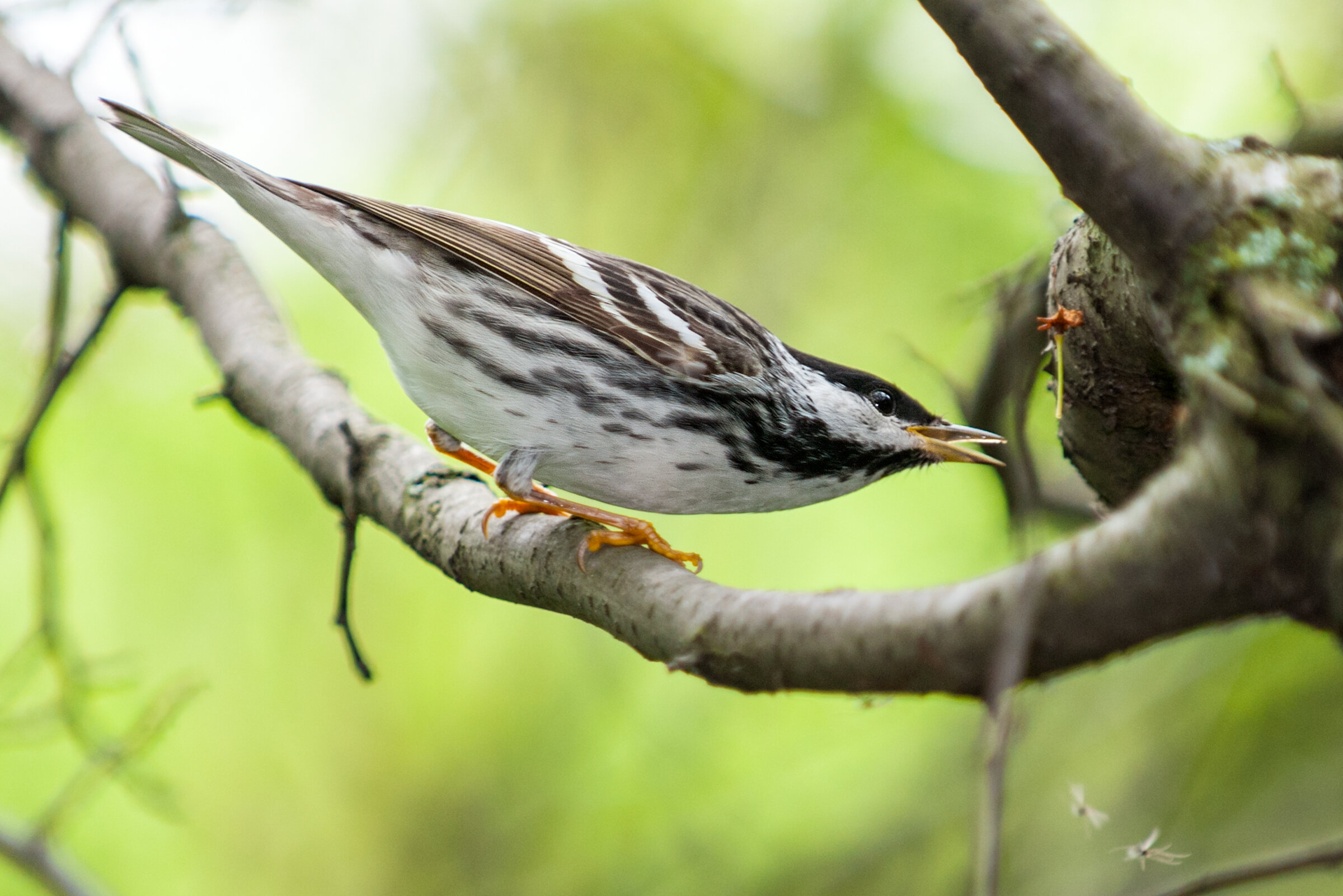
Blackpoll Warbler, Owen Deutsch/Audubon Photography Awards
In the fall migration they travel south and southeast through Canada and the northeast U.S. and collect along the coastal plain between Nova Scotia and Cape Hatteras, NC. Then, it’s believed—the experts aren’t really sure—the birds head south and southeast over the Atlantic Ocean, and fly nearly 2000 miles to Puerto Rico, the Lesser Antilles or northern South America. This potentially involves an 88-hour nonstop flight over open ocean! To accomplish this, Blackpoll Warblers nearly double their weight before setting out, and they rely on northeast trade winds to direct their flight toward South America.
(Watch Cornell Lab’s animation of Blackpoll Warbler abundance on eBird here.)
(Information from Cornell Lab of Ornithology, Birds of the World)
Butterflies and other insects have multiple over-wintering strategies, some more mysterious than others.
Many insects shelter and are nourished through the winter in micro-habitats under the soil, inside the wood of logs, in trees and even in plant galls. Inactive insects undergo a dormant state, called diapause, in which their growth, development and activities are suspended in winter, with a metabolic rate barely high enough to keep them alive.
Some insects successfully pass the winter as immature larvae, such as the Woolly Bear caterpillar, protected by heavy layers of leaf litter. Other larvae replace the water in their bodies with glycerol, a type of antifreeze. Some grubs simply burrow deeper into the soil to escape the cold.
Dragonflies, mayflies and stoneflies survive as nymphs living in ponds and streams, feeding and growing all winter to emerge as adults in early spring. A few insects lay eggs which survive the winter, such as Praying Mantids.
Some insects, such as the Mourning Cloak butterfly, overwinter as adults in tree holes, leaf litter and under logs and rocks. That’s why Mourning Cloak is usually the first butterfly to appear in Spring. Like some insect larvae, it reduces the water content of its body and builds up glycerol which acts as an antifreeze.
Many butterflies that spend the summer here cannot survive the winter, so they die. Each year, as the weather warms up, butterflies from Mexico and the southern United States fly north to repopulate Virginia such as: Common Buckeye, Cloudless Sulphur, Painted Lady, Red Admiral and others.
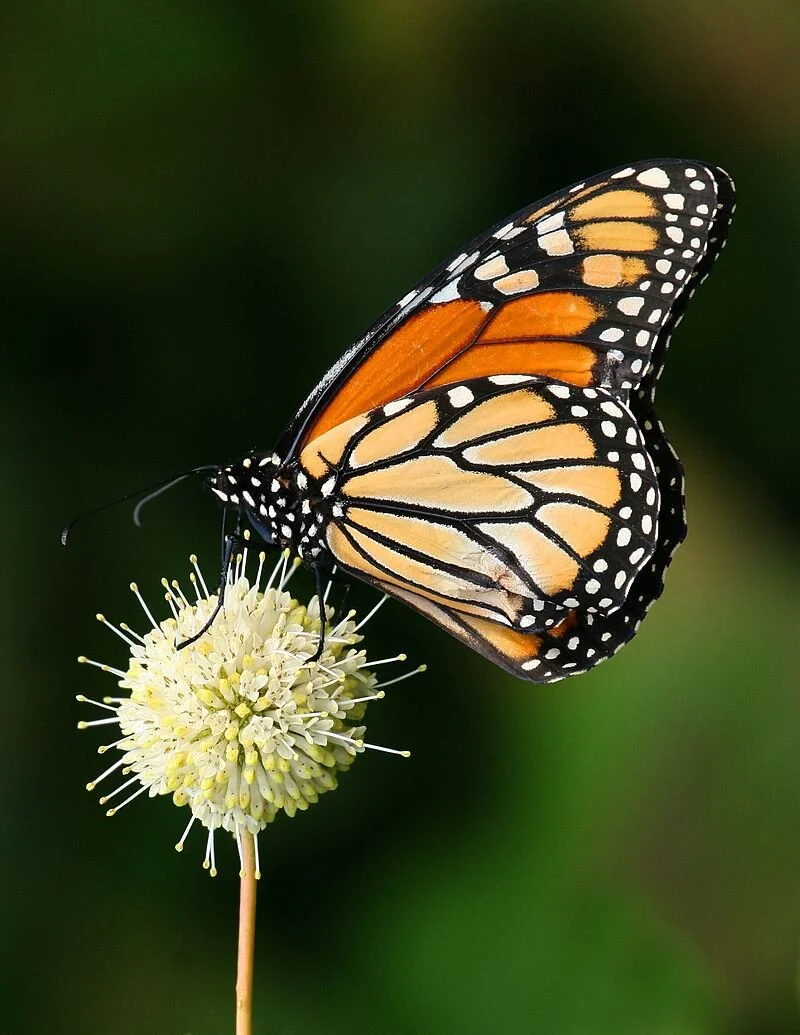
Monarch, Judy Gallagher

Cloudless Sulphur, Judy Gallagher
For some species the reverse migration, south in the fall, is more obvious. Cloudless Sulphurs, Mourning Cloaks and Monarchs can sometimes be seen moving southward in groups of thousands. Exactly where all these butterflies go is not always known. Monarchs are the best-known migratory butterflies, yet knowledge is limited even for them. Most Monarchs from west of the Rocky Mountains spend the winter along the California coast while those from central North America spend the winter in roosts in the mountains of central Mexico. But what about the Monarchs from the Atlantic seaboard? Although it seems that many of them also migrate to the same Mexican overwintering sites, others may travel to and through Florida, perhaps flying on to undiscovered sites in the Caribbean or the Yucatan Peninsula. Or, maybe northern Monarchs that enter the peninsula don't survive the winter and for them, Florida is a dead end. Some Monarchs that overwinter in Florida may be largely members of resident, non-migratory populations. At this point, we just don't know.
(Information from North American Butterfly Association, Smithsonian)
Frogs and toads commonly hibernate in winter. After an animal finds or makes a living space (hibernaculum) that protects it from winter weather and predators, its metabolism slows dramatically. It "sleeps away" the winter by utilizing its body's energy stores, then "wakes up" when spring arrives.
Aquatic frogs such as the Leopard Frog (Rana pipiens) and American Bullfrog (Rana catesbeiana) typically hibernate underwater. But they don’t dig into the mud the way aquatic turtles do—they would suffocate. Hibernating aquatic frogs must be near oxygen-rich water and spend a good part of the winter just lying on top of the mud or only partially buried. They may even slowly swim around from time to time.
Terrestrial frogs normally hibernate on land. American Toads (Bufo americanus) and other good diggers burrow deep into the soil, safely below the frost line. Some frogs, such as the Wood Frog (Rana sylvatica) and Spring Peeper (Hyla crucifer) are not adept at digging and instead seek out deep cracks and crevices in logs or rocks, or just dig down as far as they can in the leaf litter. These hibernacula (shelters) are not as well protected from frigid weather and may freeze, along with their inhabitants.

Wood Frog, VA Herpetological Society
And yet the frogs do not die. A high concentration of glucose in the frog's vital organs prevents freezing, even though ice crystals form in the body cavity, bladder and under the skin. A partially frozen frog stops breathing, its heart stops beating and it appears dead. But when the hibernaculum warms up above freezing, the frog's frozen portions thaw, its heart and lungs resume activity and it comes back to life.
(Information from Scientific American)
Various species have amazing and diverse strategies for surviving winter. You can help them.
Blackpoll Warblers don’t breed here, but they do fly over and stop during spring and fall migration. You can help sustain them in their long migration south by planting native, fall-fruiting native shrubs in your yard, such as Spicebush or Viburnum, with fatty berries that help them build up their fat reserves prior to their long oceanic voyage. Avoid using insecticides that kill insects that Blackpoll Warblers and other bird species depend on for food.
To help insects, leave the leaves—leaf litter is key to many species’ winter survival—and don’t be too tidy about cutting and cleaning up flower stems and stalks. Many insects burrow into them for winter protection.
To help the frogs and toads, be careful about digging in winter—you may be digging up somebody’s winter home.
Interested in learning more about protecting and creating habitat for wildlife in all four seasons? Check out Audubon at Home on the ASNV website. Request a visit by an Audubon at Home Ambassador who can advise on habitat improvements you can make on your property.

400 Acres of Reston Association Natural Areas Certified as Wildlife Sanctuaries
Reston has over 800 acres of natural areas and other wildlife-friendly areas, including 55 miles of trails, on property owned by the Reston Association. Six of these areas, covering 400 acres, are now certified as Audubon at Home Wildlife Sanctuaries.
Photo: Canada Warbler, Dale Bonk/Audubon Photography Awards
Reston has over 800 acres of natural areas and other wildlife-friendly areas, including 55 miles of trails, on property owned by the Reston Association.

Claudia Thompson-Deahl; Photo: Sean Bahrami, Reston Association
Six of these areas, covering 400 acres, are now certified as Audubon at Home Wildlife Sanctuaries, thanks to the efforts of Reston Association Senior Environmental Resource Manager Claudia Thompson-Deahl, Chief Operating Officer Larry Butler and former Audubon at Home Co-Director Robin Duska. They include Bright Pond and Walker Nature Center and along the Glade West/Meadow trails, Glade East’s Turquoise Trail, Twin Branches Trail and Buttermilk Trail.
To obtain certification as an Audubon at Home Wildlife Sanctuary, a property owner is asked to sign the Healthy Yard Pledge, pledging to remove invasive non-native plants, reduce area covered by lawn, plant native plants, reduce pesticide and fertilizer use and conserve and protect water quality. Certification also requires providing several habitat features, such as native shrubs and trees, a water feature, or a rain garden or pollinator garden and observing at least 10 Sanctuary Species using the property.
Reston Association already manages its natural areas in line with the Healthy Yard Pledge, and Robin documented 60 different Sanctuary Species in the six sites. All of the sites are designated as “birding hotspots” in the Cornell University eBird database, and birders have observed between 91 and 134 bird species at each.
For example, Walker Nature Center’s woodland trails leading along Snakeden Stream Valley to Lake Audubon are a prime spot for seeing warblers. Twenty-eight warbler species, including the Canada Warbler recorded on the certification application, along with migratory birds and water birds have been observed there.
Especially during the pandemic, many Reston residents and others enjoy walking or biking the trails through these areas. Hopefully the new signs designating the areas as Wildlife Sanctuaries will help people appreciate how valuable these large, contiguous areas are as wildlife habitat, and encourage better stewardship by not littering or letting dogs run unleashed.
Robin used the citizen science tools eBird and the Reston Biodiversity project in iNaturalist to certify the sites based on finding species of 29 birds, 22 insects, 4 arachnids, 2 mammals, and 3 reptiles/amphibians. “All Restonians can help document diversity via these tools,” she notes, and you can too.
Are you interested in creating a Wildlife Sanctuary in your own backyard? If you live in Arlington, Alexandria, Fairfax, Loudoun, Prince William, Rappahannock or Fauquier, just click here to learn more about the program and request a free visit by an Audubon at Home Ambassador, who will advise on steps you can take to improve habitat for birds and other wildlife in your yard—and get it certified as a Wildlife Sanctuary.

Audubon at Home Certifies 87-acre property
Audubon at Home resumed in-person visits to homes with masks and safe social distancing on July 1 and interest came roaring back. Since then AAH has had 63 requests with 47 visits reported. The most notable property to be certified is the JK Black Oak Wildlife Sanctuary.
Audubon at Home resumed in-person visits to homes with masks and safe social distancing on July 1 and interest came roaring back. Since then AAH has had 63 requests with 47 visits reported. The most notable property to be certified is the JK Black Oak Wildlife Sanctuary, an 87-acre property in Loudoun County near Lucketts which has been placed under a conservation easement by owner and Audubon at Home partner, Loudoun Wildlife Conservancy.
Biologists from the Virginia Department of Conservation’s Natural Heritage program determined the property was a globally rare wetland, with 14 vernal pools that support large and rare amphibian populations, mature forest, meadow and grassland within a unique geologic setting in an area of Karst limestone overlay. Challenges include non-native invasive plants such as autumn olive and missing understory due to deer grazing. Loudoun Wildlife Conservancy is working in partnership with The Nature Conservancy and Loudoun Soil and Water Conservation District to develop a management plan for the property.

LWC Executive Director Michael Myers said, “LWC is proud to steward this globally rare wetland and we are glad the property is now permanently protected from future development through a conservation easement. The Audubon at Home Wildlife Sanctuary certification is a very welcome recognition of the significance of this property.”
Maybe you don’t have 87 acres of globally rare wetland habitat, but Audubon at Home is always eager to work with you to improve the wildlife value of your yard, HOA or other property, no matter how small. Even a patch of a few dozen square feet can help support wildlife. Fall is a great time to plan and plant. To request a free visit from an Audubon at Home Ambassador who can advise on native plantings and other habitat improvements, visit us here.
Leave the Leaves
Here’s a habitat tip for fall: Leave the leaves! Did you know that many beneficial insects overwinter in leaf litter? And that many birds forage for their meals in leaf litter, such as the beautiful winter visitor, the Hermit Thrush? Leaf litter decays into rich humus that enriches the soil and supports a rich web of life. So, don’t bag up those leaves in plastic bags and set them out at the curb—leave the leaves on the ground.
For more advice on enhancing the habitat in your own backyard, check out our website.
In photo, from left: Anne Owen, LWC Audubon Program Coordinator for Loudoun County, Sheila Ferguson, LWC volunteer and native plant guru, Betsy Martin, ASNV Board member and AAH Program Co-Director, and Michael Myer, LWC Executive Director- all temporarily mask less for the photo. Photo by Mike Sciotino, LWC Black Oak Committee member.

Sweet Options When Selecting Woody Plants for your Home Habitat
The dog days of summer are behind us, and as our avian migrants prepare for their long and arduous journey towards their wintering grounds, you might wonder what things you and your family can do for your native bird habitat to facilitate their journey.
Photo: Gray Catbird with Beautyberry, Will Stuart
By Deidra Bryant
The dog days of summer are behind us, and as our avian migrants prepare for their long and arduous trek towards their wintering grounds, you might wonder what things you and your family can do for your native bird habitat to facilitate their journey.
Although it’s still too early to see those beautiful crimson leaves senesce within your neighborhood, colorful fruits are still abundant on many woody plants. As you may already know, birds show individual preferences for various fruit-producing plants. For example, they will select fruits they like best (such as Cornus, Rubus, and Vaccinium spp), clean them off early in the season, and let fruit they find less tasty hang onto other plants. Here are a few plants to consider purchasing if you enjoy observing birds nibble on fresh fruit within resplendent autumn foliage.
American beautyberry (Callicarpa americana L.) is a native perennial understory shrub that produces clusters of tiny magenta drupes that ring around their woody stems in late August and September. The berries have a high moisture content and serve as an important food source for many passerines such as the Northern Cardinal, Purple Finch, Northern Mockingbird, Eastern Towhee and Brown Thrasher.
Persimmons - whose genus loosely means “fruit of the Gods”- are one of the most favored fruits in Asia. However, they tend to be under-appreciated in North America. The American persimmon (Diospyros virginiana) is a large tree native to much of the eastern United States and grows vibrant orange berries (yes, the fruit is morphologically a berry!) As with Asian persimmons, the American persimmon produces delicious fruit in the fall which becomes an excellent food source for birds once they are ripe. In fact, this fruit becomes more palatable, softer and sweeter only after a couple of light autumn frosts.
Other fruiting plants to consider include American holly and Blackhaw. By adding “less-desired” species to your habitat, you’ll be stocking your feathered friends’ pantry for the late winter when berries they passed up become life-saving food stores. Birds that rely on insects in the warmer months often rely on berries when the weather turns brisk. These include woodpeckers, robins, waxwings, thrashers, mockingbirds, catbirds, thrushes, bluebirds, chickadees and titmice. So, as you clean out those nest boxes and make your brush piles, consider planting these captivating native plants in your yard next spring. You might even encounter a new visitor!

Audubon at Home Continues to offer Wildlife Sanctuary Advice Despite Covid-19
Many Audubon education and advocacy programs have been canceled or paused due to Covid-19. Fortunately, the Audubon at Home (AAH) program continues. Applicant numbers are down, but people who are proactive, enthusiastic and committed about attracting native wildlife to their yards continue to apply.
Photo: Seeding Butterfly Weed and Black-eyed Susan, Anne Owen
By Lisa Mackem
Many Audubon education and advocacy programs have been canceled or paused due to Covid-19. Fortunately, the Audubon at Home (AAH) program continues. Applicant numbers are down, but people who are proactive, enthusiastic and committed about attracting native wildlife to their yards continue to apply. “We have quality over quantity,” says Anne Owen. Anne is a Virginia Master Naturalist, AAH Ambassador and the Program Coordinator for AAH in Loudoun County.
Anne sees the Audubon at Home program’s focus on creating, restoring and enriching wildlife habitat at the individual property level as a great example of Doug Tallamy’s call for “Conservation that Starts in Your Yard.” Anne explains, “Property qualifies as AAH Wildlife Sanctuary with at least two critical habitat features, typically, a pollinator garden (which can be planted in pots) and a water source (a birdbath, natural stream, or rain garden.) Also, the owner must record at least 10 sanctuary species over a three year period. Certified properties range from an apartment balcony to acres of woodland.”
Anne lives in Loudoun, where the AAH program is a partnership between ASNV and Loudoun Wildlife Conservancy. She became involved with the program as a client, shortly after buying her property. She has spent four years planting native plants on grassy or non-productive land and had her front yard professionally landscaped with native plants. Now, Anne enjoys numerous pollinator insects – her main passion during the summer. She has Eastern Phoebes nesting and has observed them feeding their chicks with caterpillars. She also has Eastern Bluebirds, House Finches and House Wrens nesting on her property, and has seen Downy, Hairy and Pileated Woodpeckers, Wild Turkeys and Red-shouldered Hawks. Other wildlife on her property include frogs, toads, snakes, eastern box turtles, salamanders, raccoons, skunk, possum, rabbits, foxes – even a bear from time to time. Anne continues to be struck by the tremendously rich flora and fauna in Northern Virginia.
“The key thing that sets AAH apart from other wildlife habitat programs,” says Anne, “is that in normal times, an Ambassador visits each property to meet with the client, tour the property, list suggestions to improve the quality of wildlife habitat and follow-up with a report for the client.” With in-person visits suspended, Anne has been offering clients telephone consultations. “It’s not as good as being on-site but it helps people get preliminary information and start creating their habitat.”
“Nature is in trouble and needs our help,” says Anne. “Few people can replant a forest, but you can start adding native plants on your own land to provide habitat and a food source for native insects, then birds will follow. It’s a fun, practical level of engagement.” For example, a pollinator powerhouse like Coneflower (Rudbeckia spp.) will attract native bees and butterflies and they might bring goldfinches when it goes to seed. Most people can satisfy Home Owner Association restrictions with native plants but Anne advises clients to check their HOA requirements first before substantially investing in property changes.
Click here for more information about the Audubon at Home program.

Local Photographers Win National Wildlife Federation Photo Contest
ASNV member Randy Streufert has won the Grand Prize in the National Wildlife Federation’s “Garden for Wildlife” photo contest. Randy’s photo of a Prothonotary Warbler cooling off in water was the top photo out of nearly 5000 submissions from all over the world.
Photo: Prothonotary Warbler, Randy Streufert
ASNV member Randy Streufert has won the Grand Prize in the National Wildlife Federation’s “Garden for Wildlife” photo contest. Randy’s photo of a Prothonotary Warbler cooling off in water was the top photo out of nearly 5000 submissions from all over the world. Randy and his wife Barbara’s property, where the photo was taken, is a Certified Wildlife Sanctuary in ASNV’s Audubon at Home program.
Randy also won an Honorable Mention for his photo of a Cope’s Gray Treefrog tadpole and froglet.

Copes Gray Treefrog Tadpoles, Randy Streufert
Local wildlife enthusiast Arthur Hass’s photo of an Eastern Tailed-Blue won the top prize in the category Close-up Native Plants and their Wildlife Visitors, and Fairfax resident Sherry Schellenger Parker’s photo of her son in his grandmother’s garden won in the category People in the Wildlife Garden. The Category Winners and Honorable Mentions showcase a wonderful array of photos of plants, wildlife and people enjoying them.

AAH Still Providing Information About How To Create Wildlife Habitat
Although Audubon at Home has discontinued client visits, we encourage you to consult with us about how to create wildlife habitat.
Photo: Butterfly garden, Elaine Mills
Although Audubon at Home has discontinued client visits, we encourage you to consult with us about how to create wildlife habitat.
If you are already working with an AAH ambassador, please consult via phone or email. If you are not yet working with an ambassador, please send questions to us at aah@audubonva.org.
You may still request a visit here. We will schedule it when we are able to conduct visits again. Meanwhile, check out the Audubon at Home pages on the Audubon Society of Northern Virginia website.

Certified Sanctuary Map
Audubon at Home encourages you to check out our new interactive map on our Certified Wildlife Sanctuaries webpage.
Audubon at Home encourages you to check out our new interactive map on our Certified Wildlife Sanctuaries webpage.
Click the icons in the upper right of map to see additional layers of information that include Audubon Christmas Bird Count Circles and the U.S. Geological Service Protected Areas Database.
AAH heartily thanks volunteer Adam Jenkins for his work developing this page.

Reston Association's Biophilic Pledge Points Residents to AAH Wildlife Sanctuary Program
In 2018, Reston became part of the worldwide Biophilic Cities Network. To help residents identify specific actions that will protect Reston's natural resources, Reston Association's Environmental Advisory Committee is now deploying a Reston Biophilic Pledge.
Photo: Butterfly Garden at Brookside Gardens, Elaine Mills
In 2018, Reston became part of the worldwide Biophilic Cities Network. To help residents identify specific actions that will protect Reston's natural resources, Reston Association's Environmental Advisory Committee is now deploying a Reston Biophilic Pledge. Several Biophilic Pledge elements echo the Audubon at Home Healthy Yard Pledge, and the pledge element "Promoting biodiversity by supporting and creating wildlife-friendly habitat" points residents to the website for the Audubon at Home Wildlife Sanctuary Program for more information on how to create habitat.

Audubon at Home Ambassador’s Brunch
Audubon at Home ambassadors gathered on February 1 for their annual – and delicious – brunch, at which AAH co-directors and county coordinators updated them on the program's progress over the past year. It has now been 10 years since AAH first certified a Wildlife Sanctuary, as of the brunch, the program has certified 683 properties on over 6300 acres.
Photo: Tiger Swallowtail on Joe Pye Weed, Elaine Mills
Audubon at Home ambassadors gathered on February 1 for their annual – and delicious – brunch, at which AAH co-directors and county coordinators updated them on the program's progress over the past year. It has now been 10 years since AAH first certified a Wildlife Sanctuary, as of the brunch, the program has certified 683 properties on over 6300 acres.
Guest speaker Laura Beaty spoke about introducing native plants into a landscape. A former staffer for the U.S. Senate Committee on Energy and Natural Resources, she now serves as the propagation chairperson for the Virginia Native Plant Society. Ambassadors benefited from Laura's keen observation skills and excellent story-telling about the insects and other wildlife that depend on the native plants in her own garden.

Creating a Wildlife Sanctuary on Your Property: The Audubon at Home Program
Save the Date! On March 21st, Betsy Martin of The Audubon Society of Northern Virginia’s Audubon at Home Program and Linda Beaty of Plant NOVA Natives will join forces to provide a special program on how to make your yard more attractive to wildlife.
Photo: Painted Lady, Rusty Moran
Save the Date!
On March 21st, Betsy Martin of The Audubon Society of Northern Virginia’s Audubon at Home Program and Linda Beaty of Plant NOVA Natives will join forces to provide a special program on how to make your yard more attractive to wildlife. The program, which is being presented in partnership with the Friends of Mason Neck State Park, will be held at 2 PM at the Jammes House in the Mason Neck State Park.
Registration for the program will open on March 1.

Birdathon Winners Visit Oak Spring
Winning Birdathon teams traveled out to the Oak Spring Garden Foundation in Upperville, Virginia on September 17 to view some rare books, including a John James Audubon folio, and the grounds of the estate of Rachel "Bunny" Mellon, who designed the White House Rose Garden.
Photo: Oak Spring Wall, Robin Duska
Winning Birdathon teams traveled out to the Oak Spring Garden Foundation in Upperville, Virginia on September 17 to view some rare books, including a John James Audubon folio, and the grounds of the estate of Rachel "Bunny" Mellon, who designed the White House Rose Garden. The 700 acres of Foundation grounds were certified as an Audubon at Home Wildlife Sanctuary on July 25 by AAH County Coordinator Leslie Paulson. OSGF Project Development Coordinator T.J. Sherman, who led the BIrdathon teams around the grounds, indicated that nearly all AAH Sanctuary Species have been seen on the property.
Species are selected as AAH Sanctuary Species because they breed in Northern Virginia, have a reasonable chance of being found on and/or attracted to a suburban property, are considered a beneficial and/or desirable species, and are a population in decline OR at risk of being in decline (in the Northern Virginia area) due to typical suburban land use issues (pesticides, habitat destruction, etc.).
Audubon At Home Certification
The Audubon at Home program is happy to announce that the Reston Association's Central Services Facility (CSF) has achieved certification as a Wildlife Sanctuary. The site includes a native plant garden that serves as a demonstration site to educate Metro developers on how native plants can be integrated into areas near Metro stations.
The Audubon at Home program is happy to announce that the Reston Association's Central Services Facility (CSF) has achieved certification as a Wildlife Sanctuary. The site includes a native plant garden that serves as a demonstration site to educate Metro developers on how native plants can be integrated into areas near Metro stations.

Robin Duska
As you plan for the fall planting season, ASNV urges you to consider creating more wildlife habitat. Volunteer Audubon at Home Ambassadors are ready to pay you a free visit to advise on which native plants will work best on your property—and our definition of “property” includes homes, HOAs, schools, faith communities, parks, or commercial properties. After the property owner has observed at least 10 of the over 40 Wildlife Sanctuary Species that breed in Northern Virginia, Audubon at Home will certify the property as a Wildlife Sanctuary. Species that are particularly affected by loss of habitat in our area have been selected as these Sanctuary Species.
Our Audubon at Home Wildlife Sanctuary Program embraces the principles of the National Audubon Society’s Bird-Friendly Communities and promotes citizen participation in conserving and restoring local natural habitat and biodiversity. To learn about the program and to request a visit from an AAH Ambassador, click here.