NVBA NEWS BLOG
Welcome to the blog for Northern Virginia Bird Alliance, a wealth of resources about northern Virginia birds, wildlife, habitat conservation and restoration, native plants, wildlife-friendly gardening, advocacy and more.
Their Time to Sleep
It’s March. Spring is coming, but when you glance outside it’s still cold and dark, sometimes snowy. But the marvel of plant dormancy is once again unfolding, unseen.
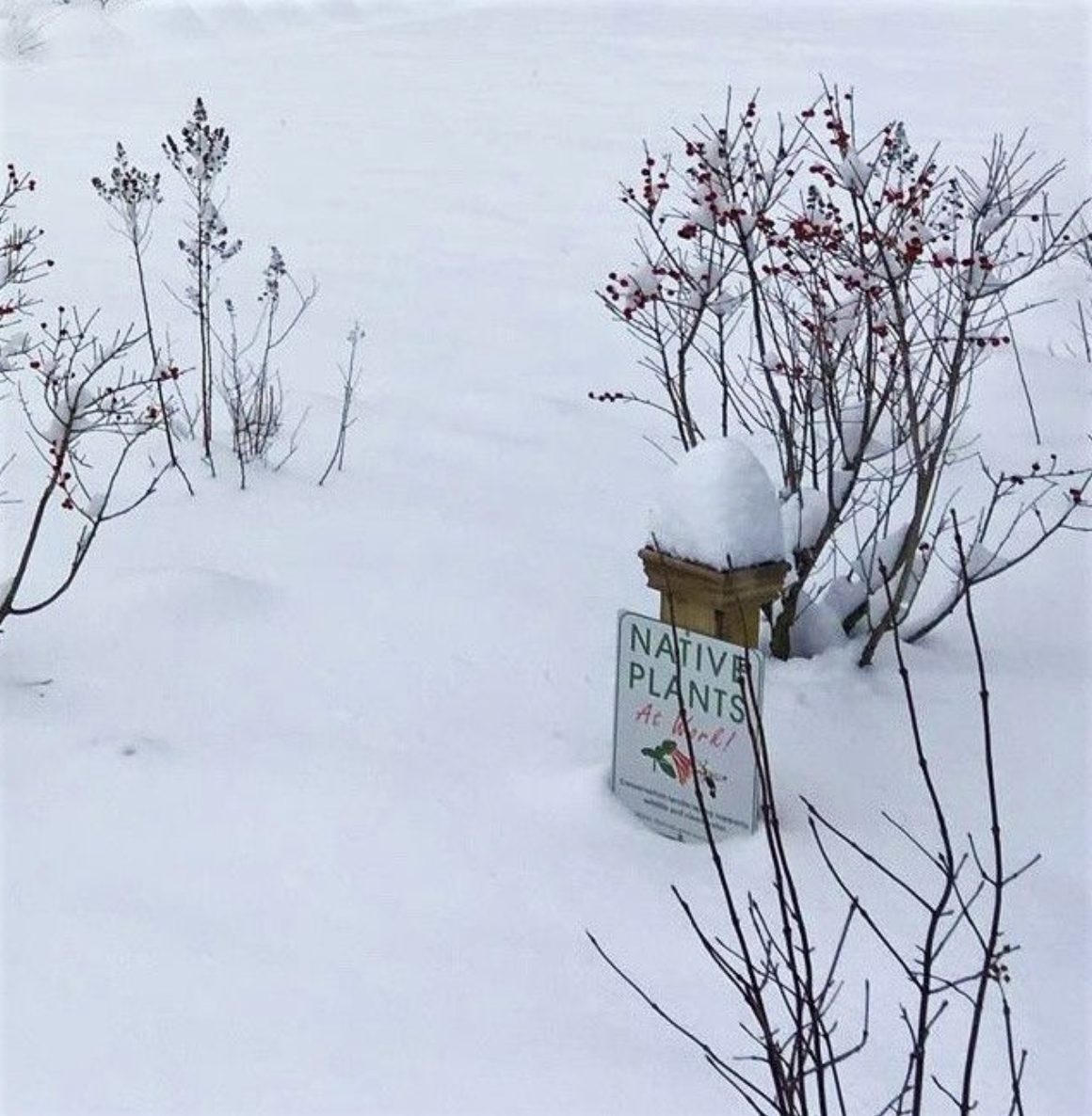
Photo: Winterberry in snow, Margaret Fisher
Eileen Ellsworth
It’s March. Spring is coming, but when you glance outside it’s still cold and dark, sometimes snowy. But the marvel of plant dormancy is once again unfolding, unseen. Plants need their rest and recuperation. It’s an annual phenomenon, a common thing, but that doesn’t make it any less of a miracle.
Dormancy in plants is ancient. While estimates vary, seed dormancy emerged roughly 360 to 370 million years ago and seems to have developed at the same moment seed-bearing plants arrived. The strategy allowed the early seed plants to survive the more lethal environmental perils. Their ability to push “pause” whenever extreme cold, drought, flood, or any other earthly or celestial catastrophe occurred gave them a huge advantage. Plants could wait out the worst and only wake up when conditions were better.
How long, exactly, can a seed lie dormant? It’s a good question. Most of our garden plant seeds are probably good in the ground for 1-5 years. After the recent California wildfires, certain “fire-follower” species germinated after 100 years of dormancy and bloomed in large carpets of spectacular color across the landscape. Some documented lotus species whose seeds enjoyed optimum storage conditions sprang back to life after 1,300 years!
No one actually knows how long a seed can lie dormant and remain viable. But it really doesn’t matter. The sheer brilliance of an adaptation that allows a plant to literally pick its go-time is mind-boggling when you think about it. Wish we could do that.
And, of course, plant dormancy goes well beyond the realm of seeds. There is “bud dormancy” triggered by shorter days and cooler temperatures that makes trees and shrubs want to stop growing and shed their leaves. There is “organ-dormancy” forcing above ground rest in some perennials. There is a kind of “pseudo-dormancy” where plants are poised to grow but pause due to unfavorable environments. There is a hibernation-type dormancy that enables plant survival in extreme heat or drought. And so on.
Winterberry in snow. Photo: Margaret Fisher
Many strategies, one goal. Keep living. And it is lucky for us that they have. With ancient bacteria as their partner, they figured out how to photosynthesize and turn water and carbon dioxide into glucose and oxygen. They are the reason we can exist, why our cells have glucose to fuel them, why our lungs have oxygen to breathe. Plants, not animals, are the reason this astonishingly beautiful planet is still blue, emergent, and alive.
Our dependency upon their health certainly calls us to be the best possible stewards of the land. There is no doubt that planting and preserving native plants directly advances the goal of restoring biodiversity across our region. Only their magic can do it. The Plant NOVA Natives campaign and NVBA’s Wildlife Sanctuary Program are all about that, and their websites have all you need to know to take action.
Even in the dead of winter, let’s hear it for the plants! Let’s cheer them on and wish them well as they sleep. We owe them everything. They’ve earned their rest. Lay dormant, dear friends. Pick the time when all is well and come to greet us again. We hope it’s soon. We love you so. We couldn’t live without you.
Be Very Brave: Plant a New Native Shrub This Fall
So, it's the right time of year to plant, and native plants are easier to find than ever before. But . . . something is still stopping you. Hmm. What could that be?
Photo: Native shrubs, Margaret Fisher
Eileen Ellsworth
Fall is the perfect time of year to add new plants to your landscapes and gardens, especially shrubs. They anchor a garden or a landscape for many years and are an ideal choice for fall planting. It may seem counterintuitive to invest in any new plants with cooler weather on the way. But the winter to come is what provides the advantage, allowing the roots to get established well before being hit by the next summer’s heat. If you install the plants properly and faithfully water for the first few weeks, they will grow and thrive beyond expectations for years to come.
Purchasing new native plants, shrubs, and trees has never been easier. Several local nurseries specialize in native plant offerings. Thanks to the grass-roots efforts of Plant NOVA Natives and its many partners, traditional sellers and garden centers now offer a far wider array of native plants than ever before. As consumer demand has risen, plant sellers also willingly participate in native plant labeling programs to help their customers more easily identify them.
So, it's the right time of year to plant, and native plants are easier to find than ever before. But . . . something is still stopping you. Hmm. What could that be?
FEAR! You’re convinced you don’t know enough about native shrubs to pick the right one. You believe there is too much to learn and to decide between now and mid-month, so best to just let it be. You’ve imagined that the life of this shrub, upon which the biodiversity of your entire yard will no doubt depend, is doomed in your neglectful hands. On all counts, you are wrong.
Remember, we’re talking about native plants here. (It’s all we ever talk about here.) And native plants have lived in northern Virginia about 100 million years longer than humans have been alive on the planet. They know exactly what they’re doing, even if we don’t. We can trust that just about any native shrub we plant will grow, so long as its light and water requirements are more or less met. These plants are very old and quite resilient. They can adjust and adapt in surprising ways non-natives can’t. They evolved in local soil under local climate conditions. Water them a bit more during very hot or dry spells, and all will be well. They’ve got this. You are three simple decisions away from success.
First decision – Where to plant the shrub. Look for an empty spot, or one that currently contains a non-native species you’ve been meaning to remove. About how many hours of direct sun does the spot get? Does it collect water, or does it drain well? Consider whether there is room for some growth, because native shrubs can grow with considerable vigor. You can always prune them back – a lot, if necessary. Pick the spot, then say to yourself, “New shrub will live here.” Done. Time for the second decision.
Second decision – What kind of native shrub to buy. Winterberry, Red Chokeberry, Highbush Blueberry, Spicebush, Buttonbush, Arrow-wood Viburnum, Virginia Sweetspire, Wild Hydrangea. These, and many others, are listed and discussed on the Plant NOVA Natives “Native Shrubs” webpage. They are all wildlife powerhouses, and yes, there are many.
But here’s the most important thing to remember when making this decision: It doesn’t matter what species you choose, and you can’t make a wrong choice. Any new native shrub will contribute to biodiversity, strengthen the food web, act as a host for some native insect species, and stabilize the soil. Many species will only set fruit if you plant two of them, in which event you’re also helping to attract and feed the birds. (It’s always best to purchase the second shrub from a different grower or seller so they are genetically divergent and not clones of each other.) Some other resources you can use to choose a shrub include
the Plant NOVA Natives newly improved Plant Finder App, and
the Plant NOVA Natives Native Plant Plants for Northern Virginia guide, available in print or as a free download.
Spend no more than an hour browsing the lists, choose the one you like, then say to yourself, “I will plant this shrub, and I’m not changing my mind.” Done. Time for the third decision.
Third decision: Where will I buy the shrub. This is the easiest one of all. Plant NOVA Natives lists fall native plant sales, native plant garden centers, and participating conventional garden centers. In the case of the one-day native plant sales, you may want to call the grower or seller a couple of days in advance and ask them to make sure they will be bringing the shrub you are seeking. If not, many folks will work with you directly to make sure you get what you want, even if that means picking it up directly from their native plant nursery. Done. All done.
So, let’s be brave. Let’s make these three decisions, buy and plant the shrub, and water it appropriately. Despite our worries, chances are excellent that next spring we will find ourselves chatting up and getting to know a new, glorious, happy, fruitful, flowerful native shrub that is anchored in our soil and smiling at the sun.
We may know nothing about native shrubs, and yet we have everything we need: joy, meaning, commitment, resolve, centeredness, and the support of a like-minded community of earth-loving native plant gardeners.
And, of course, we have the native plants themselves, who figure it all out anyway, with or without us.
Mini-grants for Invasive Removal Completed
We selected applications with the most effective and reasonable plans to address threats from invasives and involving property containing habitat of value where invasive removal efforts would provide a visible demonstration of educational value to congregants, residents, and passersby.
Image: Invasive Plant Control Area Sign for Mini-grants Program
Elizabeth Martin, Margaret Fisher, and Barb Tuset
A year ago, Fairfax County awarded NVBA’s Wildlife Sanctuary Program and Plant NOVA Natives a $32,500 grant from its Tree Preservation and Planting Fund to provide mini-grants for invasive removal on common open space owned by community associations or faith communities. We received 22 applications and funded 11 of them. We selected applications with the most effective and reasonable plans to address threats from invasives and involving property containing habitat of value where invasive removal efforts would provide a visible demonstration of educational value to congregants, residents, and passersby.
We selected three faith communities and eight neighborhood associations, although one neighborhood association dropped out when it could not muster sufficient volunteers. The final awards went to Antioch Baptist Church (Fairfax Station), Crest of Alexandria Homeowners’ Association (Fairfax), Fox Lake Property Owners Association (Oakton), Good Shepherd Catholic Church (Mount Vernon), Lakeford Community Association (Falls Church), Little River United Church of Christ (Annandale), McLean Greens HOA (Falls Church), Poplar Heights Recreation Association (Falls Church), Ridge Road Estates HOA (Springfield), and The Timbers HOA (Springfield).
We restricted mini-grants to projects focused on removal of the invasive vines and trees that most threaten native canopy trees in Northern Virginia, namely Japanese Honeysuckle, Asian Wisteria, Asiatic Bittersweet, Wintercreeper, English Ivy, Multiflora Rose, Porcelainberry, Kudzu, Callery Pear, Tree of Heaven, and Autumn Olive. These 11 vine and tree species overrun natural areas, overtop and kill trees, displace native plants, create food deserts for wildlife, and create hazards for humans. For more information about invasive plants and how to control them, see the excellent fact sheets published by Blue Ridge PRISM.
Clearing with a forestry grinder and growth of native milkweed, Photos courtesy of McLean Greens HOA
Each community received $3,000, and each mini-grant required a match of $1,500, fulfilled either with money or volunteer labor. Although the grants were modest, they enabled the grantees to effectively treat substantial invasive infestations on large areas of common property. These projects would have been impossible to tackle without the funding that the mini-grants provided to pay contractors; volunteers alone could not have done it. All told, almost 10 acres of invasives were treated.
The benefits from the mini-grants go beyond the acreage directly treated. Many of the common areas border parks, so the treated acres help buffer and protect Fairfax County parkland from invasions by harmful exotic plants. In addition, the success of their projects motivated several HOAs to embark on further projects to build on the work accomplished with mini-grant funds. For example, one grantee obtained additional funding from another source to replant a cleared area near a stream with 640 native plants. Another grantee reports its HOA has decided to use its own funds to contract for removal of Autumn Olive and English Ivy from another area of common property. Success is motivating, and one thing leads to another!
An example is the Fox Lake Property Owners’ Association, which owns 26 acres of common property. They treated two acres heavily infested by Autumn Olive, Multiflora Rose, English Ivy, Japanese Honeysuckle, Asiatic Bittersweet, and Porcelainberry. They began with forest mulching, hiring contractors who used a machine to cut, grind, and clear invasive vegetation. They experimented with three different invasive removal approaches in three different areas: sheet mulching with cardboard covered by mulch; hand pulling (near a stream), and herbicide (on a steep slope). Very soon after treatment, they found regrowth of native Milkweed, Sassafras, and Devil’s Walkingstick in treated areas. They observed wildlife returning, too, including wild turkeys and a female fox who raised a den of kits in the just-cleared area. After clearing what was once a solid wall of invasives, residents can now “see” who inhabits their woods, which has increased interest in their wild areas, even among teenagers!
About half the mini-grants were for projects in riparian areas, and applicants were required to obtain waivers from Fairfax County to work in Resource Protection Areas along Accotink Creek, Piney Branch, Tripps Run, Difficult Run, and Holmes Run. Careful removal of invasives will improve the quality of wildlife habitat in these environmentally sensitive areas.
Invasive Plant Control Area Sign for Mini-grants Program
Mini-grant recipients were also required to educate their members about the problems caused by invasive plants and about native alternatives that residents could install on their own properties. Communities received a sign to display. Some communities embarked on ambitious activities to involve their residents, congregations, and neighbors, including:
distributing brochures and doorhangers about the Tree Rescuers and Wildlife Sanctuary programs;
creating and distributing their own stewardship flyers and project descriptions to residents and Master Naturalists;
publishing newsletter articles;
making presentations or distributing information at annual meetings and other events;
conducting site tours and community hikes; and
providing an opportunity for an ecological restoration stewardship internship for a high school student as part of the project.
We thank Fairfax County for the initial grant and we especially thank all of the grantees for the hard work they put into volunteering on invasive removal, and on managing these projects. We hope this project starts them, and their neighbors and fellow congregants, on a rewarding journey of rediscovering and restoring their own nearby wild places. We have applied for renewed funding for a new round of mini-grants to community associations and faith communities in Fairfax County for next year.
To Spray, or Not to Spray?
Recently, we were confronted by the question of whether a yard where the homeowner has taken many steps to improve habitat can be certified as a Wildlife Sanctuary when the homeowner also employs a regular mosquito spraying service. We reviewed the evidence and decided that the answer is no: broadcast spraying for mosquitoes is not consistent with creating a functioning wildlife sanctuary in one’s yard.
Photo: Carolina Chickadee, Randy Streufert/Audubon Photography Awards
Elizabeth Train, Elizabeth Martin, Sarah Mayhew, and Barbara Tuset
Northern Virginia Bird Alliance’s Wildlife Sanctuary Program certifies yards and other properties as Wildlife Sanctuaries when property owners take steps to improve habitat and create a healthy yard that supports wildlife, and then observe 10 Sanctuary Species nesting, foraging, sheltering, or otherwise using the property. To qualify their yards, property owners are must adopt the Healthy Yard Pledge, including pledges to “Reduce pesticide and fertilizer use – No broad-spectrum spraying for mosquitoes” and to “Conserve water and protect water quality.”
Recently, we were confronted by the question of whether a yard where the homeowner has taken many steps to improve habitat can be certified as a Wildlife Sanctuary when the homeowner also employs a regular mosquito spraying service.
We reviewed the evidence and decided that the answer is no: broadcast spraying for mosquitoes is not consistent with creating a functioning wildlife sanctuary in one’s yard.
To qualify as a wildlife sanctuary, a residential yard should benefit wildlife species living in or visiting it at all stages of their lifecycles. Because insects are so critical to a healthy ecosystem and such a vital foundation for the food web, they should be protected along with other wildlife. Birds (as well as amphibians, reptiles, mammals, and virtually all native wildlife) depend on insects as prey. Nesting birds require an ample supply of caterpillars and other insects to support their nestlings.
A functioning wildlife sanctuary also should benefit the larger environment. Residential yards significantly affect water quality and aquatic ecosystems via streams that run through or adjacent to them, or stormwater runoff that is transported to streams by storm drains.
We conclude that the effects of mosquito spraying on insects and on the larger environment are too harmful to be approved in a Wildlife Sanctuary. Therefore, we will not certify a property as a Wildlife Sanctuary if the owner is spraying for mosquitoes.
Below we summarize our major concerns with mosquito spraying; our more detailed and fully documented discussion is in a longer paper available here.
Mosquito sprays kill pollinators and other insects essential to a functioning wildlife sanctuary.
Pyrethroids, the main chemicals that mosquito services use to kill mosquitoes in residential yards, are a class of broad-spectrum insecticides that are acutely toxic to terrestrial invertebrates, including pollinators such as bees and butterflies. Mosquito sprays kill all insects, including the caterpillars that birds rely on to feed their young throughout the breeding season. Nearly all terrestrial birds (96%), even seed eaters, feed their nestlings insects.
Pyrethroids used in mosquito sprays contaminate surface waters and kill aquatic organisms.
Spray drift can carry the chemicals directly to water, or residue can be carried to a stream through storm drains. Applying the chemicals to impervious surfaces, such as sidewalks and driveways, increases runoff into streams. If an applicator uses ultra-low volume spraying, which sprays fine or very fine droplets, the risk of drifting spray is greater, because droplets remain airborne longer.
Pyrethroids do not volatilize, are not soluble in water, and bind tightly to soil. They build up in sediments and affect benthic (sediment-dwelling) communities. There is some risk to fish, but the risks are much greater for aquatic invertebrates, because they live in the sediment where pyrethroids accumulate.
EPA reports that pyrethroid detections are widespread in surface waters across the United States, including effluent from sewage treatment plants, urban streams, and downstream of agricultural areas. Insecticide contamination is greater after storm events and near sites where the chemicals have been applied.
Following pesticide label instructions does not prevent harm to non-target species and the larger environment.
Following label instructions reduces but does not eliminate harms. When EPA approves use of a pesticide, it balances its environmental risks against its benefits. For example, pesticide use may control disease-carrying insects that pose a public health threat or control insects that threaten crops or structures, such as termites. In striking that balance, EPA attempts to impose limits on use and application that reduce the harm the chemical can cause. The limits EPA imposes appear on the product label and have the force of law.
When a pesticide is registered by the EPA for use in agriculture or horticulture, that does not mean that it is safe for non-target insects or aquatic organisms, even when applied according to label instructions. It means that there is an economic benefit to using it even though there also are known risks.
You can control mosquitoes without spraying.
The most effective, least harmful mosquito control strategy relies on habitat management and controlling the immature stages before the mosquitoes emerge as adults.
The first imperative is to minimize standing water. Common mosquito larval habitats include corrugated extension pipes coming off downspouts, rain barrels and landscape features such as ponds without fish, containers, bird baths, toys, garden and sports equipment, folds on tarps—anything that holds even a small amount of water for at least 7 days.
Larvicides
Effective mosquito management relies on killing them before they become adults. Bacillus thuringiensis israelensis (BTI) is an effective biological control, widely available at lawn and garden stores in a product called Mosquito Dunks™. The dunks are safe for birdbaths, rain barrels, ponds, ditches, tree holes, roof gutters, and anywhere water collects. One way to manage mosquitoes is to entice them to breed in a bucket filled with water, some straw, and a BTI dunk. The females are attracted to the scent of the straw and water and lay their eggs on the surface. When the larvae hatch, the BTI kills them. See how to set up a mosquito larvae trap. Jill Spohn developed a small, more aesthetically-pleasing trap, for convenience she now has them available on the Mosquito Jill Etsy site.
Lethal adult mosquito traps
Once larval habitats have been eliminated by removing or treating all sources of standing water, using a lethal trap that mimics a good oviposition site (larval habitat) such as the Gravid Aedes Trap can eliminate female mosquitoes and significantly reduce populations. GAT traps can be purchased or inexpensively constructed. Dumping all sources of water weekly helps ensure maximum draw of egg-laying female mosquitoes to the trap.
Personal protection
People can protect themselves directly by wearing long sleeves and long pants, applying insect repellent (such as DEET or picaridin or OLE) to exposed skin, and, when seated outside, deploying a fan to discourage mosquitoes.
So, while taking steps to protect our families from mosquitoes, let’s do all we can to protect all the creatures who share our environment!