NVBA NEWS BLOG

Welcome to the blog for Northern Virginia Bird Alliance, a wealth of resources about northern Virginia birds, wildlife, habitat conservation and restoration, native plants, wildlife-friendly gardening, advocacy and more.
News Jess Michetti News Jess Michetti

Tundra Swans

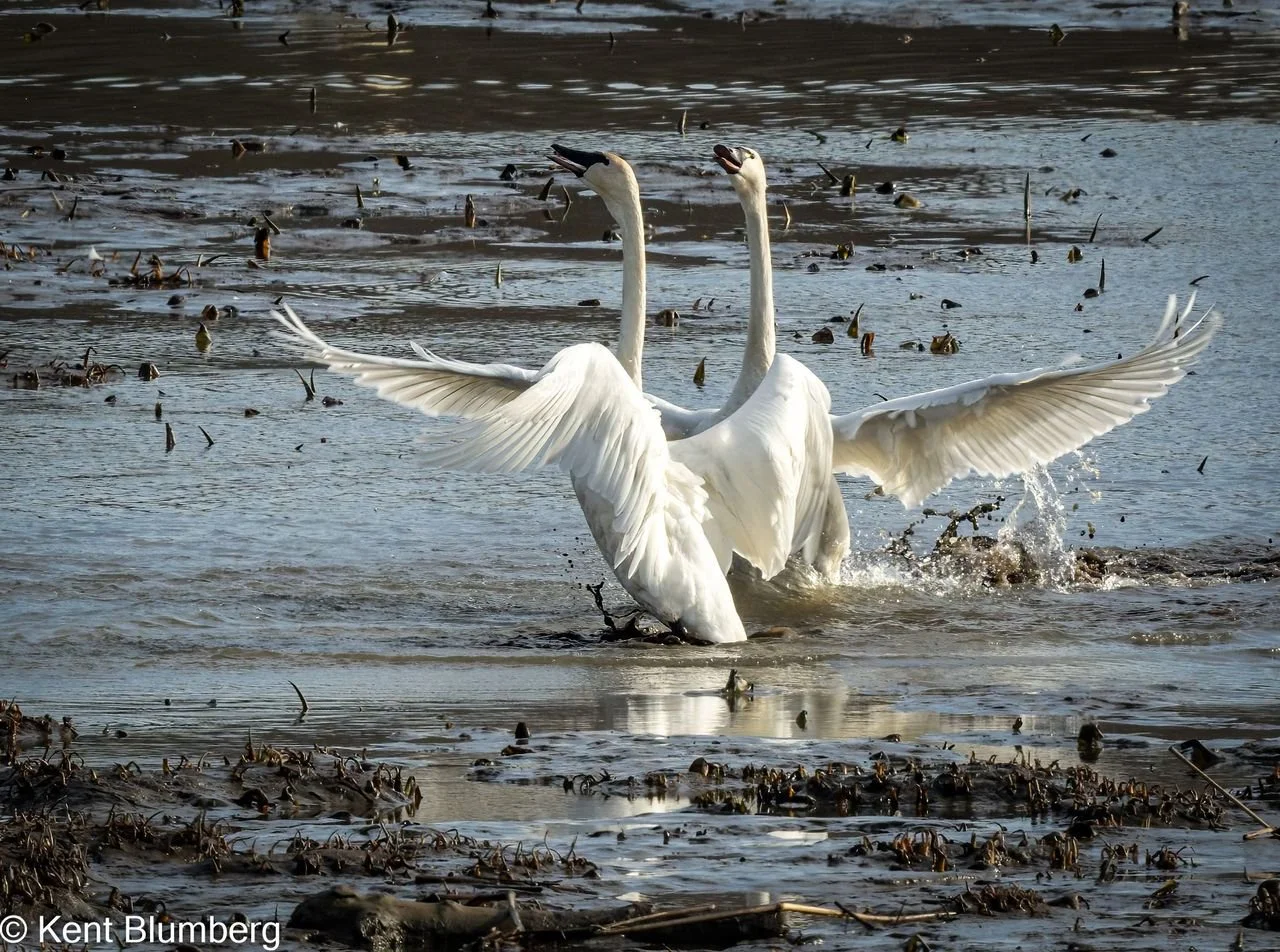
You still have time, if you’re lucky, to see one of our most spectacular winter visitors: the Tundra Swan. Hundreds of these graceful white birds spend the winter in the Chesapeake Bay and tidal Potomac from November through mid-March. When they gather in large flocks, the sight is unforgettable.

Photo: Tundra Swans, Kent Blumberg

Kent Blumberg

You still have time, if you’re lucky, to see one of our most spectacular winter visitors: the Tundra Swan (Cygnus columbianus). Hundreds of these graceful white birds spend the winter in the Chesapeake Bay and tidal Potomac from November through mid-March. When they gather in large flocks, the sight is unforgettable.

There are two native swan species in North America: the Trumpeter Swan and the Tundra Swan. Tundra Swans are far more numerous and are the species that winters with us.

Tundra Swans. Photo: Mitzi Gellman/Audubon Photography Awards

Tundra Swans are large birds, weighing up to 20 pounds. They are 47 to 58 inches long with an impressive wingspan of six to seven feet. Their bodies are bright white, with black beaks and feet. Most adults have a small yellow spot on their bill near the eye, although this can vary. Juveniles are grayer, as if they forgot to wash after a long day playing outside. 

Tundra Swans are dabblers, meaning they submerge their heads and necks to pull up underwater vegetation and roots. 

They are monogamous, often courting for months before mating for life. Once paired, they usually stay together for life and migrate, feed, and raise young as a couple.

Breeding occurs in the far north of Canada and in western and northern Alaska. Each pair has one brood per year, incubating the eggs for 31 to 40 days. Cygnets are precocial, which means they can walk within hours of hatching. Their first flight is typically within 60 to 70 days. And that first flight is just a teaser for what’s to come.

In the fall, just before their breeding grounds freeze, family groups begin their long migration. They spread those huge wings and fly over 4,000 miles south and east to visit us. The journey can take nearly three months.

Swans begin to arrive here in November. This season’s first eBird report at Elizabeth Hartwell Mason Neck NWR was on November 13, 2025. At peak winter numbers, flocks can reach several hundred birds. One checklist on December 29, 2025, for example, counted 460 swans. I first saw them just one year before that, on December 29, 2024: a cold, sunny morning and a perfect way to end the year.

If you’d like to see them, check eBird for recent reports. Two trails often provide excellent viewing opportunities at Elizabeth Hartwell Mason Neck NWR. The Woodmarsh Trail is undulating and bumpy, with a large, covered viewing platform just over a mile from the parking lot. The Great Marsh Trail is paved, with an observation platform about three-quarters of a mile from the start. Try to visit around high tide, when the swans are more likely to gather where you can see them. Bring binoculars, a scope or a camera with a telephoto lens to get the best views.

If you miss this year, mark your calendar for late November and start watching eBird. The swans will be back.

You can read more about Tundra Swans on a number of Cornell Lab websites: eBird, All About Birds and Birds of the World. Another resource is the U.S. Fish & Wildlife Service, which chose the Tundra Swan as its February 2024 Bird of the Month.

Kent Blumberg is an MBA professor, passionate bird photographer and voracious reader

Read More
News Jess Michetti News Jess Michetti

Swanfall

The Tundra Swans are back in town! Between 200 and 400 of these magnificent birds are spending the winter in the Great Marsh of Belmont Bay and will leave in mid-March for their breeding grounds in the tundra of far northern Canada near the Arctic Ocean.  

Photo: Tundra Swans, Randy Streufert

Tom Blackburn

The Tundra Swans are back in town! Between 200 and 400 of these magnificent birds are spending the winter in the Great Marsh of Belmont Bay and will leave in mid-March for their breeding grounds in the tundra of far northern Canada near the Arctic Ocean.  

“Swanfall” is the term used to describe the annual return of swans to their winter home. In years gone by, the residents of Mason Neck maintained a Swanfall telephone tree to alert each other when the beloved swans returned. Their haunting “oo, oo, oo” calls are nothing like the calls of the similar-looking Trumpeter Swans, which sound like the first attempts of a fourth grader to play the trumpet.  

Members of Lewis and Clark’s 1804 Corps of Discovery were the first Europeans to see and hear Tundra Swans, which they called Whistling Swans. Of course, the swans were well-known to the Inuit, Athabascans and other Native Americans of the far north, who hunted the swans for their meat, eggs, and feathers.

Tundra Swans, Randy Streufert

Tundra Swans breed in widely-spaced nests, about one for each ¾ square mile, but they stay fairly close together on their wintering grounds. They lay 3 to 5 eggs which hatch in about 30 days. The young, or cygnets, fledge about 65 days after hatching. The adults molt and are flightless for about a month while the young are at the nest. The adults and cygnets leave the breeding grounds in late September. They fly in flocks of up to 100 birds in a V formation, as high as 26,000 feet, and often reach air speeds of 100 miles per hour. After resting and regaining weight in North Dakota and along the northern Mississippi River, they fly nonstop to the Chesapeake Bay, eastern Noth Carolina and the tidal Potomac River – a total trip of about 4,000 miles each way. The cygnets accompany the parents for their first year, then disperse when they arrive back in northern Canada.

The best spot to see the Tundra Swans is from the Woodmarsh Trail, a mile-long trail in the Elizabeth Hartwell Mason Neck National Wildlife Refuge. Turn right off Gunston Road onto High Point Road. The trail is 0.7 miles down High Point Road, on the left. The trail is level but may be muddy and bumpy in spots. The next-best place to see the swans is from the Great Marsh Trail, which is on Gunston Road, 1.5 miles after the intersection of High Point Road. This trail is 1.3 miles long, paved and fully accessible. Regardless of which trail you take, try to time your visit near high tide, when the swans are closer to the viewing area. You can get tide information here. Bring binoculars or a viewing scope if you have them. There are fixed binoculars at both viewing sites.  

Mason Neck State Park is offering nine free guided walks to see the Tundra Swans in December and January. For more information and registration, see the park’s website.

Read More
President's Corner Jess Michetti President's Corner Jess Michetti

January 2020

We’ve already had our first snowfall of the season, and it’s getting colder, but that’s not a reason to stop going out to see birds. This is a great time to look for the winter waterfowl that are migrating to our area from colder areas to the north and west.  
Photo: Common Mergansers, Gail Norwood/Audubon Photography Awards

By Tom Blackburn

We’ve already had our first snowfall of the season, and it’s getting colder, but that’s not a reason to stop going out to see birds. This is a great time to look for the winter waterfowl that are migrating to our area from colder areas to the north and west.  

Waterfowl are one bright spot among all the disturbing news about the loss of bird populations. Waterfowl populations have increased by 50% over the last 50 years, thanks to funding under the North American Wetlands Conservation Act and matching grants from conservation groups. 98 percent of the purchase price of Federal Duck Stamps is used to help acquire and protect wetland habitat and purchase conservation easements for the National Wildlife Refuge system.  

What can you see if you venture out to the Potomac River, wetlands such as Huntley Meadows or sheltered areas like Pohick Bay Regional Park? Look for Northern Pintails, the most elegant of all ducks, with long necks, pointed upturned tails and beautiful gray, white and brown coloring. Male Ruddy Ducks are easy to spot, with blue bills and chestnut-colored bodies. Northern Shovelers, named for their broad, spade-shaped bills, are distinctive with green heads, black backs, white chests and reddish-brown flanks. The large white patch on the head of the male Bufflehead, plus its dark back and white lower body, make this small duck easy to see. Female Common Mergansers and Hooded Mergansers look like they’re having a bad hair day, with ragged red or brown crests.  

Lots of other waterfowl spend their winters here. You can find American Black Ducks, Redheads (the birds, not the humans!), Canvasbacks and Ring-necked Ducks, American Wigeons, Green-winged Teal, Gadwalls and scaup.  

Tundra Swans are wintering in the Elizabeth Hartwell Mason Neck National Wildlife Refuge, and you can see thousands of Snow Geese at the Blackwater National Wildlife Refuge and other areas along the Chesapeake. Watching a huge flock of Snow Geese fly up from the marsh and circle, as they do every 20 or 30 minutes, is simply awe-inspiring.  

Do you want to learn more about the waterfowl that you can see this winter? Come to “Winter Waterfowl of the Potomac,” our next Audubon Afternoon, at 2:30 PM on Sunday, January 12, 2020. Take a look at our website for more information about this Audubon Afternoon and our free Winter Waterfowl Workshop and field trip. 

Read More
President's Corner Jess Michetti President's Corner Jess Michetti

December 2019

In late November and early December my mailbox is filled with requests from charitable organizations. Some days there are so many, I’m tempted to ignore them all. But I try not to because sadly, charitable donations have declined over the past several years. Without funding, charitable organizations cannot do the work that is critical to protecting birds and the environment.

Photo: Sunrise, Chelsea Weithman

By Tom Blackburn

In late November and early December my mailbox is filled with requests from charitable organizations. Some days there are so many, I’m tempted to ignore them all. But I try not to because sadly, charitable donations have declined over the past several years. Without funding, charitable organizations cannot do the work that is critical to protecting birds and the environment.    

As you open your mail and decide how to allocate your own donations, I hope you will keep Audubon Society of Northern Virginia in mind. ASNV is the primary bird and conservation-oriented organization in Northern Virginia.  For over 38 years, we have conducted citizen science surveys of birds, butterflies, plants and other wildlife. We’ve used our data to conserve habitat, advocate before state and local governments and educate our community about the wonder and importance of all native species – birds, insects, invertebrates, mammals and the plants they depend on. 

You might not know it, but most of ASNV’s work is conducted by hundreds of volunteers. Our ASNV community is made up of passionate nature advocates who conduct research, lead bird walks and field trips, teach classes and workshops and advise people on how to create wildlife-friendly habitat. You can read more about their efforts in our 2019 Annual Report.

We need your donation to support their work!

Please make a donation today to help Audubon Society of Northern Virginia continue the work that is critical to the future of our region and the Earth.  You can donate online or send a check to ASNV, 11100 Wildlife Center Drive, Reston VA 20190.  

It’s up to all of us to save birds and our environment.  You can help do your part by making a generous gift to ASNV. 

Let’s help birds thrive!

Thank you!

ASNV is a Section 501(c)(3) charitable organization, and all donations are tax deductible to the extent permitted by law.  

Read More
President's Corner Jess Michetti President's Corner Jess Michetti

November 2019

Each November I look forward to seeing some of my favorite birds – Tundra Swans.  More than 100,000 of these birds are just finishing their three-month migration from north of Hudson Bay in Canada to the tributaries of the Chesapeake Bay and the coast of North Carolina, where they spend their winters. A sizeable flock usually winters from November through February at the Elizabeth Hartwell Mason Neck National Wildlife Sanctuary just south of Lorton.

Photo: Tundra Swans, Randy Streufert

By Tom Blackburn

Each November I look forward to seeing some of my favorite birds – Tundra Swans.  More than 100,000 of these birds are just finishing their three-month migration from north of Hudson Bay in Canada to the tributaries of the Chesapeake Bay and the coast of North Carolina, where they spend their winters. A sizeable flock usually winters from November through February at the Elizabeth Hartwell Mason Neck National Wildlife Sanctuary just south of Lorton. You can see them from the Great Marsh and Marsh View trails but you’ll probably hear them before you see them. Their high, whooping calls are haunting and unforgettable.  

Tundra Swans eat submerged aquatic vegetation and soft-shelled clams.  2018’s extreme precipitation led to a significant decrease in the amount of submerged aquatic vegetation last winter.  Faced with reduced food supplies, many Tundra Swans moved further south to find more to eat. I hope more of them will spend this winter in our area.

November is also the time to prepare for the Christmas Bird Count, our nation’s longest-running citizen science bird survey. ASNV has conducted the count in the Manassas-Bull Run Sector for 37 years. In 2018, 115 volunteers counted over 13,000 birds. This year’s count will take place on December 15 and we need birders of all skill levels to help out. 

If you’re interested in the 2019 CBC, please join Phil Silas, our CBC compiler, who will lead a workshop from 1 to 3 PM on November 24 at the National Wildlife Federation Building, 11100 Wildlife Center Drive in Reston.  The workshop is free, but registration is required.  You can register, learn more about the Christmas Bird Count, and sign up to participate in the count at http://audubonva.org/christmas-bird-count/.  

Don’t forget that November 5 is Election Day.  All seats in the Virginia legislature are up for re-election, as well as other state-wide and county offices, including school board and county supervisor positions.  Bond initiatives are also on the ballot. Be sure to vote – critical issues are at stake. Our planet depends on you.

Read More