
Tundra Swans
Photo: Tundra Swans, Kent Blumberg
Kent Blumberg
You still have time, if you’re lucky, to see one of our most spectacular winter visitors: the Tundra Swan (Cygnus columbianus). Hundreds of these graceful white birds spend the winter in the Chesapeake Bay and tidal Potomac from November through mid-March. When they gather in large flocks, the sight is unforgettable.
There are two native swan species in North America: the Trumpeter Swan and the Tundra Swan. Tundra Swans are far more numerous and are the species that winters with us.
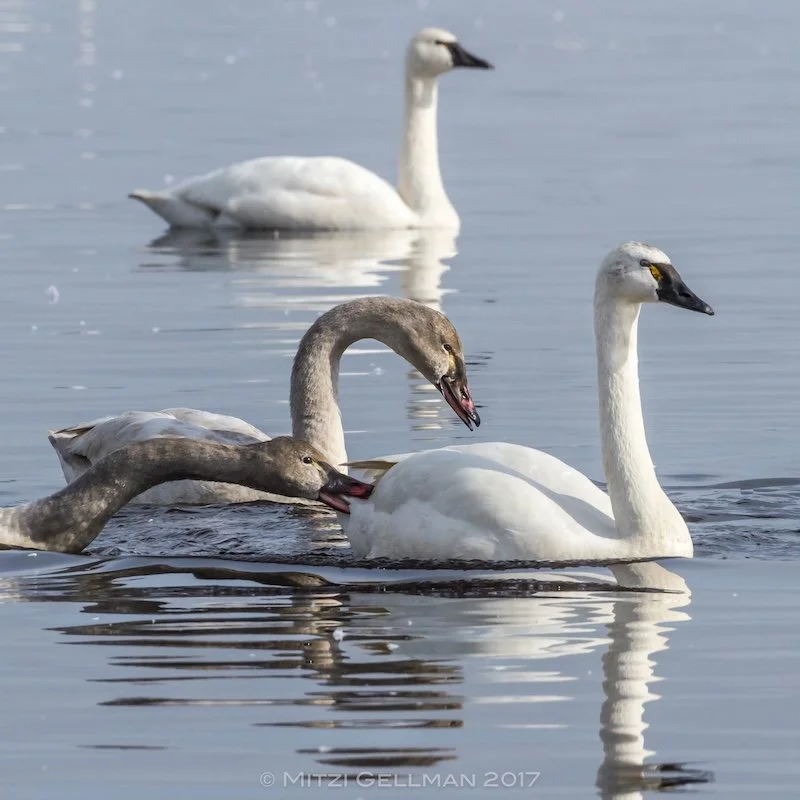
Tundra Swans. Photo: Mitzi Gellman/Audubon Photography Awards
Tundra Swans are large birds, weighing up to 20 pounds. They are 47 to 58 inches long with an impressive wingspan of six to seven feet. Their bodies are bright white, with black beaks and feet. Most adults have a small yellow spot on their bill near the eye, although this can vary. Juveniles are grayer, as if they forgot to wash after a long day playing outside.
Tundra Swans are dabblers, meaning they submerge their heads and necks to pull up underwater vegetation and roots.
They are monogamous, often courting for months before mating for life. Once paired, they usually stay together for life and migrate, feed, and raise young as a couple.
Breeding occurs in the far north of Canada and in western and northern Alaska. Each pair has one brood per year, incubating the eggs for 31 to 40 days. Cygnets are precocial, which means they can walk within hours of hatching. Their first flight is typically within 60 to 70 days. And that first flight is just a teaser for what’s to come.
In the fall, just before their breeding grounds freeze, family groups begin their long migration. They spread those huge wings and fly over 4,000 miles south and east to visit us. The journey can take nearly three months.
Swans begin to arrive here in November. This season’s first eBird report at Elizabeth Hartwell Mason Neck NWR was on November 13, 2025. At peak winter numbers, flocks can reach several hundred birds. One checklist on December 29, 2025, for example, counted 460 swans. I first saw them just one year before that, on December 29, 2024: a cold, sunny morning and a perfect way to end the year.
If you’d like to see them, check eBird for recent reports. Two trails often provide excellent viewing opportunities at Elizabeth Hartwell Mason Neck NWR. The Woodmarsh Trail is undulating and bumpy, with a large, covered viewing platform just over a mile from the parking lot. The Great Marsh Trail is paved, with an observation platform about three-quarters of a mile from the start. Try to visit around high tide, when the swans are more likely to gather where you can see them. Bring binoculars, a scope or a camera with a telephoto lens to get the best views.
If you miss this year, mark your calendar for late November and start watching eBird. The swans will be back.
You can read more about Tundra Swans on a number of Cornell Lab websites: eBird, All About Birds and Birds of the World. Another resource is the U.S. Fish & Wildlife Service, which chose the Tundra Swan as its February 2024 Bird of the Month.
Kent Blumberg is an MBA professor, passionate bird photographer and voracious reader.