
Letter to Our Members: Flickers of Hope in Winter
Photo: Northern Flicker, Barbara Tomawski/Audubon Photography Awards
Danielle Brigida
Years ago, I visited the bird banding station at Patuxent Research Refuge, and one of the birds we caught was a Northern Flicker. I’d been birding for about five years, but banding was new for me and exhilarating in a way I hadn’t expected. Seeing birds up close collapses a distance you don’t even realize exists.
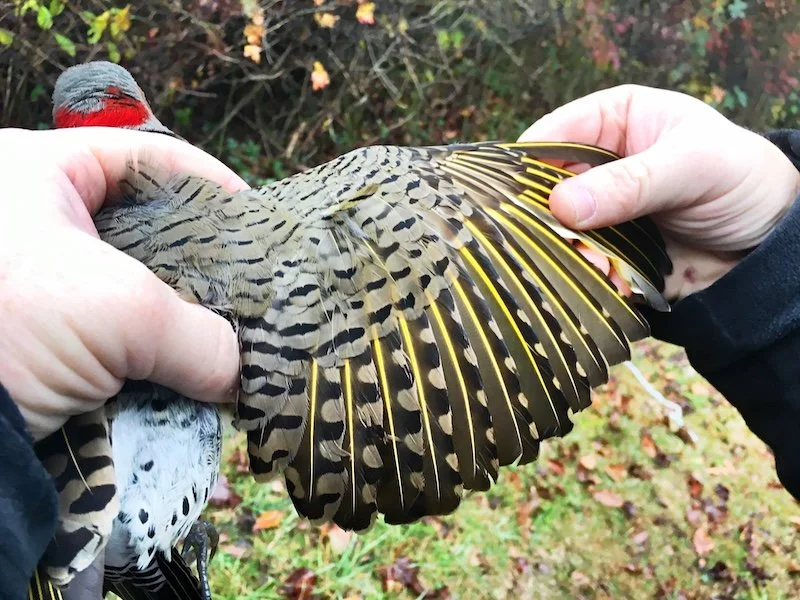
Northern Flicker wing, Danielle Brigida
I’ll never forget that bird. I’d been enjoying watching flickers, confidently thinking I knew them. But holding one, and extending its wing feathers, I gasped. He was so vibrant. What were normally just flashes of color were shockingly vibrant up close. The bird I thought I understood suddenly revealed itself as something far more magnificent.
Moments like this are part of what keeps me birding . . . a small observation that shifts into something deeper. Not just recognition, but awe. A swell of appreciation that keeps me coming back to the birds. Even when times are hard. Even when much of the news we’re reading is devastating.
And that’s the thing about flickers and about noticing birds. Their presence can be just as easily overlooked as it can be celebrated.
Woodpeckers, in particular, are marvels of specialization. Their skulls are reinforced to absorb shock, their brains cushioned to withstand repeated impacts. Their feet are zygodactyl with two toes forward, two back—perfect for gripping bark, while stiff tail feathers act like a built-in kickstand, bracing them against vertical surfaces. Even their tongues are extraordinary, long and barbed, wrapping around the skull when retracted and extending far beyond the bill to spear insects deep in crevices.
Even though Northern Flickers are woodpeckers, they don’t behave quite like the others. You’re just as likely to find one on the ground as on a tree, probing the ground for ants—a preferred food.
When flickers take off, that bright white rump flashes like a white flag, and when the wings open, the underfeathers glow—yellow in the East, red in the West. They’re birds of edges and openings, and they can be found on forest margins, open woods, parks, golf courses, and yards. In winter, especially, listen as much as you look. Their one-noted shriek that sounds like “peough” can carry through leafless trees. I've found their bounding flight becomes recognizable over time. And when the woods are mostly brown, that sudden glimpse of yellow feels like a welcome burst of light.
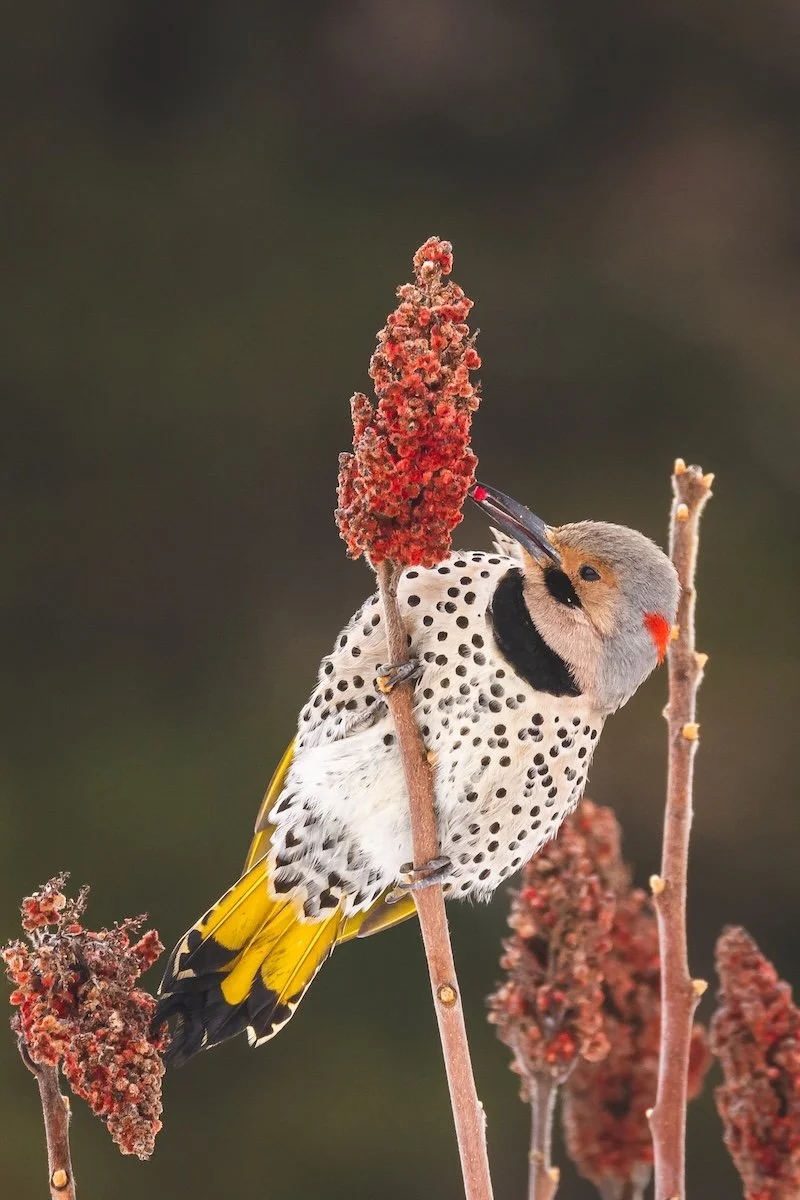
Northern Flicker, Jennifer Miner/Audubon Photography Awards
During banding, it was the first time I noticed that at the right angle, some shapes in the flicker's feathers look like hearts. Which makes northern flickers feel like the perfect bird for a season when we need both more sunshine and hearts. I think about them every Valentine's Day.
To spot them, listen for their shrieking call or scan areas for a Blue-Jay-sized, brown, spotted bird standing upright on the ground.
Working to help birds, I cherish moments in the field. It's a reminder that helping science and volunteering is about more than contributing additional data. It sharpens your noticing. And suddenly you realize there are flickers of hope everywhere.