
Mystery Arlington Bird Carried Disease First Found in Alaska
Photo: Red-Breasted Nuthatch with deformed beak, Alaska Science Center, USGS
Brad Scriber
An enigma alighted on an Arlington birdfeeder in late July, a sparrow-sized bird with an inverted feeding style and a prodigious beak almost as long as its brown and white body. Who was this strange visitor?
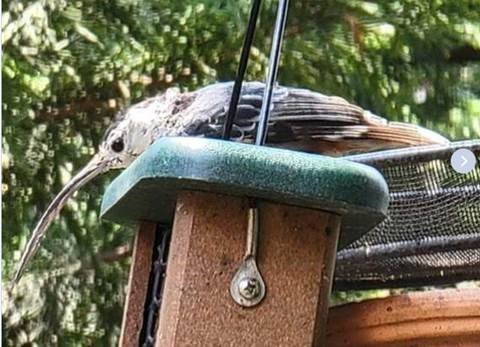
White-breasted Nuthatch with avian keratin disorder in Arlington. Photo: Chris Traugott
Thanks to a local network of experts, the bird, photographed by Chris Traugott, was quickly identified as a White-breasted Nuthatch, but there was more to this bird’s story.
Its manner of feeding matched the behavioral profile of a nuthatch, but its Cyrano-sized beak didn’t match the silhouette of one.
Almost certainly, this bird was suffering from avian keratin disorder (AKD), a debilitating condition marked by distorted and hyperextended bills in a variety of birds.
Biochemist Joseph DeRisi, reviewing a photo of the bird, called it “classic AKD, although the only way to know for sure is to get a sample.”
What DeRisi would look for in a sample is the genetic signature of the Poecivirus, a member of a large group of viruses that includes polio and the common cold. DeRisi was involved in a 2016 study led by Maxine Zylberberg, a fellow biologist at the University of California, San Francisco, which found a likely connection between this newly discovered virus and the beak deformities. In this and follow-up work with a larger sample, Poecivirus was present in every bird with an abnormal beak, but only in a small fraction of healthy birds.
The research, a collaboration between the U. S. Geological Survey, the California Academy of Sciences, and UCSF researchers, used advanced genetic sequencing to identify the virus. Previous research had ruled out many known bird diseases as well as bacteria, fungi, trauma and other possible drivers of the disease.
Avian keratin disease was first spotted in the 1990s among Black-capped Chickadees (Poecile atricapillus) by USGS researchers in Alaska. Red-breasted Nuthatches are among the species most frequently reported with AKD in Alaska. The disease has since been identified in thousands of individual birds across more than 80 species including hawks, crows and jays. The disorder has spread to the East Coast and parts of Europe.
Danielle Gerik, a biologist at the USGS Alaska Science Center says the disorder has been circulating in Virginia for more than two decades. “The earliest record we have in Virginia is of a Northern Cardinal and House Sparrow in 2001,” she says. “There are other reports of affected White-breasted Nuthatches in this region.”
The USGS researchers have been tracking reports of beak deformities since AKD was first described. Bird-spotters can report cases and send photos to the USGS at this link.
John Tracey, State Wildlife Veterinarian with Virginia’s Department of Wildlife Resources says AKD is on their radar, but confirming individual cases is not easy. “We don’t often get to see birds that are in good enough shape to pursue diagnostics,” he notes.
Even if an intact specimen were to be submitted to the state, there are no off-the-shelf tests for the Poecivirus. Collaboration with national and regional labs is required.
A few years ago, an alert from the Sandhills area of North Carolina about AKD in the Red-cockaded Woodpecker got Tracey’s attention. In an endangered or threatened species such as this, "any bottlenecks are potentially worrisome,” he notes.
Malformed, oversized and disfigured beaks that cross or curve in odd ways result from rapid growth in the rhamphotheca, a keratin sheath that sits atop the jawbones. This untamed keratin makes essential tasks like preening and foraging extremely difficult for birds with AKD. Imagine trying to button your shirt or pick up an almond with foot-long fingernails.
Afflicted birds make do as best they can. Gerik says her colleagues at the USGS “commonly hear of birds with elongated beaks turning their heads to pick up seeds because they're unable to perform normal foraging behaviors. It’s quite impressive all the ways birds adapt their behaviors to deal with having a beak deformity,” she adds.
Notwithstanding such striving, it’s a serious and often deadly barrier to survival. “A bird with such a deformed beak will be unlikely to feed well,” says UCSF’s DeRisi.
Researchers are working to understand how exactly the disease leads to deformed beaks, which sometimes develops in birds born with normal bills. They are also looking for certainty about how it spreads.
Gerik notes that even if some cause other than Poecivirus is uncovered, cleaning birdfeeders can help prevent the spread of disease in general. She recommends cleaning feeders in diluted bleach at a ratio of one unit of bleach to 32 units of water.
More tips on keeping your feeders free of disease can be found here.
Brad Scriber is a freelance writer based in Arlington.