NVBA NEWS BLOG
Welcome to the blog for Northern Virginia Bird Alliance, a wealth of resources about northern Virginia birds, wildlife, habitat conservation and restoration, native plants, wildlife-friendly gardening, advocacy and more.
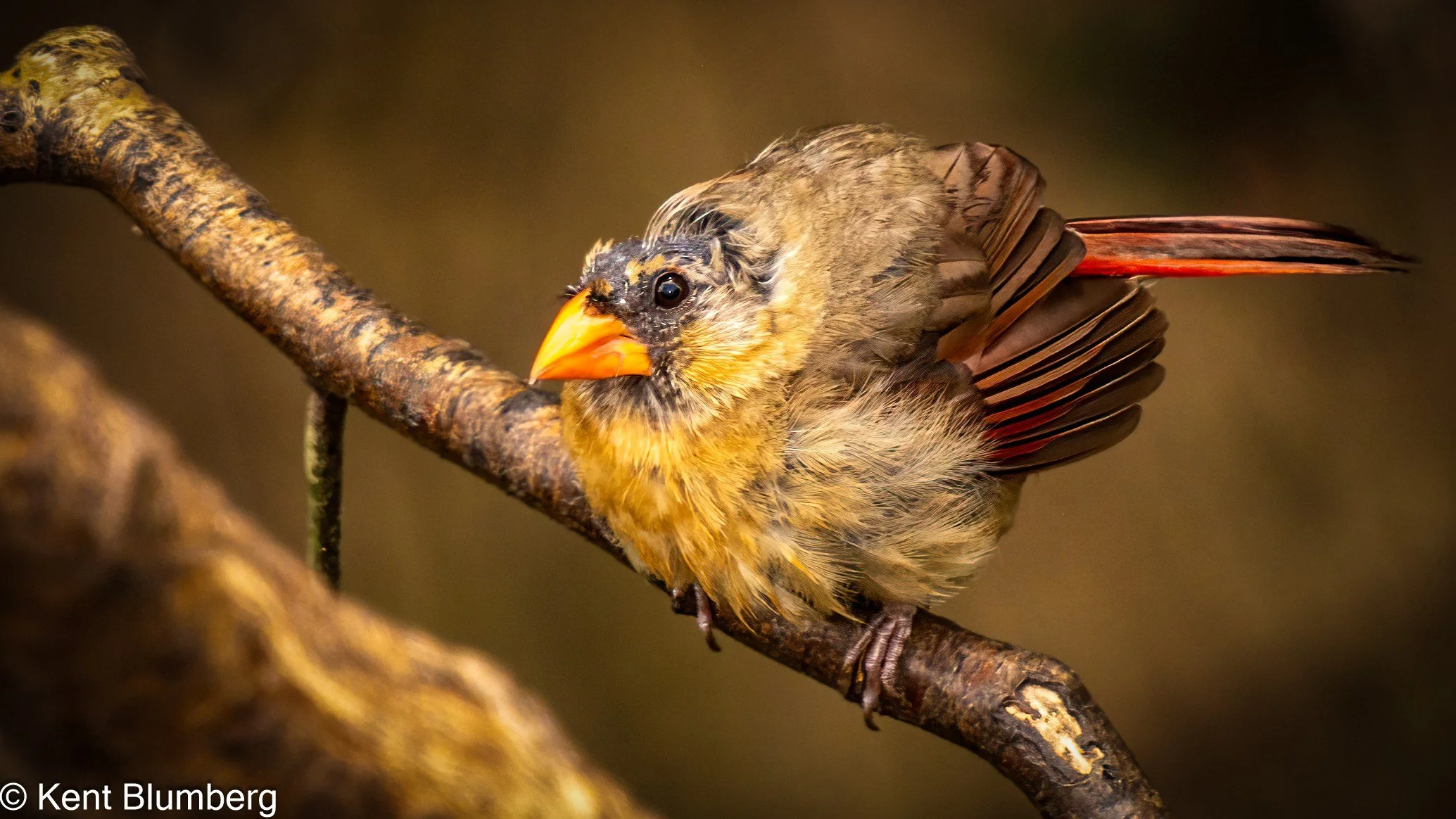
Bad Feather Days: Molt in Backyard Birds
Why is that Northern Cardinal bald? We all have bad hair days. Birds have bad feather weeks every late summer as they go through molt. Some, like Northern Cardinals, take the process to the extreme.
Photo: Northern Cardinal, Kent Blumberg
Kent Blumberg
Why is that Northern Cardinal bald? We all have bad hair days. Birds have bad feather weeks every late summer as they go through molt. Some, like Northern Cardinals, take the process to the extreme.
In a month or two we’ll start noticing changes in the birds around us as many of them molt. Let’s take a look at why birds replace their feathers, how the process works, and when it happens.
Female Northern Cardinal molting. Photo: Kent Blumberg
Feathers are made of keratin, like our hair and fingernails. Feathers serve many purposes for birds: flight, insulation, waterproofing, courtship, and camouflage. Feathers need to stay in top condition to do those jobs well. Wear or damage can hurt flight efficiency.
Unlike hair and nails, feathers grow quickly and then stop. Keratin is not live tissue and cannot be repaired, so when feathers get damaged, they must be completely replaced. That’s the main reason birds replace their feathers each year.
Another reason birds molt is to switch from their everyday plumage to brighter breeding colors. Even birds that put on fancy coats for breeding season spend most of the year in basic, less colorful plumage. Those that dress up for breeding do so only for the breeding season. Examples in northern Virginia include American Goldfinches, Wood Ducks, Indigo Buntings, and others.
In molting, new feathers growing in follicles push the old feathers out. Because growing those new feathers takes a huge amount of energy, birds carefully time their molts so as not to overlap with breeding or migration. For many birds in northern Virginia, late summer is peak molt season. There’s still a lot of food available and no need yet for migration.
Red-bellied Woodpeckers, one molting. Photo: Kent Blumberg
Molt patterns also vary by age. Young birds often go through several molts in their first season. Others take several annual molts to reach full adult plumage. Bald Eagles, for example, take four to five years, while Ring-billed Gulls can take three years.
While most birds that have a breeding plumage go through a partial molt to don their bright colors, others, like the Northern Cardinal or the European Starling rely on feather wear to reveal their brighter colors.
In late summer, male Cardinals often look duller, their red feathers hidden beneath a tan or gray wash. Over the winter, as the edges of feathers wear, the underlying red color is exposed. Similarly, a late summer European Starling will sport buff-colored tips on belly and breast feathers. By breeding season those tips will have worn away, leaving a glossy black breast.
Most local birds adopt their breeding plumage in early spring, but male Wood Ducks get a jump on the game. They swap to dull plumage in early summer and then back to their brilliant breeding colors in early fall. They fast-track the change because their courtship begins in late fall. They need the dull colors to help them hide while they temporarily lose the ability to fly during wing molt, but then jump right back into glorious technicolor.
Back to our bald Northern Cardinal. For unknown reasons, Northern Cardinals and Blue Jays often replace all their head feathers at once. When the old feathers get pushed out, they can look bald (like the female Northern Cardinal in the accompanying photo). Fortunately, new feathers emerge quickly.
Watch for signs of molt later this summer. Birds may look ragged, patchy, or downright disheveled. Remember that this is a stressful time for birds, so do your best to give them space. If you have regular visitors to your backyard, consider taking weekly portraits of them, starting now through August, to see how they change as they go through molt.
Kent Blumberg is an MBA professor, passionate bird photographer and voracious reader.
Arlington’s Nesting Ravens
This spring Arlington residents who have not spent enough time further away to observe the breeding and nesting cycle of the Common Raven had a rare treat.
Photo: Common Raven, David Howell
Steve Young
This spring Arlington residents who have not spent enough time further away to observe the breeding and nesting cycle of the Common Raven had a rare local treat. A pair of ravens built a nest in the Glencarlyn Park area. They appear to have raised two chicks successfully. I have enjoyed following their activities, and David Howell (whose photos appear in this article) documented the nesting process.
Until recently, Common Ravens were a rare sight in Arlington, and nesting was not confirmed. After being reduced to mountain populations, ravens began reappearing in northern Virginia in the last few years. There also have been reports of them nesting in the DC Metro area.
In Spring 2022, birders and staff at Glencarlyn Park’s Long Branch Nature Center started seeing and hearing a pair of Common Ravens frequently. They were clocked at the Nature Center and Sparrow Pond, and they showed particular interest in the Route 50/Arlington Blvd. bridge over Four Mile Run. But no one reported seeing a nest. In late winter 2022-2023, however, the ravens reappeared at the same place.
Around January 2023, we saw and heard the ravens flying over the Glencarlyn area. Frequently American Crows mobbed them aggressively. But I observed an interesting behavior evolve. I saw ravens “pop up,” make a short flight, vocalize, and then disappear into a perch before the crows could arrive. The ravens appeared to be playing mind games with the crows, and, perhaps due to raven craftiness and crow frustration, mobbing ended. I later saw a crow and raven flying together in close formation as if they were pals.
Incubating the eggs, David Howell
In February, several people observed the ravens building a nest on a bridge abutment. By mid-February a raven was on the nest, apparently brooding eggs! The female takes on this job, and the male brings her food. When walkers stopped near the bridge to observe the nest, one of the ravens, probably the protective male of the pair, often flew from one nearby tree to another, calling, likely trying to draw interest away from the nest.
Distracting viewers, David Howell
At least one of the chicks hatched around March 22, and was being fed as early as March 23. Later observations and photos showed two nestlings being fed, although the time of the second hatch is uncertain. One nestling was quite a bit larger than the other. By late April, it looked as if only one bird remained in the nest, and then there were none. Those of us who had been watching the nest exchanged anxious emails, concerned that one or both of the chicks had not survived.
Younger chick about to fledge, David Howell
But, we were wrong! The chicks’ departures from the nest had been stealthy, and no one reported seeing or hearing them on the ground. In May, we’ve seen and heard at least one and almost certainly both chicks. They’ve been perching in nearby tall trees, begging for food. One of the juveniles is a loud and persistent beggar, while the other seems content to keep a quieter profile. We’ve also seen a few awkward flights from treetop to treetop. Whether juveniles are preyed on by other birds, like American Crows, is always a concern. But, harking back to behavior I saw earlier, it may be that the crows and ravens have reached a modus vivendi, because in late May I saw a juvenile calling, perched right next to a crow, which was not harassing it.
Raven parents feed their young by regurgitating food into their mouths, and they continue to feed them for weeks after they fledge until the juveniles begin to forage on their own. As of May 20, we were still hearing lots of begging. We all have our fingers crossed that both juveniles survive and that the parents return to nest again in Arlington.
Osprey Killing a Crow in Alexandria, VA
Carol Stalun, who is a skilled and talented nature photographer, took photos of an Osprey killing a crow. This is probably the first incident, documented with photographs, of an Osprey killing a wild bird.
Photo: Osprey and Crow, Carol Stalun
William Young
Carol Stalun, who is a skilled and talented nature photographer, took photos of an Osprey killing a crow. This is probably the first incident, documented with photographs, of an Osprey killing a wild bird.
On Saturday, March 6, 2021, Stalun saw an Osprey along the Potomac River in Old Town Alexandria. Stalun was in the area where there is an Osprey nest from previous years on a platform on pilings in the river. She had seen a male Osprey in the same area the previous day (the first one she had seen in 2021), and she was checking to see if he was still there.
At 8:33 a.m., Stalun saw a male Osprey on a piling not far from the platform with the nest. At first, she thought the Osprey had a fish in his talons. When she looked more closely, she saw that the Osprey had a crow. Fish Crows were mobbing the Osprey, and Stalun assumed from the vocalizations of the other crows and the location on the river that the Osprey's victim was also a Fish Crow. After being harassed by the other crows, the Osprey flew off with the crow in his talons, did a circle, and returned to the piling. He continued to peck at the crow, who was still alive. The Osprey pecked at the crow a bit longer before flying with it to the platform with the nest, dunking the crow in the river along the way. At 8:45 a.m., the Osprey arrived at the nest and dropped the crow into it. Because the nest is deep, the crow was no longer visible after the Osprey dropped it. Stalun had not seen the Osprey initially grab the crow.
The incident is exceptionally unusual for many reasons.
According to the Cornell Lab of Ornithology's Birds of the World, almost every published account says that 99 percent of the diet of Ospreys consists of live fish, with a wide variety of fish species taken. Fish captured generally measure 25–35 centimeters (10-14 inches) and weigh 150–300 grams (5-10 ounces), although fish up to 2,000 grams (4.4 pounds) have been reported. According to The Sibley Guide to Birds (2nd edition), a Fish Crow weighs 280 grams (about 10 ounces), so it is in the normal weight range of fish Ospreys normally catch. A Fish Crow measures 38 centimeters (15 inches), so its body is only slightly above the size range of normal Osprey prey.
Ospreys are one of the most widely-distributed birds in the world. They are found on all continents except Antarctica. Unlike most bird species who conceal their nests, Ospreys build huge nests, usually in open areas. The nests are easy to monitor and study. Some nests are equipped with webcams so that researchers can see exactly what prey is being captured. There is believed to be no documented evidence of an Osprey bringing bird prey to its nest.
According to Birds of the World, there are anecdotal observations of Ospreys catching non-fish prey, including birds, snakes, voles, squirrels, muskrats, salamanders, mollusks, and even a small alligator. There is a documented report of an Osprey attacking a lure pigeon used by hawk banders at Cape May, New Jersey. A lure bird is placed in a small harness, and its flapping induces hawks or falcons to fly into a nearby net. The lures are captive birds who are not wild.
Birds of the World also mentions reports of Ospreys trimming their nests with the skeletal remains of birds, but this might not represent prey taken. For instance, remains of birds found in nests in Arabia were up to the size of a Socotra Cormorant (80 centimeters, or 31 inches) and Slender-billed Gull (37-42 centimeters, or 14.5-16.5 inches), but it is unclear how or if these species were caught by an Osprey. An Osprey expert with whom I communicated suggested that the dead crow might have been put into the nest for decoration rather than to be eaten. We do not know what happened to the crow after it was deposited in the nest. But Ospreys are not known to decorate their nests with either birds or feathers. Ospreys sometimes interweave plastic bags or other refuse into their nest. This might to be done more for structural rather than aesthetic reasons.
An Osprey usually will not bother other birds unless it feels threatened. I spent many hours shooting footage of an Osprey nest at the Belle Haven Marina in Alexandria for my videos Osprey Love Nest and Osprey Love Nest 2: Feeding and Fledging. The Belle Haven nest was on a piling in the river, near a boat ramp. The Ospreys at that nest were not bothered when ducks, geese, and grebes swam directly under the nest, and they never showed any interest in attacking these birds. The Ospreys also paid no notice to House Sparrows who built a nest among the sticks of the Osprey nest. Only large birds flying above the nest caused the Ospreys to become alarmed.
The crow was not scavenged, because it was clearly alive in some of Stalun's photos. Had it been injured and flapping around in the water, it is unlikely that the Osprey would go after it. Ospreys often see uninjured birds swimming and flapping in the water, and they normally leave them alone. I don't know if a certain type of thrashing in the water might trigger a different response than an uninjured bird swimming. I am unaware of any reports of this happening.
Crows do not often attack Ospreys. The corvid expert Dr. John Marzluff, from the University of Washington, sent me an article that he co-authored about the mobbing of Ospreys by American Crows. The article said that American Crows aggressively mob a variety of natural predators and learn to recognize unique threats. Because mobbing is a costly and risky behavior, Marzluff and the other authors hypothesized that crows would selectively ignore benign members of other species that look similar to predators, perhaps even learning to do so. Through a series of natural observations and experiments, they found that American Crows were more likely to mob Red-tailed Hawks and Bald Eagles than Ospreys. Mobbing intensity was higher toward a taxidermic mount of a Red-tailed Hawk than toward a mount of an Osprey, indicating that mobbing increases with the risk posed by the predator. However, the authors also found that Ospreys were more likely to be mobbed in locations where they rarely occur, suggesting that crow populations that frequently encounter Ospreys habituate to this benign raptor. For the incident that Stalun witnessed, the Osprey was in a location where it regularly occurs, and it is possible that the mobbing behavior by the Fish Crows began only after the Osprey had seized its victim.
An Osprey expert with whom I communicated suggested that the crow might have been trying to get at a fish the Osprey had caught. This is improbable, because had the Osprey been flying with the fish, the crow would not have been able to carry it, even had the Osprey let go of it. Also, it is unlikely that an Osprey with a fish (its normal food) would drop it and grab a crow (not its normal food).
The most likely explanation might be that a Fish Crow was harassing the Osprey and got a bit too close. Smaller birds tend to attack a larger bird in groups rather than as individuals because there is safety in numbers, and the larger bird will have more difficulty grabbing any one of them. Osprey's have very strong legs and feet, and if the one Stalun saw managed to grab the crow's back, the crow would not have had much of a chance to escape. When the Osprey took the crow to the piling, it pecked at it, perhaps to kill it and make it easier to carry. It is not known whether the Osprey ever ate the crow.
Photographs of the Osprey with the crow can be seen at Stalun's website . The 60 photographs show the encounter in chronological order, starting with the Osprey holding the crow on the first piling and ending with the Osprey dropping the crow into the nest. Stalun's photographic documentation of this event is an example of how citizen science can produce an important contribution to ornithological research.
William Young is a writer from Arlington, Virginia. His book The Fascination of Birds: From the Albatross to the Yellowthroat was published by Dover in 2014. He has taught numerous classes about birds for the Audubon Society of Northern Virginia. The nature videos he has created for his YouTube channel have had more than 650,000 views. Along with Ashley Bradford, he is the co-creator of the MPNature.com website, which contains a wealth of information about the natural history of Monticello Park in Alexandria, VA.
Birds of the Month: Albert and Wisdom
Samuel Taylor Coleridge’s most quoted (and misquoted) poem, “The Rime of the Ancient Mariner,” tells the story of a sailor who shoots a friendly albatross, cursing himself and his crew. As punishment, he is forced to wear the bird around its neck, making the albatross a symbol of his burden and regret. Good omens in life and bad omens in death, albatrosses have become symbols of both good and bad luck. Fittingly, while some real albatrosses have been fortunate, others have had tough luck.
Photo: Wisdom the Laysan Albatross, Madalyn Riley
By Elise Brosnan
“Water, water every where,
Nor any drop to drink.”
Samuel Taylor Coleridge’s most quoted (and misquoted) poem, “The Rime of the Ancient Mariner,” tells the story of a sailor who shoots a friendly albatross, cursing himself and his crew. As punishment, he is forced to wear the bird around its neck, making the albatross a symbol of his burden and regret. Good omens in life and bad omens in death, albatrosses have become symbols of both good and bad luck. Fittingly, while some real albatrosses have been fortunate, others have had tough luck.
Albatrosses have the world’s largest wingspans, maxing out at nearly 11 feet, with the record exceeding 12 feet. They can glide for hours on their massive wings, relying on wind currents to travel where they need to go. However, albatrosses are not so good at flapping. Found in the South Atlantic, South Pacific, and North Pacific, albatrosses stay away from the tropics, and for good reason. The area of ocean around the equator is what scientists call the Intertropical Convergence Zone (ITCZ) and what sailors call the doldrums, a place where hot air rises straight upwards, and transverse breezes are few and far between.
Albatrosses are so dependent on temperate sea breezes that if they find themselves on the wrong side of the ITCZ, they may not be able to cross back. One particularly unlucky Black-browed Albatross, Albert, has been trapped in the North Atlantic Ocean since a freak storm carried him north in 1967. Originally a native of Argentina, Albert spent 40 lonely years returning to a Northern Gannet breeding colony in Scotland, looking for love, but finding only Northern Gannets. While albatrosses do not belong in the North Atlantic, strandings may not be all that uncommon. On the tiny Faroe Islands between Iceland and Norway, the word for albatross is “gannet king,” describing lost albatrosses’ habit of seeking gannets for company.
Black-browed Albatross, Evan Siegel/Audubon Photography Awards
Other albatrosses are more fortunate. With an expected lifespan of 70 years, they are some of the longest-lived birds. The record holder is Wisdom, a Laysan Albatross who was first banded in 1956. Wisdom nests on Midway Atoll in the Pacific. In 2011, an earthquake off the coast of Japan triggered a tsunami on the island that killed over 100,000 nesting birds. Fortunately, Wisdom survived, and has since thrived. Last year, at the approximate age of at least 68, she hatched another chick, bringing her total number of offspring to nearly 40.
Albatrosses are a lot like people: some are lucky, and some are seriously unlucky. If you would like to learn about how you can give all kinds of albatrosses some extra help, follow the link here: help albatrosses
Sources:
http://news.bbc.co.uk/2/hi/uk_news/scotland/highlands_and_islands/6641021.stm
https://www.npr.org/2018/12/07/674481057/wisdom-the-albatross-worlds-oldest-wild-bird-lays-another-egg
https://www.fws.gov/pacific/news/news.cfm?id=2144374743
Bird of the Month: The Pfeilstorch
In the 19th century, a curious phenomenon stumped European bird watchers and zoologists. Why did some species of birds disappear and then reappear every year? People back then had no way to track birds as they traveled long distances, so they had to come to their own conclusions.
Photo: White Stork, Wink Gaines/Audubon Photography Awards
By Elise Brosnan
In the 19th century, a curious phenomenon stumped European bird watchers and zoologists. Why did some species of birds disappear and then reappear every year? People back then had no way to track birds as they traveled long distances, so they had to come to their own conclusions.
The 1822 Pfeilstorch is currently housed at the University of Rostock in Rostock, Germany. Image Credit: University of Rostock
One popular theory was that birds hibernated at the bottom of a pond or stream, the same strategy used by aquatic frogs and turtles. This claim was buoyed by fisherman, who said they were catching birds in their nets. In earlier times, other scientists, such as Aristotle, believed that birds metamorphized, transforming into other bird species like caterpillars transform into butterflies. Other theories were even more bizarre. In 1703, a Harvard professor proposed that birds were flying to the moon!
In 1822, one White Stork helped put an end to this mystery. The bird landed near the German village of Klütz with a 30-inch spear through its neck. The spear was discovered to be made from African wood, meaning this stork must have traveled between the continents. Being a literal people, the Germans felt this strange, new animal needed a new name: Pfeilstorch, or arrow-stork. Amazingly, there have been 24 subsequent recorded Pfeilstorchs—birds that have successfully migrated to Europe with an African spear embedded in their flesh.
The Pfeilstorch was the first concrete evidence for migration, the annual, large-scale movement of birds between their breeding and non-breeding territories. Migration may be less fantastical than space travel or shape-shifting, but it is no less impressive. Twenty-five recorded Pfeilstrorchs traveled 2,000 miles to Africa, got impaled, and then traveled 2,000 miles back. Their 4,000mile round trip pales in comparison to the Artic Tern, which makes an almost 60,000-mile voyage between the poles. The Common Swift has a shorter migration, traveling from its breeding grounds in Scandinavia to its feeding grounds in Sub-Saharan Africa. However, because of the recent development of lightweight accelerometers commonly used in smartphones, researchers have been able to prove that the Common Swift has the longest uninterrupted flight of any bird. Common Swifts eat, drink, mate, and even sleep while airborne, and consequently, some of them never set foot on the African continent they return to each year. By the time they touch back down in Scandinavia, these birds have been airborne for an entire 10 months.
Although we have had proof of migration for nearly 200 years, in many ways it still perplexes us. We still don’t have definitive answers to what triggers migration, how birds navigate across oceans, or why birds choose to go on these long and arduous journeys at all. With all of these unknowns, one thing is for certain: technological innovations like accelerometers, as well as random happenstance like the Pfeilstorch, will continue to shed light on one of the most beguiling mysteries of the natural world.
Sources:
https://www.audubon.org/news/the-common-swift-new-record-holder-longest-uninterrupted-flight
https://mentalfloss.com/article/76208/how-stork-solved-scientific-mystery
https://www.allaboutbirds.org/the-basics-how-why-and-where-of-bird-migration/
Bird of the Month: Brown-headed Cowbird
Brown-headed Cowbirds love cows. True to their name, they can often be found alongside herds of cattle or horses, eating insects that much larger animals flush from the grass. Historically, Brown-headed Cowbirds followed bison herds across the Great Plains, but the spread of livestock farming has expanded their range across North America.
Photo: Brown-headed Cowbird, Allison Farrand/Black River Audubon Society
by Elise Brosnan
Brown-headed Cowbirds love cows. True to their name, they can often be found alongside herds of cattle or horses, eating insects that much larger animals flush from the grass. Historically, Brown-headed Cowbirds followed bison herds across the Great Plains, but the spread of livestock farming has expanded their range across North America.
Their arrival has been unfortunate news for many species of birds. Brown-headed Cowbirds reproduce by being brood parasites; instead of nesting and raising their own young, they lay their eggs in the nests of other bird species, which the hosts then raise until adulthood.
Most brood parasites are specialists, meaning they lay their eggs in the nest of only one other bird species. These eggs closely mimic the hosts’ eggs, and their hatchlings closely mimic the hosts’ hatchlings. Because their young make for convincing changelings, the hosts are tricked into caring for them.
Female Brown-headed Cowbird, Doug Ritenburg/Audubon Photography Awards
However, Brown-headed Cowbirds are generalists and are known to have parasitized over 200 species of birds. Most of these birds have young that look nothing like Brown-headed Cowbirds, so why do they choose to raise offspring that are clearly not their own? It turns out that Brown-headed Cowbirds are even bigger bullies than previously thought.
In what researchers call “mafia behavior,” birds that eject Brown-headed Cowbird eggs may be subject to retaliation. In one study, researchers identified several hundred Prothonotary Warbler nests, some of which had been parasitized by Brown-headed Cowbirds. They removed the cowbird egg from some of these parasitized nests, and then protected some of the nests from harassment by cowbirds.
When a cowbird egg was removed from an unprotected nest, the nest had a 56 percent chance of being destroyed, including any eggs or nesting chicks. When the cowbird egg stayed in place, an unprotected nest had only a 6 percent chance of being destroyed. All of the protected nests were undisturbed. Because of this behavior, Prothonotary Warblers that raised a Brown-headed Cowbird had 60 percent more reproductive success than Prothonotary Warblers that had a cowbird egg removed from their nests. Brown-headed Cowbirds are unwelcome guests, but kicking them out may make them even worse.
Sources:
https://www.ncbi.nlm.nih.gov/pmc/articles/PMC1838626/
https://www.audubon.org/field-guide/bird/brown-headed-cowbird#