
NVBA NEWS BLOG
Welcome to the blog for Northern Virginia Bird Alliance, a wealth of resources about northern Virginia birds, wildlife, habitat conservation and restoration, native plants, wildlife-friendly gardening, advocacy and more.

Planting Hope: Engaging Faith-based Communities in Plants for Birds
A session on “Planting Hope: Engaging Faith-based Communities in Plants for Birds,” engaged a full room at the July National Audubon Convention in Milwaukee.
A session on “Planting Hope: Engaging Faith-based Communities in Plants for Birds,” engaged a full room at the July National Audubon Convention in Milwaukee. ASNV’s Audubon at Home Co-Director Robin Duska described how Audubon at Home has built on pioneering work by its outreach partner, Plant NOVA Natives, to certify faith community properties as Wildlife Sanctuaries and to obtain a grant from the Coleman and Susan Burke Center for Native Plants in 2018 for six northern Virginia Christian, Jewish, and Muslim faith communities, whose gardens and educational programs are now in bloom.
Also, on the program, Tom Tribble, immediate past President of the Elisha Mitchell Audubon Society in North Carolina, described EMAS’s work with a Catholic church with a large Hispanic community. John Rowden, the National Audubon Society’s Director of Community Conservation, moderated the session.

Blowing Smoke for a Prize-winning Shot
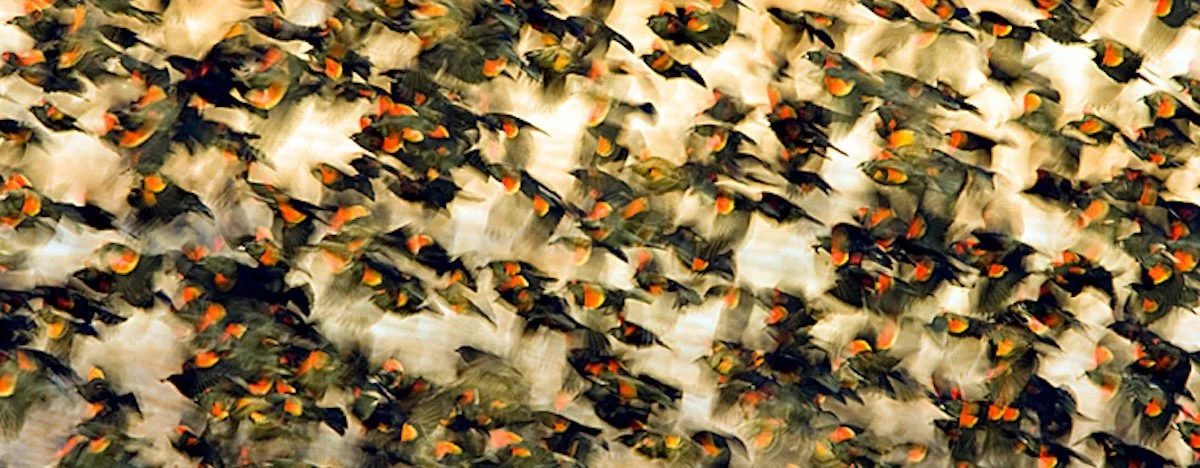
This year’s annual Audubon Photography Awards contest attracted 2,253 entrants from throughout the U.S. and Canada. Kathrin (“Kathy”) Swoboda, of Vienna, VA, won the grand prize for her photo of a Red-winged Blackbird seeming to blow smoke rings.
Photo: Red-winged Blackbird, Katharin Swoboda/Audubon Photography Awards
Local Photographer takes Grand Prize Photo in Huntley Meadows Park
By Lisa Mackem
This year’s annual Audubon Photography Awards contest attracted 2,253 entrants from throughout the U.S. and Canada. Kathrin (“Kathy”) Swoboda, of Vienna, VA, won the grand prize for her photo of a Red-winged Blackbird seeming to blow smoke rings. Kathy is an amateur photographer who started photographing birds about seven years ago in her backyard, which is beside a park. Her son created a professional-looking photography website for her, but she has never sold her photographs. Kathy originally did not plan to enter her prize-winning photo in the 2019 Audubon Photography Awards contest. Instead, she posted the picture on the Facebook site “Birds of Eastern US”, where someone suggested that she enter.
Kathy took her picture in Huntley Meadows Park, which she visits every year. She wanted to capture a bird’s backlit breath on a cold, sunny, early spring morning. The park is a 40-minute drive from her home, but “Huntley Meadows is fantastic,” says Kathy. “In the spring and summer, they have lots of birds, birdwatchers, and people taking pictures. The birds are probably tamer there than in other places because they’re used to seeing more people up and down the boardwalks.” Kathy arrived at the park at 7 am on the March morning when she took her winning photo. She slowly walked along the boardwalk, taking pictures of Red-winged Blackbirds. “A particular bird was very vocal – singing hard and long,” said Kathy. She focused on that bird, and for the first time, she saw the smoke rings. She took 26 shots of that bird, continually trying to get a better one. When the sun rose over the trees, Kathy could backlight the blackbird’s breath. The shadow of the woods behind the bird was an effective backdrop.
Initially, Kathy took photos with consumer-grade cameras. As she learned more about photography, she bought her current camera – a Nikon D500 with Nikon 200-500mm f/5.6E ED VR lens. She explained that its features, including fast focus and large buffer, are ideal for bird photography, and let her shoot many images without pausing. “You can just keep going and going,” she says. She finds her subject and just lets the camera shoot. The camera took 30 shots for her winning photo. Kathy joined a camera club and entered a club competition to hone her photography skills. She is active on social media and at National Audubon’s request, is doing an Audubon takeover on Instagram. “Watch birds, learn all you can about them,” she says. “Focus on one bird or species and know their nature story. That makes for a better picture.”
A retired physician, married with three grown children, Kathy loves all birds.

Bird of the Month: Brown-headed Cowbird
Brown-headed Cowbirds love cows. True to their name, they can often be found alongside herds of cattle or horses, eating insects that much larger animals flush from the grass. Historically, Brown-headed Cowbirds followed bison herds across the Great Plains, but the spread of livestock farming has expanded their range across North America.
Photo: Brown-headed Cowbird, Allison Farrand/Black River Audubon Society
by Elise Brosnan
Brown-headed Cowbirds love cows. True to their name, they can often be found alongside herds of cattle or horses, eating insects that much larger animals flush from the grass. Historically, Brown-headed Cowbirds followed bison herds across the Great Plains, but the spread of livestock farming has expanded their range across North America.
Their arrival has been unfortunate news for many species of birds. Brown-headed Cowbirds reproduce by being brood parasites; instead of nesting and raising their own young, they lay their eggs in the nests of other bird species, which the hosts then raise until adulthood.
Most brood parasites are specialists, meaning they lay their eggs in the nest of only one other bird species. These eggs closely mimic the hosts’ eggs, and their hatchlings closely mimic the hosts’ hatchlings. Because their young make for convincing changelings, the hosts are tricked into caring for them.

Female Brown-headed Cowbird, Doug Ritenburg/Audubon Photography Awards
However, Brown-headed Cowbirds are generalists and are known to have parasitized over 200 species of birds. Most of these birds have young that look nothing like Brown-headed Cowbirds, so why do they choose to raise offspring that are clearly not their own? It turns out that Brown-headed Cowbirds are even bigger bullies than previously thought.
In what researchers call “mafia behavior,” birds that eject Brown-headed Cowbird eggs may be subject to retaliation. In one study, researchers identified several hundred Prothonotary Warbler nests, some of which had been parasitized by Brown-headed Cowbirds. They removed the cowbird egg from some of these parasitized nests, and then protected some of the nests from harassment by cowbirds.
When a cowbird egg was removed from an unprotected nest, the nest had a 56 percent chance of being destroyed, including any eggs or nesting chicks. When the cowbird egg stayed in place, an unprotected nest had only a 6 percent chance of being destroyed. All of the protected nests were undisturbed. Because of this behavior, Prothonotary Warblers that raised a Brown-headed Cowbird had 60 percent more reproductive success than Prothonotary Warblers that had a cowbird egg removed from their nests. Brown-headed Cowbirds are unwelcome guests, but kicking them out may make them even worse.
Sources:
https://www.ncbi.nlm.nih.gov/pmc/articles/PMC1838626/
https://www.audubon.org/field-guide/bird/brown-headed-cowbird#

Bald Eagles Down in the Dumps?
Even if you have not visited the Prince William County landfill, you may have heard that it is a magnet for Bald Eagles, among other birds, including clouds of gulls. You can stand at a random spot and count more than 20 adult eagles at a time.
Photo: Bald Eagle, Antonio Busiello/Audubon Photography Awards
By Roger DiSilvestro
Our Waste Sites May Be a Threat to Birds
Even if you have not visited the Prince William County landfill, you may have heard that it is a magnet for Bald Eagles, among other birds, including clouds of gulls. You can stand at a random spot and count more than 20 adult eagles at a time. Bit of a shame, really, that we have pulled Bald Eagles back from the brink of extinction, thanks largely to federal protective laws, only to have then turn into connoisseurs of rubbish. But nature finds sustenance where it can.
Birds in Jeopardy
Unfortunately, the eagle’s adaptability to available food sources may bring harmful effects. Researchers at Argentina’s National University of Comahue, after examining blood samples from 48 adult Black Vultures that foraged in a Patagonian garbage dump, found that the birds were not only heavier than conspecifics that fed only in the wild but also had:
higher levels of uric acid from eating too much protein,
excessive levels of blood sugar from eating sweets and cereals,
an increased likelihood of developing kidney and other diseases because of the diet heavy on protein and carbos, and
higher levels of immune proteins thanks to the high density of pathogens encountered in the dumps.
The findings are a warning that other birds scavenging on rubbish, including California Condors and our own Bald Eagles, also could be at risk.
Audubon At Home Certification
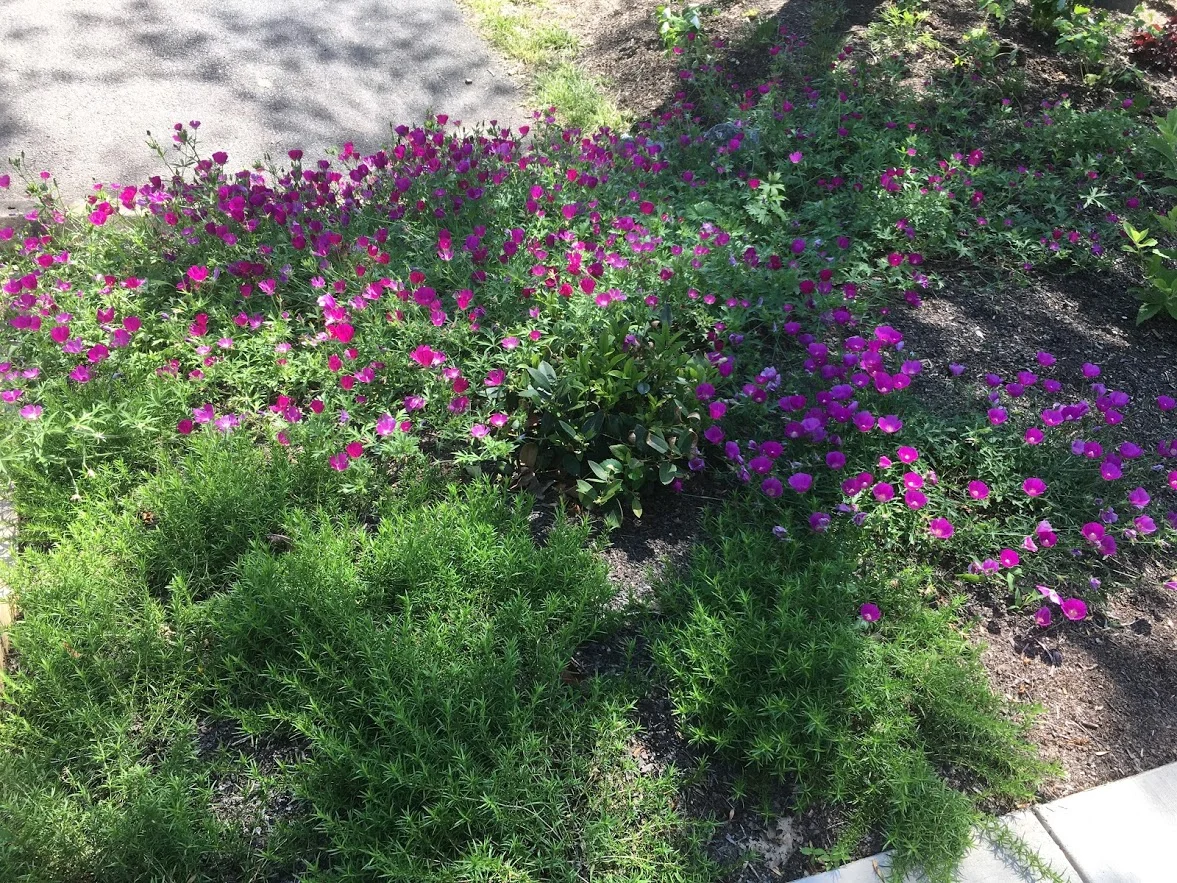
The Audubon at Home program is happy to announce that the Reston Association's Central Services Facility (CSF) has achieved certification as a Wildlife Sanctuary. The site includes a native plant garden that serves as a demonstration site to educate Metro developers on how native plants can be integrated into areas near Metro stations.
The Audubon at Home program is happy to announce that the Reston Association's Central Services Facility (CSF) has achieved certification as a Wildlife Sanctuary. The site includes a native plant garden that serves as a demonstration site to educate Metro developers on how native plants can be integrated into areas near Metro stations.

Robin Duska
As you plan for the fall planting season, ASNV urges you to consider creating more wildlife habitat. Volunteer Audubon at Home Ambassadors are ready to pay you a free visit to advise on which native plants will work best on your property—and our definition of “property” includes homes, HOAs, schools, faith communities, parks, or commercial properties. After the property owner has observed at least 10 of the over 40 Wildlife Sanctuary Species that breed in Northern Virginia, Audubon at Home will certify the property as a Wildlife Sanctuary. Species that are particularly affected by loss of habitat in our area have been selected as these Sanctuary Species.
Our Audubon at Home Wildlife Sanctuary Program embraces the principles of the National Audubon Society’s Bird-Friendly Communities and promotes citizen participation in conserving and restoring local natural habitat and biodiversity. To learn about the program and to request a visit from an AAH Ambassador, click here.
Recovery of the Peregrine Falcon – A Conservation Success Story
In July, 2015, two Peregrine Falcon chicks were found on Market Street in Reston Town Center (RTC). They were taken to the Raptor Conservancy of Virginia and safely released into the wild. No one realized Peregrine Falcons nested in Reston but the chicks prompted a discovery that two adult peregrines were nesting in RTC.
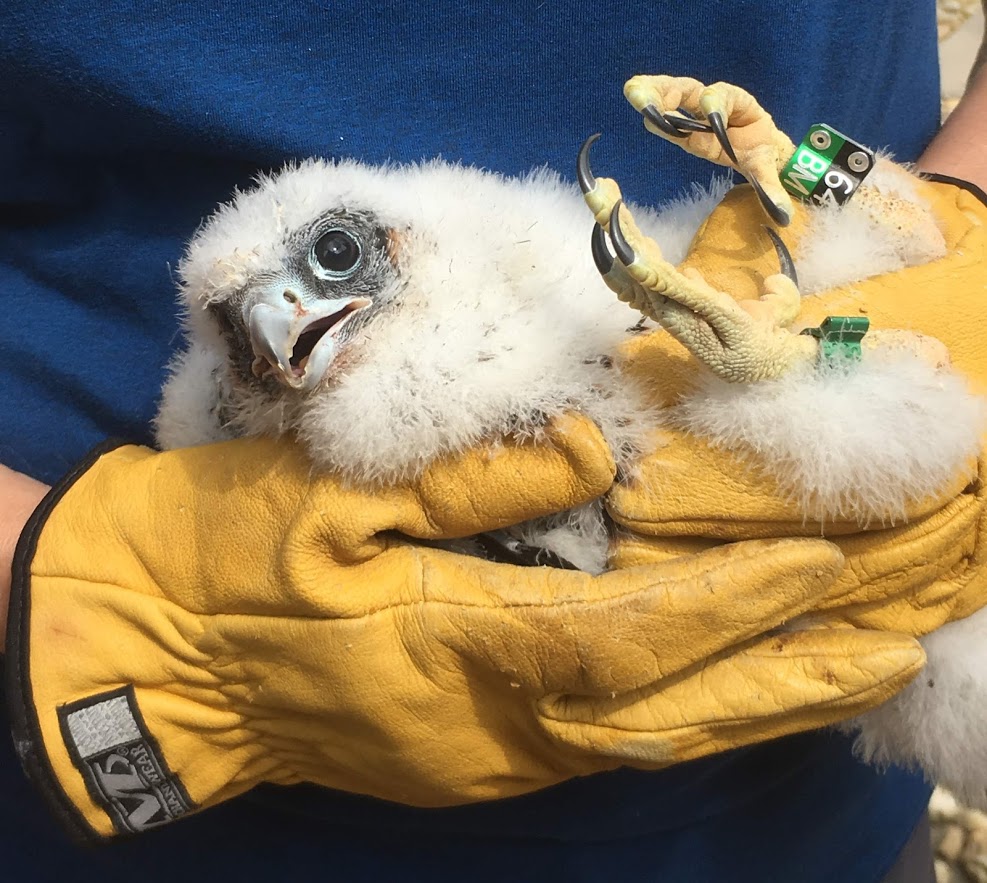
Photo: Banding Peregrine Falcon Chicks, Robin Duska
by Lisa Mackem
In July, 2015, two Peregrine Falcon chicks were found on Market Street in Reston Town Center (RTC). They were taken to the Raptor Conservancy of Virginia and safely released into the wild. No one realized Peregrine Falcons nested in Reston but the chicks prompted a discovery that two adult peregrines were nesting in RTC. The pair has continued to nest there for five years.
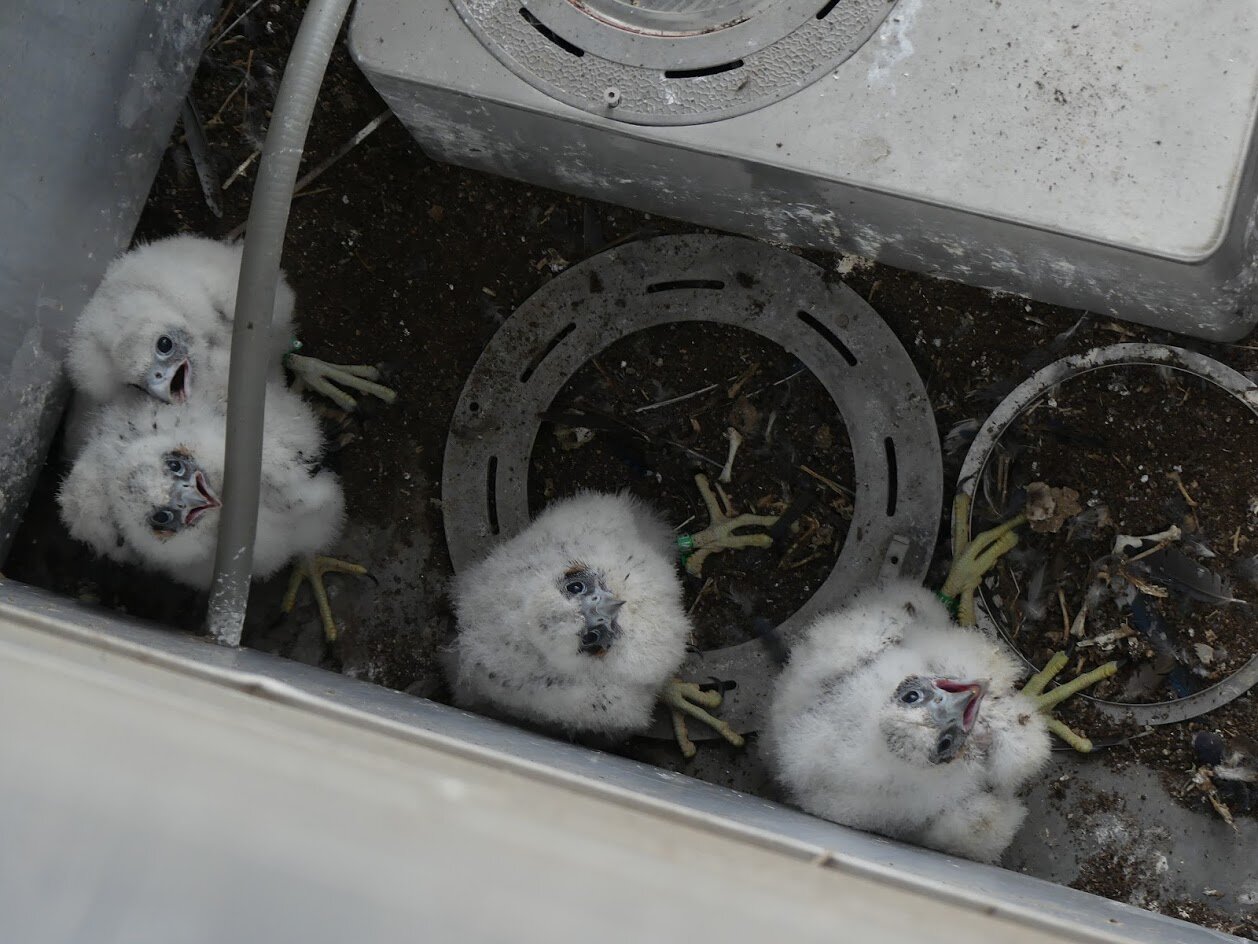
The Reston Town Center peregrines have perhaps found an ideal environment for a nest site: inaccessible, protected from rain and harsh sun, and facing south. The surrounding area is full of prey all year, while tall building roofs nearby provide safe landing areas for fledglings.
The Center for Conservation Biology in Williamsburg, VA monitors Virginia’s Peregrine Falcon population. Last year, the center’s director, Dr. Bryan Watts, and Reston resident and raptor biologist Steve Potts banded the four RTC peregrines’ offspring, assisted by a team of volunteers. Boston Properties, which owns the building with the nest, allowed access for the banding. They allowed access again this year, when four more chicks were banded.
Peregrine Falcon chicks, Robin Duska
Peregrine and other raptor and avian banding is a management tool and the United States Geological Survey licenses master banders. Virginia peregrines receive green bands with alpha numeric coding that identifies the birds. Both banding and satellite tracking allow study of the peregrines’ migratory status. Approximately half of the Virginia peregrines migrate south to establish winter territories ranging from North Carolina to Colombia, South America. Remaining birds establish winter territories within the mid-Atlantic region of the U.S. from Virginia through New York.
The Peregrine Falcon was almost extinct in the eastern U.S. and listed as endangered in 1970. In 1975, The U.S. Fish and Wildlife Service appointed an Eastern Peregrine Falcon Recovery Team to develop and implement a recovery plan. A key part of the recovery strategy was the production and release of captive-reared falcons. (Cade and Fyfe 1978, Cade 2003.) From 1975 - 1985, 307 captive reared birds were released from sites on the Virginia Coastal Plain, as well as Maryland, Delaware, and New Jersey. Additional birds were released in Washington, DC and coastal North Carolina. This breeding population helped populate the eastern peregrine population so much that they were removed from the U.S. Federal List of Endangered and Threatened Wildlife (Mesta 1999).
The historic population of Virginia peregrines nested in the mountains, but modern birds depend primarily on man-made structures for nesting. Peregrines usually nest in towers, but are also found on bridges and buildings. Less common structures include abandoned shacks, water towers, military ships, and active smokestacks at coal-fired power plants. Peregrines are vulnerable to expected risk factors in urban areas, but the Virginia peregrine population has consistently prospered since the first successful breeding between 1979-1982. In 2018, Virginia supported 32 known peregrine breeding pairs – the highest peregrine population recorded in the state. The population continues to grow at an 8% annual rate. Ongoing management activities might partially explain the increase in reproductive rates observed over time. Artificial management structures include added gravel, nest trays, nest boxes, and predator guards. Peregrine pairs nesting within boxes or on trays produced more than twice as many young as pairs that did not. The peregrines’ health can also be monitored. If a young falcon shows signs of disease that can easily be treated, it can be cured, and returned to the nest. Birds of prey suffer mortality rates of up to 70%, so all available monitoring is extremely helpful.
Peregrines are often reported to be the fastest bird in the world, increasing their average cruising flight speed of 24 to 33 mph to 67 mph when in pursuit of prey. When stooping, or dropping on prey with their wings closed, it's been calculated that Peregrine Falcons can achieve speeds of 238 mph.
Dr. Carla Dove, Program Manager at the Feather Identification Lab at the Smithsonian Museum of Natural History, analyzed bird remains found in the RTC nests in 2018 and 2019 and identified 12 prey species: Blue Jays, Common Grackle, European Starling, Mourning Dove, Red-bellied Woodpecker, Yellow-billed Cuckoo, House Sparrow, American Robin, Cedar Waxwing, Eastern Bluebird, and American Woodcock.
For more information about the peregrine falcon, see:
https://www.allaboutbirds.org/guide/Peregrine_Falcon/id

Bird of the Month: Northern Mockingbird
A few years ago, while I was at the dentist’s, I looked out the window and saw a welcome distraction: a Northern Mockingbird landed on a telephone pole, jumped a few feet in the air, and then gracefully fluttered back down. It repeated this behavior for several minutes.
Photo: Northern Mockingbird, Anthony Goldman/Audubon Photography Awards
By Elise Brosnan
A few years ago, while I was at the dentist’s, I looked out the window and saw a welcome distraction: a Northern Mockingbird landed on a telephone pole, jumped a few feet in the air, and then gracefully fluttered back down. It repeated this behavior for several minutes.
What was this bird doing? If I had seen the whole story, I might have figured it out: Bald Eagles engage in aerial combat, Mallards tussle on the ground, and Northern Mockingbirds have dance battles. In what an academic paper delightfully terms “hostile dancing,” mockingbirds “dance” to proclaim the boundaries of their territory and intimidate would-be usurpers.

Northern Mockingbird, Steven Kersting/Flickr CC
Of course, mockingbirds’ dancing is not nearly as renowned as their singing. Northern Mockingbirds famously copy bird calls and other environmental sounds to create long and complicated songs of their own. Readers may be familiar with the old American lullaby “Hush Little Baby,” where a child is promised a singing mockingbird if he or she behaves. This is not an empty promise or artistic license: because of their ability to learn new songs, mockingbirds were often kept as pets throughout the 18th and 19th centuries. The birds were routinely poached from the wild, and populations suffered as a result. Mockingbirds rebounded after the passage of the Migratory Bird Treaty Act of 1918, which outlawed the capture and sale of native migratory birds.
Mockingbirds were a favorite pet of Thomas Jefferson, who owned many of them throughout his life. He kept at least four during his time as president, making Northern Mockingbirds the first birds to live inside the White House.
Sources:
https://www.monticello.org/site/research-and-collections/mockingbirds
https://sora.unm.edu/sites/default/files/journals/condor/v062n06/p0464-p0468.pdf
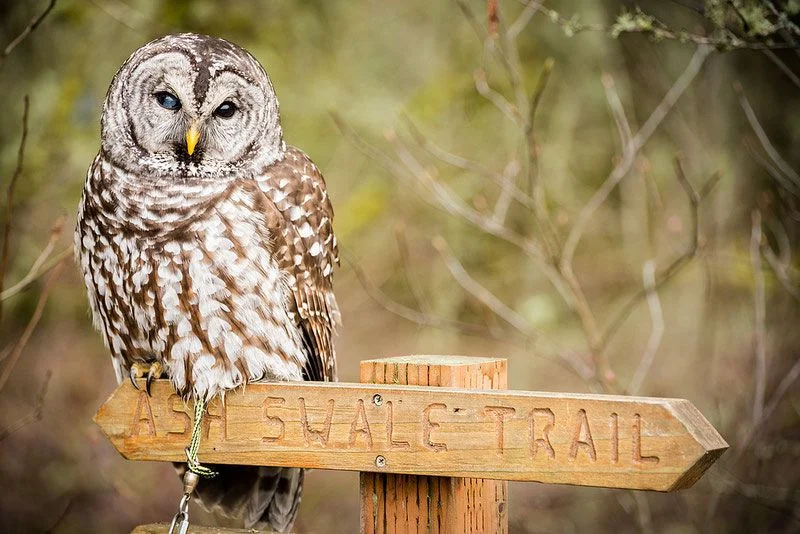
Bird of the Month: The “Sparred” Owl
The Spotted Owl just can’t get a break. Endemic to old-growth forests in the Pacific North west, the endangered owl’s population was already declining due to deforestation, but now they have been forced to accommodate an inconsiderate guest: Barred Owls. Native to the eastern half of North America, the Barred Owl’s territory has been expanding westward since the turn of the last century.
By Elise Brosnan
The Spotted Owl just can’t get a break. Endemic to old-growth forests in the Pacific North west, the endangered owl’s population was already declining due to deforestation, but now they have been forced to accommodate an inconsiderate guest: Barred Owls. Native to the eastern half of North America, the Barred Owl’s territory has been expanding westward since the turn of the last century. By the 1990s, Barred Owls have become a permanent fixture throughout much of the Spotted Owl’s historic range. Larger, more aggressive, and more opportunistic than Spotted Owls, Barred Owls have been identified as a significant new factor driving the Spotted Owl’s population collapse.
However, Spotted Owls hold no apparent ill will towards Barred Owls. The two species occasionally hybridize, or mate, producing an offspring that is half spotted and half barred. As you might expect, “Sparred Owls” look like both of their parents. They have the Barred Owl’s larger size, but the Spotted Owl’s darker coloring. Their breast plumage is a mixture of spots and bars, described as looking like a checkerboard pattern. Their call also reflects their mixed heritage; a series of staccato Spotted Owl-like “hoos” followed by a Barred Owl-like “hoo-ah,” described by a biologist as “sort of like a Spotted Owl being strangled.”

Morgan, a Sparred Owl, is help in captivity at Chintimini Wildlife Center in Corvallis, Oregon. Photo courtesy of Chintimini Wildlife Center
Hybridization is surprisingly common in birds. Up to ten percent of birds are suspected to hybridize with other species, at least occasionally. However, hybridization may be increasing as the historic range of many bird species changes. As we lose grassland in the Great Plains states, eastern forest birds are interacting with western forest birds in a way that has never been seen before. Because of climate change, both western and eastern species are finding northern territories more hospitable. The Barred Owl made its way west by colonizing Canadian forests at the very north of its range, before looping south into Spotted Owl territory.
Great Plains hybridization has threatened species before. The Midwestern Blue-winged Warbler is expanding its range eastward, where it outcompetes and hybridizes with the Golden-winged Warbler. (However, some biologists argue that Golden-winged and Blue-winged Warblers are two variants of the same species, and, by definition, cannot be under threat from itself.)
Therefore, what should be done about Barred Owls? Experimental cullings have occurred, with moderate success. However, some environmentalists argue that the arrival of the Barred Owl has provided a convenient scapegoat for another enemy of Spotted Owls: the logging industry. “Competition from Barred Owls may well need to be addressed on an interim basis until Spotted Owls’ populations can be returned to health,” says Bob Sallinger, conservation director of the Audubon Society of Portland, Oregon, “but unless critical habitat needs are adequately addressed, Barred Owl control will be nothing more than a sad and pathetic footnote on the road to Spotted Owl extinction.”
Sources:
Axelson, G. (2016) Golden-winged and Blue-winged Warblers Are 99.97 Alike Genetically. Living Bird Magazine. Cornell Lab of Ornithology, Ithaca, NY, USA. Retrieved from https://www.allaboutbirds.org/mixed-wing-warblers-golden-wings-and-blue-wings-are-99-97-percent-alike-genetically/
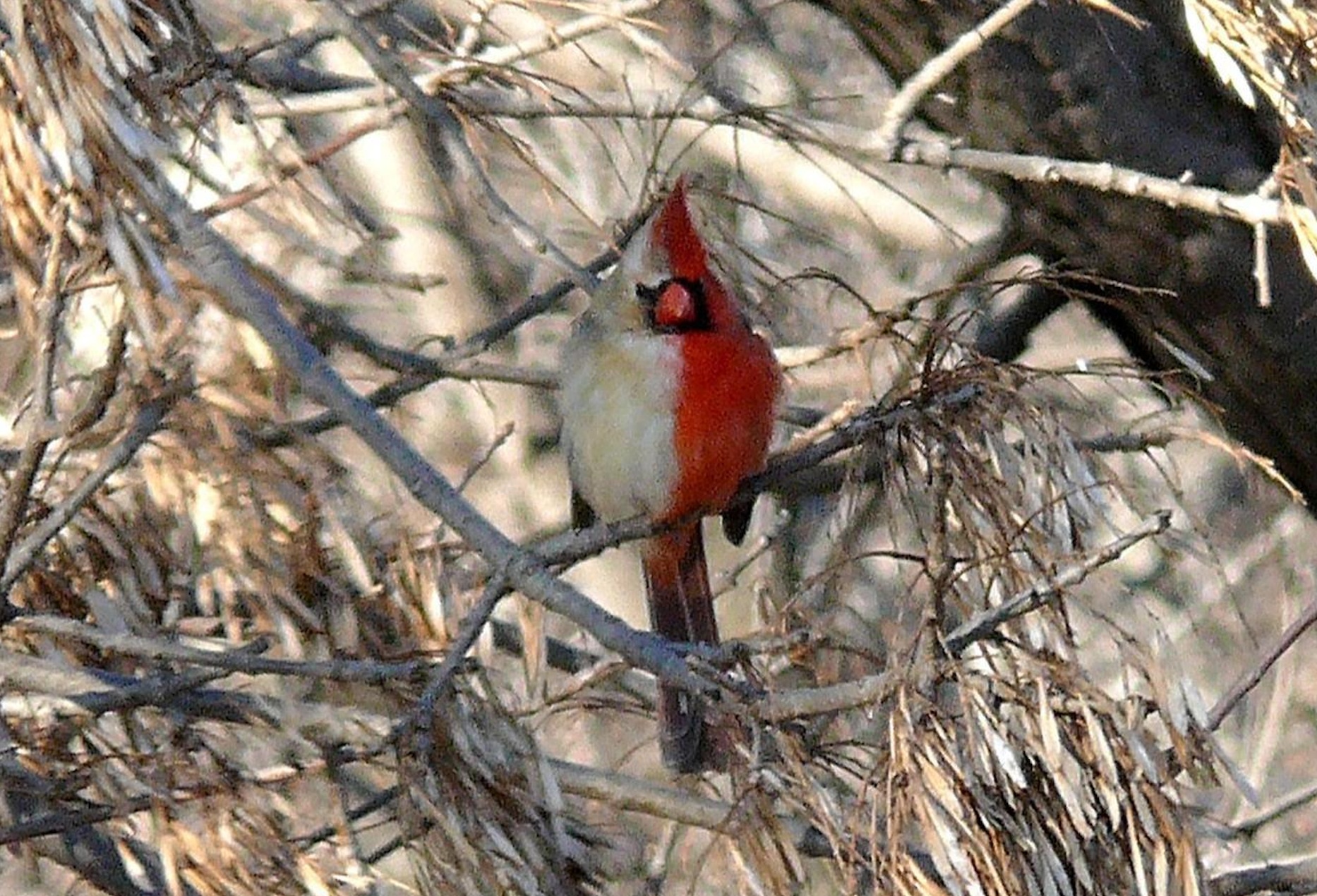
Bird of the Month: Gynandromorphic Birds
This past February, a very unusual Northern Cardinal was spotted in Erie, Pennsylvania. Its right side is brilliantly red, while its left side is a modest brown, with both sides perfectly split down the middle. The reason for the color split is remarkable; the left side is biologically female, while the right side is biologically male. Genetically, the two halves are as closely related as brother and sister.
Photo: Gynandromorphic Northern Cardinal, Brian Peer
By Elise Brosnan
This past February, a very unusual Northern Cardinal was spotted in Erie, Pennsylvania. Its right side is brilliantly red, while its left side is a modest brown, with both sides perfectly split down the middle. The reason for the color split is remarkable; the left side is biologically female, while the right side is biologically male. Genetically, the two halves are as closely related as brother and sister.
The cardinal’s rare genetic mutation is known as bilateral gynandromorphism. Bilateral gynandromorphs have been recorded in crustaceans, insects, some reptiles, and many species of birds. All these animals share what is known as the ZW-sex determination system. Scientists are not entirely sure how gynandromorphs occur. Biologist Michael Clinton of the University of Edinburgh theorizes that there are two characteristics of the ZW-determination system that combine to make gynandromorphism possible:
The first characteristic is that the mother’s genes are responsible the sex of the offspring. Having ZW sex chromosomes causes an embryo to develop into a female, while having ZZ chromosomes causes an embryo to develop into a male. The mother contributes either a Z or W chromosome, producing either a male or female child, respectively. Clinton believes that female birds have a biological mechanism that causes them to overwhelmingly contribute either Z or W chromosomes in certain environmental conditions. This would explain the incredibly skewed gender ratios seen in some species; for example, it is not uncommon for some female parrots to hatch 20 male or 20 female offspring consecutively. If this biological pathway goes awry, a female bird might produce an egg cell with both Z and W chromosomes. This egg cell is then fertilized by two normal sperm cells, getting two more Z chromosomes. The fertilized egg now has full male and female genetic information, causing it to develop with both ZZ male and ZW female DNA.
The second characteristic is that animals with the ZW-sex determination system do not appear to rely on hormones to develop primary sex characteristics. This is the opposite of what is seen in animals with the XY-sex determination system, such as humans. Humans can be physiologically male and have XX chromosomes, or be physiologically female and have XY chromosomes. These genetic abnormalities are caused when certain hormones are not created or absorbed, or when certain hormones are created when they shouldn’t be. However, a bilateral gynandromorph is able to maintain perfect male and female halves, even though both its halves are soaked in male and female hormones manufactured by its mismatched testis and ovary. Sex differences in gynandromorphs even extend to their brains; in a gynandromorphic zebra finch, the male half of its brain contained the neural pathways to sing courtship songs, while the female half did not. (Sex-specific brain structures are not seen in humans, who do not have categorically male or female brains.)
Probably as a result of these brain differences, many gynandromorphs are unable to properly perform the social behavior of either gender. They are often are shunned or even attacked by their peers. Fortunately, the Erie, Pennsylvania cardinal is an exception; she/he is frequently in the company of another male bird. Researchers suspect that her/his left ovary might be viable, so she/he may even become a mother/father in the spring.
Sources:
Robson, David “These Animals Are Male on One Side and Female on the Other.” BBC Earth. Last modified Sept. 22, 2015. http://www.bbc.com/earth/story/20150916-these-animals-are-male-on-one-side-and-female-on-the-other
Seaberg, Maureen “Rare Half-Male, Half-Female Cardinal Spotted in Pennsylvania.” National Geographic.Last modified Jan. 31, 2019. https://www.nationalgeographic.com/animals/2019/01/half-male-half-female-cardinal-pennsylvania/
Weintraub, Karen “A Rare Bird Indeed: A Cardinal That’s Half Male, Half Female.” The New York Times.Last modified Feb. 9, 2019. https://www.nytimes.com/2019/02/09/science/cardinal-sex-gender.html?action=click&module=Well&pgtype=Homepage§ion=Science

Bird of the Month: Turkey Vulture
Turkey vultures, also known as turkey buzzards, are a common sight throughout the state of Virginia. As one of the most widespread birds in the western hemisphere, their range extends west to California and south to the tip of South America. Turkey vultures are often seen gliding on thermals, buoyed by a wingspan that can reach up to seven feet.
Photo: Turkey Vulture, Kevin Juberg/Audubon Photography Awards
By Elise Brosnan
Turkey vultures, also known as turkey buzzards, are a common sight throughout the state of Virginia. As one of the most widespread birds in the western hemisphere, their range extends west to California and south to the tip of South America. Turkey vultures are often seen gliding on thermals, buoyed by a wingspan that can reach up to seven feet.

Turkey Vulture, Michelle Maani/Audubon Photography Awards
Most birds have no sense of smell, which makes turkey vultures extremely unusual, as they rely entirely on their noses to detect prey. They do so by detecting a byproduct of carrion called ethyl mercaptan. This same compound is commonly added to petroleum gas, causing confused turkey vultures to congregate around gas leaks.
While most birders are acquainted with turkey vultures, they may not know the important role that they play in the ecosystem. Like all vultures, turkey vultures are equipped with a powerful digestive system that is capable of killing harmful bacteria, such as the bacteria responsible for anthrax. In fact, when vulture numbers decline, rates of human diseases go up. In India, falling vulture populations correlated with higher rates of both anthrax and rabies.
Turkey vultures have no natural predators, but they face one significant man-made threat: contamination from lead bullets. When game is shot with lead, the bullets break apart and contaminate the meat, making it toxic for both human and vulture consumption. California Condors, turkey vultures’ larger cousins, have to be regularly treated for lead poisoning to prevent species collapse.
Vultures are the sanitation workers of our ecosystem, disposing of carrion and keeping diseases in check. Therefore, the next time you see a turkey vulture, you should give it thanks. After all, it’s a dirty job but someone’s got to do it.
Source:
Haskell, David George. The Forest Unseen: A Years Watch in Nature. NY, NY, U.S.A.: Penguin Books, 2013.