
NVBA NEWS BLOG
Welcome to the blog for Northern Virginia Bird Alliance, a wealth of resources about northern Virginia birds, wildlife, habitat conservation and restoration, native plants, wildlife-friendly gardening, advocacy and more.

How Birds Practice Social Distancing
Bryan Watts, Director of The Center for Conservation Biology, has written a timely article about the importance of social distancing or spacing among various bird species.
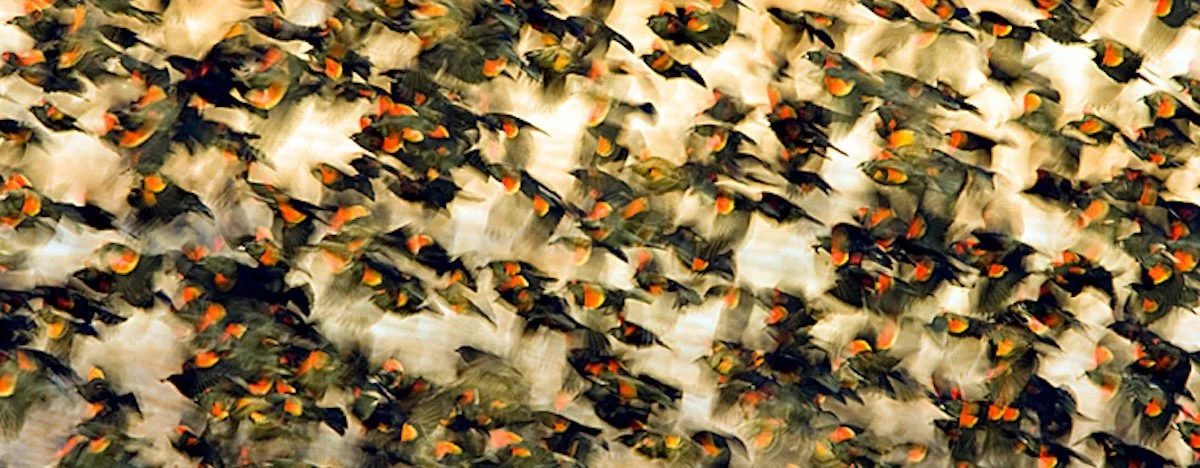
Photo: Wood Storks, Mark Cook/Audubon Photography Awards
Bryan Watts, Director of The Center for Conservation Biology, has written a timely article about the importance of social distancing or spacing among various bird species.
“For bird behaviorists, the term social distance and its variants (territoriality, individual space, social spacing) are familiar and have been in use for over a century. Social distancing was initially used to describe the common observation that birds often exhibit a uniform distribution with incredibly even distances between individuals.” Read the full article here.

Social Distancing Advice for Birders
Our birding friends tell us how glad they are to have birding during this time of social distancing. Even though they might not be visiting their favorite parks and hot spots, they can walk outside and experience the songs and displays of our region’s spectacular spring migration. When ASNV decided in March to cancel all of our in-person activities because of Covid-19, we received many questions about what was safe to do.
Photo: Birding, Christine Lin/Audubon California
American Birding Association advice during the Covid-19 crisis
Our birding friends tell us how glad they are to have birding during this time of social distancing. Even though they might not be visiting their favorite parks and hot spots, they can walk outside and experience the songs and displays of our region’s spectacular spring migration. When ASNV decided in March to cancel all of our in-person activities because of Covid-19, we received many questions about what was safe to do. Here is some good advice from the American Birding Association:

Teach Your Children to Become Avid Birders During Coronavirus Lockdown
When schools closed due to the Coronavirus, my husband and I decided to homeschool our 10-year-old daughter. We wanted to come up with some interesting science projects to keep her engaged during these challenging times. We started off raising tadpoles, where our daughter would gather data to calculate their survival and growth rates. We thought about designing a vegetation habitat survey or an invertebrate creek survey. Can you tell we’re biologists?
Photo: Camilla Cerea
By Jessica Bigger
When schools closed due to the Coronavirus, my husband and I decided to homeschool our 10-year-old daughter. We wanted to come up with some interesting science projects to keep her engaged during these challenging times. We started off raising tadpoles, where our daughter would gather data to calculate their survival and growth rates. We thought about designing a vegetation habitat survey or an invertebrate creek survey. Can you tell we’re biologists?
Since bird migration is in full swing, we decided on developing a bird identification program where our daughter could learn how to identify local and migrating bird species by sight and by their song and call.
We then added a math and science component, where our daughter would record the number of birds she saw or heard that morning. She would then add up the total number of birds, and the total number of different species she recorded earlier. After a week she would graph this information, figure out the average number of species seen and which species were more prevalent in the area.
We started off with a handful of birds and then added a few more to her list every couple of days. To keep things interesting, we started visiting different habitats to introduce her to birds she had not seen or heard before.
The Cornell Lab of Ornithology is a great resource and we referred to it often. They have lots of games to help test your child’s bird ID skills, and several educational ideas and projects that you can glean from. It’s also my go-to when I want more detail on a particular species. The photos are wonderful to look at and the song and call recordings have been extremely helpful.
Birding is a great activity, and getting your child involved can keep them busy and engaged. Kelly Preheim, a kindergarten teacher from South Dakota, started teaching her students how to identify birds. She was amazed that over time, her 5 and 6-year-old students could visually identify 100 birds, and be able to recognize the songs and calls of 25 bird species. She introduced photos of new birds to her students every day and created different games like “Name That Bird,” using bird ID flashcards. These activities improved each student’s ability to recognize those bird species out in the field.
So, if you are looking for a unique educational experience to do with your kids that combines science, math and nurtures their love of birds, here are a few tips to get started:
Bird Identification by Sight It might be good to begin with birds your child is familiar with and only pick a handful to start. Before heading out with your binoculars to look for those birds in the morning, review photos of each bird you and your child will be looking for and make sure to bring a bird book with you to refer to if needed.
Bird Identification by Sound Since many of us tend to identify birds by sound, because most of the birds we hear we can’t see, it’s not too far-fetched to teach your kids to learn a bird’s song and call. So, when your child hears “Peter, Peter, Peter, Peter,” she’ll know that a Tufted Titmouse is singing nearby. Starting with a few birds at a time will give your child time to absorb the information, and in time, be able to recognize those birds on the fly. You might want to download the free Audubon Bird Guide app. It’s easy to use with great photos, information and excellent sound recordings for 800 species of North American birds.
Mix it Up and Keep it Interesting It’s time to test those birding skills at different birding habitats. Before heading out the door with your kids, make sure to review some of the birds you are likely to see, grab your bird ID book and binoculars, and launch into your adventure.
Barred Owls in Reston
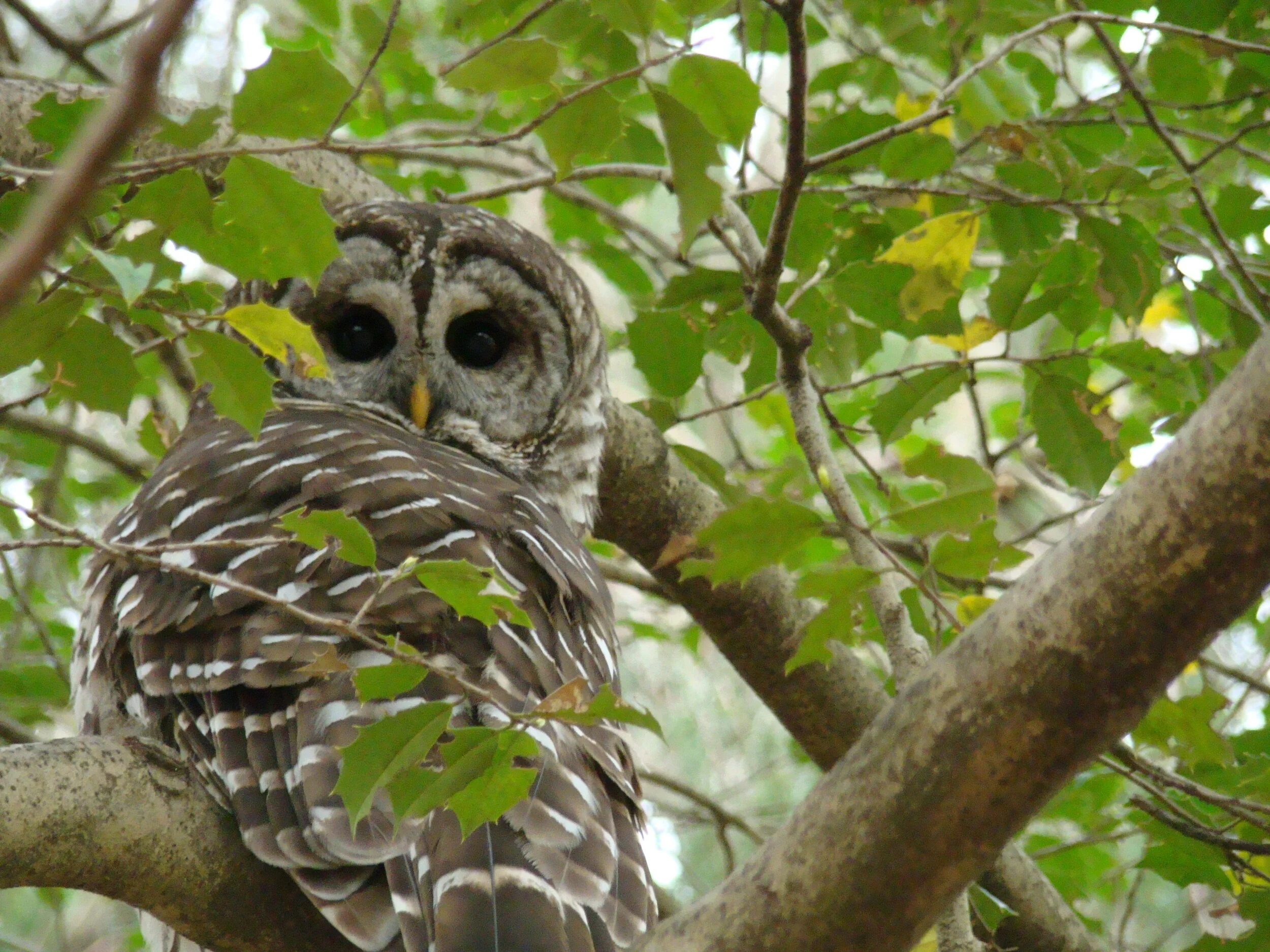
Barred Owls are some of our most intriguing local birds. Most people will recognize their hoot-sequence call that sounds like, “Who cooks for you, who cooks for you all?” Unlike many other owls, they are semi-nocturnal. Their name comes from their striped plumage, or “bars.” They are the only eastern owls with deep brown eyes, which can appear blue-black in certain light. Females are larger than males, and only females incubate chicks, or owlets.
Photo: Barred Owls, Lisa Mackem
By Lisa Mackem
Barred Owls are some of our most intriguing local birds. Most people will recognize their hoot-sequence call that sounds like, “Who cooks for you, who cooks for you all?” Unlike many other owls, they are semi-nocturnal. Their name comes from their striped plumage, or “bars.” They are the only eastern owls with deep brown eyes, which can appear blue-black in certain light. Females are larger than males, and only females incubate chicks, or owlets.
I often see Barred Owls near my home – usually when they are quietly perched in trees, and once when one was sitting on the ground. Barred Owls have distinct personalities. They watch people intently, but with different levels of tolerance. When I take pictures of them, some of these owls change positions as if striking various poses. They aren’t disturbed when I stand near or directly under their perch. Others hoot with apparent annoyance or anger and fly to a more distant perch.
The varied behavior described above might be related to the presence of other birds in the area. Small songbirds recognize Barred Owls as a threat, and sometimes band together to harass or “mob” them. Crows especially have a long-standing animosity towards owls. They frequently mob Barred Owls, chasing them from perches and potential prey. The owls will sometimes attack and eat individual crows, or other small birds (although birds are not their preferred prey), but they will retreat from a mob.
As Leigh Clavez wrote in The Hidden Lives of Owls, Barred Owls are the opportunists of the owl world, easily adapting to varied habitats, including mixed forests and disturbed areas. Although they prefer tree cavities, they will also use the nests of Red-shouldered Hawks, crows or ravens. They eat a variety of small mammals and birds, amphibians, reptiles and invertebrates but they cannot catch cats and dogs.
Great Horned Owls are the Barred Owls’ only natural enemy, but these owls are not seen frequently in Reston. Sadly, Barred Owls are often hit by cars when they swoop down to capture prey along a road. If the prey has been attracted by food people discarded out of a car window, the encounter can become deadly for the owl. I have seen some of these owl casualties along Lawyers Road in Reston.
Barred Owl courtship begins in February and breeding is from March – August. They will lay 2-4 eggs, and the incubation period is 28-33 days. Owlets fledge at 35-40 days, but adults care for their young for at least 4 months – much longer than other owls. Young owls call for their parents with a distinctive screeching hiss. They have a fuzzy appearance until they are fully mature. Barred Owls often use the same nest sites, and can occupy territories for 2-3 decades, suggesting strong site fidelity over time. They do not migrate. Captive Barred Owls can live to their early 20’s, and wild owls live for 10-20 years. They mate for life, but if a mate dies, the survivor will likely mate again.
Watch here to follow a pair of Barred Owls through their nesting.

Hog Island Audubon Camp News
Last month we announced the winner of our Hog Island Scholarship for teachers, Phoebe Riegle, a fifth-grade teacher at William Ramsey Elementary School in Alexandria, VA. Unfortunately, she will not have the opportunity to attend “Sharing Nature: An Educator’s Week” this year. Hog Island Audubon Camp cancelled their summer programs out of concern for the health and safety of campers, volunteers and staff during the Covid-19 pandemic.
Photo: Puffin desserts at Hog Island, Kirk Treakle
Last month we announced the winner of our Hog Island Scholarship for teachers, Phoebe Riegle, a fifth-grade teacher at William Ramsey Elementary School in Alexandria, VA. Unfortunately, she will not have the opportunity to attend “Sharing Nature: An Educator’s Week” this year. Hog Island Audubon Camp cancelled their summer programs out of concern for the health and safety of campers, volunteers and staff during the Covid-19 pandemic. ASNV is postponing Phoebe’s scholarship until the summer of 2021 when we hope she’ll have an opportunity to visit this unique island.
Even though camp is closed, the popular Hog Island wildlife cams are still operating. While you are watching the Ospreys, Atlantic Puffins and Black Guillemots you might want to try making the Hog Island kitchen’s famous Cream Puffin Pastries, traditionally served on the last night of each camp session.

Native-only Plant Vendors Offer Curbside Pick-up
While in-person Audubon at Home Ambassador visits are paused you can still plan for spring planting with information on our website. Native-only plant vendors in our area will be taking orders in advance and arranging for curbside pick-up.
Photo: Virginia Bluebells, Sheryl Pollock
While in-person Audubon at Home Ambassador visits are paused you can still plan for spring planting with information on our website. Native-only plant vendors in our area will be taking orders in advance and arranging for curbside pick-up. See a list here Plant NoVA Natives

Take a Virtual Tour of the 2019 National Audubon Photography Awards
In celebration of the natural connection between birding and photography, Audubon Society of Northern Virginia co-hosted the 2019 Audubon Photography Awards Traveling Exhibition with Walker Nature Center in February and again with Huntley Meadows Park in March.
Photo: Audubon Photography Award Winners
In celebration of the natural connection between birding and photography, Audubon Society of Northern Virginia co-hosted the 2019 Audubon Photography Awards Traveling Exhibition with Walker Nature Center in February and again with Huntley Meadows Park in March. Sadly the exhibition is now closed to the public but you can take a virtual tour and learn about the stories behind the photographs here.

Efforts to Protect South Island Birds Continue
Governor Northam’s commitment to help the 25,000 migratory birds whose nesting area on the South Island was displaced by the expansion of the Hampton Roads Bridge Tunnel has resulted in significant action in the past few weeks.
Photo: Banded Tern, Virginia Society of Ornithology
How Birders Can Help
Governor Northam’s commitment to help the 25,000 migratory birds whose nesting area on the South Island was displaced by the expansion of the Hampton Roads Bridge Tunnel has resulted in significant action in the past few weeks. Creation of an alternate nesting area at Rip Raps Island (also known as Ft. Wool) is proceeding, as trees have been cut down, a contract to eradicate pests has been executed and the sand and gravel to build the new nesting area are on their way. Acquisition of barges to serve as supplemental nesting areas is underway, and the Virginia Secretary of Natural Resources is consulting with National Audubon Society and American Bird Conservancy on the best ways to attract birds to the new site. Long-term, a portion of the South Island will be returned to a nesting area after construction is complete, and the Northam Administration is committed to construction of a new artificial island.
Despite the efforts to protect the birds, it is inevitable that some of the birds will be displaced by the construction. The Virginia Department of Game and Inland Fisheries and Virginia Tech banded about 5000 of the nesting birds in the last two breeding seasons. They have asked birders to be on the lookout for banded Royal Terns, Gull-Billed Terns, Common Terns, Laughing Gulls, Sandwich Terns, and Black Skimmers and to forward the information to a central data collection point. You can learn more about what information to collect and where to send it on the Virginia Society of Ornithology’s Website.

Native-only Plant Vendors Offer Curbside Pick-up
While in-person Audubon at Home Ambassador visits are paused you can still plan for spring planting with information on our website Native-only plant vendors in our area will be taking orders in advance and arranging for curbside pick-up.
Photo: Virginia Bluebells, Sheryl Pollock
While in-person Audubon at Home Ambassador visits are paused you can still plan for spring planting with information on our website Native-only plant vendors in our area will be taking orders in advance and arranging for curbside pick-up. See a list here: Plant NoVA Natives

Local Photographers Win National Wildlife Federation Photo Contest
ASNV member Randy Streufert has won the Grand Prize in the National Wildlife Federation’s “Garden for Wildlife” photo contest. Randy’s photo of a Prothonotary Warbler cooling off in water was the top photo out of nearly 5000 submissions from all over the world.
Photo: Prothonotary Warbler, Randy Streufert
ASNV member Randy Streufert has won the Grand Prize in the National Wildlife Federation’s “Garden for Wildlife” photo contest. Randy’s photo of a Prothonotary Warbler cooling off in water was the top photo out of nearly 5000 submissions from all over the world. Randy and his wife Barbara’s property, where the photo was taken, is a Certified Wildlife Sanctuary in ASNV’s Audubon at Home program.
Randy also won an Honorable Mention for his photo of a Cope’s Gray Treefrog tadpole and froglet.

Copes Gray Treefrog Tadpoles, Randy Streufert
Local wildlife enthusiast Arthur Hass’s photo of an Eastern Tailed-Blue won the top prize in the category Close-up Native Plants and their Wildlife Visitors, and Fairfax resident Sherry Schellenger Parker’s photo of her son in his grandmother’s garden won in the category People in the Wildlife Garden. The Category Winners and Honorable Mentions showcase a wonderful array of photos of plants, wildlife and people enjoying them.

Bird-Window Collision Webinar
If you missed the 19 March webinar on bird-window collisions, you may watch a recording of it here. Collisions with windows are the third greatest cause of death for birds in the United States, after habitat loss and predation by outdoor cats.
Photo: Barred Owl, Robin Conolly
If you missed the 19 March webinar on bird-window collisions, you may watch a recording of it here.
Collisions with windows are the third greatest cause of death for birds in the United States, after habitat loss and predation by outdoor cats. Peer-reviewed conservative research estimates that about one million birds collide with windows every day—the annual estimate is 365 to 988 million.
To learn about this threat and how to help mitigate it at your home, Reston Association and the Audubon Society of Northern Virginia invited Peter Saenger, President of Lehigh Valley Audubon Society, and Leigh Altadonna, President of the Wyncote Audubon Society, to speak on 19 March via webinar. They lead a Pennsylvania-based Bird-Window Collision Working Group that includes the Acopian Center at Muhlenberg College, Audubon Pennsylvania and the Lehigh Valley and Wyncote Audubon Societies. Their group has developed a “Bird-Window Collision Toolkit” which is being used by other Audubon groups.
Note that after introductions, the webinar describes how this toolkit can be used to educate others; basic information on how and why birds collide with windows then follows.
Also, this page from Pennsylvania Audubon features "how to" videos on installing solutions to prevent collisions. If you do install materials, the Bird-Window Collision Working Group would welcome your completing a survey on what you did--the survey link is also on the Pennsylvania Audubon page under “Record how you are protecting birds at your own home or place of work.”

AAH Still Providing Information About How To Create Wildlife Habitat
Although Audubon at Home has discontinued client visits, we encourage you to consult with us about how to create wildlife habitat.
Photo: Butterfly garden, Elaine Mills
Although Audubon at Home has discontinued client visits, we encourage you to consult with us about how to create wildlife habitat.
If you are already working with an AAH ambassador, please consult via phone or email. If you are not yet working with an ambassador, please send questions to us at aah@audubonva.org.
You may still request a visit here. We will schedule it when we are able to conduct visits again. Meanwhile, check out the Audubon at Home pages on the Audubon Society of Northern Virginia website.

Certified Sanctuary Map
Audubon at Home encourages you to check out our new interactive map on our Certified Wildlife Sanctuaries webpage.
Audubon at Home encourages you to check out our new interactive map on our Certified Wildlife Sanctuaries webpage.
Click the icons in the upper right of map to see additional layers of information that include Audubon Christmas Bird Count Circles and the U.S. Geological Service Protected Areas Database.
AAH heartily thanks volunteer Adam Jenkins for his work developing this page.

Youth Education Mini-grant Winners 2020
Every year, the Youth Education Committee of ASNV sponsors a mini-grant program to support teachers, schools, and non-profit organizations in youth-oriented education about birds and the environment. The committee is proud to announce three recipients ($500 per grant) in 2020.
Photo: Birding, Tom Hissong/Great Backyard Bird Count
Every year, the Youth Education Committee of ASNV sponsors a mini-grant program to support teachers, schools, and non-profit organizations in youth-oriented education about birds and the environment. The committee is proud to announce three recipients ($500 per grant) in 2020:
Fairview Elementary School in Fairfax Station, VA will use funds to build bluebird houses and purchase binoculars for its K-6 students. They will couple existing indoor environmental lessons with outdoor activities along their newly built bluebird trail. Students will engage in seasonal observations and analysis of a wide variety of avian behaviors to complement their science standards of learning.
Cub Run Elementary School in Centreville, VA will purchase wildlife cameras and bird feeding kits so that their K-1 students can track birds in their natural habitat. They will incorporate the data and observations into curriculum on the basic needs of animals.
H-B Woodlawn Secondary Program in Arlington, VA will launch a Meaningful Watershed Educational Experience (MWEE) around the topic of single-use plastics, from their environmental impacts to their re-use in the school’s makerspace. The mini-grant will help to fund a field trip on 2020 Potomac Watershed Clean-Up Day to trawl for and analyze micro-plastics.
2020 Hog Island Scholarship Winner – Phoebe Riegle
ASNV’s Youth Education Committee is thrilled to announce Phoebe Riegle as the 2020 recipient of our Hog Island Scholarship. Each summer, ASNV offers a full scholarship and transportation to “Sharing Nature: An Educator’s Week” at National Audubon Society’s Hog Island Camp in Maine.
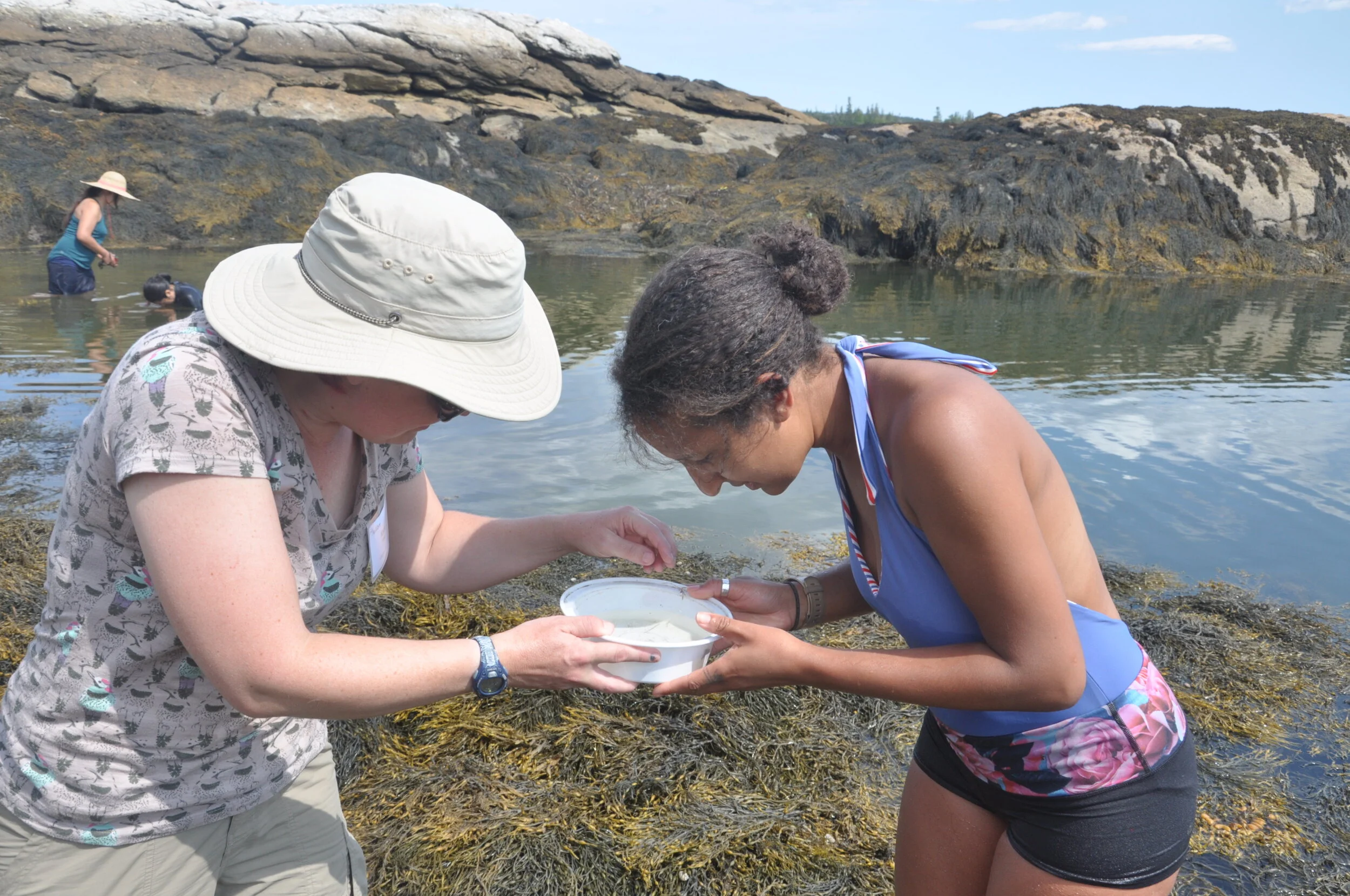
Photo: Examining tide pool organisms, Kirk Treakle
ASNV’s Youth Education Committee is thrilled to announce Phoebe Riegle as the 2020 recipient of our Hog Island Scholarship. Each summer, ASNV offers a full scholarship and transportation to “Sharing Nature: An Educator’s Week” at National Audubon Society’s Hog Island Camp in Maine. While there, educators learn interdisciplinary hands-on methods and approaches to environmental education while immersed in the natural world.
Ms. Riegle is a fifth-grade teacher at William Ramsay Elementary School in Alexandria, VA. She hopes to use the lessons learned at Hog Island to better integrate conservation and habitat content with English Language Learning (ELL) strategies across grade levels and subjects. Ms. Riegle will attend the program in July 2020 before returning to her classroom in the fall.

Calling all Birders!
The 2020 ASNV Birdathon Competition is POSTPONED. We hope to reschedule for Fall 2020.
Photo: Birders, Laura McDonald
The 2020 ASNV Birdathon Competition is POSTPONED.
Spring is on its way, and so is Birdathon! It’s time to organize your teams and sign up for our annual spring migration FUNdraising event. All birding levels are welcome!
The concept is simple: Participants form teams of two to five members, each team secures pledges and donations, then during any 24-hour period between April 17 and May 17 the teams search Northern Virginia to see how many bird species they can identify.
Get your teams READY!
Register your team here. Make sure you have a team or mascot photo ready to email once you complete the registration form.
Once you register your team, we’ll create a team page for you where you can ask your friends, family and social media pals to support your efforts.
Check out our guidelines. ( We made some changes this year)
Watch our website and newsletter for updates and tips on how to complete a successful Birdathon.
Go out and have a great day birding! And THANK YOU for supporting Audubon Society of Northern Virginia’s efforts to conserve and restore natural ecosystems, focusing on birds and other wildlife, and their habitats.
Report your Birdathon sightings by May 30 on eBird and send your list to info@audubonva.org. Ask your supporters to visit your team page and make their donations by June 1.
Winners will be announced at our Annual Meeting on June 7!

Reston Association's Biophilic Pledge Points Residents to AAH Wildlife Sanctuary Program
In 2018, Reston became part of the worldwide Biophilic Cities Network. To help residents identify specific actions that will protect Reston's natural resources, Reston Association's Environmental Advisory Committee is now deploying a Reston Biophilic Pledge.
Photo: Butterfly Garden at Brookside Gardens, Elaine Mills
In 2018, Reston became part of the worldwide Biophilic Cities Network. To help residents identify specific actions that will protect Reston's natural resources, Reston Association's Environmental Advisory Committee is now deploying a Reston Biophilic Pledge. Several Biophilic Pledge elements echo the Audubon at Home Healthy Yard Pledge, and the pledge element "Promoting biodiversity by supporting and creating wildlife-friendly habitat" points residents to the website for the Audubon at Home Wildlife Sanctuary Program for more information on how to create habitat.

ASNV Birding Trip to Colombia
In January, thirteen ASNV participants traveled to Colombia for a birdwatching tour. Gerry Abbott, chairman of the ASNV adult education committee, worked with Holbrook Travel for travel and tour arrangements. The successful trip oversold immediately.
Photo: Birding in Colombia, Aubrey Nolan
By Lisa Mackem
In January, thirteen ASNV participants traveled to Colombia for a birdwatching tour. Gerry Abbott, chairman of the ASNV adult education committee, worked with Holbrook Travel for travel and tour arrangements. The successful trip oversold immediately.
Local resident Bill Burton described the first lodge where the group stayed as rustic and charming, “like a bungalow.” On their first morning the group got up before sunrise and saw a “breathtaking” diversity of birds – “just one after another,” said Bill. As the group stood in the yard, Bill estimated that they saw about 50 different species of birds.
The group’s next location was Tinamou Lodge, which is owned and operated by a couple in Arlington, VA and located outside of the industrial city of Manizales. From there, they made two excursions per day toward the Indian foothills and saw about 30 different hummingbird species – “one species per minute,” said Bill, adding that they also saw 20 different varieties of brightly-colored tanagers. Other key sightings for Bill included the Torrent duck, which sits in rapids, and Antpitta, which is heard often, but rarely seen.
The sight of the Andean Condor – the world’s largest bird and Colombia’s national bird – was the highlight for both Bill and Gerry. This bird lives at high elevations in the Andes, and usually flies solo.
Colombia has about 1900 bird species – the most of any country. It also reports 170 species of hummingbirds. In comparison, the American east coast has only one native hummingbird species. Consequently, Colombia is an excellent place for citizen science documentation, and is in high demand for birding trips. The ASNV group made daily entries in eBird and everyone who wanted to include the sightings in their individual eBird accounts did so. Collectively they saw 260 bird species and some interesting mammals, such as howler monkeys, sloths and a river otter swimming upstream.

Birding in Colombia, Aubrey Nolan
Both Bill and Gerry commented on the friendliness of locals, who Bill noted were also enjoying the outdoors. The tour group asked their guides about sustainable development and were happy to see the Colombians’ conservation efforts.
Gerry plans to coordinate another ASNV international birding trip next year. He especially enjoys travel to warm destinations during the winter and is considering Ecuador or another Andean location. In the meantime, he recommends the ASNV adult education programs, where people have many opportunities to learn about birds and contribute to citizen science.

Audubon at Home Ambassador’s Brunch
Audubon at Home ambassadors gathered on February 1 for their annual – and delicious – brunch, at which AAH co-directors and county coordinators updated them on the program's progress over the past year. It has now been 10 years since AAH first certified a Wildlife Sanctuary, as of the brunch, the program has certified 683 properties on over 6300 acres.
Photo: Tiger Swallowtail on Joe Pye Weed, Elaine Mills
Audubon at Home ambassadors gathered on February 1 for their annual – and delicious – brunch, at which AAH co-directors and county coordinators updated them on the program's progress over the past year. It has now been 10 years since AAH first certified a Wildlife Sanctuary, as of the brunch, the program has certified 683 properties on over 6300 acres.
Guest speaker Laura Beaty spoke about introducing native plants into a landscape. A former staffer for the U.S. Senate Committee on Energy and Natural Resources, she now serves as the propagation chairperson for the Virginia Native Plant Society. Ambassadors benefited from Laura's keen observation skills and excellent story-telling about the insects and other wildlife that depend on the native plants in her own garden.

Manassas Bull Run Christmas Bird Count Results
The 38th Annual Manassas-Bull Run Christmas Bird Count on December 15, 2019 had the highest total of participants yet at 137 and counted over 20,000 birds of 86 avian species. The conditions were favorable, so there were many more walking miles than during the saturated conditions on last year’s count.
Photo: Red-headed Woodpecker, Tom Thaller
The 38th Annual Manassas-Bull Run Christmas Bird Count on December 15, 2019 had the highest total of participants yet at 137 and counted over 20,000 birds of 86 avian species. The conditions were favorable, so there were many more walking miles than during the saturated conditions on last year’s count. There were also several birders twelve years old and under getting a chance to participate in the oldest and biggest citizen-science project in the world. About half of the counters stopped for a great lunch at Cabell’s Mill in Ellanor C. Lawrence Park. The overall species count is only 3 short of our all-time high of 89 set in 2014.

CBC Moon, Rusty Moran
A 1st observation for the circle was a Wilson’s Warbler seen by the party led by Joanne & David Bauer. This bird was too quick to be photographed, but well described and documented, and approved by the regional reviewer.
Highlights also included all-time highs of Tundra Swans (28), Bufflehead (37), and a Great Egret was seen and photographed by the party led by Kristi Liercke. It was only the 2nd Great Egret observed on this count with the 1st being back in 2009. American Robin was the most abundant species with 3,673 counted. Also, all 7 of our potential wintering woodpecker species were tallied with 26 of the 42 Red-headed Woodpeckers being recorded by a team led by Phil Kenny at Bull Run Regional Park.
There were other all-time highs for this count recorded for: Barred Owl (10); Common Raven (14); Merlin (3); Ruby-crowned Kinglet (32); and Pine Warbler (5). It was nice to see the Yellow-rumped Warbler count rebound from last year’s all-time low of just 3 to a more expected 153. Bald Eagle sightings were also back up to a little above average at 22.
Another interesting observation was of a hybrid goose photographed by Gary Myers. It was determined to be a wild bird that is a cross of Canada Goose and domestic Graylag Goose. Also tallied were 10 sparrow species which included Chipping, Savannah, Swamp, Fox, and White-crowned.
Copies of the full results for the count are available here, or from the compiler, Phil Silas.
We gratefully thank all the enthusiastic birders both new and returning, and especially Carolyn Williams who is stepping down as Sector 6 leader after many, many years service. We hope you all had a good time and will be back for next year’s count, which will be on Sunday, December 20, 2020.