
NVBA NEWS BLOG
Welcome to the blog for Northern Virginia Bird Alliance, a wealth of resources about northern Virginia birds, wildlife, habitat conservation and restoration, native plants, wildlife-friendly gardening, advocacy and more.

Historic River Farm Property in Peril
River Farm, a historic 25-acre property on the Potomac River, may be sold to private developers. The American Horticultural Society (AHA), the owner of the property, has issued a request for proposals to purchase the property to create an endowment for the organization.
Photo: River Farm
River Farm, a historic 25-acre property on the Potomac River, may be sold to private developers. The American Horticultural Society (AHA), the owner of the property, has issued a request for proposals to purchase the property to create an endowment for the organization.
River Farm includes the historic Manor House, extensive gardens and a four-acre meadow of native plants. Bald eagles frequent Virginia's Potomac River shoreline and observers have documented a number of nests in the area. Despite agreeing with Enid Haupt, who donated the funds to purchase the property and keep it open to the public, the AHA has extended its request for proposals to developers and private parties. AHA’s website has more information on River Farm’s history and gardens.
Virginia Senators Scott Surovell and Adam Ebbin, Delegate Paul Krizek and Fairfax County Supervisor Dan Storck and Chair Jeff McKay are coordinating efforts to keep River Farm open to the public. You can learn more about that effort and sign a petition urging the preservation of River Farm for public use here.

Plastic is One of the Largest Culprits Harming Birds and Wildlife Today
Zach Huntington used to guide fishing tours out on the Potomac. While floating along the river in his kayak, he started noticing a significant amount of habitat loss and a glaring volume of garbage washing up on the shores and islands of the Potomac.
Photo: Laysan Albatross, Steven Siegel/American Bird Conservancy
Jessica Bigger
Zach Huntington used to guide fishing tours out on the Potomac. While floating along the river in his kayak, he started noticing a significant amount of habitat loss and a glaring volume of garbage washing up on the shores and islands of the Potomac. After four years of watching the river’s native habitat decrease and shoreline garbage accumulate, Huntington decided to take action. “I wanted to take an active role in protecting what I enjoy so much,” he explained.
Huntington is now the Clean Streams Program Manager for Clean Fairfax. Clean Fairfax is a nonprofit organization whose goal is to educate Fairfax County citizens on how to prevent and reduce the amount of litter each person generates. The organization also oversees several cleanups each year. Most recently he has been monitoring ten storm drain sites to keep track of specific trash flowing into our streams and rivers that eventually flows to the Chesapeake Bay and ultimately ends in the Atlantic Ocean.
There are about one million people living in Fairfax County. It is estimated that each person generates 320 bags of garbage each year. That’s 320 million bags of garbage dumped into our landfills. In the entire state of Virginia, where we have a population of 8.5 million people, if each person contributed 320 bags of garbage per year, it would amount to more than 2.72 billion bags of trash.
The biggest culprit is plastics. Plastics, coursing through all our waterways and culminating in our oceans, harm marine animals in a variety of ways. Some of the most harmful trash found in our waterways and oceans is single-use plastics: water bottles, plastic bags from grocery stores, Styrofoam cups and containers, microbeads used in cosmetic products, straws, balloons, wrappers and plastic rings from soda and beer cans. Discarded fishing gear is another gigantic problem.
Per year, Fairfax County’s residents and workers, have used more than 965,000,000 plastic bags (only 2% recycled), 129,000,000 water bottles (23-37% recycled) and 250,000 disposable coffee cups (not recyclable), according to Clean Fairfax who pulled the data from Fairfax County in 2017. And most likely these numbers have increased.
According to the Ocean Conservancy, plastics affect more than 700 marine species. 180 bird species ingest plastic from oceans and beaches and the rate of consumption is only increasing, according to the American Bird Conservancy. In a study published in the Marine Pollution Bulletin in 2018, researchers collected plastics from the stomach contents of 24 American Oyster Catchers between 2007 and 2015. 58% of the birds were juveniles. They found plastic pellets and smaller plastic pieces in the stomach contents of all 24 birds.
Other marine birds have also been found with microplastics in their gut: albatross species, Kelp Gulls, Red Phalaropes, Common Eiders, most shearwater species and petrels. Some researchers believe that these birds, and many others, are attracted to the smell of certain plastics, mistaking the aroma for food. Plastics tend to build up and block a bird’s digestive system, making it difficult to feed, and plastics have contributed to lower body weight and reproductive ability, noted the United States Environmental Protection Agency. Other birds, like Ospreys and Northern Gannets use plastic waste to line their nests, which their young get tangled in.
In particular, single-use plastic bags, 6-pack plastic holders, party balloons and discarded fishing gear have had devastating effects for all marine life but especially sea turtles, whales and most seabirds. These items have caused numerous fatalities, as marine animals get tangled up and unable to free themselves. Even locally at Dyke Marsh, a birder found several dead Great Blue Herons. One Great Blue Heron was found strangled by fishing gear, hanging by its neck in a tree. So, these events aren’t just happening in other parts of the world, they’re happening closer to home.
Although we have environmentally conscious people cleaning up our shores and waterways and reducing their own plastics use; it is impossible to keep up with the plastics output. Huntington believes that the only way to make significant progress is through local and national legislation that forces the plastic producers to not only take responsibility for their output, but to also reduce or eliminate the amount of plastics they push onto the market. “With the amount of waste that we’re creating locally and in our society in general; there is no way we can handle it. We have to cut it from the source,” concludes Huntington.
Litter Free Virginia keeps track of all trash reduction legislation happening right now to help citizens stay informed and encourage them to get involved. Just this year, with the effort of numerous individuals and organizations, the state of Virginia finally raised its litter tax after 43 years. Now municipalities across the state have the option to charge a 5-cent fee for single-use plastic bags.
Want to help? You can do your part by contacting your local, state and federal representatives to express your concerns and push them to write legislation to make large plastic producing companies accountable for their actions. On the local level, you can help by getting involved in cleanups, bringing your own reusable bags, ditching plastic bags to hold your produce and drinking from a reusable water bottle (preferably stainless steel or aluminum). To learn more about getting involved, you can visit , and Friends of Dyke Marsh. Let’s work towards a better future for our birds, wildlife, planet and for us.

Capturing the Natural Beauty of Birds
Bird and native plant photographers should consider entering the 2021 Audubon Photography Awards. Next year will be the contest’s 12th year.
Photo grid: Natalie Robertson
Lisa Mackem
Bird and native plant photographers should consider entering the 2021 Audubon Photography Awards. Next year will be the contest’s 12th year. Winning photos are featured in Audubon and Nature’s Best Photography magazines and showcased in Audubon Photography Awards exhibitions hosted by Audubon chapters and centers nationwide. Walker Nature Center in Reston has presented three exhibitions of winning photos and last year Huntley Meadows Park also presented the show. Even though the 2020 award winners will not be exhibited this coming winter, you can take a virtual gallery tour here.
The 2020 contest entry period ran from January 13 through April 6, 2020, and the 2021 contest entry period will probably be similar. Judges awarded six prizes to photographers including: Grand Prize ($5,000), Professional Prize ($2,500), Amateur Prize ($2,500), Youth Prize (six days at Audubon’s Hog Island Audubon Camp), Plants for Birds Prize ($2,500) and the Fisher Prize ($1,000). Introduced in 2019, the Fisher Prize recognizes an image that is as artistic as it is revealing, and the Plants for Birds Prize honors the top photo that illustrates the crucial relationships between native plants and birds. All photos were judged for technical quality, originality, and artistic merit.
In 2019, amateur photographer Kathrin Swoboda won the grand prize for her photo of a Red-winged Blackbird seemingly blowing smoke rings (actually vapor rings) in Huntley Meadows Park in Alexandria, VA. The contest attracted 2,253 entrants from throughout the U.S. and Canada that year. Swoboda had not intended to enter the contest, but had posted her picture on the Facebook site “Birds of Eastern US”, and someone suggested that she enter. In an interview for The Potomac Flier, Swoboda recommended that to take better bird pictures, “Focus on one bird or species and get to know their nature story.”
In 2020, nearly 1,800 photographers entered the contest, representing all 50 states, Washington D.C. and 7 Canadian provinces. The grand prize photographer, professional photographer Joanna Lentini, captured a Double-crested Cormorant diving toward a sardine swarm in Los Islotes, Mexico. Audubon featured the other category winners and honorable mentions along with Ms. Lentini’s article, “How to Snap Amazing Photos of Birds Underwater.”
The Audubon Photography Awards are open to all U.S. and Canadian residents (excluding residents of Quebec) who are at least 13 years old as of the date of their submission. Audubon encourages and enforces ethical bird photography, and photos that do not adhere to Audubon’s Guide to Ethical Bird Photography will be disqualified. Official rules for the 2020 Audubon Photography Awards are likely to continue for the 2021 contest.

Virtual Bird Walk at Oak Spring Garden
If you missed the virtual birding Facebook Premier with our friends at the Oak Spring Garden Foundation, you can view the recorded session.
If you missed the virtual birding Facebook Premier with our friends at the Oak Spring Garden Foundation, it’s available to view here. Join Laura McDonald, ASNV Program Manager and Tom Wood, ASNV Board member and GMU professor, on a virtual morning stroll through the property’s fields and forests.

Yellow Eyes in Moonless Skies: Researching the population status of the enigmatic Northern Saw-whet Owl
There’s something truly delightful about autumn nights. The crispness of the air, the sound of the trees rustling in the wind, and catching a glimpse of fluttering owls from deep within the woods. Northern Saw-whet Owl migration kicks off in late October which means another season of observing these elusive raptors!
Photo: Northern Saw-whet Owl, Gary Zeng/Audubon Photography Awards
Deidra Bryant
There’s something truly delightful about autumn nights. The crispness of the air, the sound of the trees rustling in the wind, and catching a glimpse of fluttering owls from deep within the woods. Northern Saw-whet Owl migration kicks off in late October which means another season of observing these elusive raptors!
The Northern Saw-whet Owl (Aegolius acadicus) is tiny, with adults averaging 8 inches long and weighing 2.8 ounces. That’s lighter than most smartphones! They can be found in the coniferous and sometimes mixed or deciduous forests of North America. However, they are very difficult to find due to their diminutive size and ability to camouflage into their environment. During my first year of graduate school I had the opportunity to observe these tiny hunters on clear nights atop South Mountain at Kings Gap Education Center in Carlisle, Pennsylvania.
Each autumn, these owls migrate southward from Canada, while licensed banders and dedicated volunteers capture, band, and safely release them back into the wild. This large-scale project in PA dates back to 1997 and is coordinated by natural historian Scott Weidensaul. Project Owlnet tries to learn when saw-whet owls migrate, map their movements, and contribute to an informal data network consisting of information from at least 120 stations across the continent.
Saw-whet owls are lured into mist nets with recordings of the males’ breeding call while scientists await their arrival nearby, taking turns checking the nets every 40 minutes. Once caught, a volunteer or two will carefully remove the owl from the net and put it into a cotton drawstring bag to calm and protect it en route to a room with a licensed bander. Upon arrival, birds are weighed and everything is measured to age and sex them. This includes their wingspan (females tend to weigh more and have a longer wingspan than males), the size of their beaks, and the amount of fat they have on their bodies.
A black light is another valuable tool which is used to observe color patterns in the feathers and estimate the age of each individual. On most owls, the undersides of the remiges (flight feathers) will glow a brilliant neon magenta in the presence of ultraviolet light. This is due to porphyrins – a type of pigment that many orders of bird species use to pigment their egg shells as well as their plumage. Sunlight exposure causes porphyrins to break down. As a result, older feathers will fluoresce less brightly, showing new growth.
After measurements are documented, the birds are then banded with unique numbers on their legs and released back into the wild. Each owl differs in temperament, which adds to the whole experience. Some will puff out their feathers and clack their beaks in a menacing manner, while others will show a curiosity towards the scientists. I highly recommend anyone who’s interested in bird banding to volunteer!
November Bird of the Month
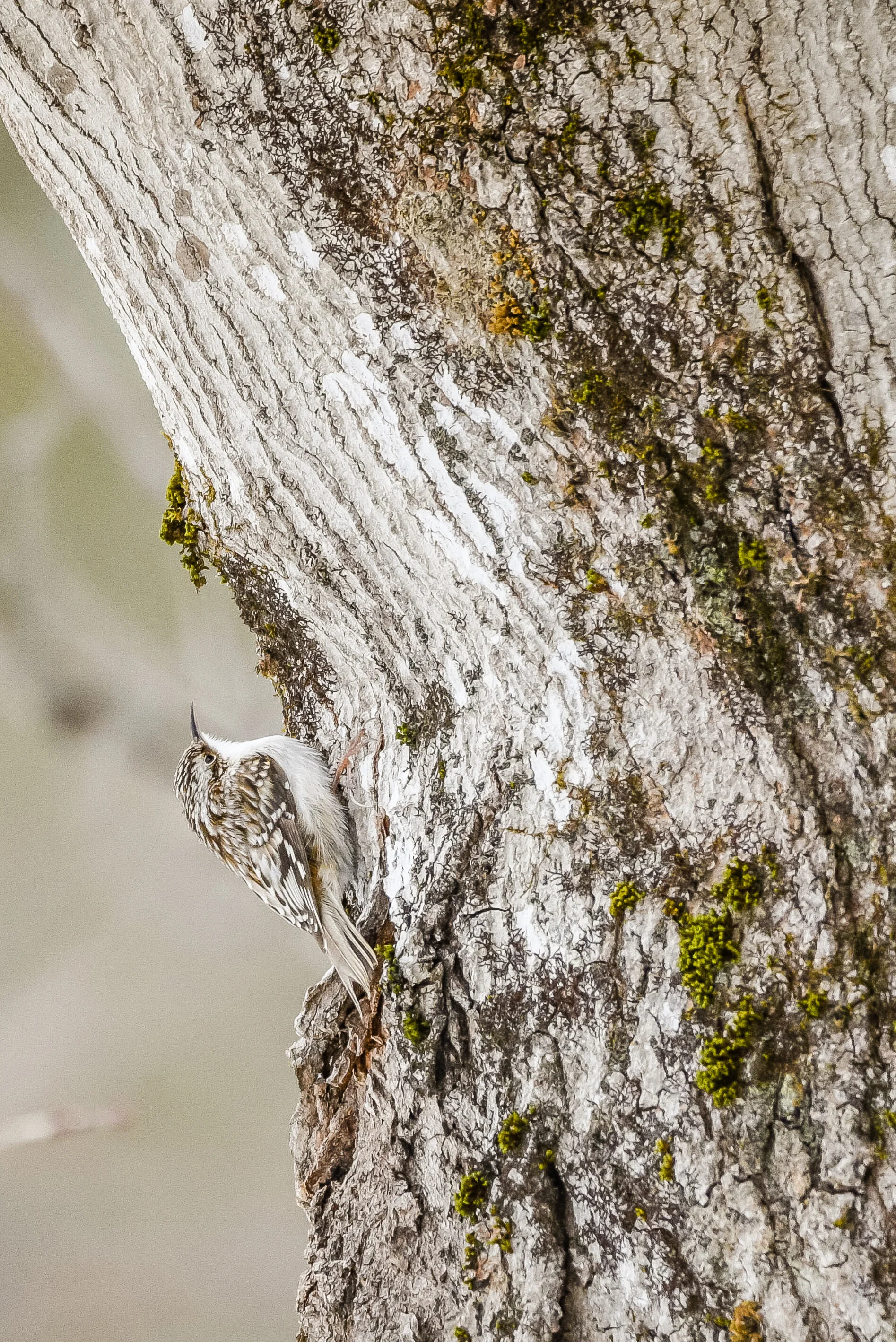
The Brown Creeper gets its name from its foraging behavior. It generally feeds on the trunks of mature evergreen and deciduous trees, especially trees with deep furrowed bark.
Photo: Brown Creeper, Donna Keller/Great Backyard Bird Count
Brown Creeper, the Tiny Tree Hugger
By Jessica Bigger
The first time I was introduced to the Brown Creeper (Certhia americana) was in my Ornithology class at Humboldt State University and it was love at first sight. However, to this day, I have not been lucky enough to spot one out in the field. But it’s no surprise, these cryptic little guys are well camouflaged by the bark they forage on.
The Brown Creeper gets its name from its foraging behavior. It generally feeds on the trunks of mature evergreen and deciduous trees, especially trees with deep furrowed bark. This little guy starts at the bottom of the tree and works its way up in a spiral formation until it reaches the top. Then it flutters back down to the bottom of the next tree to spiral its way back up again. Just one spider can give a Brown Creeper enough energy to climb 200 feet without needing to take a break. Unlike nuthatches, who can move up and down a tree, the Brown Creeper only moves in one direction – up.
Plumage is the creeper’s best defense; enabling it to blend into tree bark when there is a predator approaching. It will then spread its wings and flatten its body to the trunk, frozen in place until the threat has passed.
Here in Northern Virginia our tiny feathered friends arrive in late fall or early winter and stay through early spring. They are widespread across the continental United States in winter and in some areas year-round. Brown Creepers usually inhabit mature forests, but in winter you might also see or hear them in local parks and suburbs. Because they blend so well into their surroundings, it’s best to keep your ears peeled for their delicate call, “seet, seet, seet.” Brown Creeper males sing during the breeding season and migration.
Although the Brown Creeper’s status (9 million) is stable throughout North America, their population is declining due to habitat loss, fragmentation, climate change and window collisions. But climate change seems to be their major threat. Audubon scientists have developed climate models that predict a shift in the Brown Creeper’s range in the future due to an increase in temperature. Already the species’ distribution throughout southern Canada has decreased by 57%. And the population is moving farther north, responding to temperature shifts. Another major threat to this species is spring heat waves, which can harm nestlings. In the west, wildlife managers use Brown Creepers as an indicator species to study how logging affects bird populations in the area.
So, this winter keep your ears tuned and eyes peeled for our little cryptic friends. As naturalist W.M. Tyler wrote in 1948, “The Brown Creeper, as he hitches along the bole of a tree, looks like a fragment of detached bark that is defying the law of gravitation by moving upward over the trunk, and as he flies off to another tree, he resembles a little dry leaf blown about by the wind.”
https://www.audubon.org/field-guide/bird/brown-creeper
https://www.allaboutbirds.org/guide/Brown_Creeper/overview
https://abcbirds.org/bird/brown-creeper/

Monday Mystery - October 19
Monday Nature Mystery continues! Read on to learn who correctly identified this bird (common AND latin names), and see our most recent mystery.
Photo: American Redstart, Eric Nie
We are pleased to announce the winner of our October 19th Monday Nature Mystery, Tricia Booker!
We had some great guesses! Tricia was the first to post the correct answer by just three minutes: American Redstart (Setophaga ruticilla). This brightly colored warbler is often referred to as the “Halloween bird.” True to its nickname, they often flash their black and orange patches to flush out their next meal. This redstart was a female, they are slightly less bright than the males. To learn more about American Redstart click here.
Each Monday we’ll post a new mystery and identify the previous week’s winner who will receive an ASNV hat or tote bag.
Here is this week’s mystery audio clip. Do you know who this is? Post your guess (please list both common name and Latin name) on our Facebook page (@AudubonVA) under Monday Nature Mystery.
Good luck!

Volunteer: ASNV Finance Committee
The Audubon Society of Northern Virginia (ASNV) is looking for additional members for its Finance Committee to help advise the Board on investment allocations.
Photo: Osprey, Ly Dang/Audubon Photography Awards
The Audubon Society of Northern Virginia (ASNV) is looking for additional members for its Finance Committee to help advise the Board on investment allocations. The Finance Committee meets quarterly to review financial holdings and create recommendations to the ASNV Board for allocating/reallocating investment funds based on the organization's cash needs, financial goals and risk tolerance. The Finance Committee prepares a report to the Board twice per year. Prospective Finance Committee members should be familiar with evaluating risks and returns of securities but do not need to have a professional background in a financial field. Contact Eli Garduño

Observations from Meadowood: September
Judy Gallagher continues to survey Meadowood Recreation Area during the pandemic. Here are some findings from her most recent survey.
Photo: Meadowood Recreation Area, Rusty Moran
During the pandemic we’ve had to cancel our regular wildlife surveys but some long-time participants are going out individually on an ad hoc basis to continue collecting data. Judy Gallagher is one of those folks who also captures photos of what she sees, in particular the less common species. Here are two observations from her most recent survey.
In an example of convergent evolution, Monarchs and Milkweed Tussock Moth caterpillars have both evolved to be able to eat and process the toxins in Milkweed leaves. They sequester the toxins which gives them some protection from being eaten by birds. Although both caterpillars are fairly common, they aren't usually seen munching on the same leaf. Yet, here they are together at Meadowood's Pollinator Garden, competing for food.

Milkweed Tussock Moth and Monarch Caterpillars, Judy Gallagher
This beautiful insect is a Velvet Ant, so called because of its dense hair. It isn't really an ant, and you wouldn't want to pet its velvet coat. It's a female Mutillid wasp, seen recently at Occoquan Bay National Wildlife Refuge. Its other common name is "Cow Killer" as its sting is reputed to be bad enough to kill a cow. While the adult females don't have wings, the males do and look so different from the females that entomologists didn't realize that they were the same species until they saw the wasps mating.

Velvet Ant, Judy Gallagher

How to Prevent Bird Window Collisions: Watch this Video
Oakton High school student and passionate birder, Elliot Frank was concerned about how to reduce the high number of bird fatalities caused by window strikes. He decided to tackle the issue for his Eagle Scout project.
Photo: Bird-friendly Glass, NAS
Oakton High school student and passionate birder, Elliot Frank was concerned about how to reduce the high number of bird fatalities caused by window strikes. He decided to tackle the issue for his Eagle Scout project. With the help of ASNV mentors and his fellow scouts, Elliot produced an informative and engaging video on bird-window collisions that he has offered to ASNV. The video outlines various techniques for homeowners to make their windows bird-safe. You can watch it here.

Elliot Frank

ASNV Praises Aventon Holdings I, LLC for Bird-friendly Development Project
A little over two years ago, Aventon Holdings I, LLC approached neighboring communities in the Mount Vernon District in Virginia to get residents’ input on what kind of development they envisioned at Aventon’s proposed building site.
Photo: Black and White Warbler, Laura Erickson
By Jessica Bigger
A little over two years ago, Aventon Holdings I, LLC approached neighboring communities in the Mount Vernon District in Virginia to get residents’ input on what kind of development they envisioned at Aventon’s proposed building site. The developer is planning to erect a seven to eight story apartment building at the south end of Huntington Metro Station. “The developer came in with the approach of asking “How can we make this community better,” noted Cathy Ledec, a longtime conservation activist and a director on the Audubon Society of Northern Virginia Board.
Ledec, who lives in the Mount Vernon District, worked with Aventon to provide guidance on encompassing bird-friendly design elements into the apartment building’s exterior. Each nearby neighborhood set up committees and met with Aventon representatives and its consulting firms multiple times over the past two years to contribute their thoughts and ideas for the project prior to Aventon submitting a proposed building design plan.
With help from the Audubon Society of Northern Virginia, neighbors and other advocacy groups, Aventon incorporated environmental and bird-friendly design elements into the building plan from the beginning. “In some cases, developers will try to add these elements after a building is designed, but if you incorporate it into the building design from the get go, it’s much easier rather than adding these elements as an afterthought,” said Ledec.
The Aventon is the second project in Fairfax County with a proffer that includes bird-friendly design elements as a key component of the building plan. A proffer is an agreement between the county and the developer in which the developer agrees to minimize the impacts on the surrounding neighborhoods and the county by providing funds for amenities such as road improvements, schools, parks and more. The first Fairfax County project known to include bird-friendly design in the proffer is One Tysons East, which will be built across from the McLean Metro Station.

Bird-friendly windows, NAS
The Avenon property abuts Mount Eagle Park, which includes a heavily treed conservation area. The apartment building will sit at the top of a hill that is a migratory bird hotspot. So it was a priority for the developer to create apartments that would fit well with the surrounding environment, rather than be an obstacle. Anyone living on the east side of the apartment building will have a gorgeous view of the park, and on a clear day, residents who live on the top floor will likely get a view of the Potomac River and beyond.
Along with where the building will sit on the property, Aventon included several bird-friendly elements to the apartment building’s exterior, including reduced use of reflective glass surfaces, shading and recessed balconies. The developer has also committed to using native plants for landscaping. This will become an extension of habitat for forest-based birds, providing them food and cover.

Happy Autumn
Depending on where you live, you might start to notice a drop in temperature as the foliage from your shrubs and trees starts to change color. Cool breezes are also starting to pick up, leaving stray twigs and small branches on your lawn.
Photo: Brush Pile, Joanne Bauer
By Deidra Bryant
Depending on where you live, you might start to notice a drop in temperature as the foliage from your shrubs and trees starts to change color. Cool breezes are also starting to pick up, leaving stray twigs and small branches on your lawn. Many special techniques, some borrowed from traditional gardening and some unique to habitat gardening and landscaping can be employed by backyard bird watchers to enhance a property for use by birds. Brush pile composition is one of them!
Brush piles are highly attractive to a wide variety of birds, as they increase moisture and add nutrients to the soil attracting invertebrates. As a result, expect sparrow and wren species to spend long hours exploring the tangles for their next scrap of food. As the name implies, brush piles can be a simple pile made up of all your tree and shrub trimmings, pulled weeds, fallen branches or dried tomato and cucumber vines from a vegetable garden. There is a simple construction technique for vastly improving the usefulness of a brush pile for a wider array of wildlife by creating more diverse openings under the pile. It can be as simple as piling your clippings in some out-of-the-way location at the back of the property. Or, it can be as complex as having a planned layering of long alternating rows of prunings and small branches. The best brush piles, from a wildlife perspective, are those that allow a honeycomb of open spaces inside among the various elements. Those become places where birds and other small wildlife can hide, rest and escape from predators.
To create your brush pile:
Lay down a crisscrossing pattern of 5-inch diameter logs on the chosen spot as a base. You may also use a wooden pallet if you have one already.
Mound all available sticks, limbs, vines and such, atop the second layer, allowing them to spill over the logs to the ground.
Continue adding trimmings from your trees and shrubs to build up the brush pile. As each layer of larger branches or logs is concealed, put on another layer until your pile is as high as you’d like. The finished brush pile will look like a dry-land beaver lodge without the mud.
If you have any clipped evergreen branches, you can place those on top to conceal the interior.
Your wildlife visitors will greatly appreciate your work of art throughout the fall and winter! Just make sure that your pile is far away from any sources of fire.

Audubon at Home Certifies 87-acre property
Audubon at Home resumed in-person visits to homes with masks and safe social distancing on July 1 and interest came roaring back. Since then AAH has had 63 requests with 47 visits reported. The most notable property to be certified is the JK Black Oak Wildlife Sanctuary.
Audubon at Home resumed in-person visits to homes with masks and safe social distancing on July 1 and interest came roaring back. Since then AAH has had 63 requests with 47 visits reported. The most notable property to be certified is the JK Black Oak Wildlife Sanctuary, an 87-acre property in Loudoun County near Lucketts which has been placed under a conservation easement by owner and Audubon at Home partner, Loudoun Wildlife Conservancy.
Biologists from the Virginia Department of Conservation’s Natural Heritage program determined the property was a globally rare wetland, with 14 vernal pools that support large and rare amphibian populations, mature forest, meadow and grassland within a unique geologic setting in an area of Karst limestone overlay. Challenges include non-native invasive plants such as autumn olive and missing understory due to deer grazing. Loudoun Wildlife Conservancy is working in partnership with The Nature Conservancy and Loudoun Soil and Water Conservation District to develop a management plan for the property.

LWC Executive Director Michael Myers said, “LWC is proud to steward this globally rare wetland and we are glad the property is now permanently protected from future development through a conservation easement. The Audubon at Home Wildlife Sanctuary certification is a very welcome recognition of the significance of this property.”
Maybe you don’t have 87 acres of globally rare wetland habitat, but Audubon at Home is always eager to work with you to improve the wildlife value of your yard, HOA or other property, no matter how small. Even a patch of a few dozen square feet can help support wildlife. Fall is a great time to plan and plant. To request a free visit from an Audubon at Home Ambassador who can advise on native plantings and other habitat improvements, visit us here.
Leave the Leaves
Here’s a habitat tip for fall: Leave the leaves! Did you know that many beneficial insects overwinter in leaf litter? And that many birds forage for their meals in leaf litter, such as the beautiful winter visitor, the Hermit Thrush? Leaf litter decays into rich humus that enriches the soil and supports a rich web of life. So, don’t bag up those leaves in plastic bags and set them out at the curb—leave the leaves on the ground.
For more advice on enhancing the habitat in your own backyard, check out our website.
In photo, from left: Anne Owen, LWC Audubon Program Coordinator for Loudoun County, Sheila Ferguson, LWC volunteer and native plant guru, Betsy Martin, ASNV Board member and AAH Program Co-Director, and Michael Myer, LWC Executive Director- all temporarily mask less for the photo. Photo by Mike Sciotino, LWC Black Oak Committee member.

October Bird of the Month
One bird in particular, the male House Finch, can range in color from yellow to bright red based on the food he eats.
Photo: House Finch, Philip Sonier
Mr. House Finch You Are What You Eat
By Jessica Biggers
Years ago, I remember sitting in a boat on an estuary in the Celestun Biosphere in Mexico, completely mesmerized by the vast flock of American Flamingos feeding on shrimp on the salt flats. They were magnificent, and the first thing I thought when I saw them, was how different they looked from the pink flamingos at the zoo. These wild flamingos displayed more of an orangish pink hue; due to the type of shrimp they consumed.
To see this amazing act of nature in flamingoes, you must visit Mexico, Central American, South America or the Caribbean. But you can also witness this effect on plumage color closer to home. One bird in particular, the male House Finch, can range in color from yellow to bright red based on the food he eats. The fruits these males consume contain carotenoids, which directly contribute to how yellow or red their feathers become. Most male House Finches show off their red head, rump and headband, but if you look closely, some have a more orange or even yellowish hue. So, as the saying goes, “You are what you eat,” at least when it comes to the color of one’s plumage.
Eastern House Finches eat a variety of seeds and fruits, including mustard seeds, knotweed, thistle, mulberry, poison oak and more. They also forage in orchards eating cherries, apricots, peaches, pears, plums, strawberries and blackberries. Bird feeders provide an additional supply of food, specifically black oil sunflower, millet, milo and some colorful dried fruits as well. The redder the fruit – the redder the bird.
Since female House Finches tend to select males that are bright red, research has shown that some males tend to be selective in the fruit and seeds that they eat. In a study back in 2009, researchers offered male House Finches different colored sunflower seeds. These males had a choice between green, yellow, orange and red colored seeds. Males tended to avoid yellow-dyed sunflower seeds and preferred the red and green ones. Males who are not as picky about what they eat may find it difficult to attract and court a female during breeding season.
Even though many male House Finches will prefer fruits that are red, sometimes there isn’t enough to go around. So, they eat what they can get. This may explain why in some areas there may be more yellow or orange-colored House Finches bopping around.
Surprisingly, there are many other local bird species whose color and brightness comes from the carotenoids they get from eating a variety of fruits and seeds. These include Northern Cardinals, American Goldfinches and yellow-hued warblers. However, unlike the House Finch, most of the fruits and seeds these guys consume may affect how dull or bright their plumage is rather than displaying a different shade of color.
Read more from our Bird of the Month series here.
Sources:
https://academy.allaboutbirds.org/how-birds-make-colorful-feathers/
Monday Mystery
Monday Nature Mystery continues! Read on to learn who correctly identified this bird (common AND latin names) last week, and see our most recent mystery.
Photo: Yellow-rumped Warbler, Barbara J. Baird/Audubon Photography Awards
We are pleased to announce the winner of our Monday Nature Mystery, John Nolley!
We had some great guesses! John was the first to post the correct answer: Yellow-rumped Warbler (Setophaga coronata). According to All About Birds: Yellow-rumped Warblers winter across much of central and southeastern U.S., and they sometimes come to backyards if food is offered. To attract them, try putting out sunflower seed, raisins, suet and peanut butter. Find out more about what this bird likes to eat by using the Project FeederWatch Common Feeder Birds bird list.
Each Monday we’ll post a new photo and identify the previous week’s winner who will receive an ASNV hat or tote bag.
Here is this week’s mystery:

Photo: Brian Zwiebel
Do you know what bird this is? Visit our FB page and look for our Monday Mystery post to offer your suggestions.
Good luck!

Sweet Options When Selecting Woody Plants for your Home Habitat
The dog days of summer are behind us, and as our avian migrants prepare for their long and arduous journey towards their wintering grounds, you might wonder what things you and your family can do for your native bird habitat to facilitate their journey.
Photo: Gray Catbird with Beautyberry, Will Stuart
By Deidra Bryant
The dog days of summer are behind us, and as our avian migrants prepare for their long and arduous trek towards their wintering grounds, you might wonder what things you and your family can do for your native bird habitat to facilitate their journey.
Although it’s still too early to see those beautiful crimson leaves senesce within your neighborhood, colorful fruits are still abundant on many woody plants. As you may already know, birds show individual preferences for various fruit-producing plants. For example, they will select fruits they like best (such as Cornus, Rubus, and Vaccinium spp), clean them off early in the season, and let fruit they find less tasty hang onto other plants. Here are a few plants to consider purchasing if you enjoy observing birds nibble on fresh fruit within resplendent autumn foliage.
American beautyberry (Callicarpa americana L.) is a native perennial understory shrub that produces clusters of tiny magenta drupes that ring around their woody stems in late August and September. The berries have a high moisture content and serve as an important food source for many passerines such as the Northern Cardinal, Purple Finch, Northern Mockingbird, Eastern Towhee and Brown Thrasher.
Persimmons - whose genus loosely means “fruit of the Gods”- are one of the most favored fruits in Asia. However, they tend to be under-appreciated in North America. The American persimmon (Diospyros virginiana) is a large tree native to much of the eastern United States and grows vibrant orange berries (yes, the fruit is morphologically a berry!) As with Asian persimmons, the American persimmon produces delicious fruit in the fall which becomes an excellent food source for birds once they are ripe. In fact, this fruit becomes more palatable, softer and sweeter only after a couple of light autumn frosts.
Other fruiting plants to consider include American holly and Blackhaw. By adding “less-desired” species to your habitat, you’ll be stocking your feathered friends’ pantry for the late winter when berries they passed up become life-saving food stores. Birds that rely on insects in the warmer months often rely on berries when the weather turns brisk. These include woodpeckers, robins, waxwings, thrashers, mockingbirds, catbirds, thrushes, bluebirds, chickadees and titmice. So, as you clean out those nest boxes and make your brush piles, consider planting these captivating native plants in your yard next spring. You might even encounter a new visitor!

Virginia Breeding Bird Atlas Transitions to Next Stage
The second Virginia Breeding Bird Atlas, known as VABBA2, is one of the largest citizen science projects in Virginia’s history. Over the last five years, more than 1,400 volunteer birders have gathered data on breeding activity of over 200 species throughout the Commonwealth, resulting in over 6 million records.
Photo: Northern Pintails, Angela Vogel/Audubon Photography Awards

The second Virginia Breeding Bird Atlas, known as VABBA2, is one of the largest citizen science projects in Virginia’s history. Over the last five years, more than 1,400 volunteer birders, including many ASNV members, have gathered data on breeding activity of over 200 species throughout the Commonwealth, resulting in over 6 million records.
The VABBA2 is a joint effort of the Virginia Department of Wildlife Resources (formerly Game and Inland Fisheries), Virginia Tech and the Virginia Society of Ornithology (VSO).
In speaking of the field collection work, Dr. Ashley Peele of Virginia Tech and VABBA2 coordinator, said “We’ve ended our final year very strongly, despite constraints presented by Covid-19. This means that after five years of intense data collection, we are in an excellent position for moving forward with the next stage – data cleanup, review, and analysis for the Atlas datasets.” This stage will compile the raw data into readily useable information.
Although its final form is still being determined, the VABBA2 will provide accessible science-based information on avian population and habitat distributions, species maps and accounts, and a range of other topics. This data will support positive environmental regulation, species conservation, rural land preservation, public lands acquisition and management, climate change actions and much more. You can learn more about the atlas project here.
As a member chapter of the Virginia Society of Ornithology, ASNV is pleased to support the next phase of VABBA2. We invite you to join us in helping launch the final stage of the Atlas project through your donation, either online or by sending a check to the VSO at P.O. Box 5994, Williamsburg, VA 23188. Thank you!

Peak Hummingbird Migration Season
In Virginia, migration season is peaking for Ruby-throated Hummingbirds, which are here throughout the summer during their breeding season.
Photo: Ruby-throated Hummingbird, David Shipper
By Lisa Mackem
In Virginia, migration season is peaking for Ruby-throated Hummingbirds, which are here throughout the summer during their breeding season. This is the only hummingbird that breeds in eastern North America but birders sometimes see the Rufous Hummingbird passing through this area in the fall or winter. The Rufous Hummingbird used to be a rare stray in the southeast United States, but sightings east of the Mississippi have become more frequent. The Rufous Hummingbird nests the farthest north of all hummingbirds – up to south-central Alaska.
In late winter and early spring, hummingbirds breed in the United States and Canada, where summer food supplies are abundant. Hummingbirds occupy almost all of North America during the summer, but most of them migrate to Mexico or Central America for the winter. These are impressive journeys for tiny birds. Ruby-throated Hummingbirds weigh little more than a penny, but can fly 500 miles across the Gulf of Mexico in less than one day. The three-inch long Rufous Hummingbird makes one of the longest migratory trips in the bird world – 3,900 miles, or 78.4 million body lengths. In the United States, Ruby-throated Hummingbirds can travel up to 20 miles per day. Contrary to popular myth, they do not migrate on the backs of geese or other birds, but they do sometimes travel in mixed flocks over water.
Ruby-throated Hummingbirds will defend territories of flowers and feeders and will fight or chase off other birds that try to feed there but females will occasionally share a feeder. Male Rufous Hummingbirds will also defend a patch of flowers and vigorously chase away all intruders, including larger birds. Before placing a feeder outside, make sure there are no outside cats that can prey on birds, and that feeders are not too close to windows. Cornell Lab of Ornithology “All About Birds” recommends making a sugar water mixture with one-quarter cup of sugar per cup of water. Food coloring is not recommended. Preferred native flowers include Trumpet Creeper, Trumpet Honeysuckle, Cardinal Flower, Bee-balm and Wild Bergamot. Hummingbirds also eat and feed their young tiny insects including mosquitoes, gnats, fruit flies, small bees, caterpillars and aphids.

ASNV Board Member Cathy Ledec Receives Environmental Award
Cathy Ledec, who joined the ASNV Board of Directors a year ago, has received Fairfax County’s 2020 Sally Ormsby Environmental Stewardship Award.
Photo: Huntley Meadows Park in Autumn, Larry Meade

Cathy Ledec
Cathy Ledec, who joined the ASNV Board of Directors a year ago, has received Fairfax County’s 2020 Sally Ormsby Environmental Stewardship Award. Cathy received the award in recognition of her 17 years of volunteer service at Huntley Meadows Park and for the Fairfax County Park Authority. Cathy is President of the Friends of Huntley Meadows Park, a Site Leader for FCPS’s Invasive Management Area Program, Chair of the Fairfax County Tree Commission and a member of County Supervisor Dan Storck’s Environment Advisory Committee.

ASNV Bird Walks are Resuming in September—within Limits
Soon we will begin—cautiously – to resume bird walks this fall. While the activity is outdoors, we still want to avoid the need for participants to be in close proximity. Even though the business economy is restarting, we realize that the virus is still a significant risk, especially to older people.
Photo: Occoquan, Dixie Sommers
By Jean Tatalias and Dixie Sommers
Soon we will begin—cautiously—to resume bird walks this fall. While the activity is outdoors, we still want to avoid the need for participants to be in close proximity. Even though the business economy is restarting, we realize that the virus is still a significant risk, especially to older people.
Our walks will be limited to 4 or 5 participants plus the leader. Participants must observe social distancing whenever possible and masks will be required when that is not possible—for example, when passing other walkers. Scopes will not be used. Locations will be chosen where trails are wide enough for the needed separation.
The bird walk list will announce the general area for a walk (e.g., western Prince William County or south of Alexandria), the date and the leader. We will require that people enroll with the leader by email. The leader will limit the attendees to space available and will give enrollees the exact location to meet. Two September walks are being offered.
These walks are intended for participants who would like the guidance of a leader. In parallel, we encourage our more experienced birders to continue with their own solo birding and photography outings.
When you register for a walk you are expected to be symptom-free if you attend. If you have registered but find you cannot attend, please notify the leader. We will keep a waiting list
This is a cautious beginning for all of us who miss birding together. Some may not be comfortable with even this limited format yet—and we respect their choice. If you do register, please follow the requirements out of respect for the leader and other participants.