
NVBA NEWS BLOG
Welcome to the blog for Northern Virginia Bird Alliance, a wealth of resources about northern Virginia birds, wildlife, habitat conservation and restoration, native plants, wildlife-friendly gardening, advocacy and more.

U.S Fish and Wildlife Big Day Birding Event results in VA State Record
In this year’s Big Day birding competition sponsored by the U.S. Fish and Wildlife Service, a team comprised of four expert birders set the Virginia state record. Read all about their amazing 24-hour adventure.
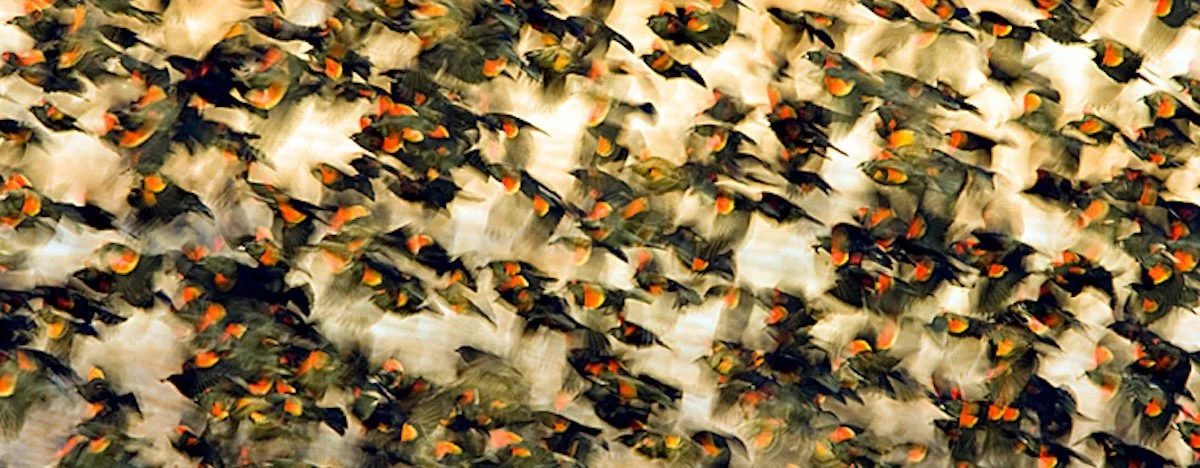
Photo: Laughing Gulls, Kurt Gaskill
In this year’s Big Day birding competition sponsored by the U.S. Fish and Wildlife Service, a team comprised of four expert birders set the Virginia state record. Congratulations to Greg Fleming, Kurt Gaskill, Tim Hodge and Eric Kershner!
Read all about their amazing 24 hours written by:
Kurt Gaskill
(Thursday pm, April 19) The phone rang: it was Greg Fleming. He was interested in doing a Big Day and had questions about strategies and whether I would join him and his colleague, Eric Kershner. We discussed how the Highland County to Chincoteague route should net the most species – he became persuaded and later, Eric was, too. I said I was interested in joining and that we should get Tim Hodge on-board.
Greg and Eric work for US Fish & Wildlife in the migratory bird program – every other year the national program holds a friendly bird-oriented competition for its staff. This year, 2021, the national program is holding a Big Year competition and one of the categories is a Big Day. This was the genesis of our recent Big Day.
I contacted Tim Hodge – he and I did a few Big Days some time ago and our best result was on May 15, 2014 where we tallied 199 species - and I suggested he join the team because of his depth of knowledge. He agreed and soon after we all Skyped and the strategizing started. Tim did extensive scouting in Augusta and Highland Counties and I scouted east of Richmond and on the Eastern Shore. We chose Thursday to avoid weather, Friday traffic and Mother’s Day.
(Wednesday 11:58 pm, May 5) We position ourselves at the top of the knoll overlooking the Bridgewater Treatment Plant – the clock strikes midnight and the first two species were Canada Goose and Killdeer and were quickly followed by Wood Duck, Blue-winged Teal, Ring-necked Duck, American Coot, Lesser Scaup, Common Merganser, and Ruddy Duck. We missed the Snow Goose and Eared Grebe reported there the day before by Eric and Greg. After that, we took many dark gravel roads and notched Mute Swan, Barn Owl, Least Bittern, Wilson’s Snipe, and Sora plus a few common species like Horned Lark and Yellow-breasted Chat. We were now west bound to Highland Co.
Our first stop was Bramble Hill, which was the O’Brian mountain residence. Pulling up I heard the tooting of a Northern Saw-whet up the slope and Tim also got it but the owl did only one sequence and Greg and Eric missed it. So, we finished up here with American Woodcock and left - the next stop netted Eastern Screech Owl calling close to the car. We started up Laurel Forks Road and the first stop was another tooting Saw-whet but it was distant and hard to hear for all in the group. Fortunately, the third Saw-whet stop was easier – Tim and Greg heard bill clapping as they got out of the car. Playback was initiated and it took about 1.568 seconds for the owl to give the wail call which was easily heard by all as it was less than 50 feet away; so, we all got in the car and sped off. The next stop yielded both male and female Long-eared Owls calling several times (there is a distinctive call for the female, see for example https://www.xeno-canto.org/638905). Straight Fork produced Barred Owls and Whip-poor-wills. To round out the owls, we heard a Great Horned Owl near the W. VA border. (This means nearly all the regular Virginia spring & summer owls are in Highland County. Now, if we only had a breeding Short-eared!)

Roughed Grouse, Kurt Gaskill
Dawn chorus started at this border spot – the first bird was an Eastern Towhee, followed by many species such as Hermit Thrush, Veery, Junco, Golden-crowned Kinglet, and Black-capped Chickadee. As we began our descent, we passed a singing Winter Wren – no longer easy to find up in this area. The species count soon increased: scads of Black-throated Blue, Magnolia, and Black-throated Green Warblers were heard. We found a Wild Turkey roosting 60 feet up in a tree, Ruffed Grouse drumming near a wet patch and nearby were migrant Ruby-crowned Kinglet and Northern Waterthrush; plus, Greg pulled out a Nashville Warbler! Driving further down slope other highlights were Cooper’s Hawk, Purple Finch, Pine Siskin, Black-billed Cuckoo, Blackburnian Warbler, more Ruffed Grouse (a real treat to see two males facing off in the middle of the road), Alder Flycatcher, Baltimore Oriole and Raven. At the edge of Blue Grass Valley, we heard a Vesper Sparrow sing, found Grasshopper and Savannah Sparrows, and heard many Bobolinks. A second visit to Bramble Hill produced Golden-winged Warbler and nearby we found Blue-winged Warbler, Green Heron, Am. Kestrel and Cliff Swallow. A well anticipated stop at Forks of Water produced Orchard Oriole and Warbling Vireo. As we sped towards Augusta County, we found a pair of Broad-winged Hawks, Cerulean and Worm-eating Warblers and Yellow-throated Vireos. Plus, another Golden-winged Warbler!
The drive through Augusta County added Red-tailed and Red-shouldered Hawks, White-throated Sparrow, and Spotted and Solitary Sandpipers. We passed Afton Mtn with 138 species at 11:20 am (we were running late from our time target – does a Big Day team ever hit its time targets?).
A stop at Observatory Hill in Charlottesville added Bay-breasted, Blackpoll, and Hooded Warblers, Eastern Wood Pewee, and Swainson’s Thrush. In addition, we found a Sutton’s Warbler (a first for some of us). We then booked, stopping east of Richmond along Rt 60 to notch Summer Tanager, White-eyed Vireo, Acadian Flycatcher, Yellow-throated and Prothonotary Warblers plus Chimney Swift. We continued to Blue Bird Farm for the staked-out Snow Goose and then drove across/under Hampton Roads to the start of the CBBT.

Snow Goose, Kurt Gaskill
For the Chesapeake Bay Bridge Tunnel (CBBT) our strategy was that everyone - other than the driver (that is, me) - combed the sea and horizon with bins; this resulted in tallies for Northern Gannet, Sandwich Tern, Caspian Tern, Common Tern, Brown Pelican, Double-crested Cormorant and Common Loon. Landfall enabled the driver to glimpse a Caspian Tern. Next stop was Ramp Road for some simple shorebirds, Bald Eagle, Prairie Warbler and an amazing Northern Bobwhite! Driving up to near Magotha Rd and Seaside Rd produced the expected Eurasian Collared Dove. Time was now running late so we skipped several spots and headed straight for Willis Wharf. We arrived at Willis close to 5pm and nearly high tide: we got 2 of the 3 targets (Whimbrel, Gull-billed Tern but missed Marbled Godwit) and spotted a bonus: Bonaparte’s Gull!
Next up: Chincoteague causeway. The oyster bar had, naturally, an American Oystercatcher. And the nesting bushes at Wire Narrows Marsh had all the expected birds: Great and Snowy Egret, Little Blue and Tricolored Heron, Glossy and White Ibis, and Black-crowned Night-Heron; yet the site lacked Cattle Egret. Black-necked Stilts were nearby, plus some shorebirds and the ever-present Boat-tailed Grackles. Next stop was in town for a Brown-headed Nuthatch behind a motel.
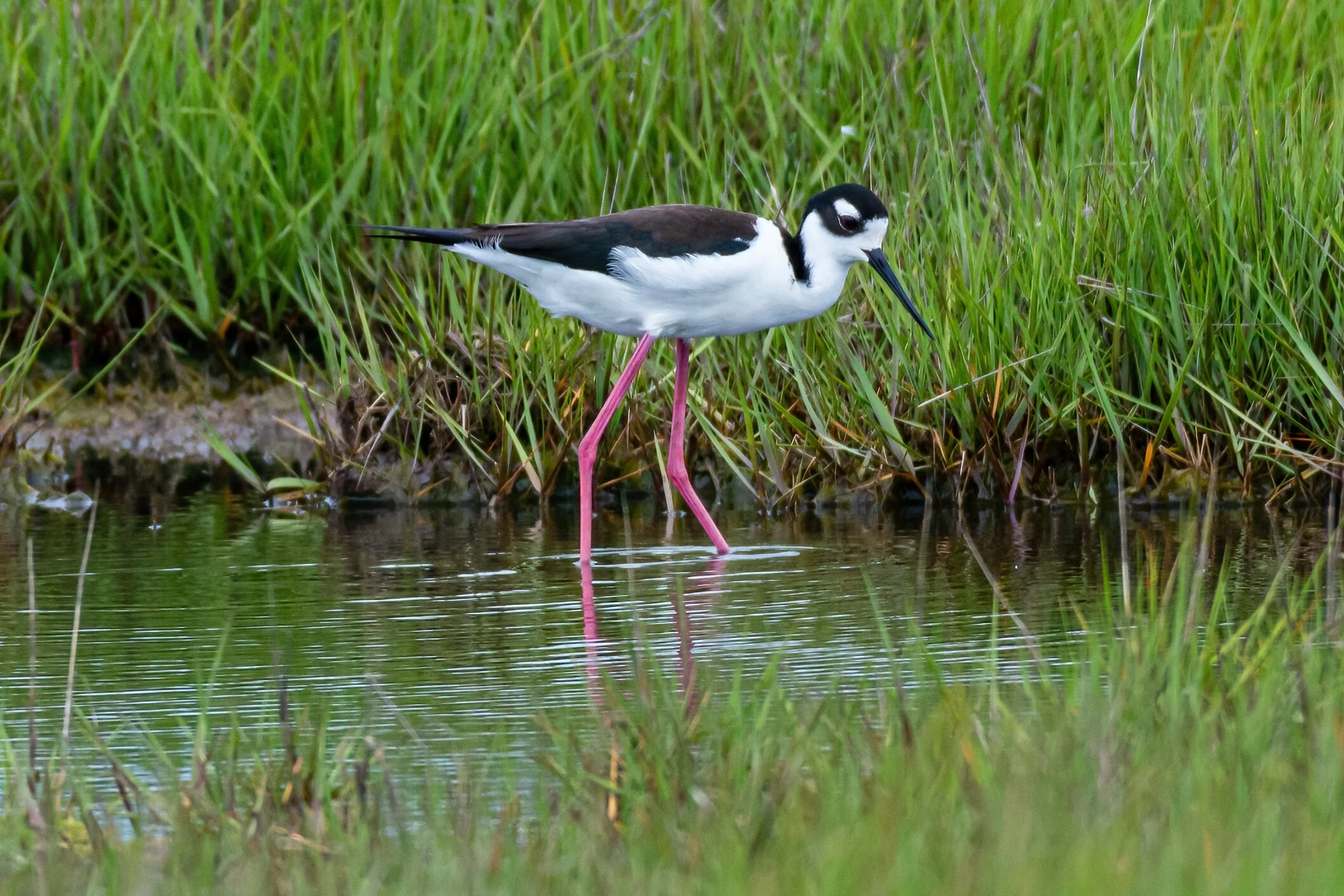
Black-necked Stilt, Kurt Gaskill
Arriving at the refuge we went straight for the beach. A quick scan found a small group of Sanderling and Red Knots. I pointed out a Least Tern flying along the beach as well as another gannet. We checked some nearby shorebirds and drove to the wildlife loop. A few more shorebirds to look over but nothing new - then Eric spotted 4 Red-breasted Mergansers swimming behind the shorebirds. We went to the Marsh Trail platform and waited a few minutes for the Yellow Rail to (finally) make a noise and then we left as the Chuck-will’s-widows started up.
Back on the causeway we found one Yellow-crowned Night-Heron through vocalization near the Wire Narrows Marsh nest sites. We stopped for take-away at Sonic and drove to the Saxis area. We had missed Yellow-billed Cuckoo during the day so we tried for it on Marsh Market Road – but no luck (yet, both Night-Herons were heard!). We then drove over to Hammock Rd in the Saxis WMA and pulled out the easy chairs and sat down to listen to the night birds (it’s about 10 pm).
We recommend doing a night visit to Hammock Rd – virtually no traffic and on a cool night the bugs are only at half-strength. The dominant bird is Clapper Rail with a dozen or so Virginia Rails close by. Probably 10 Marsh Wrens and a dozen Seaside Sparrows. We were surprised by a Yellow-billed Cuckoo singing behind us – we heard another two later plus a Black-billed Cuckoo overhead. Eventually Tim pointed out Nelson’s Sparrows singing that we all got on as well as the Saltmarsh Sparrows singing closer to the bushes where it’s a bit drier (only a few of each). We were surprised by the number of Least Bitterns out there – at least 4 and possibly 5. Plus, one American Bittern which “oomp’ed” a few times. A distant Great Horned Owl hooted from a bit south of Saxis town and its juvie also called out. We heard some quacking ducks and Canada Geese from the direction of Saxis. Overhead migrants called out “seet” but no ID could be made. And two Dickcissels overflying called out an hour apart.
The last bird was at 11:45 pm – I was checking email when it sang, perhaps 20 feet from the car. A clear Le Conte’s Sparrow song. The area is somewhat dry – no Virginia Rails or Marsh Wrens or Nelson’s Sparrows were close. All got on the bird, even though it moved 50 feet or more away. We compared vocalizations with Nelson’s but Le Conte’s was a perfect fit. And then the clock struck 12 and we were done.
The final tally was 208 species as a team, with individual totals of 201 to 208. We drove nocturnally 150 miles and in daylight traveled 470 miles. Our big misses on the route were Marbled Godwit, Ruddy Turnstone, Ruby-throated Hummingbird, Belted Kingfisher, and Kentucky Warbler.
We could not have had this amazing Big Day without the help of many people. On behalf of my teammates, Eric, Greg and Tim, we extend Special Thank You’s to John Spahr, Vic Laubach, Allen Larner, Penny Warren, Bill Hohenstein, and advice given many years ago by Bill Williams and Bob Ake. Also, we must mention the immense value of the amazing reports, and the reporters (such as the work by Carlton Noll), to eBird (which we did not access during the Big Day) that helped nail down various sites. And a thank you to Jan Frye who helped on the Richmond area scouting.
We wish you all the Best in Birds!
Kurt Gaskill, Tim Hodge, Greg Fleming and Eric Kershner

June Bird of the Month
One of most impressive songbirds to pass through Northern Virginia during migration is the Bobolink, Dolichonyx oryzivorus.
Photo: Bobolinks, Ruhikanta Meetei/Audubon Photography Awards
The Chatty Bobolink Reaches Northern Virginia
Jessica Bigger
One of most impressive songbirds to pass through Northern Virginia during migration is the Bobolink, Dolichonyx oryzivorus. I actually had an opportunity to learn more about this bird during the “Birding by Ear” class I attended in May, hosted by the Audubon Society of Northern Virginia. The Bobolink was the last bird we covered, by far one of our instructor’s favorite birds. So, it was fitting that he ended the three series course with the Bobolink. With its bubbly, metallic, garrulous song, composed of 25-50 notes in one phrase and lasting around 3.5 seconds, this bird is quite magnificent. Not only does the Bobolink have an elaborate song, but during the breeding season, males will sing while hovering like helicopters in the sky.

Bobolinks, Ruhikanta Meetei/Audubon Photography Awards
The American Bird Association included a quote from Ferdinand Schuyler Mathews from The Field Book of Wild Birds and Their Music: “The Bobolink is indeed a great singer, but the latter part of his song is a species of musical fireworks….it is a mad, reckless, song-fantasia, an outbreak of pent-up, irrepressible glee. The difficulty in either describing or putting upon paper such music is unsurmountable. One can follow the singer through the first few whistled bars and then, figuratively speaking he lets down the bars and stampedes. I have never been able to ‘sort out’ the tones as they passed at this break-neck speed.”
The Bobolink gets its name from its diet. Bobolink literally means “rice eating.” Its diet consists of weed seeds, insect larvae, adult insects, and spiders. Yet, during migration and winter, Bobolinks generally stick to eating wild and domesticated rice, oats, other small grains, corn, tassels, and seeds from a variety of weeds. They focus more on insects during the breeding season, providing much needed protein to their clutch.
The breeding range covers southern Canada through the northern United States. The Bobolink is one of the longer distant migrants traveling more than 12,000 miles round trip. One Bobolink will travel a distance equal to 4 times the circumference of the earth in its lifetime.
Before heading all the way down to their wintering grounds, Bobolinks will stop over at freshwater marshlands and coastal wetlands in North America to molt before continuing their arduous journey back to South America. According to the Partners in Flight management document published in 2019, A Full Life Cycle Conservation Plan for Bobolink, these songbirds will stage in the Llanos grasslands of Venezuela and eastern Colombia for several weeks before continuing to their wintering grounds (grasslands and wetlands) in Bolivia, Paraguay, and Argentina. They will return along the same route back to North America for the breeding season.
Bobolinks are a species of concern. Although there is a still a large population, the population has declined more than 65% between 1966 and 2015. According to Partners in Flight, the population will likely continue to decline by 30% in the next twenty years. Many factors have contributed to the Bobolink’s decline. In South America, they are considered pests and are shot on site and they are also captured and sold as pets. However, the biggest contributor has been habitat loss and conflicting mowing schedules in North America during the breeding season.
To combat this problem, bird conservation organizations have been working with local governments, communities, and farmers to improve breeding habitat. The Bobolink Project, based in New England, encourages farmers to shape their fields in an oval pattern for the following reason: “Edge habitats (including tree lines that cut into fields) can expose grassland birds to a variety of predators, so grassland birds tend to avoid long and narrow, or convoluted fields.” The organization also provides participating farmers with economic assistance to adjust their mowing and harvesting schedules during the Bobolink breeding season.
By the time this article comes out, the Bobolinks in Northern Virginia might be well on their way to their breeding grounds. If you missed them this year, you will have a chance to spot them this fall, and definitely next spring to enjoy their colorful songs, metallic calls, beautiful plumage, and magnificent flight patterns.
Sources:
https://www.allaboutbirds.org/guide/Bobolink/overview
https://www.bobolinkproject.com
https://www.aba.org/bobolink-conservation/

Annual Native Plant Symposium for Landscape Professionals
Join Plant NOVA Natives and ASNV’s Audubon at Home program for their third annual symposium for landscape professionals.
Photo: Plant NOVA Natives
Annual Native Plant Symposium for Landscape Professionals
When: Tue, August 10, 2021 9:00 AM – 12:00 PM
Where: Virtual via Zoom
Fee: $30
Register here
Join Plant NOVA Natives and ASNV’s Audubon at Home program for their third annual symposium for landscape professionals. This conference is for professionals in the landscaping industry only: landscape designers, landscape architects, growers, nurseries, landscape maintenance, property managers, builders, etc.
Topics and presenters will include:
Choosing pollinator plants for maximum beauty and benefits - Sam Hoadley
Creating an edible landscape with native plants - Lincoln Smith
Native groundcovers - Missy Fabel
For more information: Plant NOVA Natives

Audubon at Home’s Advice about Pesticides
Pesticides are occasionally necessary to prevent disease transmission to humans, but improper use of pesticides can have health and environmental risks. Reduce pesticide exposure by trying preventative and less toxic pest management first.
Photo: Sheryl Pollock
Reduce pesticides for human and environmental health
Pesticides are occasionally necessary to prevent disease transmission to humans, but improper use of pesticides can have health and environmental risks. Reduce pesticide exposure by trying preventative and less toxic pest management first. On those rare occasions when a pesticide is necessary, read the product label for precautions and safety instructions and consider hiring a qualified, licensed pest management professional to apply the pesticide safely.
Reduce unintentional harm to beneficial insects:
Insecticides don’t just kill mosquitoes. They kill all insects, which includes fireflies, bees, butterflies, ladybugs, dragonflies and cicadas. Dragonflies eat large numbers of mosquitoes. Ladybugs living in your garden are beneficial insects that eat pests like aphids. Eliminating the beneficial insects that eat others can make pest problems worse. Bees and butterflies are important pollinators--without bees, food production suffers. Songbirds feed their babies a diet exclusively of insects and spiders. If we kill off the insects, we are killing off the birds, not to mention the frogs, bats and the rest of the ecosystem.
Smarter Pest Management: Protecting Pollinators at Home, Xerces Society
Protect water quality and reduce harm to fish and other aquatic wildlife:
Stormwater runoff carries pesticides and other pollutants to streams via storm drains. Much of the drinking water in Northern Virginia comes from the Potomac River and the Occoquan. Insecticidal sprays that end up in bodies of water directly harm fish and other aquatic wildlife. To reduce the harm to non-target animals, use non-chemical control methods. If that is not enough, use larvicides such as Bacillus thuringiensis israelensis (Bti), which is safer than targeting adults with insecticides.
Pesticides and Aquatic Animals: A Guide to Reducing Impacts on Aquatic Systems, Virginia Cooperative Extension
Reduce the costs of unnecessary spraying:
Use Integrated Pest Management to identify, prevent, and control pests efficiently and with minimal negative impacts. Choose an appropriate approach with minimal negative impacts to human and environmental health. Just as antibiotics are not the solution to every illness and overuse can cause antibiotic resistance, pesticides are often inappropriate solutions to pests. Routine use can lead to pesticide resistance and a bigger problem in the future.
Introduction to Integrated Pest Management, Environmental Protection Agency
Control Mosquitoes and Ticks with Integrated Pest Management:
Identification
Identify the pest and whether it is a problem or just an annoyance. Contact a local VCE extension agent for assistance identifying the pest.
Not all mosquitoes and ticks carry disease. The public health department sprays for mosquitoes when there is evidence of disease transmission. The benefits of spraying pesticides are weighed against the health and environmental costs.
Prevention
Reduce mosquito habitat by dumping stagnant water collecting in downspouts, the saucers under pots, etc. Organize a community clean-up day to remove sources of standing water such as tires and plastic litter. Empty and refill birdbaths every 3-5 days.
Promote a balanced ecosystem that supports beneficial insects by growing native plants. Remove invasive introduced plants such as English Ivy and Japanese Barberry that harbor mosquitoes and ticks.
Keep playgrounds and other high-use areas away from the edge of woods.
Reduce your exposure to mosquitoes and ticks – wear long sleeves, tuck your pant legs into your socks, use DEET, install a fan on your porch or patio.
Targeted use of larvicide
If standing water cannot be dumped and chemical intervention is necessary, use a larvicide such as Bti that kills mosquito larvae in water. Larvicidal mosquito dunks are more targeted than adulticidal sprays and pose less risk to fish and bees. Only use larvicides to treat water that will not be used for drinking.
Mosquito Control: What you need to know about Using Larvicides, CDC
Spray for mosquitoes only for a public health emergency
Insecticides should be targeted to areas of mosquito and tick habitat such as ivy, bamboo, and brush. Never spray around fruit and vegetable gardens or flowers in bloom. People and pets should stay away from the treatment area for an hour or until the product has dried. Adulticides should be used as a last resort, not as a preventative measure.
Monitor results
Do not sign up for routine spraying of insecticides on a set schedule. Monitor treatment results and update your pest control plan regularly based on the results.
Do more: Check out the Audubon Society of Northern Virginia’s Audubon at Home program for information on the Healthy Yard Pledge and Wildlife Sanctuary Certification. Audubon at Home Ambassadors provide complimentary, personalized advice to homeowners and communities on choosing native plants, removing invasive plants, and other actions to create wildlife habitat.

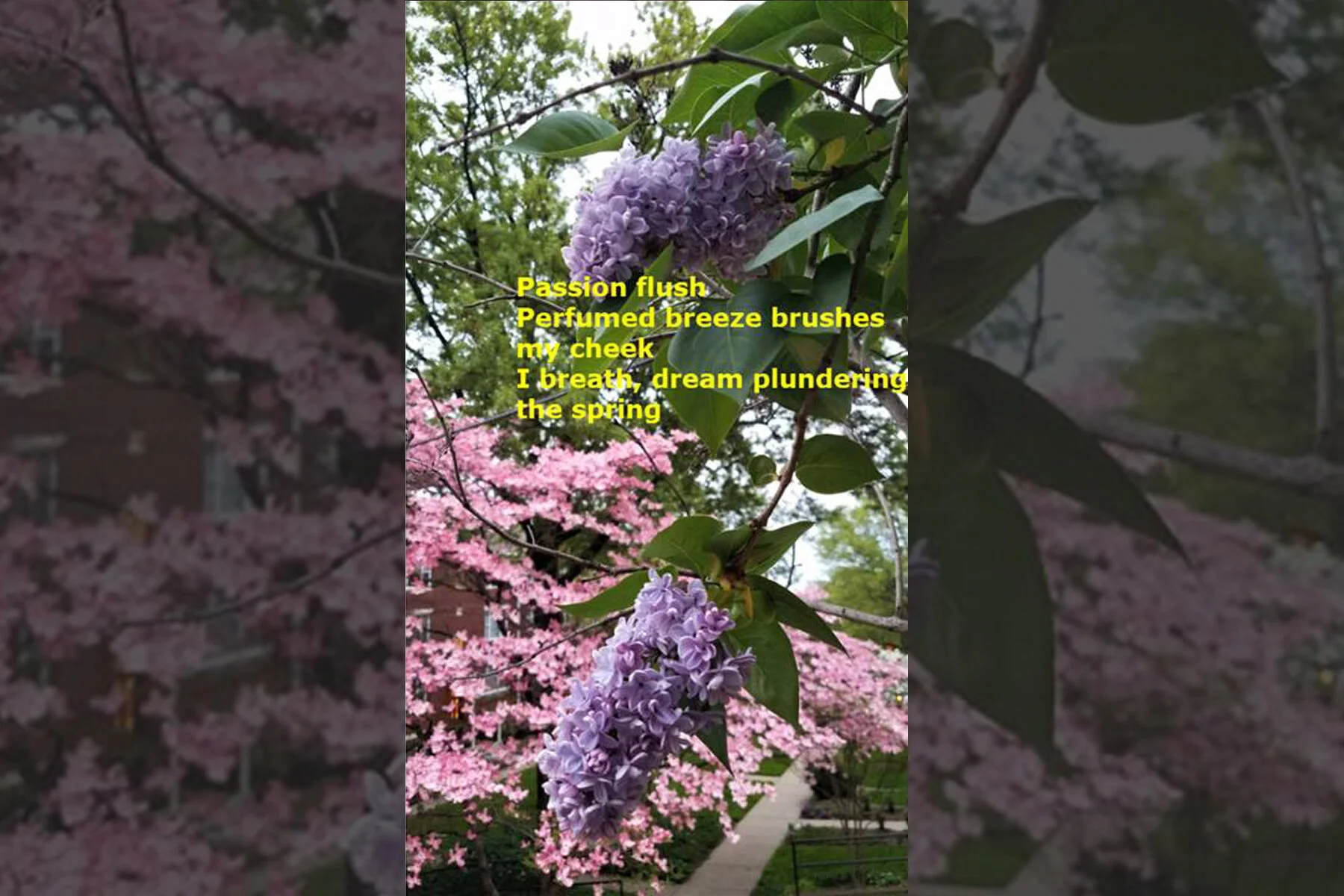
Photo Haiku Project Gallery
By sharing a Photo Haiku, others can experience the feeling that the photographer/author had. We explored this art form in recent Fireside Chats and we think you'll agree that Fireside Chat participants are a talented group!
Photo Haiku uses inspiring nature photos combined with the simple elegance of Haiku poetry to express encounters with the natural world. By sharing a Photo Haiku, others can experience the feeling that the photographer/author had. We explored this art form in recent Fireside Chats and we think you'll agree that Fireside Chat participants are a talented group!


Sanctuary Species
The Audubon at Home program helps homeowners create wildlife habitat in their own yards, with the aim of attracting and supporting beneficial species who breed and live in our area. We call these species Sanctuary Species.
Photo: Carolina Chickadee, Douglas Tallamy
The Audubon at Home program helps homeowners create wildlife habitat in their own yards, with the aim of attracting and supporting beneficial species who breed and live in our area. We call these species Sanctuary Species. If a yard attracts 10 Sanctuary Species who nest, breed, forage, shelter, or use the yard in any way, then it’s a Wildlife Sanctuary—our motto is, “Let the animals decide.”
One such Sanctuary Species is the Carolina Chickadee (Poecile carolinensis) that common, cheery visitor to backyard bird feeders. Chickadees are year-round residents and this small bird must contend with cold and potential heat loss. About half survive the winter. Homeowners can do plenty to bring chickadees to their yards and help them survive by providing a bird feeder. Hang feeders a short distance (maybe 6 to 10 feet) from trees and shrubs so birds can quickly seek cover when predators like hawks appear. Birds also need to be able to spot predators approaching on the ground, such as outdoor cats. Chickadees are cavity-nester; they can excavate nests with their little bill, although they’re not as good at it as woodpeckers. So, preserve trees (dead or alive) with cavities to provide roosting and nesting sites. Chickadees will use nest boxes, too.

Carolina Chickadee, Douglas Tallamy
More than anything, though, chickadees need a yard full of native plants. How can that be? What do chickadees have to do with native plants?
Well, native plants are required to support native insects such as caterpillars, which chickadees depend on for over half their diet. Caterpillars and other insects are especially critical when chickadees are raising young. Because the nestlings need protein to grow, they eat a diet almost exclusively of insects. Most native insects, such as caterpillars, are specialists: they eat only the host plants with which they co-evolved. Without native plants, there are fewer native insects, and without insects, birds cannot thrive, no matter how many bird feeders are available to them.
An ingenious study conducted by Douglas Tallamy and his colleagues in yards right here in the DC area confirms the effect. Scientists measured the amount of native plant material in each yard, then they observed whether chickadees nested in it and how successful their nesting efforts were. They found that yards in which less than 70% of the plant material (trees, shrubs) was native could not support insects and did not sustain chickadee families. Chickadees were less likely to nest in such yards and those that did had less reproductive success. Yards with less than 70% native plants were “food deserts” lacking sufficient caterpillars to feed nestlings, leading to declines in chickadee populations. You can read the study here.
Fill your yard with native trees and shrubs and you will attract more chickadees (as well as other wildlife) and the birds will fledge more young.
There are 42 Audubon at Home Sanctuary Species including birds, amphibians, reptiles, insects, and mammals, listed here. Click on the thumbnail picture to learn more about them and their habitat needs.
And, if you’re a photographer who enjoys photographing wildlife, please consider submitting your photos of any of the Sanctuary Species. We are updating our website, and need more and better photos of them in their natural habitats. Send your photos to aah@audubonva.org with Sanctuary Species Photographs in the subject line. We credit all photos that we use.

Calling all Birders: It’s time to get ready for Birdathon 2021!
Birdathon helps ASNV continue to support outdoor education, citizen science and habitat conservation, and encourage people to plant native plants and foster native wildlife.
How does it work? Like a walk-a-thon, Birdathon participants collect pledges from friends and family via our website. Then participants record how many species they can identify during any 24-hour period between April 16 and May 16. The more species they identify, the more funds they raise!
Birdathon helps ASNV continue to support outdoor education, citizen science and habitat conservation, and encourage people to plant native plants and foster native wildlife. Birdathon also helps ornithologists better understand spring migration by reporting sightings through eBird, an online database of bird observations run by the Cornell Lab of Ornithology.
All birding levels are welcome. Participants can bird alone or form teams of up to five. All team members donate and/or secure pledges. Participants solicit general donations or ask for pledges based on the number of species or the number of individual birds sighted. Sightings and donations are due no later than June 3, 2021. Report your Birdathon sightings on eBird and email your list to info@audubonva.org.
Ready to get started? Register your team here LINK and check out our Birdathon rules here LINK. Now go out and have a great day birding!
All participants and their supporters are invited to join us via Zoom on Sunday, June 6 at 2:30 PM for our Annual Meeting, where we’ll announce the winners of the “Most Species Counted,” “Most Money Raised” and “Youth Birder” competitions. Our speaker that day will be Dr. David Luther of George Mason University, who will speak about the impact of noise on bird song.

Apply Soon for a Native Gardening Grant!
Audubon at Home Program, in partnership with the Plant NOVA Natives campaign, has been awarded a grant of $15,000 to demonstrate the concept that native plantscan fit nicely into a conventional suburban aesthetic. Apply today!
Photo: Native plantings, Margaret Fisher
There is still time to apply for a native gardening grant. The deadline is May 31, 2021. Audubon at Home Program, in partnership with the Plant NOVA Natives campaign, has been awarded a grant of $15,000 from the Environmental Education and Stewardship Grants Program of the Dominion Energy Charitable Foundation to demonstrate the concept that native plants, so critical to wildlife habitat, can fit nicely into a conventional suburban aesthetic, including formal or semi-formal settings. Read more here.

Bird Walks are back!
Join us for a bird walk…in person! Group sizes are limited to allow for social distancing, so these walks are intended for inexperienced birders.
Photo: Brook LaValley
Because the number of attendees at walks is very limited to allow social distancing whenever possible, these walks are intended for inexperienced birders. You must wear a mask for situations where distancing on trails or from other walkers may not be possible.
Click here to find a walk and register. REGISTRATION IS REQUIRED FOR ALL WALKS! Once you have registered, the leader will tell you where to meet.
If you cannot attend a walk for which you are registered, PLEASE cancel as soon as possible and notify the leader by email. If cancellations are at least 3 days in advance, we can fill the spot from the waiting list.
Why I Bird: A Teenager’s Confession
Who knew that taking environmental science would lead me down this eventful path?
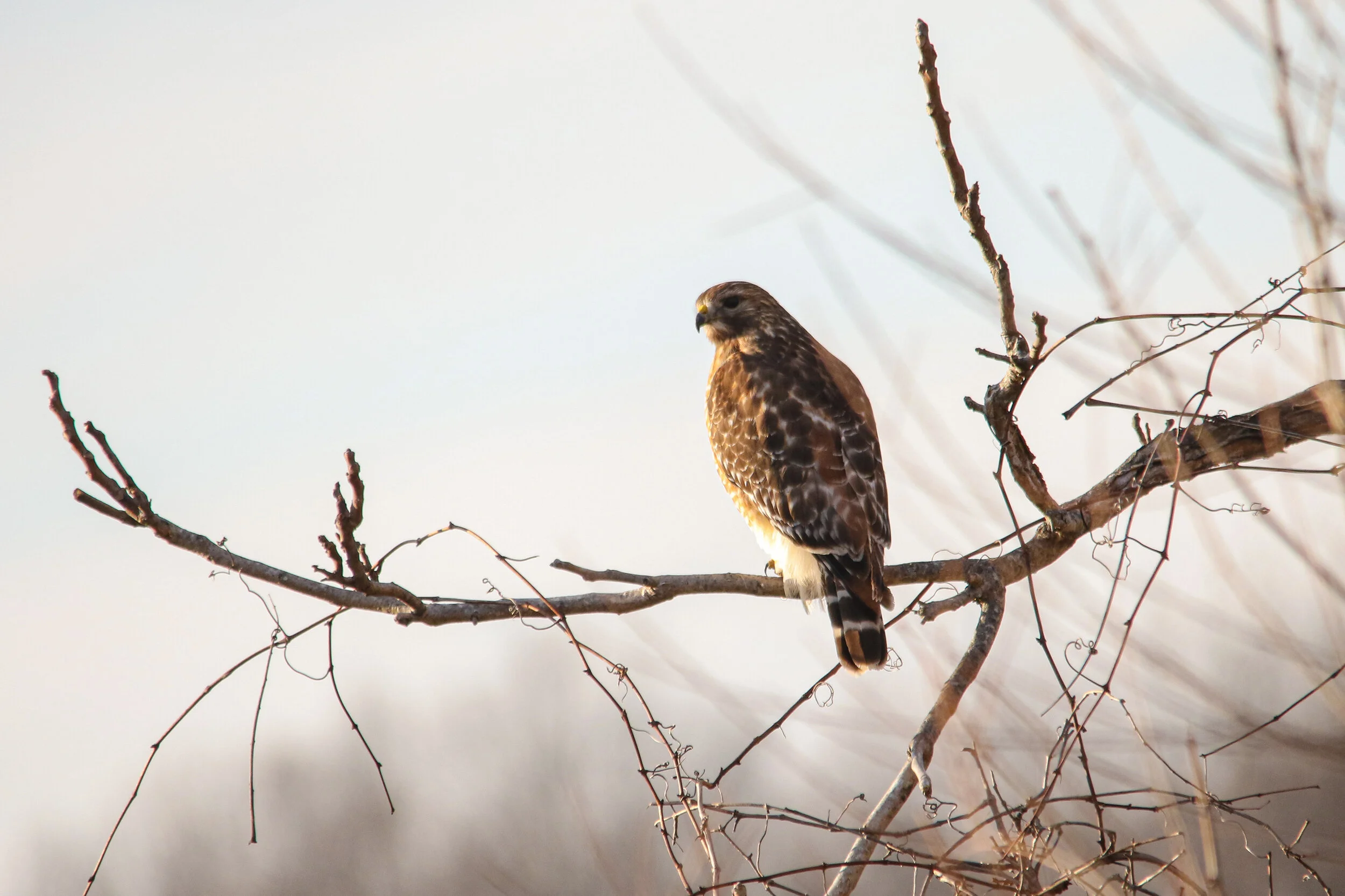
Photo: Red-shouldered Hawk, Annaliese Meistrich
Annaliese Meistrich
The winding trail led to a grassy clearing where my environmental science teacher paused, giving us a moment to take in the open landscape. He then proceeded to describe the hidden intricacies of this peaceful meadow: a few Song Sparrows that produced a lovely tune, the fluttering Tree Swallows swooping above our heads and the far-off cry of a Red-shouldered Hawk. The seemingly simple view in front of me suddenly teemed with life, illuminated by my teacher’s vibrant narrative.
Through this class, it didn’t take long for me to become hooked on birding. Soon after the class began, I was spending hours along a trail, trying to identify every last bird I caught a glimpse of. Who knew that taking environmental science would lead me down this eventful path?
As I delved into the world of birding, I realized that I knew very few teen birders. Most of my fellow birdwatchers were adults, whose company I valued, but I couldn’t help but wonder if there were any other students like myself who had a not-yet-discovered passion for birding. It seemed likely that there were students currently sitting in classes who were looking for a sense of outside fulfillment that could very well be satisfied by bird-watching. There is something so captivating about watching birds – their incredible abundance and diversity adds to one’s love of nature. It truly is a great way to get outdoors and foster a meaningful connection with the environment around you. Because birds are literally everywhere, becoming a birder will open your eyes and force you to be an observer, constantly picking up clues as to their behavior and habitat.
Life as a biology student consists mostly of staring at photos of wildlife in class but why not head out onto the local trails and find it yourself? After being stuck behind a desk all day, it is rewarding to hit the trails and bring some serenity into your mind. You may find yourself more engaged in those science classes after seeing how it all fits into the bigger picture. There is also a physical aspect to it: whether you are running around chasing that far-off hawk, or wandering around a field, you are getting those steps in! Birding is great exercise and has a positive impact on your overall health.
As young kids in middle or high school, we are drawn to social gatherings, because – let’s face it – doing things with your friends is fun! Birding is a great way to make new friends and connect with students you might not otherwise meet. Get a group of your friends together and go on a hike, documenting all the things you see. From birds to butterflies, or even wildflowers, you can have amazing experiences together. I particularly enjoy heading out with
some of my fellow young birders and keeping track of the rare bird alerts for our area! It is challenging and fun to find these rarities with a group.For me, the passion for birding continued beyond the trails and into activism. When I reached out to Audubon Society of Northern Virginia, I would never have guessed that it would have blossomed into an intern position. I hope to share my love of birding with other teens by continuing my efforts for more teen involvement. Currently, I have given presentations to youth groups such as the Cub Scouts and I am seeking any opportunity to offer more programs. I am also working to increase birding opportunities in the environmental science curriculum of Loudoun County Public Schools and connect with other school birding clubs. I am very enthusiastic about the future of this internship and I cannot wait to see where ASNV takes it.

The Hampton Roads Bridge-Tunnel Seabird Breeding Colony
To prevent birds from trying to nest on South Island, which is now entirely paved, DWR has deployed trained Border Collies and their handlers to chase off birds investigating South Island.
Photo: Border Collies, VADWR
Think back to last year’s drama and suspense surrounding the push to provide seabirds alternate nesting habitat after the Hampton Roads Bridge Tunnel Expansion project took a long-time colony’s island nesting ground. The Department of Wildlife Resources (DWR) provided substitute habitat combining barges and a sandy “beach” on Ft. Wool. DWR reported on the successful effort in the Virginia Wildlife magazine (If You Build It, They Will Come).
The seabird habitat is a continuing project for DWR. Because of high public interest, DWR in March started publishing a monthly blog post to report on this year’s activities (March Watchable Wildlife blog). You can subscribe here by providing your email address and signing up for Wildlife Updates.
The March article reported on DWR’s activities during the winter to maintain the sandy nesting habitat on Ft. Wool and prepare barriers to be installed over doorways and window openings to prevent birds (either flightless fledglings or nesting nuisance birds) from entering buildings on the site. DWR also reported that instead of last year’s seven barges it will deploy only four, but they are larger and provide 10,000 more square feet of habitat than last year’s installation.
DWR plans to issue a new article every third Thursday of the month, although April’s edition was delayed until April 22. The April article, "A Tale of Two Islands," explains how DWR has worked to attract birds to Rip Raps Island (Ft. Wool) while discouraging birds from trying to nest on South Island, the former nesting ground. In addition to building a suitable sandy beach habitat on Rip Raps Island, DWR is installing decoys to attract seabirds, as well as broadcasting nesting colony sounds through a solar-powered sound system. To prevent birds from trying to nest on South Island, which is now entirely paved, DWR has deployed trained Border Collies and their handlers to chase off birds investigating South Island. Border Collies are ideal for the job because their instinct is not to “mouth” the birds but rather to herd them. They approach in a predator-like crouch and frighten the birds off.
ASNV makes no promises but we’re hoping that DWR’s next blog post will tell us more about the barges that were scheduled to be installed in late March to provide extra habitat.

May Bird of the Month
Because of Mike Bishop and many other bird advocates across the country, the Purple Martin’s population is stable and of low conservation concern.
Photo: Purple Martins, John James Audubon
Purple Martins Thrive in Northern Virginia with a Little Help from Their Neighbors
Jessica Bigger
Mike Bishop grew up on a beautiful large piece of property in Spotsylvania, Virginia. During his childhood, Bishop and his father would put up nest houses for bluebirds and monitor the nests each year. After successfully attracting bluebirds to his family’s land, Bishop decided to put up a Purple Martin (Progne subis) house to see what would happen. After a year or two several Purple Martins had taken up residence. “We got three colonies,” said Bishop.

Today, Bishop and a group of volunteers monitor around 22 Purple Martin houses throughout Northern Virginia. After retiring, Bishop decided to get back into building special nest boxes for Purple Martins that reduce infestation by starlings and sparrows; an improved design from J.L. Wade’s aluminum version, which was quite prone to starling and sparrow infestation.
He built his first Purple Martin nest box in one of Westfield High School’s athletic fields. It took three years to attract Purple Martins to that location but now Westfield High School has three established colonies. Bishop founded the Northern Virginia Purple Martin Initiative in 2015 to increase and strengthen the Purple Martin population in the area. The organization not only builds and monitors nest boxes for Purple Martins, but volunteers also build houses for other cavity-nesting species, including woodpeckers, Chimney Swifts, Great Crested Flycatchers, the Tufted Titmouse, chickadees, wrens, Eastern Bluebirds and Tree Swallows.
Because of Bishop and many other bird advocates across the country, the Purple Martin’s population is stable and of low conservation concern. Purple Martins nest in open fields, usually near a water source. Since most of their habitat provides little nesting opportunity, this species has always depended on human assistance. People have been providing homes for Purple Martins for centuries, beginning with Native Americans, who used to build nest cavities out of gourds. They created a symbiotic relationship with the birds. In exchange for providing nesting habitat for the Purple Martins, the birds would warn the Native Americans of owls and hawks hunting nearby.
Purple Martins not only warn residents about birds of prey, they also keep the insect population at bay, which protects their gardens and makes relaxing outside a bit more enjoyable.
Purple Martins are social species. They love hanging out near people, and enjoy visiting other colonies nearby. Reston National Golf Course has a nest box near Links Pond that houses one colony of five birds. Reston resident and Fairfax County Coordinator for the Virginia Bluebird Society's nest box monitoring program, Helaine Krob, lives on the golf course and monitors the nests.“ Yesterday, we saw 12 of them up in the air flying around together. Swooping and chatting and calling. So, there is a visiting colony and after they hang out, they head home. Our colony visits another colony in the evening, and around 8:30 pm they will all return to the apt house,” explained Krob.
There are a variety of insects Purple Martins will forage for: beetles, flies, dragonflies, damselflies, leafhoppers, grasshoppers, crickets, butterflies, moths, wasps, bees, caddisflies, spiders, cicadas, termites and mayflies. They will also hunt for insects at a much higher altitude than swallows. To help them digest the insect exoskeletons, Purple Martins will eat small amounts of gravel. Some nest watchers leave crushed eggshells, which also aids in digestion.
In Northern Virginia, Purple Martins generally arrive at the end of March. Each pair raises one brood per breeding season. Last year the Reston National Golf Course Colony raised three young. At the end of August, they make the 3000-mile journey down to the Amazon Basin in South America to overwinter, and then make the 3000-mile trip back to North America the following breeding season.
If you want to get involved in citizen science visit the Northern Virginia Purple Martin Initiative Facebook Page or the Purple Martin Conservation Association.
Sources:
https://www.youtube.com/watch?v=NDLu-aaVIjY&t=634s
https://www.allaboutbirds.org/guide/Purple_Martin/overview

ASNV Resumes the Northern Virginia Bird Survey with New Coordinator
Remember the Northern Virginia Bird Survey (NVBS), ASNV’s long-running survey of breeding birds in our region? We are busy getting ready for the 2021 survey, after cancelling last year’s data collection because of the pandemic.
Photo: Camilla Cerea
Remember the Northern Virginia Bird Survey (NVBS), ASNV’s long-running survey of breeding birds in our region? We are busy getting ready for the 2021 survey, after cancelling last year’s data collection because of the pandemic.

We are very happy to have Elizabeth Krone as the NVBS coordinator. You may remember Elizabeth from her assistance on this year’s Winter Waterfowl Count. She brings to the NVBS experience as a field biologist in Hawai’i on the endangered Palila, as well as work in our region on Bald Eagle and other avian monitoring projects, and in wetlands and wildlife habitat. Elizabeth has a master’s degree in environmental and resource policy from the George Washington University, and a biology degree from Towson University.
To prepare for the 2021 survey, which will take place in June, we are contacting volunteers from prior surveys, recruiting additional volunteers as needed, organizing and distributing the survey materials and training our volunteers. If you are an experienced birder and want to help, watch for announcements on our website and social media, or contact Elizabeth at citizenscience@audubonva.org.
The NVBS started in 1994 and provides information on trends for breeding birds in our area. Many of these species have declined over the last 25 years, although some have fared well and others have recovered from population crashes, such as Bald Eagles and American Crows. Continuing to document these birds helps us understand the state of the birds in Northern Virginia and informs decisions about habitat protection.
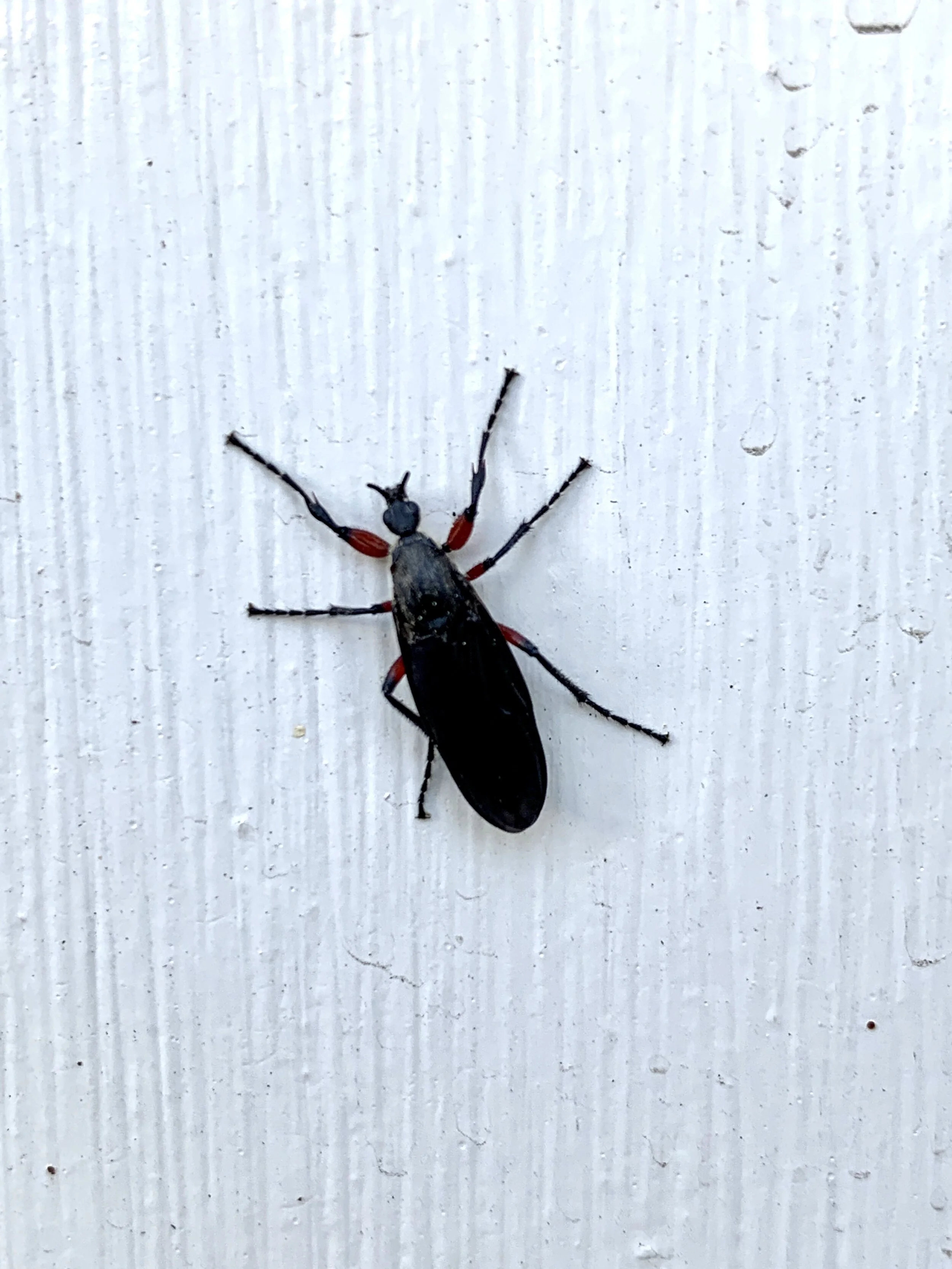
Monday Mystery - April 26, 2021
Monday Nature Mystery continues! Read on to learn who correctly identified our last mystery.
Photo: March fly (Bibio femoratus), Laura McDonald
We are pleased to announce the winner of our Monday Nature Mystery, Tess Bertonneau Winters!
Tess correctly identified a March fly (Bibio femoratus). Another common name is lovebug. There are 32 species in this genus in North America. Three of the species occur in the fall and the flight time for the others occur in the spring.
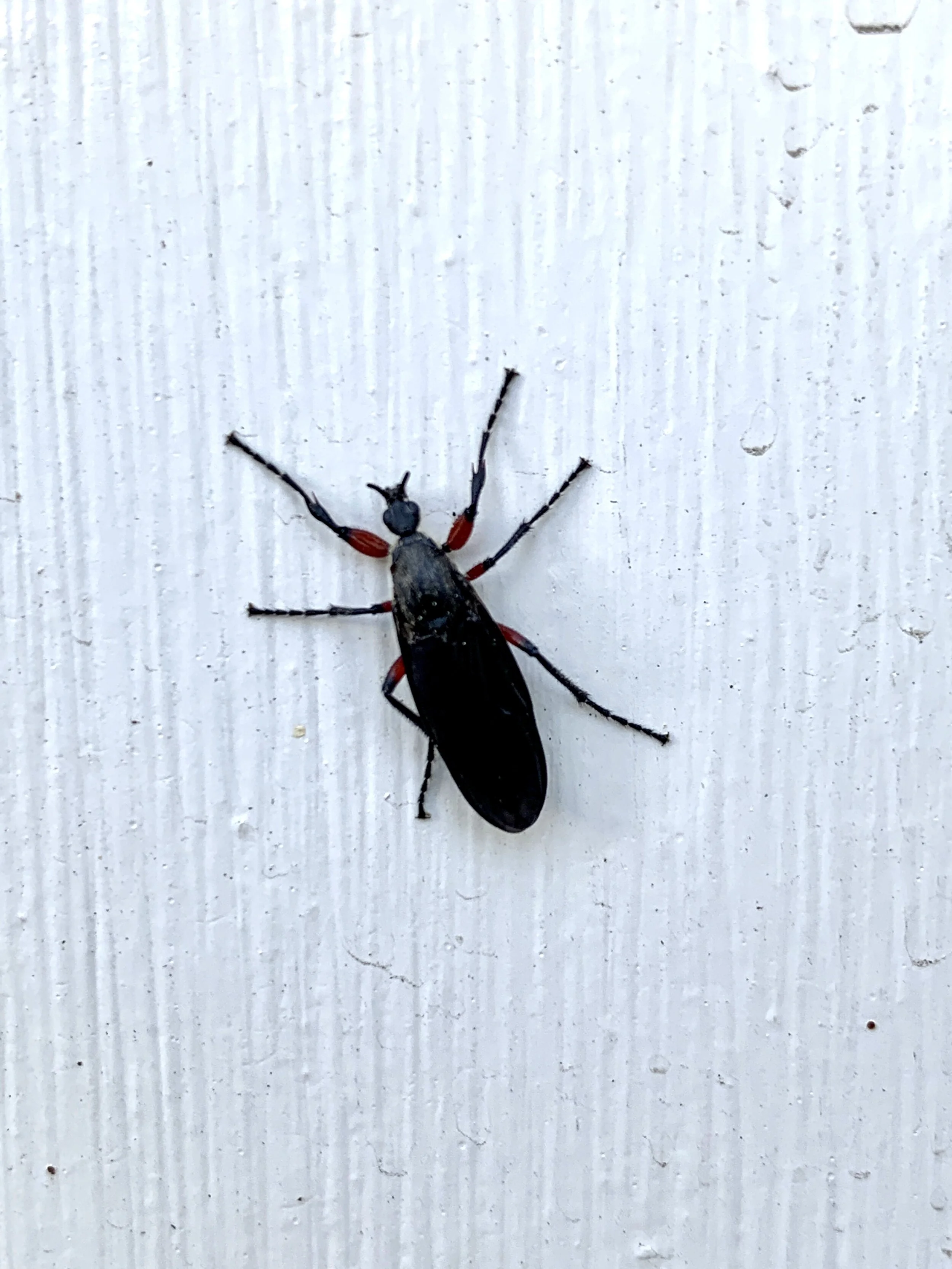
Last week’s mystery: March fly (Bibio femoratus), Laura McDonald
Each Monday we’ll post a new mystery and identify the previous week’s winner. They’ll receive an ASNV hat or tote bag.
Click here to listen to this week’s audio mystery!
Do you know who sings this song? Post your guess on our Facebook page under the Monday Nature Mystery post. List both Common Name and Latin name and be mindful of capitalization. Good luck!
Please note that all entries are date and time-stamped. We review each correct answer to see who commented first. If someone 'likes' your comment, it would move it up on the list, making it look like the first post. Winners are limited to one prize every 90 days.

Calling all Birders: It’s time to get ready for Birdathon 2021!
Birdathon helps ASNV continue to support outdoor education, citizen science and habitat conservation, and encourage people to plant native plants and foster native wildlife.
Photo: Camilla Cerea
How does it work? Like a walk-a-thon, Birdathon participants collect pledges from friends and family via our website. Then participants record how many species they can identify during any 24-hour period between April 16 and May 16. The more species they identify, the more funds they raise!
Birdathon helps ASNV continue to support outdoor education, citizen science and habitat conservation, and encourage people to plant native plants and foster native wildlife. Birdathon also helps ornithologists better understand spring migration by reporting sightings through eBird, an online database of bird observations run by the Cornell Lab of Ornithology.
All birding levels are welcome. Participants can bird alone or form teams of up to five. All team members donate and/or secure pledges. Participants solicit general donations or ask for pledges based on the number of species or the number of individual birds sighted. Sightings and donations are due no later than June 3, 2021. Report your Birdathon sightings on eBird and email your list to info@audubonva.org.
Ready to get started? Register your team here and check out our Birdathon rules here. Now go out and have a great day birding!
All participants and their supporters are invited to join us via Zoom on Sunday, June 6 at 2:30 PM for our Annual Meeting, where we’ll announce the winners of the “Most Species Counted,” “Most Money Raised” and “Youth Birder” competitions. Our speaker that day will be Dr. David Luther of George Mason University, who will speak about the impact of noise on bird song.

Birdathon 2021: When is Peak Landbird Migration in NoVA and DC?
More and more information exists to help determine the peak of migration in any given place. However, in Northern Virginia, we have a golden gem of a resource that highlights anything you might want to know about spring migration of landbirds – it’s a website called MPNature.
Photo: Yellow-throated Warbler, Lorraine Minns/Audubon Photography Awards
Greg Butcher
Audubon Society of Northern Virginia sponsors a Birdathon every spring. We send out a bunch of teams whose goal is to see as many species as possible in a 24-hour period and to raise money for our programs.
Here are the 4 main tricks to seeing the maximum number of species in a 24-hour period:
Trick #1 is to get up before dawn and bird all day long (and into the night for owls).
Trick #2 is to visit a wide variety of habitat types.
Trick #3 is to find the best birders with good eyes, good ears and good knowledge of the local birds (especially their songs).
Trick #4, especially in the Washington DC region, is to go at the peak of migration.
More and more information exists to help determine the peak of migration in any given place. There is a ton of information on eBird, the website maintained by Cornell Lab of Ornithology that records all birds encountered by eBirders every day at every birding spot in the world. The data are summarized in a variety of easy-to-understand formats, but I haven’t yet figured out the easiest way to study peak migration for species diversity using eBird.
However, in Northern Virginia, we have a golden gem of a resource that highlights anything you might want to know about spring migration of landbirds – it’s a website called MPNature. MPNature has a limitation that you might think minimizes its usefulness – it is focused on the birds (and plants) of one of the smallest and most suburban parks in Northern Virginia – Monticello Park.
But Monticello Park has three advantages that make it a wonderful barometer of the state of landbird migration in Northern Virginia and Washington DC:
It is an amazing magnet for birds, with 124 species.
Its spring birds have been meticulously documented since 2005 by Tom Albright and a host of other birders.
And, of course, it has an amazing website, beautifully and purposefully created by Bill Young, Ashley Bradford and their friends.
I should probably have written an article about the beauty of the website. Ten different photographers have contributed gorgeous stills and videos of the birds, the plants and views from within the park. But that’s a different article!
Under the “Daily Checklist” tab is a list for each day of April and May of all the birds that have been seen on that date between 2005 and 2018 divided into 4 groups: resident birds, migrants that averaged more than 2 individuals on that date, migrants that averaged between 1 and 2 individuals, and migrants that have been seen in the park on that date, but not every year.
If you are interested in a particular migratory species, there is another section of the website with photos and the earliest, latest and best dates to find that species in the park. The park is a woodland with a stream running through it, so you can’t learn much about waterbirds or grassland birds, but it does have information about 35 species of warblers!
But I had a single goal in mind – I wanted to know THE best date for spring migration in our area, so I reduced all of Tom Albright’s species-specific information to numbers, and here’s what I found out:
The website’s report of expected species begins on April 1, and for the first 24 days in April, you can expect 4 common migrant species that average more than 2 individuals per day. In addition, you have the chance to see about 11 other less predictable migrants on any of those 24 days.
Everything starts to pick up on April 25. All of a sudden, there are 7 common migrants and 14 additional possible species.
The good news is that peak migration lasts for 15 days: May 1 through 15. On any one of those days, you can expect 17-21 common migrants with a possible total of 33-37 migratory species, plus up to 23 of the park’s resident species.
The next week – May 16-22 – isn’t too bad, with 16 common migrants expected on the 16th, dropping to 11 on the 22nd and a possible total of 26-32 migratory species each day.
After May 23, migration drops off sharply, with only 7 or 8 migratory species expected on May 30 or 31.
A few caveats: every day is different! The above numbers are averaged over 14 years, creating great uniformity, but migration depends on the weather. On a beautiful clear night with strong southerly wings, all the migrants might pass us by. Better conditions (for seeing a lot of migrants) are rainy nights with northerly winds that keep migrants from flying too far too fast. But the only way to find out if tomorrow is a great day to see migrants is to get outside and look for yourself.
If you want to see the most landbird migrants in Northern Virginia on a single outing, I suggest you plan to bird between May 1 and May 15, so if you participate in ASNV’s Birdathon, this would be the best time to choose your 24-hour count day. If you just want to see as many spring migrants as possible, you should go out on as many of these days as you can, because some species are early migrants and others are later – and I still have never seen all the expected species on a single day. (Maybe this year!)
Good luck and happy birding!

Go Green, Go Native
Read Glenda Booth’s article in the Mt. Vernon Gazette on choosing nature over a manicured lawn.
Photo: Native Garden and Tiger Swallotail, Glenda Booth
Mow less, mow high, grow more, choose nature.
Glenda Booth for the Mt. Vernon Gazette
“The manicured lawn may be an iconic symbol of the American suburbs, but lawns have ecological downsides, and there are alternatives, Tami Sheiffer told members of the Friends of Mason Neck at a March 7 Zoom meeting titled “Mow Less, Grow More.” Sheiffer is the coordinator of the Fairfax County Park Authority’s “Watch the Green Grow” program.”
Read the article here.

Apply Soon for ASNV Grants and Scholarships!
Deadlines are approaching for ASNV’s grant and scholarship offerings. Apply soon!
Photo: Maggie Starbard
ASNV is offering grants for Youth Education, Conservation, and Native Gardening as well as a scholarship to Hog Island Audubon Camp for Educator’s Week. Deadlines are soon! Visit our website for more information and applications here.

Osprey Killing a Crow in Alexandria, VA
Carol Stalun, who is a skilled and talented nature photographer, took photos of an Osprey killing a crow. This is probably the first incident, documented with photographs, of an Osprey killing a wild bird.
Photo: Osprey and Crow, Carol Stalun
William Young
Carol Stalun, who is a skilled and talented nature photographer, took photos of an Osprey killing a crow. This is probably the first incident, documented with photographs, of an Osprey killing a wild bird.

Carol Stalun
On Saturday, March 6, 2021, Stalun saw an Osprey along the Potomac River in Old Town Alexandria. Stalun was in the area where there is an Osprey nest from previous years on a platform on pilings in the river. She had seen a male Osprey in the same area the previous day (the first one she had seen in 2021), and she was checking to see if he was still there.
At 8:33 a.m., Stalun saw a male Osprey on a piling not far from the platform with the nest. At first, she thought the Osprey had a fish in his talons. When she looked more closely, she saw that the Osprey had a crow. Fish Crows were mobbing the Osprey, and Stalun assumed from the vocalizations of the other crows and the location on the river that the Osprey's victim was also a Fish Crow. After being harassed by the other crows, the Osprey flew off with the crow in his talons, did a circle, and returned to the piling. He continued to peck at the crow, who was still alive. The Osprey pecked at the crow a bit longer before flying with it to the platform with the nest, dunking the crow in the river along the way. At 8:45 a.m., the Osprey arrived at the nest and dropped the crow into it. Because the nest is deep, the crow was no longer visible after the Osprey dropped it. Stalun had not seen the Osprey initially grab the crow.

Carol Stalun
The incident is exceptionally unusual for many reasons.
According to the Cornell Lab of Ornithology's Birds of the World, almost every published account says that 99 percent of the diet of Ospreys consists of live fish, with a wide variety of fish species taken. Fish captured generally measure 25–35 centimeters (10-14 inches) and weigh 150–300 grams (5-10 ounces), although fish up to 2,000 grams (4.4 pounds) have been reported. According to The Sibley Guide to Birds (2nd edition), a Fish Crow weighs 280 grams (about 10 ounces), so it is in the normal weight range of fish Ospreys normally catch. A Fish Crow measures 38 centimeters (15 inches), so its body is only slightly above the size range of normal Osprey prey.
Ospreys are one of the most widely-distributed birds in the world. They are found on all continents except Antarctica. Unlike most bird species who conceal their nests, Ospreys build huge nests, usually in open areas. The nests are easy to monitor and study. Some nests are equipped with webcams so that researchers can see exactly what prey is being captured. There is believed to be no documented evidence of an Osprey bringing bird prey to its nest.
According to Birds of the World, there are anecdotal observations of Ospreys catching non-fish prey, including birds, snakes, voles, squirrels, muskrats, salamanders, mollusks, and even a small alligator. There is a documented report of an Osprey attacking a lure pigeon used by hawk banders at Cape May, New Jersey. A lure bird is placed in a small harness, and its flapping induces hawks or falcons to fly into a nearby net. The lures are captive birds who are not wild.
Birds of the World also mentions reports of Ospreys trimming their nests with the skeletal remains of birds, but this might not represent prey taken. For instance, remains of birds found in nests in Arabia were up to the size of a Socotra Cormorant (80 centimeters, or 31 inches) and Slender-billed Gull (37-42 centimeters, or 14.5-16.5 inches), but it is unclear how or if these species were caught by an Osprey. An Osprey expert with whom I communicated suggested that the dead crow might have been put into the nest for decoration rather than to be eaten. We do not know what happened to the crow after it was deposited in the nest. But Ospreys are not known to decorate their nests with either birds or feathers. Ospreys sometimes interweave plastic bags or other refuse into their nest. This might to be done more for structural rather than aesthetic reasons.
An Osprey usually will not bother other birds unless it feels threatened. I spent many hours shooting footage of an Osprey nest at the Belle Haven Marina in Alexandria for my videos Osprey Love Nest and Osprey Love Nest 2: Feeding and Fledging. The Belle Haven nest was on a piling in the river, near a boat ramp. The Ospreys at that nest were not bothered when ducks, geese, and grebes swam directly under the nest, and they never showed any interest in attacking these birds. The Ospreys also paid no notice to House Sparrows who built a nest among the sticks of the Osprey nest. Only large birds flying above the nest caused the Ospreys to become alarmed.
The crow was not scavenged, because it was clearly alive in some of Stalun's photos. Had it been injured and flapping around in the water, it is unlikely that the Osprey would go after it. Ospreys often see uninjured birds swimming and flapping in the water, and they normally leave them alone. I don't know if a certain type of thrashing in the water might trigger a different response than an uninjured bird swimming. I am unaware of any reports of this happening.
Crows do not often attack Ospreys. The corvid expert Dr. John Marzluff, from the University of Washington, sent me an article that he co-authored about the mobbing of Ospreys by American Crows. The article said that American Crows aggressively mob a variety of natural predators and learn to recognize unique threats. Because mobbing is a costly and risky behavior, Marzluff and the other authors hypothesized that crows would selectively ignore benign members of other species that look similar to predators, perhaps even learning to do so. Through a series of natural observations and experiments, they found that American Crows were more likely to mob Red-tailed Hawks and Bald Eagles than Ospreys. Mobbing intensity was higher toward a taxidermic mount of a Red-tailed Hawk than toward a mount of an Osprey, indicating that mobbing increases with the risk posed by the predator. However, the authors also found that Ospreys were more likely to be mobbed in locations where they rarely occur, suggesting that crow populations that frequently encounter Ospreys habituate to this benign raptor. For the incident that Stalun witnessed, the Osprey was in a location where it regularly occurs, and it is possible that the mobbing behavior by the Fish Crows began only after the Osprey had seized its victim.
An Osprey expert with whom I communicated suggested that the crow might have been trying to get at a fish the Osprey had caught. This is improbable, because had the Osprey been flying with the fish, the crow would not have been able to carry it, even had the Osprey let go of it. Also, it is unlikely that an Osprey with a fish (its normal food) would drop it and grab a crow (not its normal food).
The most likely explanation might be that a Fish Crow was harassing the Osprey and got a bit too close. Smaller birds tend to attack a larger bird in groups rather than as individuals because there is safety in numbers, and the larger bird will have more difficulty grabbing any one of them. Osprey's have very strong legs and feet, and if the one Stalun saw managed to grab the crow's back, the crow would not have had much of a chance to escape. When the Osprey took the crow to the piling, it pecked at it, perhaps to kill it and make it easier to carry. It is not known whether the Osprey ever ate the crow.
Photographs of the Osprey with the crow can be seen at Stalun's website . The 60 photographs show the encounter in chronological order, starting with the Osprey holding the crow on the first piling and ending with the Osprey dropping the crow into the nest. Stalun's photographic documentation of this event is an example of how citizen science can produce an important contribution to ornithological research.
William Young is a writer from Arlington, Virginia. His book The Fascination of Birds: From the Albatross to the Yellowthroat was published by Dover in 2014. He has taught numerous classes about birds for the Audubon Society of Northern Virginia. The nature videos he has created for his YouTube channel have had more than 650,000 views. Along with Ashley Bradford, he is the co-creator of the MPNature.com website, which contains a wealth of information about the natural history of Monticello Park in Alexandria, VA.

Robin Duska is Virginia Master Naturalist Volunteer of the Year
Former Audubon at Home Co-Director and ASNV Board member, Robin Duska was recognized by the Virginia Master Naturalist state board as their 2020 Volunteer of the Year.
Photo: Common Milkweed, Sheryl Pollock

Robin Duska
Former Audubon at Home Co-Director and ASNV Board member, Robin Duska was recognized by the Virginia Master Naturalist state board as their 2020 Volunteer of the Year. During the year Robin contributed more than 500 hours of her time and expertise to conservation, nature education, citizen science and stewardship. Congratulations Robin, for well-earned recognition!
You can read more about Robin’s efforts in this article from the Fairfax Master Naturalists.