
NVBA NEWS BLOG
Welcome to the blog for Northern Virginia Bird Alliance, a wealth of resources about northern Virginia birds, wildlife, habitat conservation and restoration, native plants, wildlife-friendly gardening, advocacy and more.

September Bird of the Month
Roseate Spoonbills (Platalea ajaja) with their brilliant pink plumage, are one of those resplendent birds that attract birders from all over the world.
Photo: Roseate Spoonbill, Dixie Sommers
Will Rare Sightings for Roseate Spoonbills Become a Common Occurrence?
Jessica Bigger
Roseate Spoonbills (Platalea ajaja) with their brilliant pink plumage, are one of those resplendent birds that attract birders from all over the world. Their most unique feature is their quirky, spoon-like bills, which help them search and catch their prey. They would fit right in with the other crazy bird characters Alice discovered in the forest of Wonderland.
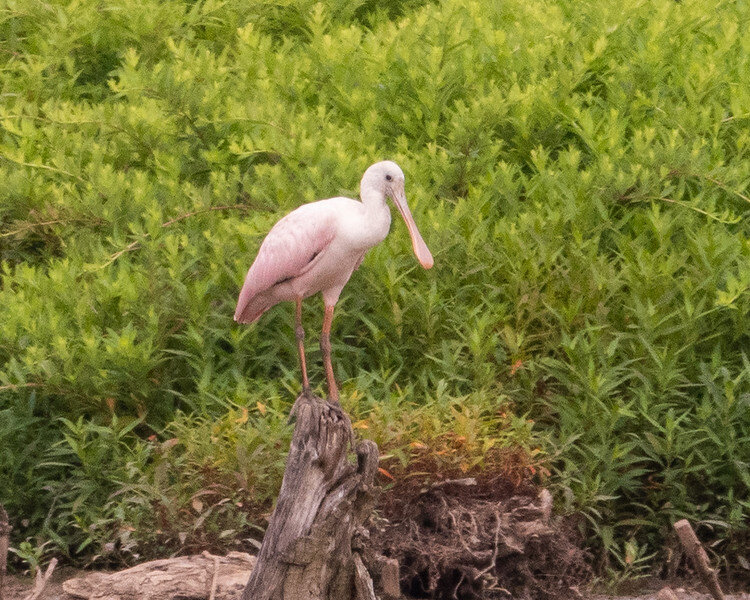
Roseate Spoonbill, Dixie Sommers
Usually, you have to go down as far as southern Florida or Texas to catch a glimpse of these amazing birds – they can also be seen down in Mexico, Central and South America, but this year Northern Virginia birders flocked to Huntley Meadows for a rare opportunity to see these birds. The first confirmed sighting was on June 26. Since then, Roseate Spoonbills have also been seen at Hunting Creek Bridge near Alexandria, on the edge of the Anacostia River and even at Kenilworth Aquatic Gardens. They were still in our region at the end of August.
Roseate Spoonbills hang out on the water’s edge moving their spoon-shaped bills back and forth searching for crustaceans and aquatic invertebrates. Unlike egrets and herons, who bend over to reach their prey, spoonbills keep their football-shaped bodies horizontal when swishing back and forth for food. These shorebirds forage in marshes, estuaries, and fresh water ponds, lakes and rivers. Watch one of our visiting spoonbills foraging at Huntley Meadows in Dixie Sommer’s video here.
Just like flamingos, spoonbills get their pink plumage from the crustaceans and aquatic invertebrates they eat which have carotenoids that turn their feathers pink. Juveniles tend to be lighter pink than adults.
Like Black-crowned Night-Herons, Roseate Spoonbills stick together. You’ll tend to find them roosting in mangroves, cypress and even willow trees, making grunting calls when they are startled.
Surprisingly, Roseate Spoonbills are not born with a spoon-shaped bill. The chicks have similar bills to other heron and egret chicks. A Roseate Spoonbill chick’s bill starts to flatten out nine days after it’s born. In 16 days, the bill starts to resemble a spoon.
Roseate Spoonbills are a species of concern in Florida and Louisiana. According to National Audubon Society, climate change can create numerous threats to the population: spring heatwaves can harm nestlings, heavy rain can flood nests and prevent adults from feeding their chicks, and as sea levels rise, more coastal habitat will be consumed by rising waters. Dan Rauch, a wildlife biologist with the D.C. Department of Energy and Environment, who was interviewed by NPR believes that we will continue to see an earlier hurricane season caused by climate change, which may be pushing spoonbills further north. The Roseate Spoonbills we’ve seen may have been blown off course when Hurricane Elsa barreled through in June.
Climate change isn’t the only threat. Last winter, the Environmental Protection Agency handed Florida the responsibility to award permits for development in the wetlands. Even though this shift of responsibility helps streamline the permitting process, many environmentalists believe that this change is a green light for significant development in wetland areas, which would be detrimental to all wildlife that rely on the wetlands for shelter and food.
Here is a video of a Roseate Spoonbill foraging at Huntley Meadows, taken by Dixie Sommers.
Sources:
https://www.allaboutbirds.org/guide/Roseate_Spoonbill/id
https://www.audubon.org/field-guide/bird/roseate-spoonbill
https://www.audubon.org/news/in-floridas-plan-take-over-wetland-permits-critics-see-gift-developers

Monday Mystery - August 30
Monday Nature Mystery continues! Read on to learn who correctly identified our last mystery.
Photo: Common Persimmon Flower, Roxanna Martin
We are pleased to announce the winner of our August 23rd Monday Nature Mystery, Jenny Ricks!
Congratulations to Jenny for correctly identifying the flower of the Common Persimmon (Diospyros virginiana). Our native persimmons can be found in old fields and dry woods. They can grow between 15-100 feet tall. The fruit of the persimmon supports birds and many woodland animals like deer and skunk. Want to learn more about this native species? We’ll be offering a special workshop with Oak Spring Garden Foundation in November. To learn more, click here.

Last week’s mystery: Common Persimmon (Diospyros virginiana), Roxanna Martin
Each Monday we’ll post a new mystery and identify the previous week’s winner. They’ll receive an ASNV hat or tote bag.
Here is this week’s mystery. Do you know what bird this is?
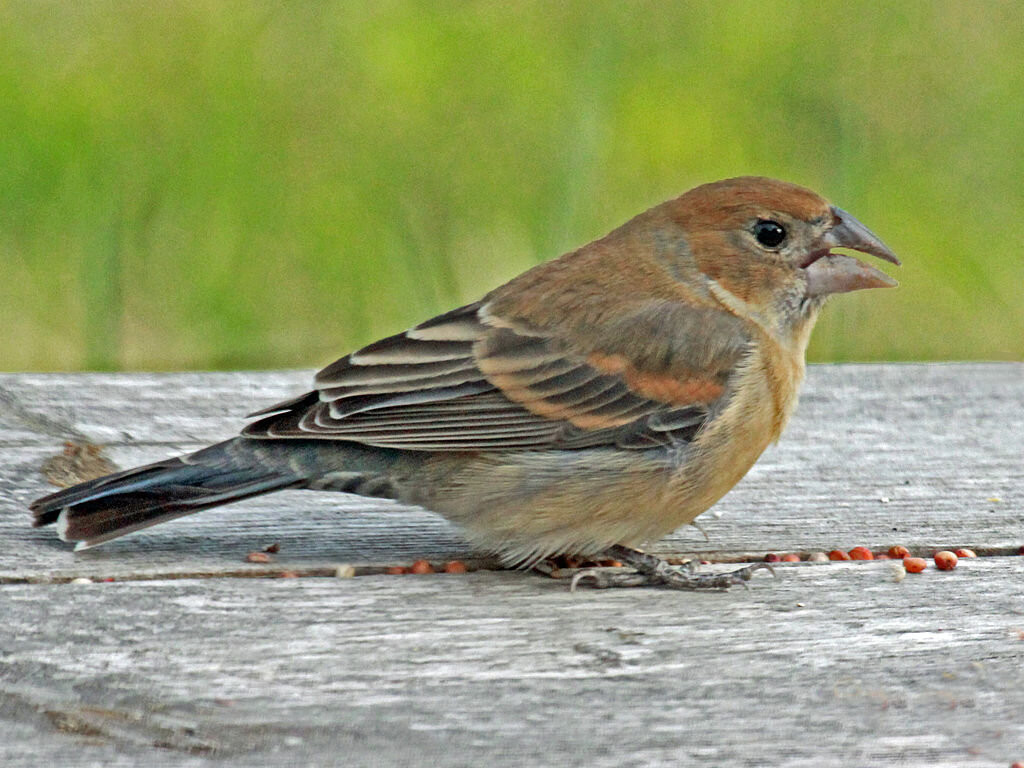
Photo: Dick Daniels , CC BY-SA 3.0 , via Wikimedia Commons
Be sure to post your guess on our Facebook page. Good Luck!
Please note that all entries are date and time-stamped. We review each correct answer to see who commented first. If someone 'likes' your comment, it would move it up on the list, making it look like the first post. Winners are limited to one prize every 90 days.

Updated Guidance on Feeding Birds from the VA DWR
On August 19, the DWR issued new guidance on feeding birds in light of the outbreak of avian disease this summer. Read on for the entire press release.
Photo: Blue Jay, courtesy of DWR
RECENT UPDATE ON FEEDING BIRDS
On Thursday, August 19, 2021 the Virginia Department of Wildlife Resources released the following advice about feeding birds:
WR Advises Following Best Practice Guidelines to Resume Feeding Bird
Press Release – Virginia Department of Wildlife Resources
In late May, wildlife managers in multiple states, including Virginia, began receiving reports of sick and dying birds that were exhibiting eye issues (swelling, crusts, discharge, etc.), along with neurological symptoms. No definitive cause(s) of illness or death have been determined. No human health or domestic livestock and poultry issues have been documented. As of mid-August, reports of sick and dead birds have declined in many jurisdictions, and the Virginia Department of Wildlife Resources (DWR) is lifting its previous recommendation to cease feeding birds in affected areas.
Virginia was one of the first states that received reports of birds displaying eye and neurological signs. Beginning in early June, the DWR, along with other local collaborating organizations, began documenting dead or sick bird reports and submissions to local wildlife rehabilitation hospitals. From these data, the DWR was able to target its response guidance to the areas of Virginia most likely to be affected by this mortality event, which included Alexandria, Arlington, Clarke, Fairfax, Falls Church, Fauquier, Frederick, Loudoun, Manassas, Prince William, Shenandoah, Warren, and Winchester. The DWR recommended removal of bird feeders in these affected areas beginning in June in order to limit potential disease transmission.
Natural resource management agencies in the affected jurisdictions continue to work with diagnostic laboratories to investigate the cause(s) of this event. The U.S. Geological Survey’s National Wildlife Health Center, the University of Georgia Southeastern Cooperative Wildlife Disease Study, the University of Pennsylvania Wildlife Futures Program, the Indiana Animal Disease Diagnostic Laboratory, and multiple state labs have been involved.
As reported previously, based on results received to date, the following pathogens have not been detected in any of the birds tested: Salmonella and Chlamydia (bacteria); avian influenza virus, West Nile virus, coronaviruses, Newcastle disease virus, herpesviruses, and poxviruses; and Trichomonas parasites. Toxicology tests have been negative for heavy metals, common pesticides, and herbicides. Additional diagnostic tests, including metagenomics work, are ongoing.
Residents that choose to feed birds or provide water in bird baths should remain vigilant for avian mortalities and consider the following best practice guidelines:
Clean feeders and bird baths at least once a week, then disinfect with a 10% bleach solution to prevent potential infectious disease spread between birds and other wildlife. After cleaning, rinse well with water and allow to air dry.
Wear disposable gloves when handling bird feeders and baths and wash your hands when finished.
When feeding birds, follow expert recommendations, such as those listed in Audubon International’s Guide to Bird Feeding.
Keep pets away from sick or dead wild birds.
Avoid handling wild birds. If you must do so, wear disposable gloves or place an inverted plastic bag over your hand to avoid direct contact with the bird. Dispose of dead birds in a closed plastic bag in household trash. Alternatively, you may bury bird carcasses at least 3 feet to prevent any disease transmission to scavenging animals.
If you observe any additional bird mortalities in Virginia, submit a mortality event to the DWR.
Bird mortality events are not uncommon. Several aspects make this particular event unique, including the extensive geographic scope, the duration of reported mortalities, and the fact that the initial reports were received from an urban area. The response and resulting recommendations to this and most all avian mortality events, however, is essentially the same. Affected birds are sent to a wildlife health laboratory for diagnostic investigation and residents of known affected areas are advised to minimize potential disease transmission by removing bird feeders and baths until the event has concluded. Once all of the diagnostic investigations involving this event are complete, the DWR hopes to be able to better tailor its diagnostic investigative response and guidance to the public for future bird mortality events.
Wildlife disease investigations can be inherently challenging and sometimes are unable to identify a definitive cause(s). The DWR greatly appreciates the assistance of the public and cooperating localities and facilities during this event, and when additional significant diagnostic results come to light, updated information will be shared. For additional information on this mortality event in Virginia, please visit dwr.virginia.gov/wildlife/diseases/2021-bird-mortality-event/

Don't Pave this Paradise
ASNV’s advocacy chair wrote an opinion piece in the Washington Post advocating for the consideration of biodiversity in land-use decisions in Fairfax County, specifically regarding plans to pave Justice Park. Read the article here.
Photo: Pileated Woodpeckers, Sylvia Hunt/Audubon Photography Awards
From The Washington Post, July 27, 2021, Letters to the Editor:
Opinion: Before Fairfax paves Justice Park, it ought to know what it would lose
The July 23 Metro article “Fairfax high school’s parking expansion idea draws anger from neighbors” included several perspectives but scrimped on the value of Justice Park’s natural resources, especially the park’s woodland.
In most land-use decisions in Fairfax County, the question of “What is there?” rarely gets asked. A brief, informal survey by volunteers from the Audubon Society of Northern Virginia in early June identified 30 species of birds at Justice Park, even though spring migration was over. A thorough bird survey would require observations in all seasons. A comprehensive biological assessment, including plants, insects, reptiles and amphibians, could inform decision-making even more. It could help preserve what’s there and enhance the park’s biodiversity, for example, by guiding removal of invasive plants and addition of plants that support wildlife. Maintaining and restoring natural resources would create a more ecologically healthy environment and an outstanding outdoor classroom.
Reducing park acreage contradicts the goal of remedying park deficits in underserved areas such as Bailey’s Crossroads. Green space and natural resources bolster our physical and emotional well-being. Northern Virginia localities have a long history of shaving off chunks of natural areas, a few acres here and another few acres there, death by a thousand cuts. Those decisions rarely consider the cumulative losses that occur over time — not just losses in actual parkland, but losses in the ecological services that nature provides.
By all means, Fairfax County should provide quality educational facilities, but the county also must protect and restore its natural resources, goals generalized in many county pronouncements, including its environmental vision and comprehensive plan.
Connie M. Ericson, Reston
The writer is advocacy chair for the Audubon Society of Northern Virginia.
You can also view this article online here.

ASNV Receives a Generous Bequest from the late Marilyn G. Bernard
ASNV has received a bequest of more than $75,000 from the late Marilyn G. Bernard, who passed away on August 16, 2020.
Photo: Northern Pintails, Angela Vogel/Audubon Photography Awards
ASNV has received a bequest of more than $75,000 from the late Marilyn G. Bernard, who passed away on August 16, 2019. Marilyn was a teacher at Sleepy Hollow Elementary School and a librarian at Belvedere Elementary School in Falls Church. She cared deeply about animal rescue.
ASNV is grateful for Marilyn’s generosity. The ASNV Board of Directors will determine how best to use her bequest in the coming months.

A Breath of Fresh Air During Black Birders Week
Earlier this year Upton Hill Regional Park, Arlington NAACP’s Environmental Climate Justice Committee, Northern Virginia Audubon Society, and Arlington Master Naturalists came together and hosted their first series of Black and Latinx guided bird walks.
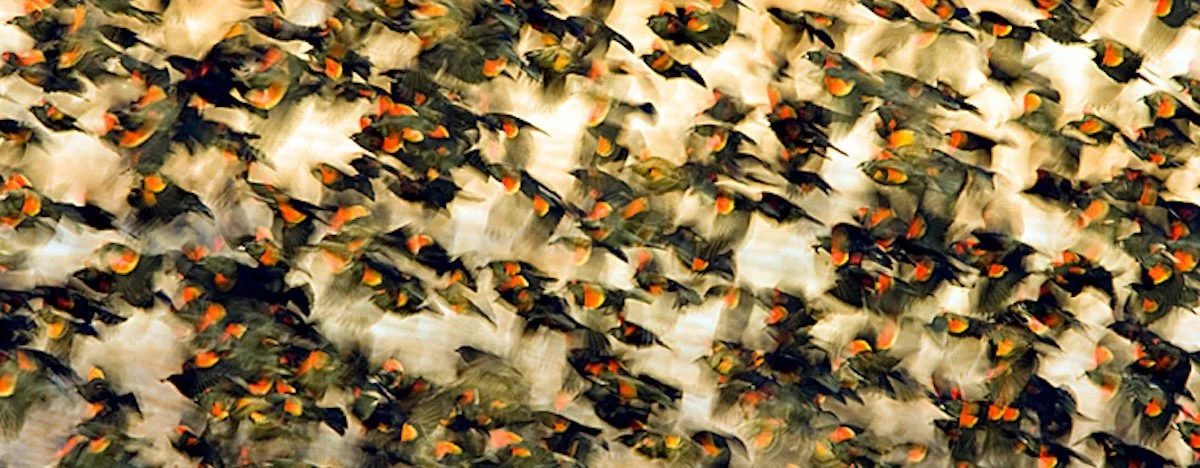
Photo: Red-winged Blackbirds, Rachel Hogancamp/Audubon Photography Awards
Deidra Bryant
Earlier this year Upton Hill Regional Park, Arlington NAACP’s Environmental Climate Justice Committee, Northern Virginia Audubon Society, and Arlington Master Naturalists came together and hosted their first series of Black and Latinx guided bird walks. Many people believe that there isn’t much wildlife to see in their local cities. The incentive for this series was to promote diversity and get participants’ feet wet in the exciting hobby of bird-watching. As quarantine restrictions in Virginia were lifted and people got vaccinated, the public was still interested in how to enjoy themselves outside in new ways since summer was approaching and school was let out. The Black and Latinx bird walks at Upton Hill Regional Park were a wonderful way to have folks participate in bird and plant identification. There were three walks occurring on April 24, May 8, and June 5 led by Musa Murawih and Melody Mobley.

Musa Murawih. Photo: Deidra Bryant
Born into a nomadic Bedouin family in central Sudan, Musa acquainted himself with all life found in the vast land he grew up on. His passion to conserve and protect natural resources globally took him to multiple continents throughout the world where he would eagerly look for birds. In 2010 he moved to the Northern Virginia area. He was elected to the ASNV Board of Directors this year.

Melody Mobley. Photo: Deidra Bryant
Melody is a 29-year veteran of the USDA Forest Service and was the first African-American woman forester. She recently joined the Audubon Society of Northern Virginia and is currently working on a video documentary. The documentary is aptly called “The Starya Project,” after her Cherokee name, “Starya,” which means “Stay strong.” The film discusses how her work protecting America’s public lands and navigating in a predominately white male field motivated her to help the next generation of BIPOC (Black, Indigenous, People of Color) biologists pursue a career in STEM (science, technology, engineering, mathematics.) You can also read more about her experiences in the Forest Service in this article here.
Overall, it was really nice to see people bring their families and friends to the walk. I had the opportunity to attend the walk in June during Black Birders Week (from May 30th -June 5th) when the 17- year cicada emergence was still going strong. The walk started with a few introductions and then a presentation from Melody on her work in the Forest Service. Having members from ARMN join in was especially cool because not only did participants see neighborhood birds including Eastern Towhees, Red-winged Blackbirds, Northern Mockingbirds, Common Grackles, American Robins and Fish Crows, but we also looked at invasive and native plant species, learned about land management projects occurring on site, and learned about the natural history of the Brood X cicadas. It was quite refreshing to talk about our observations, our personal goals to be better birders/naturalists, and share fun stories about our experiences in previous outdoor excursions, even after the bird walk was over.
To be honest, I can count on one hand the number of Black individuals who enjoy birding and identifying flowers and trees like I do, and this includes the people who participated in the bird/nature walk that day. Representation definitely matters and this walk was the first step of many in reaching out to people of color in the NOVA region who are searching for an activity with people who share similar goals in becoming better naturalists, where they can exchange knowledge with other people of color in the field, and can establish a network of individuals that uplifts each other. These kinds of opportunities and role models are needed these days, and not just in ornithology, but in: herpetology, geology, entomology, ichthyology, botany, forestry, mammalogy or basically any study in the natural sciences.
I would like to extend a special thanks to NOVA Regional Parks, Arlington NAACP and Jill Barker- the Upton Hill Regional Park Steward for helping make this a success. We need more visibility of BIPOC in these fields and this series was a breath of fresh air.

ASNV’s Birdathon Fundraiser Teams Set Records
A record seven teams of birders participated in ASNV’s 2021 Birdathon, a friendly competition to see which team can raise the most funds for ASNV and see the most bird species in Northern Virginia in 24 hours.
Photo: Yellow Warbler, Sheen Watkins/Audubon Photography Awards
A record seven teams of birders participated in ASNV’s 2021 Birdathon, a friendly competition to see which team can raise the most funds for ASNV and see the most bird species in Northern Virginia in 24 hours. Competition for bird sightings was close. Three of the teams spotted more than 80 birds each, with the Board Birders, composed of members of the ASNV Board, coming out on top with 89 species. Together, the teams logged an impressive 111 bird species.
Four members of the local birding community established a Virginia Big Day record, a competition sponsored by the U.S. Fish and Wildlife Service to spot the largest number of bird species in Virginia in 24 hours. They birded for 24 straight hours and drove 620 miles, tallying 208 bird species. You can read more about their exploits here.
The seven Birdathon teams and the Big Day team raised more than $11,000 for ASNV, nearly double the previous Birdathon fundraising record. Special thanks to The Chipper Birders, composed of two teenage brothers from South Arlington; The Scarlet Teenagers; and Eagles Geaux Birding from Baton Rouge Louisiana.
Environmental Development on the Reston National Golf Course
The previous Reston National Golf Course (RNGC) owners fought against Reston residents for the right to develop the golf course into a townhome community. A four-year court battle resulted in a ruling to preserve the golf course as provided in the Reston Comprehensive Plan.
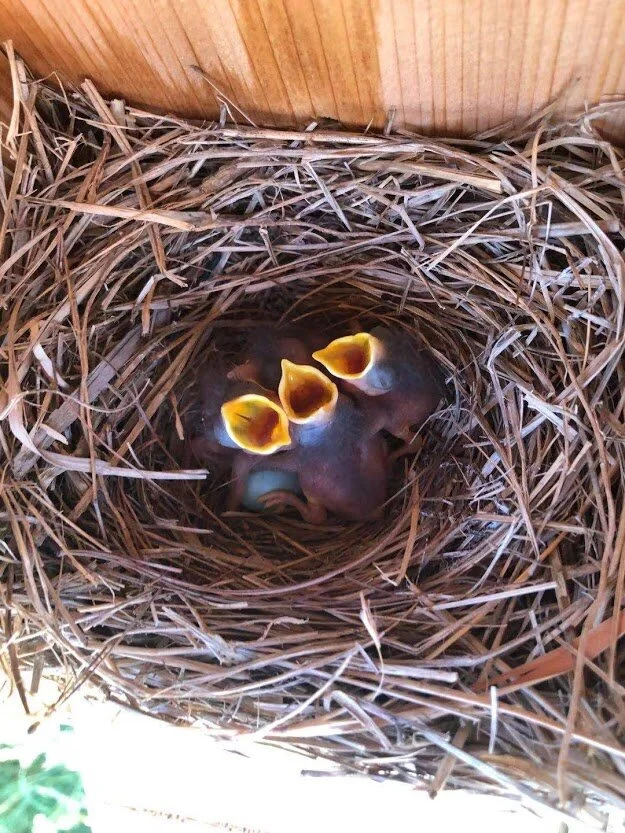
Photo: Eastern Bluebird nestlings, Xiaoyan Yin
Lisa Mackem
The previous Reston National Golf Course (RNGC) owners fought against Reston residents for the right to develop the golf course into a townhome community. A four-year court battle resulted in a ruling to preserve the golf course as provided in the Reston Comprehensive Plan. In 2019, new owners bought the golf course. They hired KemperSports to manage it and turn it into a must-play course for the region that also promotes native wildlife, trees, plants and pollinators.
Kris Anderson became the RNGC general manager late last year. He enjoys promoting golf in an all-inclusive way, and hopes the golf course’s environmental characteristics will enhance golfers’ experience. He often has tried to bring in red, yellow, and blue colors to golf courses to add visual variety. He notes that RNGC doesn’t have a large deer population, so his plantings don’t get eaten overnight. “Typically, you do see deer on golf courses inside the beltway,” says Kris, theorizing that Reston has other areas where deer feel safer and have more space. Kris is enthusiastic about the multi-year plans to improve RNGC. “We are fortunate to have owners Weller Development and War Horse Cities who have been passionate and aggressive in creating and implementing plans to add natural wildlife” says Kris. “They have provided considerable time, leadership and resources in setting up a 15- box bluebird trail, a riparian buffer around the large pond on hole #7, Carnolian honey bee hives for pollinating and large butterfly gardens. This is not the norm for a golf course owner.”
RNGC has been an Audubon International Cooperative Sanctuary since 2007 (not related to National Audubon Society). It is also one of the busiest golf courses in the mid-Atlantic region. The current owners and managers hoped that Reston residents would embrace a large environmental project that promotes birds, pollinators, bees and meadows, and is continuous with the Reston plan. The challenge, Kris says, is completing the plan soon enough to have an impact in the first year. “We hope much of this work lasts for 30 years, and we want to get it done now!” As Kris hoped, volunteers helped with planting, and qualified experts managed larger projects.
A key expert partner in the native plant project is Claudia Thompson-Deahl, Reston Association’s Environmental Resource Manager for 38 years, who retired from that position last December. In January, Chuck Veatch, who collaborated with Claudia on producing The Nature of Reston, introduced her to RNGC co-owner Scott Plank. Scott is a first-time golf course owner and not a golfer, but he wanted to show people that there are many ways to manage a golf course. He gave Claudia free reign to improve RNGC’s habitat and ecology. “This is where my heart is,” says Claudia. “It’s more of a passion than anything else.”
Claudia asked experienced blue bird monitors, Joanne Bauer and Robin Duska, to organize a Virginia Bluebird Society Trail and they trained three teams to check the boxes weekly. She also introduced local beekeeper Zak Johnson and Asclepias Landscape Design owner Karen Prante to Kris. Claudia is dedicated to improving the golf course habitat, possibly including a Chimney Swift tower and interpretive signs.
Her biggest challenge was learning about the different types of bees native to the area – mining and cellophane. Nick Dorian, who is working on a PhD about unequal cellophane bees, gave a bee tutorial and noted that few areas have these bee types. He recommended delaying a meadow planting that would have destroyed a bee habitat. Other challenges include keeping the plants free from neonicotinoids, which can poison insects, and finding native plants by the planting date to complete a large-scale design. Claudia is grateful for volunteer support, including South Lakes High School students, who were crucial in planting the first meadow.
Owner Scott Plank prioritized listening to and including Reston residents, and is proud that locals were deeply involved in RNGC’s environmental work. He reviewed years of conversation, social media posts and articles about Reston. As a student of city planning architecture, he admired Bob Simon, and wanted to give life to his vision.
The efforts have already paid off. Golfers see the bluebird houses, where Kris has counted 33 eggs, and Kris hears the golfers talk about other birds building nests. Golfers will see the Monarch butterfly garden and the signs explaining the garden, Monarch migration pattern and why Monarchs are endangered. The course has three beehives, but none of the bees will be near the golfers and the maintenance work will not disturb them. They will all be excellent pollinators throughout the golf course and adjoining neighborhood, and will create a superhighway above the trees. Claudia hopes that when the golf course meadows bloom in the summer, people will get excited and add native plants to their own yards. “It’s everyone’s responsibility to spread habitat in their own spaces. I hope it’s a model and an example.”
“Reaction from the community has been fantastic,” says Kris.. “They think it’s amazing that we’ve undertaken this project. I want it for everyone to see and enjoy, and live a healthy life around the golf course. My goal is to create spaces that will be here long after I leave.”

Hog Island Scholarship Winners
Gretchen Linton of Mark Twain Middle School in Alexandria is the 2021 recipient of ASNV’s scholarship to Educator’s Week at Hog Island Audubon Camp in Maine.
Photo: Kirk Treakle
Gretchen Linton of Mark Twain Middle School in Alexandria is the 2021 recipient of ASNV’s scholarship to Educator’s Week at Hog Island Audubon Camp in Maine. She joins Phoebe Riegle of William Ramsay Elementary School, the 2020 winner, whose scholarship was deferred a year due to the pandemic. Congratulations Gretchen and Phoebe!
Youth Education Mini-grant Winners
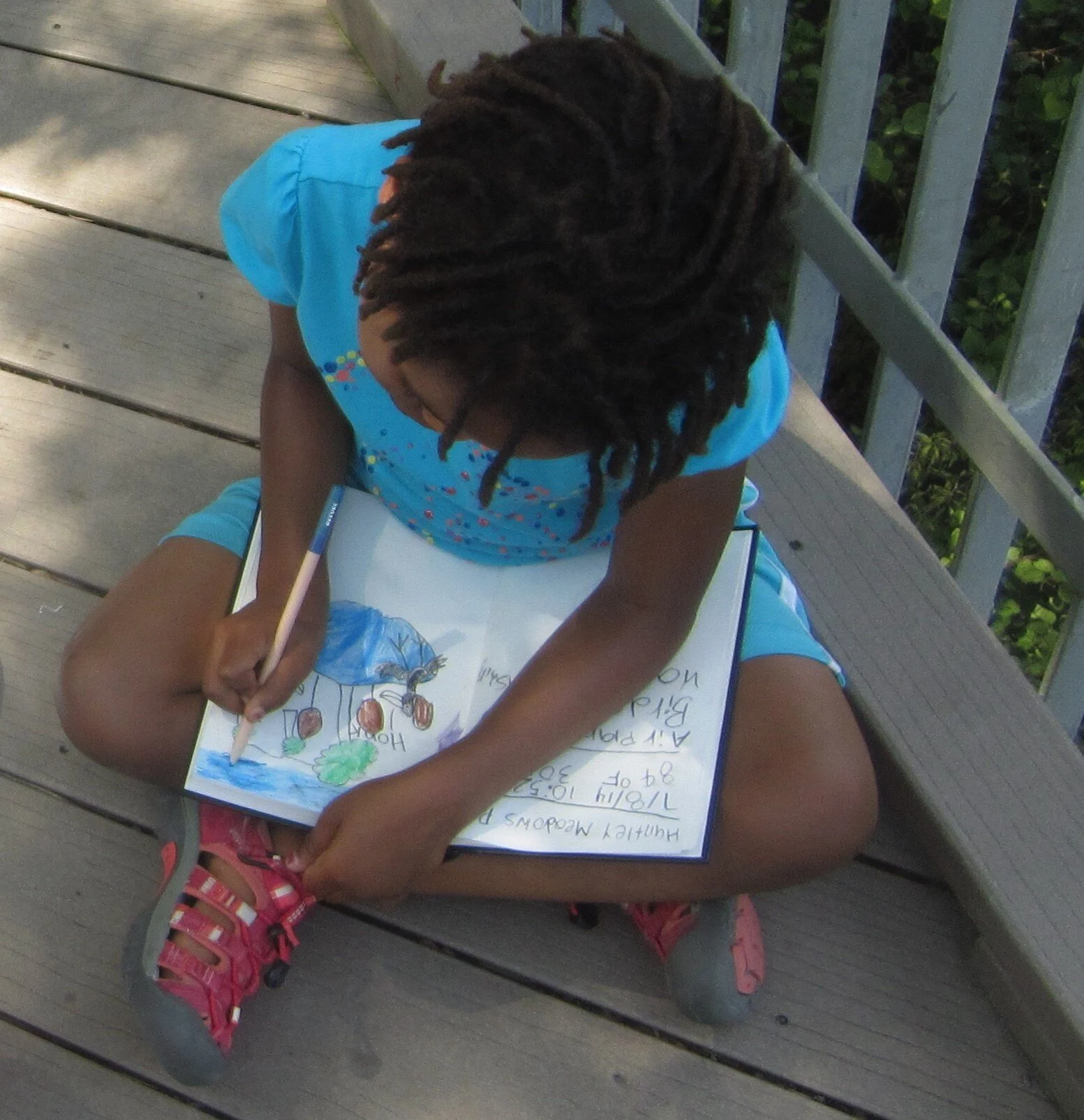
This year’s Youth Education mini grants were awarded to Knox Presbyterian Church, Ramsay Elementary School, Nativity Catholic School and Huntley Meadows’ after-school nature drawing program.
Photo: Margaret Wohler
This year’s Youth Education mini grants were awarded to Knox Presbyterian Church, Ramsay Elementary School, Nativity Catholic School and Huntley Meadows’ after-school nature drawing program. Three of the grants supported efforts to plant native plants and related educational programs. The long-running drawing program at Huntley Meadows supports observation – the key to understanding nature.
Dominion Grants to Beautify Neighborhood Entrances with Native Plants
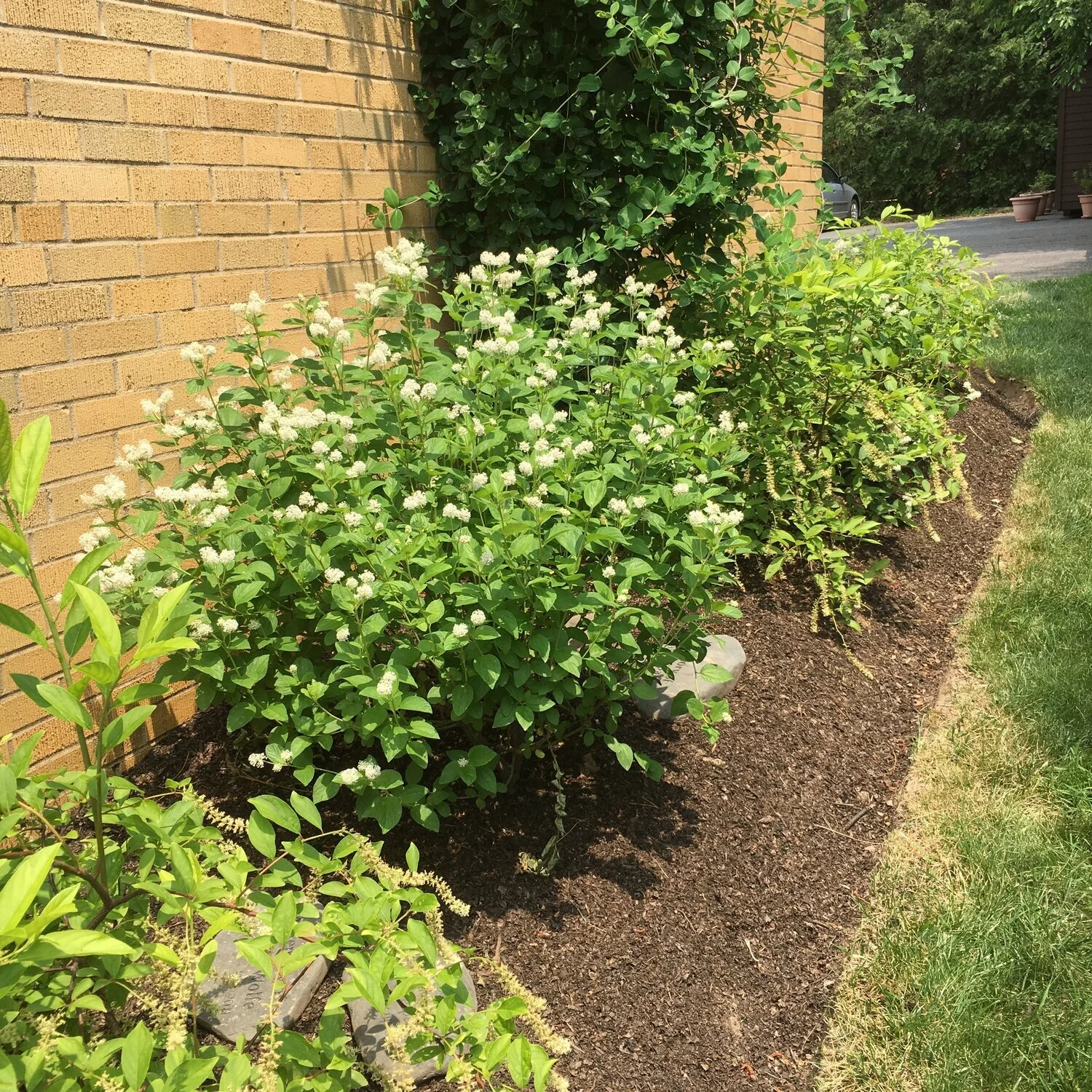
Audubon at Home partnered with Plant NOVA Natives to invite homeowners’ and civic associations to apply for funds to beautify their neighborhood entrances using low maintenance native plants.
Photo: Margaret Fisher
Audubon at Home partnered with Plant NOVA Natives to invite homeowners’ and civic associations to apply for funds to beautify their neighborhood entrances using low maintenance native plants. The mini-grant program was funded by Dominion Energy Charitable Foundation’s Environmental Education and Stewardship Grants Program.

AAH and Plant NOVA Natives received applications from 35 community associations and made their decisions based on the number of residents, ability to communicate with those residents, and the visibility of their new plantings. Six matching grants of $2,350 apiece were awarded to Auburn Village Condo in Arlington, Park Glen Heights HOA in Annandale, Civic Association of Hollin Hills in Alexandria, Water’s Edge at Fair Lakes HOA in Fairfax, Cascades Community Association in Loudoun, and Dominion Valley Owner’s Association in Prince William.
Congratulations to the winners! We look forward to working with you to design a low-maintenance, wildlife-friendly, and beautifully landscaped entrance planting. Completed installations will receive a high-quality sign that says, “Native plants support birds and other wildlife.”
The funds will go toward costs of a landscape designer to create a design and recommend native plants; purchasing and installing the plants; and removal of any invasive plants such as English ivy, Japanese Barberry, Periwinkle, etc. Each community is responsible for matching funds and/or sweat equity to cover the remaining costs. Additionally, the communities are expected to conduct educational outreach with their residents on the habitat value of native plants, and commit to maintaining the plantings for five years.
We were heartened by the number of neighborhood associations responding to our invitation to apply for funds to support their entrance beautification projects. And, we hope those who did not win a mini-grant will continue their efforts by inviting an Audubon at Home Ambassador to visit the site and provide advice on suitable, low maintenance native plantings. Residents of Arlington/Alexandria, Fairfax, Fauquier, Loudoun, Prince William, and Rappahannock counties may submit a consultation request here.

Planting for the Picky Eaters
Many insects are picky eaters, only able to eat the plants with which they evolved, meaning the plants that are native to their region.
Photo: from Plant NOVA Natives video
Plant NOVA Natives
Many insects are picky eaters, only able to eat the plants with which they evolved, meaning the plants that are native to their region. Butterflies are a good example, since although the adults can sip nectar from non-native flowers, their caterpillars depend on specific native plants. The majority of bees are more flexible than that, able to eat the pollen and nectar from a variety of species. They are known as generalist species, although even in their case they have their own favorites. The European Honeybee for example, is a generalist but chooses certain flowers in preference to others.
Of the approximately 400 native bee species in Virginia, about a fifth are plant specialists. Examples include the Spring Beauty Bee and the Blueberry Bee, which (unsurprisingly) depend on the flowers of Spring Beauties and Blueberries. These bees are short lived as adults, emerging when the plants they depend upon are in bloom and quickly gathering the pollen they need to store in their nests for their larvae, thus pollinating the plants while they are at it.
Our local ecosystem requires the full spectrum of plant/animal interactions to flourish. It is easily knocked out of balance when too many native plants are displaced by introduced species, something that has happened in many of our yards. We can restore that balance by planting a lot of native plants. One strategy could be to start with flowers that feed various specialist bees from early spring to late fall, because they will also supply food for the generalist bees. Since many of these flowers attract butterflies and hummingbirds as well, they make a winning combination. A list of popular native garden plants that feed specialist bees can be found on the Plant NOVA Natives website. It feels good to help the bees, whose numbers are in decline.
One of the many charms of native bee species is that they are highly unlikely to sting you, assuming you don’t try to grab one or otherwise threaten it. While they are foraging on a flower, you can get your face (and your camera) right up to them, and they will almost certainly ignore you. Gazing at bees brings surprises, as they come in many sizes and colors, including metallic blues and greens. It is particularly mesmerizing to watch bees on plants such as White Turtlehead, where they pry open the flowers and crawl inside, then back themselves out again, butt first. You can get a peek at those and other cute native bees on this two minute video, filmed in Fairfax County.
Many insects are picky eaters, only able to eat the plants with which they evolved, meaning the plants that are native to their region. The majority of bees are more flexible than that, able to eat the pollen and nectar from a variety of species. They are known as generalist species, although even in their case they have their own preferences. The European honeybees, for example, are generalists but choose certain flowers in preference to others.
Of the approximately 400 native bee species in Virginia, about a fifth are plant specialists. Examples include the Spring Beauty Bee and the Blueberry Bee, which (unsurprisingly) depend on the flowers of Spring Beauties and Blueberries. These species are short lived as adults, emerging when the plants they depend upon are in bloom and quickly gathering the pollen they need to store in their nests for their larvae, thus pollinating the plants while they are at it.
Our local ecosystem requires the full spectrum of plant/animal interactions to flourish. It is easily knocked out of balance when too many native plants are displaced by introduced species, something that has happened in many of our yards. We can restore that balance by planting a lot of native plants. One strategy could be to start with flowers that feed various specialist bees from early spring to late fall, because they will also supply food for the generalist bees. Since many of these flowers attract butterflies and hummingbirds as well, they make a winning combination. A list of popular native garden plants that feed specialist bees can be found on the Plant NOVA Natives website.

July-August Bird of the Month
With more than 1100 song variations – some believe that number can be closer to 3000 – the Brown Thrasher (Toxostoma rufum) has one of the largest song repertoires of all songbirds. It even beats out the Northern Mockingbird, which can sing up to 200 different songs.
Photo: Brown Thrasher, Peter Waksmundzki/Audubon Photography Awards
It’s Easier to Distinguish a Brown Thrasher from a Northern Mockingbird Than You Think
Jessica Bigger
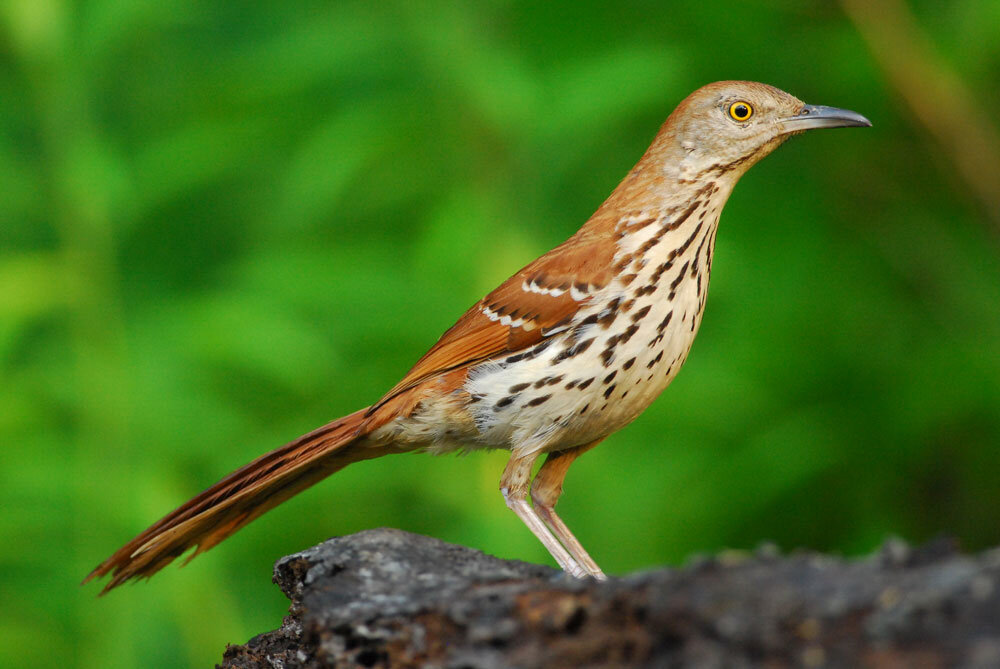
With more than 1100 song variations – some believe that number can be closer to 3000 – the Brown Thrasher (Toxostoma rufum) has one of the largest song repertoires of all songbirds. It even beats out the Northern Mockingbird, which can sing up to 200 different songs. Although their songs can be difficult to distinguish from a Northern Mockingbird’s, the easiest way to tell the two birds apart is to listen to their song phrases. Thrashers only repeat their phrases twice, while mockingbirds repeat their phrases three or more times.
Thrashers also sing with gusto, yet some birders do not understand their singing ability. Cornell mentioned on All About Birds that, “One early naturalist thought the Brown Thrasher’s song was underappreciated, writing “Much of the [acclaim] which has fallen to the Mockingbird is really due to the unperceived efforts of the Brown Thrasher. It is the opinion of many ornithologists that the song… is richer, fuller, and definitely more melodious than that of polyglottis’ (the Northern Mockingbird).
You may be able to hear thrashers in the spring, but they are quite elusive. They nest in thickets, hedgerows and forest edges, but males will fly up to higher branches in trees to sing. You might get a glimpse of them when they come down to forage in the leaf litter, chattering away while searching for food. If you spot one it might give you a scathing look, with its curved bill (frown) and its glaring yellow eyes.
Brown Thrasher, Peter Waksmundzki/Audubon Photography Awards
In Gillian Field’s article in the Herald Times, she wrote about creating habitat to attract a variety of songbirds. Fields had an infestation of vinca minor in her yard. So, she rolled up her sleeves and ripped out every last vine. She replaced the vines with a thick layer of leaves and laid several sticks on top to prevent the leaves from blowing away. To her surprise-two days later-a Brown Thrasher came bopping around her leaf litter, happily chattering away while searching for food.
Some passerines, including the Brown Thrasher, will shed feathers on the underside of their body – known as an “incubation patch.” With their skin feathers free, these birds are able to use their body heat to keep their eggs warm. Feathers would impede this process. Both female and male Brown Thrashers have this patch during the breeding season, as they both share nesting duties.
Thrashers eat both insects and seeds. They also eat fruits, nuts and arthropods. Interestingly, they love acorns. They grab these large nuts in their bill and whack them on the ground to crack the nuts into more manageable pieces.
Brown Thrashers live year-round in the southeastern part of the U.S., but we are blessed to see them in spring and summer as they migrate to Northern Virginia and other eastern states to breed. Although considered a bird of low concern on All About Birds, the Brown Thrasher is considered a vulnerable species according to the National Audubon Society.
Climate change is shifting the Brown Thrasher’s range further north. They are common in Georgia – they are the state bird – but as temperatures rise, the environment is becoming unsuitable for this mimicking species. They’re not the only birds feeling the effects of climate change.
As the earth continues to warm, most of the Brown Thrasher’s current habitat in the U.S., both breeding and nonbreeding, will be lost. The species will be forced to move farther up into Canada. Spring heat waves and heavy rains (which can flood their nests) can endanger nestlings. They are also quite susceptible to nesting parasites, like the Brown Cowbird.
However, there is still hope. Reducing global temperatures, even now, would greatly reduce the chances of a major decline in all bird populations.

ASNV Will Follow CDC’s COVID-19 Guidance
ASNV has eliminated its COVID-19 – related restrictions on in-person gatherings, bird walks and surveys and will follow the CDC’s guidelines as they change from time to time.
ASNV has eliminated its COVID-19 – related restrictions on in-person gatherings, bird walks and surveys and will follow the CDC’s guidelines as they change from time to time. Currently, fully vaccinated people are not required to wear masks or socially distance, indoors or out. People who are not fully vaccinated should wear masks and maintain socially distant when they are indoors or outdoors in crowded settings. Our website has more information on our bird walks, citizen science surveys and Audubon at Home visits. We hope to see you soon!
The White-headed Chipping Sparrow
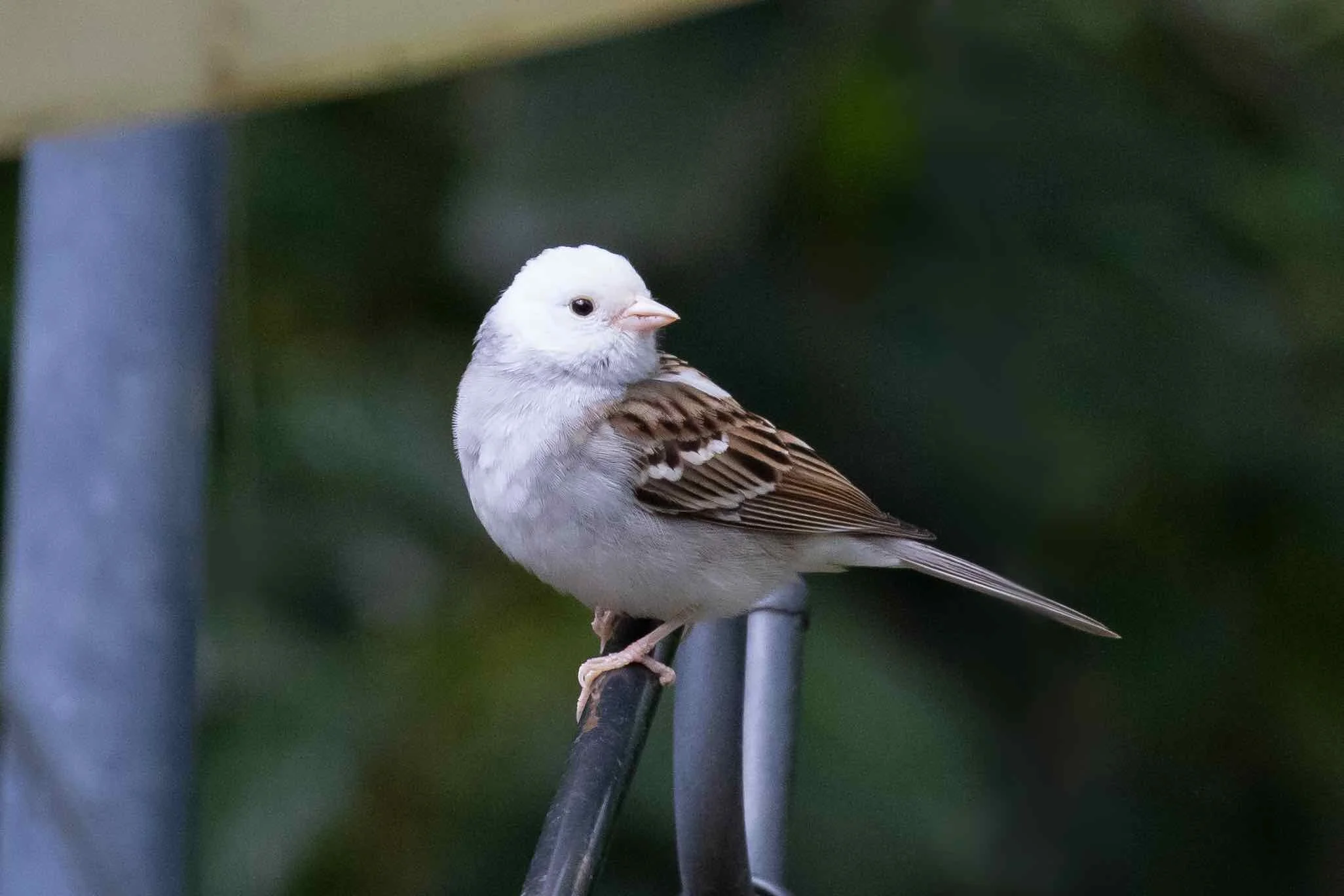
In late April, Ashley Bradford photographed a Chipping Sparrow with a totally white head. The name for the condition which caused this color abnormality is disputed.
Photo: Chipping Sparrow, Ashley Bradford
William Young
In late April, Ashley Bradford photographed a Chipping Sparrow with a totally white head. The name for the condition which caused this color abnormality is disputed. Some call it leucism. Others call it partial albinism.

Chipping Sparrow, Ashley Bradford
The word leucism (pronounced loos-ism) is derived from the Greek leukos, which means white or clear. The default color for bird feathers is white. Black and brown coloration is produced by the pigment melanin, a word that comes from the Greek melas, which means black. An enzyme produces this pigment. If a bird cannot produce melanin or if the melanin produced cannot properly reach the feathers, a color abnormality can result, causing some or all of the feathers to be white or a lighter color than normal. If the feathers have a washed-out appearance, the bird is said to have dilute plumage.
Some scientists say that leucistic birds have no melanin in some or all of their feathers. In the photographs below, a Malachite Kingfisher I saw in Uganda conforms with this definition, because it did not appear to have any melanin in its feathers.
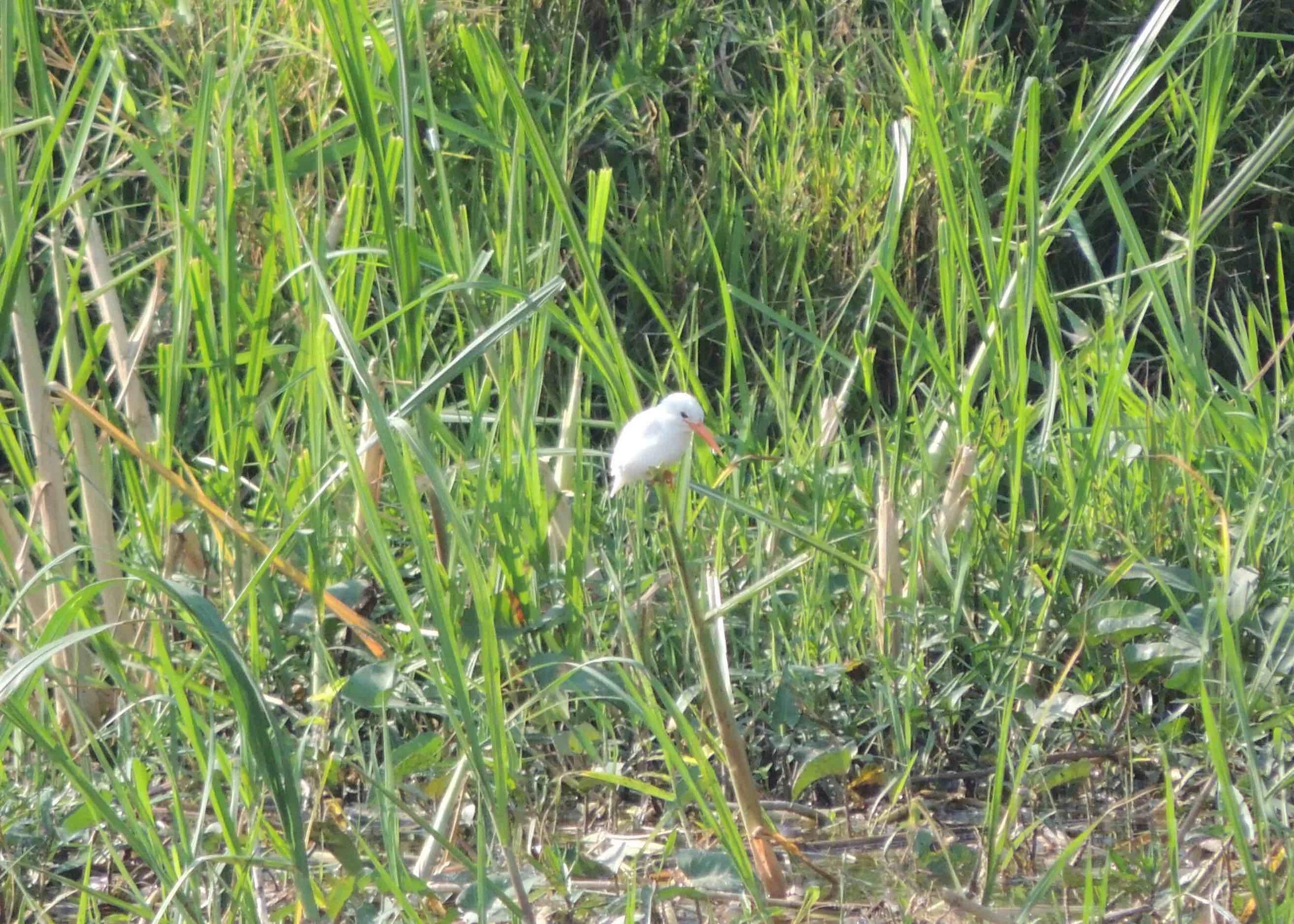
Leucistic Malachite Kingfisher, William Young

Typical Malachite Kingfisher, William Young
A bird with white splotches on its feathers would not be considered leucistic. The male American Robin pictured below would be in a category that David Sibley and others would call a partial albino. (See Sibley's article "Abnormal coloration in birds: Melanin reduction" here.
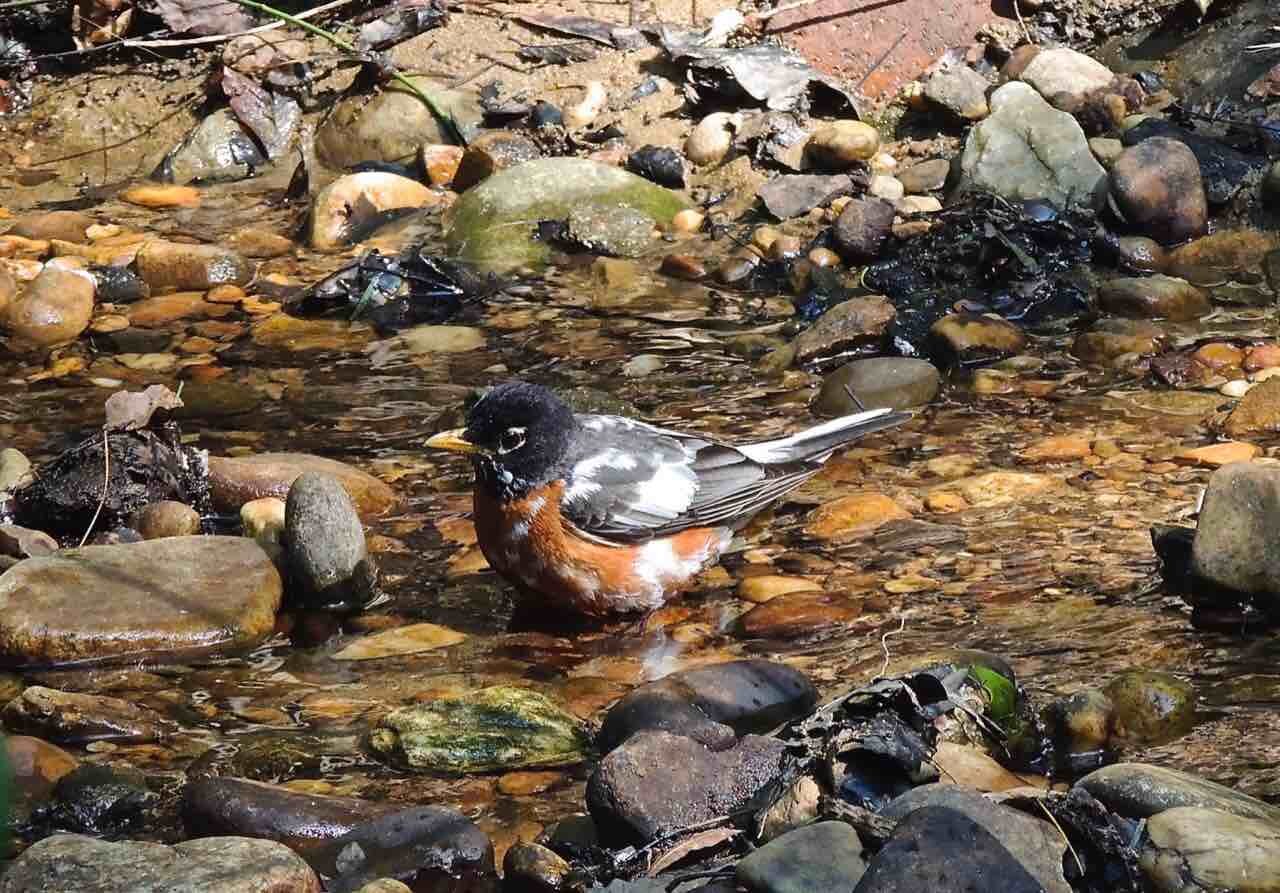
Partial Albino American Robin, William Young
Leucistic birds and pure albino birds differ in a few ways. Pure albino birds are always totally white. They have a genetic condition that causes a lack of the enzyme tyrosinase, and they are unable to produce melanin. Their eyes and soft parts (bill, skin, legs, etc.) appear reddish-pink, because blood vessels show through their colorless skin. Leucistic birds can produce melanin, but it does not get into some or all of their feathers. Their affected feathers can be either all white or appear washed out, but their eyes and soft parts are the normal color. When leucistic birds molt, their new plumage can look different than it did before the molt, showing either a greater or lesser number of white or washed-out feathers.
To add to the confusion, a condition called fright molt can result in a bird having some feathers that are temporarily white. An example would be if a bird loses some feathers to a predator. Temporary feathers might grow back without pigment and be white. The next time the bird molts, the new feathers will contain pigment.
The word bald in Bald Eagle means white rather than featherless. The head of Ashley's Chipping Sparrow would fit this definition. The head of the grackle pictured below is mostly bald.
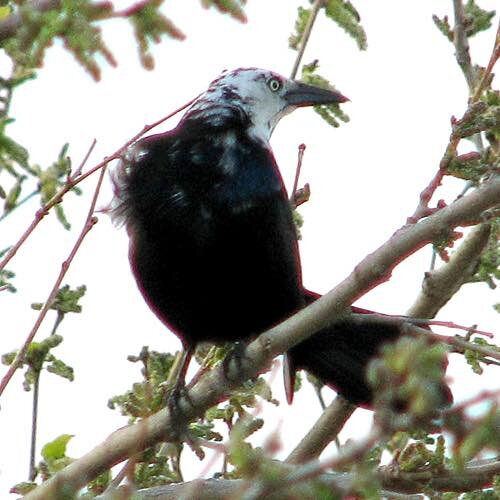
Common Grackle, Ashley Bradford
In 2019, a White-throated Sparrow with a mostly white head showed up at Monticello Park in Alexandria. The bird still had the yellow patch near its eye, and there were portions of the black crown stripes on its head.

White-throated Sparrow, William Young
In 2014, a white-headed Tree Swallow was at Riley's Lock along the C&O Canal Towpath in Maryland.

Tree Swallow, Ashley Bradford
Lola Oberman wrote an article for the Audubon Naturalist Society News about birds with color abnormalities. She related a story about a pale beige Tree Swallow flying among a large group of Tree swallows with typical coloration. She said numerous "normal" Tree Swallows attacked the beige one and forced it into the water. The beige swallow managed to fly out of the water, but Oberman thought the bird was probably doomed, because it would be the subject of similar attacks.
Whether a bird with abnormal plumage will be accepted by members of its species depends on the species and the circumstances. Ashley's Chipping Sparrow was not harassed by other Chipping Sparrows in her yard. I have seen a single white-phase Snow Goose feeding in a large group of Canada Geese with no apparent conflict. I am not aware of any studies that have been done about the ability of abnormally colored wild birds to find mates and reproduce. However, a male cardinal with an unfeathered head was at Monticello Park for a few years, and he was often accompanied by a female.
Some abnormally colored birds can appear to be more attractive than others of their species in normal plumage. If a bird with abnormal plumage visits an area over a prolonged period, it can provide an opportunity to study the behavior of an individual bird, because you can easily differentiate it from others of its species.

Chipping Sparrows, Ashley Bradford
Such birds can help birders to sharpen their identification skills. Most birders identify Chipping Sparrows by looking at the head. When the head is all white, you have to identify it by looking at the rest of the bird, including bill shape and color, pattern on the back, etc. Identifying one of these abnormal birds can provide a similar type of satisfaction to identifying a rare species.
William Young is the author of the book The Fascination of Birds: From the Albatross to the Yellowthroat. He and Ashley Bradford created the MPNature.com website.

Let’s Put Northern Virginia on the Map...The Birdability Map!
“Birding is for everybody, and every body!” This is the motto of Birdability, a growing global effort that works to decrease barriers for birders with mobility, vision, developmental, hearing, and other health challenges.
Annaliese Meistrich, ASNV intern
“Birding is for everybody, and every body!” This is the motto of Birdability, a growing global effort that works to decrease barriers for birders with mobility, vision, developmental, hearing, and other health challenges. The organization, and the movement it inspired, hope to eliminate many of the accessibility challenges that these birders face on a regular basis in order to share the joys of birding with them. The founder, Virginia Rose, a board member of Travis Audubon in Texas, had fallen at a young age and now uses a wheelchair. She found a passion in nature and birding which became the inspiration behind Birdability. A key effort is to have birders and others contribute birding locations to the Birdability Map, “a crowd-sourced map of accessible birding locations, with details of the accessibility features of them.” Their website has a wealth of resources on birding with accessibility challenges, and how individuals and organizations alike can ensure they are welcoming and inclusive. ASNV has a team of board members and adult and youth volunteers who have to date added 43 trails to the map.
The beauty behind this movement is that anyone can contribute! All it takes is a few minutes of your time while you are on a bird outing. By completing and posting responses to a simple survey, you can submit accessibility reports and help put Northern Virginia on the map. All information you need on assessing a trail can be found here.
As you prepare to review a trail, here are a few things to keep in mind. First, check the Birdability Map itself, to ensure that the trail you wish to review has not just been assessed. It can be helpful to have a printed version of the survey questions while out on the trail. (A concise, printable checklist will be added soon to the website.) You might want to complete and submit the survey later from notes, when Internet access may be more certain. In addition, a tape measure has proven to be extremely useful for accurately measuring railing heights, door entry widths, etc.
Here are a few things to record about general accessibility, if able.
First, public transit access. Are there additional methods of transportation (bus, metro) besides an automobile to this site?
Is the trail particularly wet or muddy most of the time, during high tide, or after a storm?
Any breaks in an otherwise accessible trail?
It is important to note any park issues such as car break-ins, vandalism, or any other notable information.
Lastly, if you know how to do this, copy and paste the eBird link for the site or note interesting birds that can be seen there. That way people will know what birds to look for and the general area the birds might be in.
There are a few specific tips that will prevent confusion. For example,
when placing the pin drop, ensure that you manually place the pin on the trail head. If you use the address alone, the pin drop does not necessarily mark the actual start of the trail. This can cause the report to be misplaced on the Birdability Map.
If you post trail segments for one trail--a common practice when trails are not completely accessible in all sections--accurately placing different pin drops and naming the trail segments distinctly is especially important for separating the reports on the map.
Last is the issue of measuring slopes. The survey requests information regarding the steepness of slopes. Sometimes this information is available on signs at trailheads. Other times your guess is the best you can do! There are comment boxes for every survey question so you can note the fact that this observation was your best approximation.
If you would like to determine the slope grade, free smartphone apps like Bubble Level for iPhone can help with this process. To calculate the slope yourself, measure--or at least estimate--the length of the slope and then, from the bottom of the slope, measure from the ground up to where the measuring tape is level with the top of the slope. (See illustration below.)
With this information, you can now find the slope grade by dividing the slope height into the length of the slope in inches. For instance, the grade of a 20-foot slope with a 30-inch rise is (20 x 12 inches) divided by 30 is 8:1.
You can also post photos of slopes, obstacles, or other sights of interest to this birding location so readers can assess the trail based on their own capacities. In addition to this, you can pin any notable access points on the trail such as observation platforms, bird blinds, car birding platforms or anywhere else that one may be able to bird from.
If you would like more information, there are many resources at birdability.org. If you have mapping questions, please do not hesitate to contact us at info@audubonva.org.
Thank you for joining us in supporting the Birdability movement and happy trails to everyone!

What Do We Do About John James Audubon?
Drew Lanham writes about the complexities of J.J. Audubon and his history of white supremacy in the spring issue of Audubon Magazine.
Photo: Great Egret, Adrian Brandon
Drew Lanham writes about the complexities of J.J. Audubon and his history of white supremacy in the spring issue of Audubon Magazine. As we commemorate Black Birder’s Week 2021, this article offers so much for all of us, and especially birders, to think and “grapple with” now .
“The founding father of American birding soared on the wings of white privilege. The birding community and organizations that bear his name must grapple with this racist legacy to create a more just, inclusive world.”

Great Egret, Adrian Brandon

Monday Mystery - May 24
Monday Nature Mystery continues! Read on to learn who correctly identified our last mystery.
Photo: Carolina Wren’s nest, Laura McDonald
We are pleased to announce the winner of our Monday Nature Mystery, Terri A. Lisman!
Terri correctly identified the nest and eggs of the Carolina Wren (Thryothorus ludovicianus).It’s often called, the “little bird with the big voice.” Carolina Wrens are known for building nests in strange places! They have been found in hanging flower baskets, golf carts and even boots. The nests are constructed of many materials, like moss, pine needles, and leaves. Both the male and female build the structure together. To learn more about their habits, click here.

Last week’s mystery: Nest and eggs of the Carolina Wren (Thryothorus ludovicianus), Laura McDonald
Each Monday we’ll post a new mystery and identify the previous week’s winner. They’ll receive an ASNV hat or tote bag.
Here is the May 24th Monday Nature Mystery. Did you figure out what bird species this is? Ducky Nguyen correctly guessed a leucistic Chipping Sparrow (Spizella passerina). Please email us your snail mail address and preference for a hat or tote bag to: info@audubonva.org. To learn more about leucism in birds, read Bill Young’s article, “The White-headed Chipping Sparrow.”

May 24th Mystery: Leucistic Chipping Sparrow (Spizella passerina), Ashley Bradford
We’ll resume our Monday Nature Mystery series on June 7th. Visit our Facebook page to solve the next riddle. Good Luck!
Please note that all entries are date and time-stamped. We review each correct answer to see who commented first. If someone 'likes' your comment, it would move it up on the list, making it look like the first post. Winners are limited to one prize every 90 days.

NOVA Regional Parks and Arlington NAACP sponsor Black and Latinx Bird and Nature Walks at Upton Hill Park
The walks are also supported by ASNV in collaboration with Arlington Master Naturalists. Walks take place on three Saturday mornings: April 24, May 8 and June 5.
The walks are also supported by ASNV in collaboration with Arlington Master Naturalists. Walks take place on three Saturday mornings: April 24, May 8 and June 5.
Registration is limited to 15, so sign up early here.


“The Birds Are Back in Town”
The saga of the Hampton Roads Bridge Tunnel Seabird Colony continues.
Photo: Tern Colony, VA DWR
The saga of the Hampton Roads Bridge Tunnel Seabird Colony continues. The Virginia Department of Wildlife Resources (DWR) monthly blog on the colony reports that at the last visit there were more than 3,000 adult Royal Terns nesting on the Fort Wool site. Also spotted were interspersed nesting Sandwich Terns and some Laughing Gulls nearby. Black Skimmers, Common Terns and 11 adult Gull-billed Terns (a state-threatened species) are nesting on the barges.
You will recall DWR’s construction of a habitat for the nesting birds on Fort Wool and nearby barges was a cliff-hanger last year. The habitat had to replace nesting sites from a long-time colony displaced by the Hampton Roads Bridge Tunnel Expansion Project, and success was not guaranteed. DWR celebrated the project’s success in an article in the Virginia Wildlife magazine (If You Build It, They Will Come), and started the monthly blog to report on this year’s activity.
Birders are not allowed to visit the colony, but the current issue of the blog provides the next best thing, stunning 360⁰ views of the nesting sites on Fort Wool and the barges, plus lovely pictures of the different seabird eggs. You can subscribe to DWR’s monthly reports here. Choose “Wildlife Updates” to get a monthly notice of new articles.