
NVBA NEWS BLOG
Welcome to the blog for Northern Virginia Bird Alliance, a wealth of resources about northern Virginia birds, wildlife, habitat conservation and restoration, native plants, wildlife-friendly gardening, advocacy and more.

My Educator’s Week at Hog Island Audubon Camp
My whole life I have been hearing about this camp in Maine where the showers are always cold, the mornings are always early, and the birds are always calling. My mother attended Hog Island’s Educator’s week in the 80’s as a young educator, extremely invested in ways to share the natural world with children from various backgrounds.
Photo: Phoebe Riegle
Phoebe Riegle
ASNV 2020 Hog Island Scholarship Winner
My whole life I have been hearing about this camp in Maine where the showers are always cold, the mornings are always early, and the birds are always calling. My mother attended Hog Island’s Educator’s week in the 80’s as a young educator, extremely invested in ways to share the natural world with children from various backgrounds. As her child, I was also one of her students so, I got to experience the incredible camps and lessons that she learned from Hog Island. Little did I know that one day I would get to learn from the same man on the same island that taught her “almost” everything she knows, as well as from a few other incredible educators.

Phoebe Riegle

Phoebe Riegle
The year-postponement due to COVID was unfortunate but I was still thrilled to have the opportunity to attend in 2021. Walking up onto the island I was overwhelmed with excitement and comfort in knowing that the showers were now heated because of new solar panels and, more importantly, I was going to be spending a week with like-minded educators all looking to explore nature like we were kids again.
Adorned with my new “fancy” pair of binoculars, I awoke early the first morning to join the legend himself, Ted Gillman, and fellow bird-nerds for a birding session. I learned the flight pattern and calls for birds like woodpeckers and goldfinches as well as how to “point” out birds. The biggest take-away from each of Ted’s lessons was to find ways to build-in success for every student. Celebrate every observation and inference that students make when exploring nature even if it has nothing to do with your question or lesson. Also, remember that you don’t need fancy equipment to get kids into nature- paper towel rolls can be binoculars, an old white shower curtain can be an observation station under a tree, and old cottage cheese tubs can be miniature ponds.
Throughout the rest of the week, I learned from inspiring naturalists about pollinators, insects, birds, marine ecosystems, and citizen science all with a tone of remembrance for the Native Americans who once inhabited the area. James, Kaylani, Margaret, Ted, Colleen, Khav, and Ms. Evonne taught me more than I could’ve imagined. By the end of the week one fellow camper said it best – the thing that made this camp amazing was the fact that it was a group of nature-loving educators who all bought into the magical energy of the island each and every day. With everything happening in the world, it is easy to get bogged down by negativity. Nature is one thing that has stayed consistently and relatively safe throughout these past few years. Take every opportunity you can to feel like a kid again and explore, ask questions, draw conclusions, and research – because you still can.

“Turn Right and proceed for 2,000km” Biological Compasses during Migration
Have you ever wondered how birds are able to make their way to their fall/winter migration location? Migration has to be one of the most fascinating topics in ornithology.
Photo: Ring-billed Gull, Sandra Wilbur/GBBC
Deidra Bryant
Have you ever wondered how birds are able to make their way to their fall/winter migration location? Migration has to be one of the most fascinating topics in ornithology. Primarily because of the avian physiology that works overtime to get them to their ultimate destination and how it may possibly be connected to something as ancient as the earth’s magnetic field.
Some birds, like the Sandhill Crane (Antigone canadensis) and Snow Goose (Anser caerulescens), learn their migration routes from the adults as they travel in family groups, while others may use their sight to note various geographic landscapes and bodies of water to let them know that they are on the right track. However, what I found most interesting were studies that investigated species that may use special chemicals in their eyes, magnetite in their beaks, or small currents generated in the bird’s inner ear as it navigates the planet’s magnetic field. These internal compasses allow them to orient themselves in locations that do not have obvious landmarks (such as oceans) even at night. However, after more than half a century of research on this topic, scientists are STILL unable to understand this “sixth sense”.
In the last couple of years, scientists in Europe have published articles explaining how a protein called Cryptochrome 4 or “Cry4” found in the retinas of Zebra Finches (Taeniopygia guttata) and European Robins (Erithacus rubecula) may allow them to “see” magnetic fields like a heads up display on a plane. They believed that changes in the concentration of this protein may affect light-sensitive cells within the eye, causing the bird’s view of the sky to become lighter or darker depending on the location and power of the magnetic field. The problem here is that scientists are now doubtful of the methods used to test this protein in the past. For instance, because they are light-sensitive, it does not explain their ability to navigate the dark NIGHT skies across the open seas. Another issue is that most of the studies that tested this chemical were only tested in a lab, and when scientists like Henrik Mouritsen and his team at the University of Oldenburg tried to replicate the original methods used to test magnetoreception, their results differed from the historical literature. Lastly, the magnetic fields used in the original study were much stronger than those generated by the planet. So, it begs the question: would the same finding apply to Earth-strength fields in a migrating bird?

Ring-billed Gulls, Sandra Wilbur/GBBC
As for the hypothesis that magnetite, a ferromagnetic mineral, may be present in the beaks of birds such as the messenger pigeon (Columba livia domestica), and even Ring-billed Gulls (per the 1972 study by William E. Southern), results have only been speculative. Current data shows that these birds may have a magnetic receptor in their body, but we don’t quite know how it works. For example, unlike the compasses people use, scientists believe certain birds are able to detect the axis of the magnetic field but aren’t able to distinguish between the north and south poles. Since magnetite crystals would respond to a flipped field like a compass needle, a bird should easily notice the difference and adjust accordingly. But in previous studies, birds only knew which direction the closest pole was but couldn't distinguish between north and south. So, when scientists inverted the magnetic field in the lab, they didn’t notice the change and continued to fly in the same direction. Another major issue with this idea of “trace magnetite within the beaks” is that no one has ever seen these iron crystals, even under a microscope, and even if they eventually did, much work would have to be done to prove that it has any relevance to the species’ nervous system and ultimately having it translate to directions.
Australian neuroscientist David Keays is currently testing a theory first proposed in the late 19th century that hypothesizes that tiny electric currents are generated in the bird’s ear through electromagnetic induction as they move through the planet’s magnetic field. Using an apparatus he built by running electricity through Helmholtz coils, he created a magnetic field to test the magnetic sense of pigeons. Essentially, he analyzes how neurons in the pigeons’ brains respond since extremely sensitive receptors in their inner ear would pick up the small induced voltages and send signals to the brain. He also believes that the rapid head turning in messenger pigeons during flight may serve to boost the voltage in the birds’ ears.
It is still a mystery as to how certain species are able to know just where to go every year, even when they are very young. This innate ability is still being explored.

Field Trip to the Lorton Landfill
Why do I want to go birdwatching at a landfill? Only because I want to see multiple kestrels, harriers, Bald Eagles, meadowlarks, sparrows (maybe some rare ones, if I’m lucky).
Photo: American Kestrel, David Zieg/Audubon Photography Awards
Greg Butcher
Why do I want to go birdwatching at a landfill? Only because I want to see multiple kestrels, harriers, Bald Eagles, meadowlarks, sparrows (maybe some rare ones, if I’m lucky). The I95 landfill is mostly closed, so we can safely drive around and experience open grassland birds and also visit small ponds and forest edges. 134 species have been recorded here, including 58 on a single day in late October. It’s one of those places where you’re never quite sure what you’ll see.
Join us at 8 AM on Saturday November 20 at the Administration Building by following Google Map directions to Fairfax County Recycling and Disposal Center, 9850 Furnace Road, Lorton VA. As you drive in past the weigh station (stay to the left so you don’t get weighed), the administration building is the first building on the right. Contact Greg Butcher for more information.
This walk is FREE, but registration is required.

Arlington National Cemetery Treasures its Trees
Arlington National Cemetery is a place to honor, remember, and explore. The beauty of the grounds and the comfort of its visitors is enhanced by close to 10,000 trees, some dating back to before the Civil War.
Photo: Arlington National Cemetery Trees, courtesy of ANC employee
Reprinted with permission from Plant NoVA Natives
Arlington National Cemetery is a place to honor, remember, and explore. The beauty of the grounds and the comfort of its visitors is enhanced by close to 10,000 trees, some dating back to before the Civil War. The diverse collection of this Certified Level III Arboretum include many species native to Northern Virginia including the state co-champion Pin Oak, near the Memorial Amphitheater. (A champion tree is the largest representative of its particular species within a geographic area.)
Arlington National Cemetery is dotted with native trees such as Redbuds with their lavender flowers in spring, Black Gum with its bright red fall foliage, and American Hollies that shelter the birds. Oaks are the most common species, which reflects their predominance in the Eastern forest.
Forester Greg Huse gives tours of the arboretum to visitors four times a year and points out the ecosystem services provided by mature trees. That Pin Oak, for example, not only supports the caterpillars that are the food for baby songbirds – a feature intrinsic to native plants but nearly absent in non-native ones – but also absorbs 1,400 pounds of atmospheric carbon and intercepts 23,000 gallons of storm water every year.
After President John F. Kennedy was assassinated in 1963, a landscape architect firm designed the Kennedy memorial site, home of the Eternal Flame. The designers worked around a 200-year-old Post Oak, 60 inches in diameter, which later became known as the Arlington Oak. In 2012, this massive tree was blown down by Hurricane Irene and could not be rescued. By good fortune, though, its acorns had been collected by American Forests as part of their historically significant trees project. Three of those saplings were donated back to Arlington Cemetery and planted in the same plaza, where they are now ten to twelve feet tall and thriving.
Trees are not the only native plants at the cemetery. Horticulturalist Kelly Wilson has been steadily adding a diversity of herbaceous and woody plants throughout the last decade, especially in the newer bio-retention areas (rain gardens). In these public areas, she designs with a small number of species to keep a neat-and-clean look, while in a staff parking area, she allows for more exuberance. Favorite natives utilized are the purple-flowering Ironweed which attracts many pollinators. Monarch caterpillars have taken advantage of the Butterflyweed. River Birch with its beautiful peeling bark does very well in rain gardens.
The 639 acres of Arlington National Cemetery, which is the resting place for 400,000 American servicemembers and family, are cared for by five permanent staff members who supervise the work of 90-100 contractors. The trees that grace this National Treasure are an essential feature, just as they are in any neighborhood where residents value the beauty and services they provide.
To learn what you can do to plant and protect trees on your own property, visit www.plantnovatrees.org. To see some of the beauty in Arlington National Cemetery, click here. Many of the trees will still have their fall colors in November when Arlington National Cemetery hosts the Centennial Commemoration of the Tomb of the Unknown Soldier. On November 9-10, a flower ceremony takes place where the American public will be able to place a flower at the Tomb of the Unknown Soldier. On November 11, an Armed Forces full honors procession takes place as it did a hundred years ago on November 11, 1921. Find out more about the Tomb of the Unknown Soldier Centennial Commemoration at www.arlingtoncemetery.mil.

November 2021 Bird of the Month
Surf Scoters (Melanitta perspicillata) are one of the many seabirds we get to see during the winter months here in Northern Virginia. They are easy to spot, especially the males, by their black and white patched heads and bright orange, white and black bills.
Photo: Surf Scoter, Eric Reuter
Winter is Coming When the Surf Scoters and Waterfowl Arrive
Jessica Bigger
Surf Scoters (Melanitta perspicillata) are one of the many seabirds we get to see during the winter months here in Northern Virginia. They are easy to spot, especially the males, by their black and white patched heads and bright orange, white and black bills. They even have their own nickname, “old skunk-head,” because of the white and black patches on their heads. The female’s plumage on the other hand is not as spectacular as the male’s. Females are brown with two small white patches on their faces.
For most bird species, males and females court during the breeding season, but not Surf Scoters. They find their mates during the nonbreeding season and then fly together to their breeding grounds when it’s time to mate. During winter, the male will swim back and forth with his head erect, occasionally dipping his bill into the water. As he approaches the female, he will shake his head, preen and gurgle. After the breeding season Surf Scoters fly to a protective location, away from harsh storms and predators, to molt before heading to their wintering grounds. While they are molting, Surf Scoters are unable to fly.
Surf Scoters can be found on the Pacific and Atlantic coasts, and occasionally inland on lakes and reservoirs where they avoid storms off the coast. While bobbing up and down in the water, Scoters dive down to the bottom to feed on small mollusks, snails, small crabs, sea squirts, hydrozoans, and a variety of marine worms. They even eat sea vegetation on occasion. To protect themselves from the high salinity levels in the ocean, Surf Scoters have glands above their eyes to remove the salt from the oceans and bays they swim in. The salt concentrates in the blood and then is excreted out of their nostrils.
As with all bird species, climate change will affect the Surf Scoters’ breeding and wintering ranges. According to the National Audubon Society, if the earth’s temperature increases 1.5 degrees Celsius, the Surf Scoter population will lose 10% of its range in the southern and middle regions of Canada. If the temperature increases to 2.0 degrees Celsius, the species will lose 39% of its range. If the temperature reaches 3.0 degrees Celsius (that is if nations around the world do almost nothing to curb greenhouse gases), Scoters will lose 62% of their habitat in Canada.
At this moment, the Surf Scoter population is stable, but impacts from climate change (harsh weather patterns and rising sea levels) and habitat loss will negatively impact the population. It’s an important reminder for all of us who care about birds to advocate for governments around the world to start shifting away from carbon-based energy to more renewable energy resources, like wind and solar power.
Sources:
https://www.allaboutbirds.org/guide/Surf_Scoter/overview
https://www.audubon.org/field-guide/bird/surf-scoter
https://blackhills-audubon.org/bird-of-the-season-surf-scoters/

The Big Sit! 2021
Read the highlights of 2021 The Big Sit at the Mustang Trailhead in Meadowood Special Recreation Area, attended by more than 20 staffers, board members, and friends of the Audubon Society of Northern Virginia.
Photo: Laura McDonald
By Greg Butcher, ASNV Vice President
It’s always fun when you see a bird that eBird questions! So it was satisfying on Saturday, October 9, when I recorded two Northern Rough-winged Swallows and eBird demanded documentation. It was amusing when eBird questioned the sighting of 210 cowbirds in an hour, but they went streaming by all morning. And I was disappointed when eBird didn’t question the Scarlet Tanager that several of us saw, that I thought was pretty late for northern Virginia.
Those were the highlights of The Big Sit at the Mustang Trailhead in Meadowood Special Recreation Area attended by more than 20 staffers, board members, and friends of the Audubon Society of Northern Virginia (ASNV).
(I hope you are all eBirding when you bird. eBird organizes bird records from all over the world and adds information immediately upon receiving it. eBird data is then available to answer a wide variety of questions about bird distributions that everyone can access. But this article isn’t about eBird, it’s about The Big Sit!)
When I go birding, I usually walk a steady pace the whole time, stopping only when I see or hear a bird, then moving on again. So I was a late convert to The Big Sit, where one or a few people draw a small circle and promise to stay inside, counting all the birds seen or heard from that one spot.
The Big Sit was started in 1992 by the New Haven Bird Club in Connecticut and turned into a global event by BirdWatcher’s Digest from 2001-2019. It is now back in the hands of New Haven. The circle size is 17 feet in diameter.
In 2017, Laura McDonald and Zach Reichold decided that it would be fun to do a Big Sit at Meadowood, where Zach is the manager for the Bureau of Land Management. They quickly roped me into the plan, and I have been the chief bird-list-keeper in 2017, 2018, and 2021. I start a half-hour before dawn, so I can be sure to hear the nearby Barred Owl, and other people (and birds) come and go all morning.
We had 37 species this year, compared to a high of 46 species in 2018 and a low of 35 species in 2017. Surprisingly, we have seen a total of 62 species in the three years; bird sightings in migration are unpredictable!
We saw hundreds more birds this year than the two previous years: 815 starlings, 335 cowbirds, 153 Canada Geese, 111 redwings, 51 bluebirds, and 43 Blue Jays for a total of 1,708 individual birds in a total of five and a half hours!
A scientific study has proven that you see (and hear!) more birds when you are quiet. So, we made a big mistake this year: we socialized way too much! We had way too much people-to-people conversation (and laughter!). With that much migration going on, we probably missed several (many?) species that we could have gotten if we had focused more on the birds. Too bad, so sad!
If you want to do your own Big Sit, I recommend finding a place in view of water. There’s a Big Sit at Riverbend Park on the Potomac that sees a lot of species. But you might consider joining us at Meadowood next year and sacrificing a few birds for some good camaraderie among friendly birdwatchers.
View the official results of this year’s Big Sit here.

Birdability Week 2021 is October 18-24!
Birdability Week is a celebration of birders with disabilities and other health concerns, and an opportunity to share resources and ideas to help the birding community be accessible, inclusive and welcoming to everybody and every body!
Birdability Week is a celebration of birders with disabilities and other health concerns, and an opportunity to share resources and ideas to help the birding community be accessible, inclusive and welcoming to everybody and every body! Learn more about Birdability Week here, and see if your favorite birding spots have been surveyed for accessibility features using the Birdability map.
You can also read an article by ASNV volunteer Steve Tzakis, who wrote about his extensive experience surveying parks and trails for accessibility.
New App Brings Awareness of ADA Requirements to Trails
As we celebrate Birdability Week, October 18 – October 24, 2021, we would like to highlight Steve Tzikas, an energetic volunteer who has been mapping trails in Northern Virginia for their “Birdability.”
Photo: Stephen Tzikas
As we celebrate Birdability Week, October 18 – October 24, 2021, we would like to highlight Steve Tzikas, an energetic volunteer who has been mapping trails in Northern Virginia for their “Birdability.”
“The Birdability Map is a crowdsourced map which describes the accessibility features of birding locations all over the world. This allows people with accessibility challenges to find out in advance if a birding location is one they would like to visit.”
Read Steve’s account of his mapping experience:
In early 2021 I inquired if the Audubon Society of Northern Virginia needed any volunteers for a citizen science field project that involved exercise. As I got older I needed more exercise opportunities, but as a scientist and engineer, I wanted it to involve science to keep my interest. The response I received informed me about Birdability, which was founded in 2016 by Virginia Rose. As the Birdability website notes,
“Birdability works to ensure the birding community and the outdoors are welcoming, inclusive, safe and accessible for everybody.” They “focus on people with mobility challenges, blindness or low vision, chronic illness, intellectual or developmental disabilities, mental illness, and those who are neurodivergent, deaf or hard of hearing or who have other health concerns.”
A lot of information can already be found on the Internet about Birdability, including that found on its own website. Rather than repeat much which has already been noted by others, this article focuses on how a government regulation can become common knowledge to the public.
Accessibility is an important part of trail development, because it is key to ensuring that trails are available to all groups such as the elderly and people with disabilities. The first accessibility laws were enacted in 1968 under the Architectural Barriers Act (ABA) of 1968. The Americans with Disabilities Act (ADA) of 1990 prohibited discrimination based on disability.
After some thought the proposal to volunteer and evaluate trails for Birdability became an interesting prospect, even if not citizen science. Birdability still offered exercise by walking trails, but it also intrigued me. One of my many duties as an engineer over the years was the creation and review of facility design standards and agency policies as they related to specific requirements for the environment, safety, health, and security. These were technical requirements that few people, except professionals, ever see. Such regulations keep the public safe, even if they are not aware of their surroundings and the issues that impact them. Sometimes, during reviews, a rather broad-based standard could include many other requirements not necessarily for my attention, but for other professionals in collaborating offices. As such, I would see information pertaining to ADA requirements.
So, when I reviewed the Birdability template used in trail reviews, I thought about how this organization took a complicated regulation and converted it to an app for the public to use, educating them in the process. Moreover, this caught my interest, because as an engineer I also develop models that track government operations based on transactional data and the resource requirements that are part of those operations. Developing models based on big data is another item only professionals will do. But, Birdability developed a public app based on “dry” government requirements and made it appealing, useful, and educational.
The Birdability survey template covers the basic ADA requirements so people with accessibility challenges can access a reviewed trail quickly and get outside to experience the natural surroundings. When submitting a survey, reviewers are asked to comment on ADA aspects including parking, ramps, restrooms, and other accessible features as well as trail accessibility criteria such as surface(s), slope(s), shade, benches, gates, railings, steps, and viewing blinds.
The largest section is for any additional information. This connects the trail to the types of birds seen, seasonal conditions, width of trails, overall difficulty, wildlife activity, and so on. This is followed by a section for rating the location's overall accessibility, and there is the ability to add photographs.
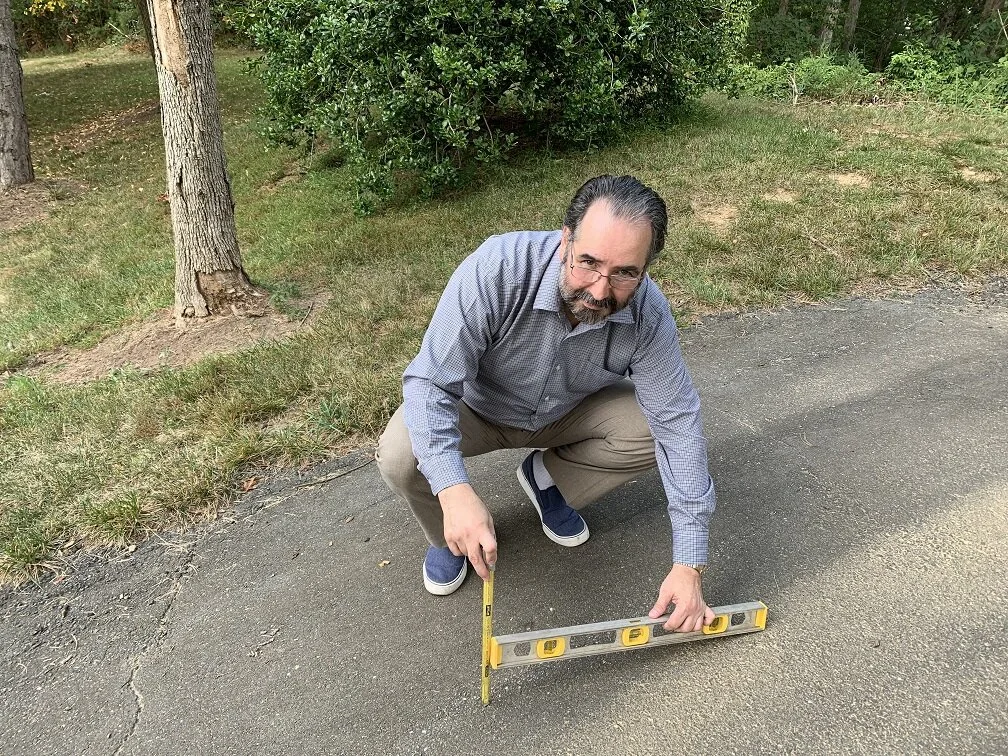
I forwarded suggestions for improvements, whether for future upgrades of the website itself, or to fellow reviewers on best practices for entering a review. For example; slope criteria are noted, but it’s not always an easy task to measure, especially if a trail has a lot of vertical variability. Reviewers can’t be expected to conduct an engineer’s transit measurement on every trail slope encountered. At first I attempted to measure the slope with the greatest incline. I used a simple astrolabe I owned to get a quick estimate for the degrees of inclination. However, it was even easier to take a photograph and post it so a reader could decide whether such inclines posed a challenge to their body strength or wheelchair. The photograph section of the survey template acted as a useful place to add information that words alone could not describe accurately. I also noted other ideas by including comments, such as whether a trail is accessible through public transportation.

Steve measuring slope
While most people might associate ADA with people using wheel chairs, the ADA also covers conditions due to deafness, blindness, diabetes, cancer, epilepsy, intellectual disabilities, missing limbs, autism, and other medical conditions.
The accessibility guidelines apply to those trails that are designed and constructed for pedestrian use. These guidelines are not applicable to trails primarily designed and constructed for recreational use by equestrians, mountain bicyclists, snowmobile users, or off-highway vehicle users. Regulations also recognize the existence of constraints and limitations in the outdoor environment and allow for certain other exceptions.
I do many of my reviews in my town of Reston, Virginia. Reston was founded in 1964 as a planned community. Today it has 60,000 residents, over 55 miles of walking paths, about 250 acres of woodlands and open space, 4 lakes, and a tree canopy covering about half of its total area. There is a high degree of accessibility, and there are many birds along the paths and lakes. Birdability offers the chance to get to know your community and what it has to offer. The Birdability map notes the locations where people have submitted reviews. It is constantly growing with submissions.

Steve with Astrolabe
If you are seeking a good experience with exercise and learning, Birdability mapping may be the one for you. Visit the website and view the Birdability map, where you can read what others wrote, as well as submit your own trail review. Whether it is a simple trail review, or a more thoughtful one that attempts to identify the variety of birds and their habits through the seasons, it’s worth a try.

October 2021 Bird of the Month
Seeing a Northern Harrier flying over the Reston Library during fall migration was quite a surprise, especially since there isn’t any spacious grasslands or wetlands nearby. But there is no doubt in my mind that what flew over the library, was a harrier. So, this harrier was likely just passing through.
Photo: Northern Harrier, Gary Zeng/Audubon Photography Awards
Is that an Owl Flying Low Across the Grasslands?
Jessica Bigger
While living in Humboldt County, CA, I would see Northern Harriers (Circus hudsonius) flying low with their “V” shaped wing formation hunting in the Arcata Bottom on a regular basis. Harriers were a common sight there. The Arcata Bottom, with its open grasslands as far as the eye can see, is prime habitat for the Northern Harrier, and other hawks and falcons. They were easy to identify by their obvious white rump and black-tipped wings.
So, seeing a Northern Harrier flying over the Reston Library during fall migration was quite a surprise, especially since there isn’t any spacious grasslands or wetlands nearby. But there is no doubt in my mind that what flew over the library, was a harrier. So, this harrier was likely just passing through.
Northern Harriers spend their breeding season throughout the Canadian provinces and winter throughout most of the United States, Mexico, and a small portion of Central America. Harriers spend their winters foraging in habitats like deserts, coastal sand dunes, farmlands, grass lands, floodplains, marshes, and estuaries.

Northern Harrier Female, Timothy Shore/Audubon Photography Awards
Hawks and raptors have keen eyesight to zero in on their prey, but the harrier relies more on its hearing than its sight when hunting. Their disc-shaped face – similar to an owl – enables them to use their hearing to locate prey. Harriers usually eat small birds and mammals, but they will occasionally hunt larger prey, like waterfowl and rabbits. Since larger animals are impossible to grab, harriers will attempt to drown them.
Northern Harriers have been found flying around the September 11, 2001 Memorial of Flight 93, in Stoystown, PA, which has been transformed into an ecological hotspot for many birds, as the area surrounding the crash site has transitioned into grassland. “There are now family members who say the most important part of the site to me is that all this nature came back, and it’s very healing to see that,” said John Reynolds during an interview with WESA-FM.
As far as conservation goes, Northern Harriers are currently of low concern, but there are states where this bird has been listed as endangered like in northern New Hampshire. Currently Chris Martin, a biologist with the New Hampshire Audubon Society, has been conducting monitoring surveys of Northern Harriers during the breeding season since 2019. Last year in 2020 Martin and his team identified ten breeding pairs that successfully raised nine fledglings. After reaching out to Martin for this year’s monitoring results, he informed me that unfortunately they had fewer successful breeding pairs than last year. They only counted six breeding pairs and 3 fledglings. When I asked Martin in an email what might be the cause for the decline he said, “I suspect several factors involved, including wet weather late (in the season) and reduced early-season survey effort.”

Northern Harrier Male, Gary Zeng/Audubon Photography Awards
Climate Change will continue to have a negative effect on the population. As the planet’s temperature increases, the Northern Harrier’s range will continue to push further north into Northern Canada, with estimated range loss of 39% in northern midwestern range, western habitats of the United States, and portions of Canada. Climate Change threatens the Northern Harrier population as it does all bird species. Wildfires will reduce habitat and heat waves will harm nestlings during breeding season, according to the National Audubon Society.
Sources:
https://www.allaboutbirds.org/guide/Northern_Harrier/overview

Invitation to Celebrate Trees!
This fall is for celebrating trees as well as planting them. Plant NoVa Natives is launching a PLANT NOVA TREES campaign that will continue for five years, according to Margaret Fisher, PNN’s Outreach Coordinat
Photo: Oak leaves, max1-2-3 via Pixabay

Fall is for planting trees. The lowering of temperatures and frequent rains makes it easier for trees to get established. Even after they drop their leaves, their roots continue to grow while the soil is warm, so they are able to survive, and thrive, by the time next summer’s heat and humidity and (often) drought roll around.

This fall is for celebrating trees as well as planting them. Plant NoVa Natives is launching a PLANT NOVA TREES campaign that will continue for five years, according to Margaret Fisher, PNN’s Outreach Coordinator.
The new campaign aims to make it easy for homeowners to plant native trees in their yards, in hope that as many as 100,000 or 200,000 Northern Virginians will do so. PNN has partnered with 21 garden centers to put tags identifying native trees on their stock.
The campaign is kicking off with a Celebration of Trees this fall. We hope you’ll join in, and celebrate trees by planting a tree in your own yard. Not sure which native tree species might be suitable? Request a visit here from an Audubon at Home Ambassador, who can advise on native trees and other plantings which are suitable for site conditions in your yard, and will attract and support wildlife. Or maybe you’d like to really go for it, and install a “mini-forest” in your yard—read Meghan Fellow’s excellent article here.
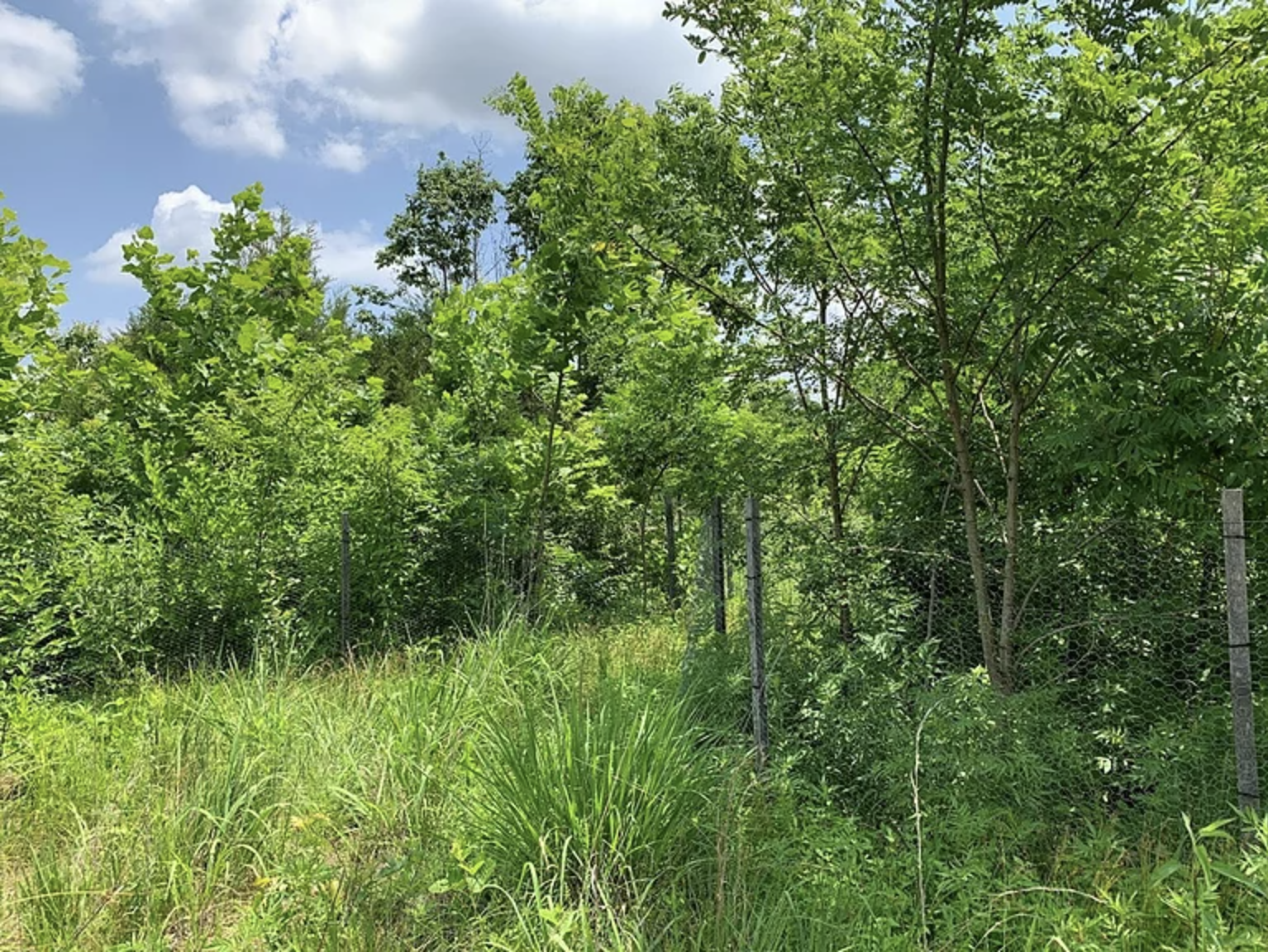
“Mini-forest,” Meghan Fellows
Plant NoVa Trees aims to inspire tree preservation as well as tree planting. It’s not enough to plant young saplings while we continue to lose so many mature trees to development, invasive vines and insects, and disease. Plant NoVa Trees will soon begin to recruit volunteer Tree Rescuers, train them, and ask them to survey the trees in their neighborhoods to catalog trees in trouble. Property owners will be provided information about how to address any problems and care for their trees. Read about this upcoming effort and sign up to get trained and volunteer here.
This fall, organizations all over our region are invited to put on Celebration of Trees events, and 90 have already answered the call—find an event near you here. Does your organization want to join in with its own Celebration of Trees event? Get ideas and sign up here. And, here are useful tips for organizing community tree plantings.

Take the Plastic Free Challenge!
350 Fairfax, a non-profit dedicated to challenging systems that lead to catastrophic climate change, is sponsoring a plastic-free, 30-day challenge from October 1 – 30. 2021.
Photo: pasja1000 via Pixabay
350 Fairfax, a non-profit dedicated to challenging systems that lead to catastrophic climate change, is sponsoring a plastic-free, 30-day challenge from October 1 – 30. 2021. Audubon Society of Northern Virginia and other organizations are co-sponsors.
Help us make our dream of a #PlasticFreeDMV possible.
From October 1 to 30, avoid single-use plastic—especially plastic bags, bottles, and straws. Join with others across NOVA to reduce your plastic footprint and protect our waterways and wildlife. Enroll today!
Fairfax County enacts a Disposable Plastic Bag Tax in Fairfax County
On September 14, 2021, the Fairfax County Board of Supervisors adopted an ordinance enacting a five-cent tax on disposable plastic bags provided by retailers in grocery stores, convenience stores and drugstores within its borders. The tax will take effect on January 1, 2022, and will be administered and enforced by the state in the same manner as the Retail Sales and Use Tax.
The purpose of the tax is to curb our collective use of disposable plastic bags, to reduce the amount of plastic waste in our local waterways and the damage it causes. Plastic pollution is a serious problem for ecological and health reasons. Plastics do not biodegrade like wood or other natural materials. Instead, plastic materials photodegrade, breaking down into smaller and smaller pieces but never fully disappearing. Pieces of plastic both large and very, very small can wreak havoc on our natural resources and can find their way into our food and water.
Revenue from this tax will be collected by the Virginia Department of Taxation and will be disbursed to Fairfax County monthly. Fairfax County’s ordinance tracks both enabling legislation passed in the 2020 session of the Virginia General Assembly , as well as guidelines adopted by the state Tax Commissioner, which were finalized on September 1, 2021. The legislation requires that the plastic bag tax be collected by the retailer at time of purchase, with revenue to be allocated toward:
Environmental cleanup programs
Pollution and litter mitigation programs
Educational programs on environmental waste reduction
Provision of reusable bags to recipients of Supplemental Nutrition Assistance Program (SNAP) or Women, Infants, and Children Program (WIC) benefits
Affected retailers will be able to retain a two-cent discount in the first year of implementation. Starting January 1, 2023, this discount will decrease to one cent.

Conservation Counts
Join Jim Waggener in his ongoing natural resource surveys at two of Northern Virginia's best birding spots.
Photo: Common Buckeye, Rusty Moran
Join Jim Waggener in his ongoing natural resource surveys at two of Northern Virginia's best birding spots. Surveys alternate between Occoquan Bay National Wildlife Refuge and Meadowood Special Recreation Management Area on Mason Neck. From April through October, surveys are conducted primarily for butterflies and dragonflies at those two locations and two others—Occoquan Regional Park and Julie J. Metz Memorial Wetlands Preserve. Participation is limited. Email us to make a reservation here. More information is available here.
Are you Interested in Managing a “Before and After Photography” Contest?
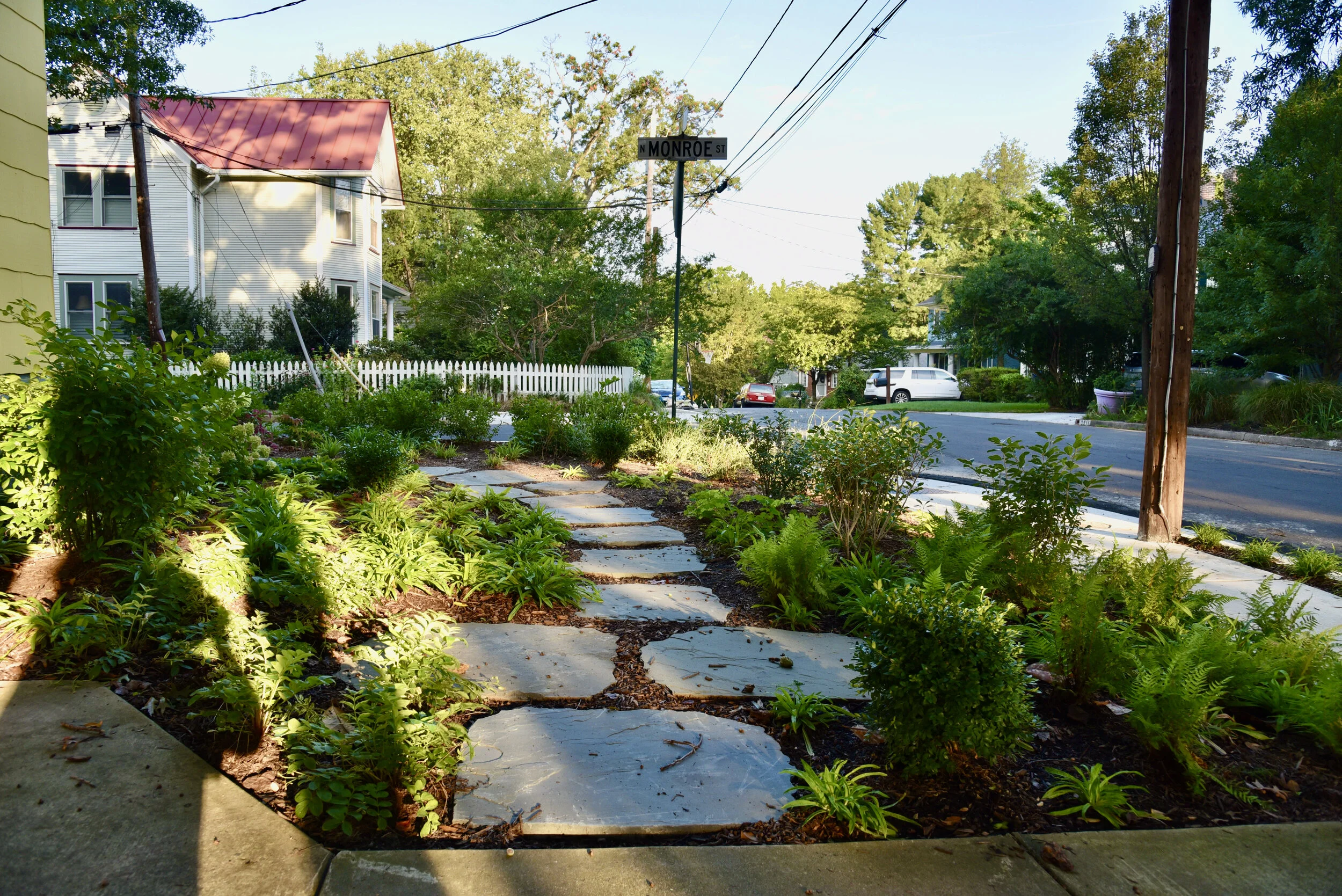
Audubon at Home is looking for a volunteer to manage a photo contest. The contest will solicit high-quality before and after photos of natural landscaping projects from Audubon at Home clients and ASNV members.
Photo: E. Harvey and A. Hoffman
Audubon at Home is looking for a volunteer to manage a photo contest. The contest will solicit high-quality before and after photos of natural landscaping projects from Audubon at Home clients and ASNV members. The volunteer would assist with the contest definition, manage the submitted photos, establish the review protocols and work with the AAH team to determine the winners. If you are interested in this opportunity, respond here.
See the following examples of Before and After photos. This landscape project was designed by Native Plant Landscape Design.

“Before” front yard, E. Harvey and A. Hoffman

“After” front yard, E. Harvey and A. Hoffman

The Making of a Passionate Birder and Nature Photographer
This year, local teen Adit Nehra’s photo of Snow Geese was one of the top 100 photos in the National Audubon Society’s annual photo contest.
Photo: Snow Geese, Adit Nehra/Audubon Photography AWards
Lisa Mackem
Eighteen-year-old Adit Nehra has always loved birds. He officially started birding in 2014. Two years later, he joined Loudoun Wildlife Conservancy bird walks around the Banshee Reeks Nature Preserve. On one walk, he saw a Scarlet Tanager in a bare tree, 30-40 feet above the group – a gorgeous red male with jet-black wings, singing away. It inspired him to continue birding. Later that year, Adit found his parents’ old camera, bought a telephoto lens, and began taking pictures of birds in his backyard and in local parks. This year, his photo of Snow Geese was one of the top 100 photos (see 86) in the National Audubon Society’s annual photo contest.
Adit focuses on birds because “birds are obvious and visible – the only animals I saw without much effort.” He joined Fred Atwood’s Teen Birding Club (co-sponsored by ASNV and Flint Hill School) in 2016 and also joined the ASNV Birdathon team, “The Scarlet Teenagers.” Because of Covid, the team couldn’t bird as one unit this year, so three groups spread out over several counties. Adit and his friend, Amiel Hopkins, birded at the Mason Neck Peninsula with a special focus on the Elizabeth Hartwell National Wildlife Refuge. They rode their bikes because they wanted a carbon neutral day with no vehicular emissions and they found 110-130 bird species. Together, all three groups of Scarlet Teenagers found a total of 150 species – a higher total than usual, says Adit.
Adit’s favorite place to bird is the Bharatpur Bird Sanctuary in Rajathastan, India. He explored it in 2014 with his family, which has ancestral roots there. Locally, he enjoys Frying Pan Farm Park. “For the entire time I’ve considered myself a serious birder, I’d bike over before or after school almost every day,” says Adit. “The diversity of habitat is amazing. Some fields are fallow, there are wetlands, small ponds, forests. You can’t find that diversity in many places in Fairfax.”
Learning about birds individually and as a species helps Adit’s photography. “The camera plays a big part in how your photos turn out, but the photographer is the driving force behind a photo,” he says. Adit’s favorite birds are Barred Owls. He found a Barred Owl nest and watched these owls for three years. He learned when the owlets would fledge and photographed the adults feeding them. He also learned about Barred Owl prey and then knew where they would hunt. He even saw them fish – “just like eagles,” he says, “not something Barred Owls are known for.” He admires these owls for their ability to adapt to suburban life, taking advantage of development for their own benefit. “Getting to know an individual bird is very rewarding.”
In 8th grade, Adit read the Sibley Guide to Birds for hours every night. Now, he appreciates the variety of apps available for bird identification, but he recommends against over-reliance on technology. Adit likes regional field guides and checklists such as ASNV’s Checklist for Birds of Northern Virginia, which he considers a go-to resource.
Adit will attend the University of Miami. He will study biology with a focus on conservation and ecology, including elements of birding and photography. In addition to birding, he loves being outside, photographing all wildlife, biking, hiking, and rowing his boat around the Potomac.

Barred Owlet, Adit Nehra

Belize and Guatemala | Neotropical Birds and Mayan Ruins
Audubon Society of Northern Virginia invites you for an international birding opportunity in Belize and Guatemala.
Photo: Tikal, Rodrigo Campos
January 12, 2022 – January 19, 2022
Registration due: October 29
Audubon Society of Northern Virginia invites you for an international birding opportunity in Belize and Guatemala. Participants will be seeking out resident and migratory birds as well as other wildlife in this culturally rich area. Click here for additional information on the trip itinerary, pricing, travel info and other resources. If you have questions, contact Gerry Abbott.

Boat-billed Heron, Bernard Dupont

Conservation Grants 2021
There can never be enough habitat for birds, wildlife, and pollinators in Northern Virginia! Thus, the Conservation Committee of ASNV administers grants to support native plant gardens throughout the region
Photo: Maggie Starbard
There can never be enough habitat for birds, wildlife, and pollinators in Northern Virginia! Thus, the Conservation Committee of ASNV administers grants to support native plant gardens throughout the region.
This year we have awarded 14 conservation grants, including one at Jamestown Park and one at Upton Hill Regional Park, both in Arlington, one at Haymarket Gainesville Library in Prince William County, and one at Lake Accotink Park in Fairfax County. The other 10 are for schools throughout Northern Virginia, including Alexandria, Arlington, Fairfax, and Prince William.
Removing invasive plants and installing natives in their place will improve foraging and cover for birds, insects, and other wildlife at Upton Hill Regional Park. Upton Hill consists of 26 contiguous acres spanning Arlington County and Fairfax County. It is a natural oasis in a very urban corridor located in the midst of single-family housing, multi-family housing, an assisted living facility, and the Seven Corners shopping area.
Upton Hill’s steep geological formation results in numerous seeps, springs, and rivulets that feed Reeve’s Creek, a tributary of Four Mile Run and the Potomac River. According to a 2007 report, the naturally occurring waters at Upton Hill are among the cleanest in all of Arlington. This native habitat supports the only Fan Clubmoss (Lycopodium digitatum) that grows in Arlington. However, this and other rare or significant plants have been impacted by the spread of English Ivy, Five-leaved Akebia, Bush Honeysuckle, Multiflora Rose, Linden Viburnum, and Japanese Holly, among other invasive species. Nevertheless, Upton Hill is a birding hotspot on eBird, hosting many migratory warblers, woodpeckers, Eastern Towhees, Ruby-crowned Kinglets, and many other species of birds.
The Jamestown Park project involves converting several acres of sod into a wildflower meadow. The park is located next to Jamestown Elementary School. It consists of a long turf grass field (50 by 200 yards) connected to about 5-6 acres of woods. A large portion of the sod area is perpetually soggy. Within living memory there was a creek that ran down the length of the field, but the County buried the stream except for about a 40-foot section. The reclamation plan is to daylight the creek, remove the sod, and create in its place a meadow area populated by native sedges, wildflowers, shrubs, and understory trees that would be especially well suited to our local pollinators and be low to no-maintenance.
The Haymarket Gainesville Library native plant garden for pollinators is meant to reinvigorate the return of birds, bees, and butterflies to the Piedmont region. They have already planted native trees. The next step is to plant native shrubs that provide berries for birds and masses of flowers such as yarrow, coneflower, and others to attract pollinators. Finally, benches and boulders will be placed in the area to provide seating for library visitors.
At Lake Accotink Park, a major problem is deer browse, so we will pay for wire fencing to protect native plants from the deer.
The other 10 projects all involve small native plant gardens at local schools. We include seven public elementary schools, one public middle school, and two private schools. We will provide an update on the school projects in a future newsletter.

Moth Field Trip
Judy Gallagher briefly recaps a magical summer evening surveying moths and other nocturnal creatures at Meadowood Special Recreation Management Area Pollinator Garden during Moth Week.
Photo: Tulip Tree Beauty, Judy Gallagher
Judy Gallagher
I always enjoy being in the field, but it is a rare privilege to be in the field at night. On July 31 we set up a black light at the Meadowood Special Recreation Management Area (SRMA) Pollinator Garden to celebrate Moth Week, and 14 of us spent several hours experiencing nature at its best. We saw 19 moth species including this Tulip Tree Beauty male with his gorgeous feathery antennae. But moths weren't the only stars of the show. Coyotes howled and yipped in the distance. A Barred Owl hooted softly. And there were bats. We hope you have the opportunity to come on a night outing with us in the future.

Moth Week Resources
Judy Gallagher hosted an excellent workshop and field trip on moths. Here are some resources from her presentation.
Photo: Io Moth, Judy Gallagher
Judy Gallagher hosted an excellent workshop and field trip on moths. Here are some resources from her presentation.
The video of Judy’s workshop on July 29, 2021 can be accessed on our Vimeo channel.
To see more of Judy's amazing photographs, visit her site on Flickr.
Here are a few online resources from Judy:
Discover Life - You can specify characteristics like month in which you see the moth, forewing color, etc. and a list of moths that meet your search criteria will be returned.
Bug Guide - You can submit a picture with details about where and when you saw the moth (or any other North American insect) and it will be ID'd by experts.
iNaturalist - This is for all living organisms. You submit a photograph of the species, either through the app on your phone, or using a picture from your computer. iNaturalist has Artificial Intelligence that can help narrow down your choices.
Moth Photographers Group - This is the most comprehensive resource for American moths, but is challenging to use for the novice.
Butterflies and Moths of North America (BAMONA)- This has pictures and descriptions of moths and butterflies, and you can submit pictures for ID, and also document occurrences.
NOTE: it is not always possible to ID a moth from a photograph.
Texts Judy recommends:
Moths: A Complete Guide to Biology & Behavior
Peterson Field Guide to Moths of Northeastern North America
Peterson Field Guide to Moths of Southeastern North America
Caterpillars of Eastern North America: A Guide to Identification and Natural History

Wintering Waterbirds Program with Friends of Dyke Marsh
Join the friends of Dyke Marsh (FODM) on October 20th at 7:00 PM on Zoom for Greg Butcher’s presentation on wintering waterbirds. Read on for more information!
Photo: Great Blue Heron, Mary-Catherine Miguez/Audubon Photography Awards
Join the friends of Dyke Marsh (FODM) on October 20th at 7:00 PM on Zoom for Greg Butcher’s presentation on wintering waterbirds. Mr. Butcher will introduce the diversity of waterbirds that spend the winter in Northern Virginia and explain the difference between waterbirds and waterfowl. He will also review citizen science studies and conservation needs for birds and people along the Potomac River.

Greg Butcher
Greg Butcher is Vice President of ASNV and Migratory Species Coordinator for the U.S. Forest Service’s International Programs.
Click here to view the event flyer and register for this event!
Plant NOVA Trees Launched!
Plant NoVA Trees is live! Check out this brand new initiative from Plant NOVA Natives to encourage planting more native trees.
ASNV is proud to announce the launch of Plant NOVA Trees, a five year, collaborative effort with Plant NOVA Natives and other local conservation organizations to encourage residents and businesses across Northern Virginia to plant more native trees and preserve the ones we have already. Read more about this important initiative here.