
NVBA NEWS BLOG
Welcome to the blog for Northern Virginia Bird Alliance, a wealth of resources about northern Virginia birds, wildlife, habitat conservation and restoration, native plants, wildlife-friendly gardening, advocacy and more.

Native Groundcovers and Trees: The perfect pairing!
Native groundcovers are becoming increasingly popular, for good reason: even if they have minimal time for gardening, people want to use native plants to support our local birds and butterflies.
Photo: Native groundcovers, Margaret Fisher
Plant NoVA Natives
Native groundcovers are becoming increasingly popular, for good reason: even if they have minimal time for gardening, people want to use native plants to support our local birds and butterflies. To avoid invasive non-native groundcovers such as English Ivy, Vinca, Yellow Archangel, and Japanese Pachysandra, they turn to native plants for the same landscaping benefits without the damage to our trees and the rest of the environment.
Equally popular among time-pressed residents are native trees, which are similarly easy to install and which have benefits that far exceed those of any other plants. Not only does the great mass of tree leaves and roots provide food and homes for birds, soak up stormwater, and cool the air, the insects that evolved with native plants are adapted to the chemical make-up of those plants and are able to co-exist peacefully with them. An American Beech tree, for example, is the host plant to 126 species of lepidoptera (butterflies and moths), Hickory to 200 species, Black Cherry around 450 species, and native oaks over 500 species. (The numbers for non-native trees are in the single digits or even zero.)
Over 30 species of locally native plants make excellent groundcovers, with options available for any growing condition. Several are evergreen, and many have the bonus of a month or two of colorful flowers. Some form a tight mat on the ground, while others such as ferns and White Wood Aster provide a taller look. Native sedges provide even more options. Some sedges make a beautiful substitute for the invasive Liriope, some look more like a grass that never needs mowing, and still others sport spiky seed heads that add a touch of quirkiness to the garden. Our local conventional garden centers are starting to carry some of these plants, and many more can be found at native plant garden centers.
Encircling native trees with native groundcovers makes eminent sense. Turf grass does poorly under trees because of the limited light. Trees do not appreciate lawn chemicals, not to mention the risk of injury from lawnmowers and string trimmers. A harmful but common practice, especially in commercial areas, is to pile layer after layer of mulch in a “mulch volcano” around trees and spray it with herbicides to prevent grass and weed growth. Not only does this poison the soil, but mulch that is touching the trunk will rot the bark, and compacted mulch prevents rainwater from reaching the roots. Arborist wood chips, which allow the water to run through, are an improvement over shredded bark mulch if applied properly and can protect the tree as it gets established. But in the long run, why not use nature’s alternative to a toxic mulch bed, which is to allow the fallen leaves to remain in place and add a “green mulch” made up of native plants? The trees and the soil will thank you for it.

Observations from Meadowood: June 2022
Judy Gallagher continues to survey Meadowood Recreation Area. Here are some findings from her most recent survey.
Photo: Melanactes species Click Beetle, Judy Gallagher
Judy Gallagher is an ASNV board member and a regular surveyor of local wildlife who also captures photos of what she sees, in particular the less common species. Here are some observations from her most recent survey.

Melanactes species Click Beetle, Judy Gallagher
When I was a young girl, boys liked to try to scare me by showing me snakes or insects. Click beetles were one of their favorite subjects. The boy would open his hand and the upside down click beetle would snap its spinelike structure into a groove on the underside of the thorax and flip into the air. I would shriek with surprise and then with delight as the boy recaptured the poor beetle and made it do it again.
I didn't know it at the time, but this is an amazing defense mechanism. It startles predators and helps the click beetle escape, and also gets the beetle on its feet again. The audible "click" when this happens is why this family of beetles is called click beetles.

Click Beetle Larva, Judy Gallagher
Like all beetles, click beetles start as eggs, hatch into larvae that resemble worms, pupate, and then become adult beetles. The larvae, sometimes called wireworms, can live for as long as four years before becoming adults. They live in soil or rotten wood or under bark. Some larvae are pests, feeding on corn, potatoes or grain. They locate food by following carbon dioxide trails that are created by plant material in the soil. Other species' larvae help control insects by preying on their larvae. Some are fungi specialists.

Neopristilophus aethiops, Judy Gallagher
There are almost 1000 named species of click beetles in North America. Most of our local click beetles are small and dark and can be found on vegetation, under bark or at lights at night.

Lacon discoideus, Judy Gallagher
Some click beetles are more colorful, although one would have to look closely to see that. This click beetle, Lacon discoideus, is less than 1/3 inch long.

Eyed Click Beetle, Judy Gallagher
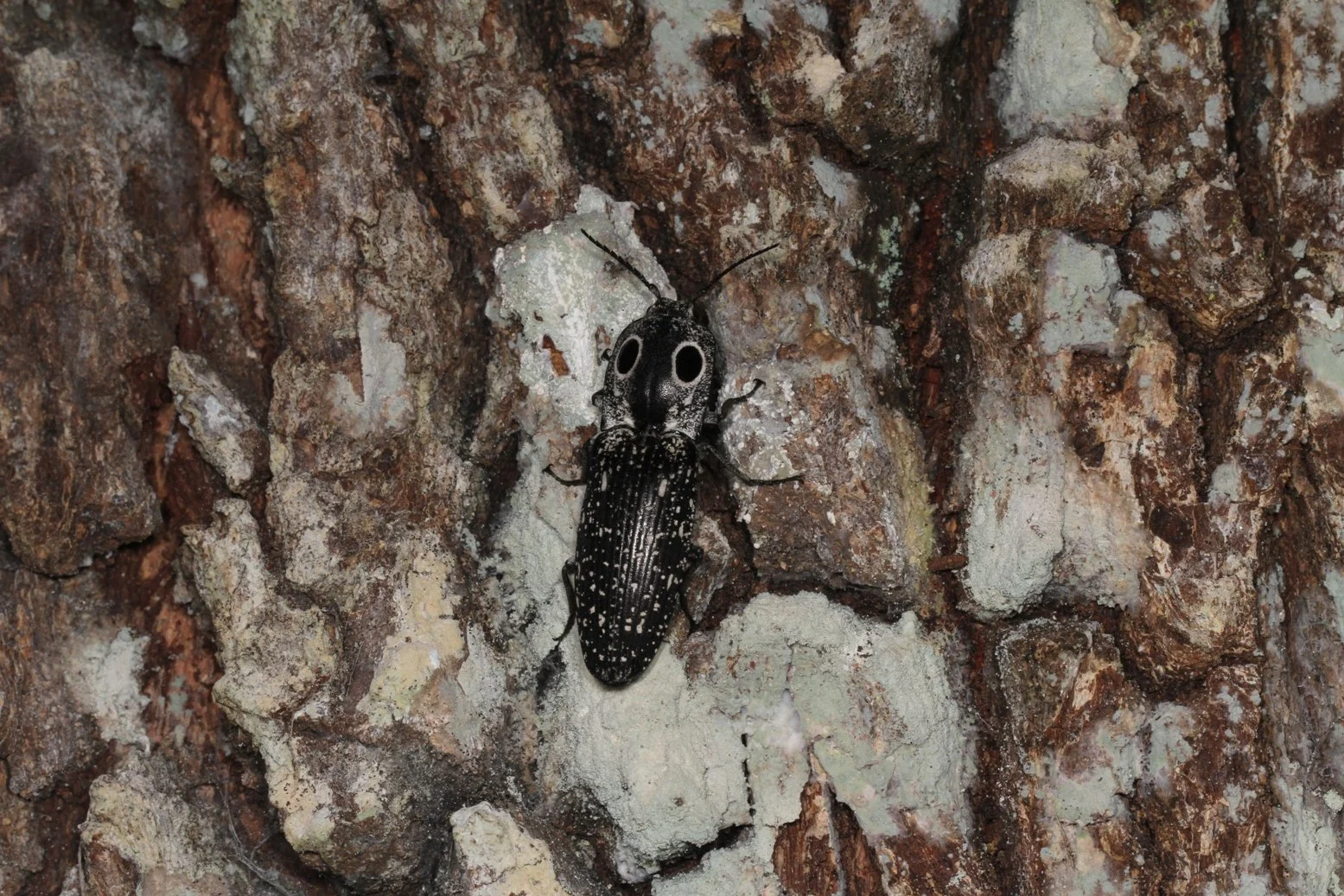
By far the most charismatic of our local click beetles is the 2 inch long Eyed Click Beetle. I usually spot them when they land on me. They're hard to miss with those striking eye markings.
Eyed Click Beetle, Judy Gallagher
But when they're on bark, they blend in pretty well despite their size. Eyed Click Beetle larvae feed on wood-boring beetle larvae, so are helpful as a biological control. Adults don't eat much at all. I hope you'll all see one of these astonishing beetles this season.
View all of Judy’s Observations from Meadowood articles here.

Monday Mystery - May 30
Monday Nature Mystery continues! Read on to learn who correctly identified our last mystery.
Photo: Hanging Thief, Bill Young
We are pleased to announce the winner of last week’s Monday Nature Mystery, Grant West!
Congratulations to Grant for correctly identifying the Hanging Thief.

Last Week's mystery: Hanging Thief. Photo: Bill Young
According to Insect Identification’s website, the Hanging Thief is a type of Robber Fly in the genus Diogmites. This carnivore eats other flying insects by hanging around until its prey flies by. It eats biting flies, dragonflies, and other flying insects. When flying, it makes a loud whirring noise by beating its wings very quickly!
Each Monday we’ll post a new mystery and identify the previous week’s winner. They’ll receive an ASNV hat or tote bag.
Here is this week’s mystery:
I’m a common butterfly but you might not recognize my ventral side! The ventral side is the underside of the wing that you see when a butterfly’s wings are closed.
Be sure to post your guess on our Facebook page under the latest Monday Nature Mystery post. Good Luck!
Please check our guidelines here.

Monday Nature Mystery: Who is this? Photo: Judy Gallagher

A Birdathon Story: The Chipperbirders
This story is about one of our youngest teams, The Chipperbirders.
Photo: Spotted Sandpiper, Maxwell Julius

Scarlet Tanager, Maxwell Julius

Yellow-throated Warbler, Maxwell Julius
This story is about one of our youngest teams, The Chipperbirders. Two brothers in high school, Maxwell and Danté Julius completed an excellent Birdathon on Mother’s Day, but these considerate young men reassured us that they celebrated the holiday the day prior with their family.
Maxwell is in 11th grade and his brother Danté is in 9th grade. They have both been birding for four years. Maxwell enjoys photographing birds and Danté often draws field sketches of the birds.
The brothers started out their big day at about 7 AM and birded until after 8 PM, seeing an incredible 85 species at four locations!
Maxwell took photos of a number of their species, such as the Spotted Sandpiper, Scarlet Tanager, and a life-bird for Maxwell – the Yellow-throated Warbler, which they saw right at the end of their day.
When they sent in their impressive list of birds, Maxwell reported that they had a great time bird watching, stating that “the variety of species we witnessed was truly amazing, and all of the birds were spectacular.” The boys went to Huntley Meadows, Gravelly Point, Monticello Park, Four-mile-run Park, and Occoquan Bay National Wildlife Refuge. We are all grateful and very proud of these talented young birders.
Please consider donating here to support their team and to celebrate their accomplishments. They are so close to reaching their fundraising goal! This team inspires us to think about the future, about what birds we will still have in Northern Virginia when these two young people are enjoying their retirement. Your support helps us protect birds and their habitats not just now but in the years to come, for the next generation of birders. Thank you.
Spotted Sandpiper, Maxwell Julius

A Birdathon Story: The Three Beaks
Our Program Administrator Louise Edsall led her team (composed of herself, her husband Bart Edsall and his caregiver, Salay Kamara) on a successful big-day outing. Louise shares her story of the team’s experience below.
Photo: Yellow Warbler, Sheen Watkins/Audubon Photography Awards
Our Program Administrator Louise Edsall led her team (composed of herself, her husband Bart Edsall and his caregiver, Salay Kamara) on a successful big-day outing. Louise shares her story of the team’s experience below.

The Three Beaks Birdathon Team!
“The three of us had a great time on this adventure. We were amazed at how many species we got just in our backyard at the feeders and nearby brush and woods where our home is located in Manassas. Our newest visitors are the Indigo Buntings, Rose-breasted Grosbeaks, Ruby-throated Hummingbirds, and Gray Catbirds. Starting this week, we’ve been seeing six male and six female catbirds at the same time. Those Indigo Buntings are just gorgeous and their songs are beautiful, too. The Red-shouldered Hawk seemed to pass just as I commented, “Now where is that hawk?” Boom, there he was! Same with the Scarlet Tanager which I found while walking down our long driveway to the mailbox. It just pays to be alert!
Our count was limited to wheelchair-accessible places because of Bart’s disability, so the Neabsco Creek Boardwalk and Trails provided a very user-friendly access to the boardwalk and paved trails. We were joined by a young mom and her three-year old son as we were leaving and the young boy tried to race Bart’s wheelchair. Bart’s energy along the walk flushed the Field Sparrow and the Baltimore Oriole. We got the female Orchard Oriole as we entered the boardwalk and the Yellow Warblers put on a show there as well. Bart was at boardwalk wall height which limited his view a bit but he was the first to spot the Osprey which had caught a fish just in front of the “No Fishing” sign. Bart also saw our first Great Blue Heron.The Red-winged Blackbirds were unusually ‘friendly’.
We had a great time outdoors despite the limitations of our access to woodland trails. The three of us had a load of fun. Migration is on full-steam!”
The Three Beaks team identified 62 species across four locations. You can donate here to help this wonderful team reach their fundraising goal of $1,500.

Support our Birdathon Teams!
Eleven teams of birders have committed to support Audubon Society of Northern Virginia’s 2022 Birdathon. Can you help by supporting one or more of our teams?
Photo: Luke Franke
A Birdathon is a competition in which teams compete to find the greatest number of species in a day to raise money for conservation. Eleven teams of birders have committed to support Audubon Society of Northern Virginia’s 2022 Birdathon. Can you help by supporting one or more of our teams? You can pledge an amount for each species found or donate a specific amount of money. Here is a link to the teams with information on how to support the teams of your choice. Thanks for helping ASNV fulfill its mission of enjoying, conserving, and restoring nature for the benefit of birds, other wildlife, and people!

Use your Birding Skills for Science
Want to bird for science? Consider participating in the Northern Virginia Bird Survey, ASNV’s long-running survey of breeding birds in our region!
Photo: Prairie Warbler, Dixie Sommers
Want to bird for science? Consider participating in the Northern Virginia Bird Survey, ASNV’s long-running survey of breeding birds in our region!
We are busy getting ready for the 2022 survey which will take place in June. We are contacting volunteers from prior surveys and recruiting additional volunteers.
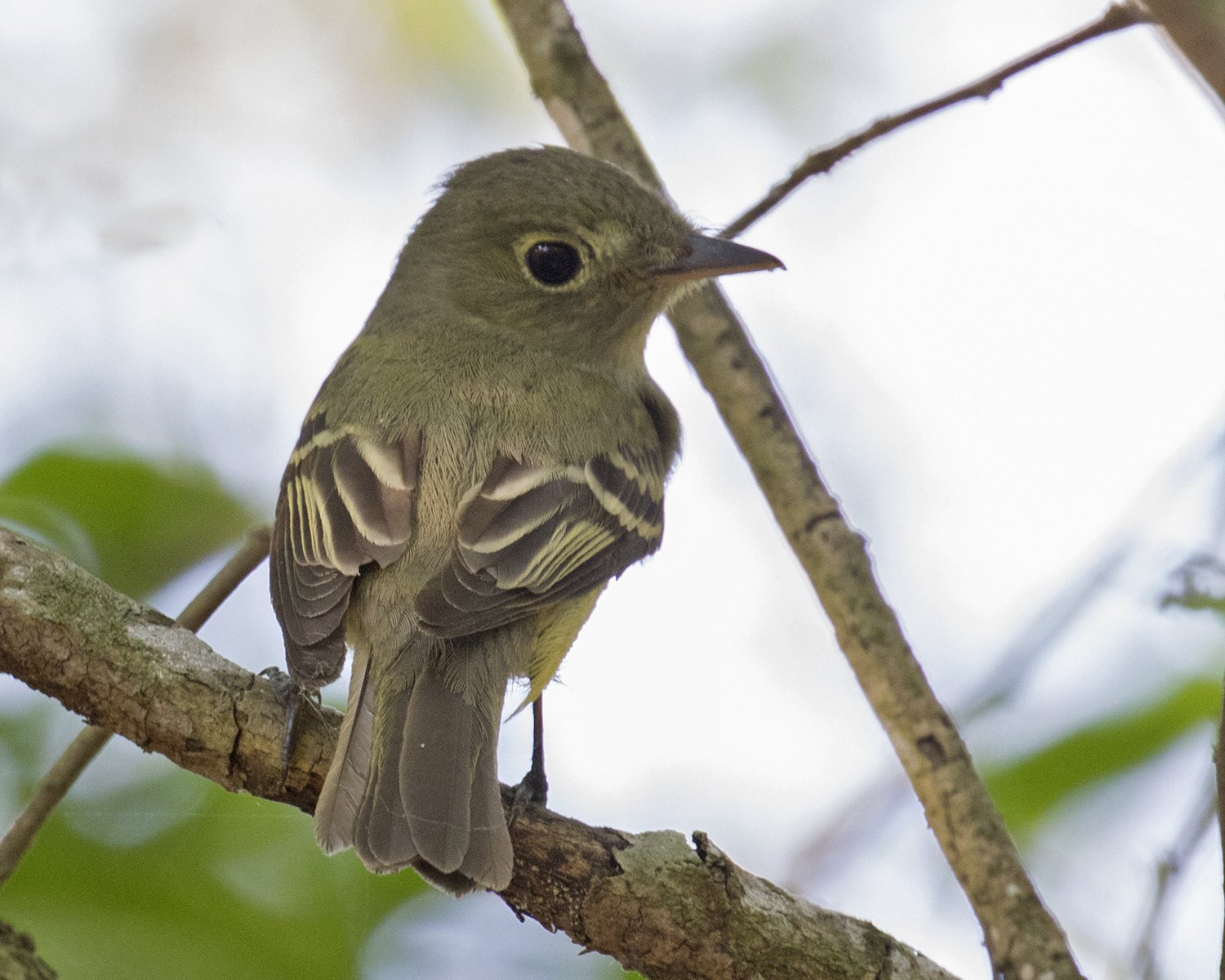
Acadian Flycatcher, Dixie Sommers
The NVBS is a point-count survey. The survey team counts all birds heard and seen during a 5-minute period at each assigned point. Because this survey relies mostly on auditory observation, we need survey participants who can recognize our common birds by sound and can hear a range of calls, including our sometimes difficult to hear species such as Cedar Waxwings. Surveyors should also be able to identify birds by sight with the use of binoculars. If you are an experienced birder and want to participate, please contact Elizabeth Krone at citizenscience@audubonva.org by May 23, 2022.
The NVBS started in 1994 and provides information on trends for breeding birds in our area. Many of these species have declined over the last 25 years, although some have fared well and others have recovered from population crashes, such as Bald Eagles and American Crows. Continuing to document these birds helps us understand the state of the birds in Northern Virginia and inform decisions about habitat protection.

Wood Thrush, Dixie Sommers

Join us in-person for our Annual Meeting and Audubon Afternoon, “A Year in the Life of an Owl”
ASNV will have its first in-person Audubon Afternoon in more than two years on June 5.
Photo: Northern Screech Owl, Randy Streufert
ASNV will have its first in-person Audubon Afternoon in more than two years on June 5.

Northern Screech Owl, Randy Streufert
Four live owls will be the stars of the show. We’ll gather informally starting at 2:30PM in the cafeteria of the National Wildlife Federation Building, 11100 Wildlife Center Drive, in Reston. At 3:00PM we’ll have a brief Annual Meeting where we will elect officers and directors. Our main program will begin at 3:15PM, when Secret Garden Birds and Bees will present “A Year in the Life of an Owl,” featuring four live owls for you to see and photograph: a Barn Owl, a Screech Owl, a Great Horned Owl, and a Barred Owl. This is an event the whole family will enjoy!
We welcome any food and drink you would like to share with everyone during the informal portion of the program.
Learn more about our Annual Meeting here.

Learning about Native Plant Communities
Plant communities are assemblages of plant species that grow in a particular habitat and interact with each other, wildlife, and the environment around them. Plant communities are a natural extension of “right plant, right place.”
Photo: New York Ironweed, Matt Bright
Audubon at Home Ambassadors held their annual Potluck Ambassadors’ Brunch at the Fairfax County Government Center on March 19—a welcome gathering, their first in two years. Thirty-two Ambassadors attended, and enjoyed a presentation on “Earth Sangha’s Native Plant Compendium, Plant Communities and Native Plant Selection” given by Matt Bright, Conservation Manager for Earth Sangha.
Plant communities are assemblages of plant species that grow in a particular habitat and interact with each other, wildlife, and the environment around them. Knowing the features of the landscape and the dominant vegetation allows us to predict what other plant species “belong” there, and provides a basis for making plant selections. Plant communities are a natural extension of “right plant, right place.”
New York Ironweed, Matt Bright
A plant community is simply the native plants that tend to grow together in any given habitat. So, for example, different plant communities are found on a steep dry slope, or in the floodplain near a stream, or in an open area. Often the assemblage of plants present is governed by topography.
Conserving and restoring plant communities allows us to protect plants and wildlife in ways that mirror natural environments. Restoring common, dominant native plants that are the ecosystem drivers can create ecological uplift—the drivers will create the conditions that bring along rarer, passenger species that need those conditions to thrive and reproduce.
Plant communities can also help guide choices not only about what to plant, but how much. For example, a floodplain forest often has a dense herbaceous layer, while a mesic to dry forest understory is often sparse, with large areas of leaf litter. The density that occurs in nature may not match gardening conventions, such as planting a single specimen surrounded by 18” of mulch. Planting for succession will create a multilayered understory, with varying age classes of mature canopy trees and young saplings.
Plant communities can provide far greater benefit over the complete life cycle of wildlife species than focusing narrowly on a single species. For example, many people have learned that milkweeds are essential for Monarch caterpillars. While they are necessary, Milkweeds are not sufficient. They are actually relatively poor insect hosts: Goldenrods are much more important late-season nectar sources for migrating Monarch butterflies, and as hosts for specialist bees. A diversity of species within a plant community supports a greater diversity of wildlife.
Matt Bright stressed that ecological value is in the details. An example is leaf litter, which provides essential habitat to many species. He cited results from a recent study that shows large declines—by a shocking two-thirds—in lepidoptera populations when leaf litter is removed. This confirms Audubon Ambassadors’ advice to their clients to “leave the leaves!”
Reconnecting areas has tremendous ecological value. Matt cited results from an 18-year experiment showing that creating even narrow corridors between areas of habitat resulted in fewer extinctions, faster recolonization by native plants, and 14% greater biodiversity in connected sites than in isolated ones.
Matt provided good, practical (and work-saving) advice for prospective native gardeners and restorationists:
Focus on dominant species that will create conditions to create ecological uplift. For a first round of planting, he suggests sticking to common, generalist species, which have more “right places” and are more frequently the right plant that will establish more quickly. Generalist plants often support specialist wildlife.
Leave healthy areas of intact habitat alone. Remove invasives, and before replanting wait to see what regenerates from the seed bank. Volunteer plants are free, and can guide you towards what to plant in the future.
Although plant communities may seem daunting, Matt argued they are actually less work than picking and choosing plants individually. He provided several sources of guidance:
Earth Sangha Native Plant Compendium: You will learn a lot about native plant communities from this text-heavy website, which provides useful advice on high-value generalist canopy trees, understory trees and shrubs, and plants for wet and dry meadows.
Plant NOVA Natives Natural Plant Communities made easy is perhaps the most comprehensible site, which offers practical advice and will help you understand the concept of plant communities.
Natural Ecological Communities of Northern Virginia, by Glenn Tobin—this site is more oriented to the quantitative user. Tobin has begun developing a scheme to help identify plant communities.
Department of Conservation and Recreation, Natural Heritage Program—this site provides descriptions of each of the natural communities of Virginia, as well as its key plant species. Very data rich. Definitive and technical.
Nature Serve Explorer—this site uses different common names for the communities than the DCR site.

Invasive Plants Bill Became Law
Under a new law, the General Assembly has directed the Virginia Department of Agriculture and Consumer Services (VDACS) to prepare a brochure that explains the value of native plants and the harm from noxious weeds and other invasive plants.
Photo: Ivy-smothered tree, Glenda Booth
Under a new law, the General Assembly has directed the Virginia Department of Agriculture and Consumer Services (VDACS) to prepare a brochure that explains the value of native plants and the harm from noxious weeds and other invasive plants. The brochure is for use by retail establishments that sell plants. The new law also requires the Department to post information on how to get more information about noxious weeds and invasive plants on its website and to work with “industry stakeholders” to promote distribution of the brochure.

Invasive Porcelain Berry Vine, Glenda Booth
The bill the General Assembly passed evolved from a bill introduced by Delegate Paul Krizek, HB 314, which required VDACS to develop a model sign for retail vendors that explains the value of native plants and the harm of invasive plants and a model label that could be used for the sale of plants. The House of Delegates approved a substitute bill on a 99 to zero vote and the Senate, on a 39 to zero vote. Governor Glenn Youngkin signed it into law.
ASNV participated in a workgroup last year created by the General Assembly to prepare legislative recommendations to “reduce, mitigate and eliminate the continued sale and use of invasive species” that the Department of Conservation and Recreation (DCR) identifies as invasive. The workgroup’s report made very few recommendations. Delegate David Bulova, the author of the bill that created the workgroup, introduced several bills this past session addressing invasive plants, but none of them advanced.
Proponents of the bills made several arguments. Having information at the point of sale is critical to educating consumers and to encouraging the purchase of native plants and avoidance of invasive plants. Many retail employees are not knowledgeable about native and invasive plants and thus provide limited guidance to consumers. VDACS has experience with educating the buying public as the administrator of the Virginia’s Finest program, which promotes Virginia food and beverage products.
The key to halting the spread of invasive plants, according to Chris Ludwig, former Chief Biologist, DCR Natural Heritage Division, is to (1) prevent the introduction of invasive plants and (2) control those that are here.
Although the workgroup’s report and the failure of several other bills are disappointing, at least Delegate Krizek’s bill became law. ASNVers should thank Delegates Krizek and Bulova for their efforts.

Join the Fun this Spring and Summer and Monitor Breeding Birds with NestWatch
With the season of baby birds now here, it is important for ornithologists to collect data on nest construction, successful nestling development, and overall care from adults. To do this, nest boxes must be constructed and mounted properly.
Photo: Purple Martin Nestlings, Deidra Bryant
Deidra Bryant
With the season of baby birds now here, it is important for ornithologists to collect data on nest construction, successful nestling development, and overall care from adults. To do this, nest boxes must be constructed and mounted properly. If scientists are reusing a nest box from the previous season, the box needs to be cleaned out so birds can have a nice place to call home. You can build and set up nest boxes at your residence too and casually watch as birds fly in and out. However, you can also take a more involved and scientific approach to observing and understanding the reproductive biology of native birds nationwide via the Cornell Lab of Ornithology NestWatch program.
Purple Martin nestlings, Deidra Bryant
NestWatch is an interactive online program that allows you to view tips on how to build and install your own nest box, and upload your personal nest monitoring metrics to an archived database that aids in bird conservation. You can also read blog posts, annual reports from previous years (NestWatch Digest), and scientific publications regarding nesting ecology and breeding bird populations. You will have to make a free account with Cornell Lab to get the full experience though. Viewing the website is possible on multiple devices (via tablet, personal computer, smartphone) but I find that using a tablet or PC works best since the images and infographics are much larger and the text is easier to read. There are also some helpful documents that you may want to download and print from your personal computer like the Nest Check Data Sheet for when you’re in the field and don’t want to bring your electronics outside.

Deidra Bryant monitoring Purple Martin nests
Getting started is very easy. When you open the webpage you will immediately see “How To Participate.” Although it’s tempting to just select a bird on the homepage and initiate a nest plan, the first and most important step is to read the Code of Conduct and take the short quiz to get certified. The test is a safety measure used to minimize risk of accidentally damaging the nest, causing parental desertion, and attracting predators to the nest. The test also communicates planning tips so you know what to expect and how to quickly, accurately, and safely record useful data.
So, you have your nest box(es) set up in the proper manner using the provided species specific structure plans, followed tips on how to deter predators, and placed it/them in its respective habitat…what do you do now? You wait. You monitor your nest every 3-4 days and wait for someone to safely lay their eggs in the shelter you made for them. Use this time to familiarize yourself with how to enter data online using the multiple data entry tutorial videos from the LEARN tab on the website. If you’re lucky and get a resident, make sure you remember the Code of Conduct and keep your paper records safe from damage such as water stains, page tears, bird excrement, etc. Those notes need to be digitized after each visit or after a nesting attempt is complete. In graduate school I surveyed over 300 Purple Martin (Progne subis) nests in at least 10 sites in South Central Pennsylvania. I had several paper datasheets similar to the one used in NestWatch for every site and used them to excruciatingly transfer numerous results to an Excel spreadsheet.
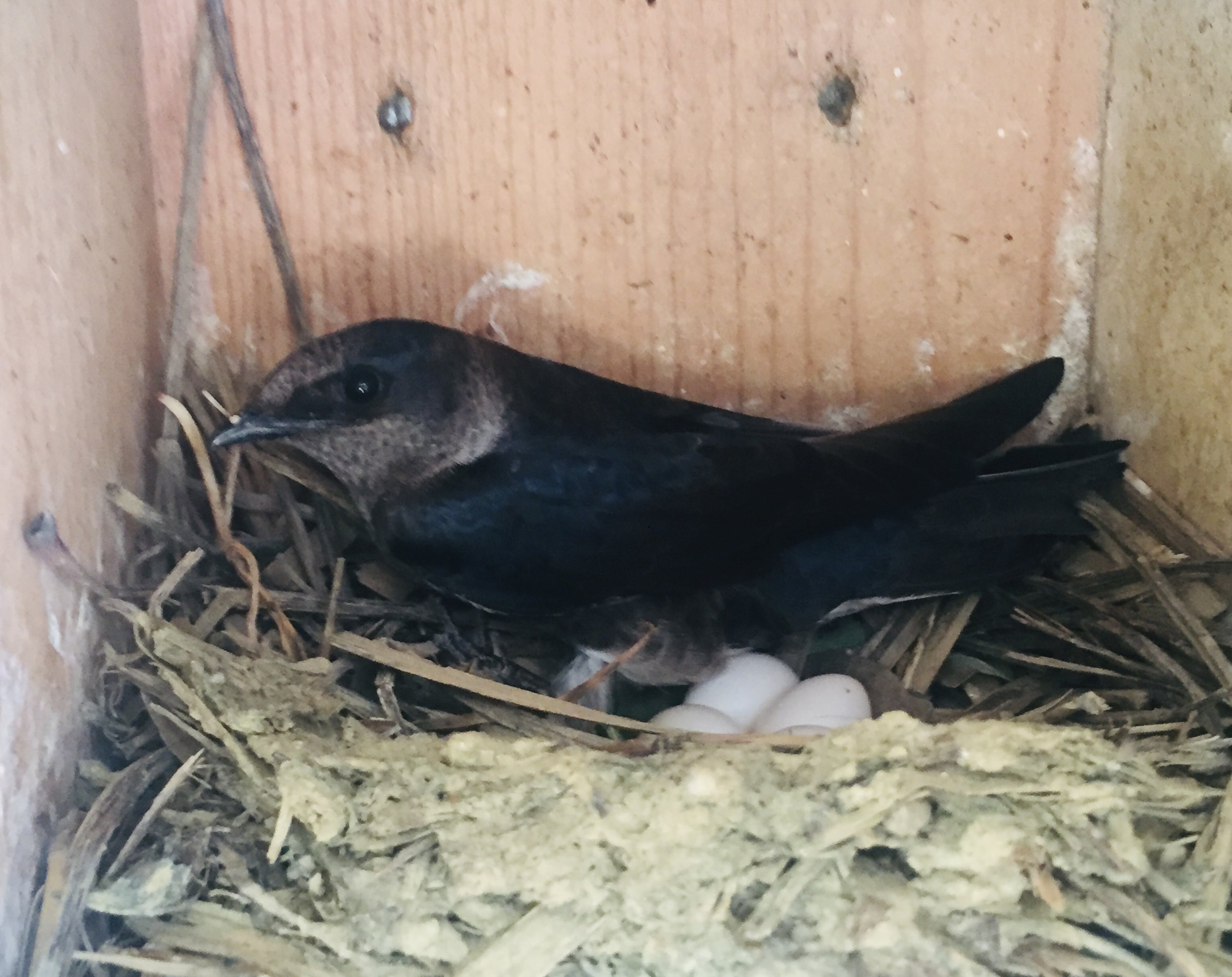
Purple Martin on nest, Deidra Bryant
As I write about Cornell University’s NestWatch program I think of the kind Amish families I met when I monitored their martin birdhouses for research. Young children and their parents would come outside and tell me what other interesting birds they saw flying around, and sometimes their neighbors would join in and observe if I brought my drone to geofence the site. One empty nester (no pun intended) would always ask me to sit with her on her porch and chat about gardening tips and her engaged sons while we watched the martins fly in and out of their nest gourds with bees in their beaks. One family had binders with laminated data sheets that were over a decade old! I also remember how I’d often come home with gifted bags of fruit and veggies from their orchard and/or farm when it was time to leave. It was such a wonderful experience with so many people and I’ll never forget it. Although we currently live in an age where our community often communicates through a screen, I think where NestWatch succeeds is employing citizen science to not only bring us together to achieve something bigger than ourselves individually, but also to step outside and talk to friends and neighbors about how nest monitoring can be a memorable experience.

Do You Have Room for a Shade Tree?
If your yard sits in the blazing sun in the summer, it may have already occurred to you that a native shade tree would benefit you tremendously. But even if your yard is already graced by one or more mature trees, you should give some serious thought as to whether it is time to start the next generation.
Photo: Margaret Fisher
Plant NoVA Natives
Mt. Vernon Tulip Poplar, Margaret Fisher
If your yard sits in the blazing sun in the summer, it may have already occurred to you that a native shade tree would benefit you tremendously. But even if your yard is already graced by one or more mature trees, you should give some serious thought as to whether it is time to start the next generation. Trees in natural areas can live many hundreds of years, but urban and suburban conditions present stresses that may cause premature decline, a problem that can be seen in many of our older neighborhoods. If you wait until a tree dies, it will be a long time before a seedling can grow to full size. Very likely, the time to plant a replacement is now.
There is an unfortunate tendency to replace tall canopy trees with short ornamentals. This does a disservice to the people who will come after us and who will have to contend with even hotter summers and more torrential downpours than we have now. The larger a tree’s canopy, the more benefits it provides in terms of cooling the environment and controlling stormwater, not to mention sequestering carbon, sheltering birds and other critters, and providing food for the caterpillars that are needed to feed baby birds (which only native trees support in noticeable quantities.)
Shorter native trees and shrubs are appropriate for many situations, such as under a power line or in a small yard. There are specific recommendations on the Plant NOVA Trees website about how far from obstacles to plant your trees and how large a soil area to allow. The roots of trees can overlap, though, so you can plant them as close as fifteen feet apart and within five feet of shrubs.
Trees produce shade, but most canopy trees cannot grow in the shade. (The understory is the space where shorter native trees such as Flowering Dogwood and Redbuds thrive.) It is easy to overestimate the available sun. The number of hours of direct sun per day should be measured when the nearby trees have already leafed out. Good choices for planting under existing shade trees include oaks, American Holly and Black Gum, which will grow slowly but steadily in those conditions then rapidly take off if the overstory lightens up in the future. Native oaks hold the place of honor as the most valuable of trees – the reasons for this are outlined in Doug Tallamy’s most recent book The Nature of Oaks – but any native tree provides major ecological benefits.
There is deep gratification to be had from planting and nurturing a little native tree, even if we ourselves may not be around later to sit under it. How fortunate that George Washington had the foresight to plant the pictured Tulip Poplar that thrives at Mount Vernon today! It is a simple act, easily accomplished. To find out how easily, see the Plant NOVA Trees website.

ASNV is Looking for New Board Members
Would you like to help Audubon Society of Northern Virginia? We’re looking for candidates to join our Board of Directors.
Photo: American Robins, Dennis Atwell/Audubon Photography Awards
Would you like to help Audubon Society of Northern Virginia? We’re looking for candidates to join our Board of Directors. Board members help to ensure that ASNV fulfills its mission through oversight of the organization’s activities. They also help manage ASNV’s wide variety of activities through our committees. As a Board member you can:
Expand the scope of our activities to underserved communities in Northern Virginia
Help plan our classes, workshops, and special events
Protect birds, wildlife, and their habitats by submitting testimony and written statements to local, State, and Federal governments
Plan bird walks and surveys of birds, butterflies, and other wildlife
Work with public land managers to encourage the creation and preservation of wildlife-friendly habitat
Write and edit articles for our newsletter and website
Ensure that young people learn to love and protect our environment through teacher scholarships, conservation grants to schools, and oversight of student interns.
Our Nominating Committee is evaluating candidates now. If you’re interested, send an email no later than May 5th to President@audubonva.org, with brief background information and we’ll get in touch with you.

Monday Mystery - May 2
Monday Nature Mystery continues! Read on to learn who correctly identified our last mystery.
Photo: Common Baskettail, Judy Gallagher
We are pleased to announce the winner of last week’s Monday Nature Mystery, Diane Ames!
Congratulations to Diane for correctly identifying the Common Baskettail dragonfly (Epitheca cynosura)!

Last Week's mystery: Common Baskettail Dragonfly. Photo: Judy Gallagher
According to Dragonflies of Northern Virginia, this species can be found in the Spring near sunny streams or high above clearings. This is a small dragonfly, about 1.6” or 38-43mm. Both males and females have distinctive tan markings on their thorax and abdomen.
Each Monday we’ll post a new mystery and identify the previous week’s winner. They’ll receive an ASNV hat or tote bag.
Here is this week’s mystery:
This bird species is an early migrator who breeds in our region. Do you know who it is?
Be sure to post your guess on our Facebook page under the latest Monday Nature Mystery post. Good Luck!
Please check our guidelines here.

Monday Nature Mystery: Who is this? Photo: Leslie Scopes Anderson

April 2022 Bird of the Month
What do we call these birds that are definitely not robins but are well known as robins? Are they thrushes, are they chats? Does all of this really even matter?
Photo: American Robin, Joseph Mahoney/Audubon Photography Awards
Deidra Bryant
Happy spring! On that first warm day after the mini snowstorm this month, the scent from the snowmelt was enticing so I took a stroll around my neighborhood. Perpendicular to the swale bordering my residential community, there were dozens of robins hopping along the muddy grass looking for insects and worms that might have migrated to the surface. There were so many robins that I sent my friend a lengthy video of myself trying to count them all.

American Robin, Joseph Mahoney/Audubon Photography Awards
As you may already know, American Robins (Turdus migratorius) are ubiquitous in Northern Virginia, and for some people their presence signals that spring has sprung! As I was counting them on video, I remembered how many robins I encountered in Europe, conveniently named the European Robin (Erithacus rubecula). Although both species have the notable crimson-colored breast, the American Robin’s coloring extends all the way down to its belly, whereas the European Robin has a patch of color on its face that stops at the breast. Another difference is that the European Robin lays smaller cream-colored eggs with reddish-brownish splotches, while American Robins lay eggs with a distinctive blue color caused by a compound called “biliverdin,” a bile pigment passed on from the mother’s blood. There’s also the obvious difference in body size. American Robins are members of the thrush family (Turdidae) and range from 8 – 11 inches in length, whereas adult European Robins range from 5 – 5.5 inches in length and are from the Old-World flycatcher family (Muscicapidae). Even their songs and calls are very distinct. I found European Robin calls melodious and more high-pitched than that of the American Robin, and quickly discovered they were more solitary too.
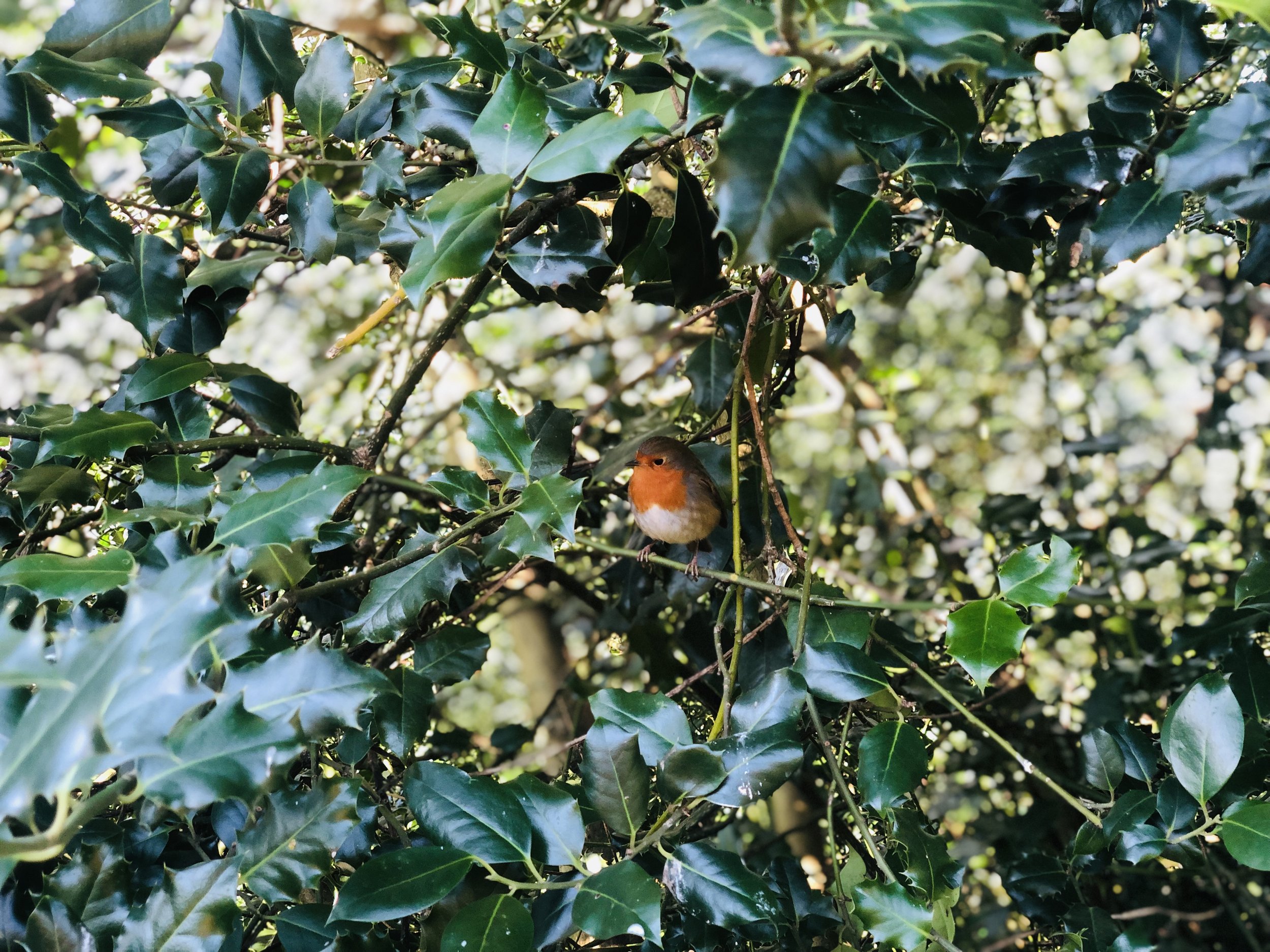
Robin sp., Deidra Bryant
With all these differences, you may wonder how they can both be considered “robins.” The term “robin” is pretty much irrelevant in regards to taxonomy. In the 17th to 18th century European settlers designated our familiar backyard bird when they arrived in the New World. Why “American Robin” though? We can speculate on why, but I personally believe their hubris played a role in determining its name since a bird with a red breast was strictly called a “robin” in England during that time, and considered their robin to be the standard. As a result, it was possibly their goal to shoehorn flora and fauna in the newly established colonies into the familiar framework of Great Britain as if they attempted to cling on to aspects of their homeland. And let’s not forget about Australasia. Settlers arrived at the remote continent and decided to identify birds there as “robins” too like the Scarlet Robin (Petroica boodang).
Notice how all these birds have flame-colored breasts. I bet you’re starting to see a pattern here, right? Well, don’t get too carried away. There are 49 endemic species of robins (conveniently named Austrilasian robins) in the Petroicidae family and they look nothing like the American or the European Robins. Early ornithologists had named birds as robins from three different families in at least three different continents and things got more convoluted as time went on. During the 18th century, most of the New World Turdids were called robins because of their superficial similarity to the American one, but now have reverted to being called thrushes to better represent the genus’s cosmopolitan distribution. However, we still have robins from different families and genuses all over the globe that look very different from each other. For example, we have the White-breasted Robin located in southwest Australia (Eopsaltria georgiana), the Forest Robin from southeast Africa (Cossypha dichroa), the Japanese Robin (Larvivora akahige), the Siberian Blue Robin (Larvivora cyane), etc. On the Indian subcontinent there’s the Indian Robin (Copsychus fulicatu) and the Oriental magpie-robin o(Copsychus saulari).
The prior examples put scientists in a predicament that taxonomists have been trying to solve for decades. What do we call these birds that are definitely not robins but are well known as robins? Are they thrushes, are they chats? Does all of this really even matter? I care enough to have contemplated such a complicated term, but not enough to get visibly upset about how to classify a bird's common name like a “warbler” or a “wren.” The good news is that laypeople in the states can easily understand what the other is talking about when they discuss robins, but ornithologists have to clarify in journals and research papers (which they usually do) using the species name.

ASNV Awards Two Audubon Hog Island Scholarships
Every year, ASNV awards a scholarship to “Sharing Nature: An Educator’s Week” at Hog Island Audubon coastal Maine.
Photo: Hog Island sunrise, Gretchen Linton
Bill Burton, Lisa Mackem

Chrissy Brownson, science resource teacher at Providence Elementary
Every year, ASNV awards a scholarship to “Sharing Nature: An Educator’s Week” at Hog Island Audubon coastal Maine. The scholarship is awarded to a classroom teacher, specialist, or school administrator and covers tuition, room, board, and transportation. Hog Island has offered environmental education programs for adults, teens, families, and conservation leaders since 1936. The camp takes a multidisciplinary approach in helping instructors develop effective techniques for teaching children and adults about nature.

Candice Centinkaya, Fairfax County Public Schools at-large science resource teacher
This year, ASNV selected two scholarship winners: Chrissy Brownson, science resource teacher at Providence Elementary and Candice Centinkaya, a Fairfax County Public Schools at-large science resource teacher. Each winner is expected to use her Hog Island experience to develop a new conservation-themed educational program or enhance an existing one. The teachers will share their summer experiences in the September newsletter and submit final reports to ASNV next year. We look forward to hearing from them!

Help Our Migrating Birds Navigate Safely through Northern Virginia
Peak songbird migration in our area is mid-April to mid-May. Now is a good time to take extra steps to greet our migrants by making our homes and neighborhoods a little safer for them, helping them avoid window collisions and exhaustion.
Photo: Black-throated Blue Warbler, Matt Felperin
Ines Nedelcovic
Katherine Wychulis
We’re all looking forward to spring migration when warblers and other migrating birds return to Northern Virginia to breed or visit on their way north. Peak songbird migration in our area is mid-April to mid-May. Now is a good time to take extra steps to greet our migrants by making our homes and neighborhoods a little safer for them, helping them avoid window collisions and exhaustion.
The American Bird Conservancy estimates that up to 1 billion North American birds die each year due to collisions with windows. ( ABC) Some species greatly affected by window collisions include the Black-throated Blue Warbler, Ovenbird, Ruby-throated Hummingbird and our star singer, the Wood Thrush. (Klem, Solid Air, pp. 40-41) The toll during migration can be high because about 70 percent of North America’s bird species are migrants. (Audubon Talk to Arlington Joint Advisory Committee at 18:10)
Birds crash into windows because they perceive the glass as air, and see reflections of vegetation, or they see through the glass to indoor plants. The highest collision rates occur in large areas of continuous glass like office buildings and large residential windows.
Lights are another part of our built environment causing bird mortality, particularly the external lighting concentrated in urban and suburban areas and along highways.
So how do outside lights harm birds? Eighty percent of our migratory birds migrate at night, using the star map and the moon to navigate. Bright lights can dampen or mimic moonlight and starlight, confusing the birds. Disoriented or dazzled birds can lose their way or stall. The confusion exhausts them in the middle of an already arduous journey and can trap them in hazardous city environments. (Audubon Talk, at 18:10)
Voluntary “Lights Out” programs are helping to reduce the harm in cities like Chicago, the #1 most light-dangerous city for migratory birds. (Audubon Talk, at 31:00) Effective techniques include taking light “breaks,” down-shielding lights, and minimizing blue light.
So, how can we reduce the impact of our buildings on birds?
Turn lights off when leaving a room, and cover windows with blinds, shades, or other coverings.
Install insect screens on windows, or apply decals or stickers providing visible patterns on the outside of the window. Most birds will avoid glass with vertical and horizontal stripes or markings spaced 2” apart. The stripes should be at least ⅛” wide. Dots work if they are at least ¼” in diameter. ASNV’s website has a very helpful video on how to prevent window collisions. ABC and Klem, pp. 150-151 are also useful sources.
Place bird feeders either within 3 feet of windows or more than 30 feet away. (Klem, p. 108)
Turn off outside lights at night if possible. As an alternative, use yellow LED lights less than 3,000 kelvins which are less disorienting and deadly to beneficial insects, and for any security lights, use motion-sensor lights. (Audubon Talk, 41:00-43:50)
Report bird-window collisions resulting in a dead or live bird on iNaturalist, joining the bird window collisions project.
Share these tips with your neighborhood via an HOA, landlord or NextDoor and support local “Lights Out” initiatives.
Youth Education Mini-grants - Last Chance to Apply is April 1!
The ASNV Youth Education Committee is pleased to offer three mini-grants of up to $500 each for 2022. Read on to find out how to apply.
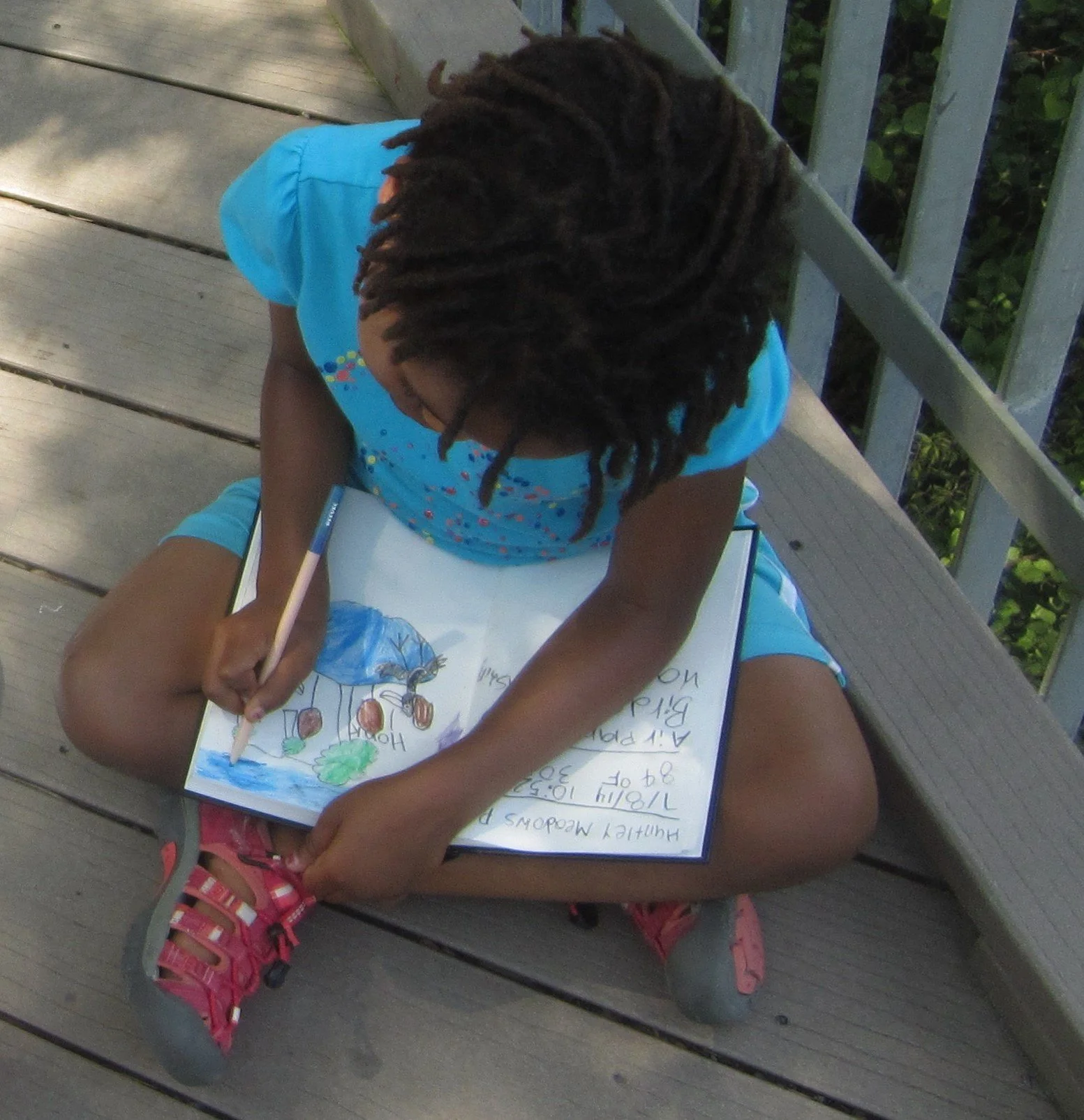
Photo: Huntley Meadows youth nature drawing class, Margaret Wohler
Are you an educator with a great idea for a bird-related conservation project with your students? Every year, the Youth Education Committee of ASNV sponsors a mini-grant program to support teachers, schools, and non-profit organizations in youth-oriented education about birds and the environment. The committee is pleased to offer three mini-grants of up to $500 each for 2022.
Funding may be used to support Meaningful Watershed Educational Experiences (MWEEs), professional development, field trips, speakers and admission fees, equipment, transportation, trees, plants, etc. All projects must include an educational component and be completed by December 31, 2022 by submitting a one-paragraph summary and photos of the finished project to youtheducation@audubonva.org.
The application form for the mini-grants can be found here. Deadline for applications is April 1. Please contact Youth Education with questions about the Youth Education Mini-Grant program.

Do you have a Scope you’d like to Donate?
The Vieques Conservation and Historical Trust is looking for a telescope to use for bird counts and surveys.
Photo: White-cheeked Pintail, Lorraine Minns/Audubon Photography Awards
The Vieques Conservation and Historical Trust is looking for a telescope to use for bird counts and surveys. The mission of the Trust, which is located on the island of Vieques in Puerto Rico, is to foster, protect and conserve the environmental, archaeological, and cultural resources of Vieques. They are currently doing bird counts and surveys of shorebirds using binoculars. As anyone who has done surveys of waterfowl knows, a scope is invaluable in obtaining accurate counts and identifying species. The Trust is a Section 501(c)3) charitable organization, and donations are tax deductible to the extent permitted by law. You can read more about the Trust here.
If you are interested in donating a scope, please email President@audubonva.org.

Help Us Promote Stronger Conservation Policies in Fairfax County
We’re looking for volunteers to help ASNV contact members of the Fairfax County Board of Supervisors from time to time. Depending on the issue, we may ask you to call, email, or request a meeting with your district’s supervisor. Can you help?
Photo: Huntley Meadows fog, Dixie Sommers
We’re looking for volunteers to help ASNV contact members of the Fairfax County Board of Supervisors from time to time. Depending on the issue, we may ask you to call, email, or request a meeting with your district’s supervisor. We will help research the issue and develop key points to make.
Local elected officials make many decisions affecting how and where we live, work, and recreate. At times, issues arise that affect individual districts, such as planned changes to parks. Some issues affect the entire county, such as the county’s budget. These decisions can have a substantial effect on the natural resources that ASNVers care about, such as wildlife, habitat, tree preservation, clean air, and water quality. Elected officials need to hear from their constituents and are often responsive to constituents’ concerns.
If you are uncertain who your supervisor is, you can find out by entering your address in the box at the top of the map here.
Please let us know today if you can help by providing your name and the name of your Fairfax County Supervisor. Contact our advocacy committee via our website here. We hope to hear from you soon.