
NVBA NEWS BLOG
Welcome to the blog for Northern Virginia Bird Alliance, a wealth of resources about northern Virginia birds, wildlife, habitat conservation and restoration, native plants, wildlife-friendly gardening, advocacy and more.

Observations from Meadowood: September 2022
Judy Gallagher continues to survey Meadowood Recreation Area. Here are some findings from her most recent survey.
Photo: Snowberry Clearwing, Judy Gallagher
Judy Gallagher is an ASNV board member and a regular surveyor of local wildlife who also captures photos of what she sees, in particular the less common species. Here are some observations from her most recent survey.

Hummingbird Clearwing, Judy Gallagher
If you've been out at a pollinator garden recently, you've probably seen tiny hummingbirds zooming from one pink or purple flower to another. But what you're likely seeing is a day-flying moth, either a Hummingbird Clearwing or a Snowberry Clearwing. They fly and move just like hummingbirds, and can remain suspended in the air in front of a flower while they unfurl their long tongues and sip nectar from a flower. They even hum like hummingbirds.

Snowberry Clearwing, Judy Gallagher
This Snowberry Clearwing didn't bother to retract its tongue while flying between flowers.

Hummingbird Clearwing, Judy Gallagher
Looking like a hummingbird might give the moth some protection from predation. A moth would be tasty, but a feisty hummingbird not so much. It's hard to freeze these moths' wing action, as they can beat their wings up to 70 times per second!

Snowberry Clearwing, Judy Gallagher
They are called Clearwing Moths because they lose scales from patches on their wings, leaving areas of transparency. Hummingbird and Snowberry Clearwing Moths are members of the Sphinx Moth family, but there is another whole family of moths called Clearwings which may be the subject of a future column.
Unlike many other moths, Hummingbird and Snowberry Clearwings don't have hearing organs. Moth hearing organs are often used to detect bat calls, and since these Clearwings are day-flying moths, they don't need them.

Hummingbird Clearwing, Judy Gallagher

Snowberry Clearwing, Judy Gallagher
So how do you tell these beauties apart? The easiest distinguishing characteristic is that Hummingbird Clearwings have pale legs and Snowberry Clearwings have black legs. The Hummingbird Clearwing has an olive back and a red-brown abdomen, and the Snowberry Clearwing is usually yellow and black with a black line running through its eyes and down its sides.

The adult moths nectar on various flowers, but the caterpillars are a little more picky. The Hummingbird Clearwing caterpillar feeds on Viburnum, Honeysuckle, Snowberry, Cherry, Hawthorn and Plum. The Snowberry Clearwing caterpillar feeds on Honeysuckle, Snowberry and Dogbane. When the caterpillars are ready to pupate, they drop to the ground and form fairly nondescript pupae. So gardeners beware: if you remove leaf litter from your garden, you will likely also be getting rid of your Clearwing Moth population.
I hope all of you will see some of these incredibly fast and beautiful moths this season.
View all of Judy’s Observations from Meadowood articles here.

Monday Mystery - August 29
Monday Nature Mystery continues! Read on to learn who correctly identified our last mystery.
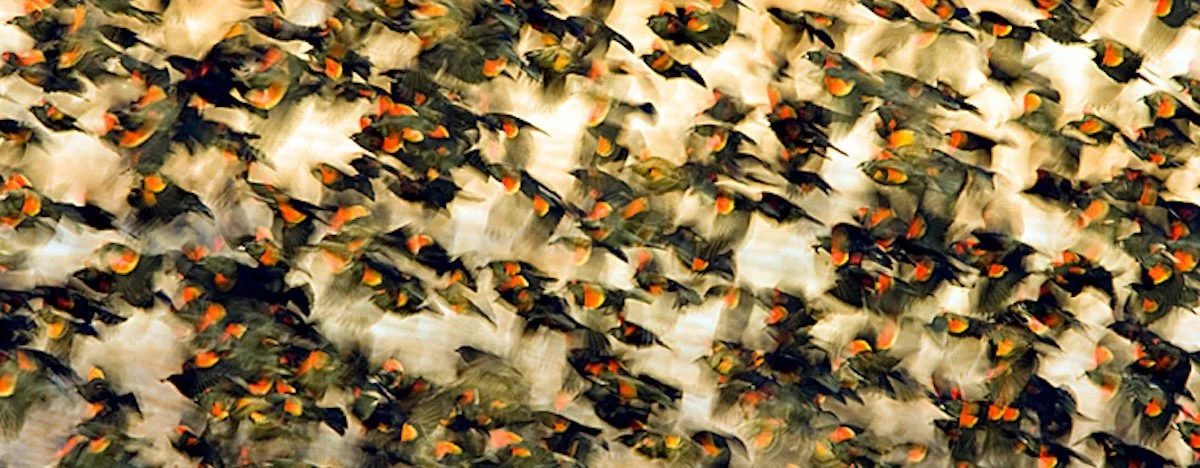
Photo: Juvenile Red-winged Blackbird, Brian Rice/Audubon Photography Awards
We are pleased to announce the winner of last week’s Monday Nature Mystery, Michael Piper!
Congratulations to Michael for correctly identifying the juvenile Red-winged Blackbird (Agelaius phoeniceus).

Last Week's mystery: Juvenile Red-winged Blackbird (Agelaius phoeniceus). Photo: Brian Rice/Audubon Photography Awards
According to All About Birds, female Red-winged Blackbirds build the nests by winding stringy plant material around several close, upright stems and weaving in a platform of coarse, wet vegetation. Around and over this she adds more wet leaves and decayed wood, plastering the inside with mud to make a cup. Finally, she lines the cup with fine, dry grasses. Young stay in the nest for just 11-14 days before fledging.
Each Monday we’ll post a new mystery and identify the previous week’s winner. They’ll receive an ASNV hat or tote bag.
Here is this week’s mystery:
Who is this fall visitor?
Be sure to post your guess on our Facebook page under the latest Monday Nature Mystery post. Good Luck!
Please check our guidelines here.

Monday Nature Mystery: Who is this fall visitor? Photo: Ben Cvengros/Audubon Photography Awards

ASNV’s Birdathon Fundraiser Results in Record Donations and Number of Bird Species
Our chapter’s annual Birdathon competition raised a record amount of money and found a record number of birds this year.
Photo: Yellow Warbler, Sheen Watkins/Audubon Photography Awards
Tom Blackburn
Our chapter’s annual Birdathon competition raised a record amount of money and found a record number of birds this year. Birdathon is a friendly competition among teams of birders. It has two goals: to raise money for ASNV and to find the most birds within our chapter’s boundaries in a 24-hour period.
Eleven teams raised $12,059, beating last year’s total by more than $1,000. The Board Birders, a team of ASNV board members Gerry Abbott, Tom Blackburn, Libby Lyons, and Dixie Sommers, won the fundraising competition. The Chipper Birders, teenaged brothers Dante and Maxwell Julius, came in second. The Three Beaks team of Louise and Bart Edsall and Salay Kamara came in third.
The Drake and Two Chicks team of Greg Fleming, Elizabeth Krone and Laura McDonald was the runaway winner in the bird species competition. They logged 123 species, an ASNV record. The Board Birders came in second with 92 species, followed by the Chipper Birders with 85. See more about the Chipper Birders in our December 2020 article and a recent news article on WUSA Channel 9.
The Scarlet Teenagers, a bird club sponsored by Flint Hill High School biology teacher Fred Atwood, deserves an honorable mention this year. The club raised money for ASNV in connection with a birding field trip to the Eastern Shore. Because they counted birds outside ASNV’s chapter boundaries, their total doesn’t count in the species competition, but the 120 species they saw is a testament to their birding skills.
The seven Birdathon teams that reported their bird species for the competition saw a total of 143 species, a reminder of how rich the bird life is in Northern Virginia. They saw 25 warbler species, or nearly all the warblers that are normally found here during spring migration. Other birds of interest included a Common Loon, a tree full of Bobolinks, and a Horned Grebe.
Thank you to all the teams that participated in the Birdathon. And thank you especially to the more than 100 people who supported our fundraiser. Your donations make it possible for ASNV to fulfill our mission of engaging all Northern Virginia communities in enjoying, conserving, and restoring nature for the benefit of birds, other wildlife, and people.

Audubon’s 2022 Photography Awards
Prepare to spend some time in front of your computer or on your phone looking over Aubudon’s 2022 Photography Awards, both still photos and videos.
Photo: White-tailed Kite, Jack Zhi/Audubon Photography Awards
Prepare to spend some time in front of your computer or on your phone looking over Aubudon’s 2022 Photography Awards, both still photos and videos. Audubon announced the top eight winners earlier this summer. But there’s more. Audubon released an additional file of 100 photos and videos from the nearly 10,000 entries from almost 2,500 photographers and videographers. You can view the collection here. Be sure to read the “behind the shot” stories that accompany the winners and other entries. They demonstrate the wide variety of techniques the photographers use and the lengths they go to for the perfect shot.
White-tailed Kite, Jack Zhi/Audubon Photography Awards

Nextgen Birders for Conservation: A New Program Targeting Younger Birders
ASNV is excited to announce the official launch of Nextgen Birders for Conservation (Nextgen). This new program aims to cultivate the next generation of birders and conservationists by providing opportunities for younger birders to meet, socialize, learn, and bird together.
Photo: Morgan Peterson
Tina Dudley and Libby Lyons
ASNV is excited to announce the official launch of Nextgen Birders for Conservation (Nextgen). This new program aims to cultivate the next generation of birders and conservationists by providing opportunities for younger birders to meet, socialize, learn, and bird together.
In the 2016 “Birding in the US Report,” the U.S. Fish & Wildlife Service found that the average age of a bird watcher in the United States was 52 years old, and the greatest number was in the 55+ age group. As ASNV looks to the future, we see the need to engage more young birders to carry the torch of conservation, citizen science, and education. Inspiring the “next generation of naturalists and conservation advocates,” is a key goal in ASNV’s newly adopted strategic plan.
This is where Nextgen comes in. To reach younger audiences, ASNV is hosting Nextgen on Meetup, a platform for finding and building local communities. Here is the link to our page on Meetup.
Nextgen aims to connect young birders, including any young people who enjoy wild birds, with their peers. We welcome people who are new to the hobby, loaning out binoculars during our events to beginners. Since the beta launch in April, Nextgen has attracted over 65 members with various levels of birding experience. Members include new birders, nature enthusiasts, photography hobbyists, aspiring ornithologists, natural resource professionals, and experienced bird walk leaders.

Nextgen outing at Leopold’s Preserve. Photo: Morgan Peterson
The Nextgen event schedule will include a mix of activities and formats, both peer-focused events and events where Nextgen members will join regularly scheduled ASNV programs. Upcoming events include backyard birding on Lake Audubon and a Wingspan game night. Most Nextgen events include a social component to encourage connections and to counter the isolation some younger birders feel when enjoying a hobby more commonly practiced by an older generation.
The Nextgen leadership team includes Adam Jenkins, Tina Dudley, Emerson Milam (a member of ASNV’s Diversity and Inclusion Committee) and Andreana Lin. Introduce yourself to the newest member of the leadership team, Andreana Lin, in this member spotlight. We are optimistic that as the group grows its members will join ASNV in promoting conservation and citizen science projects. We encourage Nextgen members to consider volunteering on an ASNV committee or joining our Board of Directors.
Help us make the Nextgen Birders for Conservation group a success. The group is targeted at younger people with an interest in birds, birding or conservation. Join us and steer younger birders you know in our direction. We also are looking for a few birders with 5+ years of birding experience who can serve as mentors. Interested individuals can sign up as mentors here.

Member Spotlight: Andreana J. Lin, Age 22
Andreana is a member of the Audubon Society of Northern Virginia’s recently launched Nextgen Birders for Conservation meetup group, part of a new initiative to engage younger birders.
Photo: Courtesy of Andreana Lin
Tina Dudley

Meet Andreana J. Lin, a member of ASNV’s recently launched program to engage younger birders, Nextgen Birders for Conservation (Nextgen). In addition to bird watching, Andreana’s hobbies include breakdancing, baking, and karaoke. She’s a 2022 graduate of George Mason University with a B.F.A. in Creative Writing and a double minor in Conservation Studies and Professional and Technical Writing. She was a University Scholar, one of only 20 students in her class to receive a full tuition scholarship to GMU, and graduated with an impressive 3.96 GPA.
Andreana had a run-in with some geese as a toddler, making her wary of birds during her childhood. It wasn’t until she took Prof. Stephanie Lessard-Pilon’s birding practicum at Smithsonian-Mason School of Conservation in 2020 that she found a passion for birding. As a project for that class, Andreana created a wooden model comparing wingspans and other facts about selected birds. The model is now on display at the Shenandoah Valley Discovery Museum. She credits her weekly bird walks with Prof. Lessard-Pilon for opening her heart and mind to the beauty of birds and the natural environment.
On how birding benefits her life, Andreana says, “Birding has given me the ability to perceive my everyday life more vividly. I notice the rustling in the shrubs. I notice the wing bars on a northern mockingbird, the chitter-chatter of European starlings, the cat-like wails of gray catbirds, and the owl-like coos of mourning doves. I notice the beetles scurrying on the ground. I see my surroundings through a brighter, bolder lens full of natural curiosity, warmth, and inspiration, and I have birding to thank for that.” In encouraging new birders, she recommends, “Go birding in your everyday life -- in your backyard, your neighborhood, your town, your city. You can bird with just your eyes and ears on your walk to school just as much as you can with a $200 binocular set at a marsh or forest.”
It can be challenging to have a hobby outside the norm for your age group, which is why Andreana was thrilled to find Nextgen on Meetup. Andreana has attended almost every Nextgen event held so far and is on the leadership team organizing future events. She offers a glowing review: “Really love this group! Nextgen is such a welcoming, adaptable, and diverse group with a wide variety of events. I’ve been inviting my friends and little brothers to the events as well!”
As a recent graduate, Andreana also welcomes the networking opportunities Nextgen offers. She is eager to explore career paths where she can combine her skills in program management, community organizing, and telling stories to benefit birds and the environment. Through Nextgen she can connect with other ASNV members, many of whom have had successful careers in the environmental and conservation fields and may be able to help her reach her goals.

Nextgen members, from left to right: Sam Criscuolo (23), Sohan Tamang (28), Maheen Hussain (22) and Andreana J. Lin (22), attending the Birding by Ear Field Trip led by Colt Gregory. Photo: Tina Dudley.

My ASNV Internship
I started working as an intern for ASNV this May, and I believe my experiences will help me pursue a career in conservation.
Photo: Joan Haffey
Carolina Sanabria
I started working as an intern for ASNV this May, and I believe my experiences will help me pursue a career in conservation. My title is “citizen science and public engagement intern.” ASNV’s Diversity and Inclusion Committee chose me from a field of candidates because of my interest in conservation and my fluency in Spanish. My work for ASNV has used both.
I am a junior at George Mason University studying environmental science with a concentration in conservation. The Green Atoms club at Annandale High School started my interest in conservation. The club members attended educational talks, but also participated in recycling and local park cleanups, all of which taught me the importance of caring for local flora and fauna. At GMU I serve on a Patriot Green Fund committee that makes decisions about green projects on campus. I am interested in pursuing a career in animal conservation.
Carolina Sanabria at Family Fun Day. Photo: Joan Haffey
One of the first projects I worked on for ASNV was assisting two ASNV board members with a Spanish translation of Florence McBride’s book, Some Common Birds in Northern Virginia, which is available free on ASNV’s website. The book is a useful and accessible educational tool. It includes great photos and information on migration, food, threats, and other interesting facts about birds in our area, all in everyday language. The book’s style made it easy for us to adapt into Spanish. Following guidelines in the book for derivations, I used it to create laminated cards on ten common birds, with photos and information in both Spanish and English for each bird. The cards are designed for walk leaders to use to introduce beginners to birds they may see on a bird walk.
I also had opportunities to test the cards in the field, as you can see in the photo accompanying this article. Working with two ASNV board members, I co-led bird walks for children and families attending the June 4 Family Fun Day at Mount Vernon Woods Park, sponsored by NAACP/Fairfax. I answered questions about birds, gave out literature, taught walk participants how to use binoculars ASNV loaned out, and used the cards to introduce our beginners (in both English and Spanish) to local birds. It was interactive and the kids found it fun to use the binoculars for sightseeing and to explore the natural areas in the park. I look forward to helping at another event, this time for Latino Conservation Week, July 24 at Justice Park in Falls Church.
I also have assisted ASNV with a long-running citizen science project. With guidance from several ASNV board members (including GMU faculty), I entered butterfly and dragonfly data into Microsoft Excel spreadsheets. The data is from long-term natural resource surveys ASNV sponsors. This information will eventually be uploaded to PollardBase, a data entry and management system for butterfly, dragonfly, and damselfly monitoring programs, where ASNV maintains information on the Occoquan Regional Monitoring Project. ASNV plans further data analysis using information from the surveys to inform future conservation projects.
My ASNV internship has been a great experience.

Free trees for communities
As community associations around Northern Virginia ramp up their native tree planting efforts, they are looking around to find ways to make it affordable.
Photo: Ann Hathaway
Margaret Fisher
As community associations around Northern Virginia ramp up their native tree planting efforts, they are looking around to find ways to make it affordable. Burke Centre resident Craig Willett has solved that problem for his neighbors: all they have to do is fill out a simple form to get a free tree. A member of Burke Centre Conservancy’s volunteer Open Space Committee, Craig has organized a system both for private property and for common land. On private land, residents pick up seedlings from Craig’s house and plant them themselves. On common land, the Trustees of the various clusters put in a request, and Craig and his colleagues will install trees or shrubs either to replace ones that have died or to reforest open areas. You can see him pictured here with fellow volunteer Mike Hathaway, in red.
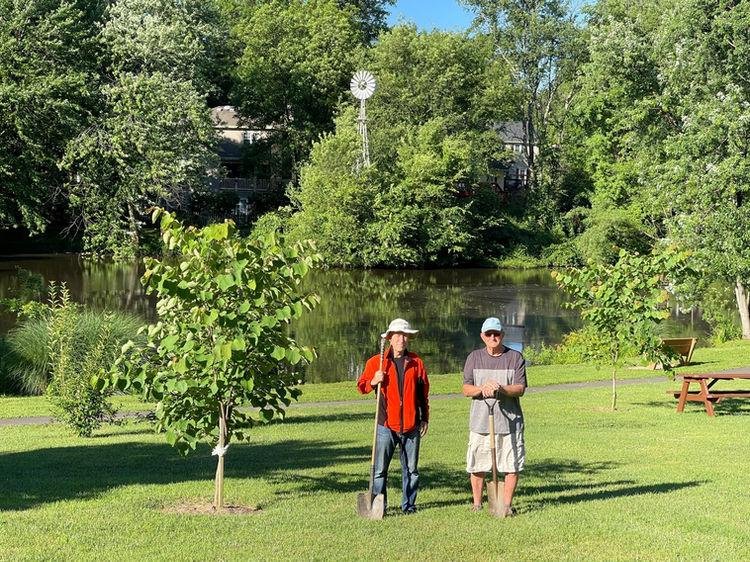
Newly planted tree. Photo: Ann Hathaway
Trees grow slowly, and they also die slowly. Many neighborhoods around Northern Virginia have been losing their canopy coverage, bit by bit, so that once pleasantly shaded yards and streets where neighbors and children could gather are gradually becoming intolerable as our summer temperatures rise. Communities that wish to reverse this trend are most likely to succeed if they build a long-term routine for tree care and tree replacement into their master plans. Where there is no community association, residents will need to step forward to help each other make a plan.
Burke Centre Conservancy obtains its tree seedlings from Fairfax ReLeaf, a non-profit organization of volunteers who plant and preserve native trees on public and common lands in Northern Virginia. Individual landowners may also request seedlings from Fairfax ReLeaf.
Any community in Fairfax County that owns open space may also apply for free trees from the Fairfax Tree Preservation and Planting Fund. It is not necessary to be a 501(c)3 organization to apply as long as the open space is commonly owned. This is a solid funding source for organizations that want to plant either seedlings or larger trees. The application process looks a little intimidating at first glance because of the long list of requirements, but in fact the required steps are all ones that any organization would take anyway when planting trees.
Programs for obtaining free native trees are also available to communities in Arlington and Falls Church. And although not free, there are numerous ways to obtain native trees for a very low price. For example, the Virginia Department of Forestry sells tree and shrub seedlings for $2.00 apiece for orders of ten or more. Our local native plant garden centers all sell medium-sized trees in containers at reasonable prices. Those trees may look a little small when first planted, but they will rapidly catch up to trees that were planted when larger, since older trees suffer more transplant shock. Two wholesalers of larger trees offer their trees at wholesale cost to people who are organizing community plantings. Links to all these programs can be found on the Plant NOVA Trees website.
Since 2018, Burke Centre Conservancy has planted over 600 bare root seedlings, which is in keeping with the nature-centered philosophy of this community with its extensive network of trails through the woods. More details about their process can be found on this web page.

Monday Mystery - July 18
Monday Nature Mystery continues! Read on to learn who correctly identified our last mystery.
Photo: Persimmon Tree bark, Tina Dudley
We are pleased to announce the winner of last week’s Monday Nature Mystery, Melanie Welles!
Congratulations to Melanie for correctly identifying the American Persimmon Tree (Diospyros virginiana) bark.

Last Week's mystery: American Persimmon Tree bark. Photo: Tina Dudley
According to Wildflower.org, this native tree is in the ebony family. Native Americans made persimmon bread and stored the dried fruit like prunes. Opossums, raccoons, skunks, deer, and birds also feed upon the fruit. Principal uses of the wood are for golf-club heads, shuttles for textile weaving, and furniture veneer.
Each Monday we’ll post a new mystery and identify the previous week’s winner. They’ll receive an ASNV hat or tote bag.
Here is this week’s mystery:
Who do these powerful talons belong to?
Be sure to post your guess on our Facebook page under the latest Monday Nature Mystery post. Good Luck!
Please check our guidelines here.

Monday Nature Mystery: Whose talons are these? Photo: Deborah Roy/Audubon Photography Awards

June 2022 Bird of the Month
The Prothonotary Warbler (Protonotaria citrea), is one of only two North American warblers to nest in cavities. Prothonotaries nest in cavities already established by other woodpeckers and chickadees but they will also nest in boxes designed for their specific preferences.
Photo: Prothonotary Warbler, Edward Episcopo/Audubon Photography Awards
Bird of the Month: Prothonotary Warbler
Jessica Bigger
The Prothonotary Warbler (Protonotaria citrea), is one of only two North American warblers to nest in cavities. The other is the Lucy’s Warbler. Prothonotaries nest in cavities already established by other woodpeckers and chickadees but they will also nest in boxes designed for their specific preferences.
They prefer nests on trees over standing water, like Bald Cypress and Willow Trees, but they will also nest on the ground or in the understory. Location is important as this species chooses to nest in forests near a body of water; on the edge of lakes, streams, and alluvial floodplains or near swamps. Prothonotary Warblers forage on the ground near their nests searching for a variety of insects including mayflies, caterpillars, and butterflies.
With its bright yellow and smooth grayish blue plumage, it’s not a surprise that this warbler was named after the Roman Catholic Prothonotories (Papal Clerks) who wore bright yellow robes during mass.
Since 1966, the Prothonotary Warbler population has been declining. Population numbers have dropped 1% each year between 1966 and 2015. One of the biggest threats is a loss of habitat on both breeding and wintering grounds. Removal of snags and channeling streams reduces nesting habitat. Mangrove swamps, a prime wintering habitat, are disappearing at a dramatic rate because of an increase in aquaculture and development.
Climate change has also become another factor. As the global temperatures increase, this warbler’s summer breeding range is predicted to shift further north into Canada. Some of the Prothonotary Warbler’s habitat in the Midwest will likely become uninhabitable. As for most birds, a huge threat is spring heatwaves, which can kill young nestlings.
As with many warblers, the Prothonotary Warbler can be elusive despite its bright color. It’s sometimes easier to hear its song, a series of 5-7 “sweet-sweet-sweet…” sounds than it is to spot one.

Prothonotary Warbler, Edward Episcopo/Audubon Photography Awards
ASNV Member Spotlight: James, Age 10
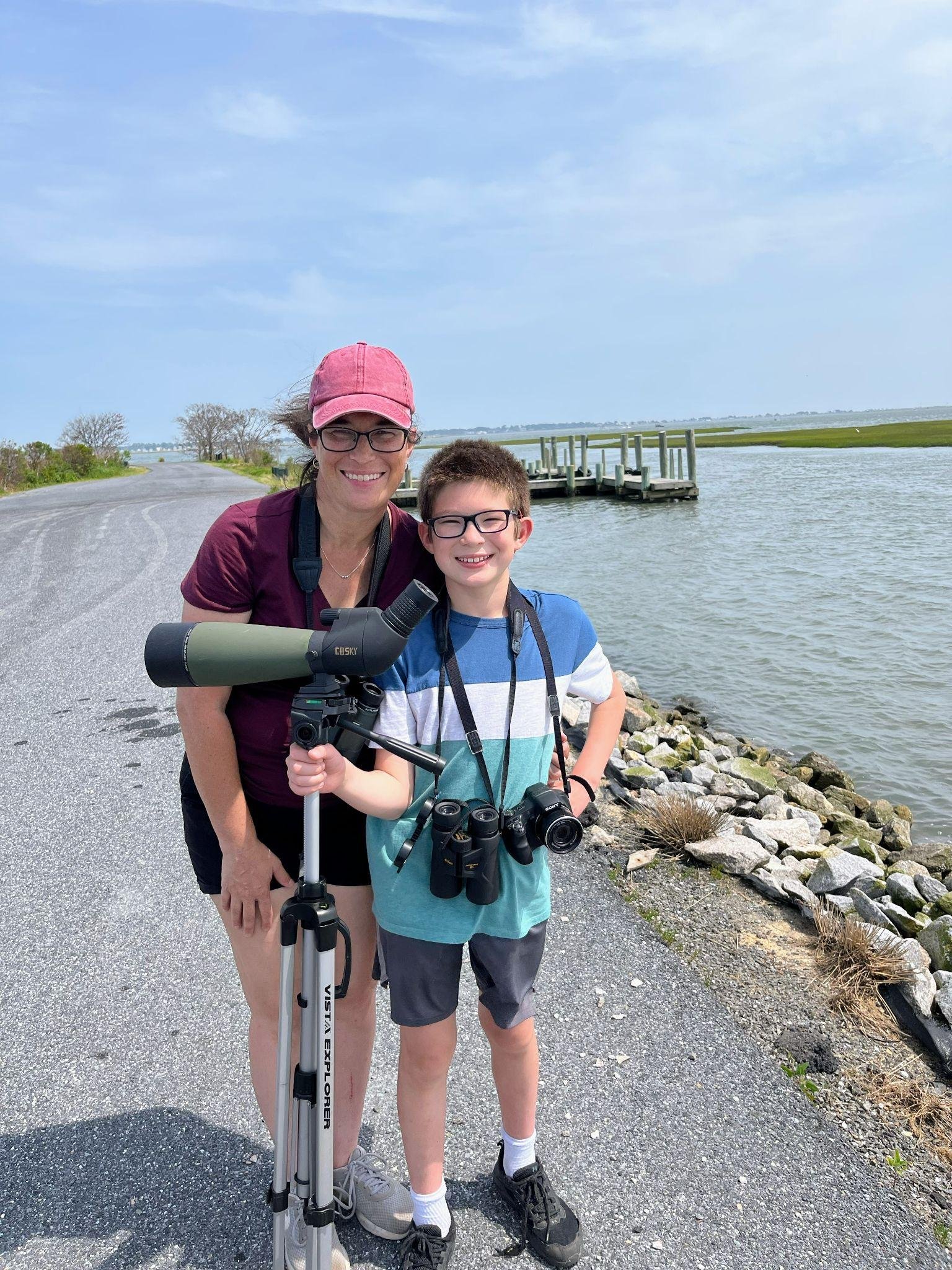
On a birding weekend at Chincoteague, I had the pleasure of meeting a young birder named James and his mother, Luisa. Birding has been really good for James - it was a safe activity to do during the pandemic and it also piqued his interest in nature in general.
Tina Dudley
Luisa and James Gallager birding, Tina Dudley
On a birding weekend at Chincoteague, I had the pleasure of meeting a young birder named James and his mother, Luisa. James has been birding for two years, since he was eight. He is a skilled birder, even correcting seasoned birders on occasion. I enjoyed speaking with his mother, who admitted that James is the birder of the two of them, but she wants him to spend time with “his people.”
Luisa first noticed James’s interest in birds after the family put up a feeder in their yard. James was very curious and wanted to know all about the birds he was seeing. His mother explained; “Sensing his enthusiasm, we took him to a local birding spot. Once he identified his first bird, he was hooked. We identified just three species that day and then went back the next weekend and found ten more.”
James was fascinated. He used the Merlin app to memorize bird calls and his mother signed up for eBird’s rare bird alerts. James shared with me one of his favorite birding memories, “We went to Dyke Marsh to see the rare (for Virginia) Yellow Headed Blackbird and I identified it by ear. It sounded like a chainsaw. When I finally saw the bird it was at the top of a tree singing. I was really excited to see such a rare bird and I wondered how it flew so off-course and what happened to it after it left the marsh.”
This photo of the Yellow Headed Blackbird was actually taken by James through his spotting scope using an iPhone.

Yellow-headed Blackbird, James Gallager

Great Blue Heron, James Gallager
In just two years, James has seen over 130 species of birds. On the trip to Chincoteague, he added 14 new species to that list. He identified the Black-necked Stilt and the Boat-tailed Grackle as his two favorite new birds he saw on the trip. His next birding adventure will be on Cape Cod, when he visits his Grandfather.
Birding has been really good for James - it was a safe activity to do during the pandemic and it also piqued his interest in nature in general. His mother told me that since he began birding, “He is much more aware of the outside world and the impact of humans on the environment. He has a greater appreciation of nature; not only birds, but also insects, plants, animals, and the climate. Birding on Cape Cod with his grandfather increased his love for the ocean. Identifying birds also led him to new interests like photography.”
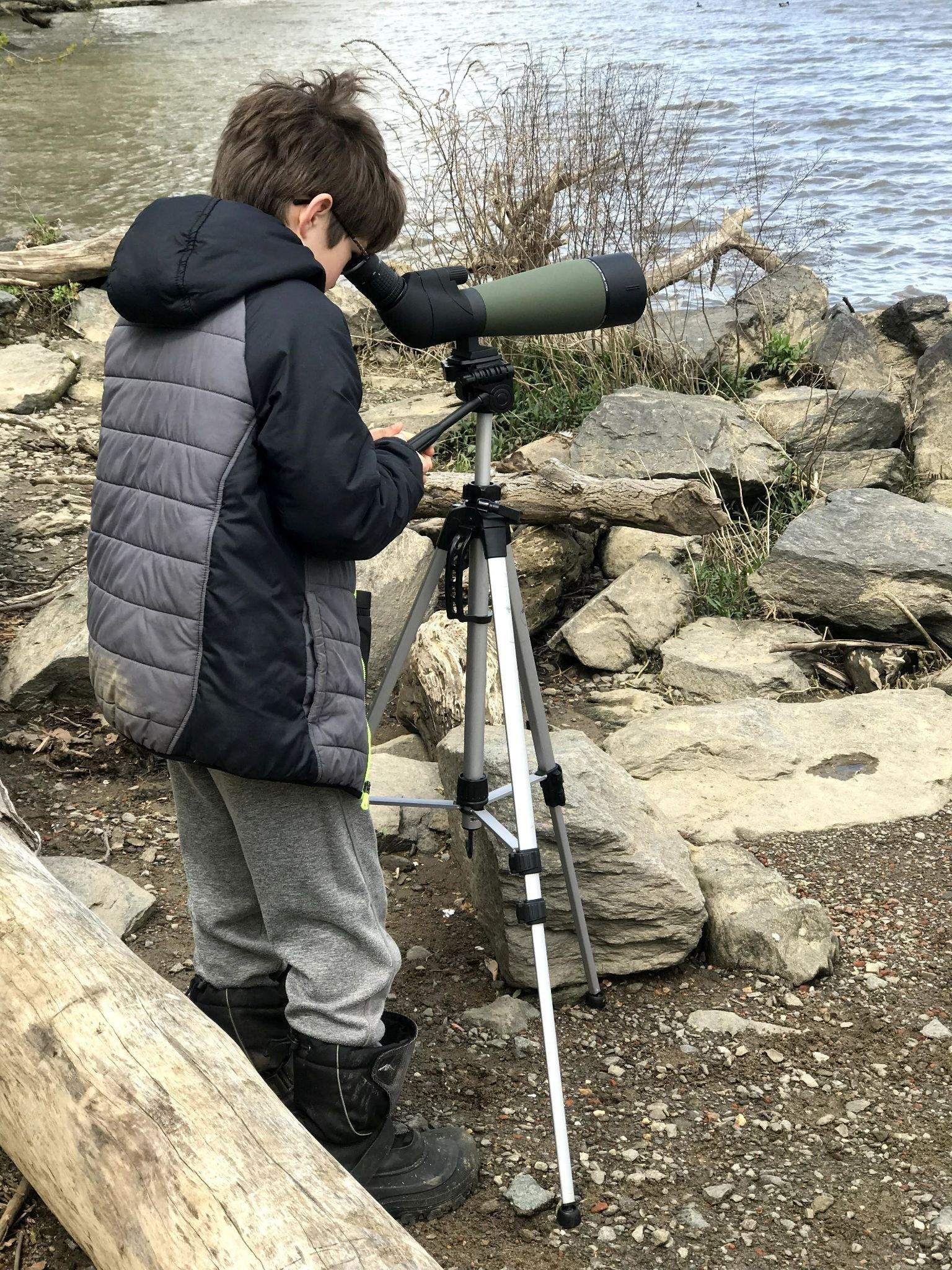
James Gallager birding, Tina Dudley
Luisa is very supportive of James’ interest in birds. She takes him frequently to parks and birding hotspots like Huntley Meadows, and even got him a nice pair of adult binoculars. (James informed me that he saved up by himself to buy his spotting scope.) The two of them joined the Northern Virginia Bird Club and the Friends of Dyke Marsh and started attending weekly bird walks. I was glad to hear from Luisa that they have found the birding community in Northern Virginia to be very welcoming and helpful.
Luisa’s advice for parents: “The most important thing is to make birding fun for kids and follow their lead. Children who are just starting out do not need fancy equipment or trips. They can identify and watch birds in their own backyard with a simple field guide or an online app. If a child wants to explore birds further, there are a wide range of resources available to help, including the Cornell Lab, e-Bird, Audubon, and local birding organizations. Like any other activity, traveling to birdwatching spots can be time-consuming, but there are tremendous benefits. And being outside in nature is something the whole family can enjoy – birders and non-birders alike.”
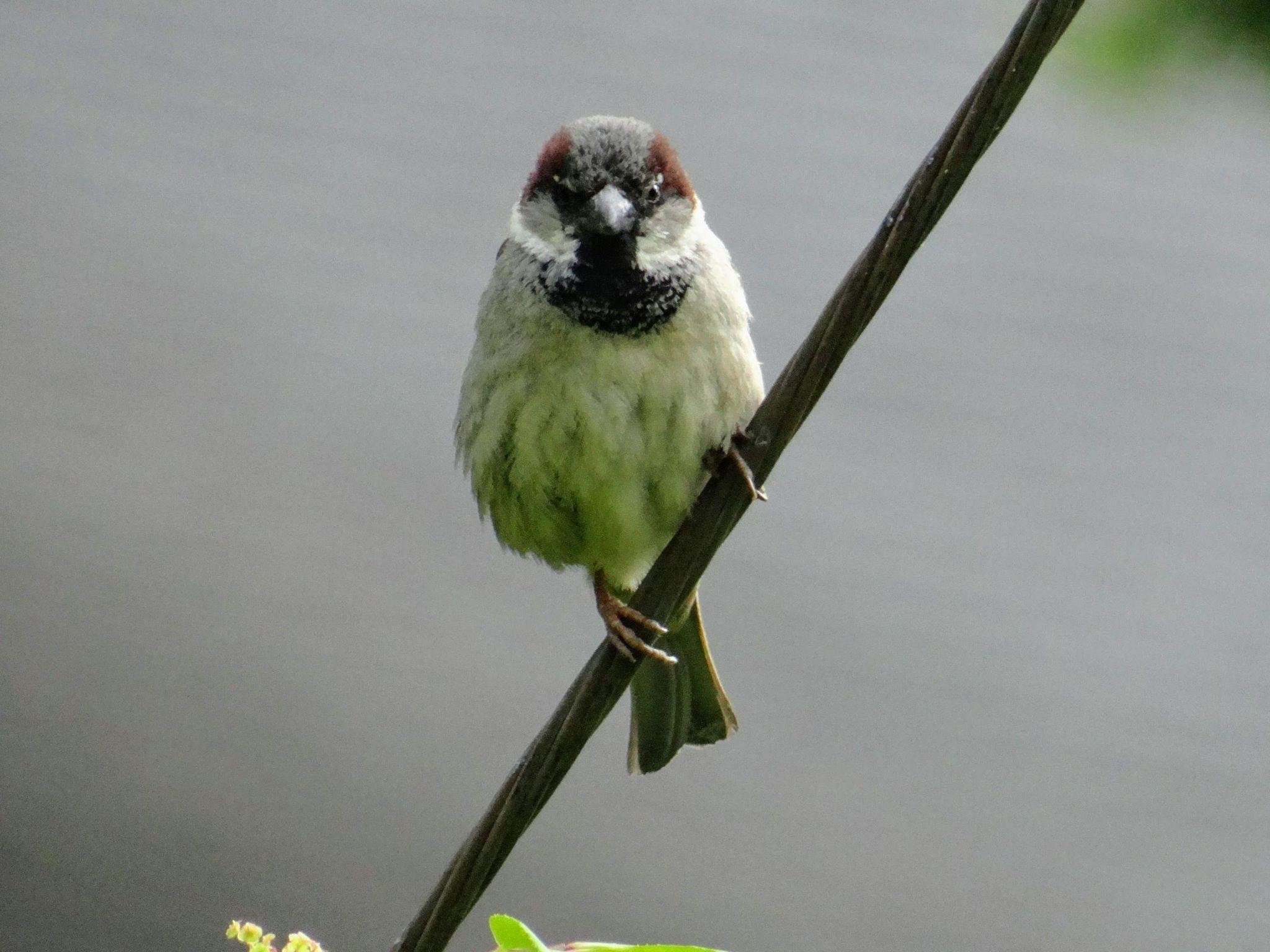
House Sparrow, James Gallager
At one point, James asked his mother, “Why are there not more kids who like birding?”
There is a great teen birding club and various camps and programs for birders 13+, but Luisa has not found much for birders around James’s age. It is up to us, as birders, to change that.
So, I have a challenge to all the birders who read this: Please bring a kid out birding with you. Invite your grandchildren, nieces and nephews, or friends’ children. Help us cultivate the next generation of birding enthusiasts. If you feel strongly about this, consider joining our youth education committee so we can work together on programs to engage families and young birders like James.
To any children or teens reading this - I want to share with you James’s advice for new birders: “I would say have fun and don’t feel pressure to find certain birds. I really like my [spotting] scope, it helps me see birds I might not see with my binoculars. I also recommend a reliable field guide; my favorite is Sibley’s Birds East (but you could just use any field guide).”

ASNV Announces Candidates for Offices and the Board of Directors
These individuals have been nominated for positions on ASNV’s board. Read on to meet the candidates.
Photo: American Robin, Mick Thompson
Elizabeth Lyons – Candidate for President for a two-year term. Member of the Board since July 2021.
Greg Butcher – Candidate for Vice President for a one-year term. Vice President since July 2016 and member of the Board since July 2014.
Ron Grimes – Candidate for Treasurer for a two-year term. Member of the Board since July 2021.
Connie Ericson – Candidate for Secretary for a two-year term. Member of the Board since July 2018, Secretary since July 2020.
Joel Beauvais – Candidate for the Board of Directors for a three-year term.
Tom Blackburn – Candidate for the Board of Directors for a three-year term. Member of the Board since July 2016, President since July 2018.
Rita Peralta – Candidate for the Board of Directors for a three-year term.
Stacey Remick-Simkins – Candidate for the Board of Directors for a three-year term.
Jerry Touval – Candidate for the Board of Directors for a three-year term.
Tom Wood – Candidate for the Board of Directors for a three-year term. Member of the Board since 2019.

Last Call for Birdathon Donations
To celebrate migration and the nesting season, please donate to an ASNV Birdathon team if you haven’t already.
Photo: Camilla Cerea

A Drake and Two Chicks

The Chipperbirders
To celebrate migration and the nesting season, please donate to an ASNV Birdathon team if you haven’t already. This year, we had 12 fantastic teams birding their hearts out and raising funds. Let’s celebrate their efforts! We even had a last-minute team sign up, A Drake and Two Chicks, which includes our former Program Manager, Laura McDonald, who worked at ASNV for 12 years and continues her involvement as a volunteer. We will be accepting Birdathon donations until Friday, June 3rd, and the winners of Birdathon’s “most species identified” and “most funds raised” will be announced at our Audubon Afternoon (featuring live owls!) on June 5, 2022 at 3:00 PM.

The Three Beaks
See exciting reports from The Three Beaks and The Chipperbirders.
Youth Education Mini-grants Awarded
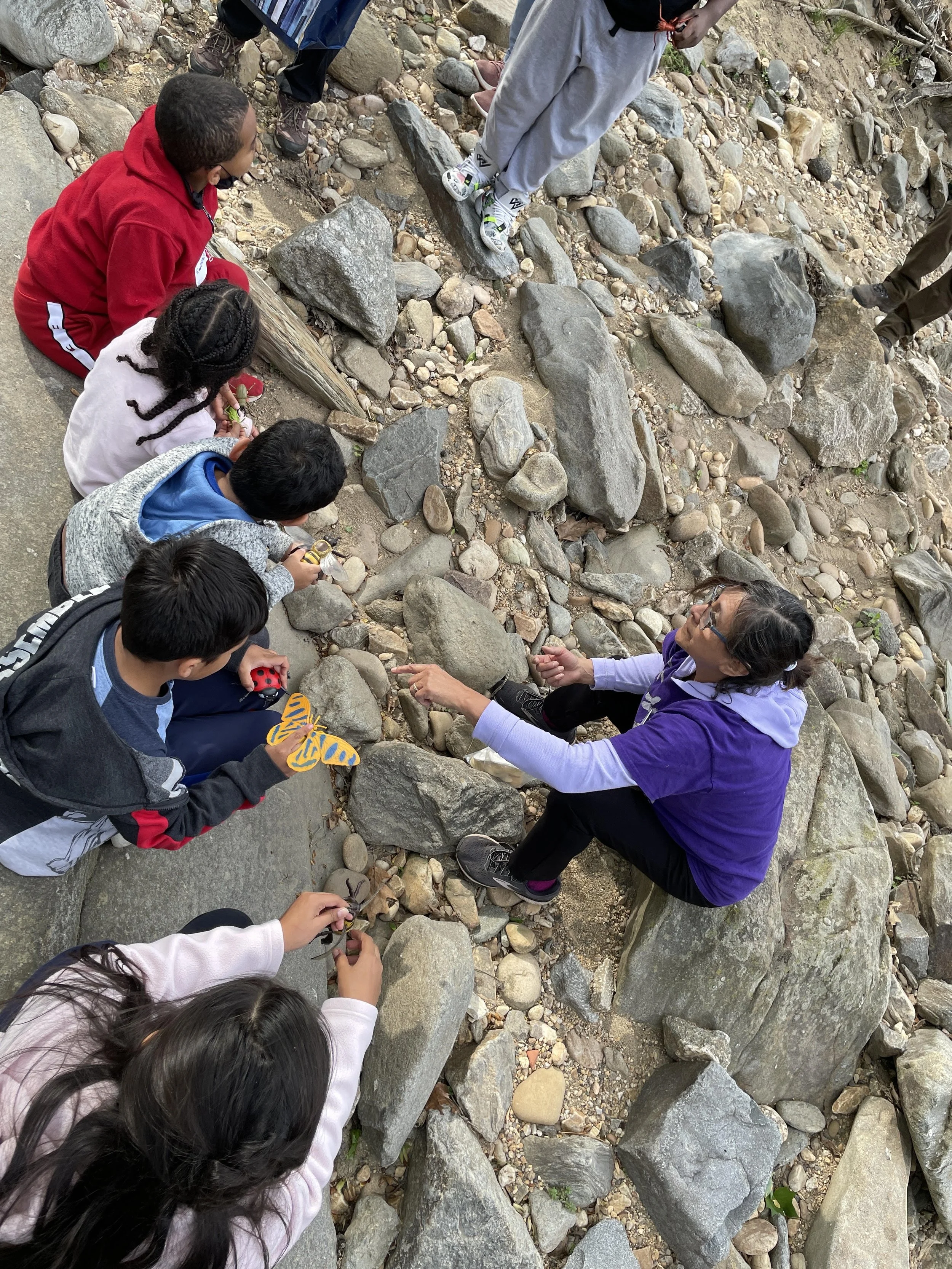
Each Spring ASNV awards Youth Education “mini-grants” to local schools and nonprofit organizations for projects involving youth that establish or enhance a learning experience about nature and conservation.
Photo: Arlington Master Naturalists
Each Spring ASNV awards Youth Education “mini-grants” to local schools and nonprofit organizations for projects involving youth that establish or enhance a learning experience about nature and conservation. Preference is given to projects that involve underserved groups and communities.
This year three grants of $500 each were awarded: Bucknell Elementary School in Alexandria, for materials to establish a student-run garden with native plants behind the school and adjacent to a local stream valley with abundant wildlife; Rockledge Elementary School in Woodbridge, to continue and enhance with new plantings an existing pollinator garden that will hopefully serve as an important stopover for migrating Monarch butterflies; and the Arlington Regional Master Naturalists (ARMN), who will use the funding to help develop an educational “toolkit” about local bird life for use by naturalists in local schools and ARMN-run nature clubs that have been established in low-income communities. The toolkit will utilize the recently published book on common Northern Virginia birds by Florence McBride which is now available in Spanish and English.
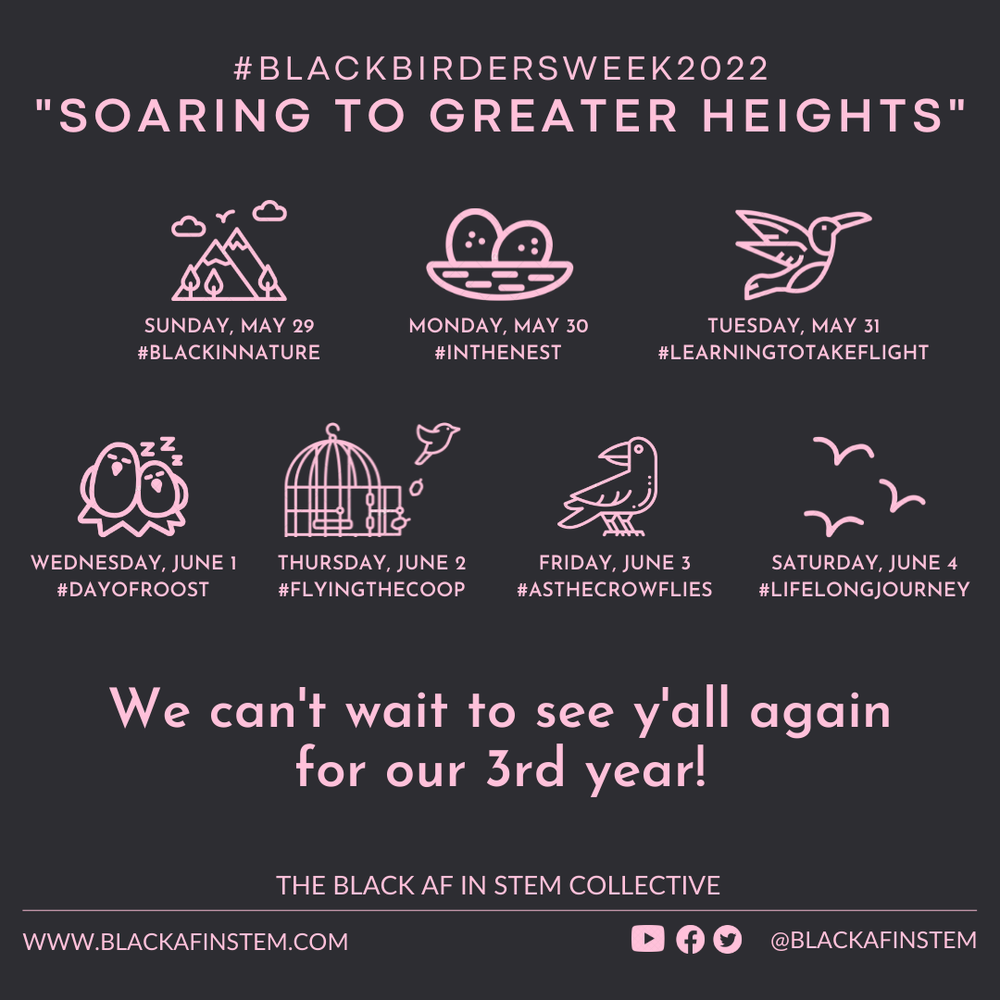
“Soaring to Greater Heights” Black Birders Week May 29 – June 4
June 1, 2022 is the fourth day of Black Birders Week, “Soaring to Greater Heights.” It continues an annual event intended to “…celebrate and highlight birding as a lifelong learning journey that is enjoyed by Black cultures across the diaspora.”
June 1, 2022 is the fourth day of Black Birders Week, “Soaring to Greater Heights.” It continues an annual event intended to “…celebrate and highlight birding as a lifelong learning journey that is enjoyed by Black cultures across the diaspora.”
This year’s online events are coordinated by Black AF in STEM. “The BlackAFinSTEM Collective seeks to support, uplift, and amplify Black STEM professionals in natural resources and the environment through professional development, career connection, and community engagement. We aim to inspire new audiences to engage in nature and share the stories of Black conservationists from across the country.”
“Soaring to Greater Heights” has seven daily themes.
Wednesday June 1, the theme is “A Day of Roost.”
“Did you know that birds choose where, when and how to roost carefully? Today’s theme is about mental health, prioritizing and choosing when to rest. Today, take at least 10 minutes to sit outside to rest and reflect. What do you notice?”

Let’s Go Birding Together!
Birding and being in nature are opportunities for everyone. Whether it’s for healing, respite, or peace, a walk in the outdoors can be especially meaningful to people who face discrimination, experience violence at higher rates, or are rejected by their families for being themselves.
Photo: Pinar Ates Sinopoulous-Lloyd
Celebrating Pride Month
Birding and being in nature are opportunities for everyone. Whether it’s for healing, respite, or peace, a walk in the outdoors can be especially meaningful to people who face discrimination, experience violence at higher rates, or are rejected by their families for being themselves.
National Audubon explains why many LGBTQ people find comfort in nature, “…a raccoon doesn’t care who you’re attracted to, a garter snake isn’t going to question your gender, and a bird of paradise isn't going to raise an eyebrow to how you’re dressed.” The article also acknowledges that more work needs to be done to make everyone feel welcome in nature. It explains, “…people who are historically accustomed to being excluded (or worse) must hear and know, explicitly, that we are welcoming, that we want to learn from them, and that they will be safe with us,” said Deeohn Ferris, vice president for equity, diversity and inclusion at Audubon, in an email to Audubon staff last week. “It’s important to act on our intentions and to speak them out loud.”
Audubon Society of Northern Virginia stands for equality. Everyone is welcome at our events, regardless of who you love or how you identify. Let’s go birding together!

UPDATE: A team of ASNV volunteers has translated Florence McBride’s book into Spanish!
As with the English version, the digital picture book on local birds, tailored to beginners, is available free of charge on the ASNV website.
As with the English version, the digital picture book on local birds, tailored to beginners, is available free of charge on the ASNV website. Useful links to Spanish-language and English-language bird-related websites is included.

Click to download the Spanish version of Florence McBride’s book in pdf format.
The copyright and sharing protocols are the same as those for the English version.
A link to the Spanish-language book in downloadable PDF format may be found here or by clicking the image. We hope this translation of Florence McBride’s book builds on the original outreach and expands the range of educators and beginning birders inspired to learn more about our local birds!

Barred Owl Fledgling Leaves its Nest
Reston resident Dorli Bokel doesn’t consider herself a birder, but she loves the Barred Owls that she often hears nearby – especially the young ones.
Photo: Barred Owl fledglings, Dorli Bokel
Lisa Mackem

Barred Owlet, Dorli Bokel
Reston resident Dorli Bokel doesn’t consider herself a birder, but she loves the Barred Owls that she often hears nearby – especially the young ones. “I love watching them turn their heads – almost like it’s on a rotation axel. The fuzzy babies are adorable.” Recently, she saw one of the owlets fledge, right on her deck railing. “I just looked outside, and the owlet was just sitting there. It started turning around, trying to get its footing…timidly walked for a bit, turned, and walked more. We were mesmerized.” Dorli estimates that the owlet spent five hours on her deck, then returned two days later. She took this video on the first day and additional pictures on the following days.
Unlike most young birds, Barred Owl chicks fledge before they can fly. They leave their nest when they are 4-8 weeks old but don’t master flight until they are up to 12 weeks old. Dorli doesn’t know how the owlet in her video got to her deck railing, where she says there is nothing to climb on, and the trees surrounding it are very high. However, Barred owlets are known to climb out of their nest using their beaks or talons to sit on branches, and hop to nearby limbs or other surfaces, climbing up to 15 feet.
Dorli noticed early this spring that the owls hooted during the day. Now she only hears them at night. This pattern matches the Barred Owl mating season, with courtship activities beginning in February and breeding between March – August.
Barred Owls mate for life, and usually have a single clutch of 2-3 white eggs each year. The incubation period lasts 28-33 days. After they hatch, young Barred Owls can stay near the nest for up to 6 months, rarely straying from each other and often sitting side by side. Adults care for their young for up to four months – much longer than many owl species. Most Barred Owls remain close to their birthplace and their nest sites can be maintained for years.
Northern Virginia residents hear Barred Owls often, and sightings are not uncommon. Dorli hopes that someone else will share her unique experience of watching an owlet fledge.
More than a century ago, Harriet Tubman used her knowledge of the natural world, including the call of the Barred Owl, in her efforts to guide people to freedom. Read the full story from Audubon.

Sound ID on the Merlin Bird ID App Update
Did you know that there is now a Sound ID feature on the Merlin app that analyzes bird songs in real time and matches the species that produces that sound while they’re singing?
Photo:
Deidra Bryant
My significant other and I recently explored this large recreational area in Ashburn named “Beaverdam Reservoir” last month. The area of the park near us used to be closed off due to renovations and wasn’t open to the public for a long time so we never had the opportunity to go in the past. However, in late April this year, it opened for hiking, biking, kayaking, fishing, and canoeing. It was very warm out when we went, and fortunately there were no mosquitoes (yet), so I felt comfortable wearing short sleeves in a relatively wooded area near water.

Merlin App screenshot
Like any hardcore naturalist, I got to the start of the trail and spent at least 10 minutes just taking notice of everything before proceeding. This included the blooming flowers, the budding leaves, the crawling insects, the smell of honeysuckle in the air, and the numerous bird songs. There was a symphony of different sounds that day and it got a bit overwhelming trying to guess who was singing. In the past I had the opportunity to take a Birding by Ear course right about the same time last year, so I was able to match some sounds to a bird, but most birds have more than one call or song which made identifying trickier. Luckily the Cornell Lab Merlin Bird ID application had just the tool to help me out.
Now, I’ve used the Merlin Bird ID app plenty of times, but I mostly used it for ID-ing birds that I can see. If you haven’t used the app in a while, there was an update not too long ago that made birding much more fun. Did you know that there is now a Sound ID feature on the app that analyzes bird songs in real time and matches the species that produces that sound while they’re singing? For example, when an unknown bird sings, open the app, select “Sound ID”, and it will listen and give a best match for all the species it hears using Merlin’s incredibly robust dataset and the powerful AI tools in the app’s programing. A spectrogram will also appear showing pitch and frequency, and the app will save your recordings with a date and time along with its best matches regarding species at that time. Also, if there are multiple birds singing simultaneously, the app will highlight the one currently singing, while continuing to list the other species in the area. The more people who use this feature, the better the AI becomes at matching the bird with the song. It’s currently free on both iOS and Android devices, but it only works for birds in the United States and Canada right now.
Birding by ear takes a lot of practice. The best way for me to learn is to just get out there and test myself every day. Not only does it help keep my skills sharp, but it allows me to hear calls under different circumstances like near a busy street or trying to isolate one bird call among many others singing. It’s even better when you get to actually see the bird you identified by ear, confirming your guess. This update helps tremendously for when you hear an unfamiliar song or call. It shows whether your guess was wrong or right (although it’s not perfect yet), maps the sound for those interested in bird acoustics, and keeps records of it so you can refer to it later or share it on social media or with your friends and family. The feature definitely opens doors for research and conservation efforts. Download it if you haven’t already. I’ll be using it all summer!
Ivy Kills!
Ivy is an invasive exotic species that destroys trees and natural habitat. Please, do not allow English ivy to grow up trees on your property, and if it has done so, take steps to remove it.
Photo: Betsy Martin
Betsy Martin
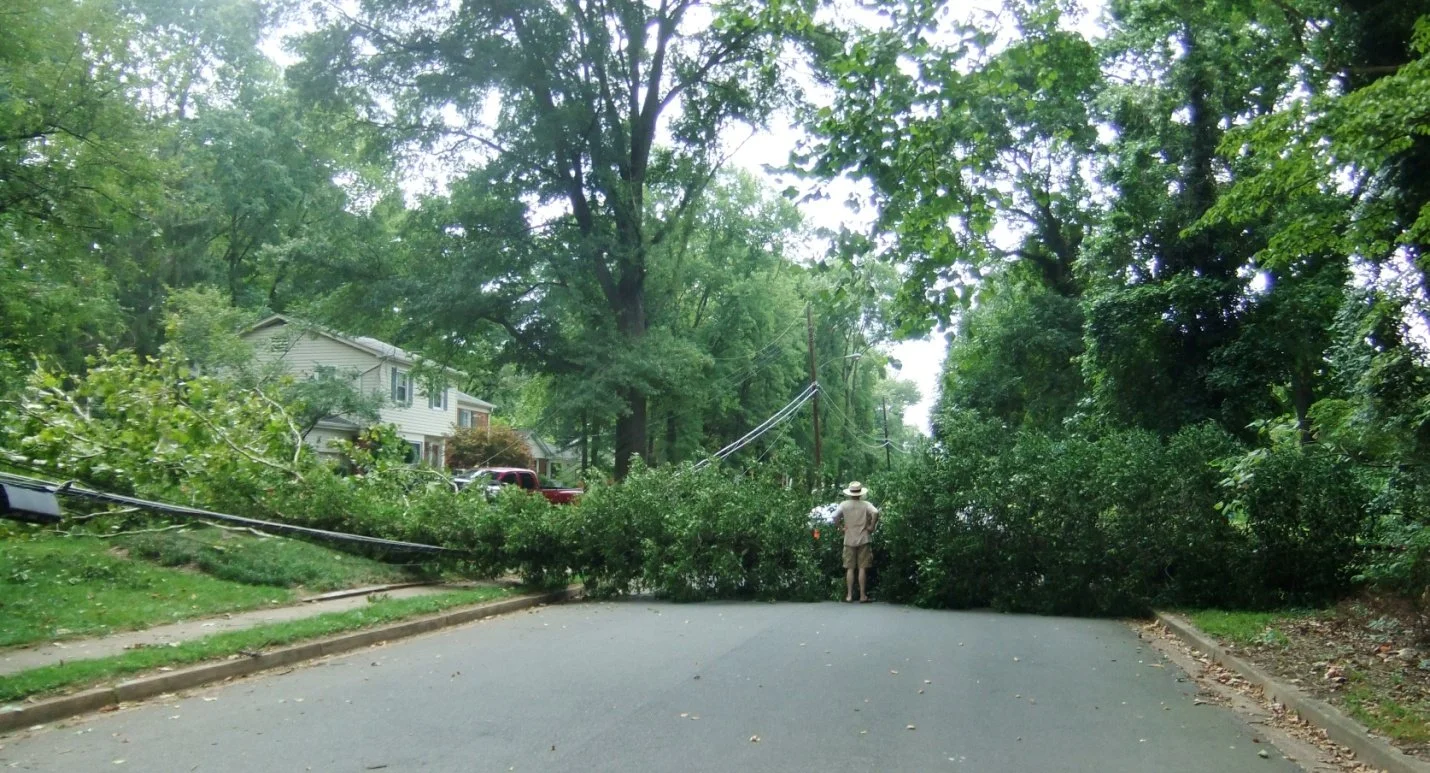
One hot August night several years ago, a Sycamore tree fell across the street a block from my house. It took out a pole as well as power, telephone, and cable lines. The street was blocked for a day, and many residents were without power for hours. For some residents, it was days before their services were restored.

Fallen Sycamore, Betsy Martin
Luckily, the tree was relatively young (about 40 years old, according to the tree service) and had not reached its mature size, so it did not fall on a house across the street in which four young children and their mother were sleeping. Because it was late at night, the streets were empty and no one was hurt by the falling tree or the downed power lines.
The tree was not dead or diseased. There was no storm or big wind. According to employees of the tree service, the tree was brought down by the weight of English ivy that had grown almost to the top of the tree. (You can see it in the photo above.)
English ivy destroys trees and creates hazards. Its weight can bring a tree down, as happened in this case. In a storm, the ivy acts as a sail to uproot a tree, and ivy becomes even heavier with water trapped in its dense foliage. Ivy also traps moisture next to the tree’s trunk, and causes disease which creates habitat conducive to rats, and the spread of West Nile virus. It then displaces native plants that benefit wildlife, and creates a food desert—native insects cannot eat it and so birds cannot find caterpillars to feed their young in a forest smothered by ivy.
Ivy is an invasive exotic species that destroys trees and natural habitat.
Please, do not allow English ivy to grow up trees on your property, and if it has done so, take steps to remove it. (See below for guidance on removing ivy from trees.) The beauty of the numerous mature trees in our Northern Virginia neighborhoods depends on your interest in taking care of them.
Preventing ivy from growing up your trees is probably the single most important thing you can do to keep trees healthy—and safe.
If you’re concerned about ivy growing up your trees, first be sure it’s English ivy. Ivy is evergreen (stays green all winter) and has distinctive three-lobed leaves like this:
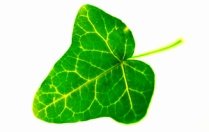
English Ivy leaf
Removing ivy from trees is simpler than you might think. You can get rid of the ivy in three fairly easy steps:
With big loppers, cut the ivy stems that are growing up the tree trunk. Cut them near the ground. For very thick stems, it may take a hand saw. Be careful not to damage the tree or its bark with the saw.
Next, cut the ivy stems about three feet above the ground. Make sure to cut all the ivy stems—don’t leave any growing up between the ground and the second set of cuts you’ve made.
The last step is to wait. The ivy will die, turn brown, and eventually fall from the tree. Don’t try to pull the ivy down—that is a lot of work, and can be harmful to the tree and dangerous to you, especially if you’re dealing with a large mass of ivy.
Eliminating ivy from around trees is the most helpful action you can take, because even if it is removed from trees, a stand of ivy near trees will eventually grow up. Ivy needs to grow vertically to set seed, and when it does, birds eat the berries and spread new ivy plants far and wide.
In addition to liberating your own mature trees from English ivy and other invasive vines, please consider joining up with other Tree Rescuers as part of the Plant NOVA Trees campaign. (The Tree Rescuers link has lots of good information about what to do about invasive vines, and how you can help your neighborhood preserve its trees.)
So much depends on the preservation of our native tree canopy. Native trees clean the air and water, store carbon, create shade that mitigates intensifying heat, beautify our yards and neighborhoods, and provide critical habitat for birds and other wildlife. It is at least as important to save the native trees we have as to plant new ones.