
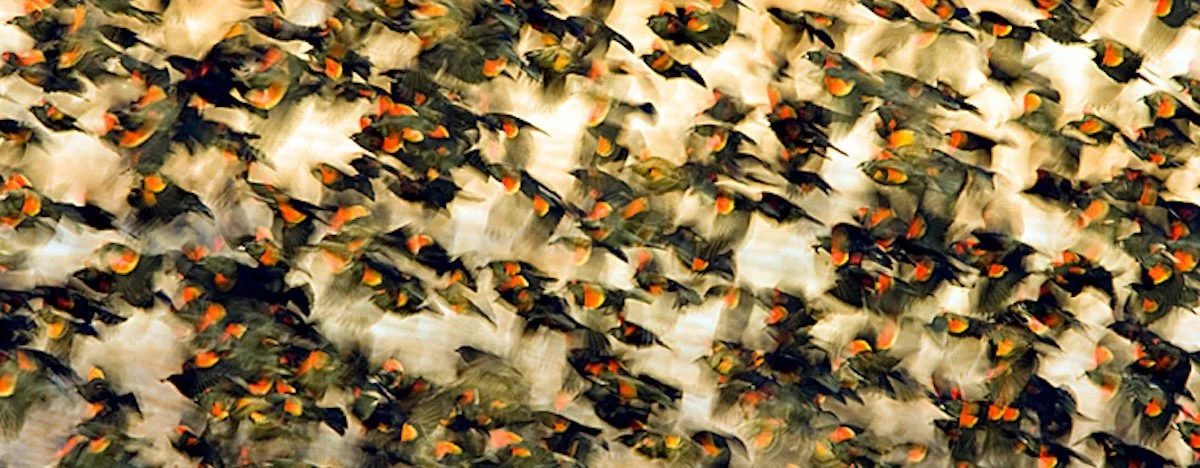
NVBA NEWS BLOG
Welcome to the blog for Northern Virginia Bird Alliance, a wealth of resources about northern Virginia birds, wildlife, habitat conservation and restoration, native plants, wildlife-friendly gardening, advocacy and more.

Keeping our wooded areas beautiful
If your community owns some wooded common land, or if you yourself own a wooded property, you may have noticed that the woods around here have been slowly changing, and not for the better.
Photo: Healthy woods, Margaret Fisher
Margaret Fisher
If your community owns some wooded common land, or if you yourself own a wooded property, you may have noticed that the woods around here have been slowly changing, and not for the better. They may still look green, but the devil is in the details: much of that “green” is now made up of invasive, non-native plants that damage the ecosystem and bring down the trees.

Margaret Fisher
Natural wooded areas are a beautiful and invaluable resource for any landowner or community. Unlike most material assets, they appreciate over time. They capture stormwater and keep our basements from flooding. They provide soundproofing and a visual barrier between properties as well as a place for us to walk and enjoy nature. They block the wind and lower heating costs in the winter. And, of course, they are the home to birds and other wondrous beings, who will need our help if their homes are not to disappear completely.
In the past, the woods managed themselves nicely. In present-day northern Virginia, at least some care is needed to keep the woods from degrading, turning an asset into an increasingly expensive problem. It is wise to make a forest management plan that looks ahead for twenty or twenty-five years. You can do this on your own, or you can call in a consultant to help you evaluate the situation and map out solutions to any problems. Professional assistance is available, as are volunteers from various programs including Tree Stewards, Master Naturalists, and Audubon-at-Home ambassadors.
The two biggest threats to our woods are invasive, non-native plants and browsing by deer. In many places, the deer have taken away everything except the mature trees and the invasive plants, not even leaving the seedlings that should be there to become the next generation of trees. Removing the invasives and protecting native plants from deer are the highest priority in most areas.
Some of our attempts to “improve” the woods may have the opposite effect. Woods do not need to be cleaned! The dead leaves and fallen trees are essential components of a healthy ecosystem. (Dumping extra leaves from your lawn damages that ecosystem, though.) Standing dead trees provide perches for birds of prey, nesting sites for songbirds, shelters for mammals, and food for thousands of species of insects. They are also becoming increasingly rare in our human-managed environment. Try to leave them standing, or, if they pose a hazard, just cut off the top and leave as much as you can standing.
For information about how to manage your woods, and how to help your community develop a long-term plan, see the Plant NOVA Trees website.

Spend Some Time with the Bird Migration Explorer—You Won’t Be Sorry
Fall migration through northern Virginia is by no means over, but the numbers of birds traveling to, as well as passing over and through, our area is on the decline. Some of us may now stop obsessively checking BirdCast daily to see what we may anticipate passing through overnight.
Photo: American Kestrel, Matt Felperin
Fall migration through northern Virginia is by no means over, but the numbers of birds traveling to, as well as passing over and through, our area is on the decline. Some of us may now stop obsessively checking BirdCast daily to see what we may anticipate passing through overnight. But, that doesn’t mean that we should stop obsessing about migration and the challenges it presents to North American birds.
The last few years have seen an explosion of data collection and data management tools that are giving us a more detailed view of migration than we have ever had before. The Bird Migration Explorer is an online guide to the journeys of 458 species of birds generated from data consolidated from multiple sources. It is available as a free interactive platform through National Audubon Society, but was developed through a partnership among Audubon and Birds Canada, Bird Conservancy of the Rockies, Bird Genoscape Project, BirdLife International, Cornell Lab of Ornithology, Esri, Georgetown University, Movebank, and the Smithsonian Migratory Bird Center.
Spend a little time on the site and you can see what information is available and how the information can help focus conservation and advocacy efforts in the North America.
Look, for example, at the maps for the American Kestrel, a bird facing significant challenges in our area because of vanishing meadows. The base map that underlies the migration and connection maps shows the bird’s summer, winter, and year-round ranges, information that is generally available from field guides, both printed and online. That data for the explorer comes from eBird at the Cornell Lab, BirdLife International, and Audubon.
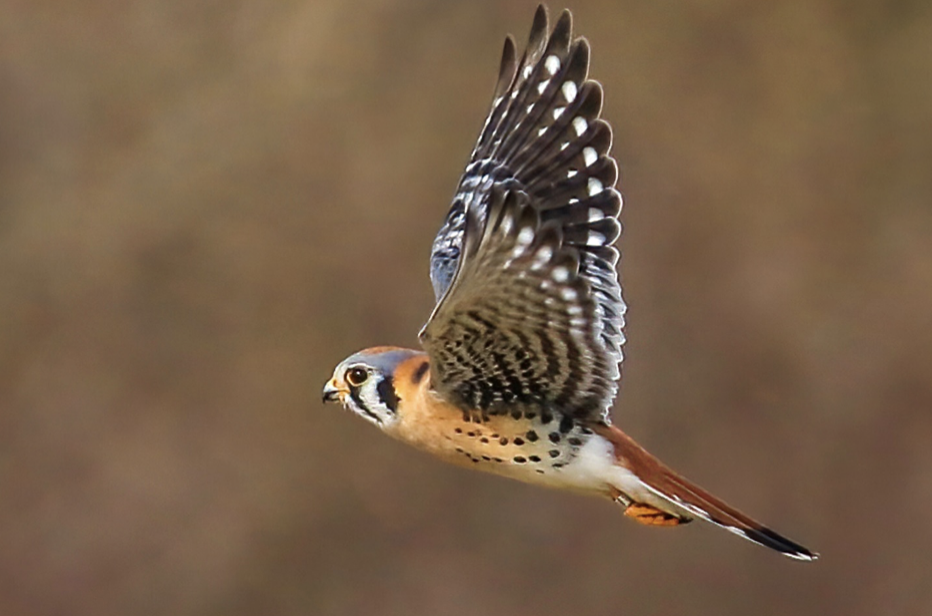
American Kestrel, Matt Felperin
But the migration map provides more. Overlaid on that base, using information from the same sources, is a graphical representation of abundance of the species throughout the yearly cycle. While the map shows moderate abundance in some areas of the country, it clearly shows the perilous state of the bird in our area. And what seems almost magical, the map includes the route of tracked birds: the routes are generated from two studies that tracked 10 individual birds, data shared by researchers and stored on Movebank and Motus. There’s also a link to a 2020 article about the species’ decline.
But there’s even more! Species connection maps show where tagged birds of one species have been re-encountered as they traveled across the hemisphere. Connections are derived from millions of re-encounter observations from tracking, banding, automated radio telemetry, and genetics data. A mouse click on a location displays the locations the species traveled to and the number of individuals that have traveled between the locations. The map shows birds from our area showing up further up the coast into Canada, down to the east coast of Florida, and inland to Georgia. The kestrel map shows connections for 1,943 individual birds, data from four studies stored on Movebank, the USGS Bird Banding Lab, Motus, and the Bird Genoscape Project.
But how does all this information help direct our conservation efforts? Click over to the conservation challenges maps and look for our area. The data for these maps come from weekly distribution data from Cornell’s eBird. The map provides a visual image of different challenges in the area throughout the year. Conservation challenges such as suburban development, roads, and power lines fluctuate in intensity during the year depending on the relative abundance of birds in the area—showing higher exposure and higher abundance during migration as birds pass through our developing landscape.
The data indicate that ASNV’s current focus on conservation and advocacy efforts is appropriate—that is, a focus on preserving and maintaining habitat, supporting wildlife corridors and responsibly sited bike paths, creating bird-friendly habitat in developed areas, encouraging developers to use bird-friendly glass in construction, educating the public about turning off lights during migration, and working to limit exposure of birds to predation by free-roaming cats. Those efforts can help our local wildlife as well as vulnerable migrants.
Another takeaway from the exercise of exploring the Bird Migration Explorer is the importance of citizen science to bird conservation. Identification of the relative abundance of birds throughout the calendar year and throughout the Americas provides the base for the migratory bird initiative. Continuing development of citizen science data, as well as analysis of the available data over time, also can show important trends that can further focus all of our efforts.
On the issue of changing trends over time, you can look forward to an article in next month’s Potomac Flier on the recently-updated State of the Birds Report 2022 (released on October 12, 2022). The report is available at StateoftheBirds.org. Until then, take a look at this month’s “President’s Corner” on how ASNV can use multiple data sources to focus its efforts on behalf of the birds and our local environment.
Enjoy exploring!

Christmas Bird Count
The 123rd Audubon Christmas Bird Count (CBC) will take place between this December 14 and January 5, 2023.
Photo: Winter Wren, Therese Scheller/Audubon Photography Awards
The 123rd Audubon Christmas Bird Count (CBC) will take place between this December 14 and January 5, 2023. General information about the CBC is available on the Audubon website.
ASNV sponsors the Manassas-Bull Run CBC, which will be held for the 41st year on Sunday, December 18. Those who participated in our count last December will to be contacted no later than Thanksgiving. Anyone who would like to participate in this count but did not participate last year should contact the compiler, Phil Silas, at epsdcva@aol.com, or 703-987-0817, as soon as possible but not later than December 8.
Information on other local CBCs that you may be interested in is available in the November 2022 issue of The Siskin, the newsletter of the Northern Virginia Bird Club. Look for the list on page 3.
If you have any questions or concerns about participating in this fun and very useful annual event, you can email or call Phil Silas.

Autumn Acoustics and Great Horned Owls
Autumn is in full swing. November and December are the best times to enjoy the beautiful sound of hooting, especially from Great Horned Owls (Bubo virginianus).
Photo: Great Horned Owl, Michael Rosenbaum/Audubon Photography Awards
Deidre Bryant
Autumn is in full swing. November and December are the best times to enjoy the beautiful sound of hooting, especially from Great Horned Owls (Bubo virginianus). Although they call a variety of wilder environments home, they can live among us on farms and in small woodlots and city and suburban parks. We can hear them most effectively now because the end of our calendar year is courting and territory setting time for Great Horned Owls, and late fall weather creates conditions that allow us to hear the birds’ calls better.

Great Horned Owl, Michael Rosenbaum/Audubon Photography Awards
The Great Horned Owl is probably one of the most recognizable birds in the Americas, with its large fluffy feathers, pointed tufts on its head, and unmistakable low, but soft call. A common hooting pattern is a longer “hooooooot,” followed by three or four shorter hoots. During a duet, females will reply to a male with a raspy hoot in a higher pitch. Great Horned Owls have a range of other vocalizations, too, some of which sound like a screeching cat. Despite their notable appearance and recognizable calls, they are not always easy to locate because of their nocturnal habits and preference for places with little to no light pollution.
Nevertheless, at the right location, and especially at this time of the year, you can hear a chorus of hoots piercing the night and providing an enchanting soundtrack from dusk till dawn. That’s because in November, male Great Horned Owls begin scouting and claiming vast territories (an average of about 1.5 square miles) around their nests. Come January, mating will already be underway and a pair will begin settling in their home. They do not build nests, instead typically taking over nests previously used by squirrels, red-tailed hawks, or other arboreal animals.
When I was much younger, I used to think owls only called during the cooler months and at night. Owls will actually hoot throughout the year and quite often, even when the sun is up. But, in many ways, it’s much easier to hear them on crisp, cold nights. If you’ve ever been to a night football game and listened to a marching band during halftime or when they’re in the stands, you’ll know exactly what I’m talking about. Sound doesn’t get louder as the air gets colder, but it travels farther.
Sound is carried by the collision of vibrating molecules in a longitudinal wave, and sound waves travel faster in warm air because warm air molecules are more energetic than cold air molecules. Faster moving molecules mean sound waves will, in fact, travel faster. Relative humidity also affects sound. Because increasing humidity lowers the density of air and its ability to absorb sound, sound waves move faster in high humidity than in low humidity. On the other hand, fall and winter conditions carry sound farther, even though it may travel more slowly. A number of fall conditions can cause this effect.
Temperature inversion. Sound moves in all directions from its source, including up. During cooler months, a layer of cold air sits under a layer of warm air, and the boundary between them refracts or bends the sound waves, redirecting them toward the ground. (Think of how a prism affects light.) When the sound waves oscillate, or move back and forth, between the cold and warm air layers, they are amplified and can be heard over a greater distance.
Leaf fall. The absence of leaves from deciduous trees and shrubs prevents sound from being dampened, allowing sound to travel farther.
Windy conditions. The wind on breezy days and nights also can refract or bend sound waves. Wind moves faster at greater heights because it encounters fewer obstacles. The difference in speed of the wind causes sound waves to bend towards the ground and travel farther when they travel with the wind (but upwards if they’re travelling against the wind). When an owl is hooting on a windy day, its hoots travel farther downwind than on a still day.
The fall acoustics help owls claim and hold nesting territory. The distance sound travels in some fall conditions allows hooting to be more effective in alerting intruders who enter a claimed territory or in signaling the presence of a threat to other owls. Better acoustics also facilitate courtship displays over long distances.
Of course, even without the assistance of fall conditions, territorial hooting, because it is generally very low-pitched, can travel farther without significant reduction. So why does low-pitched or deep sound travel farther? Pitch refers to frequency, and low frequency sound is from a sound wave that oscillates fewer times per second. Low frequency waves travel farther than high frequency waves because there is less energy from oscillation transferred to the medium (in this case, it’s air) allowing them to have relatively more energy left over to travel longer distances. Think of a fog horn, which produces a low-pitched sound.
If you’re interested in more than territorial hooting, here’s a link to an interesting article on the variety of owl vocalizations.
As with many birds, great acoustics are paramount in acquiring a mate and claiming territory. However, it’s quite fascinating how Great Horned Owls are able to take advantage of their cold, dark environment while other birds, who breed in the spring and summer, have migrated elsewhere. And, anthropomorphizing just a little, isn’t their calling out to a long-term (maybe life) mate over the miles just a little romantic?
Happy hooting season!

Observations from Meadowood: November 2022
Judy Gallagher continues to survey Meadowood Recreation Area. Here are some findings from her most recent survey.
Photo: Bold Jumper, Phidippus audax, Judy Gallagher
Judy Gallagher is an ASNV board member and a regular surveyor of local wildlife who also captures photos of what she sees, in particular the less common species.
Arachnophobes beware! This month's column is not for you. But if there ever were a spider that could charm its way into your heart, a jumping spider would be a likely candidate.

Sylvan Jumping Spider, Colonus sylvanus, Judy Gallagher
I really like them because they appear to interact with me - they don't seem worried that I am much bigger than they are. They have four sets of eyes encircling their head, two pairs pointing forward and two pairs pointing sideways and backward, so they can see almost 360 degrees. But different eyes serve different purposes. The central eyes see colors and recognize patterns and shape, while the other sets track movement. This is rather different from our eyes, which perform all the functions at once.
They can alter the pressure of their body fluid (hemolymph), which allows the spiders to jump well without having big legs like a grasshopper. Most jumping spiders can jump several times the length of their bodies.
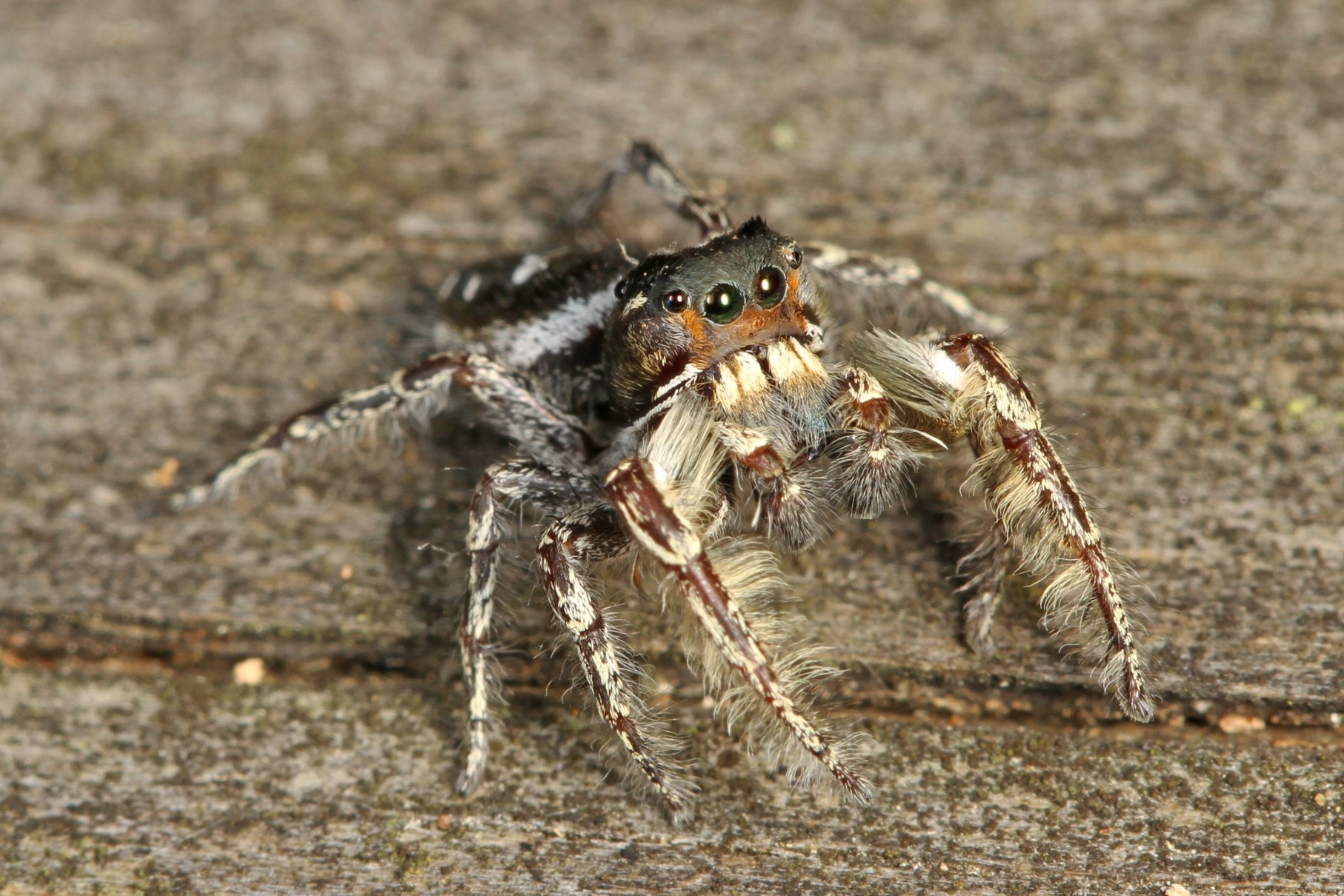
Phidippus putnami, Judy Gallagher
There are about 6,000 jumping spider species worldwide, and we have dozens of species in our area (some without common names), including some that are exquisitely hairy and others that are almost hairless.

Tan Jumping Spider, Platycryptus undatus, Judy Gallagher
Like other spiders, they produce silk, but they don't use it for prey capture. They will use a line to guide them back to their previous location and can spin elaborate creations in which to overwinter.

Sylvan Jumping Spider with Crane Fly, Judy Gallagher
But for capturing food, they rely on their excellent vision, sneaking up on and capturing their prey. This spider will dine well on a crane fly, an insect much bigger than it is. But jumping spiders can also be prey for other jumping spiders, birds, frogs, toads, and lizards.

Ant Mimic Jumping Spider, Synemosyna formica, Judy Gallagher
Some jumping spiders disguise themselves to look like ants which helps them to avoid predation by mantises, ants, other jumping spiders, and birds. Spiders have eight legs as opposed to ants' six legs, so the spider waves its front leg pair around to look like antennae rather than legs.

Gemmed Satyr, Cyllopsis gemma, Judy Gallagher
They are such good predators that at least one butterfly has incorporated a jumping spider as part of its protection against predation. The Gemmed Satyr, only found in the southernmost part of our chapter's area, has a distinct image of a jumping spider on its wing.

Bold Jumper, Phidippus audax, Judy Gallagher
If I haven't convinced you yet to like spiders, how could you resist this charmer, "smiling" at you with green "teeth"?
View all of Judy’s Observations from Meadowood articles here.

Monday Mystery - October 31
Monday Nature Mystery continues! Read on to learn who correctly identified our last mystery.
Photo: Rose-breasted Grosbeak, Dana Greindl/Audubon Photography Awards
We are pleased to announce the winner of last week’s Monday Nature Mystery, Cathy Crosby Grose!
Congratulations to Cathy for identifying the female Rose-breasted Grosbeak (Pheucticus ludovicianus).

Female Rose-breasted Grosbeak, Dana Greindl/Audubon Photography Awards
According to All About Birds, these birds build such flimsy nests that eggs are often visible from below through the nest bottom. The male Rose-breasted Grosbeak takes a turn incubating the eggs for several hours during the day, while the female incubates the rest of the day and all night long. Both sexes sing quietly to each other when they exchange places.
Each Monday we’ll post a new mystery and identify the previous week’s winner. They’ll receive an ASNV hat or tote bag.
Here is this week’s mystery:
Who was this? Happy Halloween!
Be sure to post your guess on our Facebook page under the latest Monday Nature Mystery post. Good Luck!
Please check our guidelines here.

Monday Nature Mystery: Who was this? Photo: Wikimedia user Sklmsta

The View from Hawk Mountain: Highlights from the ASNV Day Trip with Dr. Tom Wood
Fourteen participants met up at the Hawk Mountain Sanctuary Visitor Center on Saturday, September 18, 2022, to witness and learn about a migration hawk watch.
Photo: Broad-winged Hawks, Matt Felperin
Tina Dudley
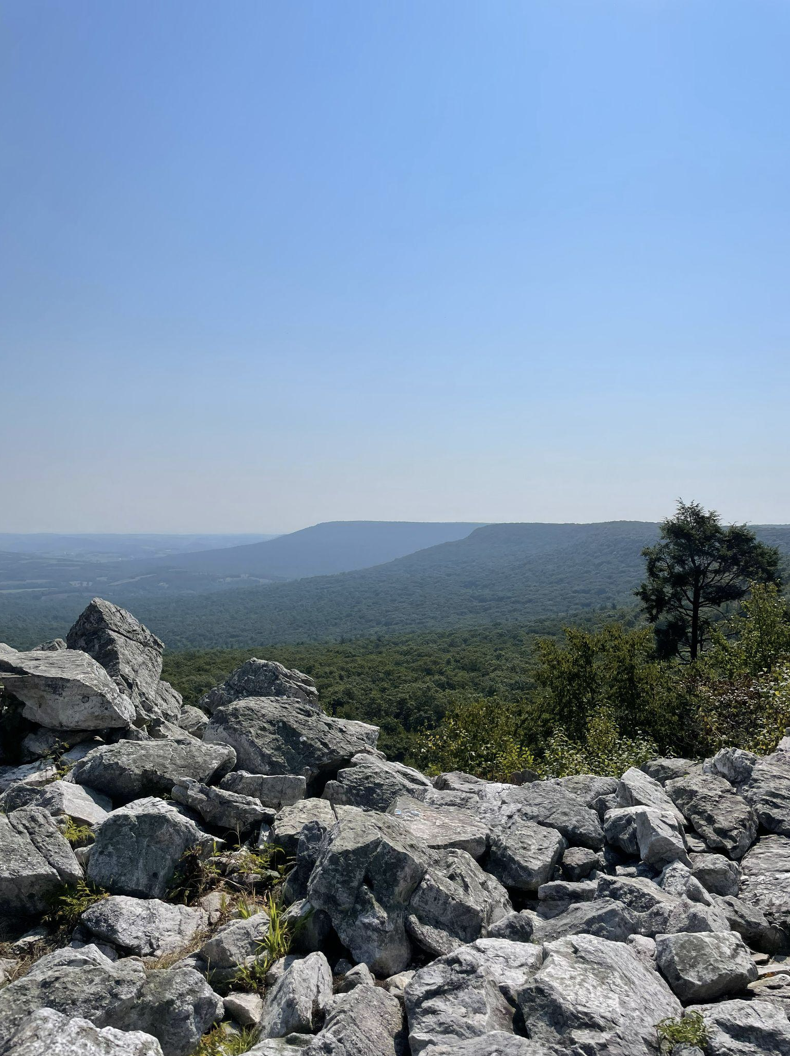
Hawk Mountain view, Sophie Bodrog
Fourteen participants met up at the Hawk Mountain Sanctuary Visitor Center on Saturday, September 18, 2022, to witness and learn about a migration hawk watch. The group was a lively mix of new and long-time ASNV members, including Nextgen members. Professor Tom Wood oriented everyone to what we would be seeing at the North Lookout. He explained what to look for and how to follow along with the hawk counters’ calls. He provided each participant with a helpful cheat sheet on what to look for in making an identification. He also explained how the weather could affect the number of hawks that might be on the move that day. Studies over time have shown that the number of migrants passing through can increase during the one to three days after a cold front.
The migration spectacle begins somewhat late in the morning, because ideal conditions occur when the sun heats the ground enough to cause rising currents of warm air. When warm air hits cooler air, the warm air rises up, forming thermals, which are like elevators to the hawks. When they catch one, they can soar up effortlessly, letting them then drift south from on high while they look for the next thermal. When the air is heating up in the morning the hawks circle one another, looking for a bird catching a thermal. A “kettle” forms when a number of hawks catch the same thermal, rising on the warm air in big circle.
The hike up was moderately challenging, but the view at the top was stunning. After we all got situated on various rocks, we were able to observe a distant kettle of Broad-winged Hawks. The photo of Broad-winged Hawks that accompanies this article is from a different hawk watch, but it’s a good image of what we were able to see. On a few occasions, a Broad-winged flew close enough to our lookout to give us a clear view of its distinctive black-and-white-banded tail and the dark border of its wings.
While we were at the North Lookout in the morning, we saw 30-40 raptors along with some resident turkey vultures. As Nextgen member Sophie Bodrog described it, “[K]ettles of Broad-winged Hawks began to form in the haze on the horizon. The specks appeared and disappeared in the clouds as they were buoyed by currents of rising warm air. In mere minutes, the birds would be gliding overhead, heading for the next thermal” to continue their journey. All About Birds reports that Broad-winged Hawks migrate an average of 4,350 miles to northern South America to over-winter, averaging 69 miles each day.
In addition to raptors, we saw an unsettling number of Spotted Lanternflies. We could see them in the air all across the valley in front of us. Dozens of them landed on us and skipped around the rocks we sat on. This invasive species can damage native plants, trees, and agricultural crops significantly. It has already been found in Loudoun County. Learn how to identify and combat this invader here.
Most of the participants were on the road back to Northern Virginia when a large number of hawks passed through later in the afternoon. Although it was frustrating to miss them, participants who came down from North Lookout before the busy afternoon were treated to an entertaining live raptor show in the Sanctuary’s amphitheater. Volunteers showed off two of the raptors cared for at the facility, an American Kestrel and an Eastern Screech-Owl. None of the resident raptors can be released because of injuries or, in the case of the Kestrel, its imprinting on humans instead of its parents.
Hawk Mountain Sanctuary was founded by Rosalie Edge in 1934 to combat the over-hunting of hawks on the Kittatinny Ridge. In the 85 years since its inception, Hawk Mountain has welcomed and educated thousands of visitors. Edge originally leased 1,400 acres for the Hawk Mountain Sanctuary Association, and it has since grown to 2,600 acres, with over 60,000 visitors per year and more than 9,000 members that keep the Sanctuary’s mission alive. The two Kestrel boxes ASNV is donating to encourage nesting birds at the Lorton Landfill come from the Sanctuary’s gift shop.

Committing to Diversity, Inclusion, and Access
The COVID pandemic and our resultant programmatic pause allowed ASNV to reflect and act on how we engage with all communities in Northern Virginia.
Photo: Outdoor Afro and ASNV at Huntley Meadows, Antonio Simmons
The COVID pandemic and our resultant programmatic pause allowed ASNV to reflect and act on how we engage with all communities in Northern Virginia. In particular, the Spring 2020 murder of George Floyd and the incident in Central Park involving NYC Audubon board member Christian Cooper brought into focus that racism is still present in our country and organizations.
There are multiple reasons to consider our organizational diversity and inclusion. First, and most important, it’s the right thing to do. ASNV’s mission is to serve all of the communities of Northern Virginia, providing all of them with access to nature and conserving nature to meet their needs. Second, if we are to address successfully the overwhelming problems of climate change, the stunning loss of 2.9 billion birds from the U.S. and Canada since 1970, and the challenges of rapid urbanization and habitat loss in our area, we need the involvement of all northern Virginia communities.
Where to start to solidify and improve our diversity efforts? Some believe that the first priority should be renaming our organization, thereby acknowledging John James Audubon’s racism. National Audubon Society, of which ASNV is a chapter, is considering that question now, but its decision is still pending. So far, ASNV has tentatively decided to await that outcome.
What could not wait was taking positive action to effect change in our own organization to become more inclusive. In planning how to move forward, we took to heart the words of Black American ornithologist Dr. J. Drew Lanham in his discussion of John James Audubon’s racism: “[M]any blind spots remain in the wake of a legacy that can either be ignored to a fate of stagnancy and decline or be learned from to move, with eyes wider open, toward a more equitable, just, and inclusive conservation future.”
Here are some highlights of what we have done since 2020 to move forward, “with eyes wider open”:
Formed a Diversity and Inclusion Committee to integrate and energize our efforts.
Expanded our Board of Directors to include members from diverse groups and perspectives.
Cultivated partnerships with like-minded groups for joint programming. Here are just two examples: We partnered with NOVA Parks and NAACP/Arlington to establish an ongoing, award-winning Black and Latin/Hispanic Bird and Nature Walks series at Upton Hill Regional Park. We partnered with the Public Education and Outreach Committee of the Arlington Regional Master Naturalists to operate programs to reach underserved, low-income families.
Improved outreach by engaging a variety of groups already connecting to diverse communities in ongoing activities. Examples include partnerships with NAACP/Arlington, NAACP/Fairfax, Black Women Hike, Outdoor Afro, and Asian-American seniors in HUD housing, with ASNV providing support and volunteers for regular walks, outings, and community events. We also developed and translated into Spanish materials that we used in events such as those during Latino Conservation Week.
Reached out to different age groups by enlisting volunteers in our programs, including Scouts, and, through our new program, NextGen Birders for Conservation, younger adults.
Improved inclusion in all of our programs: For example, our college interns in 2022, who came from or work with underserved communities, helped us develop materials for Spanish speakers, people on the autism disorder spectrum, and American Sign Language users.
Improved access for appreciating birds and other natural resources. For example, our members contributed over 80 entries to the crowd-sourced Birdability map, which describes the accessibility features of birding locations all over the world; provided links to public transportation to over a dozen eBird hotspots; promoted COVID-inspired Zoom programming to communities that had never participated in our events, reaching new audiences; and adding closed captioning to all of our virtual programs.
So, what’s next? We plan to expand on our efforts with our current partners; ensure that all of our program committees, from advocacy to citizen science and conservation are actively involved in diversity, inclusion, and access; expand the geographic range of our programs; and expand our work with youth and families.
We need help with all of these efforts. Please consider volunteering. It’s important and lots of fun.

Plant NOVA Trees – One Year On
September marks the first anniversary of the launch of Plant NOVA Trees, a regionwide effort by over a hundred local organizations and thousands of individuals to promote native trees and shrubs in Northern Virginia.
Photo: Peggychoucair via Pixabay
Margret Fisher
September marks the first anniversary of the launch of Plant NOVA Trees, a regionwide effort by over a hundred local organizations and thousands of individuals to promote native trees and shrubs in Northern Virginia. There is no regional tree planting agency that can do the job for us. Rather, it is up to each individual to look around to see how they can contribute, at home, at work, or on common land. Plant NOVA Trees connects people to the resources they need to do that.
There are many ways to participate. The simplest is to identify every appropriate site and plant young trees or shrubs there now, preferably canopy trees if there is room. They may not look like much the first couple years, but soon they will grow and provide shade and cooling for humans as well as shelter and food for our birds and butterflies. Information on how to choose and plant a native tree or shrub is available on the Plant NOVA Trees website. Fifty volunteers have visited local garden centers to hang thousands of tags on the native trees, making them easy to identify. (The same volunteers have been putting red stickers on all the native plants in those garden centers for several years.)
Each of our local jurisdictions and park services has tree planting plans for public lands. For example, the Prince William Soil and Conservation District has been working with 3rd and 4th graders to plant trees on school grounds. Kudos go especially to Purcellville, which planted 118,100 trees last year on former farmland that is owned by the town.
Members of local communities have also gotten together to plant trees in their common areas and to help residents plant on their own properties. So far, residents have self-reported 7,850 trees and shrubs on the Plant NOVA Trees website form. The Virginia Department of Forestry is collecting these figures as it works to meet its goal of 600,000 trees planted in Northern Virginia by 2025. This number is intended to help our region meet its obligation to protect the Chesapeake Bay, since runoff from roofs, roads and empty lawns is causing damage downstream, and trees are nature’s tool for capturing water. Those who appreciate our waterways should give careful thought to how they can contain stormwater on their own properties before it rushes off to erode our streams and dump sediment and pollutants into the Bay.
Despite all these efforts, Northern Virginia is gradually losing tree canopy. Multiple factors contribute to tree death. Some are hard to change on a local level, such as the stress on trees from climate change. Others are absolutely within our control, such as poor planting and mulching practices or the sacrifice of trees for more roads, buildings, and park amenities. Each native tree lost is one less home for birds and other wildlife as our local ecosystem suffers its death from a thousand cuts.
Invasive vines (as opposed to the beneficial native vines) pose another important threat to trees, and this has become one of the foci of the Plant NOVA Trees campaign. Volunteers for the new Tree Rescuers program spot trees that are at risk from English Ivy, Asian Wisteria, or other invasive non-native vines and drop off literature with the owners to alert them to the easily-mitigated problem. While they are at it, the volunteers count the trees at risk so we can get a more precise handle on where resources should be concentrated. So far, over two hundred volunteers have alerted 799 residents to 3,491 trees at risk in 4.2 square miles of residential properties. In addition, they have counted almost 22,000 trees at risk in 3.3 square miles of non-residential areas. The data collection is too preliminary to make an accurate extrapolation, but it would appear that the total number of trees in need of rescue in Northern Virginia’s 1,300 square miles may be in the millions.
There are numerous opportunities around Northern Virginia to help control these invasive vines by cutting them near the ground. Over 3500 trees have been reported as saved so far. Besides saving the trees on their own properties, volunteers can organize the work on common land within their communities or join the invasives management programs of the various park services, listed on the Plant NOVA Trees “Rescuing Trees” page. Residents and communities can obtain a permit to clip the vines on VDOT property. In general, though, the resources to control invasives on government-owned land and easements will need to come from the governments themselves (and ultimately from the taxpayers.) It is also critical that everyone stop planting invasive plants to begin with, not only the invasive vines but all the other invasive non-native landscaping plants such as Bradford Pears and Burning Bush that escape from our properties into natural areas.
Businesses have been helping with the regional tree campaign in several ways. Local garden centers are promoting native trees and shrubs in honor of Celebrate Native Trees Week (Sept 26-Oct 2). Landscaping companies are increasingly choosing native species, and a few have started to offer invasive plant removal services. Any company could educate its employees and customers and provide financial support to neighborhoods that need help with their open spaces. Those businesses that control property can plant and preserve native trees there, which in some places may mean tearing up concrete to make room.
So, what can you do to support the native tree campaign? Plant NOVA Trees is essentially an educational organization. The success of this initiative depends on the individual efforts of residents across the region. There is no shortage of ideas on how to get involved, whether where you live or work, or on a wider scale. Find these ideas on the Plant NOVA Trees website.
Plant NOVA Natives is the joint marketing campaign of a grand coalition of non-profit, governmental, and private groups, including ASNV, plus hundreds of individuals, all working to reverse the decline of native plants and wildlife in Northern Virginia. Our strategy is to encourage residents as well as public and commercial entities to install native plants as the first step toward creating wildlife habitat and functioning ecosystems on their own properties. All are welcome to participate in this collective action movement!
Plant NOVA Trees is a focused drive of the Plant NOVA Natives campaign to increase native tree canopy in Northern Virginia by encouraging residents and businesses to plant new trees and preserve the ones we already have.

Proposed Alpine-X Indoor Ski Resort Detrimental to Grassland Bird Habitat
People don’t typically think of landfills as birding hotspots, but southeastern Fairfax County’s Lorton I-95 Landfill Complex is one.
Photo: American Kestrel, David Zieg/Audubon Photography Awards
Jessica Bigger
People don’t typically think of landfills as birding hotspots, but southeastern Fairfax County’s Lorton I-95 Landfill Complex is one. Phil Silas, who leads bird walks throughout the region for both ASNV and the Northern Virginia Bird Club, observed that, when people think about landfills, they think they will find stinking mounds where there’s lots of noise, dust, and congestion from the trucks dumping garbage. However, he reported that the bulk of this landfill has been closed and capped for more than ten years, and most of the garbage that comes in is burned to produce energy at Covanta's on-site waste-to-energy facility, with the balance buried in other sections.
Because the county is no longer actively burying trash, the capped hills tucked between the Laurel Hills Equestrian Park and Occoquan Regional Park naturally become a meadow-like habitat, a rare oasis for a variety of grassland birds and birds of prey. I had an opportunity to take a tour of the landfill with Silas to see what makes this place such a desirable habitat for certain bird species. As we headed over to the landfill from the Laurel Hills Equestrian Park parking lot, Silas pointed to a tower at the Covanta plant, where a Peregrine Falcon was perched.
Before we could ride or walk on the landfill, we had to stop at the front office to sign the visitor log. It was apparent from the greetings by the staff that Phil is a regular here. During our drive up to the top of the hill, we spotted Wild Turkeys, a Grasshopper Sparrow, an American Kestrel, and a Mourning Dove. That’s only a fraction of the total number of bird species that visit the meadows. Over time, the area has become ideal habitat for grassland birds.

American Kestrel, David Zieg/Audubon Photography Awards
A Disturbing Luxury Ski Resort
Unfortunately, Alpine-X LLC is expected to apply for county permits to build an indoor ski resort on the very spot where Silas and I were standing. In addition to the indoor ski center, Alpine-X has plans to add an upscale hotel, a zip line, and possibly a waterpark. This development would eliminate the habitat these grassland birds depend on for nesting and food.
ASNV has already sent a statement to the Fairfax County Board of Supervisors expressing concerns about the environmental impacts of a development project of this size and kind. The developers began their talks with the county officials back in 2016 before submitting a proposal for the ski resort development in 2018. The first public hearing was in October 2020.
The negative impact to the local environment promises to be significant, a point that Alpine-X disputes. The facility could have a high energy demand to make snow and keep it cold year-round. The facility also will need lots of water for the snow, as well as to meet the operating needs of a luxury resort. Alpine-X has asserted that it will offset energy requirements with renewables, but has provided no specific information, and it has not fully explained the source of the needed water. Increased traffic to the site, especially on I-95, will create more greenhouse gas and other pollution. Although county officials maintain that methane gas emissions for the capped landfill have decreased over time, Alpine-X has not explained how it will avoid releases to the atmosphere from construction disturbing the landfill.
From an environmental perspective, one of the most significant adverse effects would be the loss of meadow habitat and the natural resources that depend on it. Since 1970, we have lost more than half of the grassland birds from the US and Canada. Most grassland and meadow habitats have been destroyed or degraded in Northern Virginia, so even though this is a landfill, it represents rare habitat among our increasingly compromised natural resources.
Meadows and grasslands attract a variety of insects that grassland birds feed on and provide prime nesting habitat and protection from predators. Some grassland insects only feed on specific plants, but there are others, like grasshoppers, that are generalists. Many ground-nesting birds eat these insects.
Judy Gallagher, ASNV’s expert on insects, who writes the monthly “Observations from Meadowood” feature of the Potomac Flier, explained why the landfill is so valuable: “For a meadow to be useful to ground birds you need [at least] 20 acres. That’s why the landfill is pretty cool, . . . [because there] is a fairly good-sized area that is undisturbed in the capped part of the landfill. So, insects thrive there and therefore so do Kestrels and other bird species.” ASNV recently acquired two Kestrel nest boxes that a volunteer will install at the landfill.
The meadows in the Lorton Landfill also attract Monarch Butterflies, which are listed as endangered by the International Union for Conservation of Nature. The meadow provides them an abundant source of the milkweed that they need for food. The meadow also is a source of plants in the pea family, which sulfur butterflies depend on.
If this indoor ski resort is allowed to move forward, it will be a great loss to our local grassland birds and the insects who use the meadows, not to mention other forms of environmental degradation a ski resort will bring. ASNV is working to prevent this massive development. ASNV and other natural resource organizations have urged Fairfax County to require a comprehensive environmental impact study, including a survey of existing plant, insect and other natural resources, before approving this controversial project. Watch for alerts from ASNV, and please tell your elected officials now to oppose it.

World Shorebirds Day
World Shorebirds Day, an event sponsored by the Shorebird Conservation Society, was September 6th. Around this time people around the world celebrate the planet’s shorebirds, including by participating in the Global Shorebird Count.
Photo: American Avocet, Georgy Semenov/Audubon Photography Awards
Deirdre Bryant
World Shorebirds Day, an event sponsored by the Shorebird Conservation Society, was September 6th. Around this time people around the world celebrate the planet’s shorebirds, including by participating in the Global Shorebird Count, an annual event since 2014. This year’s count took place September 1-7, and data collected by volunteers was entered into eBird. The information collected from tens of thousands of volunteers is used to track population abundance and distribution, which are fundamental to the assessment of their status. Trends identified in repeated citizen science projects like this help determine whether a population of a bird species is declining or increasing, or is in need of coordinated conservation efforts.
But before we talk more about the count, let’s review what a shorebird is. They are sometimes thought of as any bird that visits the coastlines of the sea and large lakes, but the term isn’t quite accurate. The term “shorebird” actually describes a member of the order Charadriiformes, which includes birds such as sandpipers, plovers, snipe, and avocets, among others. While “shorebird” is a colloquial term, it has gained popularity to describe the species in that order. Besides the beach, you can find them in saltwater wetlands, tidal lagoons, brackish impoundments, mudflats, flooded pastures, and even evaporation ponds. But they also can be an upland species. The Killdeer is a good example. It is a very common, large plover that can be found on the beach, but also is commonly found on lawns, golf courses and farms.

American Avocet, Mary D’Agostino/Audubon Photography Awards
As for what shorebirds look like, they come in many shapes and sizes but many have relatively long legs, a round head, and a long bill used to probe the sand, mud, gravel and water for food. Their diet consists of mollusks, worms, larvae, tadpoles, and small fish. Common threats to shorebirds include climate change (such as from storms affecting nest sites), coastal development, pollution, and egg predation (by rats, foxes, and raccoons). Another unfortunate threat is the unintentional trampling of camouflaged eggs by people or their beach vehicles.
Many individuals in the United States, specifically in Maine, Massachusetts, Connecticut, and New Jersey on the east coast, and California, Oregon, and Idaho in the west, have submitted checklists on eBird for the Global Shorebird Count; however, there have been only two locations in Virginia surveyed (as of the 2021 count), suggesting that the Global Shorebird Count is not well known here. If you are interested in participating in next year’s count, Chincoteague, Wallops Island and Kiptopeke are terrific spots for observing shorebirds in Virginia. There are also many spots closer to home in Northern Virginia where shorebirds stop off during migration, such as Huntley Meadows Park in Fairfax County.
Participating in citizen science projects can help conserve birds and other natural resources, but other everyday actions are just as or more important to preserving habitat for future generations of shorebirds.
When in a shorebird area, properly dispose of your garbage or take it with you to avoid attracting predators such as gulls, raccoons and rats, which may come for the trash and then move on to prey on shorebirds and their eggs.
Never release balloons anywhere! Birds can become entangled in the ribbon when the balloon comes back down, and some marine life can ingest the balloons and die. Scroll down on this Clean Virginia Waterways site for information on alternatives to releasing balloons at celebrations.
Watch where you step. Again, shore-nesting birds lay their camouflaged eggs directly on the sand (or rock or caliche paths or parking lots). Next spring and summer, pay attention to signs to avoid areas where eggs are likely to occur, and never enter roped off areas or areas where large congregations of birds occur. Birds will vocalize loudly or dive-bomb you if you enter a nest area. Killdeer also are famous for feigning injury to steer you away from their nests.
Finally, if a location is barred because coastal habitat rehabilitation is underway, respect the signs and do not trespass.
If you missed World Shorebirds Day, there is still plenty of time to plan a weekend trip to Virginia’s eastern shore or Cape May to catch some of the migrating birds skittering along the sand before the season is over. If you plan on visiting the beach this fall for World Migratory Bird Day (which is on October 8th this year), you are likely to find American Avocet (shown in the photos in both breeding and non-breeding plumage), Semipalmated Plover, Greater and Lesser Yellowlegs, Willet, Dunlin, Least Sandpiper, Short-billed and Long-billed Dowitcher, Black-bellied Plover, and American Oystercatcher. Make sure you share your findings on eBird!

Wildlife Rescue
Do you know what to do if you find an injured wild animal? When ASNV receives calls about injured or orphaned birds, we refer the calls to the Wildlife Rescue League.
Photo: Rescued Barred Owlet, Jill Spohn
Jill Spohn
Do you know what to do if you find an injured wild animal? When ASNV receives calls about injured or orphaned birds, we refer the calls to the Wildlife Rescue League (WRL), a non-profit organization operating in Northern Virginia that is dedicated to providing care for sick, injured and orphaned wildlife, with the intent of releasing them back into their native habitat.
Rescued Barred Owlet, Jill Spohn
If you find an animal that you believe is orphaned or in distress, first check WRL’s Animal Help Tips page to help determine whether to call WRL. WRL has a network of partner veterinarians and permitted wildlife rehabilitators, along with other volunteers who answer the helpline (703-440-0800) and transport wildlife. When a call comes into the helpline, a volunteer takes the call and assesses the situation, sometimes providing advice on reuniting orphans with parents or, at other times, locating care for an injured animal or resolving a wildlife conflict. If an animal does need help, the typical first step is to have the caller, often the person who found the animal, transport it to a wildlife veterinarian for assessment.
If the prognosis is good, the helpline volunteer then looks for a rehabilitator that works with that type of animal. The helpline volunteer then arranges for a volunteer transporter to pick up the animal and drive it to the available rehabilitator. Rehabilitators are permitted by the Virginia Department of Wildlife Resources. There are various categories of permits, including for apprentices and care providers. It typically takes years to become trained and permitted at the highest level. Rehabilitators are not funded in any way by the state, but do accept donations. A volunteer transporter does not need an individual permit but has to operate under the authority of a permitted organization or hospital.
I am a volunteer Ambassador with the ASNV’s Audubon at Home Program, and I also volunteer with WRL as a transporter. Another organization in the area that I work with is Animal Education and Rescue Organization (AERO), founded by Olivia LoBalbo. In cases where someone who has found an animal needs assistance in capturing it for transport, I have worked with Mark Khosravi with the K2C Wildlife Encounters organization. There also are several specialized wildlife centers in Virginia. The closest one to Northern Virginia is the Blue Ridge Wildlife Center in Boyce, VA, a wildlife teaching hospital.
A spoiler alert here: for those of you who despise Snapping Turtles (Chelydra serpentina) because they sometimes eat ducklings (as do raptors), I suggest you read no further. If you are willing to accept that these fearsome turtles are part of our natural environment in Northern Virginia and want to know what a volunteer transporter does, please read on.
During a recent WRL transport shift, I took a snapper from the Blue Ridge Wildlife Center to where it had been found, along Russell Road on the Quantico Marine Corp Base (QMCB). The entire operation took almost six hours. The Wildlife Center veterinarian put the turtle’s large box into my car and pointed out the release location written on top. All turtles must be released where they were found. I could read some of the words, but not all. I asked how to release the turtle, ever mindful of the snapper’s big, powerful bite. The veterinarian suggested tilting the box slowly and letting the turtle adjust. She assured me that when the turtle saw freedom it would move in that direction and not turn around to bite me!
After driving 170 miles through several hair-raising thunderstorm cells, I arrived with the turtle at the QMBC commissary gate. After giving up my driver’s license, returning to the visitor center for a pass and back to the gate again, it was finally time to release the turtle—but where? QMBC is huge. I asked for hints on the release location, and the guards deciphered the words on the box as the Raymond Davis Center (RDC). Although they were in charge of security, they did not ask me to open the box so they could verify its contents. They, too, were aware of the snapper’s reputation.
There was no water body to be seen at the RDC parking lot, but I saw a large body of water south of Russell Road and headed that way. I parked near an embankment leading towards the water. Thankful the rain had stopped, boxed turtle in hand, I walked several hundred yards on a gravel path to find a flat, happy-snapper spot only 20 yards from water. I put on my elbow-length, leather gloves even though the veterinarian assured me my cargo would just break for the water. And it did! Mission accomplished. You can see the evidence from the photos: turtle in the box, turtle on the ground.

Rescued Snapping Turtle, Jill Spohn

Rescued Snapping Turtle released, Jill Spohn
Transporting the Snapping Turtle is just one of my most recent missions. Over the last few years, I have also transported a heron, owls, hawks, osprey, a vulture, crows, many passerines, box turtles, a red-bellied turtle, many snakes, many squirrels, a chipmunk, rabbits, raccoons, and even mice.
I find volunteering to assist injured wildlife very rewarding. I have met wonderful people who give their time, energy, and financial resources to provide wildlife a second chance within our shared habitats and dwindling natural areas. If you are interested in volunteering or donating, please go to https://www.wildliferescueleague.org/ or https://aeroanimalrescue.org/.

Monday Mystery - September 26
Monday Nature Mystery continues! Read on to learn who correctly identified our last mystery.
Photo: Sachem Skipper, Fred Siskind
We are pleased to announce the winner of last week’s Monday Nature Mystery, Marjorie Sieb!
Congratulations to Marjorie for identifying the Sachem Skipper (Atalopedes campestris).

Last Week's mystery: Sachem Skipper (Atalopedes campestris). Photo: Fred Siskind
Skippers are named for their quick, darting flight habits. According to Butterflies and Moths, these common butterflies lay their eggs on grasses. They do well in disturbed, open areas such as roadsides, landfills, pastures, meadows, fencerows, yards, parks, and lawns.
Each Monday we’ll post a new mystery and identify the previous week’s winner. They’ll receive an ASNV hat or tote bag.
Here is this week’s mystery:
Who is this?
Be sure to post your guess on our Facebook page under the latest Monday Nature Mystery post. Good Luck!
Please check our guidelines here.

Monday Nature Mystery: Who is this? Photo: Judy Gallagher

Turn Your Lights Out to Protect Fall Migrants
Fall migration is expected to peak from September 15 to November 3 in the northern Virginia area. You can help protect the hundreds of millions of birds that are expected to fly over our area by turning off or dimming non-essential lighting during critical migration periods.
Photo: AdinaVoicu via Pixabay
Ines Nedelcovic and Robin Duska
Fall migration is expected to peak from September 15 to November 3 in the northern Virginia area. You can help protect the hundreds of millions of birds that are expected to fly over our area by turning off or dimming non-essential lighting during critical migration periods. Type your location’s name into BirdCast’s local migration alert tool to see how many birds are expected to fly over on any given night. If the tool indicates migration is expected to be “High,” please turn off any nonessential lights that would be visible to birds, including outdoor lights and, if you have access, those in tall office buildings.
Turning off or dimming non-essential lighting during critical migration periods drastically reduces bird deaths, because artificial light can attract, confuse and disorient migrating birds by competing with the natural nighttime light from the stars and the moon by which the birds navigate. Disoriented birds exhaust themselves and also can collide with buildings. Hundreds of millions of birds die in collisions with buildings annually, including many species of high conservation concern.
Lights Out efforts to attack this problem are underway in over 30 North American cities. Learn more about what you can do from this information from the International Dark Sky Association and National Audubon. More information on migration in your area is also available from the BirdCast Migration Dashboard. BirdCast applies weather surveillance radar to gather information on the numbers, flight directions, speeds, and altitudes of birds aloft in order to expand the understanding of migratory bird movement.

Illustration reprinted with permission from the Cornell Lab of Ornithology. Learn more and see when bird migration is happening in your area, with forecasts and real-time bird migration maps at Birdcast.info.
Read our article on Lights Out here.

UPDATED: How to Set Up a Mosquito Larvae Trap and New Mini Trap
Just updated with questions and answers and new photos! Here’s an effective alternative to harmful mosquito spraying, as suggested by Doug Tallamy. Jill Spohn takes us through the steps of building your own mosquito larva traps at home.
Photo: Mosquito larvae traps, Jill Spohn
August 28, 2021 (Updated June 4, 2025)
Jill Spohn
Douglas W. Tallamy, an entomologist at the University of Delaware and author, suggests controlling mosquitoes at the larval stage instead of the adult stage. As he says in his book, Nature’s Best Hope, page 210:
Oppose mindless mosquito spraying by your township or HOA. Contrary to what the fogger operator may have told you, the pyrethroid-based insecticides used by mosquito foggers indiscriminately kill all insects, not just the mosquitos. Ironically, targeting adult mosquitos is the worst and by far the most expensive approach to mosquito control, because mosquitos are best controlled in the larval stage. Put a five-gallon bucket of water in a sunny place in your yard and add a handful of hay or straw. After a few days, the resulting brew is irresistible to gravid (egg-filled) female mosquitos. After the mosquitos have laid their eggs, add a commercially available mosquito dunk tablet that contains Bacillus thuringiensis (Bt), a natural larvicide, to your bucket. The eggs will hatch and the larvae will die. This way, you control mosquitos, and only mosquitos, without the use of harmful insecticides.
Insects are at the base of the food chain and, without them, birds and other creatures are challenged to find enough food for themselves and their young. When they eat sprayed insects, the insecticide can build up and affect their health and the insecticide remains in soil and water. Based on NVBA Wildlife Sanctuary Program research, it is clear to us that fogging chemicals are bad for our environment and critters. Our To Spray, or Not To Spray brochure summarizes that research.
There is an effective alternative to harmful mosquito spraying – reducing standing water on your property and building mosquito larvae traps. The most effective control of mosquito populations is at the larval stage, not the adult stage of their life cycle. The University of Maryland Extension provides advice on mosquito life cycle and control at home here. Note that you must eliminate standing water and monitor; here is a good checklist from Montgomery County.
A mosquito larvae trap works because adult mosquitoes are drawn to a fermenting solution and lay their eggs. An added Mosquito Dunk®, or similar product that releases a selective bacterium, affects only the mosquito larvae. Do NOT use Mosquito Bits® (they are quick kill and do not have the slow release that you need).
I have tried this Do-It-Yourself (DIY) method at home in Northern Virginia and in Maine and have seen an impressive lack of mosquitoes and pleasant times outdoors. Dr. Tallamy reviewed these instructions and we have updated them based on his feedback and our own and others’ experience below.
There are also commercially-available traps listed below.
How to Make Your Own Mosquito Larvae Trap: Instructions for the Original Bucket Trap
What you need:
Bucket
Straw or Hay - Dried; or Dried Leaves or grass (not freshly-picked green grass or leaves)
Water – funky water from a rain barrel would also work, says Tallamy
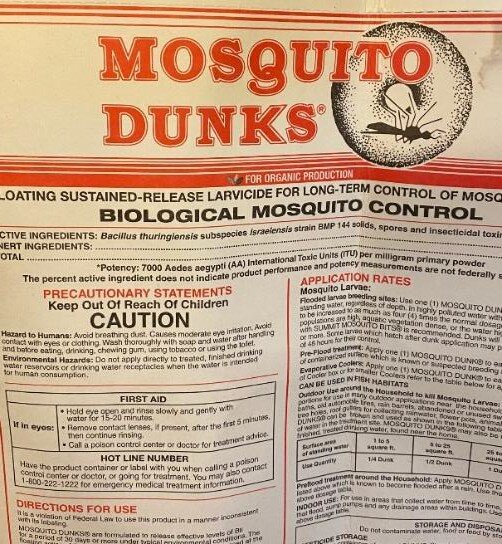
Mosquito Dunk® or another brand containing Bacillus thuringiensis (Bti) - for a surface area under 5 square feet, use at least a 1/4 of a Dunk
Chicken Wire or similar screening – or critter escape ramp (such as a stick).
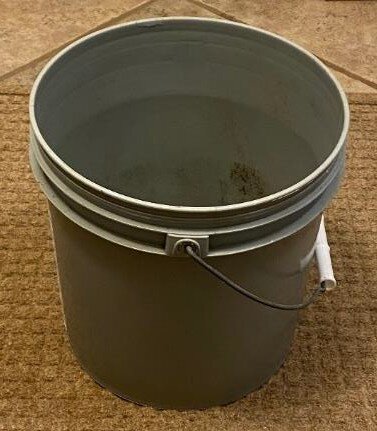

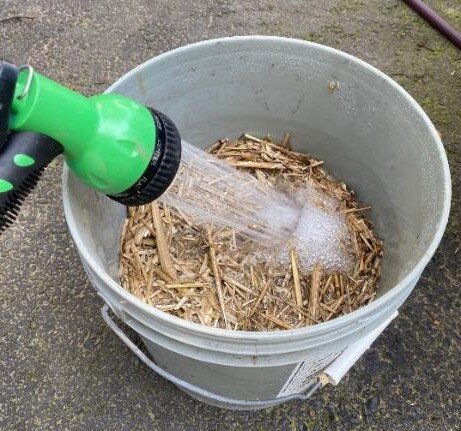
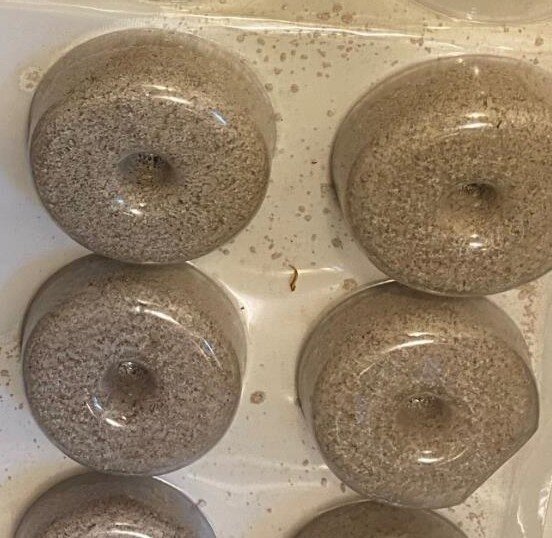
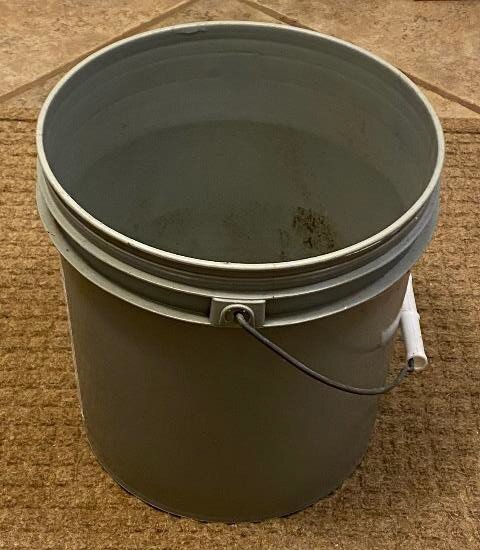
1. Use an empty bucket.
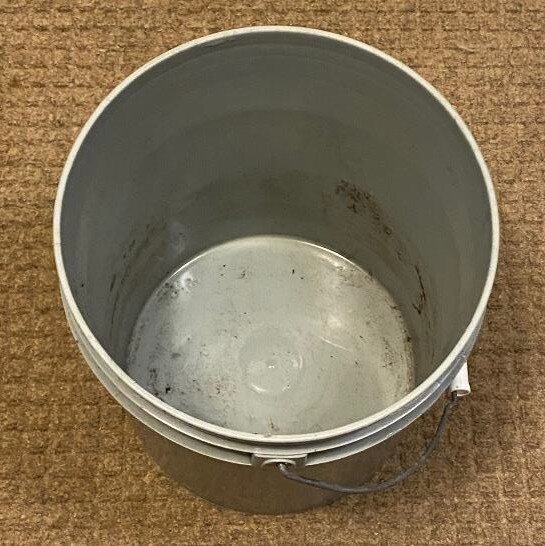
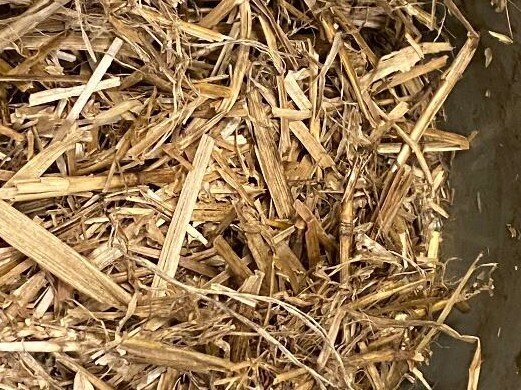
2. Add dried organic matter to the bucket. I used 3 or 4 handfuls here – 3 or 4 cups. I use hay in these photos.
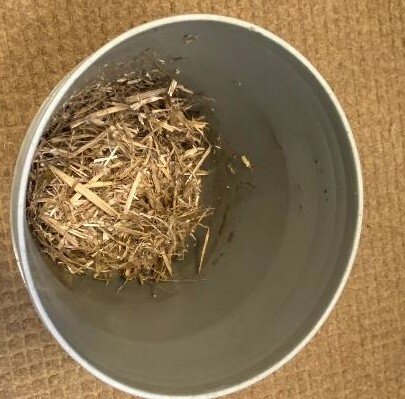
3. Add water to the bucket. I fill the bucket up halfway. My ratio of hay to water is about 1 to 4.
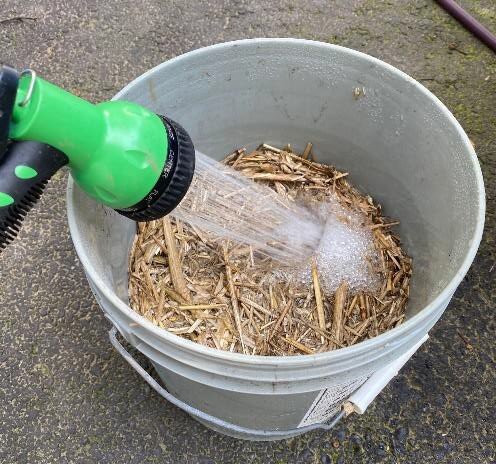
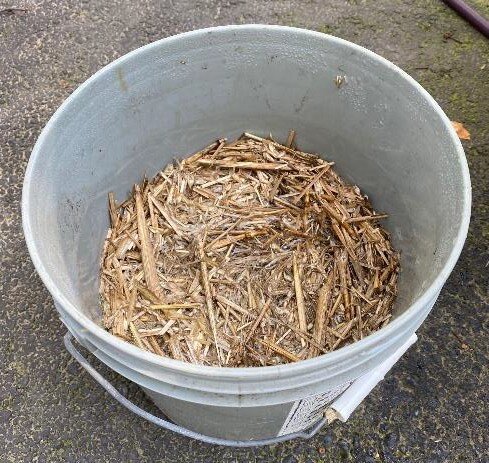
4. Allow the water and organic matter to ferment for a few days. I usually let it sit for 3 days but if it’s hot, you probably need less time. (Add a cover or a critter escape ramp.)
5. After 3 days, the mixture has fermented. Add the Mosquito Dunk®. Summit Chemicals recommends at least a 1/4 of a Dunk for under 5 square feet of water surface area.
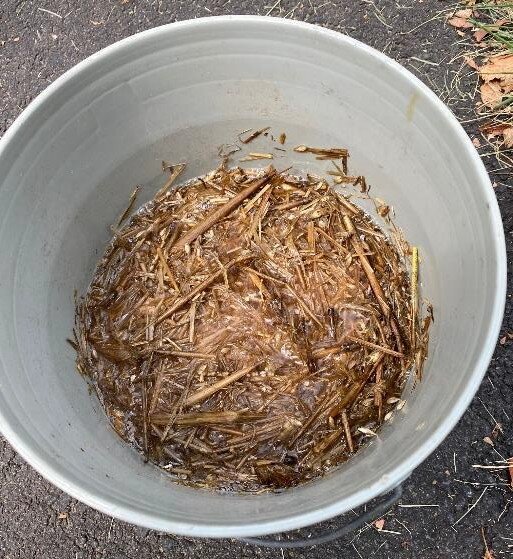
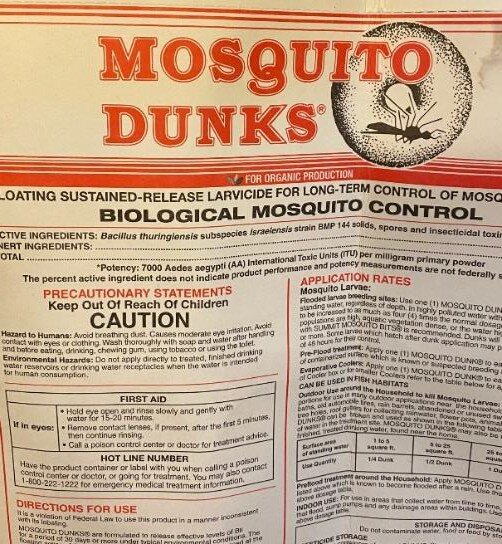
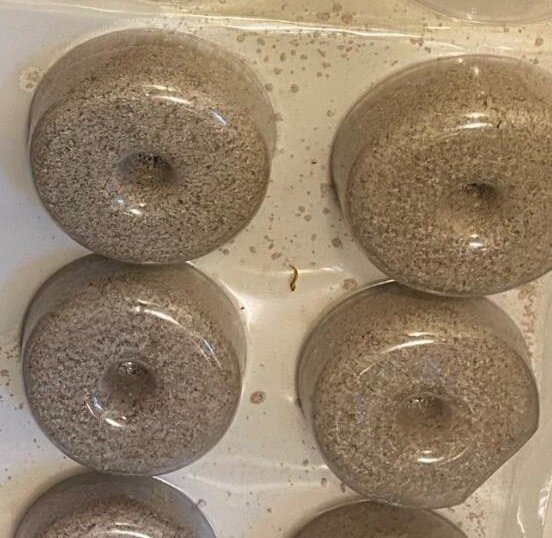
Place Mosquito Dunk® in the bucket on top of the fermenting solution. Dr. Tallamy may know when a mosquito has laid eggs, but I don’t. I place the Mosquito Dunk® in right before I set the trap.
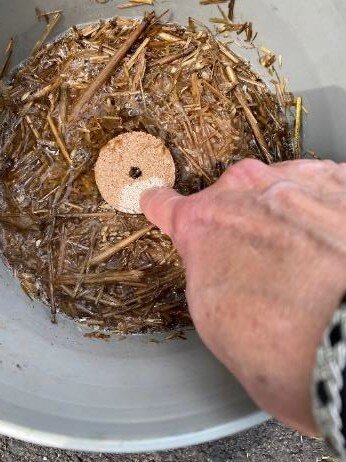
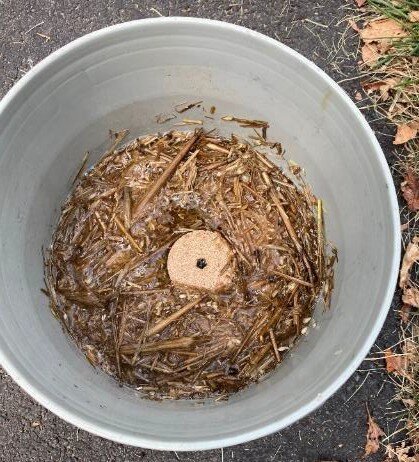
6. Cover the bucket with chicken wire or similar screening that allows adult mosquitos into the solution, but keeps other critters out. Be careful of the sharp points on the chicken wire. Some people use sticks that can be placed in the bucket to be used as an escape ramp for critters.
7. Set in place. Dr. Tallamy recommends a sunny spot but I have placed it in dappled shade with good results. The Mosquito Dunk® lasts for about a month and I replace the solution after about 3 or 4 weeks.
I try to put the traps away from where we have had mosquito issues and keep them out of the way of our dogs. They should be out of the reach of children as well. Based on feedback and experience, I have moved the buckets farther away from people; for example, underneath the deck rather than on the deck and at the edge of the woods rather than close to the patio. See the FAQs for additional placement information.
In recent testing, I feel that the traps in shady areas have more mosquito activity with eggs and larvae.
8. Monitor Occasionally. I have not drilled drainage holes in the side of our buckets, thus when we get significant rains, I will ensure that the buckets are not overflowing. I will drain out some water when they are too full. I have only needed to do this a few times over the years. See the Commercially Available Trap section for a Maintenance Tracking Sheet.
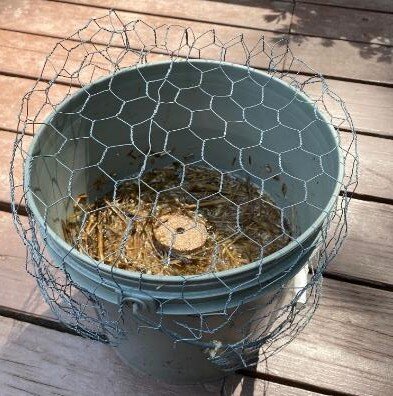
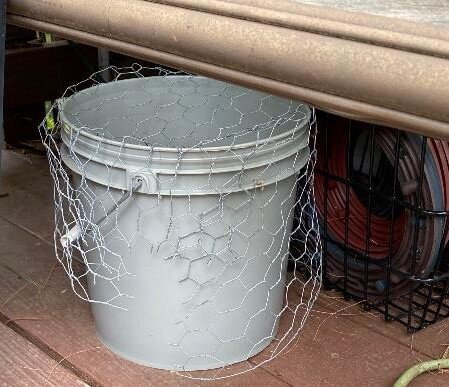
I hope you will give all non-insecticide mosquito control methods a try. They really work, and limiting insecticide use is critically important.
Jill’s Mosquito Larvae Trap - With Bucket and Hydroponic Lid
I have tried to improve the appearance of the mosquito traps I use at home. I found plain, white 3.5 gallon food-safe buckets (with handles) that I use with a black hydroponic growing lid (snaps on to secure in place). I got sets of 6 for our home. I use 2 underneath our deck, 2 at the edge of the woods, and 2 on either side of our covered porch. I use a lid to try to keep our dogs out of the solution and to make sure that chipmunks and such do not get trapped in the solution.
Here are photos:
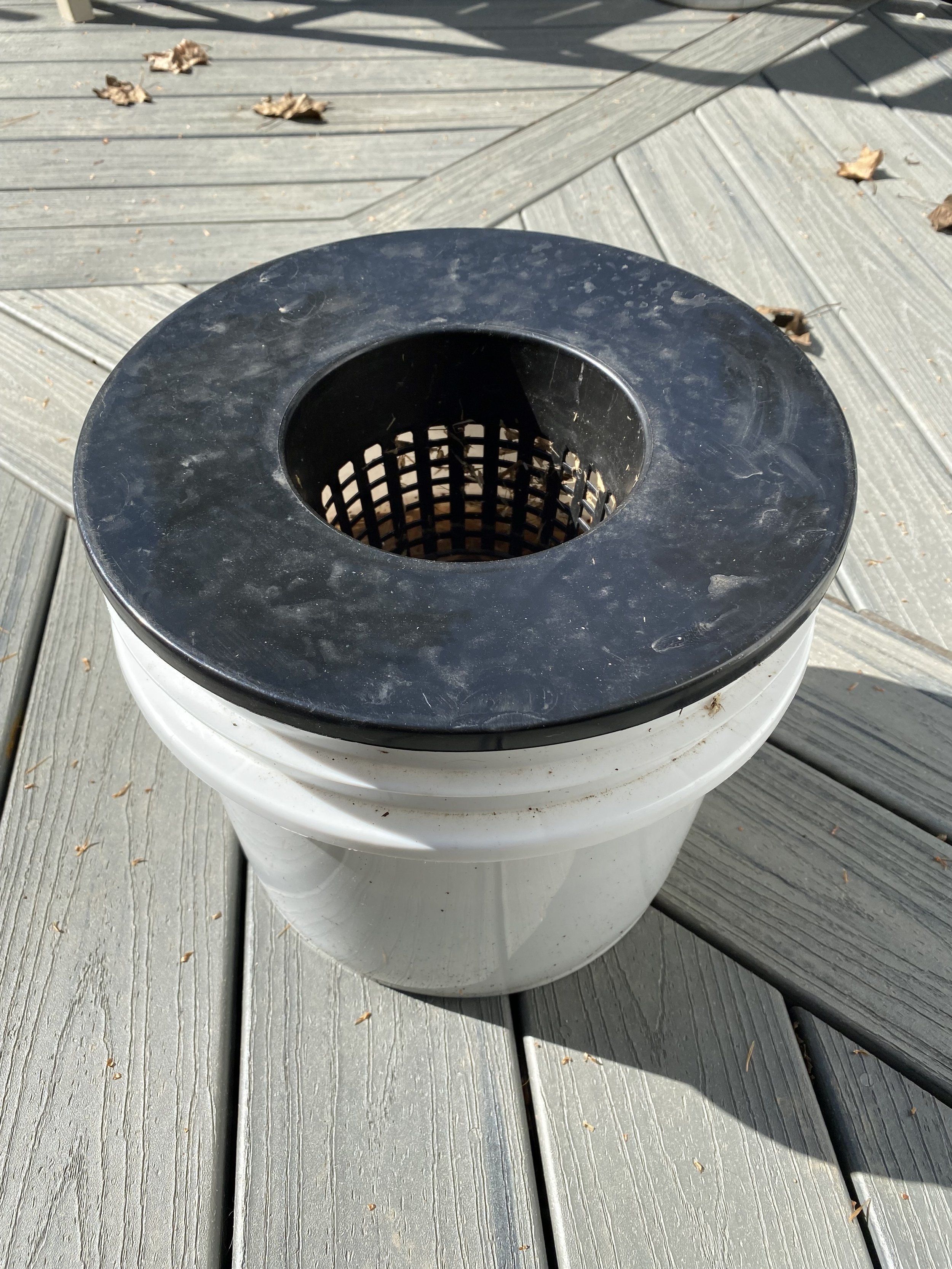
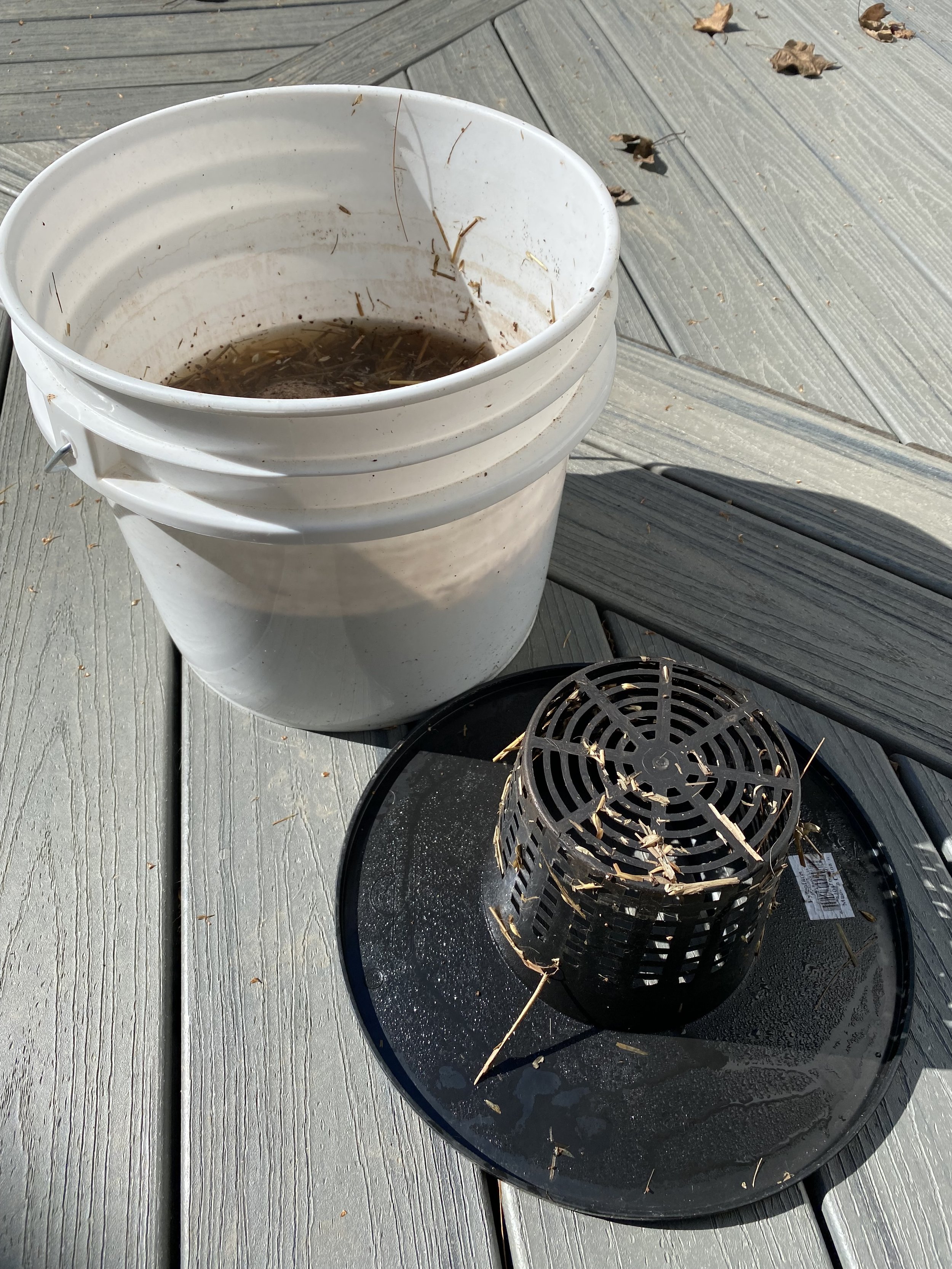
Jill’s Mini Mosquito Larvae Trap
To create a smaller, more aesthetically pleasing larvae trap, I am using a quart size wide mouth mason jar as the base. I found a vase “frog” insert grid to allow mosquitoes to enter the trap and to keep critters out of the water. To hide the fermented water and add black (some research shows mosquitoes are attracted to black), I used a slide on cover. For covered areas, these are the essential pieces - plus, of course, the fermented water with dried organic material and a quarter of a Mosquito Dunk®. DO NOT use Mosquito Bits® - those are just for quick kill according to Summit Chemical; therefore, if you used the Bits, you have created a breeding spot for larvae to mature after the quick kill.
The best part is that the mason jar can be tossed into the dishwasher. Before cleaning, I pull out the Dunk and then dump the solution into a dry area in the yard. I remove the cover and the grid and hand wash.
Note that you must monitor to make sure there’s fermented water and replace the Mosquito Dunk® regularly. To help myself with the maintenance, I have created an Excel spreadsheet for tracking. Commercially available on my Etsy site (see below).
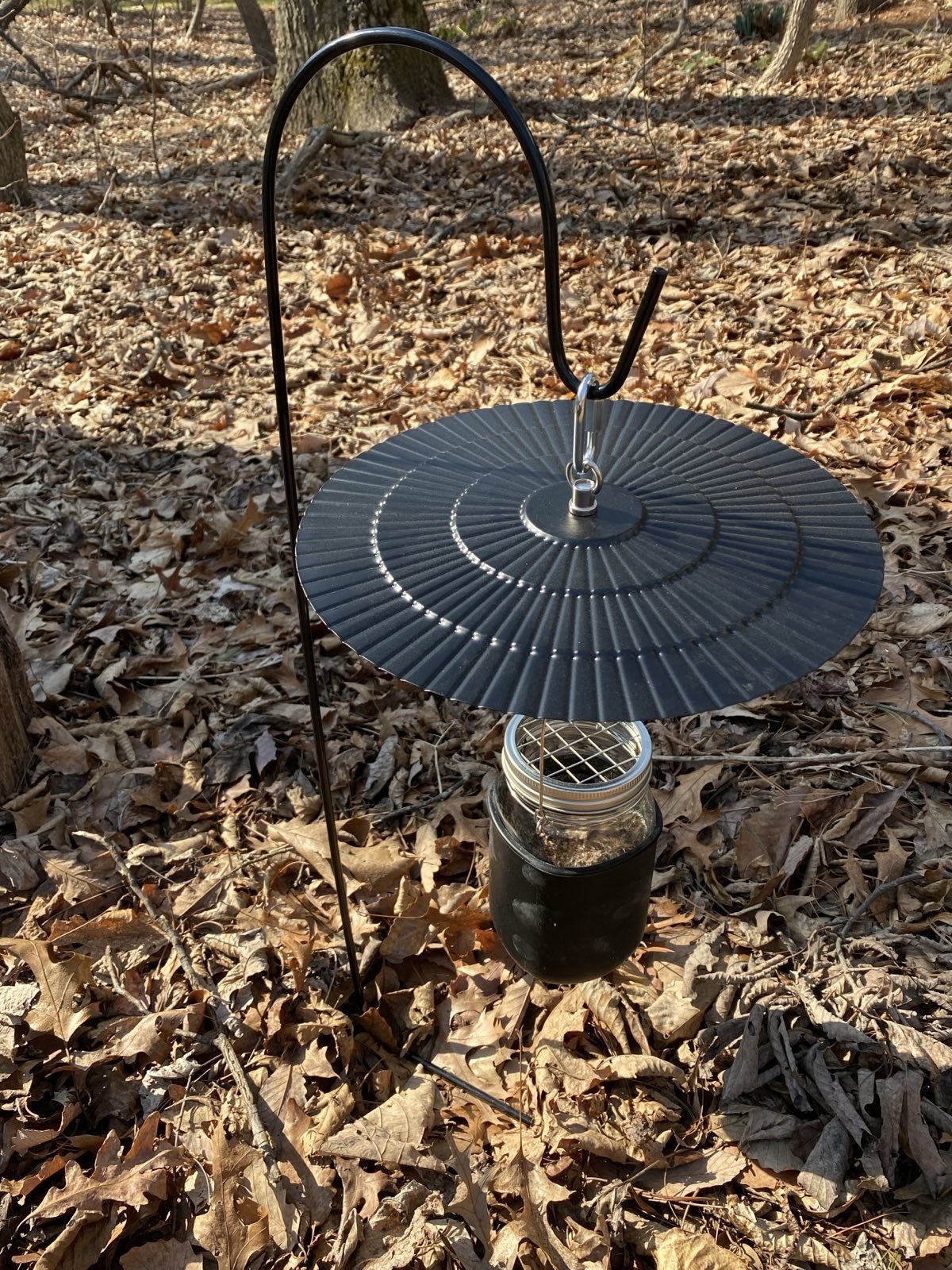
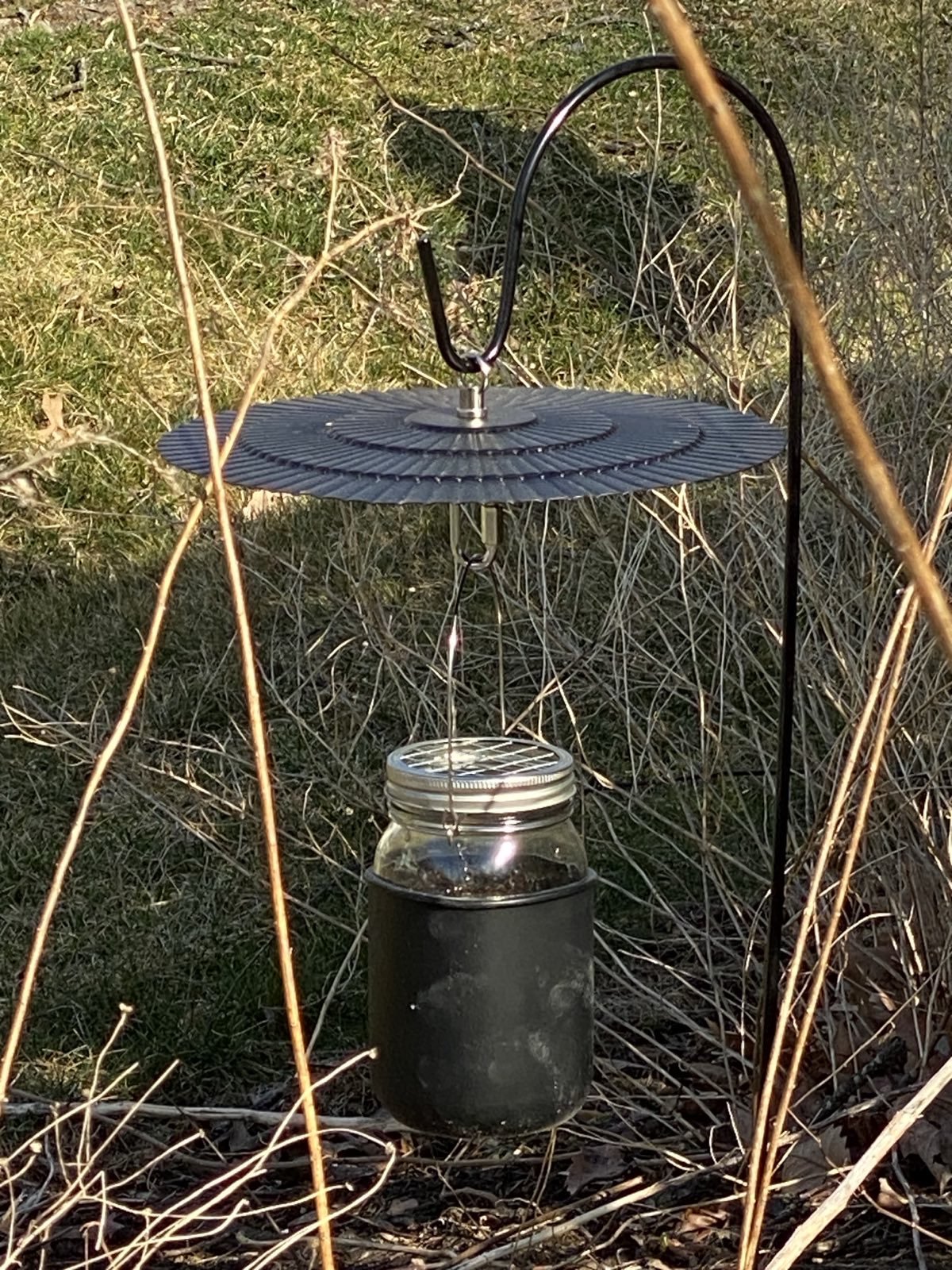
In areas that are exposed to the elements, I added a shepherd’s hook, bird feeder cover, mason jar hanger, and some hooks (to keep the glass jar in place).
Here are photos:


Frequently Asked Questions
Question: Could I use grass clippings or old leaves instead of straw or hay?
Laurie Tyler Dodd reports success using grass or dead leaves instead of hay.
G. Lambert reports that if you use grass or leaves, they need to be dried - not fresh green grass or leaves. (Reported after consulting with Doug Tallamy.)
Question: Can I remove the solid organic material once it’s started fermenting?
Doug Tallamy: I think the straw or hay needs to remain in the water to keep generating the attractive smells that bring in the female mosquitoes.
Question: My traps are 3 or 4 weeks old. Do I need to dump the solution and restart the trap? Or can I just add new mosquito dunks?
Doug Tallamy: I think you can just add some water to freshen it up a bit. Maybe throw in a few more leaves. Make sure there’s enough of the mosquito dunk.
Question: If I put the dunks in before fermenting will this decrease the dunks’ amount of chemicals due to chlorine affecting Bti?
Doug Tallamy: That's a waste of dunk. There are no mosquito eggs in there yet so why put the dunk in early. They don't last forever.
Question: Are there larvae traps that kill the females too?
Yes, passive mosquito traps can provide additional protection and they do not use pyrethroids. See links to commercial sources of such traps below.
Question: What do you recommend we do with the water that now has dead larvae, Bti, and old straw or hay in it? Can the spent dunk and straw/hay be composted?
Doug Tallamy: Sure. It is harmless
Question: Our property has a swamp area on it, that I cannot drain. Will the mosquito larvae traps still be effective in reducing the mosquitos somewhat or will the swamp take any benefit away?
Doug Tallamy: The reality is that the swamp will always make mosquitoes. Setting up larvae traps might reduce the population but whether that will be noticeable to someone sitting in the yard is hard to say. There is little to lose by trying, but that swamp area is a mosquito producing machine.
Summit Chemicals: The swamp/wetlands will always produce mosquitoes unless a State or County entity treats it effectively. It would be next to impossible for an individual to control.
Commercially Available Traps and Maintenance Tracker
Autocidal Gravid Ovitrap, developed by the Center for Disease Control and Prevention and marketed as the BioCare AGO.
Jill Spohn created the Mosquito Jill’s Etsy site to sell the mini traps shown above for those who desire the convenience of a kit. A maintenance tracking sheet is also available for download.


Reports from Hog Island Educator’s Week
ASNV issued grants to send two teachers to Educator’s Week at Hog Island, Audubon’s Camp in Bremen, Maine. Here is what they had to say about their visit, the week of July 17.
Photo: Candice Cetinkaya and Chrissy Brownson arriving at Hog Island for Educators’ Week
ASNV issued grants to send two teachers to Educator’s Week at Hog Island, Audubon’s Camp in Bremen, Maine. Here is what they had to say about their visit, the week of July 17.
Candice Cetinkaya and Chrissy Brownson arriving at Hog Island for Educators’ Week
Chrissy Brownson, Science, Technology, Engineering, Arts, and Math (STEAM) and Science Resource Teacher, Providence Elementary, Fairfax County Public Schools
When we learned that some of the paragons of environmental science had spent time researching on Hog Island, it was no surprise that the week was packed with learning. To think that we were walking in the footsteps of Rachel Carson and Roger Tory Peterson enriched our learning and lent to the magic that Hog Island exudes. From examining a preserved passenger pigeon to seeing the thriving renewed puffin colony, the opportunities for learning and wonder were numerous.
Each day we spent time on the island or in the water deepening our science knowledge and learning how we could bring these lessons back to our schools. Teaching is a craft, and we had the opportunity to learn from several gifted educators and environmental scientists. I have done pond studies before, both as the teacher and as an adult learner, but doing it with the instructors from the Audubon camp was like taking a master class. I found myself jotting take-aways in between identifying macroinvertebrates and planning for how I could bring this same level of enabling discovery back to my students.
I am so appreciative of this opportunity, both to learn from the amazing team at the camp and to collaborate with passionate educators from across the country. I can’t wait to share this with our school and ignite a passion for the world around them.
Candice Cetinkaya, Science Resource Teacher for Region 5 Elementary Schools and Three Middle Schools in Alexandria
A big thank you from the bottom of my heart for enabling me to experience the Educator’s Week at Hog Island. The highlights of the week were countless, but some of my favorites included: exploring the tide pools; uncovering the geologic history of the islands while scrambling over granite boulders with basalt intrusions; learning about, and then witnessing, the return of puffins to Easter Egg Island; tramping through shoulder-high ferns, only to emerge into a field of milkweed with swarms of monarch butterflies; watching harbor seals, osprey, and (from the deck of the Queen cabin where I slept each night) the departure of the lobster boats.
Beyond the amazing opportunity to immerse myself in nature was the learning that occurred by connecting with naturalists and educators from across the country and from diverse backgrounds. The experiences, conversations with others, and periods of reflection nourished my mind, body, and soul and prepared me to share my love of nature with students. Again, thank you for providing this enriching, motivational, and soul nourishing experience. I can’t wait to share it with my students.
Welcoming Visitors with Native Plant Landscaping
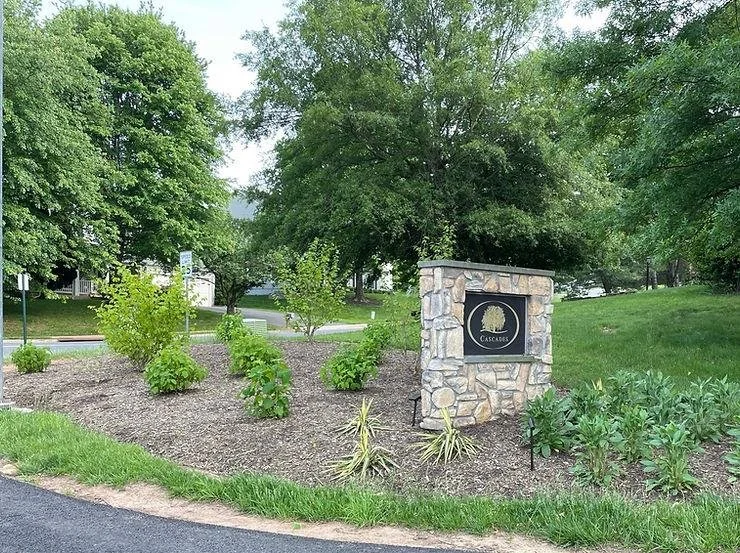
The big signs that welcome visitors to neighborhoods are usually framed by conventional ornamental shrubs, grasses, and annual flowers. Last year, Northern Virginia communities were invited to apply for matching mini-grants to spruce up their entranceways using only Virginia native plants.
Photo: Native plants on display at a neighborhood entrance, Jane Kirchner
Margaret Fisher (Plant NOVA Natives), Barb Tuset and Betsy Martin (Audubon at Home)
The big signs that welcome visitors to neighborhoods are usually framed by conventional ornamental shrubs, grasses, and annual flowers. Last year, Northern Virginia communities were invited to apply for matching mini-grants to spruce up their entranceways using only Virginia native plants. A condition of the mini-grants was that the projects be designed by a professional landscape designer to require no more long-term maintenance than the typical landscaping crew is accustomed to providing. The original grant money was provided by Dominion Energy Charitable Foundation’s Environmental Education and Stewardship Grants Program to the Audubon at Home program in collaboration with Plant NOVA Natives. Audubon at Home volunteers help residents and organizations strategize about using their properties to create wildlife sanctuaries.
Interest in the grants was high. Thirty-five neighborhoods in Arlington, Fairfax, Prince William, and Loudoun counties applied for the six grants, which also required that the communities do outreach to educate their residents about the value of using native plants to beautify their yards and support birds and other wildlife. Conventional landscaping may appeal to the aesthetic tastes of many people, but keeping the look fresh is a challenge and can be expensive. Shrubs that are repeatedly trimmed start to decline, ornamental grasses get overgrown and floppy, and annual flowers have to be replaced three times a year. More importantly, the usual non-native choices for shrubs and grasses in this situation are often invasive, which contributes to adjacent yards and natural areas being overrun by escaped Chinese Privet, Japanese Barberry, Chinese Silvergrass, English Ivy, Periwinkle, Liriope, and other offenders. By contrast, carefully chosen native shrubs can be allowed to reach their natural height without trimming, and tidy-looking native perennials need only be planted once. The result can still satisfy residents’ desire for a formal look (and for flowers) while requiring different but no more burdensome maintenance tasks.
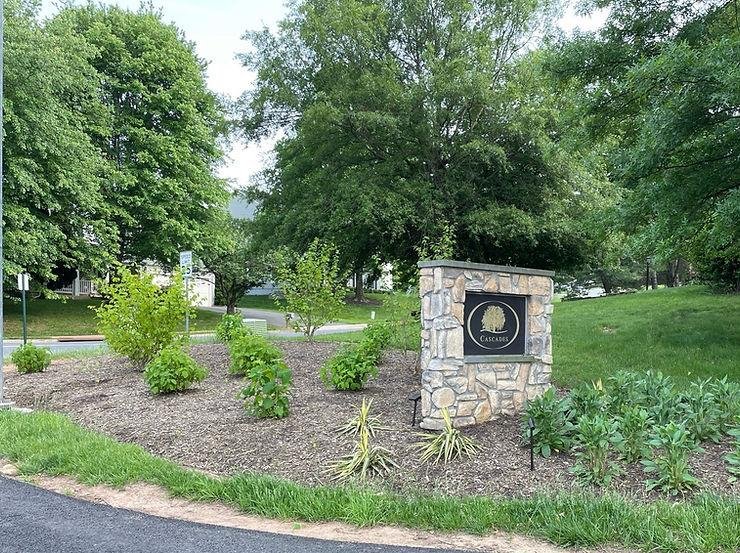
Native plants on display at a neighborhood entrance, Jane Kirchner
As seen on this web page, even soon after installation, the entranceways of the grant recipients were showing the potential of this new approach. As they fill in over the next two years, passersby will be able to appreciate what native plants can do when installed using solid design principles. Landscaping in an institutional setting has its challenges, whether it be a community association, faith community, or other organization where volunteers run the Board and committees. Tempting though it is to install colorful pollinator gardens with a dizzying array of native flowers to attract butterflies, most communities would be hard pressed to find experienced gardeners to dedicate the hour or so per month needed for an average size garden bed, year after year. This degree of expertise becomes unnecessary if only a few distinctive-looking plant species are installed, making weeding a simpler task for any worker. More tips can be found on the Plant NOVA Natives website. As the volunteers at Auburn Village Condominium wrote, “Communities should not be afraid to have native gardens. They can be designed in a way to look like conventional gardens and at the same time be beneficial to critters. We wanted our space to show the community that beautiful spaces can be created with native plants.”
You Can Help Stop the Spread of Invasive Plants
What do English ivy, barberry, butterfly bush, and mimosas (the tree, not the drink) have in common? You can find them in most Northern Virginia neighborhoods, and you can buy them at many local nurseries, garden shops and big box stores. But they are all invasive plants in Northern Virginia.
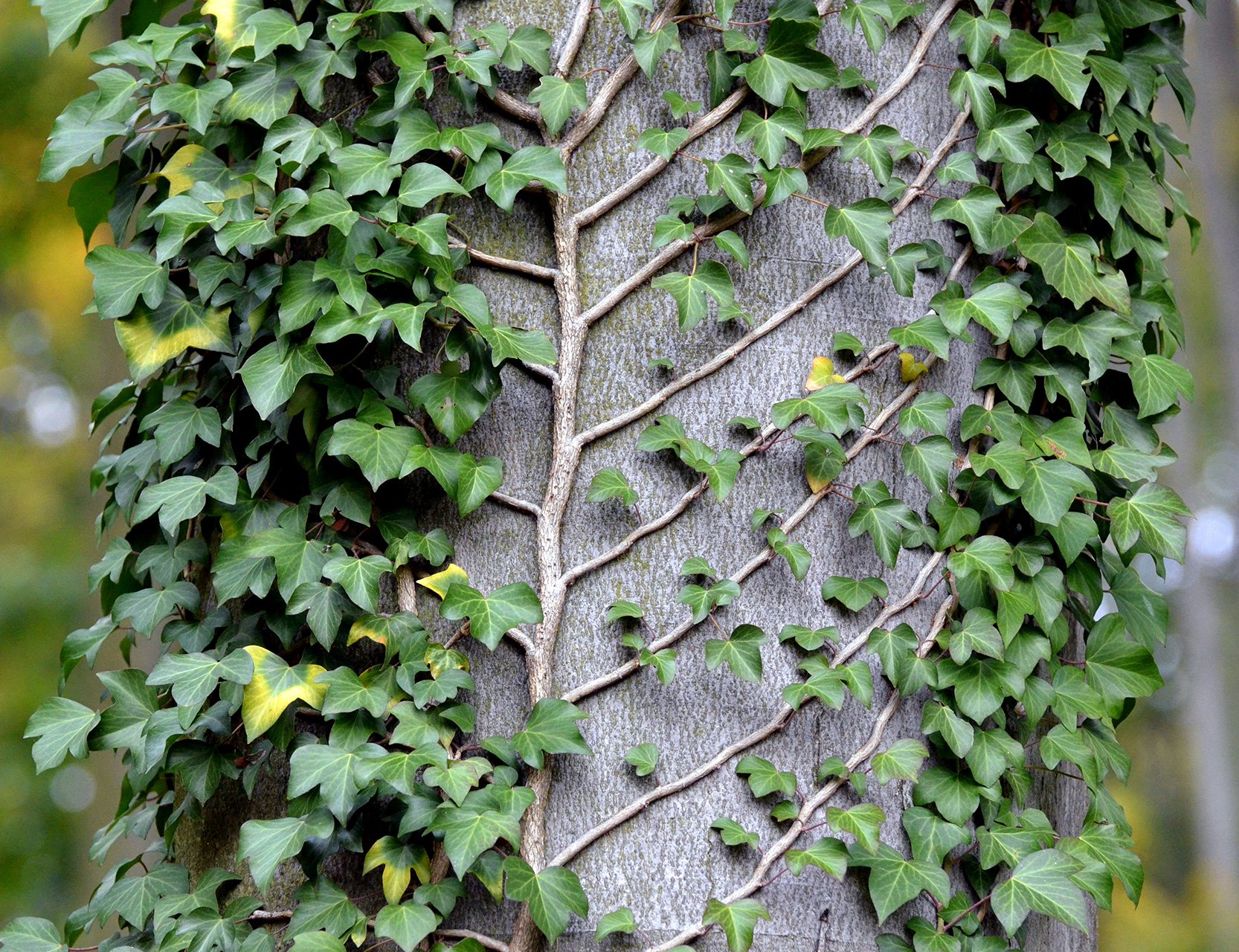
Photo: English Ivy, an invasive species in Northern Virginia, Wikimedia Commons
What do English ivy, barberry, butterfly bush, and mimosas (the tree, not the drink) have in common? You can find them in most Northern Virginia neighborhoods, and you can buy them at many local nurseries, garden shops and big box stores. But they are all invasive plants in Northern Virginia and can harm the environment. Although they threaten to overwhelm us, there are some steps you can take to reduce their spread.

English Ivy, Wikimedia Commons
But before we get to actions you can take, a little background: Invasive plants are species that have been introduced by human activity into a region in which they did not evolve and cause harm to natural resources, economic activity or humans. The Virginia Department of Conservation and Recreation’s website states that invasive plants cause more than $120 billion each year in losses in the United States. They displace natural plant species that provide habitat and food for native animals, and some can clog waterways, cause crop losses and degrade soil.
Passing state legislation to curb the sale of invasive plants in Virginia has so far mostly been unsuccessful, due largely to the opposition of growers and sellers. In February 2021, the legislature approved a bill creating a workgroup to evaluate various methods of reducing the sale of invasive plants. The workgroup, which included Glenda Booth representing ASNV, issued a report that largely failed to meet the objectives set out in the enabling legislation, concerns expressed at pages 24-25 of the report.
In the 2022 regular General Assembly session, Delegates Paul Krizek and David Bulova introduced bills that, among other things, would have required retail establishments to label invasive plants to educate consumers about which plants are invasive and would have prioritized the use of native plants on state property. Unfortunately, the only legislation enacted requires the Commissioner of Agriculture to develop a brochure that retail establishments can use to explain the value of native plants and the harm caused by invasives. Retail establishments would have to reproduce the brochures at their own expense, and the law will expire on July 31, 2023.
Several legislators may introduce bills in the 2023, session which will begin in January, and we will report on them when they do.
Steps You Can Take Now
Would you like to help reduce the number of invasive plants in our region? Here are four things you can do:
Educate yourself on what plants are invasive before your next trip to the plant nursery. You can get a list of invasive plants on the website of the Virginia DCR and guides to native plants on the Plant Nova Natives website.
Remove invasive plants from your yard and replace them with native plants. For guidance on making your yard a wildlife sanctuary, contact Audubon at Home for a visit.
Sign a petition asking Home Depot to stop selling invasives. Having failed in their efforts to achieve significant statewide action on invasive plants, some concerned residents of Northern Virginia are trying now to convince a local retail establishment to stop selling invasives. Lauren Taylor, who participates in Fairfax County’s Invasive Management Volunteer Program, created the online asking Home Depot to stop selling invasive plants. More than 50,000 people have signed the petition so far. The petition has garnered support from Plant NOVA Natives, Blue Ridge Partnership for Regional Invasive Species Management, and other groups.
Join the hundreds of volunteers working to better control invasive plants, through Fairfax County’s Invasive Management Volunteer Program, and programs sponsored by EcoAction Arlington, the Friends of Dyke Marsh, and other organizations throughout Northern Virginia.

Be Nice to your Trees
We all try to stay in the shade in hot weather, competing for the parking spaces under trees. What we may not realize is that tree-lined neighborhoods are cooler not just because of the shade but because the trees themselves act as air conditioners.
Photo: Felix Mittermeier via Pixabay
Margaret Fisher

Temperature comparison, Margaret Fisher
On a recent day, driving out of the sun into a wooded community resulted in a temperature drop from 91 to 86 degrees. We all try to stay in the shade in hot weather, competing for the parking spaces under trees. What we may not realize is that tree-lined neighborhoods are cooler not just because of the shade but because the trees themselves act as air conditioners. The basic concept is that it takes energy to turn a liquid into a gas – we see that when boiling water. When a tree sucks up water through its roots and releases it as a gas through its leaves, a process known as transpiration, the energy that causes the water to evaporate is absorbed from the surroundings in the form of heat, and the result is a lower air temperature. This principle of physics also explains why sweating cools our bodies.
Newly planted trees are particularly vulnerable to high heat, so the most basic care needed from us is to provide enough water until they are well established. Seedlings establish quickly, but a landscaper-sized tree needs several years for its root to grow out of the planting hole into the surrounding soil. Our torrential summer storms can fool us into thinking we are getting enough rain, but many of them are brief and don’t even budge the rain gauge. A young tree with brown leaves is a very sad sight. At the same time, overwatering any plant can be worse than underwatering, by depriving the roots of oxygen, so we need to be careful to follow instructions in that regard and allow the soil to dry out between waterings.
Once a native tree gets established, though, little if any care may be required for the next twenty years or so. Our oaks and other native trees evolved here and are accustomed to the local soils and our variable temperatures and rainfall, although those 91-degree days are adding to the stress of living in an urban or suburban environment. Because older trees may start to develop issues, it is wise to have those that are near houses inspected every two years by an independent consulting arborist, meaning one who has no financial incentive to sell tree care services. They can recommend procedures that may prevent a tree from becoming hazardous. Even better, they may be able to provide reassurance, for instance, that a tree that is leaning a little may be quite stable, despite the dire warnings of a marketing rep from a tree company that is eager to keep its crew busy. Always use the services of arborists certified by the ISA (International Society of Arboriculture.)
When future residents are facing temperatures even higher than today’s, a five-degree lower temperature may make a life-or-death difference. Consider what hundred-degree weather does to the human body when a prolonged blackout shuts down everyone’s air conditioning. It pays to take good care of our trees. Find out how on the Plant NOVA Trees website.

Appreciating Hummingbirds and Their Aerial Acrobatics
This summer I traveled to San Diego for the first time and a highlight of the trip was the San Diego Zoo. The park’s thoughtful landscaping serves the animal exhibits but also attracts wild visitors, including a variety of hummingbird species.
Photo: Ruby-throated Hummingbird, Patrick Carney/Audubon Photography Awards
Deirdre Bryant
This summer I traveled to San Diego for the first time and a highlight of the trip was the San Diego Zoo. The park’s thoughtful landscaping serves the animal exhibits but also attracts wild visitors. San Diego’s mild climate allows the park to grow a much larger variety of plants than anywhere else in the country. These include cacti/succulents, carnivorous plants, grasses, herbs, ferns, cycads, trees, shrubs, vines, and flowers, creating an optimal habitat for a variety of hummingbird species.
Hummingbirds were everywhere in San Diego, especially at the zoo. The day of my visit I spotted the Anna's Hummingbird (Calypte anna), Allen’s Hummingbird (Selasphorus sasin), and Rufous Hummingbird (Selasphorus rufus), but at least 8 species can be found in California. The male Anna’s is identified by its beautiful iridescent pink head feathers, while the female Anna’s has a red throat patch. The male Allen’s Hummingbird has brownish, greenish feathers on its back, with a brilliant reddish-orange throat and orange belly. Male Rufous hummingbirds are orange on the back, as well, unlike the Allen’s. Both the Allen’s and Rufous females have brown feathers with shimmering green feathers mixed in, with an orange spot on the throat, and are difficult to tell apart in the field.
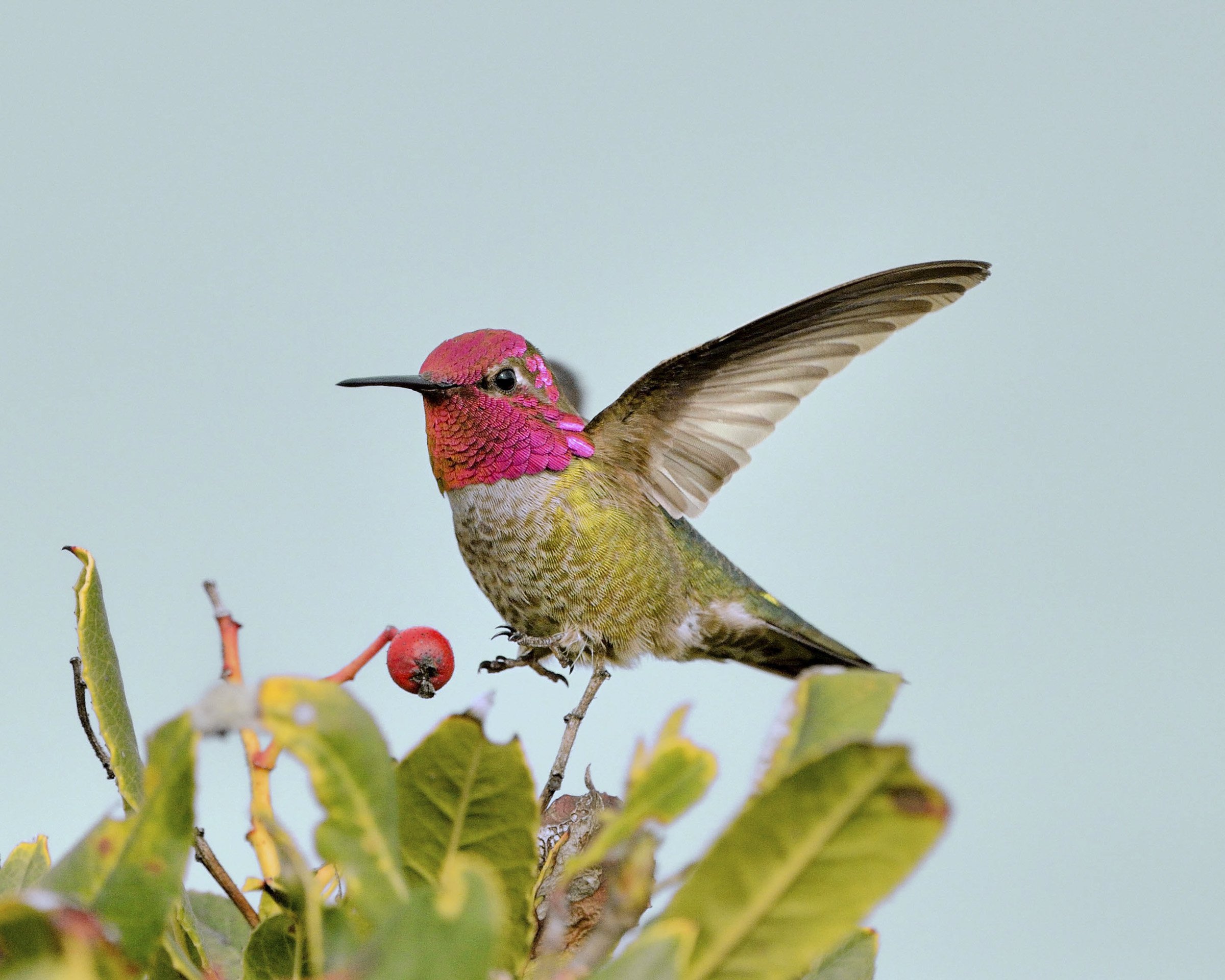
Anna’s Hummingbird, Mike Anderson/Great Backyard Bird Count
In Northern Virginia it is very difficult to find a hummingbird species other than the Ruby-throated Hummingbird (Archilochus colubris). It has the largest breeding range of any in North America and is the most common hummingbird east of the Mississippi River. The male has a dazzling crimson-colored throat, thinly bordered with black feathers on the upper margin. Its tail is forked, black with a muted violet sheen. The female’s back is metallic green black and brown. Its throat is white with dusty streaks, and its tail is short, fan-shaped, and mostly black with white tips.

Ruby-throated Hummingbird, Patrick Carney/Audubon Photography Awards
Before San Diego, I had only seen hummingbirds in the wild a few times. They’re elusive when they aren't feeding. In fact, when I catch one flying past in my distant, peripheral vision I sometimes assume it’s just a horsefly or large bee. One tip I use now when determining whether what I’m seeing in the distance is a large insect or a hummingbird is to notice how it flies. Sure, the hovering might be a clue, but there are large bees that hover, too, and from a distance it may be difficult to gauge the size. Poor lighting may also make identification difficult, even if the feathers are iridescent. A profile view also helps, but only if the bird stays in view long enough for a good look. See also this month’s Observations from Meadowood on hummingbird moths.
The trick I use is to watch for “graceful and purposeful movement.” It’s a little difficult to explain because some bees move with purpose, too (carpenter bees), but hummingbirds have better control of how they move in a 3-dimensional space. When flying, they’ll quickly rotate their wings in a figure-8 pattern. The movement pushes air backward, forward, and downward, creating lift force on both forward and back strokes of the wing. Observing the body swivel mid-flight is also helpful even if all that’s visible is a silhouette.

Ruby-throated Hummingbird, Laura Zamfiresccu/Audubon Photography Awards
The Ruby-throated Hummingbirds in Northern Virginia migrate to Southern Mexico and Central America later this year, because their breeding season is coming to a close. Male hummingbirds don’t stick around too long after mating, so females are more common right now. While they’re still here, try watching for “graceful and purposeful movement” to find them in grasslands, meadows and forest edges instead of at the feeder. Looking for movement also should allow spotting them from afar in the trees or near shrubs, even without binoculars.