
NVBA NEWS BLOG
Welcome to the blog for Northern Virginia Bird Alliance, a wealth of resources about northern Virginia birds, wildlife, habitat conservation and restoration, native plants, wildlife-friendly gardening, advocacy and more.

Plant This, Not That: Replacing English Ivy
English ivy is one of America’s foremost invasives, taking over natural areas especially along both coasts.
Photo: Christmas Fern, Alyssa Ford Morel
Alyssa Ford Morel
Few plants are more recognizable even to non-gardeners than English Ivy (Hedera helix). Americans have had a long time to get acquainted with it since early colonists introduced this European and Asian native to North America in 1727. We kept planting it, and it started spreading, both by vining and by birds who eat the berries, then poop them out elsewhere. Records show that it was spreading without human effort by the 1870s.
Compared to how long ivy has spread in America, conservation biology and our understanding of the damage that non-native, invasive plants wreak on local biodiversity is recent. In 1999, President Clinton signed Executive Order 13112 (amended in 2016 by President Obama) defining invasive plants and animals as being non-native to the area in which they are occurring and causing “economic or environmental harm, or harm to human, animal or plant health.”

English Ivy, Alyssa Morel
English ivy is one of America’s foremost invasives, taking over natural areas especially along both coasts. It aggressively colonizes both the ground level and the tree canopy, where it reaches sexual maturity, setting berries. Ivy on a tree blocks sunlight, impeding photosynthesis, and adds weight that can topple a weakened tree.
Besides being invasive, ivy also hosts the Xylella fastidiosa pathogen, which is a threat to Oak, Elm, Maple and Sweetgum trees, among other plants. While ivy does not support many native creatures, it does support rats, mosquitos and ticks. People mistakenly think that ivy is good for erosion control, but, in fact, ivy’s shallow roots do little to stabilize banks.
Nonetheless, our eyes are used to ivy and many homeowners cite its hardy evergreen nature as essential. The good news is that there are excellent native choices to replace it.

Golden Ragwort, Alyssa Morel
Like ivy, Golden Ragwort (Packera aurea) is evergreen and takes either sun or shade. This aggressive spreader has yellow daisy-like flowers each spring. Homeowners on a budget can clear a small space in their ivy, and plant Golden Ragwort in it. The following year, the ragwort will have spread, and some can be dug up and transplanted to another space. Keep repeating until the ivy is gone!

Christmas Fern, Alyssa Morel
Christmas Fern (Polystichum acrostichoides) is an elegant choice for shade, with leathery fronds growing in arching clusters. Plants are between a half foot and two feet tall, and increase in size over time. Unlike ivy, Christmas Fern does prevent soil erosion, especially on slopes. Though the fronds look fairly ratty by late winter, pristine new fronds will emerge in spring, and the old ones will slowly decay, helping build the soil.

Hairy Alumroot, Alyssa Morel
Hairy Alumroot (Heuchera villosa) is a semi-evergreen plant native to southwestern Virginia that can take sun or some shade. It puts up beautiful feathery flower plumes in late summer that support pollinators. It spreads both by expanding clumps and by seed.
All three of these beautiful native plants will make themselves at home in your yard, and be an environmental asset instead of a creeping problem.
Note: A version of this article was originally printed in the Glencarlyn Village View and on the Master Gardeners of Northern Virginia website.

Monday Mystery - January 30, 2023
Monday Nature Mystery continues! Read on to learn who correctly identified our last mystery.
Photo: American Tree Sparrow (Spizelloides arborea), Shari McCollough/Audubon Photography Awards
We are pleased to announce the winner of last week’s Monday Nature Mystery, Lisa Benoit!
Congratulations to Lisa for identifying the American Tree Sparrow (Spizelloides arborea).

American Tree Sparrow (Spizelloides arborea). Photo: Shari McCollough/Audubon Photography Awards
According to All About Birds, despite their name, these sparrows are actually ground-nesting and ground-foraging birds. Although the female lays only one egg per day until she's got 4 to 6 eggs (and may even skip a day between eggs), the chicks hatch within hours of each other and may not even hatch in the order their eggs were laid.
Each Monday we’ll post a new mystery and identify the previous week’s winner. They’ll receive an ASNV hat or tote bag.
Here is this week’s mystery:
Who is this?
Be sure to post your guess on our Facebook page under the latest Monday Nature Mystery post. Good Luck!
Please check our guidelines here.

Monday Nature Mystery: Who is this? Photo: Luke Franke/Audubon Photography Awards

State of the World’s Birds 2022
Birdlife International’s State of the World’s Birds 2022 (SOTWB 2022) concludes that the world’s birds are in a fragile condition: One out of 5 of the world’s 11,000 species is threatened or near threatened with extinction.
Photo: Long-tailed Duck, Barbara Saffir/Audubon Photography Awards
Greg Butcher
Birdlife International’s State of the World’s Birds 2022 (SOTWB 2022) concludes that the world’s birds are in a fragile condition: One out of 5 of the world’s 11,000 species is threatened or near threatened with extinction.
BirdLife has been working on global bird conservation for 100 years, so members assembled in September for a big party. Of course, that celebration was tempered by the fact that the world’s birds have been declining and require major assistance to assure a positive future. So, in addition to celebrating 100 years of work, BirdLife’s partners, which include the National Audubon Society and the American Bird Conservancy, planned the next 10 years of conservation action.
BirdLife provides the analysis for birds for the Red List of Globally Threatened Species published by the International Union for the Conservation of Nature (IUCN). There are also Red Lists for mammals, reptiles, amphibians, and fish, with assessments beginning for flowering plants, corals, mollusks, insects, and mushrooms. Here is the status of some North American, Puerto Rican, and Hawaiian birds, according to BirdLife and IUCN:

Black Rail, Scott Bowers/Audubon Photography Awards
Long-tailed Duck, Barbara Saffir/Audubon Photography Awards
231 bird species are Critically Endangered, including California Condor, Puerto Rican Parrot, and more than a dozen Hawaiian species.
423 species are Endangered, including Gunnison Sage-Grouse, Black Rail, Whooping Crane, Black and Brown-capped Rosy-Finches, Saltmarsh Sparrow, Tricolored Blackbird, Golden-cheeked Warbler, several seabirds, and more than a half-dozen Hawaiian birds.
755 species are Vulnerable, including Long-tailed Duck, Horned Grebe, Chimney Swift, Atlantic Puffin, Snowy Owl, Bicknell’s Thrush, Evening Grosbeak, Rusty Blackbird, and others not found in or near Virginia.
1,002 species are Near Threatened, including Northern Bobwhite, Common Eider, Black Scoter, Eastern Whip-poor-will, Chuck-will’s-widow, King Rail, Piping Plover, Red Knot, Semipalmated Sandpiper, Loggerhead Shrike, Eastern Meadowlark, Common Grackle (!), Golden-winged, Cerulean, and Blackpoll Warblers, and others not found in or near Virginia.
Forty-seven species were classified as Data Deficient (none in the United States), and the rest of the birds are classified Least Concern.
Island birds have suffered the most extinctions, and islands host the most birds on the brink of extinction today, but bird populations are in decline throughout the world.
The pressures (threats) acting on birds are legion: industrial agriculture, unsustainable logging, invasive non-native species (especially, but not only, on islands), fisheries by-catch of seabirds, climate change (especially drought and sea-level rise), urban and suburban development, and energy production. An issue that is of greater concern globally than in the United States is harvest of almost all bird species for consumption and the capture of some birds for the pet trade.
Luckily, BirdLife has 100 years of experience in bird conservation because there is a lot that needs to be done! For the past 30 years, BirdLife has been identifying and protecting Important Bird Areas (IBAs) throughout the globe. (IBAs are also called Important Bird and Biodiversity Areas and Key Biodiversity Areas when they include other taxa in addition to birds.)
SOTWB 2022 cites 10 BirdLife activities that have saved birds over the past 10 years and up to 32 species that likely would be extinct today without human intervention. Some of the most effective actions have included eradicating non-native invasive species from more than 36 Pacific islands, negotiating by-catch mitigations with the global ocean fishing communities, establishing key sites in Asia’s Yellow Sea as UNESCO World Heritage sites, and working with ranchers to put more than 500,000 hectares under bird-friendly management in southern South America.
The report does not stop at citing successes, but identifies other key actions needed to continue conserving birds:
Community management of sites
Habitat protection and restoration
Combatting illegal killing of birds
Minimizing negative impacts of energy infrastructure
Eliminating or managing non-native invasive species
Minimizing fisheries by-catch
Targeting recovery of globally threatened species
Getting people interested and involved in bird conservation
Improving laws and policies
Building the capacity of bird conservation organizations
Monitoring birds to evaluate the success of conservation actions
SOTWB 2022 helps us think globally; ASNV is here to help you act locally. Please join us this year as we work to protect, restore, and create bird-friendly habitat, improve laws to protect wildlife, and continue to collect and analyze information on birds that migrate through or make a home in northern Virginia.
Solar Panels vs. Trees – How to Choose?
Residents who are interested in installing solar panels often face a dilemma. Which is better for the environment, solar panels or shade trees?
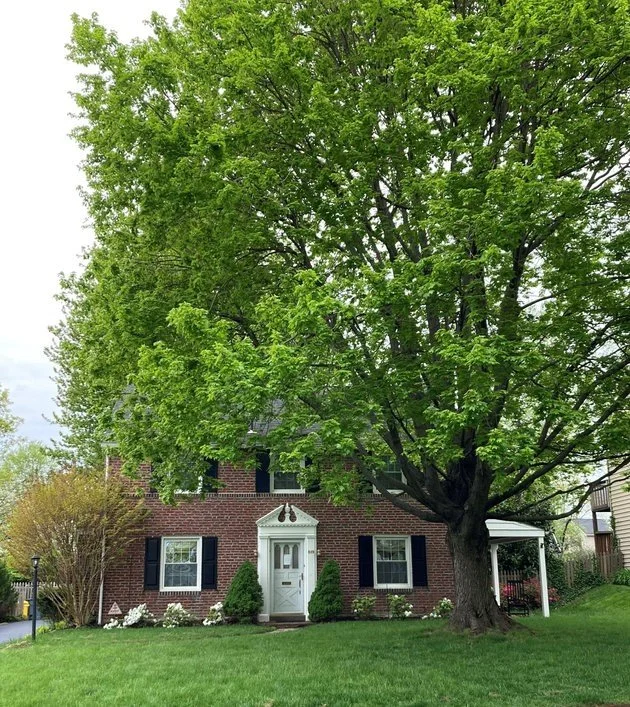
Photo: Shade tree, Margaret Fisher
Margaret Fisher
Residents who are interested in installing solar panels often face a dilemma. Which is better for the environment, solar panels or shade trees? After all, climate change due to burning fossil fuels is threatening the very existence of trees, not to mention human beings, and the timeline for preventing catastrophic temperature rise is short. Before we get out the chainsaw, though, there are several other things to consider.
One of the main reasons to try to limit temperature rise is to prevent ecosystem collapse. The native trees in our yards are as much a part of that ecosystem as the ones in the Amazon, providing food, shelter and nesting places not only for birds and mammals but for a myriad of invertebrates that are a critical part of the web of life. If we do not even protect the environment where we live, we can hardly expect people in the Amazon to take more of an interest.
Sunny rooftops are an ideal place to put solar panels, because that real estate is already built upon, and because decentralizing the grid helps build resilience. The land use anticipated for solar farms and new transmission lines is so massive, and the willingness of companies to replace forests with them so counterproductive and disheartening, that the more we use our own rooftops, the better.
But solar energy is neither the only way to reduce fossil fuel use nor the most efficient of the various options for homeowners. The first step should always be to reduce energy consumption, by weatherizing and taking other steps to reduce waste. For those ready to make a big investment, an alternative to consider is a heat pump or even a geothermal system for heating and air conditioning. As is true for solar panels, the cost of installation can be partially offset by a significant tax credit. Some utility companies, including Dominion, allow customers to choose a renewable energy option. “Renewable” is not always the same as “clean” (It can include burning chopped down trees, for example.), but much of the renewable electricity is generated by wind and solar farms.
It will take considerable effort and broad participation for our community to meet its climate goals, but not everyone has to do everything themselves on their own property. Those with sunny roofs can contribute solar energy. Those with trees can take care of them.
Shade tree, Margaret Fisher
Trees themselves are what are known as a “natural climate solution.” They provide benefits that mitigate the effect of climate change. Trees improve the energy efficiency of houses. In the winter, they reduce heating costs by blocking the wind. In the summer, they reduce air conditioning costs, because roofs and walls in the shade are often twenty degrees cooler than those in the sun. In addition, trees improve air quality and sequester carbon dioxide. Their ability to capture stormwater is particularly important in flood-prone suburban and urban areas with their excess of impervious surfaces. The leaves of the trees capture much of the rain before it even reaches the ground. Once it does reach the ground, transpiration by canopy trees sucks thousands of gallons of water from the ground, thus enabling the soil to control flooding.
Try using the National Tree Benefit Calculator at the bottom of the Plant NOVA Natives web page to see what you save in monetary terms by preserving a few mature trees, strategically located around your property. For the birds and other critters that depend on them, the native trees are priceless.

Get a Boost on Waterfowl Identification
Now that the ducks and geese are flooding into our area for winter, make sure your identification skills are at their peak.
Photo: Hooded Merganser, Matt Felperin
Now that the ducks and geese are flooding into our area for winter, make sure your identification skills are at their peak. If you want to brush up for joining the Winter Waterfowl Count, or if you just want a refresher before testing your skills at Huntley Meadows, Occoquan, Mason Neck, or other northern Virginia hotspots, make sure to register for Ducks and Waterfowl Identification with Greg Butcher, a virtual tutorial on February 2, and the February 4 Field Trip with Greg Butcher and Phil Silas.
It may be cold out there, but winter provides some of the best opportunities to see waterfowl in our area.

Bufflehead, Christopher Baker/Audubon Photography Awards
Memories from the Wildlife Center of Virginia
On January 19th, ASNV is hosting a virtual event featuring Ed Clark of the Wildlife Center of Virginia. He will discuss the Center’s life-saving work and what plans the Center has for the future as it celebrates its 40th anniversary!
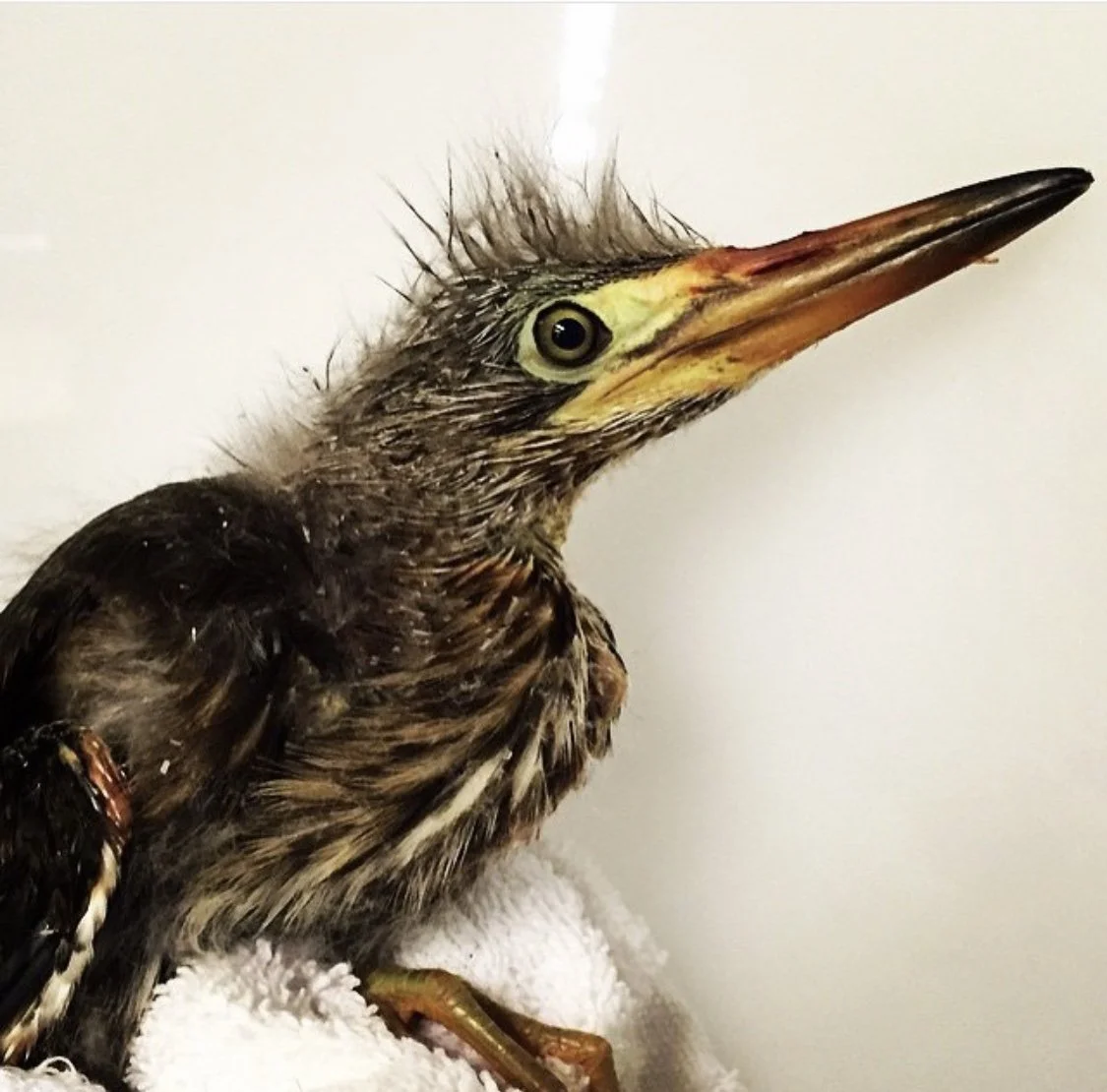
Photo: Fledgling Green Heron, Deidra Bryant
Deidra Bryant
On January 19th, ASNV is hosting a virtual event featuring Ed Clark of the Wildlife Center of Virginia. He will discuss the Center’s life-saving work and what plans the Center has for the future as it celebrates its 40th anniversary! Several years ago, I worked there as a wildlife rehabilitation extern. Notice of the class reminded me how much I enjoyed learning how to help different types of birds--including waterfowl, passerines, and raptors--grow or regain their strength so that they could be released back into the wild.

Fledgling Green Heron, Deidra Bryant
Flight school was probably my favorite feature of the facility. The staff had built long, tall, rectangular pens, and, with veterinarian approval, we would assess raptors for necessary survival skills like stamina (how many passes they could make flying back and forth in the pen), stealth (quietness in flight), landing, perching, flying upwards, and vision. The flight school sessions also help the birds build wing and grip strength. The sessions in the facility pen typically were reserved for owls, vultures, and eagles.
Flight school also included creancing, which was a lot of fun, but also a useful assessment tool and another way for a bird to build back strength. Creancing involves transporting a bird to a large, but secluded, area, attaching leather straps (jesses) to the bird’s lower legs, and then attaching these jesses to a very long line (up to 300 feet in length). The birds are then able to fly in the open for an additional test of their rehabilitation. The activity gives rehabbers a better idea of the bird’s flying ability, and it allows caregivers to see how the patient handles outdoor conditions like open space and wind. Because this activity can be more strenuous than pen exercise, veterinary clearance is essential.
The Center also included swimming pools for waterfowl like loons and ducks. The pools give the birds a chance to practice normal behavior (and do what they like to do), and helps the rehabbers determine if patients are able to swim properly. When the birds are in the water, we can also check them for buoyancy, preening behavior, and, when vegetation is added to the pool, effectiveness at feeding. When I was there, there was one giant pool exclusively for a loon, which it enjoyed zooming around in.
For gulls, geese, and ducks with bumblefoot (a common bacterial infection and inflammatory reaction that occurs on the feet of birds, rodents, and rabbits) we placed special padding on the ground to make walking easier and less painful. In addition to providing for comfort, we needed to create environments in small enclosures that mimicked our patients’ natural habitat. For gulls, geese, and ducks we included small pools in their enclosures so they could swim. There are more examples of enclosure “decorating” in this article, which I wrote for the Center at the end of my externship.

The author with a patient (crow)
We cared for younger birds and birds that required more observation in the Intensive Care Unit (ICU). We usually housed songbirds like robins, bluebirds, mourning doves, and finches there, but the ICU also sometimes included a few larger birds such as crows, like the one I am holding in the photo. The birds’ charts listed their specialized diets and feeding schedules. Each bird’s diet reflected what it would eat in the wild, so our larder included earthworms and mealworms for the insectivores, as well as seeds and a variety of fresh fruit for the non-insectivores. When caring for a few ducklings, we put shredded leafy greens in a large water bowl so that they could feed naturally while splashing around. They were … very … messy.
To feed the baby birds we had to mimic mother birds, feeding the babies with small tweezers or syringes when the patient was too young to feed itself. We also kept records of how much and when the patients ate, and observations on overall condition: Were they lively? perching? playing with toys or enrichment items? Has their body mass increased?
The Center also has ambassadors that do outreach programs. An ambassador paying a visit to a school or other venue usually brings along an ambassador bird, that is, a bird that cannot ever be released in the wild due to medical conditions or imprinting. The ambassador can then talk about the natural history and biology of the ambassador bird while also discussing the Center’s work and what it is able to do thanks to generous donations!
If you have any questions, or are curious about more of the goings on at the Wildlife Center of Virginia, make sure you register for the virtual event on the 19th. Even though I spent time there, I plan to tune in!

Observations from Meadowood: January 2023
Judy Gallagher is an ASNV board member and a regular surveyor of local wildlife who also captures photos of what she sees, in particular the less common species.
Photo: Eastern Yellow Jacket, Judy Gallagher
Judy Gallagher is an ASNV board member and a regular surveyor of local wildlife who also captures photos of what she sees, in particular the less common species.
Last month's column was on social wasps, which, as most of you already know, will sting when they feel threatened. In particular, yellow jackets' distinctive coloration warns that they should not be messed with. But a number of other sting-free insects mimic yellow jackets and gain protection from predation because they look like yellow jackets, and most predators know to leave them alone.

Eastern Yellow Jacket, Judy Gallagher
Here's an Eastern Yellow Jacket (above), looking rather innocent on a flower. But if I threatened it, it would not hesitate to attack me.

Hover Fly, Spilomyia longicornis, Judy Gallagher
And here is a Flower Fly or Hover Fly (above), Spilomyia longicornis, looking very much like a yellow jacket and counting on predators thinking that it is a yellow jacket. Look at it closely: the short antennae make it obvious that it is not a wasp, but it extends its front legs to mimic wasp antennae.
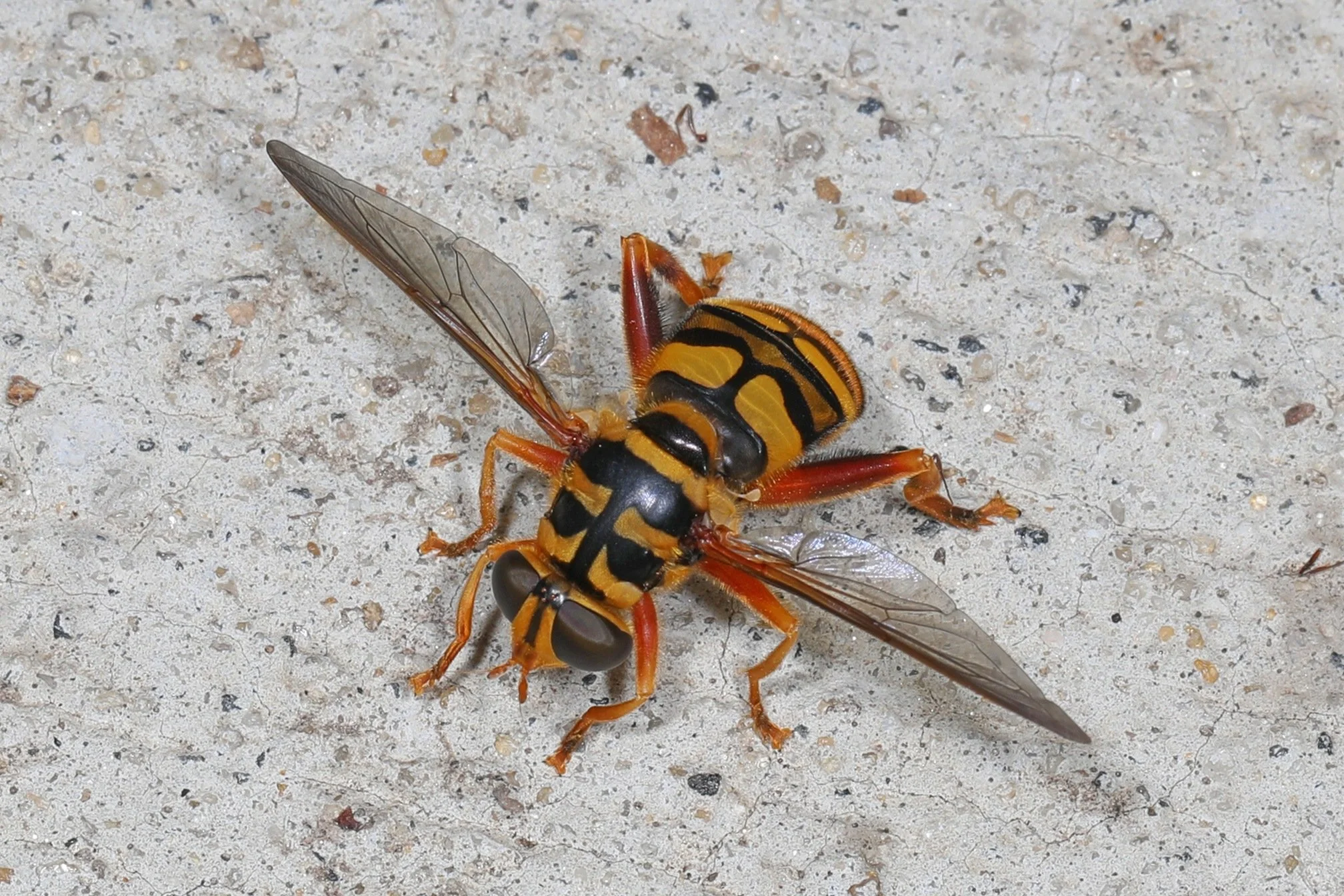
Yellow Jacket Hover Fly, Milesia virginiensis, Judy Gallagher
There are many other flower flies that mimic yellow jackets, including the Virginia Hoverfly, also known as the Yellow Jacket Hover Fly. It buzzes loudly and acts aggressive, demonstrating that sometimes a good offense is the best defense.
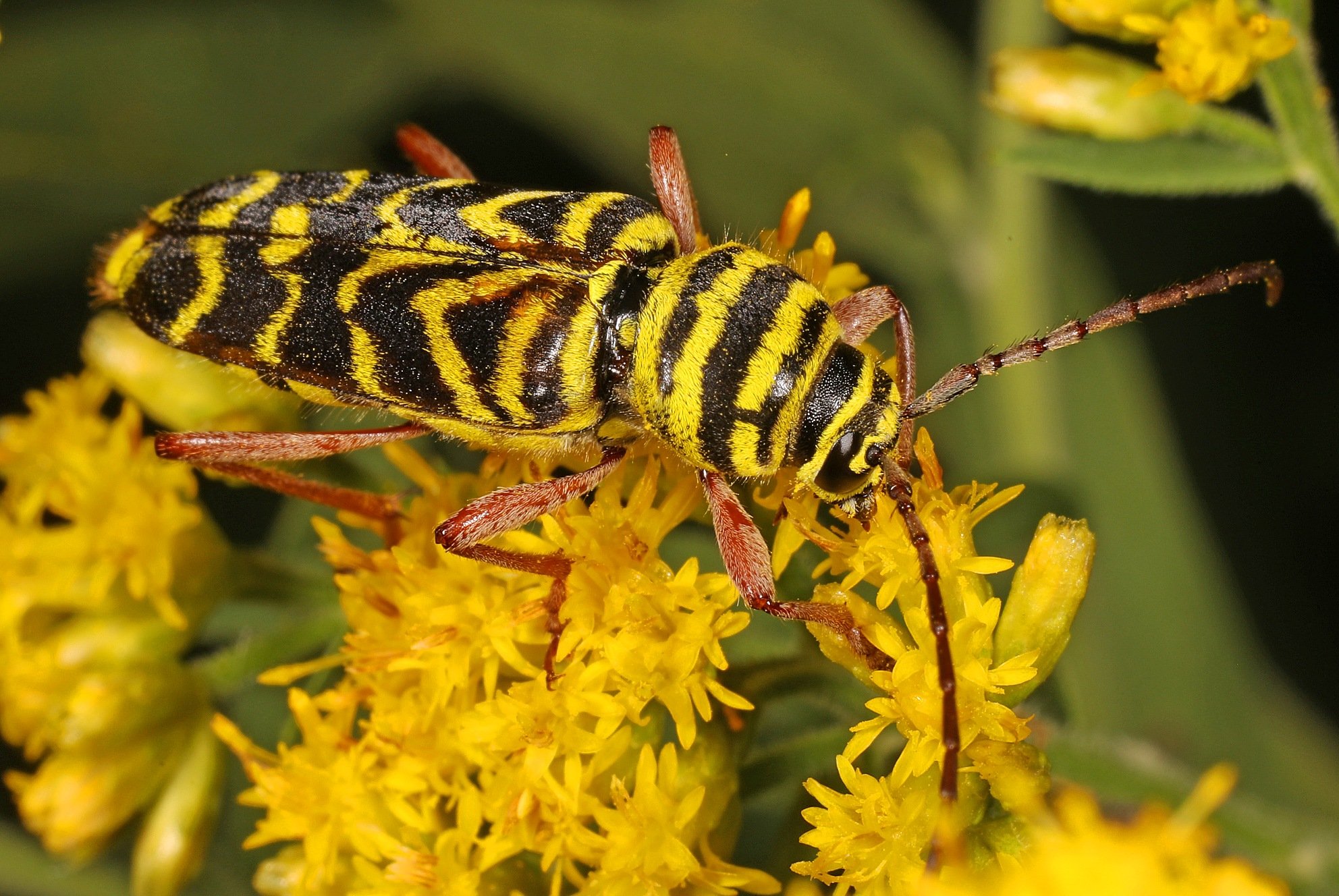
Locust Borer, Judy Gallagher
But flies are not the only insects that mimic yellow jackets. This is a Locust Borer (above), a long-horned beetle. It spends most of its adult life harmlessly feeding on Goldenrod pollen. But it looks like a wasp and has evolved to smell like a wasp, so the mimicry protection is both visual and chemical. I often see Locust Borers and wasps on Goldenrod together, which may enhance the protective disguise.

Raspberry Crown Borer, Judy Gallagher
Sesiidae Family moths, also known as clearwing moths, mimic wasps, although many of them mimic paper wasps rather than yellow jackets. This is a Raspberry Crown Borer (above), a pest of raspberries and blackberries in its larval stage. Note that, unlike most moths, it doesn't have scales on its wings. This makes it look much more like a wasp than a moth. And unlike most moths, this moth flies during the day, when yellow jackets also fly. It doesn't have the pinched waist of a wasp and the antennae are not wasp-like, but when I originally took this picture at Occoquan Regional Park, I thought I was taking a picture of a yellow jacket. Some moths mimic wasp behavior, looking like wasps when they fly, which protects them from predators that don't like wasps, and also from other wasps!

Leaf Cutter Bee, Anthidium manicatum, Judy Gallagher
And finally, there are bees that resemble yellow jackets. Unlike yellow jackets that can sting multiple times, bee stingers detach, which kills the bee. They therefore use this defense sparingly. This is a non-native Leafcutter Bee, Anthidium manicatum, but it looks like a wasp until you examine it closely.
So, the next time you see one of those dreaded yellow jackets, look closely; you might be in for a non-stinging surprise.
View more of Judy’s Observations from Meadowood articles here.

Plant This, Not That: Replacing Burning Bush
For years I thought Burning Bush (Euonymus alatus) wasn’t a big problem, at least not around Northern Virginia. I wasn’t spotting it in wild areas like I was seeing other plants on Arlington’s invasive list. Then I learned.
Photo: Burning Bush, Elaine Mills
Alyssa Ford Morel
The more I learn about our environment, the more I see that invasive plants are a big problem. We’re not talking about the pesky plants that spread in the garden. Invasives have a strict definition laid out in Executive Order 13112, signed by President Bill Clinton. The definition says that an invasive must be non-native where it occurs and be capable of escaping cultivation into wild spaces and out-competing natives, causing harm to the economy, human health, or the environment. So, invasiveness isn’t about how aggressive a plant is in our gardens. It’s about how it behaves in the wild.
Almost all invasives have appealing qualities. More than 80 percent of the invasive woody plants in America were introduced in the nursery trade. After decades of use, we often know and like them better than native plants. Problematic behavior can be hard to see.
For years I thought Burning Bush (Euonymus alatus) wasn’t a big problem, at least not around Northern Virginia. I wasn’t spotting it in wild areas like I was seeing other plants on Arlington’s invasive list. Then I learned.

Burning Bush in a garden setting, Elaine Mills

Burning Bush in the wild, Alyssa Ford Morel
I was asked to help lead a class on invasives at Potomac Overlook Regional Park in Arlington. The other leaders and I met for a reconnaissance walk before the class. Someone pointed out Burning Bush, but it didn’t look like the Burning Bush I knew! Instead of the large, dense, deep green (or red in fall) shrub found in private yards, it was more airy and lighter colored. But when we looked closely at the branches, there were the tell-tale corky “wings” that give it the alternative name “Winged Euonymus.” In the wild, with more shade and less pruning, the shrub looks significantly different, and I moved it up my mental ranking to “real problem.”
Fortunately, there are many great native substitutes that support wildlife and still have beautiful autumn color.
One possibility is Black Chokeberry (Aronia melanocarpa). It grows 4- to 6-feet tall, has white flowers in mid-spring followed by bird-friendly, black fruit in mid-summer, and it turns crimson in fall.

Black Chokeberry Flowers, Elaine Mills

Black Chokeberry Fruit, Elaine Mills
Another choice is Highbush Blueberry (Vaccinium corymbosum), whose fruit is a human “superfood.” This species likes acid soil and sets the best berries with two varieties to cross-pollinate. It grows 4- to 10-feet tall and has white spring flowers and a fiery red fall show.

Highbush Blueberry, Elaine Mills

Highbush Blueberry Fall Foliage, Elaine Mills
If you’d like bright golden fall color, consider Spicebush (Lindera benzoin), which has lacy yellow spring flowers and red berries in late summer that are especially nutritious for birds. Deer don’t like Spicebush, so it’s a great choice if you have deer issues. Spicebush grows from 6- to 15-feet tall and is good in shade. It is dioecious, meaning plants are either male or female, so you’ll want a group for good pollination. Or, convince your neighbors to plant Spicebush, too.

Spicebush, Elaine Mills
Whether you choose one of these shrubs or another native to replace Burning Bush, you will feel good for having turned an environmental problem into an environmental plus.
Note: A version of this article was originally printed in the Glencarlyn Village View and on the Master Gardeners of Northern Virginia website.

Monday Mystery - January 1, 2023
Monday Nature Mystery continues! Read on to learn who correctly identified our last mystery.
Photo: American Wigeon (Mareca americana). Photo: Alix d'Entremont/Macaulay Library
We are pleased to announce the winner of last week’s Monday Nature Mystery, John Wilson!
Congratulations to John for identifying the American Wigeon (Mareca americana).
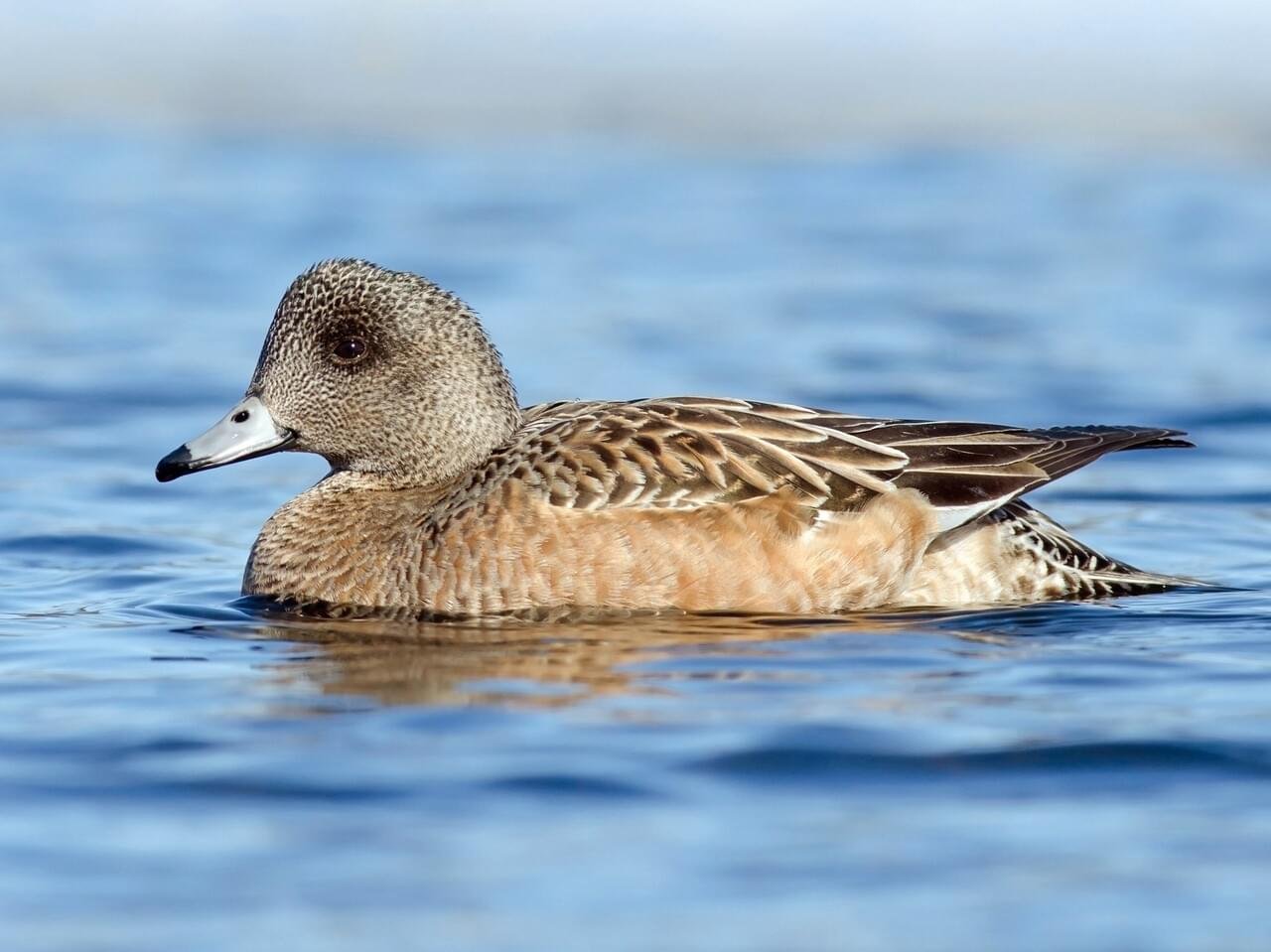
American Wigeon (Mareca americana), Alix d'Entremont/Macaulay Library
According to All About Birds, American Wigeons spend more time swimming and cover more ground between foraging periods than other dabbling ducks such as Gadwalls, Mallards, and Green-winged Teals. When startled, they erupt in flight from the water's surface at a moment's notice, flying erratically and rapidly. Males aggressively compete for females on the wintering grounds, frequently chasing females and fighting off rival males with bill snaps and threatening postures.
Each Monday we’ll post a new mystery and identify the previous week’s winner. They’ll receive an ASNV hat or tote bag.
Here is this week’s mystery:
Who is this?
Be sure to post your guess on our Facebook page under the latest Monday Nature Mystery post. Good Luck!
Please check our guidelines here.

Monday Nature Mystery: Who is this? Photo: Anonymous/Macaulay Library

We're Hiring! Applications for Volunteer Coordinator due Jan 9, 2023
The Audubon Society of Northern Virginia is now accepting applications for a Volunteer Coordinator. This will be a part-time, temporary position for one year, with a possibility to renew for a second year.
Photo: Royal Tern, Walker Golder/Audubon
The Audubon Society of Northern Virginia is now accepting applications for a Volunteer Coordinator. This will be a part-time, temporary position for one year, with a possibility to renew for a second year.
The Volunteer Coordinator will play a critical role assisting with planning, recruiting, and implementing various volunteer programs and projects for ASNV.
This position is also an opportunity to learn more about birds and wildlife, connect with other people who share a passion for nature, and utilize a range of skills to make an impact in our community.
Please view the full job listing here for additional information.
For questions, please email Stacey Remick-Simkins, chair of the Community Engagement Committee at sremicks@gmail.com. To apply, please email a cover letter and resume to info@audubonva.org by January 9, 2023.
State of the Birds 2022
The 2022 State of the Birds report gives us concern but also provides some basis for hope for the future.
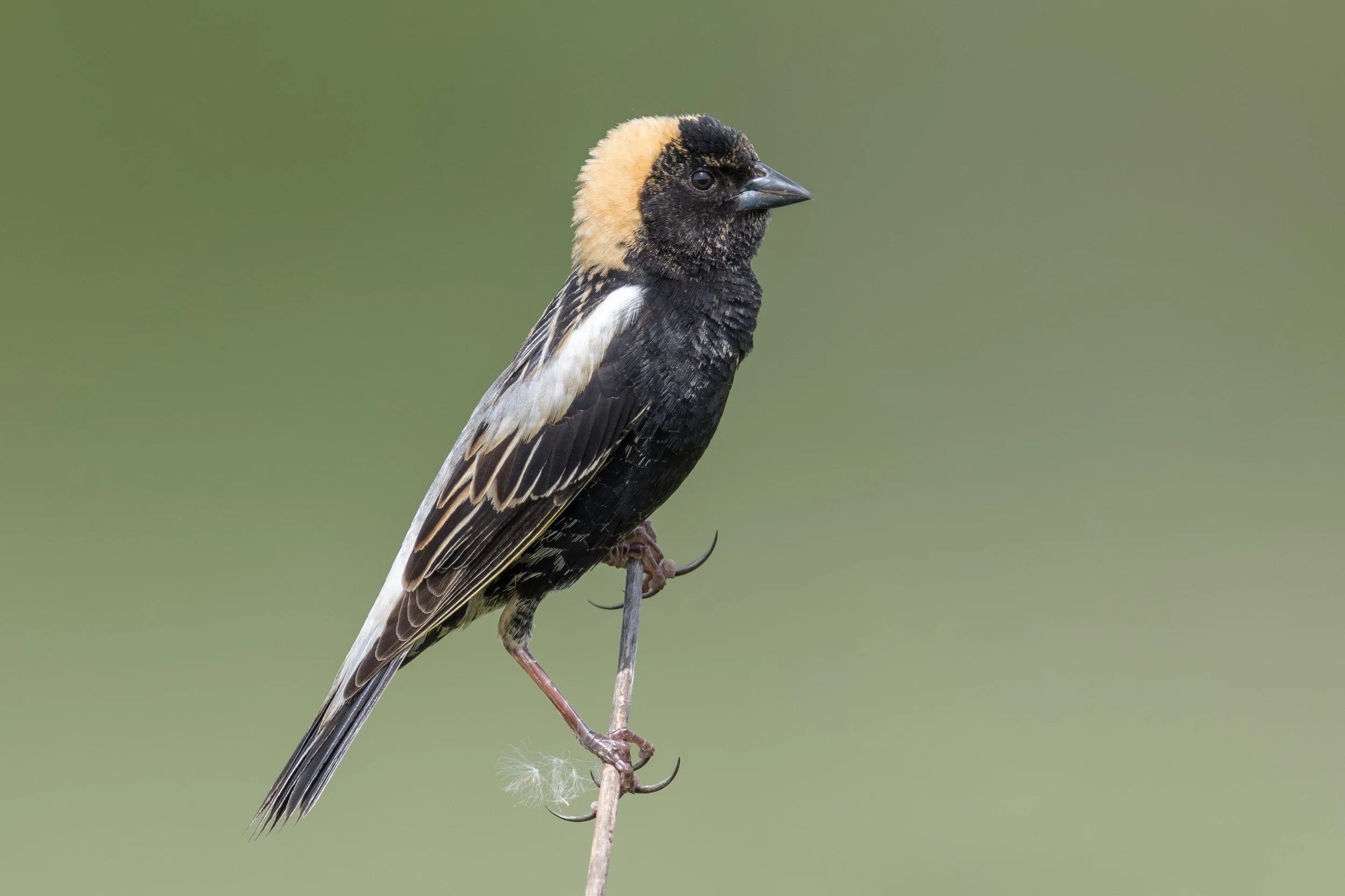
Photo: Bobolink, Adam Brandemihl/Audubon Photography Awards
By Greg Butcher
The 2022 State of the Birds report gives us concern but also provides some basis for hope for the future. I started birdwatching in 1963 and I got my first job in bird conservation in 1984. Like many of you, I celebrated the first Earth Day in 1970. So I felt a bit of personal failure three years ago when an article in Science revealed that North America has lost 3 billion birds – 25% of the total – since 1970. The 2022 State of the Birds Report released last month revisits the sad tale, provides a bit more detail, and tries to reverse my (our?) sense of despair that birds continue to decline despite our efforts to help them.
North American State of the Birds reports (SOTB) began in 2004 and have been produced by the North American Bird Conservation Initiative (NABCI) since 2009. The U.S. NABCI Committee is a coalition of state and federal government agencies, private organizations, and bird initiatives in the United States working to ensure the long-term health of North America’s native bird populations. The 2022 report summarizes population trends over the past 50 years by habitat type and by groups of related bird species. In addition, SOTB highlights successful conservation actions and recommends priorities for future work.
SOTB 2022 reiterates that we have lost 25% of North American birds in the last 50 years. The emphasis in this year’s report is on 90 species that have lost half of their population in those 50 years, of which 70 are expected to lose another 50% in the next 50 years.
The report is not completely negative because wetland birds have increased over the same time span. Geese have increased exponentially, and most duck species are doing better now than they were 50 years ago. Why? Geese have discovered waste agricultural grain and greatly increased their overwinter survival. Ducks and other waterbirds have benefitted from relatively wet years in the Prairie Potholes of the Dakotas and Manitoba, the duck breeding capital of North America.
The good news of SOTB 2022 is that a major reason that wetland birds have done better than other species is because we have invested heavily in wetlands conservation since the passage of the North American Wetlands Conservation Act in 1985. We haven’t achieved “no net loss” of wetlands, but we have slowed their decline, saved the best, and improved many. To reverse declines in other bird groups, we will need to invest in conservation of grasslands, forests, aridlands, and other habitats at least to the extent we have for wetlands.

Bobolink, Adam Brandemihl/Audubon Photography Awards

Eastern Meadowlark, TiTi McNeill/Audubon Photography Awards
Unfortunately, birds are declining in all other major habitats. Grassland birds are doing particularly poorly, as evidenced here in northern Virginia, where bobwhite quail have disappeared. American Kestrels have become a rare wintering bird, and Bobolinks are a rare migrant. Eastern Meadowlarks and Grasshopper Sparrows are the last breeding species in northern Virginia’s grasslands and meadows. It is easy to see why - large meadows with native plant species have been declining throughout my lifetime.
Shorebirds (sandpipers and plovers) are also doing poorly, left vulnerable by their long-distance migrations. The tundra and boreal habitats where they spend the North American summer are reeling from the effects of climate change. Aridland birds in western sagebrush and southwestern desert habitats are also suffering, primarily from drought, heat, and habitat degradation.
Sea ducks show steep declines, but I suspect that at least some of that may reflect birds that winter farther north where there are no Christmas Bird Counts to report them.
Eastern forest birds are also showing declines, as evidenced by the increasing rarity of our beloved Wood Thrush. Local favorites Kentucky and Prothonotary Warblers are also in decline.
Many efforts are being made to reverse these declines. Over the past 35 years, joint ventures among federal agencies, state governments, and the private sector to conserve bird habitats have sprouted up across the United States, Canada, and northern Mexico. In northern Virginia, we are located within the Atlantic Coast Joint Venture. SOTB 2022 reports on many conservation successes of these joint ventures.
SOTB 2022 recommends the following steps for successful bird conservation: 1) identify causes of population declines and suggest key actions to reverse them, 2) work with local communities on solutions, 3) develop an action plan that supports birds throughout the year and wherever they migrate, 4) take action, and 5) achieve success.
Audubon Society of Northern Virginia is implementing the strategy recommended by SOTB. We call our initiative “Stretch Our Parks” to improve the impact all the northern Virginia natural parks have on bird populations by improving habitat in the parks and in the neighborhoods that surround the parks.
So, every once in a while I am tempted to despair, but SOTB 2022 and ASNV strategic planning point the way to effective actions we can take to halt bird population declines – and in many cases to reverse them. SOTB 2022 helps us think globally; ASNV is here to help you act locally. Please join us this year as we work to improve habitats both in and around the many beautiful parks in northern Virginia!

Protecting Birds Improves the Lives of People
Bird conservation helps to slow the decline in bird populations, but it also contributes to human well-being in a variety of ways.
Photo: Maddie McGarvey/Audubon
By Greg Butcher
Bird conservation helps to slow the decline in bird populations, but it also contributes to human well-being in a variety of ways. Conservation of bird habitat contributes to the fight against climate change, reduces heat islands in cities, preserves water sources, and reduces forest fire threats. By making our parks better for birds, we also improve their value as a reservoir for clean water and air and for people to interact with and enjoy the natural world.
Birds are great indicators of conservation success because they occupy so many habitats and they are easy to count, so if the habitat indicators used in the State of the Birds Report stabilize or increase, then we have concrete evidence that things are improving for people and for other wildlife in those habitats. Here in northern Virginia, we are lucky that citizen scientists have been tracking bird populations in a variety of ways, especially over the past 30 years. ASNV conducts natural resource surveys, butterfly and dragonfly surveys, the annual Northern Virginia Breeding Bird Survey, the World Migratory Bird Count, and the Christmas Bird Count and sponsors the Great Backyard Bird Count.
Declining bird populations reflect commercial agricultural development, over-fishing, over-abundant deer, plastic pollution, and loss of natural habitats. Conservation success will require changing these practices that negatively affect both birds and humans.
Saving, restoring, and properly managing habitat are the most important actions we can take, but reducing threats to birds is also important. This past year, World Migratory Bird Day focused on “Turning Down Lights at Night” to prevent luring night migrants into dangerous urban areas. There are several things we can do to reduce threats in our neighborhoods: reduce window reflections to keep birds from crashing into them, keep cats indoors, and reduce pesticide use in our yards.

Managing larger properties for birds, butterflies, and people
The outdoor space on larger properties in Northern Virginia, whether residential or commercial, is typically divided into formal landscaping close to buildings and natural areas at the periphery.
Photo: Courtesy of Plant NoVA Trees
By Margaret Fisher
The outdoor space on larger properties in Northern Virginia, whether residential or commercial, is typically divided into formal landscaping close to buildings and natural areas at the periphery. New practices are emerging on how to manage both areas, practices that protect the ecosystem and support the birds and the butterflies while better satisfying human needs.
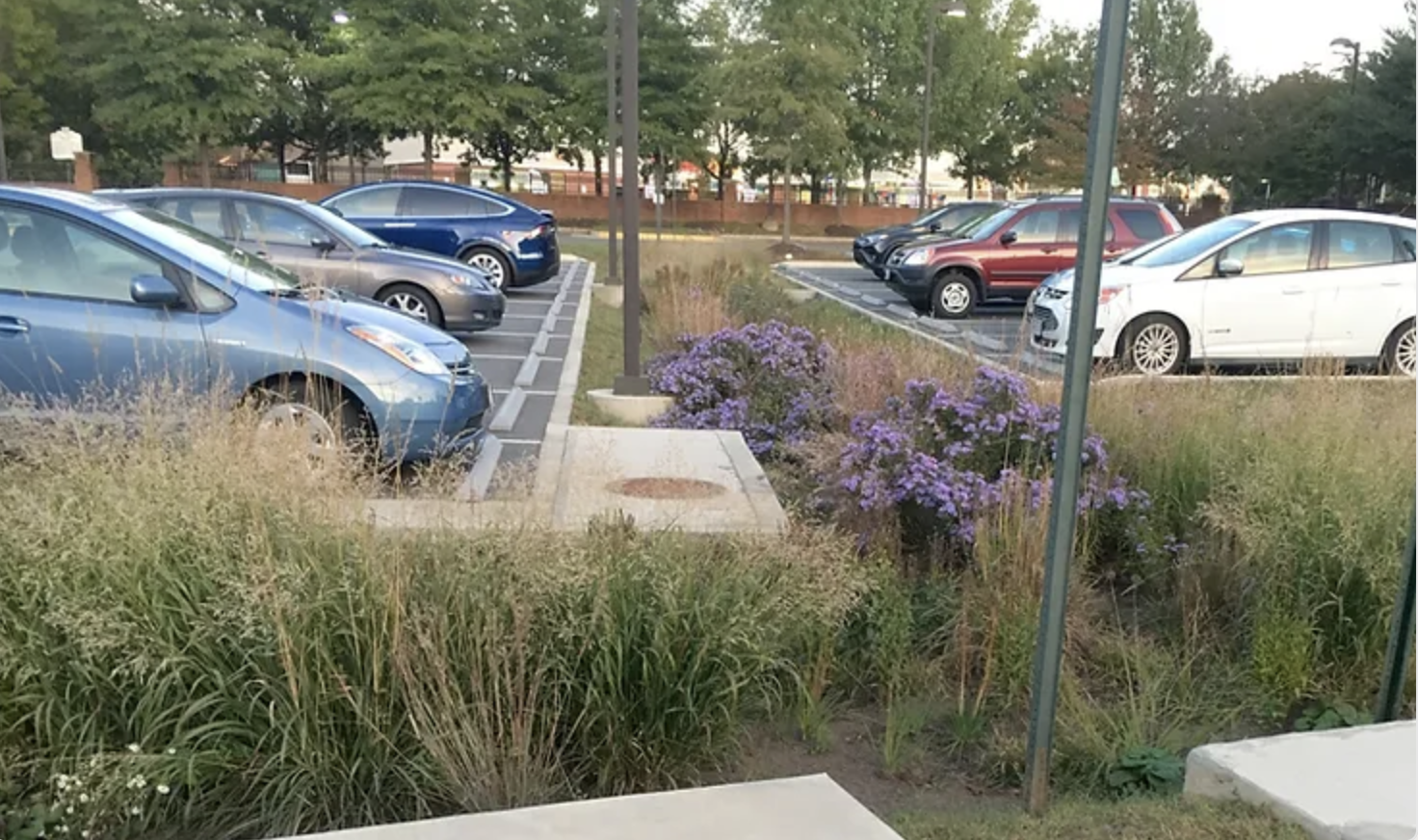
The natural areas between properties are an important amenity, providing visual barriers and sound buffers while capturing stormwater and reducing flooding. Looking around, it is evident that those natural areas are often being left to take care of themselves. The result is that they are steadily degrading as the native trees are displaced by invasive non-native trees and directly killed by invasive vines. The shrubs and ground layers are equally damaged by invasive species at those levels. Many of these invasive plants originate from the landscaped areas where they had been planted before people knew to do otherwise. Preserving trees and habitat in both areas requires taking out the invasives and replacing them with native species, of which numerous options are available.
Some other tweaking is also needed to common landscaping practices. To name a few examples, piling mulch against the trunks of trees causes the bark to rot. Blowing the fallen leaves out from under trees destroys the cover where fireflies and many butterflies overwinter. Leaf blowers with two-stroke engines pour pollution into the air and are loud enough to damage workers’ ears. Outdoor lighting can adversely affect birds, insects and plants. Spraying insecticides kills the bees and caterpillars even more than the mosquitoes they are intended to target. Simple solutions are available to mitigate all these problems.
Professional property managers and community managers negotiate the contracts with landscaping companies and can work with them to adjust their services. Details of the various options for both landscaped and natural areas can be found on the Plant NOVA Trees website in a section specifically for professionals. www.plantnovatrees.org/property-managers Please spread the word to the managers of any properties where you live or work.

Audubon Afternoon Live on January 22!
Join us on Sunday afternoon for our semi-annual live Audubon Afternoon at the National Wildlife Federation in Reston.
Photo: Forensic Ornithologist Carla Dove
Join us on Sunday afternoon for our semi-annual live Audubon Afternoon at the National Wildlife Federation, 11100 Wildlife Center Drive in Reston.
Forensic Ornithologist Carla Dove
We’ll gather informally starting at 2:30 so you have an opportunity to reconnect with everyone. We welcome any food and drink you would like to share with everyone during the informal portion of the program. At 3 PM, we’ll have a presentation by Forensic Ornithologist Dr. Carla Dove, a scientist with the Smithsonian National Museum of Natural History. Carla does specialized research in the microscopic identification of feathers. Her current research involves establishing techniques in this newly developing field within Ornithology, which applies forensic methodologies to determine species of birds from fragmentary evidence using microscopy, whole feather comparisons with museum specimens and DNA 'barcoding'.
The Audubon Afternoon is free, and everyone is welcome to attend. Registration is requested so we have an idea of how many people will attend, but is not required.

Christmas Bird Count
Would you like to help count birds and connect with other birders during the 123rd Audubon Christmas Bird Count (CBC)?
Photo: Camila Cerea/Audubon
Would you like to help count birds and connect with other birders during the 123rd Audubon Christmas Bird Count (CBC)? Teams all over the country will be counting birds between December 14 and January 5. You can learn all about the CBC on the Audubon website.
ASNV sponsors the Manassas-Bull Run CBC, which will be held for the 41st year on Sunday, December 18. You don’t need to be an expert birder to participate. We pair experienced birders with people who are still learning, and everyone has a good time. If you would like to participate in this count please contact Phil Silas (or 703-987-0817), as soon as possible but not later than December 8.
Information on other local CBCs that you may be interested in is available in the November 2022 issue of The Siskin, the newsletter of the Northern Virginia Bird Club. Look for the list on page 3.
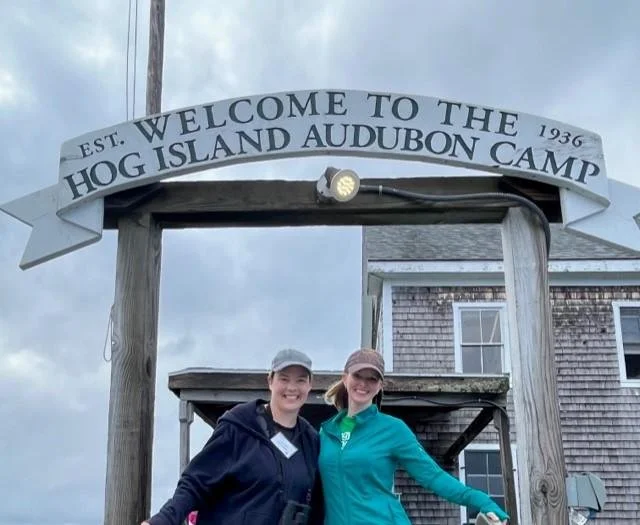
Applications Are Now Open for a Full Scholarship to Educator’s Week at National Audubon’s Hog Island Camp
Each summer, ASNV offers a full scholarship and transportation to “Sharing Nature: An Educator’s Week” at the National Audubon Society’s Hog Island Audubon Camp in coastal Maine.
Photo: 2022 ASNV Hog Island Scholarship Winners Chrissy Brownson and Candice Centinkaya
Each summer, ASNV offers a full scholarship and transportation to “Sharing Nature: An Educator’s Week” at the National Audubon Society’s Hog Island Audubon Camp in coastal Maine. Hog Island Audubon Camp has offered environmental education programs for adults, teens, families and conservation leaders since 1936. While there, educators learn interdisciplinary hands-on methods and approaches to environmental education while immersed in the natural world. From the Hog Island Audubon Camp website: “Learn practical approaches and add inspiration to your environmental education curriculum during this action-packed program. Our experienced and enthusiastic instructors share their favorite approaches, methods, and activities for engaging both children and adults with nature.”
The applicant must be a public classroom teacher, specialist or school administrator in the ASNV chapter territory (Counties: Arlington, Fairfax, Fauquier, Loudoun, Prince William, Rappahannock and Stafford; independent cities: Alexandria, Fairfax, Falls Church, Fredericksburg, Leesburg, Manassas and Manassas Park.) Dates for the coming year are July 16-21, 2023. To apply, please complete the online application and submit two letters of recommendation no later than February 28, 2023. One of these must be from your principal. Please see the application for additional details, including post-camp requirements.
2022 Hog Island Scholarship Winners
Would you like to learn more about what a week at the camp is like? You can read the reports of the two scholarship winners to last summer’s camp here.

Observations from Meadowood: December 2022
Judy Gallagher is an ASNV board member and a regular surveyor of local wildlife who also captures photos of what she sees, in particular the less common species.
Photo: Metricus Paper Wasp with wood fibers in her mouth, Judy Gallagher
Judy Gallagher is an ASNV board member and a regular surveyor of local wildlife who also captures photos of what she sees, in particular the less common species.
It's late autumn and you're sitting on your deck, beverage in hand, enjoying the unseasonably warm fall day. What could possibly mar this occasion, other than the swarm of yellowjackets that want to join your party? You would be forgiven for wondering why social wasps should exist, yet they are very important to a healthy ecosystem.
There are more than 100,000 worldwide wasp species, but only about 1000 of them are social wasps. Social wasps, which include yellowjackets, hornets and paper wasps, live in colonies with a queen and anywhere from dozens to thousands of sterile female workers who gather food and defend the nest, and males, whose only job is to mate with the queen.

Metricus Paper Wasp with wood fibers in her mouth, Judy Gallagher
Social wasps nests are constructed of paper cells. The worker wasps collect wood fibers, then mix them with water to form sort of a papier mache.

Hornet nest in tree at Occoquan Bay National Wildlife Refuge, Judy Gallagher
Hornets and Yellowjackets construct huge nests and the individual cells are not noticeable. Most yellowjackets construct their nests underground, but they can also build nests in trees or buildings.
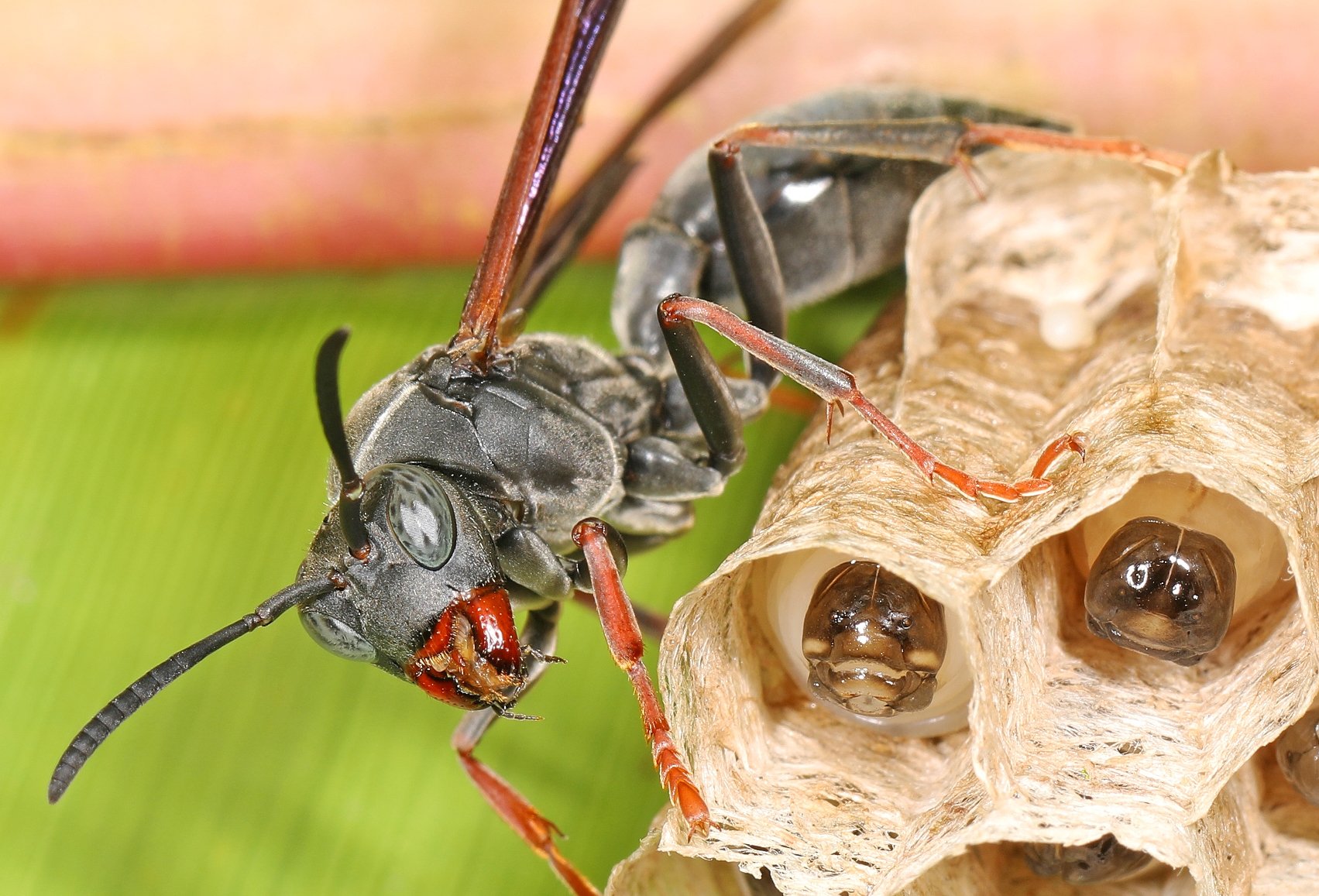
Paper Wasp with larvae, Judy Gallagher
Paper wasp nests look a little different. You can see the individual cells, and if you dare to get close enough, you might see the larvae inside each cell.

Metricus Paper Wasp at Dyke Marsh, Judy Gallagher
Paper wasp nests can be almost anywhere: this one (above) was right above the door to the Lady's Restroom at Dyke Marsh in Alexandria.

Guinea Paper Wasps, Occoquan Bay National Wildlife Refuge, Judy Gallagher
But this is a more typical view of a paper wasp nest (above), showing just how many workers there typically are.

Eastern Yellowjacket eating a Black Swallowtail caterpillar, Judy Gallagher
Adult social wasps collect protein to feed the larvae. This is one of the important roles they play in the environment - they keep other insects in check. The wasp adult macerates the captured insect and feeds the resulting insect paste to the larvae. The larvae converts the protein into carbohydrates and secrete sugary wastes that feed the adults. But when the larvae have become adults, the worker wasps no longer have this food source, so they search for nectar and yes, your beverage or sweet foods that you are eating outside.

German Yellowjacket with pollen, Judy Gallagher
As social wasps nectar on flowers, they accumulate pollen and when they visit the next flower, they pollinate it. So the next time you are bothered by social wasps, please consider the valuable roles they play in our environment and give them a break.
View all of Judy’s Observations from Meadowood articles here.

Plant This, Not That
This new series, “Plant This, Not That” by Alyssa Ford Morel offers suggestions on replacing invasive non-native plants with northern Virginia Natives.
Photo: Itea virginiana (Virginia Sweetspire), Elaine Mills
Introduction:
Invasive plants are one of the most significant risks to native habitat. Frequently, invasive plants get their start in gardens when they are planted deliberately. However, they can escape their original plantings and take over surrounding areas because native insects do not eat them. Bradford Pears are one obvious example of a non-native plant that has escaped cultivation and is growing wild in northern Virginia.
This month we are initiating a new series, “Plant This, Not That” by Alyssa Ford Morel that offers suggestions on replacing invasive non-native plants with northern Virginia Natives. Alyssa is an Extension Master Gardener with the Master Gardeners of Northern Virginia and serves as one of the Coordinators of the Glencarlyn Community Library Garden. She is also a Master Naturalist with the Arlington Regional Master Naturalists and an Audubon at Home Ambassador.
Plant This Not That: Replacing Nandina
by Alyssa Ford Morel
In the mid-70s, my family moved from Southern California to Northern. My parents purchased a typical ranch home made distinctive by the builder’s love of all things Asian. The shingles on the corners of the roof were built up into peaks and the front door had a calligraphic pattern on it.
My parents were dedicated gardeners and immediately hired a landscape architect to turn the yard into something special. Taking cues from the house, he used Asian plants including Japanese maples, Barberries, and Heavenly bamboo, or Nandina domestica.
Imported plants like the ones in that garden often do extremely well in America, partly because they are removed from the native insects that eat them. Over the years, many non-native plants have been so widely used that they are now more familiar to the average gardener than native plants. Sadly, over time, some of these exotics have shown an invasive nature.
Invasiveness is a commonly misunderstood term – it is not about what happens in cultivation. By definition, to be invasive, a plant must be non-native to the particular area and be capable of escaping cultivation and out-competing local wild plants, causing harm. A plant may be well-behaved in a garden, but a bully in the wild.
Nandina is one of those beautiful but invasive plants throughout much of the American Southeast, and is invasive in much of the East Coast. At the Glencarlyn Library Demonstration Garden which I help coordinate, we used to have Nandina, but we replaced them with other great plants. If you would like to do the same, here are some ideas.
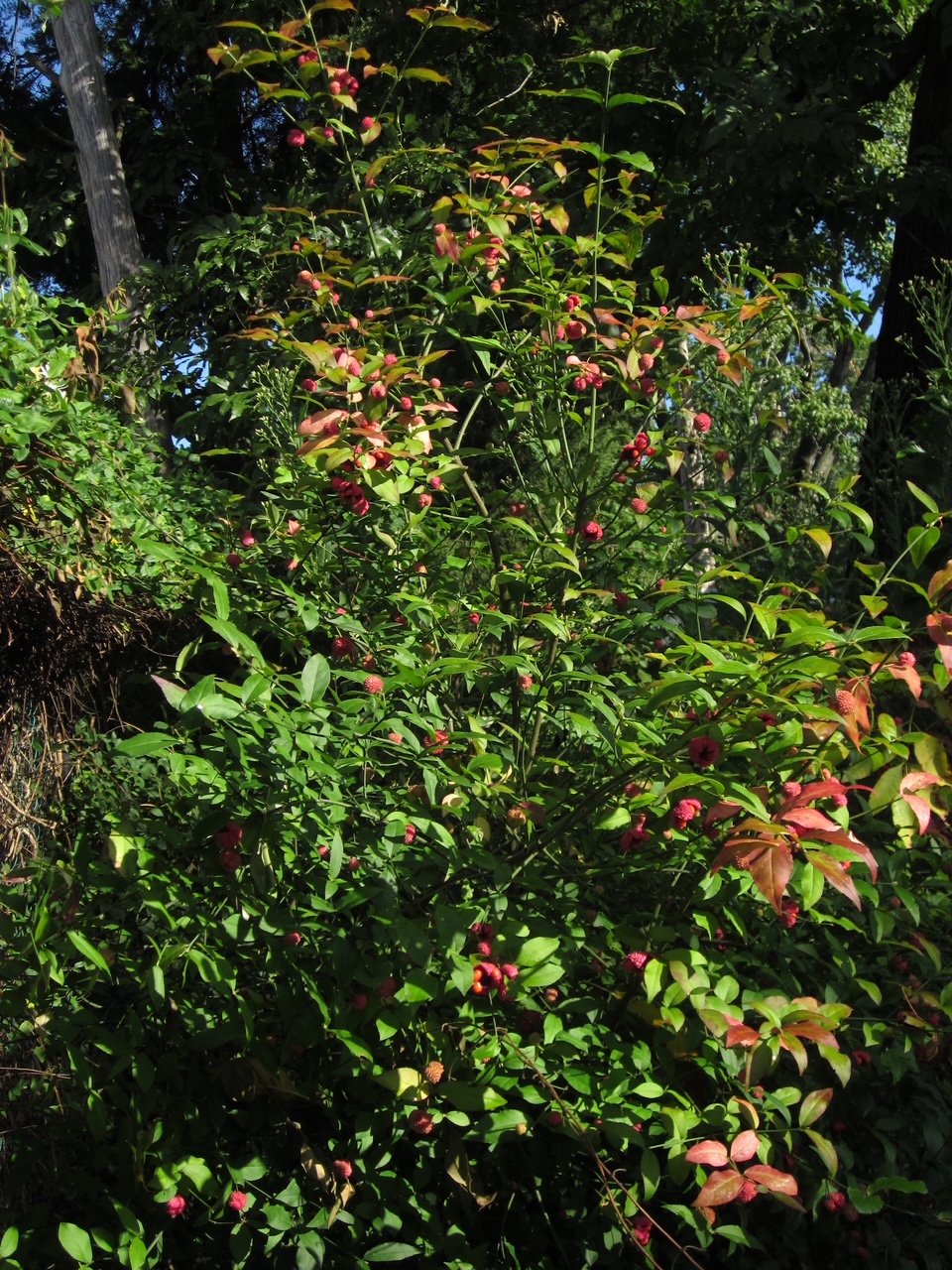
Euonymus americanus (Strawberry Bush), Elaine Mills
If you like Nandina’s colors, consider replacing it with Euonymus americanus (Strawberry bush). Its mixed peach/rust/green leaves in the fall are similar to the colors of Nandina, plus it has vibrant strawberry and orange-colored berries in the fall, giving rise to its two common names, Strawberry Bush and Hearts-a-Bustin. One word of warning is that this shrub is deer candy, and if you have trouble with deer browse, it’s not the best choice for you. However, if you don’t have deer issues, please consider this plant, as it struggles to survive in the wild anywhere that the deer population is high.
If you have small Nandina that you want to replace with another small shrub, consider Itea virginiana (Virginia sweetspire) ‘Little Henry,’ ‘Merlot,’ ‘Scentlandia,’ or any of the other small cultivars. These cultivars get to be 2 ½’ to 3' high and wide and have white flowers in spring and vibrant fall colors. Scentlandia has fragrant flowers.

Itea virginiana (Virginia Sweetspire), Elaine Mills

Cornus sericea (Red Twig Dogwood), Elaine Mills
In the Library Garden, we replaced a Nandina with a Cornus sericea (Red twig dogwood) shrub. This graceful upright shrub has white flowers in spring and red stems that brighten the winter landscape after it drops its leaves. New growth yields the brightest stems, so strategic cutting back is helpful. Happily, if you put those cuttings in a pot or directly into the ground, they root very easily, and you will soon have a new shrub to enjoy or share with a friend.

Monday Mystery - November 28
Monday Nature Mystery continues! Read on to learn who correctly identified our last mystery.
Photo: Turkey Tail, Judy Gallagher
We are pleased to announce the winner of last week’s Monday Nature Mystery, Katy Nor John!
Congratulations to Katy for identifying Turkey Tail (Trametes versicolor).

Turkey Tail, Judy Gallagher
According to Mushroom Expert, Turkey Tail is one of the most common mushrooms in North American woods. It is considered a “white-rot” fungus because it feeds on the lignin of hardwoods and helps return nutrients to the soil.
Each Monday we’ll post a new mystery and identify the previous week’s winner. They’ll receive an ASNV hat or tote bag.
Here is this week’s mystery:
Who is this?
Be sure to post your guess on our Facebook page under the latest Monday Nature Mystery post. Good Luck!
Please check our guidelines here.

Monday Nature Mystery: Who is this? Photo: Marc Butt/Audubon Photography Awards
Our Very Necessary Insects
People spend more time trying to kill insects than trying to save them, University of Delaware entomologist Douglas Tallamy told a Zoom gathering of 300 on September 25.
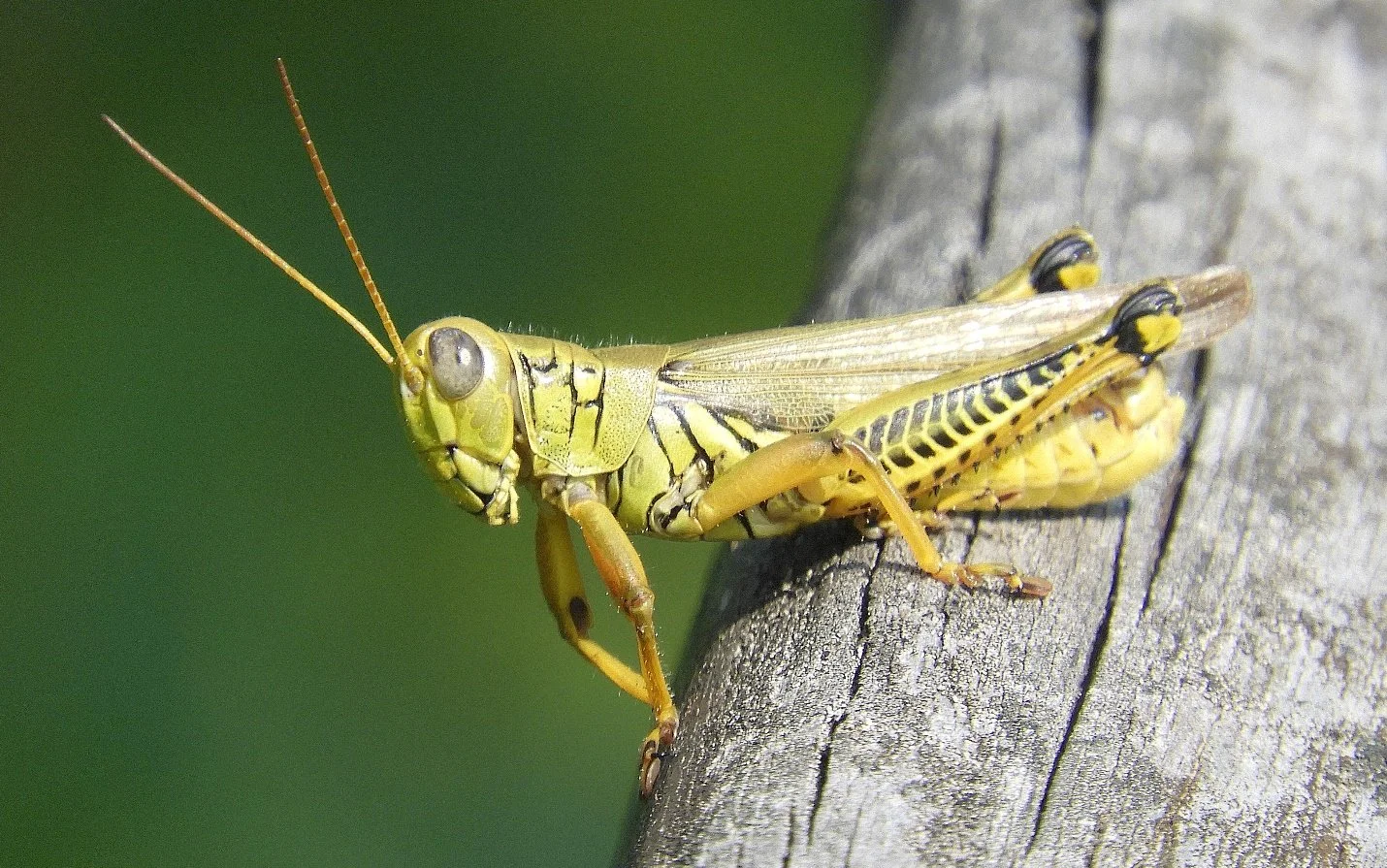
Photo: Differential Grasshopper, Bob Veltkamp
By Glenda C. Booth
People spend more time trying to kill insects than trying to save them, University of Delaware entomologist Douglas Tallamy told a Zoom gathering of 300 on September 25. Think about all those pest eradication products on hardware shelves, trucks spraying grassy lawns, and bug zappers, also aptly called electric insect killers.
Many people want to eliminate insects, he lamented, but his key message was, life as we know it depends on insects. Without insects, food webs would collapse, plants would not get pollinated, animals would disappear, insect decomposers would vanish, and people would be left with bacteria and fungi, he explained.
Tallamy quoted the late Dr. E.O. Wilson, an ant expert, who called insects “the little things that run the world,” but Tallamy stressed, though critical to life, insects are in serious decline.
Differential Grasshopper, Bob Veltkamp
A 2019 study published in Biological Conservation concluded that more than 40 percent of the world’s insect species face possible extinction, a phenomenon the media has called the “insect apocalypse.” A study published in Science Focus in 2020 found that one-quarter of land-dwelling insects have disappeared in the past 30 years. One million species face extinction in next 20 years and most will be insects, said Tallamy, citing a United Nations report. “The creatures that keep us alive are disappearing,” he warned.
Many birds depend on insects for food. Birds that winter in Costa Rica and migrate north lose 35 percent of their body weight when they cross the Gulf of Mexico. When they land, they must replace that weight by eating insects. Resident birds too need insects, especially caterpillars to feed their young. A chickadee, for example, needs 6,000 to 9,000 caterpillars to raise two young or one caterpillar every three minutes. But many bird species too are declining in numbers and at least 432 species birds in North America are threatened with extinction, a 2016 analysis found.
He showed a photo of a church surrounded by a treeless lawn and noted the irony that people were inside worshipping God’s creation, but with few to no native plants, destroying it outside.
Losing Critical Plants
Black Swallowtail, Bob Veltkamp
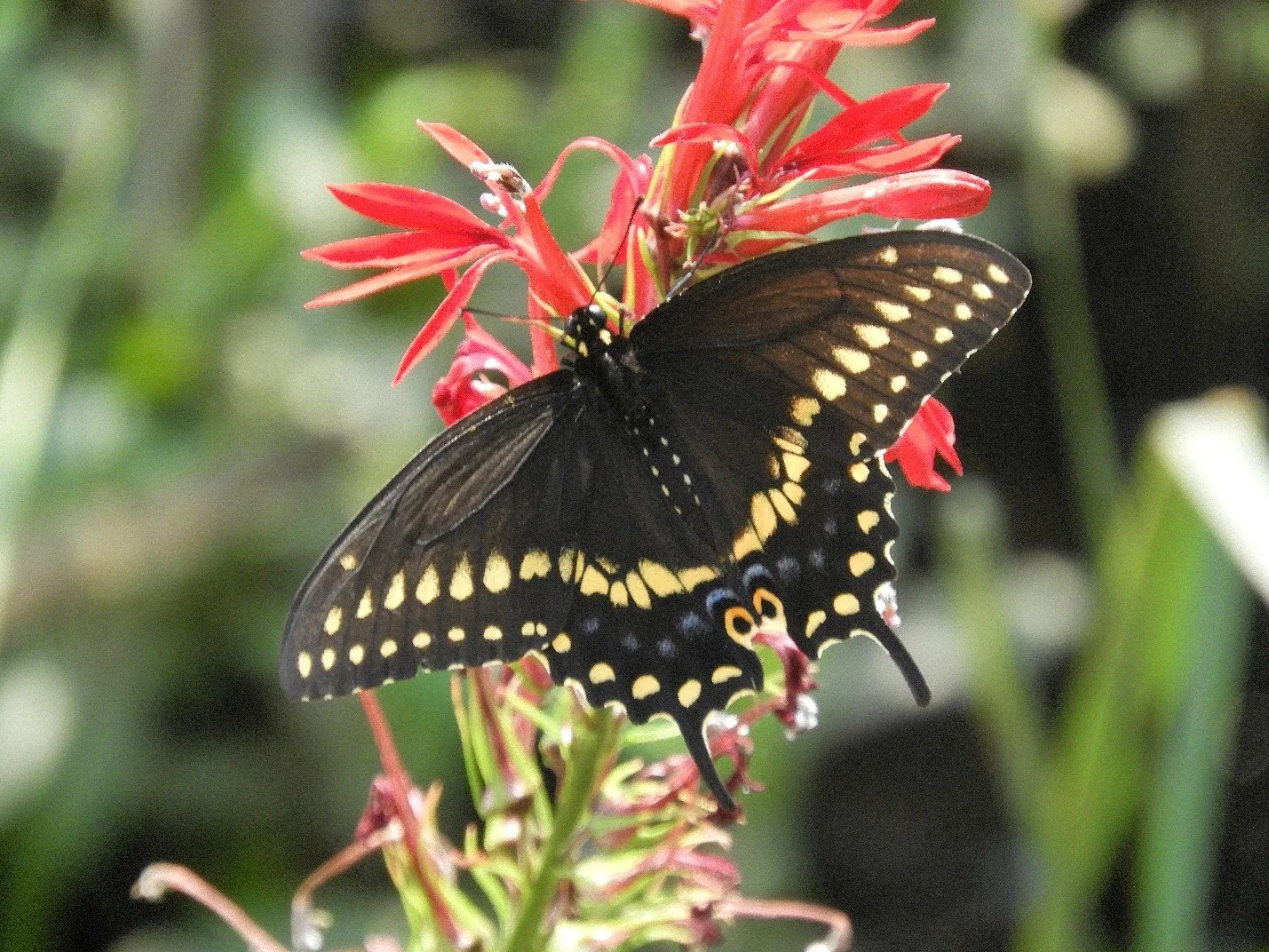
A major cause of these declines is that people have altered and disturbed natural habitat by replacing native plants on which native insects depend with non-native or invasive plants that give little support. Ninety percent of insects eat only vegetation from plants with which they share an evolutionary history. One of the most famous examples is the monarch butterfly. Its caterpillar eats only milkweed. Other examples: the Pandora sphinx needs Virginia creeper; the Zebra swallowtail butterfly needs pawpaw trees; the evening primrose moth, evening primrose; and the emerald moth, smooth sumac. “Plant choice matters,” Tallamy emphasized.
Oak trees are champion “keystone species,” the most productive plant, Tallamy contends. In his home state of Pennsylvania, 511 species of moths and butterflies rely on oaks, far more than other trees. Oaks support 557 species of caterpillars in the mid-Atlantic. Non-native trees like gingkos, Callery and Bradford pear and plants like barberry and amur honeysuckle do not support native insects.
Other Causes
Insects are also adversely affected by climate change, herbicides, pesticides, and light pollution. Building and street lights can increase predation on insects and cause incineration, collisions, dehydration and disruption of circadian rhythms and mating, Tallamy said.
What You Can Do
East of the Mississippi, 85.6 percent of land is privately owned so saving insects requires broad-based action, Tallamy challenged. We must “live in harmony with the natural world sustainably,” he urged, instead of “declaring war on nature.”
He offered some suggestions:
Cut lawns in half, create beds around trees, add trees, and leave the fall leaves for overwintering insects.
Plant native plants and remove invasive plants.
Reduce light pollution by using motion-sensitive lights and yellow light bulbs outside.
Avoid mosquito spraying, even if companies claim their products are “natural.” These products kill all insects, not just mosquitoes. Use a mosquito dunk or a fan instead.
Minimize insecticides and pesticides.
Don’t use bug zappers. They kill 99 percent of insects.
Tallamy concluded, “Insects are the currency in our ecological bank account. The insect decline is a global problem with a grassroots solution. We created the problem and we can solve it.”
He is the author of Bringing Nature Home, Nature’s Best Hope and The Nature of Oaks and formed Homegrown National Park to encourage private property owners to restore habitat and ecological networks with native plantings.
Libby Lyons applauded the talk “because his approach is straightforward and promises significant impact. His message is particularly powerful because he enables folks to see how each of us can make a positive difference for conservation right in our own backyards.” Lyons is president of the Audubon Society of Northern Virginia (ASNV). ASNV has free “ambassadors” that will advise property owners. Visit ASNV's Audubon at Home site.
The meeting was sponsored by the Audubon Society of Northern Virginia, Plant NOVA Natives, the Prince William Conservation Alliance and the Loudoun Wildlife Conservancy.
You can watch the talk here.
This article appeared originally in the Mount Vernon Gazette, Connection Newspapers, October 13, 2022.
How to Find Native Plants
Elizabeth Martin, Audubon at Home
The organizations sponsoring Dr. Tallamy’s September 25 talk offer resources for property owners wishing to adopt lawn and garden practices that are more friendly to wildlife and the environment. Plant NOVA Natives offers recommendations and guidance on native plants on its website. The Audubon at Home Ambassadors do on-site consultations, advising on substituting native plants for invasives. ASNV’s Audubon at Home program operates in the City of Alexandria and Arlington, Fairfax, Prince William, Fauquier, and Rappahannock Counties. The Loudoun Wildlife Conservancy operates the Audubon at Home program in Loudoun County.
Other websites with information on native plants are available from National Audubon Society and the National Wildlife Federation.