
NVBA NEWS BLOG
Welcome to the blog for Northern Virginia Bird Alliance, a wealth of resources about northern Virginia birds, wildlife, habitat conservation and restoration, native plants, wildlife-friendly gardening, advocacy and more.

Northern Virginia’s Winning Photographer, Amiel Hopkins
Dawn had not yet broken, but in his freezing cold bird blind Amiel Hopkins was awoken by the “booming” of Greater Prairie Chickens all around him.
Photo: Greater Prairie Chickens, Amiel Hopkins
Tom Blackburn
Dawn had not yet broken, but in his freezing cold bird blind Amiel Hopkins was awoken by the “booming” of Greater Prairie Chickens all around him.
Amiel, a northern Virginia resident and member of the NoVA Teen Birding Club, had journeyed to Fort Pierre National Grassland in South Dakota to watch and photograph Greater Prairie Chickens as the males put on elaborate displays in the hope of attracting a mate. He had spent the night in a 4 x 8 plywood box with a small viewing window, and his sleeping bag wasn’t adequate to protect him from the 18-degree overnight temperature. Nonetheless, he quietly began photographing the birds as they raised the long feathers on their necks, inflated their bright-orange throat sacs and released them with booming sounds that can be heard a mile away and performed a stylized dance.

Greater Prairie Chickens, Amiel Hopkins
Amiel submitted five of the photos he took that day to the National Audubon Society’s 2022 Photo Awards Contest. One of those photos, a closeup of a bird with its neck feathers raised and its orange throat sac glowing in the morning sunlight, won the Youth Honorable Mention Award. You can see Amiel’s winning photograph and all the other winning entries here. Accompanying this article is a photograph taken the same day he shot the winning photo of the Greater Prairie Chicken.
Amiel says he has been interested in nature his whole life. He got his first camera seven years ago, and since then has become increasingly interested in bird photography. He particularly likes photographing shorebirds, because he can get down low to capture images at the birds’ level. Chincoteague National Wildlife Refuge and the Pea Island National Wildlife Refuges on the Outer Banks are two of his favorite places to bird.
Amiel credits Fred Atwood, a local teacher and the sponsor of the NoVA Teen Birding Club, for not only encouraging his passion for birding but also influencing how he views nature and life. He calls Fred a “great mentor.” In turn, Fred advises that Amiel’s winning picture is only a small representative of his amazing photo portfolio. Few people get to see Amiel’s photos. He says he doesn’t show them off very often, and the National Audubon Society’s contest is the only one he has ever entered.
Amiel is a senior in high school, and will be leaving to attend Virginia Tech this fall, where he plans to specialize in wildlife biology.

Observations from Meadowood: April 2023
Judy Gallagher is an ASNV board member and a regular surveyor of local wildlife who also captures photos of what she sees, in particular the less common species.
Photo: American Bumble Bee, Judy Gallagher
Judy Gallagher is an ASNV board member and a regular surveyor of local wildlife who also captures photos of what she sees, in particular the less common species.
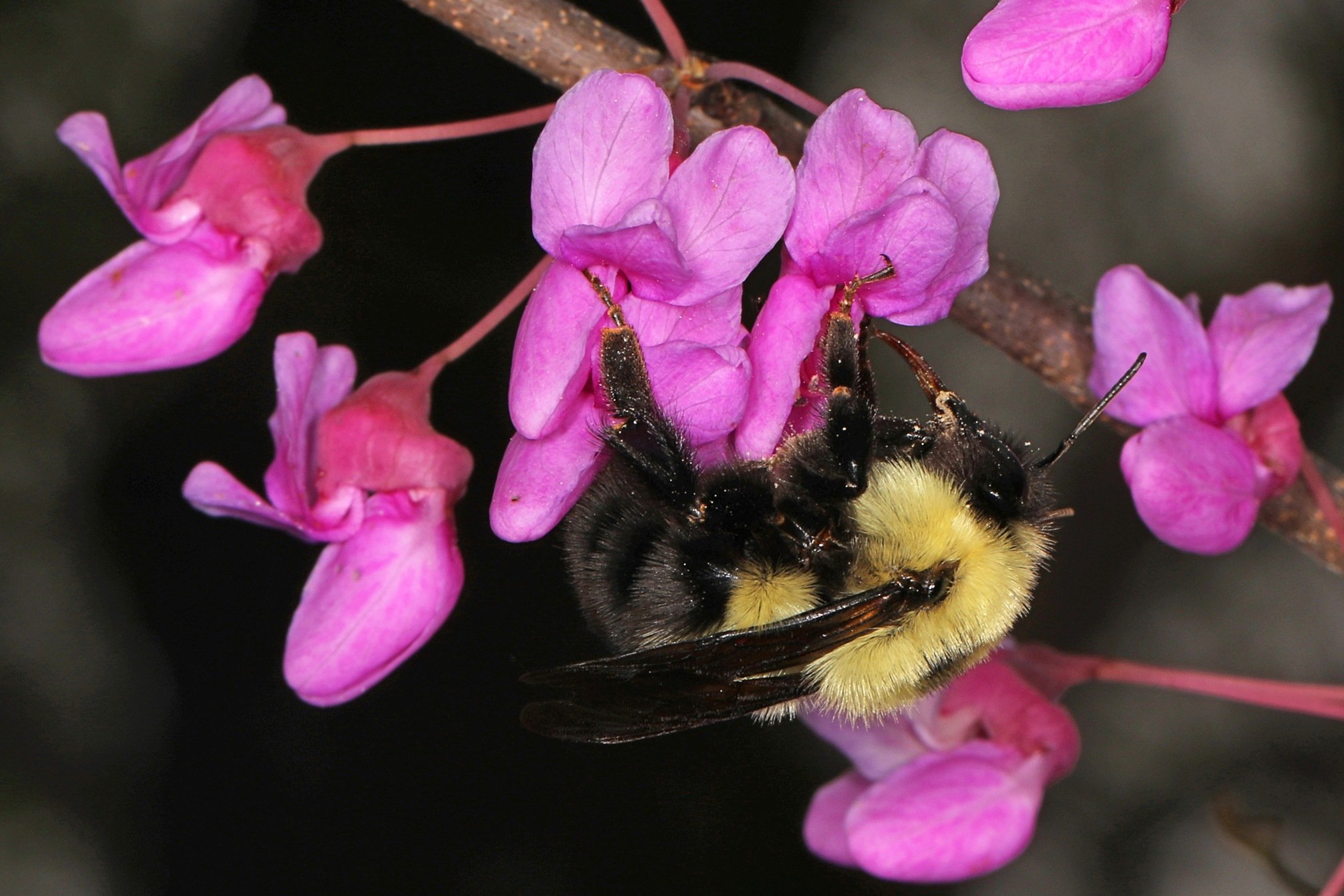
Two-spotted Bumble Bee - Bombus bimaculatus on Redbud, Judy Gallagher
This month's column was inspired by a large Bumble Bee seen recently at Meadowood. At this time of year, it would be a queen bee who has hibernated over the previous winter. She will choose a nest site, typically underground, and will build a mound of pollen and secreted wax on which to lay eggs. The eggs hatch, and the larvae feed for a couple of weeks, build cocoons, and develop into adult female worker bees. The worker bees collect pollen and nectar, enabling the queen to stay inside the nest for the rest of the season, laying hundreds of eggs. Other broods that hatch include male bees and new queens. The new queens mate in late summer, feed heavily to prepare for hibernation, and form new colonies the following spring.
Bumble Bees are large and furry, and most are black and yellow. Their fuzzy coats enable them to be out when temperatures are cool, and they warm up by basking in the sun and contracting their flight muscles without flapping their wings. Unlike Honey Bees, female Bumble Bee stingers are smooth, so they can sting more than once. But they aren't aggressive, and rarely sting.
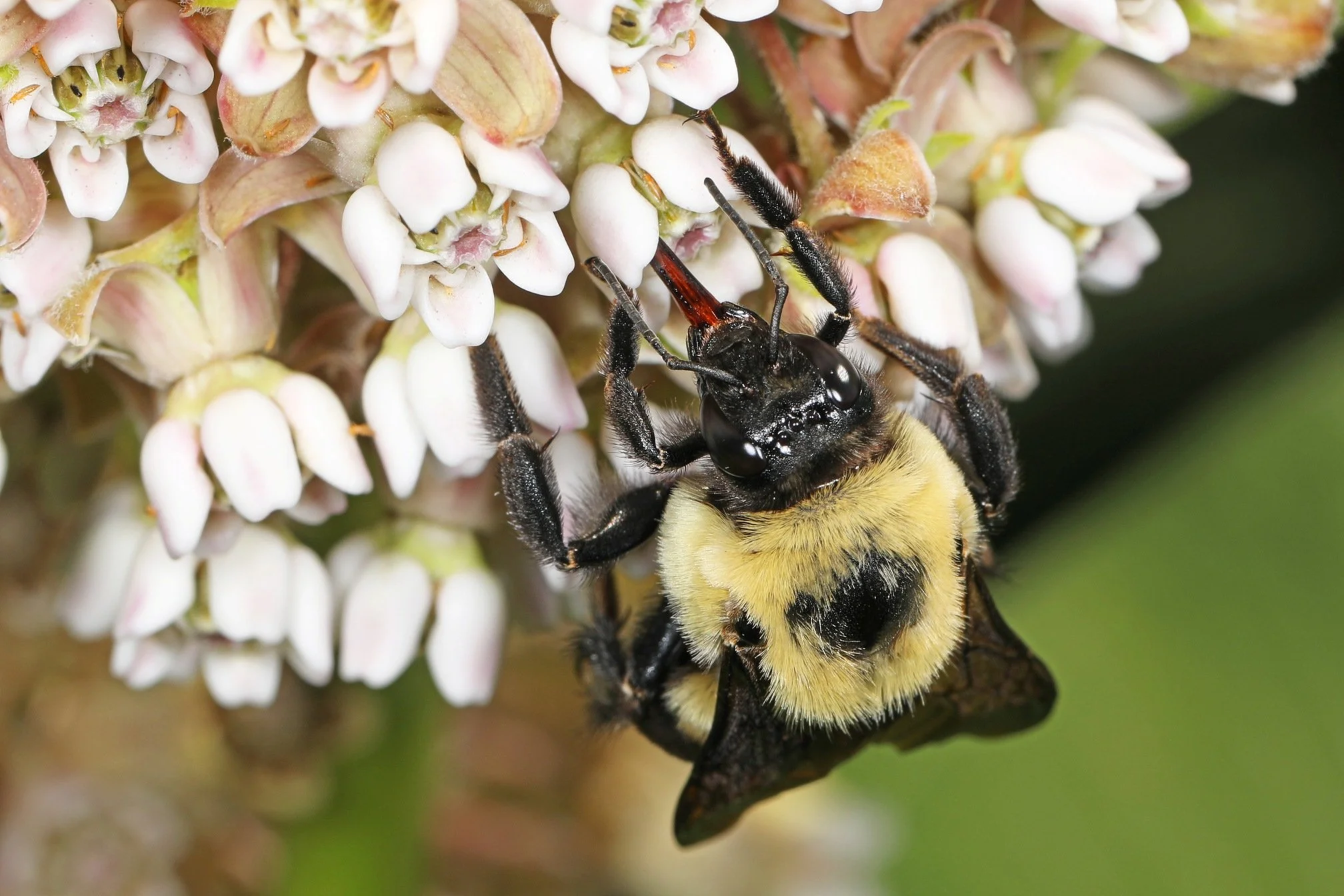
Brown-belted Bumble Bee - Bombus griseocollis on Milkweed, Judy Gallagher
Bumble Bees are generalists when it comes to food, collecting nectar and pollen from whatever flowers are available at the time. The nectar is nutrition for the adult Bumble Bee, and the pollen feeds the larvae. A Bumble Bee can carry up to half its body weight in nectar and pollen. Some species, for instance the Brown-belted Bumble Bee, show a preference for milkweed, thistles and sunflowers. Flower preferences are often related to the tongue length of different species. A long-tongued Bumble Bee can access tubular flowers' nectar, whereas a short-tongued Bumble Bee would need to depend on flowers that are easier to access.

Bumble Bee - Bombus species nectar robbing, Judy Gallagher
To get around this restriction, some Bumble Bees "nectar rob," cutting a hole in a flower in order to get to nectar. This means that the flower does not get pollinated.
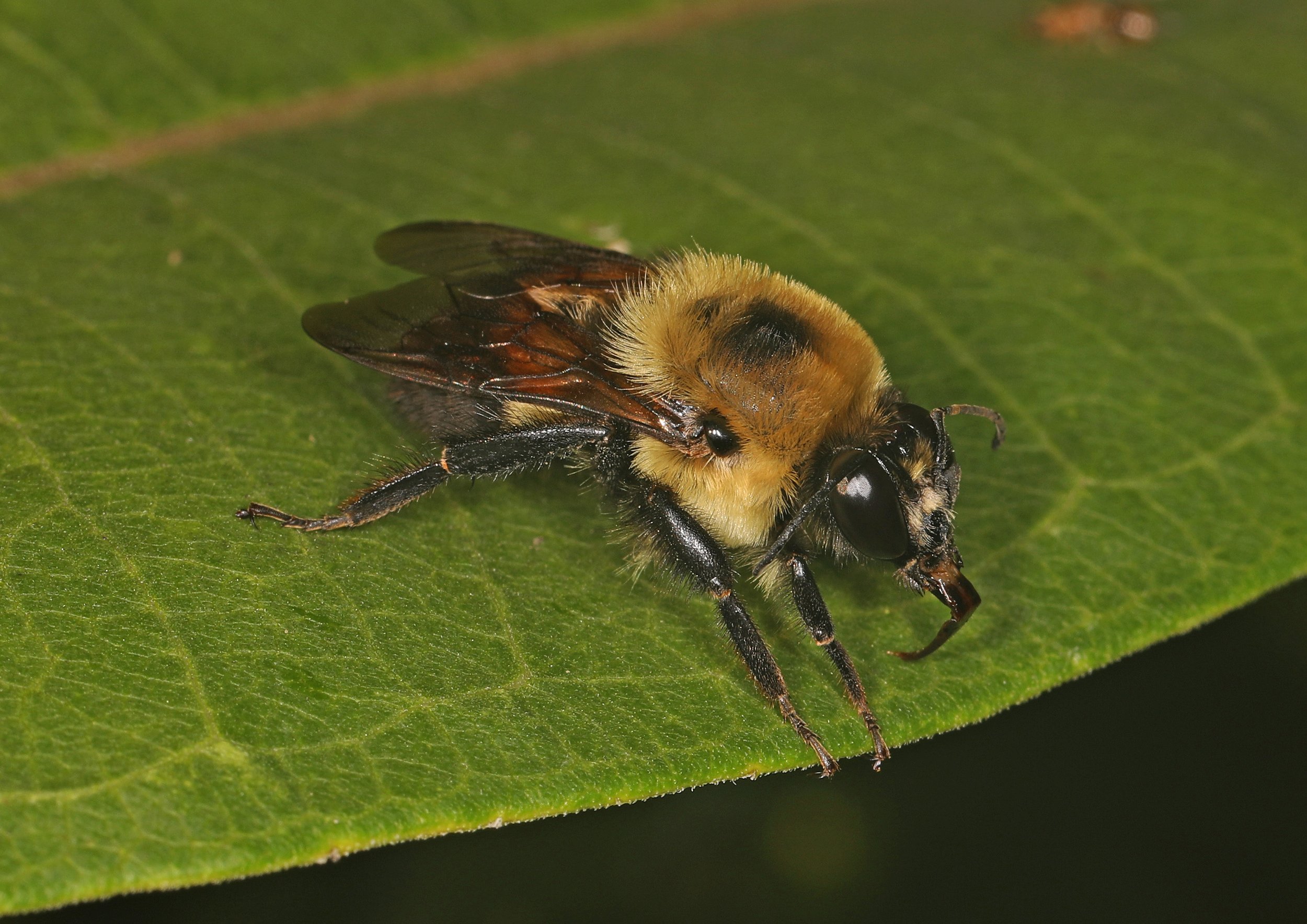
Brown-belted Bumble Bee - Bombus griseocollis folding up its tongue in preparation for flight, Judy Gallagher
When the Bumble Bee is flying, the tongue folds up under its head and body. Speaking of flying, sources differ on how fast Bumble Bees fly. Estimates range between 6 and 20 miles per hour. Bumble Bees are important pollinators, especially for crops such as tomatoes, red clover, and blueberries.

American Bumble Bee - Bombus pensylvanicus, Judy Gallagher
We have fourteen Bumble Bee species in Virginia, eight of which I've seen at Meadowood. They include the American Bumble Bee, which the U.S. Fish and Wildlife Service is considering for endangered species status, and the Great Northern Bumble Bee, which is considered "vulnerable" from a conservation standpoint.
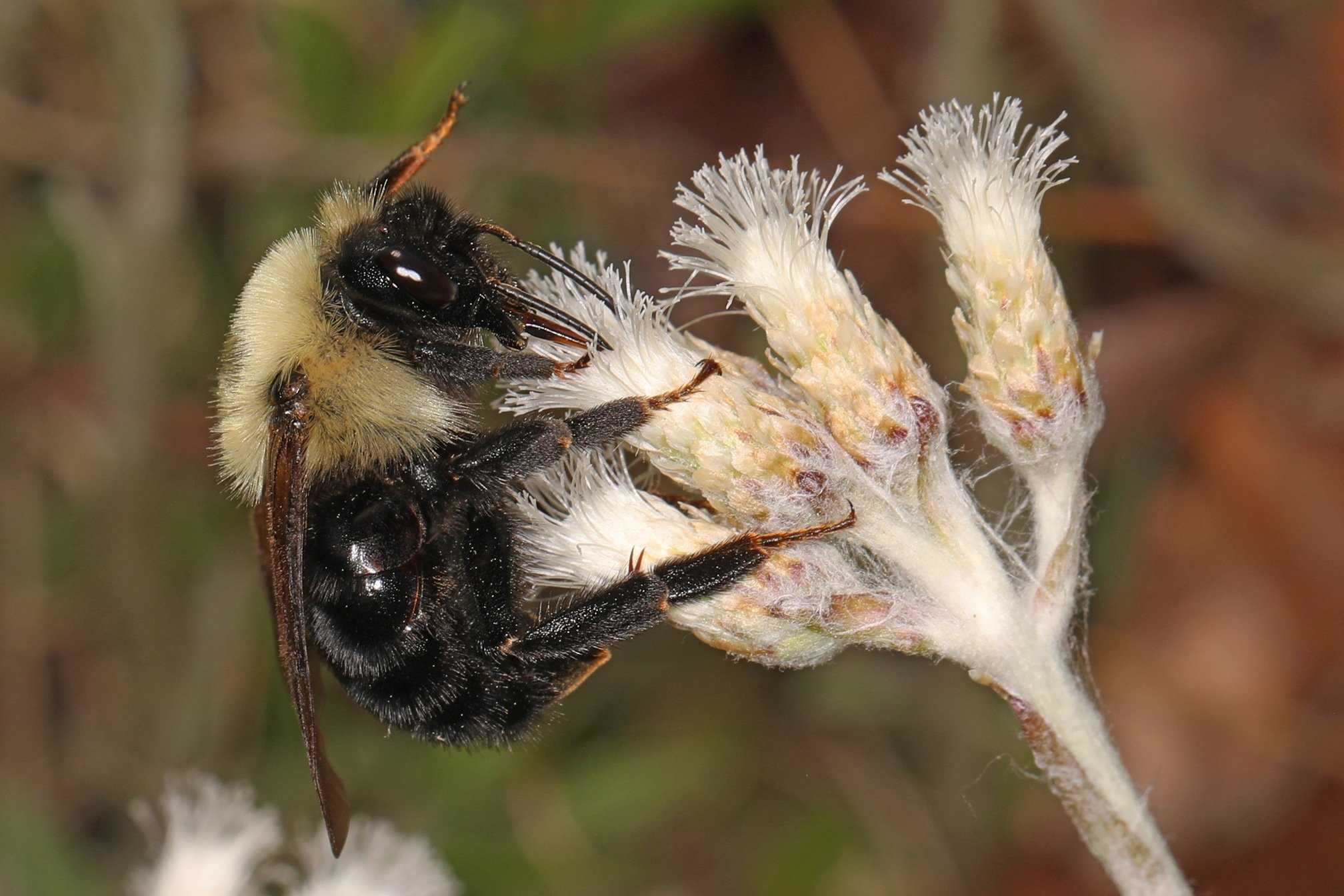
Lemon Cuckoo Bumble Bee - Bombus citrinus, Judy Gallagher
Because I'm not good at Bumble Bee identification, I submit my observations to iNaturalist. I usually only specify the genus, leaving species-level identification to the experts. And I sometimes get unexpected IDs. In mid-January of this year, an observation from 2021 was identified as the Lemon Cuckoo Bumble Bee, a species that I hadn't previously seen, or at least I didn't know that I had seen it. It has a different life cycle from the other Bumble Bees described here.
The Lemon Cuckoo Bumble Bee queen invades a colony of either Common Eastern Bumble Bee or Half-black Bumble Bee, kills the resident queen, her eggs and larvae, and takes control over the workers. She acquires the host scent by "mauling" or rubbing her body against the host workers, which suppresses the host workers' ovarian development. The Lemon Cuckoo Bumble Bee then lays eggs which are cared for by the host workers.
Most Bumble Bee species are declining in numbers. Pesticides, diseases, monoculture agriculture, habitat loss, and climate change are some of the threats faced by bees. You can help bees by planting native plants, providing them with nectar and pollen sources.
View more of Judy’s Observations from Meadowood articles here.
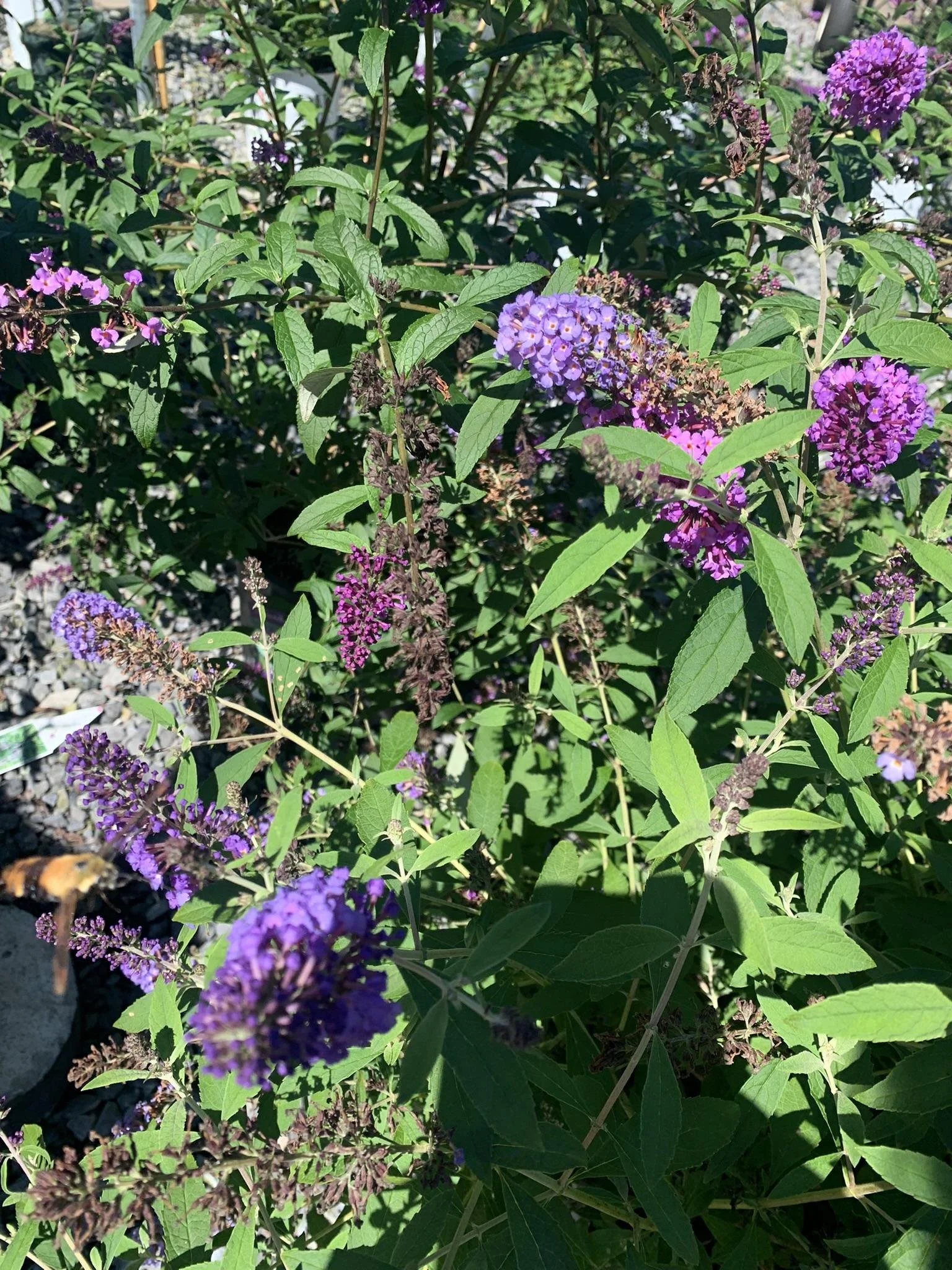
Plant This, Not That: Replacing Butterfly Bush
Confession is said to be good for the soul, so here it goes: I have, while standing in someone’s garden, wimped out on telling them their Butterfly Bush (Buddleia davidii) is invasive.
Photo: Butterfly Bush, Alyssa Ford Morel
Alyssa Ford Morel
Confession is said to be good for the soul, so here it goes: I have, while standing in someone’s garden, wimped out on telling them their Butterfly Bush (Buddleia davidii) is invasive. More than once. In more than one garden.
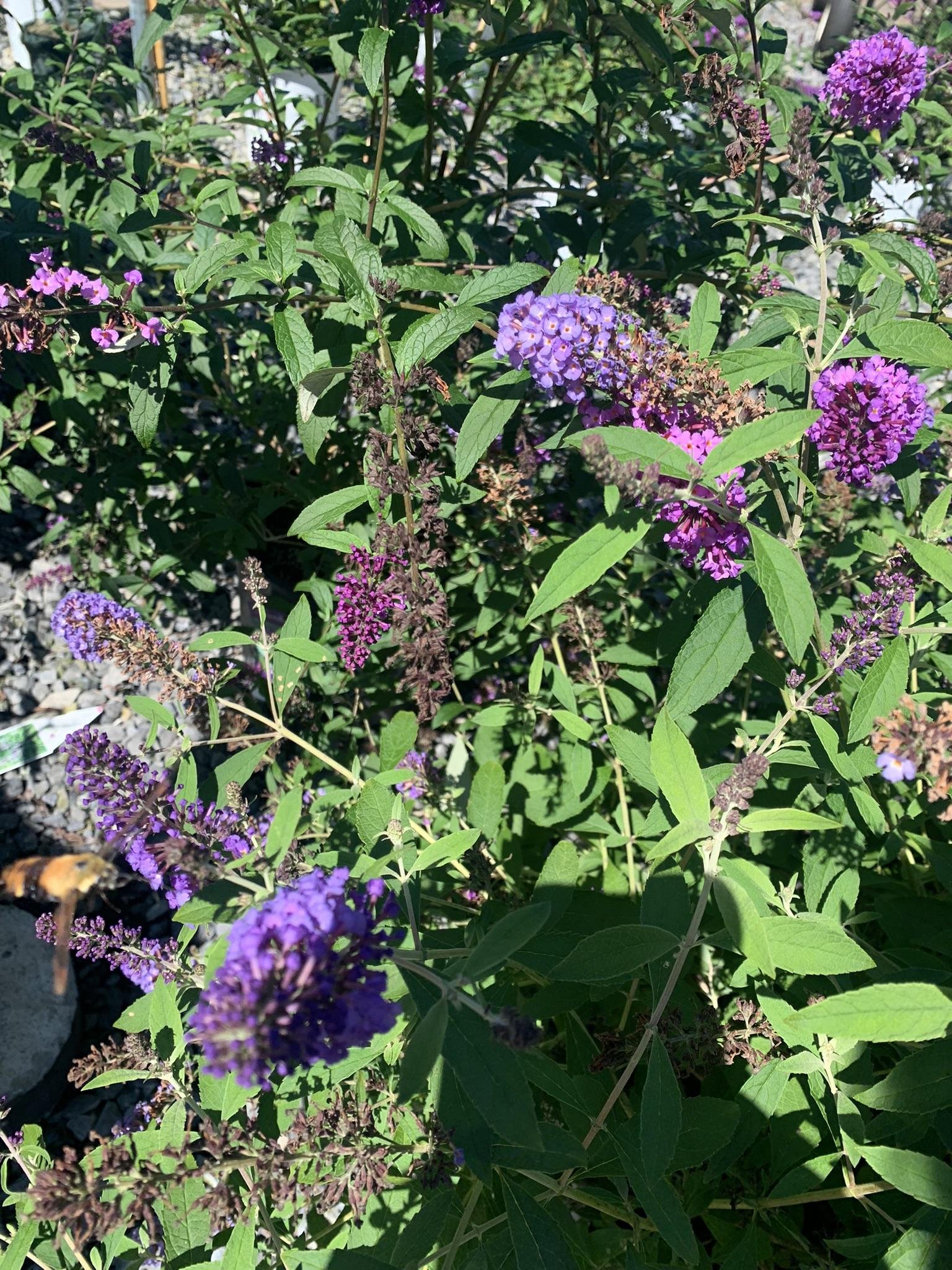
Butterfly Bush, Alyssa Ford Morel
I am not always so lily-livered. I’ve mustered up the courage to speak the truth a few times, and seen the light of horticultural zeal dim in a gardener’s eyes as they realize the beautiful plant they love and believed would help the environment is actually a problem. I’ve apologized to them for the harsh truth. Causing this pain also pains me, even though the message is important.
So now I am telling the truth in writing, where I do not have to watch my words disappoint: Butterfly Bush is a beautiful, butterfly-attracting problem. Do not plant it. If you have it, you should make plans to replace it.
You may not see the baby Butterfly Bushes that your plant has parented because they are growing out of sight in wild areas. The nature of invasiveness is not reflected by what a plant does in cultivation, it is about the plant escaping cultivation and out-competing natives in the wild, causing harm to the economy, human health or the environment (per Executive Order 13112, signed in 1999).
Butterfly Bush is a problem in the environment in several ways. First, it out-competes native plants, taking up the space they need. Second, because it produces abundant nectar, pollinators often ignore flowers on native plants, depriving them of the pollination they need to reproduce. Thirdly, although adult butterflies indeed flock to the shrub, it does not support a single American butterfly baby (that is, caterpillars).
There are some Butterfly Bush cultivars that are marketed as being sterile or low-fertility. Unfortunately, as Jurassic Park fans know, over time species sometimes revert to their original fecundity, so such offerings should not be seen as a safe alternative. The answer, instead, is to plant one of the many beautiful native plants that attract and support butterflies. Fortunately, there are great choices available.
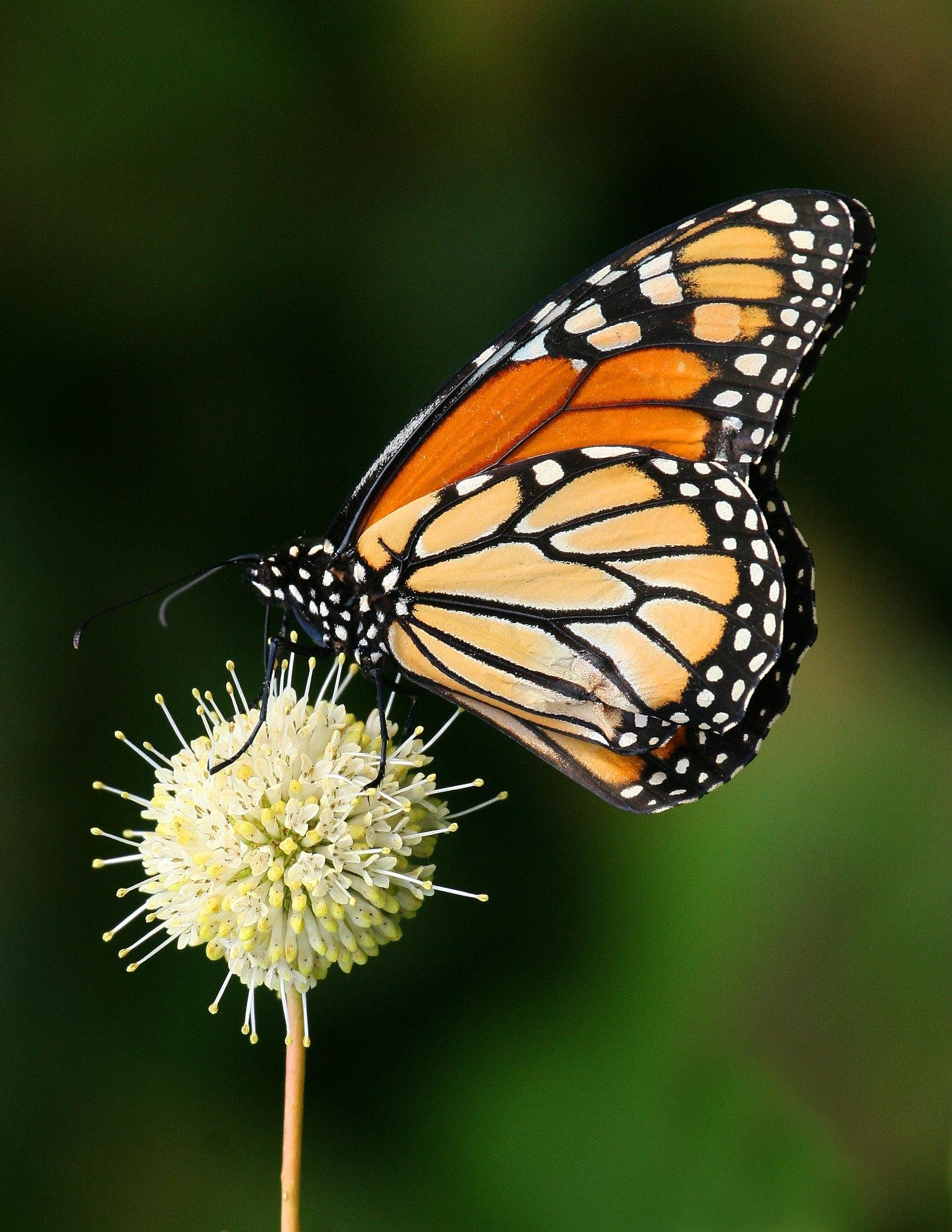
Buttonbush with a Monarch, Judy Gallagher
My personal top choice is Buttonbush (Cephalanthus occidentalis). This 6-to-12-foot-high shrub sets fabulous cylindrical white flowers that attract not only butterflies, but bees, hummingbirds and songbirds, as well as serving as host plant for two kinds of Lepidoptera. A smaller cultivar, ‘Sugar Shack’ is an alternative for those with less space. Buttonbush particularly likes moist areas.
If it’s the purple flower color that you particularly like, Gayfeather (Liatris spicata) is a great choice. This clump-forming perennial is easy to grow and maintain, and also attracts bees, hummingbirds and butterflies. It plays nicely with other plants in a mixed border or meadow design, providing striking purple spikes in mid-summer.
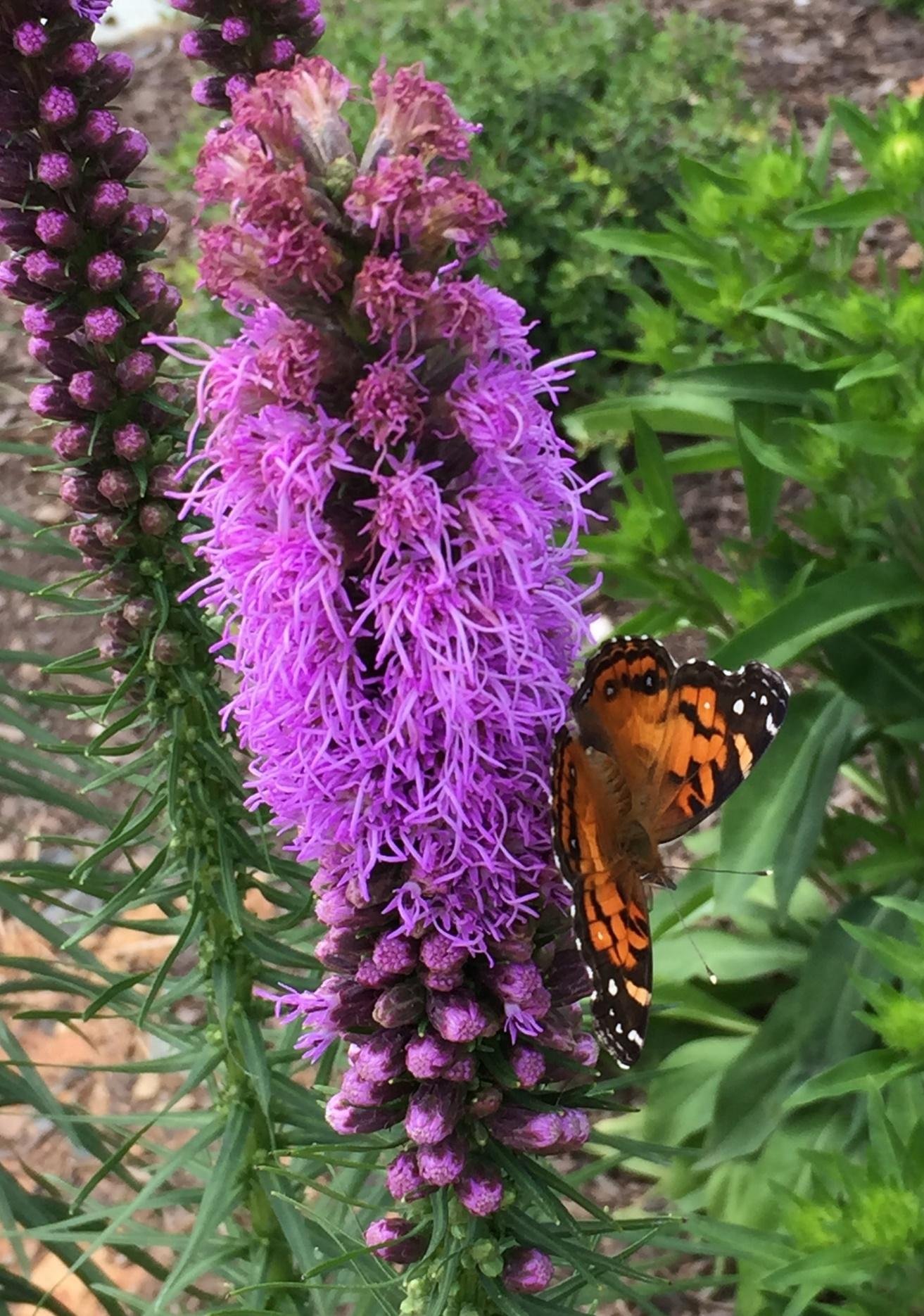
Gayfeather, Elaine Mills
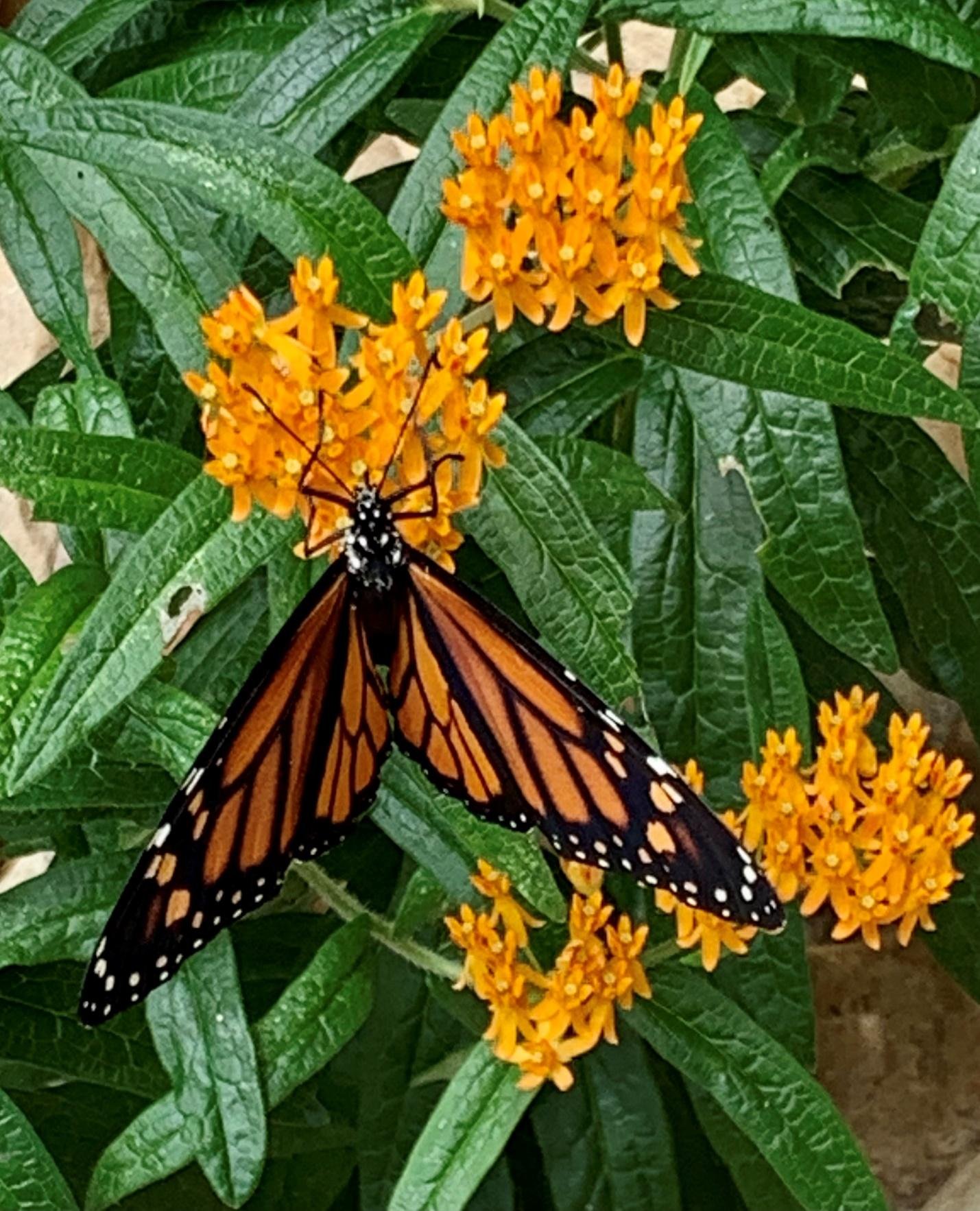
Butterfly weed with Monarch, Alyssa Ford Morel
An iconic native plant known for supporting butterflies to consider is Butterfly-weed (Asclepias tuberosa). Like all members of the Milkweed family, it is a host plant to Monarch butterflies, whose eastern population has declined 85 percent in the past two decades. One thing we can do to help them is plant more Milkweeds, including this happy, easy-to-grow plant. It not only supports Monarchs, but also attracts other butterflies and beneficial insects as well as hummingbirds.

Monday Mystery - March 27, 2023
Monday Nature Mystery continues! Read on to learn who correctly identified our last mystery.
Photo: Yellow Lady’s Slipper (Cypripedium parviflorum), Doug McGrady
We are pleased to announce the winner of last week’s Monday Nature Mystery, Judy Dority!
Congratulations to Phoenix for identifying the quickly identifying the Yellow Lady’s Slipper (Cypripedium parviflorum).

Yellow Lady’s Slipper (Cypripedium parviflorum). Photo: Doug McGrady
According to the North American Orchid Conservation Center, this species produces a large flower with a pale to dark yellow (and very rarely white) pouch-like labellum, which sometimes has reddish spots on the interior. Green or yellowish sepals and petals twist outwards in spirals. It produces up to five stem leaves; both the stem and leaves are covered in thin hairs. It grows in dry to mesic forests, woodlands, fens, prairies, and meadows.
Each Monday we’ll post a new mystery and identify the previous week’s winner. They’ll receive an ASNV hat or tote bag.
Here is this week’s mystery:
Who is this? Can you tell by just the beak?
Be sure to post your guess on our Facebook page under the latest Monday Nature Mystery post. Good Luck!
Please check our guidelines here.

Monday Nature Mystery: Who is this?

Migrants at Upton Hill Regional Park
What few people know is that there is a lot of natural habitat at Upton Hill, and that habitat attracts a lot of migratory birds. In that sense, Upton Hill is a microcosm of northern Virginia – we have lots of people and lots of development, but we also have lots of birds, especially in spring and fall.
Photo: Brown Thrasher, Will Stuart/Audubon Photography Awards
Greg Butcher
What is the most popular activity at Upton Hill Regional Park in Arlington? Is it the waterpark? The huge climbing apparatus? Mini-golf? Batting cages?
What few people know is that there is a lot of natural habitat at Upton Hill, and that habitat attracts a lot of migratory birds. In that sense, Upton Hill is a microcosm of northern Virginia – we have lots of people and lots of development, but we also have lots of birds, especially in spring and fall.

Northern Parula, Linda Steele/Audubon Photography Awards
For most people, warblers create the most excitement in spring. Roger Tory Peterson called them “the butterflies of the bird world” because they are small, colorful, and active! In most springs, Upton Hill hosts 30 or 31 species of warblers. If you count Yellow-rumped Warblers (that might spend the winter here), warbler migration has already begun. The next expected species is Palm Warbler, then Louisiana Waterthrush and Northern Parula, all possible in early April. Any of the 31 species can be expected during the first week of May.

Red-eyed Vireo, Greg Pasek/Audubon Photography Awards
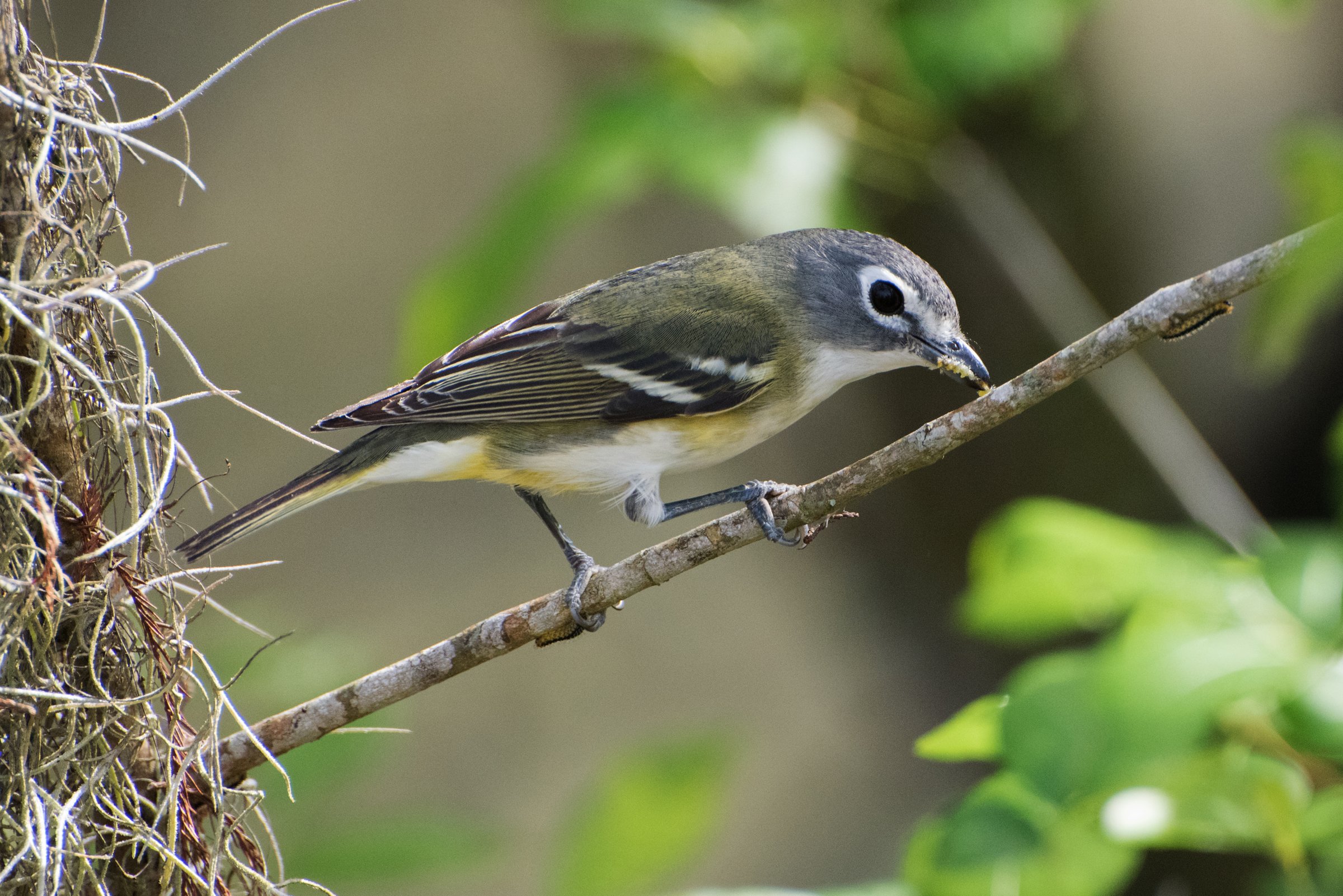
Blue-headed Vireo, Doug DeNeve/Audubon Photography Awards
Other highlights of spring migration include vireos, thrushes, and flycatchers. Upton Hill features five species of vireos (including Red-eyed Vireos that stick around to breed), five species of thrushes (including Hermit that spends the winter and Wood that breeds nearby), and six species of flycatchers (all of which breed in our area). Eastern Phoebe is the earliest arrival, during the first week of March. Next is Blue-headed Vireo at the beginning of April. The latest and rarest of the group is Gray-cheeked Thrush that sneaks through in mid-May, heading for the boreal forest of Canada.

Baltimore Oriole, Mark Boyd/Audubon Photography Awards
There are a number of other special migrants to look for at Upton Hill: Baltimore Oriole, Scarlet Tanager, and Rose-breasted Grosbeak. And many birds that breed in our area are easiest to see from late April to late May when they first arrive and sing and display to set up territories and attract mates. Upton Hill has Blue-gray Gnatcatcher and Brown Thrasher as early arrivals. Red-eyed Vireo will arrive in late April and sing all summer long.

Brown Thrasher, Will Stuart/Audubon Photography Awards
Because of the great opportunities to see songbirds during migration, ASNV and Upton Hill Regional Park plan to co-host a birdwalk every weekend in April and May. Watch the listings on our website for more information.
To view a bar chart of the comings and goings of Upton Hill Regional Park, click here.

Virginia General Assembly Passes Two Bills to Deter Invasive Plants
The Virginia House of Delegates and Senate have approved two bills that can help deter the spread of invasive plants in Virginia and encourage use of native plants.
Photo: Porcelain Berry vine, Wikimedia Commons
Elizabeth Martin

English Ivy, Wikimedia Commons
The Virginia House of Delegates and Senate have approved two bills that can help deter the spread of invasive plants in Virginia and encourage use of native plants. The next step is to send the bills to the Governor for approval. The success of the bills so far is due to tireless efforts of two northern Virginia legislators, Delegate David Bulova (37th District) and Delegate Paul Krizek (44th District) and advocacy by conservation organizations and voters throughout Virginia. Thank you from ASNV and its members! Please take a few minutes to write each of them a personal thank you.
The Two Bills
Delegate Bulova’s HB 2096 requires the state agriculture board to develop a list of invasive plant species, and includes provisions to discourage their use. The bill directs the board to develop regulations requiring commercial designers and installers to notify property owners of proposed use of any plants on the state’s invasive plants list. Because plant retailers and customers often do not know which plants are invasives, the requirement to provide information allows customers to make better choices. The bill also prohibits state agencies from planting, selling, or propagating the plants except for scientific or educational purposes. It also authorizes the board to adopt regulations for permits to move, transport, deliver, ship, offer for shipment, sell, or offer for sale any invasive plant.
Delegate Krizek’s HB1998 directs state agencies to prioritize native plant species and to take steps to identify state properties for native plantings and prepare guidance to rehabilitate state properties degraded by invasive species. Because the state owns many large properties, such as universities and prisons, the bill would expand native plant habitat. It also provides the state the opportunity to set an example for responsible environmental stewardship by enhancing its properties’ habitats with native plants that serve Virginia wildlife.
So Why Is This Important?
Non-native plants were introduced into the United States intentionally or accidentally by people sometime after Europeans first arrived in North America. Many are important food crops or ornamental plants that do no harm. But many are harmful invasives, non-native plants that can spread out of control and overwhelm and displace native vegetation. They can spread dangerously because they have no natural predators in our ecosystem. Even if an invasive plant appears to be “under control” in a private yard, its seeds can spread and invade nearby parks and wildlife areas. Native plants co-evolved with local wildlife and provide the best food value to them. An area overrun with non-native invasives is a food desert for native wildlife that depends on native plants to survive.
Chickadees provide a good example of that dependence. Research shows that unless a yard is at least 70 percent native plant material, it cannot support even one family of chickadees. Chickadee nestlings depend on caterpillars to survive, and caterpillars eat very specialized native plant species. No native plants (or trees) means no caterpillars, and that means no birds. Our native wildlife is losing habitat not only to development but also to encroachment by invasive plants, and habitat loss is the largest cause of the decline of North American birds.
The annual cost of invasive plant species in the U.S. is estimated to be $35 billion. (Swearingen and Fulton, Plant Invaders of Mid-Atlantic Natural Areas, 2022, p. 10). Current Virginia law identifies only 14 plants on the state’s “noxious weeds list,” but the list of invasives recognized by the Department of Conservation and Recreation is much longer. Common invasive plants in Northern Virginia include English ivy, running bamboo, Bradford pear trees, tree-of-heaven, oriental bittersweet, privet, porcelain berry and stilt grass. Virginia law allows the sale of most of them, and they have invaded our parks and reserves. Change, like that called for in the Bulova and Krizek bills, is sorely needed.
What You Can Do
Here are the links to track the further progress of Delegate Krizek’s HB 1998 and Delegate Bullova’s HB 2096. If you’re interested in learning more about how to advocate for legislation to improve wildlife habitat and halt the decline in bird populations, contact the ASNV Advocacy Committee using this link]
There’s more information available about invasive species, the harm they do, and what you can do about them here. And if you’d like to tackle invasives in your own yard, request a visit here from an Audubon at Home Ambassador who can help you identify them, tell you how to remove them, and advise on native plants that will enhance the habitat value of your property.

See a National Audubon Society Award-Winning Photograph by a Local Birder
Please join us at the Huntley Meadows Park Visitor Center on Saturday to view the winning photographs and videos from National Audubon Society’s 2022 photo contest.
Photo: Greater Prairie Chicken, Amiel Hopkins/Audubon Photography Awards
Saturday, March 4, 1-3 PM
Greater Prairie Chicken, Amiel Hopkins/Audubon Photography Awards
Please join us at the Huntley Meadows Park Visitor Center on Saturday to view the winning photographs and videos from National Audubon Society’s 2022 photo contest. Among the photos you’ll see is an image of a Greater Prairie-Chicken, pictured above, taken by Amiel Hopkins, a member of the NoVA Teen Birding Club. Amiel’s photo won the Youth Honorable Mention award. ASNV will lead bird walks through Huntley’s stunning wetlands at 1:30 and 2:30, and refreshments will be served.
Huntley Meadows Park is located at 3701 Lockheed Boulevard in Alexandria.

Five Myths About Trees
It’s no myth that trees hold a special place in our collective psyche. Trees play a prominent role in myths, often symbolizing life and rebirth. Unfortunately, some of the stories about them are just plain wrong.
Photo: Sara Holtz
Margaret Fisher
It’s no myth that trees hold a special place in our collective psyche. Trees play a prominent role in myths, often symbolizing life and rebirth. Unfortunately, some of today’s stories about them are just plain wrong.
What not to do, Sara Holtz
1. Trees need big piles of mulch. Or perhaps we should call this The Myth of the Angry Volcano Gods, who are appeased by stuffing trees down their maws. It’s hard to know how this harmful practice got started, but we are seeing it everywhere. Trees should be planted with the top of their roots level to the ground, just as in nature. Mulch should never be allowed to touch the trunk, as it causes bark rot. Shredded mulch can form a barrier to water when it mats down, so arborist wood chips are preferred – assuming mulch is needed at all – and no more than 2-4 inches deep. The Fairfax County Tree Basics booklet, which you can download for free, shows proper tree planting and care practices and is available in multiple languages.
2. Tree wounds need dressing. Trees cannot heal the way we do after they are cut, which is one reason why topping a tree is such a bad idea. A broken limb should be trimmed back to just beyond the branch cuff then left alone to try to close over, which, with luck, it may accomplish before fungi set in. Painting tar on the surface just encourages rot.
3. All leaning trees are dangerous. It is normal for trees to grow toward the light. They reinforce their wood to make themselves stable. If you are worried that a tree may become hazardous, you can get an opinion from a consulting arborist who is certified by the International Society of Arborists (ISA) and who has no financial interest in cutting it down.
4. Trees litter. Well, trees do create leaf “litter,” but that’s an unfriendly word to use to describe feeding the soil and providing habitat for fireflies and wintering grounds for butterflies. The best thing you can do for a tree and the ecosystem is leave the leaves underneath where they fall. If you are afraid that they will smother the grass, you can chop them up with a lawn mower so they at least add organic matter to the soil, a practice that is good for the trees and the grass (but hard on the critters).
5. One tree is as good as another. Not so! All trees can provide shade and capture stormwater, but only native trees support biodiversity. In fact, native trees are the very backbone of our local ecosystem, providing the majority of the leaves upon which our native caterpillars feed, which in turn provide the diet required by baby songbirds. In fact, not only do some non-native trees do nothing to feed the birds, they are actually invasive, taking over and destroying what is left of our remnant woods and starting to threaten our bigger forests as well. With few exceptions, there are native trees to serve any landscaping need. Find out all about them on the Plant NOVA Trees website.

ASNV Welcomes New Volunteers at Training Session
On Saturday, February 18, ASNV welcomed 18 new volunteers to our team during our Outreach Volunteer Training.
Photo: Volunteer training session, Tina Dudley
Tina Dudley
On Saturday, February 18, ASNV welcomed 18 new volunteers to our team during our Outreach Volunteer Training. The group included 15 adult and 3 youth volunteers. The afternoon began with refreshments and socializing before the training sessions.

Socializing before the training session, Tina Dudley
Stacey Remick-Simkins, chair of ASNV’s new community engagement committee, thanked everyone for attending and emphasized the importance of public outreach to the core of our mission, which is to engage all northern Virginia communities in enjoying, conserving, and restoring nature for the benefit of birds, other wildlife, and people. Libby Lyons, ASNV President, provided an overview of our chapter’s activities, and Greg Butcher, Vice-President, shared information about the recent State of the Birds 2022 Report.
Greg reported that although, since 1970, the number of birds in the U.S. has declined 25 percent (over 3 billion birds), progress has been made in preservation and recovery of wetland species because of focused conservation efforts. Bald eagles also made a dramatic recovery after DDT was banned -- all of which shows that progress is possible, but it requires investment, which requires public will. ASNV’s work to increase our reach out to the community is connected directly to crucial, species-saving conservation work we need to do in our region as it rapidly develops and grows more densely populated.
“We cannot protect something we do not love, we cannot love what we do not know, and we cannot know what we do not see. And touch. And hear.”
We regularly receive requests for presentations, community nature walks, and tabling for various kinds of events around the region. The newly trained volunteers will help us be better equipped to answer the requests. Our new volunteers also will also help us to attract new members and volunteers, build new partnerships, and undertake some new bird conservation projects we are planning for later this year. The more we can educate the northern Virginia community in how to enjoy and conserve natural resources, the better we can help our avian neighbors and migrating visitors.
The training session begins, Tina Dudley
The volunteer training included opportunities for participants to get hands-on practice with tabling, leading a community nature walk, and giving a presentation. Six ASNV board members participated in the training to help orient the new volunteers. Staff members Tina Dudley, Jill Spohn, and newly-hired volunteer coordinator Meg Oakley also were on hand to answer questions and support the event.
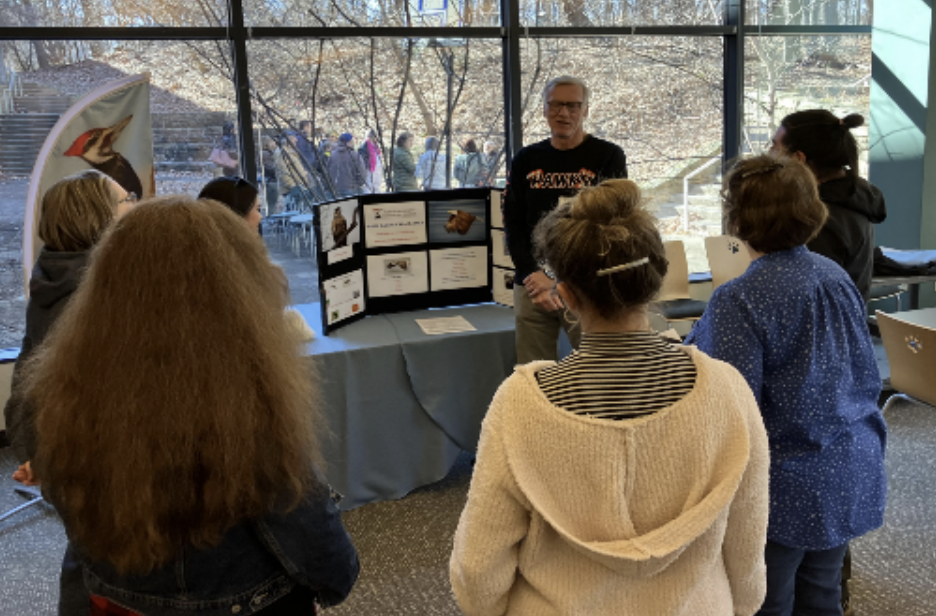
Practice session for providing information at a community event (with practice nature walk in the background), Tina Dudley
We are very fortunate to live in a region with great intellectual talent. Participants in the training had diverse backgrounds and skills. The group included individuals who speak Spanish (five of them!), Portuguese, French, and German. Some volunteers told us they were interested in using their language skills to reach out to diverse communities in northern Virginia. Many of the volunteers have a life-long passion for nature with deep environmental experience, which goes to the heart of why they are volunteering. Among them were expert birdwatchers, a public-school science teacher, an Audubon at Home Ambassador, a nature writer, and several who are or are training to be Master Naturalists. But the group also included people with a new interest in nature and a great desire to help. Two of our volunteers are just 12 years old and excited to share their passion with other young people.
Anyone who enjoys talking to people about nature is welcome to join our Outreach Team! Our next Volunteer Outreach Training will be in the fall, but we are happy to accept new volunteers on an ongoing basis. A video of the training is available, and, after completing a brief quiz, new volunteers can be assigned to support our more experienced volunteers at events. To learn more about volunteering for ASNV, visit the Volunteer with ASNV page on our website. Just fill out the intake form and a staff member will be in touch.
To request a community nature walk, a presentation at your school, home owners’ association meeting or other community event, or an ASNV representative to provide information at an event (tabling), please make your request using the form on our Community Outreach page. We offer talks on Bringing Wildlife to Our Yards, Backyard Birds, Birding for Beginners, and Bird Migration. We can develop talks on other subjects for a suggested $75 donation.
Note that ASNV will continue to host our regular bird walks led by expert birdwatchers, but we are expanding our programs to include more diverse community nature outings that tap into the environmental knowledge and enthusiasm of volunteers who might not be expert at identifying birds but can help us increase the interest of northern Virginians in the natural resources around them.

Observations from Meadowood: March 2023
Judy Gallagher is an ASNV board member and a regular surveyor of local wildlife who also captures photos of what she sees, in particular the less common species.
Photo: 17 Year Cicada, Magicicada septemdecim, with Massospora cicadina fungus, Judy Gallagher
Judy Gallagher is an ASNV board member and a regular surveyor of local wildlife who also captures photos of what she sees, in particular the less common species.
I recently read a book on Fungi which inspired this month's column. I usually think of them breaking down and recycling dead matter, but some affect live organisms.

Weevil, Laphrastus taeniatus, with fungus, Judy Gallagher
I typically notice fungus on insects when I'm taking pictures, getting closer and closer, and the insect doesn't fly away. That's when I realize that it can't. This weevil may have been infected when it was alive, or it might have happened after it was already dead. I have no idea which fungus this is.

Cephalochrysa species Robber Fly with Fungus, Judy Gallagher
Here's a Soldier Fly, also affected by fungus, but likely not the same fungus that infected the Weevil.
There are many fungal pathogens with unknown life histories, but there are a few which scientists have studied, and their stories are remarkable and rather gruesome.

Secondary Screwworm, Cochliomyia macellaria, infected by Entomophthora species fungus, Judy Gallagher
Entomophthora species fungi infect flies. There are a number of different species, possibly a different one for each fly family. These fungi have an interesting way of ensuring their survival. Several days after a female fly is infected, the fungus takes over the behavior of the fly and directs it to a high point on vegetation or a wall. Then the fly dies and the fungus emits chemical signals that attract a male fly. The male fly mates with the lifeless female carcass. As time passes, more fungus grows, more chemical signals are emitted and the female carcass becomes even more attractive to males. The male flies become infected and the fungus is passed on.

17 Year Cicada, Magicicada septemdecim, with Massospora cicadina fungus, Judy Gallagher
Periodical Cicadas like the ones that we saw here a couple of years ago also have a fungal parasite, Massospora cicadina. Cicada nymphs are infected by spores in the soil as they burrow up from tree roots before emerging as adults. The fungal mass growing in the cicada's abdomen produces an amphetamine that makes the cicadas even more anxious to mate than normal. Eventually the rear segments of the infected cicada's abdomen fall off, revealing a white chalky mass of the fungus. This is called a Stage 1 infection, and it kills the cicada. As the infected cicadas fly around, spores drop from them, further spreading the infection. Infected males don't only attract females; they also attract healthy males by flicking their wings, a behavior that is normally restricted to females. Healthy cicadas that become infected through mating get a Stage 2 infection, which does not kill the adult, but the resulting spores lie dormant in the soil and affect the next brood of cicadas. Massospora cicadina typically kills about 10 percent of the cicada brood.

Ant parasitized by Ophiocordyceps unilateralis complex fungus, Judy Gallagher
Possibly the most well-known of the fungi that parasitize insects is the Ophiocordyceps unilateralis complex. It affects tropical ants and isn't known in our area. Spores attach themselves to a foraging ant and slowly take over its behavior. The ant is compelled, zombie-like, to leave its nest, go to a vantage point about 10 inches off the ground, and attach itself to a leaf by its jaws. It then dies. The fungus feeds on the dead victim and eventually sends a fruiting body through the base of the ant's head. Spores are then launched, potentially infecting new ants. The fungus doesn't invade the ant's brain but uses bioactive compounds that affect the ant's nervous system and take control of its muscles.

Fungus Ant, Cyphomyrmex rimosus, farming fungus, Judy Gallagher
Not all insect/fungal interactions inspire nightmares. These ants, Cyphomyrmex rimosus, farm fungus. They bring plant material back to the nest to feed the fungus, and then the ants use the fungus as food. The ant at the bottom right in this picture is carrying fungus. The fungus could not survive without the ants' care.
The fungi described here have co-evolved with their insect counterparts. If the fungus kills off too many of the insects, the fungus will not thrive. If there is no control on insects, nature is also out of balance. Fungi play a crucial role in balancing biodiversity and maintaining healthy ecosystems
View more of Judy’s Observations from Meadowood articles here.

Plant This, Not That: Replacing Liriope
One extremely popular plant that has recently been showing its invasive qualities and is on invasive lists in various northern Virginia jurisdictions is Liriope, commonly called Monkey Grass or Lilyturf.
Photo: Liriope spicata, Alyssa Morel
Alyssa Ford Morel
Almost every gardener in the U.S. has planted or nurtured at least one invasive plant. They may have even loved it without realizing the problems it poses. Until fairly recently there wasn’t even a good definition of what an invasive plant or animal was. Executive Order 13112, signed in 1999, finally codified the fact that invasives are (1) not native where they are occurring, (2) able to escape cultivation, and (3) capable of causing harm in the wild to human health, the economy, or the environment.
Embracing that definition and opening our eyes to the problems of invasives can be a rude awakening and hard to accept. Worse, acting on it can be a lot of work. But taking action in our own yards can also be an empowering act of hope for the future of our environment.
One extremely popular plant that has recently been showing its invasive qualities and is on invasive lists in various northern Virginia jurisdictions is Liriope, commonly called Monkey Grass or Lilyturf. There are several varieties of Liriope, including clumping Liriope muscari and spreading Liriope spicata, and while Liriope spicata’s running habit is particularly difficult to control, both are increasingly showing up in wild spaces, crowding out native plants that wildlife depend on.

Liriope muscari, which clumps. Alyssa Morel

Liriope spicata, which spreads. Alyssa Morel
Liriope was introduced to the United States from Asia more than 200 years ago. It is a hardy, evergreen member of the asparagus family, often used for edging or as a ground cover. It has purple-blue spring flowers and sets blackish berries in fall. Liriope can be dug out, though it is rarely a one-and-done process. Roots, rhizomes and dropped seeds that hide can sprout and must be dug again. Take heart, repeated effort for two or three years will remove it all.
Fortunately, there are great native plants that support biodiversity and can fill the garden roles played by Liriope. Like Liriope, all three of these choices are evergreen.

Plantain-leaved Sedge or Seersucker Sedge (Carex plantaginea), Elaine Mills
Carex plantaginea (Plantain-leaved Sedge or Seersucker Sedge) has strappy, rippled leaves. Its bright lime-green color and the maroon and green stripes of its spring inflorescence stalks make it a standout in its preferred shady habitat. Other environmental pluses are that it serves as a larval host for butterflies, birds eat its seeds, and it helps control erosion on banks.

Moss Phlox (Phlox subulata), Elaine Mills
Phlox subulata (Moss Phlox) is a standout in sunny areas in spring with bright masses of flowers in shades of pink, purple and white. An American native that has long been available in the nursery trade, this hardy performer stands up to drought, erosion, air pollution and salt. It attracts bees, butterflies and hummingbirds.

Golden Alexander (Zizia area), Elaine Mills
Zizia aurea (Golden Alexander) shares the dark green color of Liriope, and can take either sun or shade. It’s a member of the parsley family and serves as a host of Black Swallowtail butterflies. It has lacy yellow flowers in spring, and is an important support to native bees. It happily spreads by seeds if you need to fill an area from which you have removed Liriope spicata.
NOTE: A version of this article also appears in the Glencarlyn Village View and on the mgnv.org website.

Monday Mystery - February 27, 2023
Monday Nature Mystery continues! Read on to learn who correctly identified our last mystery.
Photo: White Trillium, Forestwanderer/Wikimedia
We are pleased to announce the winner of last week’s Monday Nature Mystery, Phoenix Poppendeck!
Congratulations to Phoenix for identifying the White Trillium (Trillium grandiflorum).

White Trillium (Trillium grandiflorum). Photo: Forestwanderer/Wikimedia
Congratulations to Phoenix for correctly identifying this White Trillium flower. According to our friends at Master Gardeners of Northern Virginia, this showy trillium, with flower diameters up to four inches, is a familiar spring, native wildflower in the Mid-Atlantic woodlands of the Blue Ridge Mountains and Appalachian Plateaus. This species’ seeds are spread by ants and the wide flowers provide cover for small mammals.
Each Monday we’ll post a new mystery and identify the previous week’s winner. They’ll receive an ASNV hat or tote bag.
Here is this week’s mystery:
Who is this? Can you tell by just the beak?
Be sure to post your guess on our Facebook page under the latest Monday Nature Mystery post. Good Luck!
Please check our guidelines here.
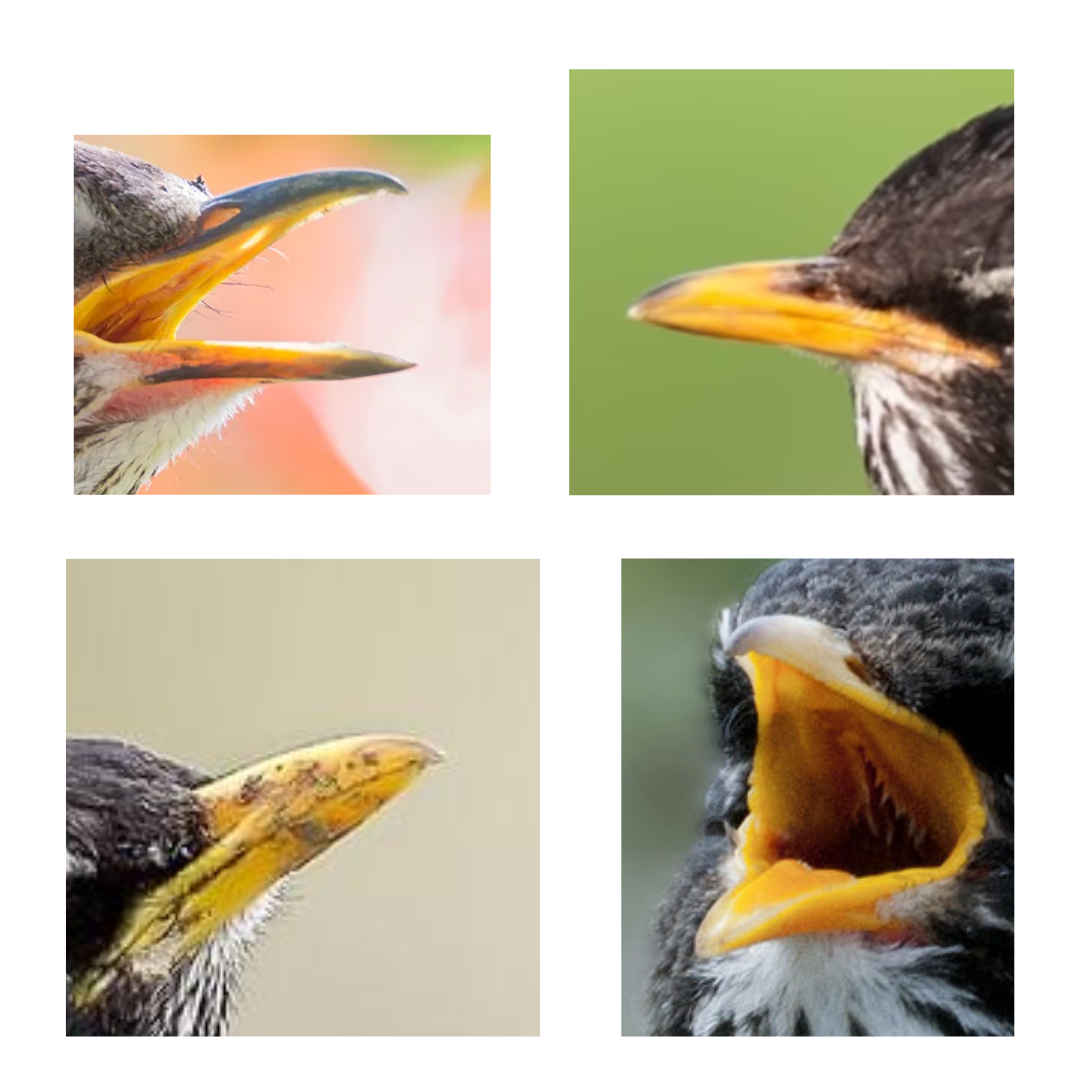
Monday Nature Mystery: Who is this?

Members of Workgroup Appointed by Virginia General Assembly Release Report on Managing Free-Roaming Cats
Fourteen members of a Virginia General Assembly workgroup appointed in 2021 to study problems associated with free-roaming cats have just released a comprehensive report detailing the negative impact of cats on wildlife and public health and recommending legislative solutions.
Photo: Domestic Cat Killing Ruffed Grouse, Navvvrisk
Tom Blackburn
Fourteen members of a Virginia General Assembly workgroup appointed in 2021 to study problems associated with free-roaming cats have just released a comprehensive report detailing the negative impact of cats on wildlife and public health and recommending legislative solutions.
Among the major findings in a report from fourteen of nineteen workgroup members, including ASNV, is the determination that, by itself, the controversial practice of Trap-Neuter-Return (TNR) does not work for the reduction of free-roaming cat populations. The practice, in which cats are trapped, neutered, typically given a one-year rabies vaccination, and released back to the outdoors, is also ineffective at mitigating the risks posed by these cats to wildlife and public health. According to a report published in the journal Nature Communications and referenced in the report, 1.3 to 4 billion birds and 6.3 to 22.3 billion mammals are killed annually by cats in the U.S.

Domestic Cat Killing Ruffed Grouse, Navvvrisk
The workgroup was created at the request of then-Chairman of the House Committee on Agriculture, Chesapeake and Natural Resources, Delegate Ken Plum. The nineteen-member work group, composed of experts in wildlife conservation, veterinary medicine, public health and safety, agriculture, animal welfare, and animal law, was tasked with making recommendations for the reduction of the population of free-roaming cats in Virginia, and mitigating their impacts on wildlife, natural resources, public health and property. I participated as chair of ASNV’s Advocacy Committee. We deliberated for 18 months before fourteen members submitted their report to the General Assembly.
Among the findings in the meticulously-documented 28-page report are:
There are an estimated 2.1 million free-roaming cats in Virginia, of which 1.2 million are unowned.
These cats are one of the most serious threats to native wildlife in the Commonwealth.
Free-roaming cats are vulnerable to many hazards and have high mortality rates, especially for kittens, and often have a very poor quality of life.
Free-roaming cats present numerous risks to public health, including rabies, toxoplasmosis, and other diseases.
A comprehensive and multi-faceted population control strategy is required to produce results.
The unregulated feeding of outdoor cat colonies may exacerbate the negative impacts of free-roaming cats by concentrating cats and attracting wildlife.
The report relies on scientific findings from peer-reviewed publications in presenting recommendations for addressing risks and damage caused by the growing population of free-roaming cats in Virginia. Among these recommendations are:
Each locality must develop an outdoor cat management plan implementing state guidelines and regulations to reduce the population of free-roaming cats and mitigate their negative impacts.
There must be a local option for the removal of free-roaming cats where conflicts exist.
Public education is critical to eliminating the abandonment and unintended reproduction of cats.
Public education should emphasize the importance of keeping cats indoors or confined on the owner’s property to eliminate the impacts of free-roaming cats and to protect the cats themselves. The public also should be made aware of options for the placement of cats that need to be re-homed through shelters, pet adoption programs, and other alternatives to abandonment.
A statewide policy is needed concerning animal shelters and releasing agencies regarding the intake and acceptance of cats. While 56 localities in Virginia currently have ordinances regulating cats, many others have no regulation whatsoever.
Where TNR is included in the comprehensive strategy for the reduction of the free-roaming cat population, individual and organizational practitioners must be required to receive training in the various aspects of TNR and cat colony management and should be required to create and maintain complete records of their activities, including individual health records for every cat in a managed colony. These records must be available to animal control, public health, or other taxpayer-funded agencies as needed.
Release of cats and management of cat colonies should be prohibited in certain areas, including, including parks and other protected areas, near schools or daycare centers, and on land where the permission of the private or public landowner or property manager has not been secured.
The report also includes several recommendations regarding research that should be conducted in Virginia to assess the root causes of cat abandonment, as well as the effectiveness of various strategies and techniques for the reduction of free-roaming cat populations.
Members of the workgroup who released the report expect to work with legislators to develop legislation on free-roaming cats to be introduced in the 2024 session of the General Assembly. You can contact me if you have questions about the report.

Partnerships Mean Success—Upton Hill Regional Park
In November 2020, ASNV became part of an Upton Hill Regional Park support team that has worked together to improve both habitat restoration and activities welcoming to underserved groups.
Photo: Lindsay Clark, THINK Global School via Flickr
Joan Haffey
In November 2020, ASNV became part of an Upton Hill Regional Park support team that has worked together to improve both habitat restoration and activities welcoming to underserved groups.

Stag antler rubbing, Joan Haffey
Work by the partnership includes the Black and Latin/Hispanic Bird and Nature Walk series that continues in various forms. In its latest iteration, children from Falls Church’s Culmore Branch of the Boys and Girls Clubs of Greater Washington come repeatedly to the park to learn about nature, meet live animals, and explore the park’s wooded areas. The photo at right shows one of the participants identifying correctly a stag antler rubbing at the park. Partners for this series include NOVA Parks, National Association for the Advancement of Colored People (NAACP)/Arlington, Arlington Regional Master Naturalists (ARMN), and ASNV.
Last spring, Paul Gilbert, NOVA Parks Director, and various Arlington County leaders presided over a public ceremony where volunteer walk leaders and supporters from all partner agencies won NOVA Parks awards for their efforts. In a separate ceremony on December 8, 2022, Paul Gilbert presented a new award to Evan McGurrin, Park Manager, acknowledging the NOVA Parks employee making the most notable contribution to achievement of the agency’s five-year strategic plan. You can read about the partnership and the event here and in a separate article in the Sun Gazette.
Under the able leadership of McGurrin and Jill Barker, ARMN Park Steward, ASNV also participates actively in habitat restoration in the park, with ASNV board members taking part in regular invasive plant removals and donating native plants for the restoration. ASNV also provided the park one of its conservation grants. Other partners in the restoration have included ARMN members and youth from the Church of Jesus Christ of Latter Day Saints, among others.
ASNV has begun discussions with Upton Hill Regional Park to develop even more connections with the surrounding community for projects both within the park and, potentially, on adjoining properties to expand and improve native habitat for the benefit of native birds and other wildlife. We will report regularly on progress in these efforts in the future. Stay tuned!

Save a Sapling: Pull Invasives
One of the most satisfying moments of invasive plant management comes when you pull the last vine off a struggling native sapling, freeing it to claim its full share of sunlight and grow without restraint.
Photo: Rescued Sapling, Laura Handley
Laura Handley
One of the most satisfying moments of invasive plant management comes when you pull the last vine off a struggling native sapling, freeing it to claim its full share of sunlight and grow without restraint.
Volunteers with Fairfax County's Invasive Management Area (IMA) program get to do just that twice a month at Idylwood Park in Dunn Loring. In a series of workdays, primarily on Saturday mornings, these volunteers have worked to clear invasives from a meadow along the park's driveway. A wide range of people has participated so far, from scout troops to high-school students seeking service hours to venerable Virginia Master Naturalists. Several have brought family or friends to chat with as they work, taking advantage of the chance to socialize outdoors.
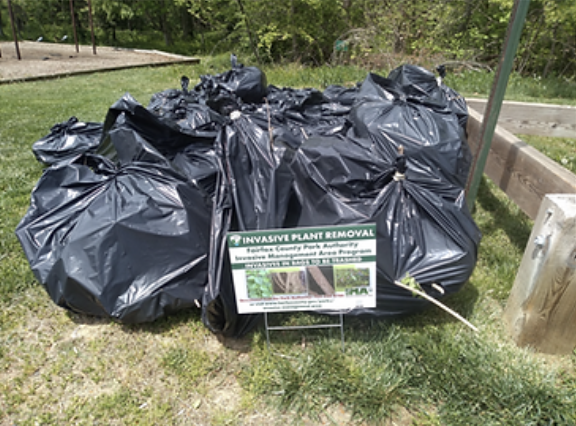
Bags of invasive vines, Laura Handley
According to Patricia Greenberg and Gloria Medina, the coordinators of the IMA program, several of the saplings the volunteers have uncovered (including black walnuts, multiple species of oaks, and a large Honey Locust) were planted by the park service in the late 2000s. But the area around the saplings was left unmowed and unmonitored, allowing invasive vines to creep in from adjacent areas. By the time the volunteers started working, those invasives dominated the meadow.
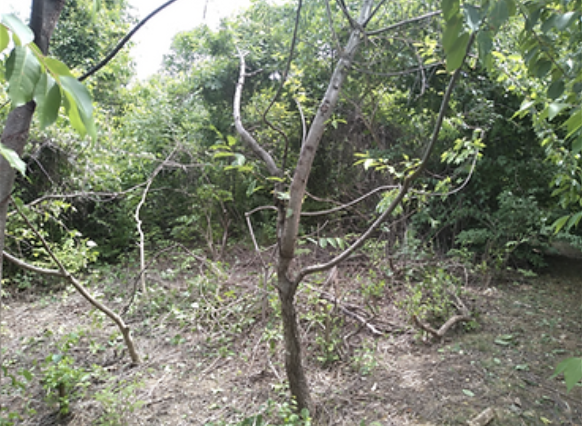
Rescued saplings, Laura Handley
The volunteers' first challenge was to clear a path to the trees, which were blocked not just by the invasives but also by Poison Ivy and thorn-covered blackberry canes (both of which are native plants but which were blocking the way). Next came the delicate operation of untangling the vines from the young trees' branches. Any vines growing out of reach were left to hang on the trees, where they will eventually die and fall down on their own. The final challenge has been maintenance: keeping the vines from re-growing to cover the trees again. After repeatedly cutting them to the ground failed to do the trick, Greenberg and Medina joined site leader Laura Handley one morning this fall to apply herbicide to the vines' stumps. This targeted application should (it is hoped) finish off the vines while leaving the surrounding vegetation unharmed. The rescued trees are often oddly shaped, their crowns pulled sideways and their trunks wrapped with spiraling vine-scars. But as they grow, now free of obstructions, they should straighten up and fill out. And by rescuing existing trees rather than clear-cutting the area, the volunteers have given the meadow a ten-year head start on the process of returning to a mature forest.
Once the meadow is clear of invasives, the group plans to spread seeds for native wildflowers over the ground they've bared -- that is, if any of the ground stays bare. In the two years they've been working on the site, several native species have reappeared or expanded their footprint, including Common Milkweed, Canada Goldenrod, Wingstem, Foxglove Beardtongue, and New England Aster. This robust layer of herbaceous plants will help keep invasives from returning to the site and will serve as food and habitat for many native insects, birds, and other critters—and, as the saplings grow, they'll start to do the same.
Winter is a great time to rescue trees, because it is easier to get at them, and cold temperatures are good for working. The winter workdays for this site will soon be posted to the IMA program calendar, and similar volunteer events in locations throughout Northern Virginia can be found on the Plant NOVA Trees website.

Results of the 2022 Manassas-Bull Run Christmas Bird Count
The results are in! On December 18, 2022, nearly 100 birders counted almost 20,000 birds of 82 species in this 15-mile diameter circle.
Photo: Wilson’s Snipe, John Troth/Audubon Photography Awards
The results are in! On December 18, 2022, nearly 100 birders counted almost 20,000 birds of 82 species in this 15-mile diameter circle. There were 36 parties of field observers led by experts and including birders of all skill levels. Read more about this year’s count here.
February is National Wild Bird Feeding Month
It’s February, which often has the most severe winter weather. For this reason, back in February 1994, Illinois Congressman John Porter read a resolution into the Congressional Record naming February National Wild Bird Feeding Month, now generally known as National Bird Feeding Month.
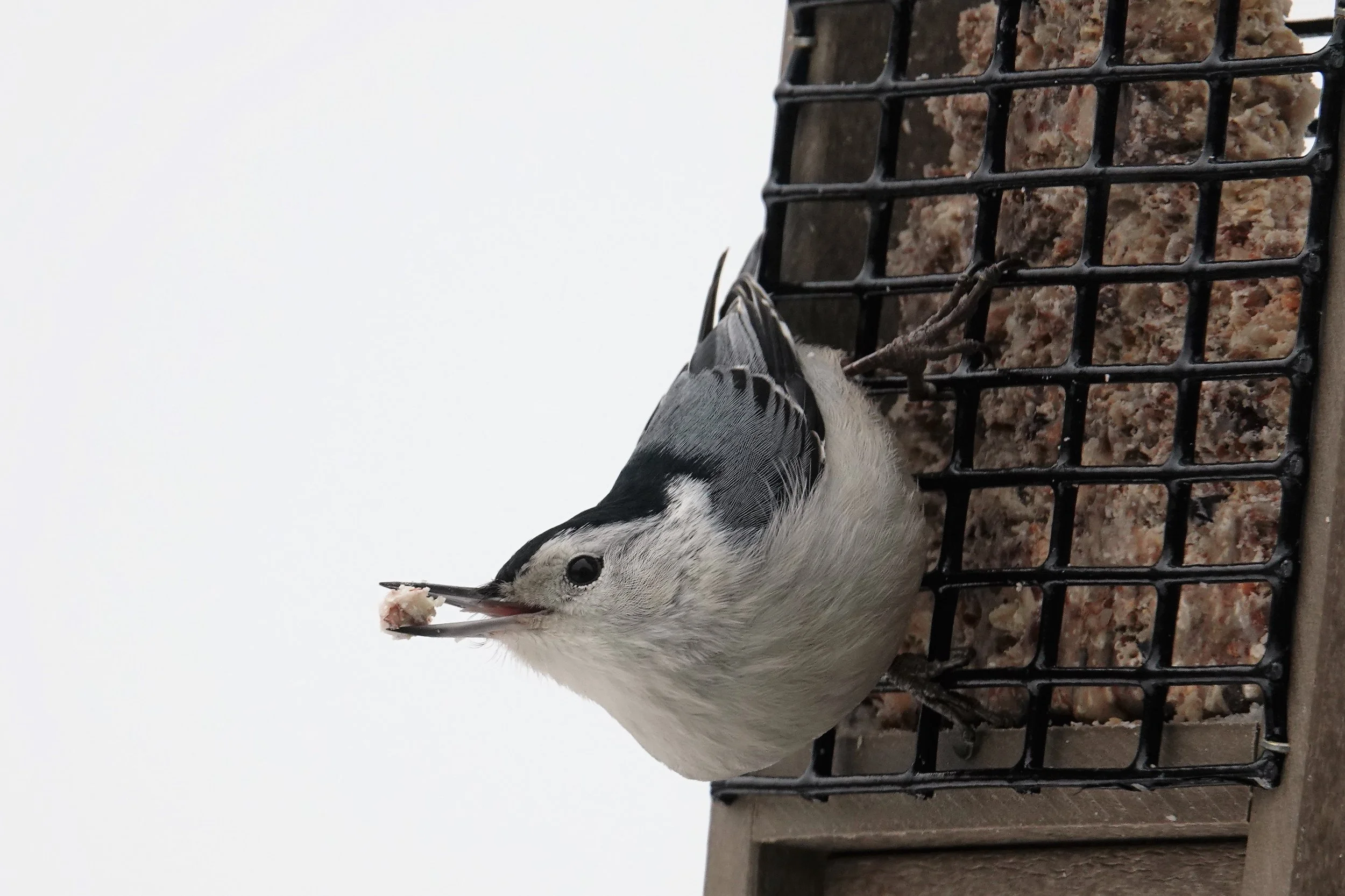
Photo: White-breasted Nuthatch, Pamela Brown/Audubon Photography Awards
Evelyn Novins
It’s February, which often has the most severe winter weather. For this reason, back in February 1994, Illinois Congressman John Porter read a resolution into the Congressional Record naming February National Wild Bird Feeding Month, now generally known as National Bird Feeding Month. His resolution states that feeding wild birds, particularly through February, “benefits the environment by supplementing wild birds’ natural diet of weed, seed, and insects,” helping them survive the winter. He further stated that “backyard bird feeding is an entertaining, educational, and inexpensive pastime enjoyed by children and adults.” He suggested that the hobby could begin as simple feeding and progress to bird identification, to discovering the relationship between birds and specific seeds as well as the relationship between type of birds and the location of feeders. Congressional Record 140:16, p. E49, Feb. 23, 1994.
Because there are downsides to indiscriminate wild bird feeding, National Bird Feeding Month is not generally promoted by conservation organizations. ASNV, for example, through its Audubon at Home program, promotes helping wild birds by creating welcoming habitat, with native plants that nurture insects and other food sources, such as seeds and berries. The Cornell Lab, which also encourages creating good native habitat but recognizes the popularity of wild bird feeding, has created Project Feeder Watch, encouraging people who put up bird feeders to choose a two-day observation period during the winter months in which to tally bird sightings and submit the data as a citizen science project. At the same time, its Feeder Watch website provides tips on best practices to protect wild birds.
So, what are the downsides to wild bird feeding and how to mitigate them? A U.S. Fish & Wildlife Service article on feeding wild birds cites disease, predation, and collision as the greatest risks feeders pose.

European Starling and House Sparrows, Bevi Chignon/Audubon Photography Awards
First, disease: Birds swarming at feeders (often those that do not need help such as non-native House Sparrows and European Starlings) can readily transmit salmonella and E.coli, and feeders have been cited for spreading conjunctivitis in finches. So, keep the feeders clean! Clean feeders every couple of weeks and even more often during heavy use or wet weather. In addition to disassembling them and scrubbing off debris, run them through the dishwasher on a hot setting or scrub them in soap and boiling water. To ensure they are disinfected, soak them for 10 minutes in a bleach and water solution or for an hour in a weak vinegar solution, rinsing them well afterwards and drying them completely. See the Project Feeder Watch blog on cleaning for tips. In addition, make sure to rake under the feeders and clean away waste and moldy or spoiled food.
NOTE on Avian Influeza: At this writing Cornell Lab’s All About Birds has not advised people to take down bird feeders because of avian flu, unless they also keep poultry. Confirmed cases in Virginia have so far been limited to water birds (ducks, geese) and birds that feed on them (Bald Eagle, Black Vulture). If you are concerned, monitor the Cornell Lab website for updates.
The second greatest threat is predation: large groups of feeding birds invite predators. Sharp-shinned Hawks and Cooper’s Hawks are attracted to feeding swarms of birds, and you may find them haunting your feeders. If they become daily visitors and scare the birds away, take the feeders down for a few days to encourage the hawks to move on to other hunting grounds. The other very dangerous predator is the domestic cat. If you notice neighborhood cats hunting in your yard, try chasing them away with a good squirt of water. If they persist, you may have to remove your feeders permanently. ASNV works actively to educate people on the dangers cats pose to native wildlife and advocates for programs to decrease populations of free-roaming cats. See the article on its advocacy efforts in this issue of the Potomac Flier.
The third greatest threat is window collisions. Birds do not see glass and, confused by what is on the other side of a window or what shows up reflected in a window, they can crash into it, usually with fatal results. If you find birds are hitting your windows as they swarm your feeders, take steps to ensure that the birds see the windows as obstacles. Cornell’s All About Birds and the American Bird Conservancy publish information on window treatments that deter collisions. You also can watch a video on ASNV’s website that demonstrates options.
Backyard bird feeding provides us entertainment, education, and relaxation, and it’s up to us to ensure that we’re feeding birds in a responsible way. Keep the concerns we have outlined in mind, and, as a last note, make sure the food you provide is nutritious: NO bread, crackers, or popcorn, which provide no nutritional value for wild birds but can fill their stomachs without giving them the protein, fat and carbohydrates they need. Quality seeds such as black-oil sunflower, hulled sunflower, Nyjer (thistle), and whole peanuts are most nutritious to seed eating birds. Meal worms can attract wrens and bluebirds, and suet can attract woodpeckers, nuthatches, and other birds. The Project Feeder Watch site provides additional suggestions, and local feed stores can also be helpful resources.

We Need Your Help to Engage Our Community!
Do you enjoy speaking to people about your passion for birds and the environment? We need your help!
Photo: Audubon Burke
Do you enjoy speaking to people about your passion for birds and the environment? We need your help! The Audubon Society of Northern Virginia is currently seeking new volunteers to help us with representing ASNV at community events, leading nature walks for a general public audience, and delivering presentations to audiences of children and/or adults.
We will be holding an outreach volunteer orientation and training session on February 18. Click here for more information!

It’s Not Too Late to Enter National Audubon Society’s 2023 Photography Awards Contest
You still have until Wednesday, March 1 at noon (Eastern Time) to enter your photographs or videos to Audubon’s 2023 Photography Awards Contest.
Photo: Western Grebes, Peter Shen/Audubon Photography Awards
You still have until Wednesday, March 1, at noon (Eastern Time) to enter your photographs or videos to Audubon’s 2023 Photography Awards Contest. You have to be at least 13 years old and have a parent or legal guardian’s permission to enter if you are younger than 18 years old. You can submit multiple photos or videos depicting birdlife in any form in one of the five following divisions: Professional, Amateur, Youth, Plants for Birds, and Videos. Complete rules for submission, as well as essential guidelines for ethical bird photography and videography, are available on the Audubon website.
If you need inspiration, you can view the 2022 winners.
If you don’t feel ready yet to enter but want an introduction to bird photography, join Matt Felperin on February 21 for a webinar on bird photography, with an optional February 25 field trip. You can find both on our website under Classes and Events.

Western Grebes, Peter Shen/Audubon Photography Awards

Observations from Meadowood: February 2023
Judy Gallagher is an ASNV board member and a regular surveyor of local wildlife who also captures photos of what she sees, in particular the less common species.
Photo: Marbled Orbweaver, Judy Gallagher
Judy Gallagher is an ASNV board member and a regular surveyor of local wildlife who also captures photos of what she sees, in particular the less common species.
Many of you have owned a silk garment and have marveled at the softness and strength of it. And you've all heard about how silk comes from silkworms, domesticated moth caterpillars. But spiders also produce silk, and it has been used for a number of different purposes including as crosshairs for optical instruments and for suspending fusion targets during laser ignition.
All spiders produce silk. An individual spider can produce up to 7 different types of silk and each type of silk is produced by a different gland. Wikipedia lists the following uses of spider silk: prey capture, prey immobilization, reproduction, dispersal, source of food, nest lining and nest construction, guidelines, drop lines and anchor lines, alarm lines and pheromonal trails.

Marbled Orbweaver, Araneus marmoreus, Judy Gallagher
Here's a Marbled Orbweaver (above), and this is a fairly typical prey capture web for the Orbweaver (Araneidae) family.

Yellow Garden Spider, Argiope aurantia, Judy Gallagher
In this picture, a Yellow Garden Spider is using aciniform silk to wrap up its prey. It took less than 30 seconds for the prey to be completely enveloped. The web that you see here is a different type of silk, possibly ampullate silk or flagelliform silk.
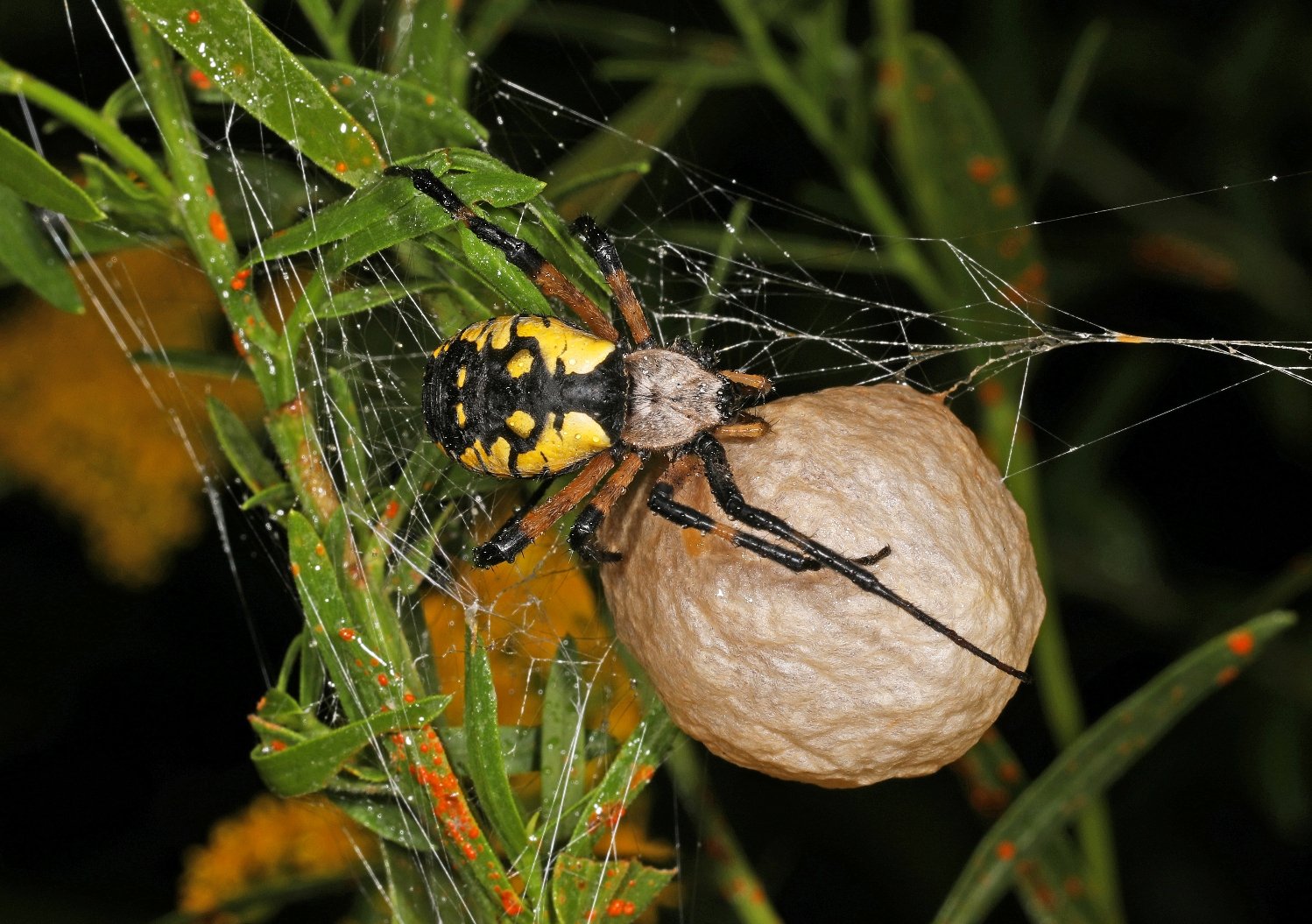
Yellow Garden Spider, Argiope aurantia, Judy Gallagher
When the Yellow Garden Spider female creates her egg sac (above), she will use tubuliform silk for the tough outer coating.

Toad-like Bolas Spider, Mastophora phrynosoma, Judy Gallagher
But even Orbweaver family members don't all use webs for catching things. The Bolas Spider (above) secretes a silk line with a sticky blob of silk on the end (bolas). The spider then creates a scent that mimics a moth pheromone, attracting male moths. When the moth approaches, the Bolas Spider swings its sticky bolas at the prey. I am fascinated by Bolas Spiders, and am honored to have several of my pictures in the Wikipedia entry for Bolas Spiders.

White-jawed Jumping Spider, Hentzia mitrata, Judy Gallagher
When we think about spider webs, we typically think of those used for prey capture, the ones that I sometimes fail to see on nature walks until I am festooned in sticky spider silk, but there are spiders other than Bolas Spiders that don't use webs to catch their food. Jumping Spiders leap on their prey. But they use ampullate silk as a drag line to find their way back to where they came from, as seen in the rainbow colored strand behind this Jumping Spider (above).

Bold Jumper, Phidippus audax, Judy Gallagher
Jumping Spiders also use silk to make nests.
Spider silk is strong, tough and stretchy, and scientists are studying spider silk for possible commercial uses.
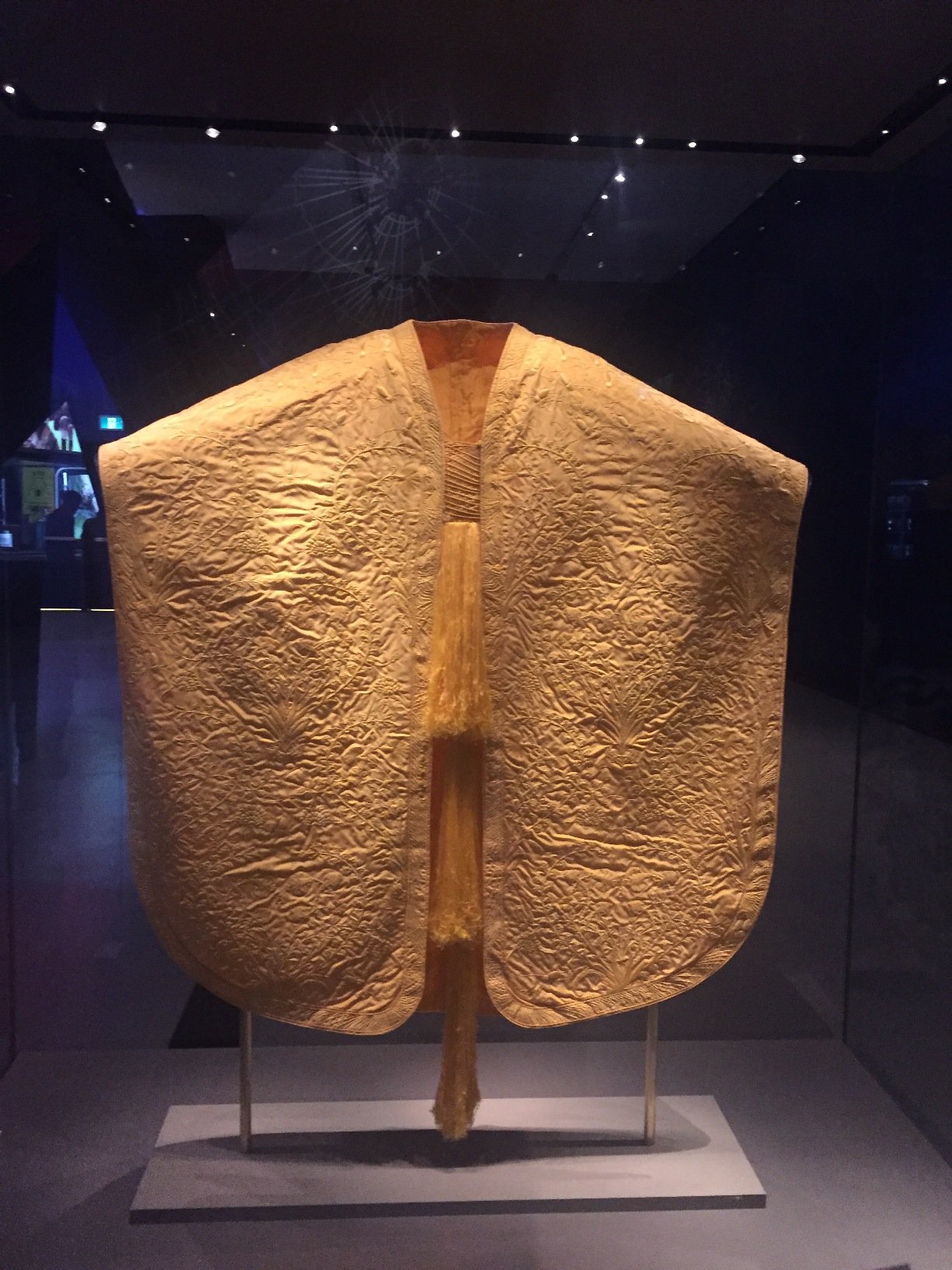
Spider Silk Shawl, Judy Gallagher
You may be wondering if garments can be made with spider silk. The answer is yes. I saw this incredible cape at an exhibit at the Royal Ontario Museum. It's made from the silk of more than 1,000,000 Madagascaran Golden Orb-weaver spiders, and it took 82 people more than 4 years to extract the silk from the spiders. And spiders are cannibals, so it would be more challenging to raise spiders than silkworms. So it is unlikely that we will see commercially available spider silk clothing any time soon.
View more of Judy’s Observations from Meadowood articles here.