
NVBA NEWS BLOG
Welcome to the blog for Northern Virginia Bird Alliance, a wealth of resources about northern Virginia birds, wildlife, habitat conservation and restoration, native plants, wildlife-friendly gardening, advocacy and more.

Arlington’s Nesting Ravens
This spring Arlington residents who have not spent enough time further away to observe the breeding and nesting cycle of the Common Raven had a rare treat.
Photo: Common Raven, David Howell
Steve Young
This spring Arlington residents who have not spent enough time further away to observe the breeding and nesting cycle of the Common Raven had a rare local treat. A pair of ravens built a nest in the Glencarlyn Park area. They appear to have raised two chicks successfully. I have enjoyed following their activities, and David Howell (whose photos appear in this article) documented the nesting process.
Until recently, Common Ravens were a rare sight in Arlington, and nesting was not confirmed. After being reduced to mountain populations, ravens began reappearing in northern Virginia in the last few years. There also have been reports of them nesting in the DC Metro area.
In Spring 2022, birders and staff at Glencarlyn Park’s Long Branch Nature Center started seeing and hearing a pair of Common Ravens frequently. They were clocked at the Nature Center and Sparrow Pond, and they showed particular interest in the Route 50/Arlington Blvd. bridge over Four Mile Run. But no one reported seeing a nest. In late winter 2022-2023, however, the ravens reappeared at the same place.
Around January 2023, we saw and heard the ravens flying over the Glencarlyn area. Frequently American Crows mobbed them aggressively. But I observed an interesting behavior evolve. I saw ravens “pop up,” make a short flight, vocalize, and then disappear into a perch before the crows could arrive. The ravens appeared to be playing mind games with the crows, and, perhaps due to raven craftiness and crow frustration, mobbing ended. I later saw a crow and raven flying together in close formation as if they were pals.

Incubating the eggs, David Howell
In February, several people observed the ravens building a nest on a bridge abutment. By mid-February a raven was on the nest, apparently brooding eggs! The female takes on this job, and the male brings her food. When walkers stopped near the bridge to observe the nest, one of the ravens, probably the protective male of the pair, often flew from one nearby tree to another, calling, likely trying to draw interest away from the nest.
Distracting viewers, David Howell
At least one of the chicks hatched around March 22, and was being fed as early as March 23. Later observations and photos showed two nestlings being fed, although the time of the second hatch is uncertain. One nestling was quite a bit larger than the other. By late April, it looked as if only one bird remained in the nest, and then there were none. Those of us who had been watching the nest exchanged anxious emails, concerned that one or both of the chicks had not survived.

Younger chick about to fledge, David Howell
But, we were wrong! The chicks’ departures from the nest had been stealthy, and no one reported seeing or hearing them on the ground. In May, we’ve seen and heard at least one and almost certainly both chicks. They’ve been perching in nearby tall trees, begging for food. One of the juveniles is a loud and persistent beggar, while the other seems content to keep a quieter profile. We’ve also seen a few awkward flights from treetop to treetop. Whether juveniles are preyed on by other birds, like American Crows, is always a concern. But, harking back to behavior I saw earlier, it may be that the crows and ravens have reached a modus vivendi, because in late May I saw a juvenile calling, perched right next to a crow, which was not harassing it.
Raven parents feed their young by regurgitating food into their mouths, and they continue to feed them for weeks after they fledge until the juveniles begin to forage on their own. As of May 20, we were still hearing lots of begging. We all have our fingers crossed that both juveniles survive and that the parents return to nest again in Arlington.

Say “NO” to Both Mosquitoes and Mosquito Control Companies
It’s that time of year again, and even though we’ve had a couple of cool, rainy days in May, summer is upon us. That means the dreaded mosquitoes are beginning to make their move.
Photo: Tree Swallows, John Pennell/Audubon Photography Awards
Deidra Bryant
It’s that time of year again, and, even though we’ve had a couple of cool, rainy days in May, summer is upon us. That means the dreaded mosquitoes are beginning to make their move.
For me, mosquitoes are the absolute worst part of summer. It’s hot, but if you expose too much skin in an effort to cool down and forget to put on bug repellent, you’re likely to become a victim to these blood-sucking pests. As a result, I tend to cover my bases and wear long sleeves and long pants regardless of the temperature, and for good measure I’ll spray a generous amount of bug spray on my body AND my clothes.
Many people in our area opt for a more war-like approach, hiring a company to spray or fog their yards with chemicals as a way to reduce mosquito populations. That approach may be tempting, particularly if you are hosting outdoor parties or get-togethers, or simply plan on spending a lot of time outdoors on your property. But, please RECONSIDER.
Mosquito sprays usually work in one of two ways. Permanent systems may be used (like an irrigation system) to spray an insecticide solution all day long, as a way to constantly and continuously eliminate insect pests (regardless if there are any pests there at all). Or, a company may schedule treatment sessions that target both adult and larval mosquitoes every few weeks. The treatments used by mosquito control companies can provide some immediate and residual effects depending on the chemicals used, but that comes at a high cost.
The most important thing to know is that many chemicals used in mosquito sprays also kill other insects that are a beneficial food source for birds. The chemicals also may be absorbed by plants and then transferred to the insects that eat those plants via bioaccumulation, affecting insect reproduction and brain function.
Don’t be fooled. Company marketing will boast that their sprays and foggers are regulated and approved for use by the Environmental Protection Agency. However, that doesn’t mean they won’t have negative effects on the environment. For example, foggers and sprays affect the delicate ecosystem in not only your yard, but also your neighborhood. Chemicals in sprays get leached from lawns and migrate to local water sources, poisoning fish and crustaceans in local streams. They also can be harmful to dogs if they drink the polluted water.
Another thing to note is that some companies may SAY their treatments are “all natural,” but what they’re actually referring to is pyrethrum, a range of plants (some species of chrysanthemums) which contain insect neurotoxins. Their extracted chemicals are pyrethroids. Some mosquito pesticides are man-made pyrethroids, such as:
Bifenthrin -- affects the nervous system of fish, other aquatic organisms and is highly toxic to bees
Deltamethrin -- kills insects on contact or if it is consumed, and disrupts their nervous systems
Permethrin -- also disrupts the nervous system in insects, causing muscle spasms, paralysis and death; highly toxic to birds when aerosolized and inhaled; highly toxic to bees and other beneficial bugs and pollinating insects
Please do your research on the chemicals used in these treatments.
Overall, broad spectrum mosquito spraying and fogging kills native bees, dragonflies, caterpillars, ladybugs, butterflies, frogs, and a range of other wildlife. No matter how many native plant species you may grow outside, it won’t matter if the yard doesn’t support a truly healthy food web for birds and is loaded with harmful pesticides. So, what can you do? Well, there are a few things you can do to avoid those annoying mosquitoes this summer.
Get an agitator or “water wiggler” for your bird bath. Mosquitoes will develop from larva if they hatch in standing water, so adding an agitator will prevent them from multiplying in your yard. Moving water also tends to attract more birds, so make sure to clean your bird bath frequently.
Use an electric fan. When I was growing up, air conditioning was only turned on during REALLY hot days (90+). Even if it was 88 degrees, we just had to suffer through it indoors, or go outside and play in the sprinkler, kiddie pools, or water slides, or duel with water pistols. We also had fans turned on all day in almost every room, and outside, too, if the cord was long enough. Mosquitoes are poor fliers and can’t land on you if there is a strong breeze.
Eliminate other breeding grounds. Mosquitoes can breed in many places: water in clogged gutters, large puddles of standing water, water pooling in outdoor children’s play equipment, flower-pot saucers, some yard debris, and dense groundcover like invasive English Ivy. Again, mosquito larvae require stagnant water to develop. Clearing the space of standing water or making it turbulent will greatly reduce mosquito populations.
Mosquito dunks. If there is a location where you can’t eliminate water (like a backyard pond, or some stormwater drains), use mosquito dunks, which are toxic only to the larvae of mosquitoes and other biting flies and are nontoxic to other wildlife. The dunks contain Bacillus thuringiensis or “Bt,” a bacterium naturally found in soil. The spores made by Bt damage the gut of insect larvae after they eat them. As a result, within 5 days the insect larvae will die of infection and starvation. You also can make mosquito larvae traps using dunks.
Encourage mosquito-eating birds. There are lots of birds that eat mosquitoes, and we can encourage them to help us by making our yards and neighborhoods bird-friendly. So, do what you can to welcome Purple Martins and other swallows, Northern Cardinals, Eastern Bluebirds, and local flycatchers like Eastern Phoebe. Bats are also great mosquito-eaters, so put up a bat house or two if you have a likely spot.
I, unfortunately, am a mosquito magnet, and like many other people I absolutely loathe being itchy. The “remedies” do not work, scratching makes it worse, showering becomes a miserable experience, certain clothes become uncomfortable to wear, and I can’t escape my own skin! My skin is already extremely sensitive, and it takes a very long time for the hyperpigmentation to go away once the swelling goes down. As a result, I have found solutions that work for me: wearing long pants, shirts with long sleeves, and a hat with a mesh covering my face (which allows me to keep insect repellent away from my eyes), putting bug repellant all over my body, setting oscillating electric fans on “high,” and getting rid of any still water. I know how tempting it is to go completely “scorched-earth” with these frustrating bugs, but please do not risk harm to the local environment with lethal chemicals. There are better and safer ways to protect yourself and cut mosquito populations.

Plant This, Not That: Replacing Spanish Bluebells
I got some bad news recently. I picked up a new edition of “Plant Invaders of Mid-Atlantic Natural Areas” and found that one of my favorite bulbs, Hyacinthoides hispanica, or Spanish Bluebells, is a new entry, its invasive qualities manifesting in my area.
Photo: Spanish Bluebells, Alyssa Ford Morel
Alyssa Ford Morel
I got some bad news recently. I picked up a new edition of “Plant Invaders of Mid-Atlantic Natural Areas” and found that one of my favorite bulbs, Hyacinthoides hispanica, or Spanish Bluebells, is a new entry, its invasive qualities manifesting in my area.
Spanish Bluebells, Alyssa Ford Morel
This pretty flower has sentimental meaning for me because I was first given bulbs of it by my mother, now deceased, who dug them from her beautiful garden. I liked it so much that 15 years ago, after spending a year and a half removing invasive English Ivy from my shady back yard, I bought a bag of 50 of the bluest variety I could find and carefully planted them throughout. A friend who knew I liked them gave me another 25 or so white ones. Over the years, I’ve watched what started as 75 individual bulbs mature into large clumps, making a beautiful show every spring. I’ve even recommended them to other people, compounding my guilt.
It’s a hard way to personally learn a truth I’ve stated before but now am painfully living: the only way to guarantee you aren’t planting future invasives is to plant natives. By definition (specifically Executive Order 13112 signed in 1999 by President Clinton), invasives are organisms that (1) are not native to the area in which they are being found, (2) are capable of escaping cultivation, and (3) can out-compete native organisms causing harm to human health, the economy or the environment. Invasive plants too often become a problem because we humans fall for the attractive qualities of a non-native plant and use it extensively, providing an expanding pool from which it reproduces itself.
I am relearning the lesson that only natives cannot become invasive over time each time I push my hori hori knife into the ground, hoping to get deep enough to remove the round, white bulbs that have proliferated. While this is a giant task, it is made worse because I know that, try as I might, I will not find all the bulbs, and I will certainly have to come back and retry next spring, and maybe for many springs to come.
One comfort that I cling to is the fact that I will have a lot more room to plant some of the native plants that I have learned to love. Here are three that I’ll be planting more of:

Virginia Bluebells, Elaine Mills
Virginia Bluebells (Mertensia virginica) are the obvious replacement for Spanish Bluebells. I’ve long believed their blue is one of the most beautiful colors nature provides. They are a spring ephemeral, with foliage dying to the ground by summer. They look great with ferns which will quickly grow to cover the Bluebells’ dying foliage. Virginia Bluebells support a variety of bees, butterflies and hummingbirds. One tip is that if you are planting on a slope, plant them at the top of the slope and they will gradually drop their seeds downhill, forming a beautiful carpet.

Great White Trillium, Elaine Mills
Another one of northern Virginia’s most stunning ephemerals is the Great White Trillium (Trillium grandiflorum). These three-petaled flowers spread very slowly if undisturbed. They start their bloom bright white and fade to a lovely pink as they age. One of the most delightful nearby nature walks is the “Trillium Trail” section of the Appalachian Trail with miles of Trilliums and other native spring ephemerals, showing best at the end of April and beginning of May each year.

Foamflower, Elaine Mills
Another plant I’ll be adding more of is Foamflower (Tiarella cordifolia). The lacy spikes of white flowers that bloom from April to July are the source of their name, but their pretty leaves with deep red along the veins make them attractive throughout the growing season. The leaves may turn a red-bronze color in autumn and sometimes remain evergreen in mild winters.
While my feelings about having planted a sentimental favorite that is now identified as a problem are complex, my feelings about being able to plant more favorite natives is pure joy.
Monday Mystery - May 29, 2023
Monday Nature Mystery continues! Read on to learn who correctly identified our last mystery.
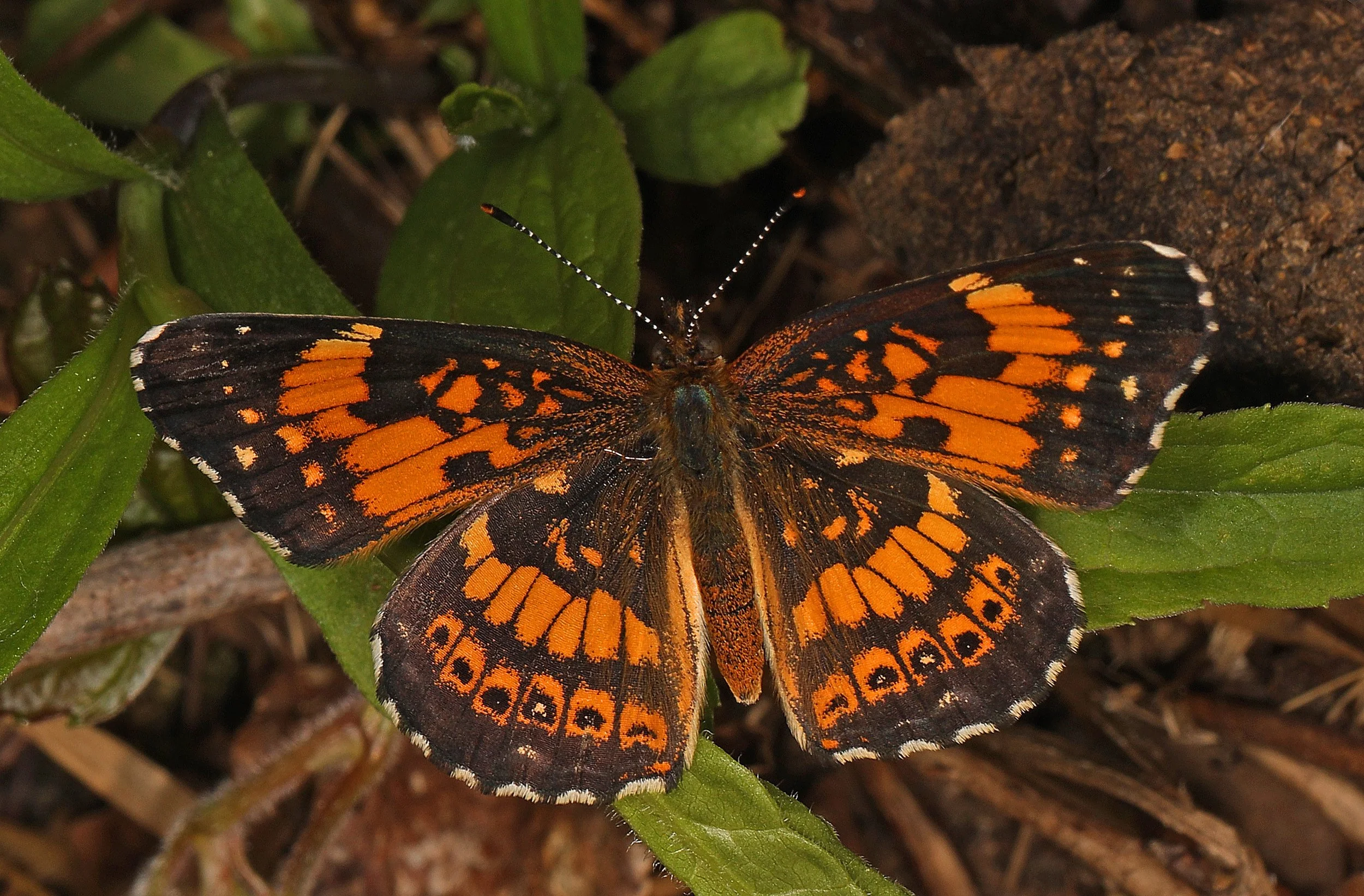
Photo: Silvery Checkerspot Butterfly (Chlosyne nycteis). Photo: Judy Gallagher
We are pleased to announce the winner of last week’s Monday Nature Mystery, Linda Nordstrom.
Congratulations to Linda for identifying the Silvery Checkerspot Butterfly (Chlosyne nycteis).
Silvery Checkerspot Butterfly (Chlosyne nycteis). Photo: Judy Gallagher
According to ButterfliesandMoths.org, this butterfly prefers moist, somewhat open places including streamsides, meadows, forest openings. Sometimes confused with a Pearl Crescent, this species can be distinguished by taking a closer look at the row of black spots on their lower wings. In Pearl Crescents, these dots are solid black; in Silvery Checkerspots they have pale centers. To bring this butterfly to your yard, grow their host plants such as black-eyed susan (Rudbeckia), sunflowers (Helianthus), and wingstems (Actinomeris alternifolia).
Each Monday we’ll post a new mystery and identify the previous week’s winner. They’ll receive an ASNV hat or tote bag.
Here is this week’s mystery:
Who is this?
Be sure to post your guess on our Facebook page under the latest Monday Nature Mystery post. Good Luck!
Please check our guidelines here.

Monday Nature Mystery: Who is this? Photo: Bill Young

Recovering Our Night Sky for People and Wildlife
Remember the last time you saw the Milky Way? Around 33 percent of the world’s population can’t see it. In North America, nearly 80 percent of us cannot.
Photo: La Palma, Canary Islands, May 2018, Copyright Babak Tafreshi, TWAN
Robin Duska

La Palma, Canary Islands, May 2018, Copyright Babak Tafreshi, TWAN
Remember the last time you saw the Milky Way?
Around 33 percent of the world’s population can’t see it. In North America, nearly 80 percent of us cannot.
“Lights Out: Recovering Our Night Sky,” open through 2025 at the Smithsonian National Museum of Natural History, introduces visitors not only to the serious problem of light pollution but also reminds us of the night sky’s wonders via gorgeous images of protected dark sky areas around the world and insights into human cultural connections across our shared sky.

“Milky Way, Starry Night # 2” by Margaret Nazon, Gwich’in Tsiigehtchic, Northwest Territories, Canada, 2021, Photo by Smithsonian
The “Who Needs the Dark?” section notes that many organisms evolved to live in darkness, just as many (including humans) evolved to be active during the day—and that we need a daily cycle of light and dark. “Light pollution is one of our fastest growing forms of environmental pollution” with the “main culprits” being “more lights aimed upward and more light being emitted per person.” Displays outline possible wide-scale ecosystem impacts for animals and plants when the light/dark cycle is disturbed and note that astronomical research is also being disrupted. It’s also estimated that about 30 percent of all U.S. outdoor lighting is wasted.
ASNV members may gravitate to a small exhibit featuring birds killed in window collisions. The International Dark Sky Association (IDA) and National Audubon Society chapters, often working with other organizations, have started Lights Out programs in North America to reduce deaths of birds diverted from their migration paths by bright nighttime light. No program exists in northern Virginia--the closest is City Wildlife’s Lights Out DC.
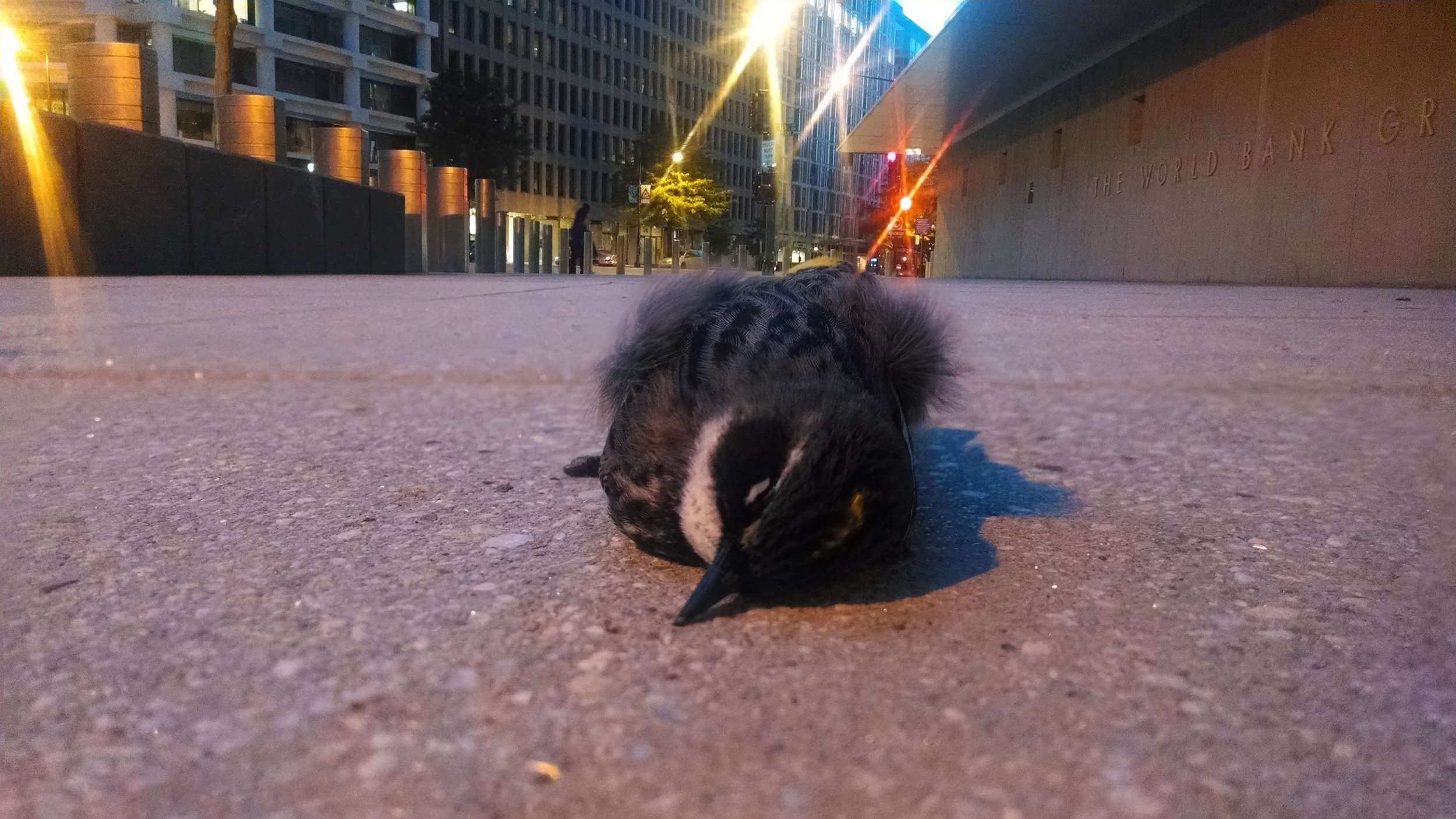
Victim of window collision, Photo Courtesy of DC Wildlife
Questions such as “how much light at night is enough?” challenge visitors. Many people are concerned that reducing outdoor lighting will reduce personal safety. Displays demonstrate how some lighting can actually reduce safety by making people and objects more difficult to discern.
This exhibition does not only warn, however--it also highlights success stories and notes that light pollution is a problem that can be solved. Displays include “Five Principles of Responsible Outdoor Lighting” solutions for common poor-lighting practices.
As a birder, I left wishing the exhibition informed visitors how to know when it is most important to turn off lights to protect migratory birds. BirdCast, a consortium of Cornell Lab of Ornithology and others, allows users to see a migration dashboard for their county and/or enter a town name here to see a forecast for the upcoming night and, for those near a Lights Out program area, to receive email alerts before high-migration nights.
If you are interested in helping ASNV start a Lights Out program in northern Virginia, please contact Tom Blackburn.

Shopping for the birds
Warm weather has many of us headed to the garden center, where lovely blooms await. Did you know that those shopping trips can double as one of the most effective ways to contribute to a healthier environment?
Photo: Native plant tag, Margaret Fisher
Margaret Fisher
With a little planning, our plant choices can make the difference between a community that supports the birds and butterflies and a community that completely displaces them. The key is to pick native plants, the ones that evolved right here with those critters and provide them the food they need to survive. Native trees and shrubs are especially important, but even the tiniest plants play an important role in the ecosystem.

Native plant tag, Margaret Fisher
How do you tell if a plant is native to our area? A simple way is to look for the red “Northern Virginia Native” stickers at participating nurseries. Over fifty volunteers from the Plant NOVA Natives campaign have been labeling the natives in those garden centers. The trees get hang tags, and the other plants get red stickers. You won’t find the stickers in the annuals sections, though, since those plants are purely ornamental and not locally native. Since turnover is rapid this time of year, making it hard for volunteers to keep up with the labeling, you might want to take along a copy of the Native Plants for Northern Virginia guide, or use the online pdf or search app.
Any even simpler way to guarantee that a plant is native is to buy it from someone who only sells native plants. There are four garden centers in Northern Virginia that do just that. In addition, periodic native plant sale events are held around the region in the spring and the fall.
Spring planting for many people consists primarily of filling pots with colorful flowers. The absence of annuals might seem like a problem until you learn that native plants make excellent container specimens as well, with the added advantage that they only need to be planted once, since they will overwinter in the pot and provide the fun of watching their tender leaves emerge in the spring. Visits to the blooms from butterflies and hummingbirds add even more enjoyment. The Plant NOVA Natives website has plant suggestions for container gardening, but almost any native can be used for this purpose if the container is big enough.

Why Did the Canada Goose Cross the Road?
Ah, the notorious Canada Goose. We see them on golf courses, at parks, on corporate office campuses, near ponds, and of course, casually crossing busy roads in suburban neighborhoods.
Photo: Canada Goose, Deidra Bryant
Deidra Bryant
Ah, the notorious Canada Goose. We see them on golf courses, at parks, on corporate office campuses, near ponds, and of course, casually crossing busy roads in suburban neighborhoods. Although some still migrate, many, sometimes too many, make northern Virginia their year-round home. All our expansive suburban lawns are just too attractive.
The Canada Goose (Branta canadensis) and I have an . . . interesting relationship. Now, the Anatidae family--which includes ducks, geese and swans--is actually my favorite family of birds. They have interesting feather colorations, I find their vocalizations therapeutic, and they’re a lot of fun to watch. I enjoy watching geese fly in V-shaped formations when they migrate, and I enjoy observing their interactions with each other when they’re gliding along the water. However, they’re scarily aggressive.

Canada Goose, Stephen Zarate/Audubon Photography Awards
They’re fearless towards humans, fast on the wing and foot (they’ll chase you), and are relatively large and hefty birds weighing around 7-14 pounds. Because of their size they have powerful flight muscles in their wings which can cause significant damage if they strike with them. The inside of the bill also has layers (lamellae) of hardened keratin that form sharp cutting edges, called “tomia,'' making goose bites very painful. Their loud hissing and angry honking also are intimidating. I always keep my distance because they can be unpredictable. ESPECIALLY in the springtime when I know it’s likely they’ll have goslings nearby.
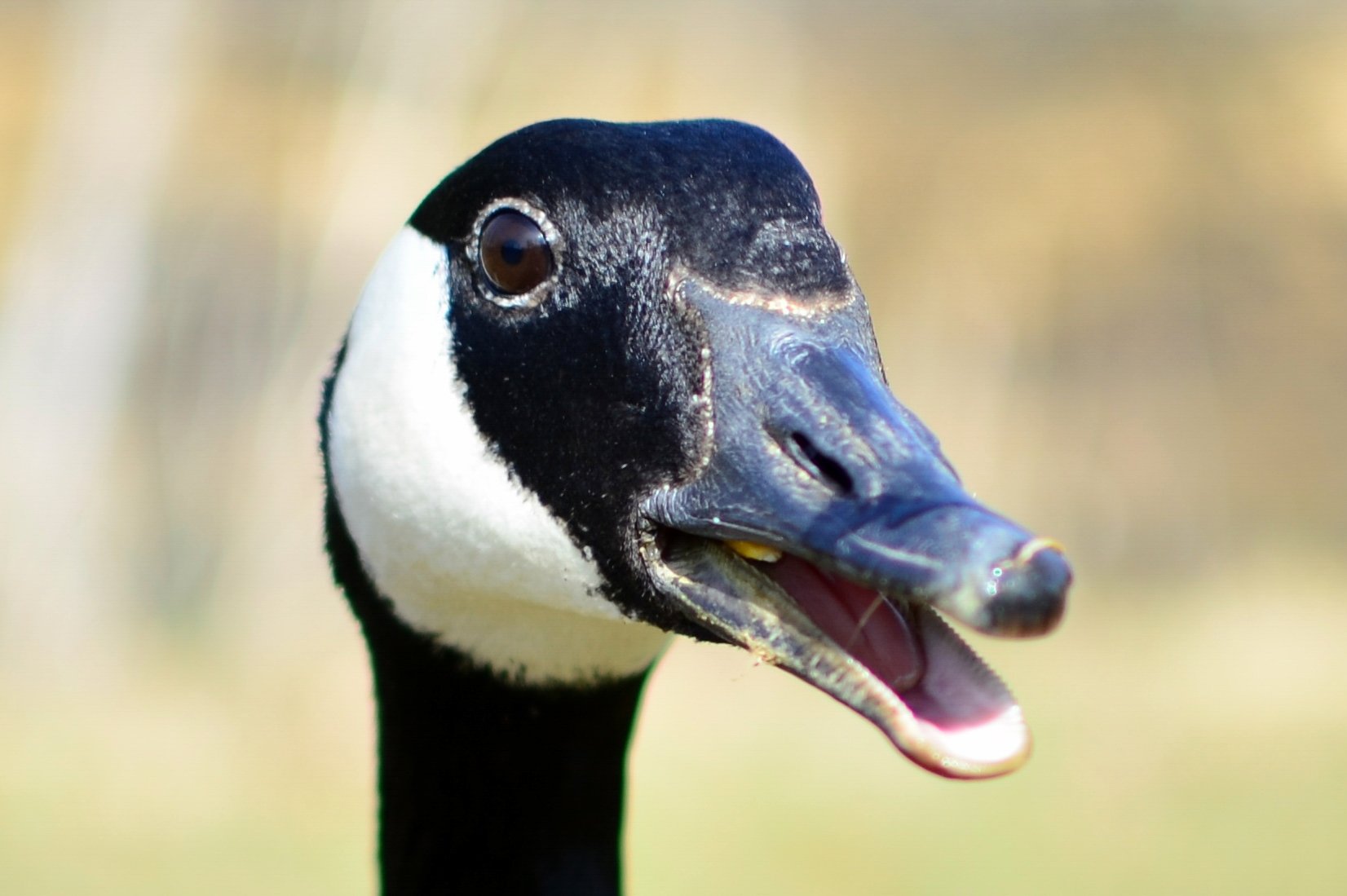
Canada Goose, Benjamin Schelling/Audubon Photography Awards
I’m sure everyone has had, or knows someone who has had, a negative encounter with this confident waterfowl, whether it’s a goose stalking you, standing in the road as you’re trying to get somewhere fast, trying to steal food from you if you’re eating outdoors, or being a nuisance at airports. The confrontations are so common that there are many videos online and on television of them scaring young children and making grown men back away. However, I don’t want this article only to rant about their aggressive behavior. I want people to understand why they are the way they are, and why we should respect their space.
Nesting for Canada Geese begins around mid-March to late April here in northern Virginia. Females build their nests on the ground in places that provide concealment, such as under shrubs or at the base of mature trees that are located on the edges of wetlands or on small islands in lakes or ponds. Their nest sites are usually always within 100 feet of water, and the nest is a bowl-shaped scrape lined with dry grasses, twigs, moss, lichen, and soft, down feathers. After nest construction, which is mostly done by the female, she will lay one egg every 1-2 days for a total of between 2-8 eggs. Incubation is 28 days, and both males and females will defend the nest and the goslings. The males are the most protective/hostile and will defend the goslings until they learn to fly (10-12 weeks after hatching). When feeding, they’ll forage as a family and choose to do so in open areas so that the adults have a 360° view of potential predators.

Canada Geese with goslings, Marilyn J. Grubb/Audubon Photography Awards
Canada Geese also are very social. Parents will bring their goslings together in groups called “crèches” that are looked after by other mating pairs, like some kind of goose kindergarten. Parents also may form “gang broods” with other pairs and their families. These broods can range from 20 to 100 goslings being shepherded by only a few adults! Goslings may mingle and waddle away from their parents, but communal babysitting is key in areas with a high nest density, so another mating pair will look after them. It’s literally just one big family neighborhood watch, and I find that pretty interesting. So yes, they’re very aggressive towards threats several times their size, but once you understand their behavior in looking after offspring that aren’t even genetically theirs, expending their energy and risking their lives in doing so, it makes sense. They’re just really good parents.
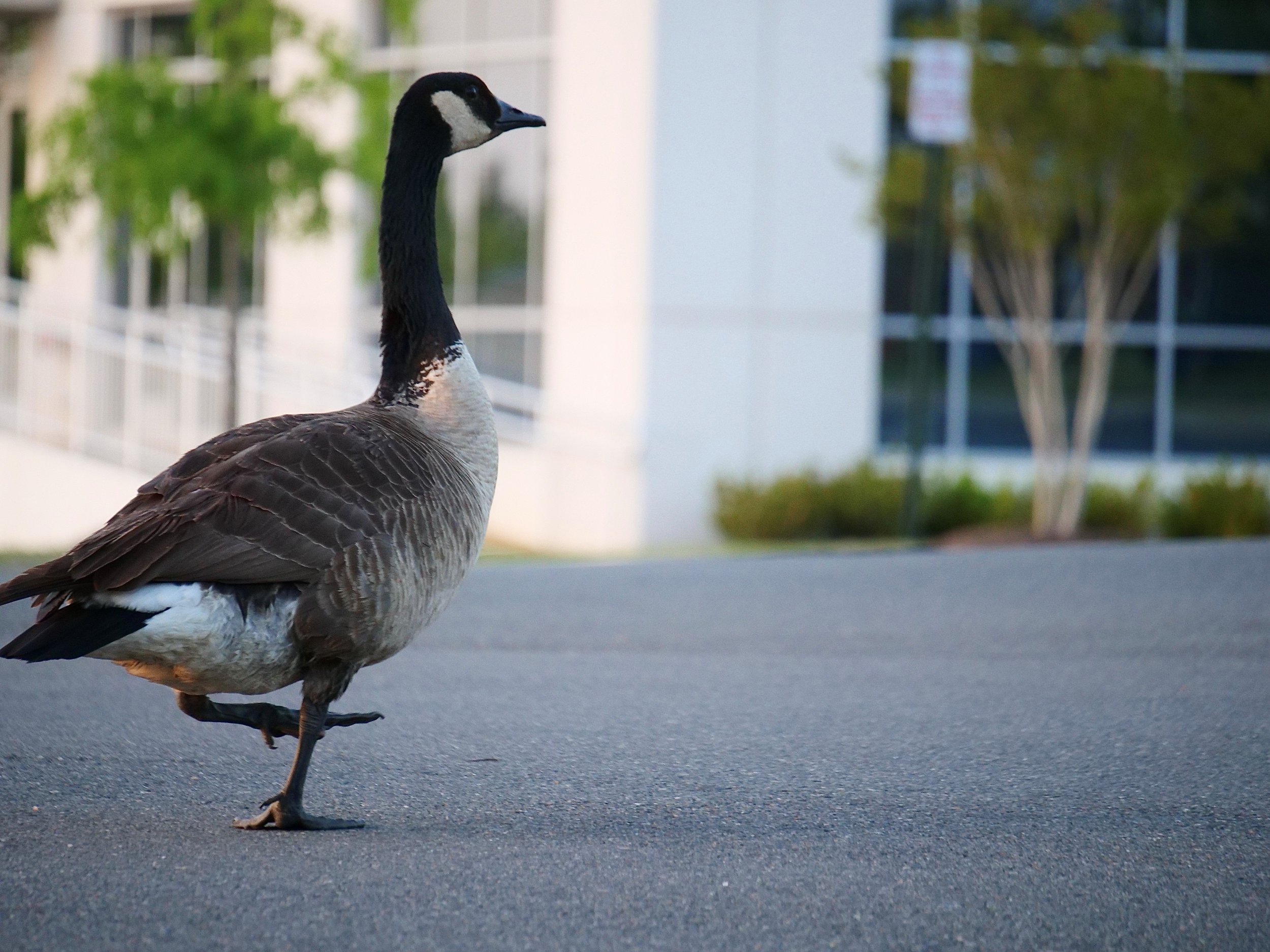
Canada Goose crossing the road, Deidra Bryant
So why did the Canada Goose cross the road? Don’t worry about it. It has goose things to do over there. Be patient and let them saunter safely to their destination . . . or else.

Welcome Back Yellow Warblers
Spring is a busy time for bird-watchers in northern Virginia as flocks of tiny warblers migrate through our area to northern breeding grounds. But there are some that migrate to northern Virginia to breed, and it’s exciting to welcome them back.
Photo: Yellow Warbler, Sheen Watkins/Audubon Photography Awards
Evelyn Novins
Spring is a busy time for bird-watchers in northern Virginia as flocks of tiny warblers migrate through our area to northern breeding grounds. But there are some that migrate to northern Virginia to breed, and it’s exciting to welcome them back. The inventory of northern Virginia breeders includes Black and White Warbler, Common Yellowthroat, Hooded Warbler, Louisiana Waterthrush, Northern Parula, Ovenbird, Pine Warbler, Prairie Warbler, Prothonotary Warbler, Yellow Warbler, and Yellow-throated Warbler.

Yellow Warbler, Gregory Seitz/Audubon Photography Awards
One of my favorite local warblers is the Yellow Warbler. Its song is easily recognizable: sweet, sweet, I’m so sweet, and although the female can be relatively drab, the bright reddish streaks on the yellow breast of the breeding male are highly visible.
This small bird, 5 inches in length with an 8-inch wingspan, weighs less than half an ounce, but, like most warblers, it’s a champion at migration. It winters in Central and South America, dining on the formidable selection of rainforest insects. Yellow warblers use the winter to fatten up for the long journey to nesting grounds in the eastern United States. They wing their way across the Gulf of Mexico to the Dry Tortugas and southern Florida. They stop there to rest and refuel before continuing up the coast.
Creating an environment to attract warblers as they proceed to northern nesting grounds is challenging. They do not come to feeders, so providing an insect-rich habitat is the only option. This means giving up chemical pesticides and planting trees (such as native oaks or maples) and shrubs that host a variety of insects. You also can plant some fruiting natives, such as Poke Weed and Virginia Creeper, because warblers do, on occasion, eat berries. Water is essential, and gently bubbling or running water is best. Make sure there is nearby shrubby vegetation to provide safe perches for bathing birds.
Although generally not the first warbler to make its appearance in northern Virginia, the Yellow Warbler arrives relatively early and should be here in numbers by early May. So, grab your binoculars and start checking some local warbler hotspots. Good options for Yellow Warbler are wooded areas by water with a thick understory. In Alexandria, try along Dyke Marsh’s Haul Road, in Four Mile Run Parks in Arlington and Alexandria, and Woodbridge’s Occoquan Bay National Wildlife Refuge.

Observations from Meadowood: May 2023
Judy Gallagher is an ASNV board member and a regular surveyor of local wildlife who also captures photos of what she sees, in particular the less common species.
Photo: Six-spotted Tiger Beetle, Judy Gallagher
Judy Gallagher is an ASNV board member and a regular surveyor of local wildlife who also captures photos of what she sees, in particular the less common species.

Six-spotted Tiger Beetle - Cicindela sexguttata, Judy Gallagher
When the weather is chilly, it is difficult for me to find insects to photograph. So, I resort to rolling over logs or peeking under loose bark, hoping to find an organism that is hiding to keep warm. On one such day at Meadowood, I looked under some loose bark and found a Six-spotted Tiger Beetle. They are commonly seen during bug season, but they are very fast and are therefore challenging to photograph. This one was cold, so it was cooperative for its photo shoot.

Bronzed Tiger Beetle - Cicindela repanda, Judy Gallagher
The Six-spotted Tiger Beetle is one of a number of local tiger beetle species. They are called tiger beetles because of their tiger-like predatory habits and their voracious appetite. They have impressive mandibles which are used to capture and manipulate prey, for defense, and for holding the female while mating, as demonstrated here by Bronzed Tiger Beetles. For mating, the male's mandibles fit into grooves on the female's thorax to allow him to have greater control of the mating process. The male mandibles and female thoracic grooves may be species-specific, possibly preventing males and females of different species from mating.
Tiger beetles hold their antennae directly in front of them. The antennae sense the environment and enable the beetles to avoid obstacles while running. The front legs have specialized grooves to help clean the antennae.

Splendid Tiger Beetle - Cicindela splendida, Judy Gallagher
Males have pads on their front legs, which aid in grasping the female while mating. If you look carefully, you can see the pads on this male Splendid Tiger Beetle.
Tiger beetles come in a variety of colors, which vary depending on the amount of melanin and cuticle layering, and many of them have additional markings on their elytra (wing covers).
Tiger beetles are the fastest insects for their size. Their eyesight is excellent, but they run so fast that their eyes can't capture enough light to form images of their prey. So, they have to stop briefly to relocate prey, then start running again.

Oblique-lined Tiger Beetle - Cicindela tranquebarica, Judy Gallagher
Both larvae and adults are carnivores. This Oblique-lined Tiger Beetle has caught a Leafhopper, but tiger beetles are also capable of catching prey that is larger than them. The tiger beetle uses its mandibles to chop the prey into more manageable pieces and then secretes digestive enzymes to liquefy the prey.
Since tiger beetles find their prey by sight, most species need open spaces where they can see their prey.

Hairy-necked Tiger Beetle - Cicindela hirticollis, Judy Gallagher
Most of our local tiger beetles like sandy soil, possibly because it's easier for the larvae to burrow in sand. Multiple species can live in the same general area, but usually each species occupies a slightly different part of a habitat, or the species hunt at different times during the day. I saw this Hairy-necked Tiger Beetle in the same vicinity as Bronzed Tiger Beetles and Twelve-spotted Tiger Beetles on a beach at Leesylvania State Park.

One-spotted Tiger Beetle - Apterodela unipunctata, Judy Gallagher
Several species, including the Six-spotted Tiger Beetle, like upland bare soil habitat and can be found along forest trails. While these bright green beetles stand out against the forest trail, they virtually disappear when they fly into the vegetation. The One-spotted Tiger Beetle lives throughout upland forests, but is usually only seen along forest trails. I've only seen this species once.

Carolina Metallic Tiger Beetle - Tetracha Carolina, Judy Gallagher
Most of our local tiger beetles are out during the day but there are a couple of species that are strictly nocturnal. I therefore rarely see them, but this lovely Carolina Metallic Tiger Beetle was attracted to a black light.
As with other insects, there are many threats to tiger beetle species. Habitat loss is a problem, especially for species that have very specific habitat requirements. They are sensitive to pesticides and light pollution. Fire, which once kept forests relatively open, is now suppressed, causing environments to become overgrown and therefore not good tiger beetle habitat. I consider it a real privilege to see a tiger beetle, especially if I'm able to get close enough to photograph it. I hope you'll be fortunate enough to see some soon on your nature walks.
View more of Judy’s Observations from Meadowood articles here.
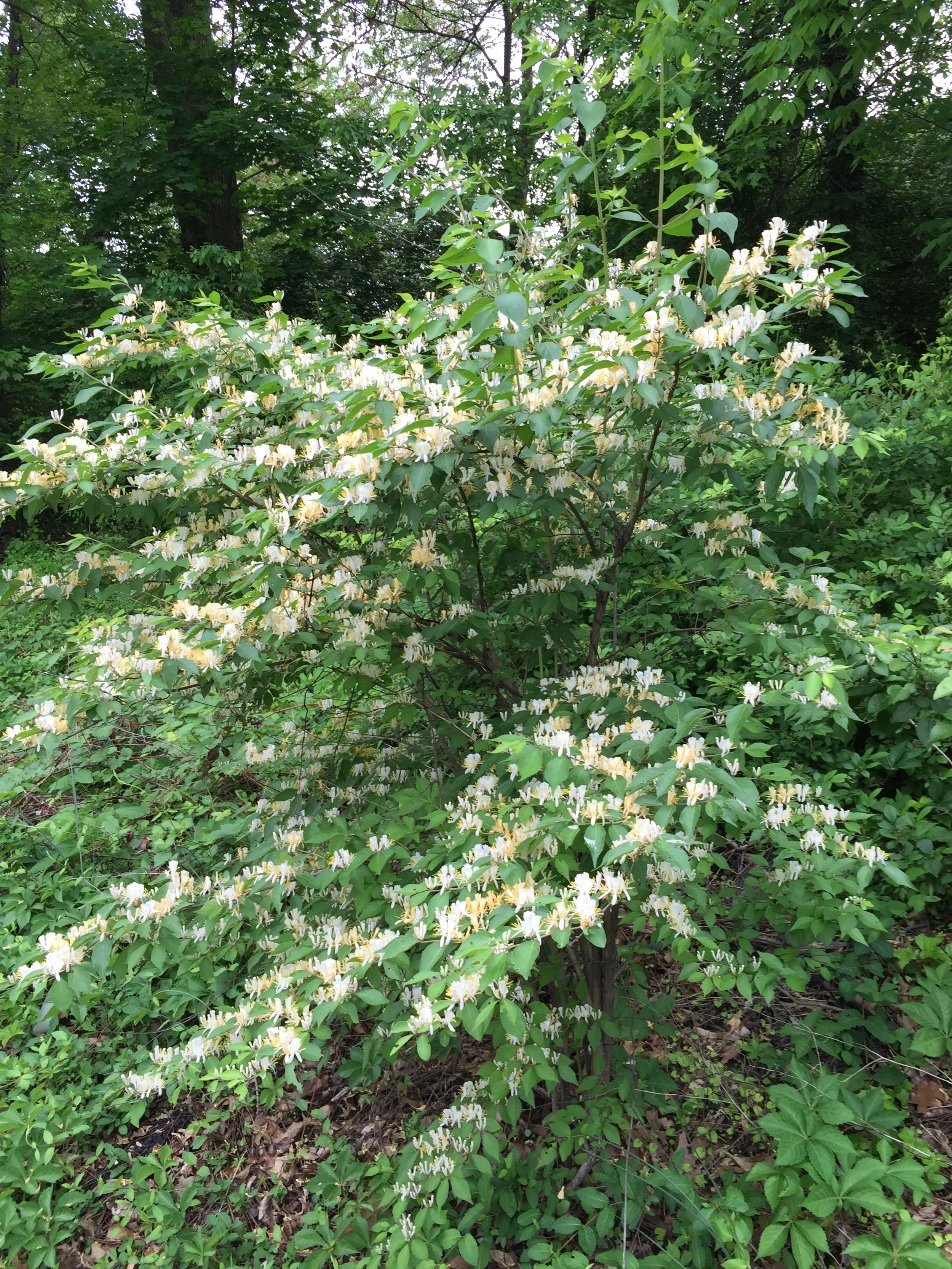
Plant This, Not That: Replacing Bush Honeysuckle
Some invasive plants are sneaky. They pop up in one’s garden without explanation or obvious origin and force gardeners to take action on the spot, lest they be forgotten and allowed to grow and spread. Some of the sneakiest are the Bush Honeysuckles, several species of Lonicera with Eurasian origins.
Photo: Flowering Bush Honeysuckle, Elaine Mills
Alyssa Ford Morel
Some invasive plants are sneaky. They pop up in one’s garden without explanation or obvious origin and force gardeners to take action on the spot, lest they be forgotten and allowed to grow and spread. Some of the sneakiest are the Bush Honeysuckles, several species of Lonicera with Eurasian origins. I’ve encountered Bush Honeysuckle plants two feet high that clearly have been growing for a year or more in areas where I know I’ve recently spent time gardening, and yet somehow missed their presence. Sneaky.
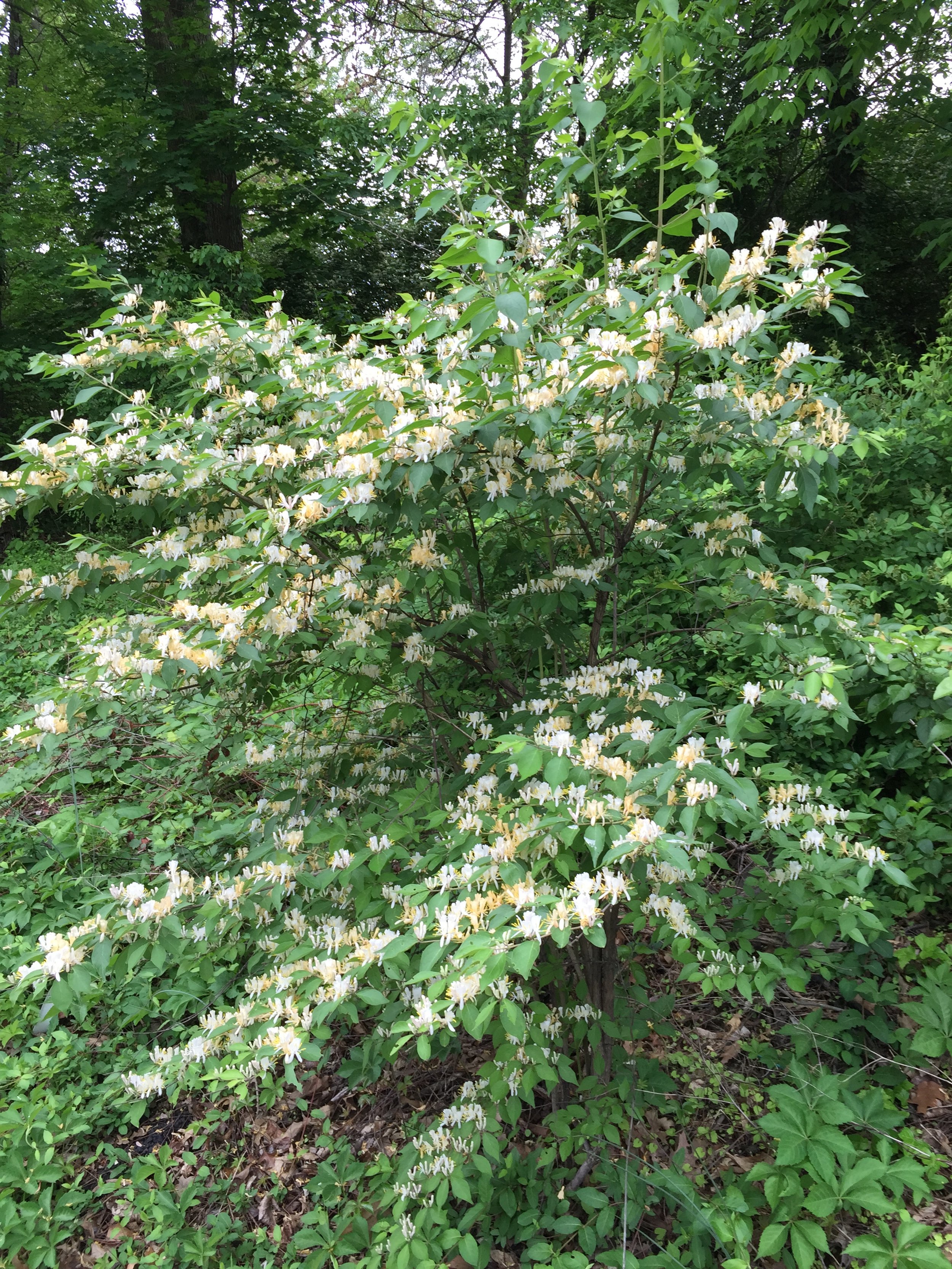
Flowering Bush Honeysuckle, Elaine Mills
The name Bush Honeysuckle is also sneaky, implying a plant of a certain size. Several years ago I was explaining to a volunteer at an invasive pull how to recognize and remove Bush Honeysuckle, when he pointed at another plant further away and asked if it was also a Bush Honeysuckle.
“No,” I said, squinting without my glasses. “That’s a tree.”
My curiosity roused, I went over to see what the tree was, and was embarrassed to realize it was indeed a Bush Honeysuckle grown to 20 feet. I’ve since encountered many more such giant Honeysuckles, pruned at the bottom and considered trees by their caretakers.
Like so many invasive plants, Bush Honeysuckle has positive qualities that mislead Americans to plant it widely. Its flowers are attractive and fragrant, and its berries are tasty to many birds. Unfortunately, like other invasives (as defined in 1999 by Executive Order 13112 signed by President Clinton and amended by President Obama), it easily escapes cultivation, spreading rapidly in the wild and out-competing the native plants that support local food webs. Those berries that attract birds are high in carbohydrates instead of the healthy fats our birds need. It is also allelopathic, producing chemicals harmful to native plants and mycorrhizal fungi. Studies have shown it has chemicals that can hurt or kill native insects and young amphibians.
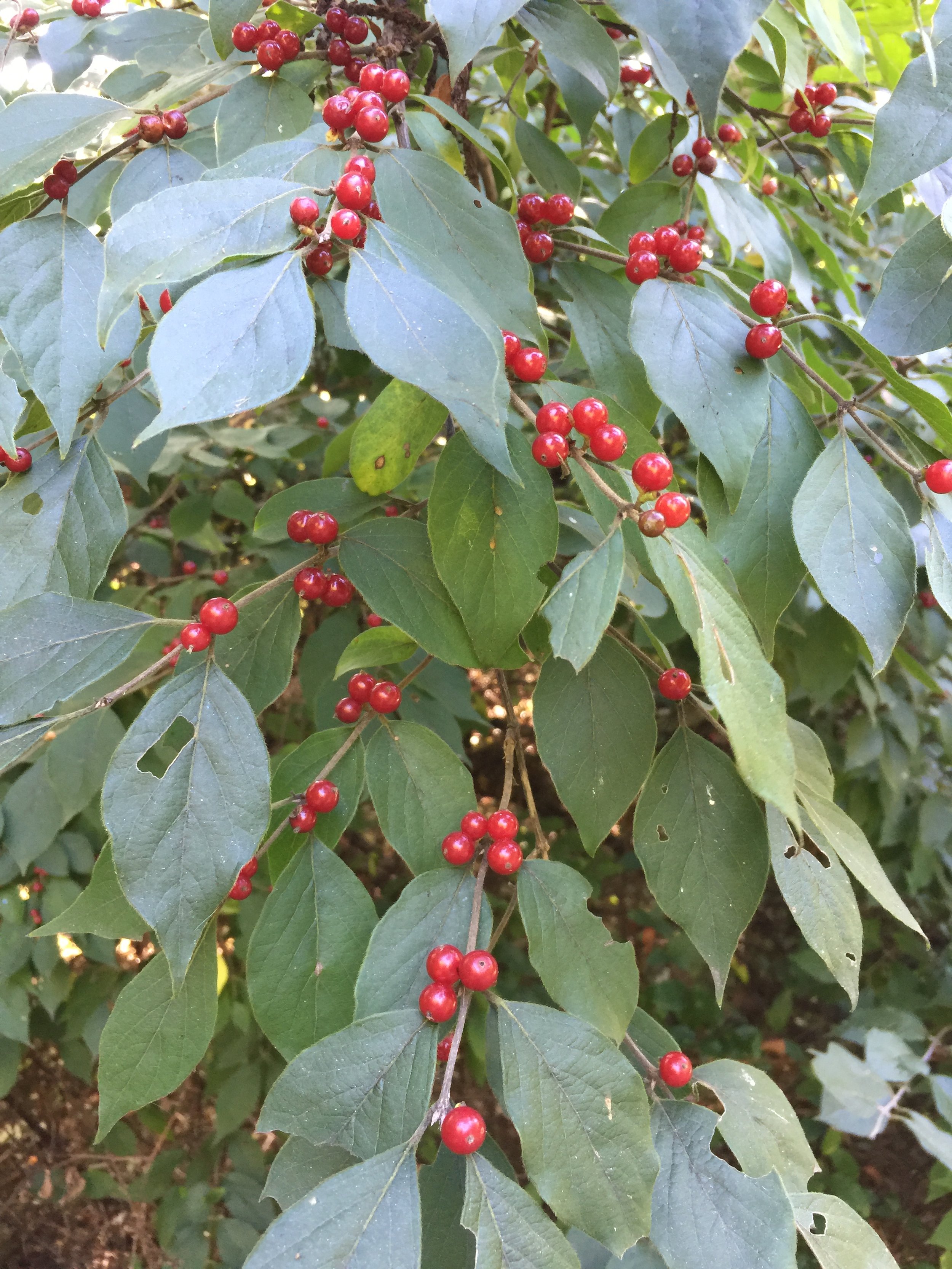
Fruiting Bush Honeysuckle, Elaine Mills
So, what to do about this sneaky plant? First, we must identify it correctly. It has a branching growth habit, with leaves held opposite each other. When a branch is cut, a clear hole can be found in the center. In spring, the pretty and fragrant tubular white to pink flowers that fade to yellow are helpful in identification as are the bright red late-summer berries that persist into winter.
Bush Honeysuckle can be pulled by hand when it is young, and dug up when larger. Plants too tricky to be dug up can be cut low and an herbicide carefully applied to the new growth.

Sweet-shrub, a.k.a. Carolina Allspice, Elaine Mills
There are many great replacement plants. If you want a native shrub with fragrant flowers, consider Sweet-shrub, a.k.a. Carolina Allspice (Calycanthus floridus), which is native in some southern parts of Virginia but does well in Northern Virginia. It has dramatically beautiful maroon flowers with a fruity scent from April to July. Sweet-shrub is seldom severely damaged by deer and likes sun to part shade.
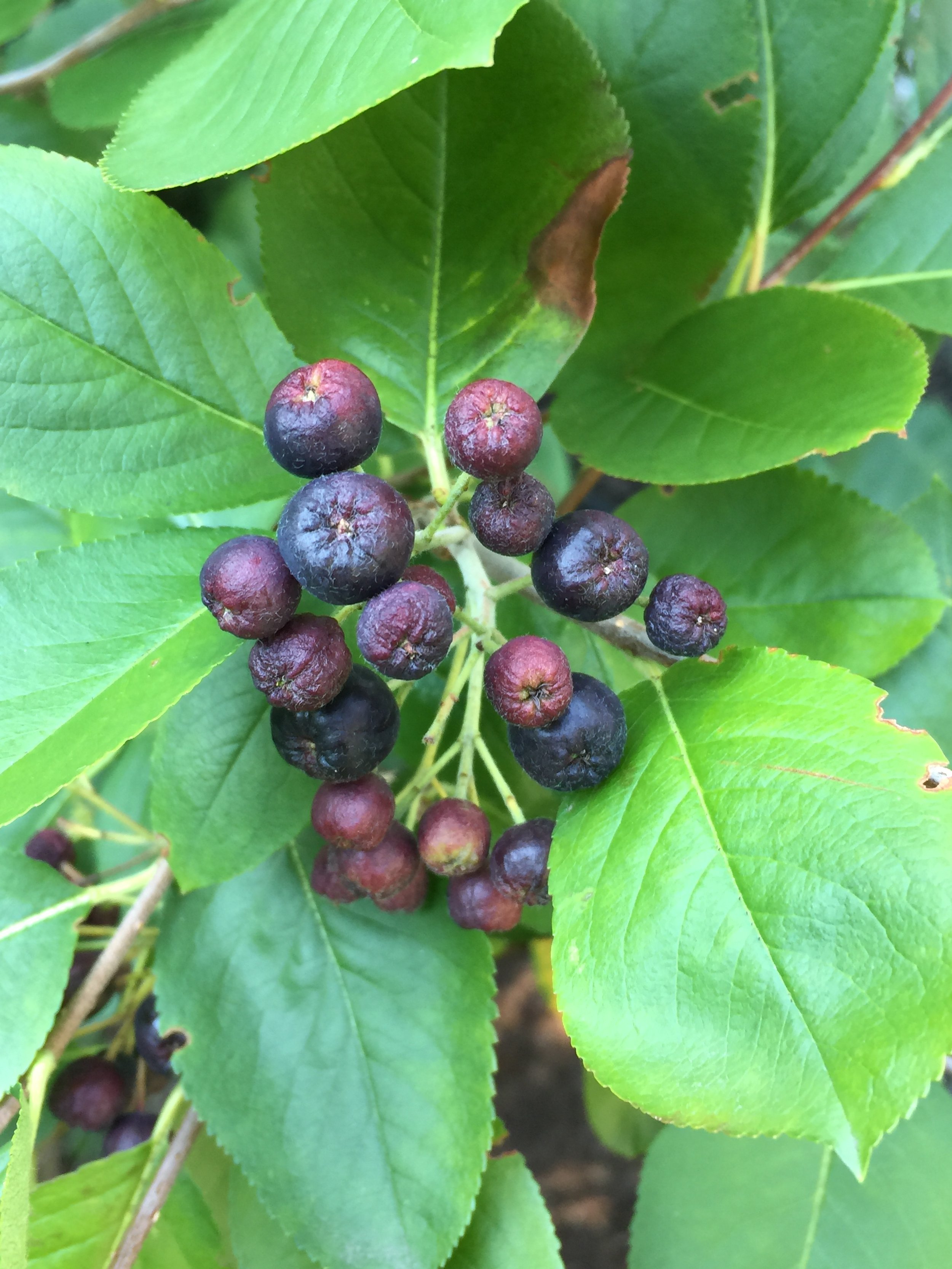
Black Chokeberry, Elaine Mills
Black Chokeberry (Aronia melanocarpa) offers nectar and pollen to bees from white to pink-tinged flowers in April to May, and black fruit from September through November which appeal to many birds. Its size of three to six feet, both tall and wide, makes it a great fit for many suburban yards, and it offers attractive fall coloring that varies from yellow to orange to crimson. Despite the off-putting name, the berries can be used for jams, juices, and natural red coloring.

Arrowwood viburnum, Elaine Mills
Arrowwood Viburnum (Viburnum dentatum) earned its common name because the very straight branches were used by Native Americans to make the shafts of arrows. Normally six to ten feet tall and wide, this shrub likes sun or some shade. It has showy white blooms in May to June, followed by attractive fruit in the fall. There are many cultivars of Arrowwood Viburnum which are propagated vegetatively by cloning. For good cross pollination and fruit set, it is important to have at least two Arrowwood Viburnums that are genetically different from each other.

Monday Mystery - May 1, 2023
Monday Nature Mystery continues! Read on to learn who correctly identified our last mystery.
Photo: Foamflower (Tiarella cordifolia), Tina Dudley
We are pleased to announce the winner of last week’s Monday Nature Mystery, Elise Larsen! PJ and Judy won too recently to claim another prize.
Congratulations to Elise for identifying the Foamflower (Tiarella cordifolia).

Foamflower (Tiarella cordifolia). Photo: Tina Dudley
According to Master Gardeners of Northern Virginia, this plant, also known as Heart-leaved Foamflower, looks as wonderful as a ground cover in shady locations as it does in a container on a patio or balcony. The plant’s tiny, star-shaped flowers and fine-textured stamens resemble foam, accounting for its common name. Make sure you check out some of the many upcoming native plant sales to look for this and other native plants.
Each Monday we’ll post a new mystery and identify the previous week’s winner. They’ll receive an ASNV hat or tote bag.
Here is this week’s mystery:
Who is this? Can you tell by just the beak?
Be sure to post your guess on our Facebook page under the latest Monday Nature Mystery post. Good Luck!
Please check our guidelines here.

Monday Nature Mystery: Who is this?

Calling All Birders: It's Time to Get Ready for Birdathon 2023!
Birdathon helps ASNV continue to support outdoor education, citizen science and habitat conservation, and encourages people to plant native plants and foster native wildlife.
Photo: Birders, Laura McDonald
How does it work? Like a walk-a-thon, Birdathon participants collect pledges from friends and family via our website. Then participants record how many species they can identify during any 24-hour period between April 15 and May 21. The more species they identify, the more funds they raise!
Last year’s winning team saw 123 species in 24 hours! Wow! Can you beat it?
Birdathon helps ASNV continue to support outdoor education, citizen science and habitat conservation, and encourages people to plant native plants and foster native wildlife. Birdathon also helps ornithologists better understand spring migration by reporting sightings through eBird, an online database of bird observations run by the Cornell Lab of Ornithology.
All birding levels are welcome. Participants can bird alone or form teams of up to five. All team members donate and/or secure pledges. Participants solicit general donations or ask for pledges based on the number of species or the number of individual birds sighted. Sightings and donations are due no later than June 2, 2022. Report your Birdathon sightings on eBird and email your list to info@audubonva.org.
Ready to get started? Register your team here and check out our Birdathon rules . Now go out and have a great day birding!
All participants and their supporters are invited to join us at our Audubon Afternoon in June for our Annual Meeting, where we’ll announce the winners of the “Most Species Counted,” “Most Money Raised” and “Youth Birder” competitions. Plus our new award categories for this year - "Most Species Counted by a New Team," "Widest Age Range," and "Backyard Bounty."
Deer Management
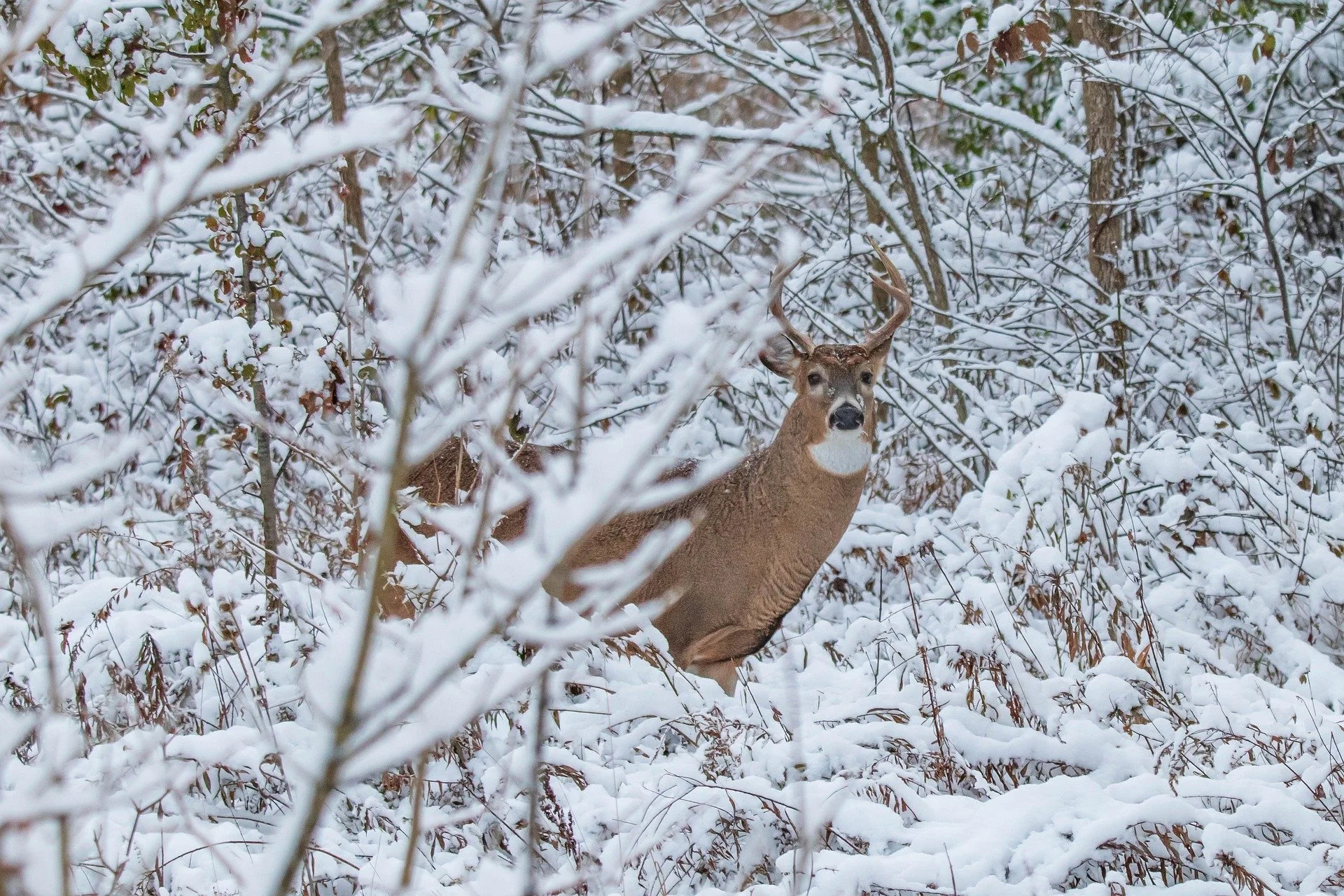
Deer are eating our understory, presenting another threat to woodlands already endangered by invasive plants, climate change, and development.
Photo: MarkRay66 via Pixabay
Greg Butcher
Deer are eating our understory, presenting another threat to woodlands already endangered by invasive plants, climate change, and development. Wolves and mountain lions, the primary predators of deer, have been eradicated from the Eastern United States, and in many areas the number of deer has been growing steadily. Deer love the suburban habitats we have created. In addition to frustrating home gardeners, the deer are eating the smaller plants and young trees in our parks, and, in many areas, there not enough young trees to replace the older ones as they die.
ASNV focuses on improving habitat for birds and wildlife in our region. Usually, that involves promoting the removal of invasive plant species and their replacement with native plants. We have done this for many years on private property through our Audubon at Home program, and we are expanding this work through partnerships with parks.
The first park we have focused on is Upton Hill Regional Park (in Arlington, on the border of Falls Church) where a lot of work has already been done to improve the vegetation, in both the park and its surrounding neighborhood. Arlington Master Naturalists (ARMN) have done a great job already, but much more needs to be done.
In a recent meeting, participants working in partnership to improve Upton Hill raised the concern that we could spend a lot of time, money, and effort planting natives, but the deer population is so high that they might eat all the new plants before they can benefit the other wildlife in the park.
Arlington County is the only local county that does not have a deer management program. Both Fairfax County in Virginia and Montgomery County in Maryland have extensive deer management programs, and many would like Arlington to adopt a similar program. Loudoun and Prince William Counties also have deer management programs, as does the Commonwealth of Virginia .
Last fall ASNV submitted comments on Arlington County’s draft Forestry and Natural Resources Plan, recommending that the county give higher priority to managing its deer population. We plan to alert our members when the issue comes before the board again this summer, after it receives recommendations from expert consultants on the problem.
And of course, the problem goes beyond Virginia. ARMN recently presented a very interesting webinar by a deer expert at Cornell University who explained the impact deer are having on the ability of our urban forests to replenish themselves. You can watch a recording of his presentation here.

Landscapers’ Conference in Spanish
One hundred and thirty-five landscape professionals attended a conference on sustainable landscaping on February 15 on the Annandale campus of Northern Virginia Community College.
Photo: February 2023 Landscapers’ Conference, Wendy Cohen
Wendy Cohen
One hundred and thirty-five landscape professionals attended a conference on sustainable landscaping on February 15 on the Annandale campus of Northern Virginia Community College. Although Plant NOVA Natives, in partnership with ASNV, has held other sustainable landscaping conferences for professionals, this one was special: it was held completely in Spanish and targeted Spanish-speaking landscapers. Funding came from individual donations and grants from Transurban and the Virginia Department of Forestry.
February 2023 Landscapers’ Conference, Wendy Cohen
Participants learned from experts in the field about the importance of native plants, identification of invasive plants and the Spotted Lanternfly, the vital work of invasives removal, and best practices in planting and pruning techniques. Speakers included the owner of a sustainable landscape design business, the director of the Fairfax County Parks Invasive Management program, the commercial horticulturist for Loudoun County’s Cooperative Extension program, and a sustainable landscaper.
The audience was completely engaged and participated actively in the question-and-answer sessions. Participants were given handouts in Spanish, including an invasive plant identification guide, the Fairfax County Tree Basics booklet, and lists of online resources. Hip City Veg provided a vegan lunch, and several event organizers provided home-baked vegan cookies. The conference was a “low-waste” event, using only non-disposable cups and plates and recycling and composting lunch and breakfast items.
The great turnout for the event made clear the huge need for Spanish-language training for landscape workers. For example, it is hard to find pesticide or fertilizer certification in Spanish, a big gap considering who is doing much of the landscaping work in northern Virginia. Plant NOVA Natives is planning to start a series of webinars for a general Spanish-speaking audience. Check out the Spanish language material currently on the website at https://www.plantnovanatives.org/espanol.
Plant NOVA Natives, ASNV, and other partners hope to make the conference an annual event, and look forward to the day when landscaping companies become proficient at recognizing and removing invasives, start advertising invasive removal services, and make money off it.

New Barn Owl Box Installed in Northern Virginia
The ASNV Conservation Committee is excited to announce the successful installation of a new barn owl nesting box in an unused silo in a park near Leesburg.
Photo: Barn Owl, Michael Phillips/Audubon Photography Awards
Tina Dudley
Barn Owl, Michael Phillips/Audubon Photography Awards
The ASNV Conservation Committee is excited to announce the successful installation of a new barn owl nesting box in an unused silo in a park near Leesburg. This project was implemented by our friend and raptor advisor, Liz Dennison, in partnership with NOVA Parks.
Liz Dennison, president of Secret Garden Birds & Bees, a nonprofit, also worked with the Conservation Committee to help us install two Kestrel nesting boxes at the Lorton Landfill in 2022.
The effort to find a suitable location to install the barn owl box began at the end of last year. We investigated a few siloes close to the Lorton Landfill, but each silo proved to be problematic for different reasons. Several were completely inaccessible, welded shut in fact. Another was accessible but, due to poor drainage, had several inches of water in the bottom. This was a problem because when young barn owls fledge, they often fall from their nest as part of the process of learning to fly. We did not want to risk the fledglings drowning accidentally.
We found the perfect silo by posting a question to Reddit’s NOVA community - asking if anyone happened to know about a silo that might be suitable. One commenter replied that it was a strangely specific question to post. Luckily, one reader in the thread happened to be an employee of NOVA Parks, who contacted us with a lead on a good location.
This park, which we are not identifying to prevent harassment to any future nesting owls, is the perfect site. It has ample grassland nearby to provide a bounty of mice and voles. Barn owls have in fact been spotted in and near that park by NOVA Parks staff. The silo also is in a part of the park that is closed to the public.
Although Barn Owls prefer to nest in barns, they will use a silo because the silo helps protect the owls from the elements. Liz shared a memory of the first time she and Dave installed a barn owl box in a silo on her own property. “I did not have high expectations because I did not think we were in good barn owl territory. But I was wrong. Just a few weeks after installing the box, I stuck my cell phone through one of the silo doors and snapped a picture of the box. And there was a beautiful barn owl face looking down at me! The owls are still here and still using the box to raise their young.”

Nest box in the silo, Liz Dennison
It was Liz’s brave friend Dave Cazenas who actually climbed high up into the silo to install the box. He also brought his drone and was able to capture this great image of the silo and the surrounding habitat.
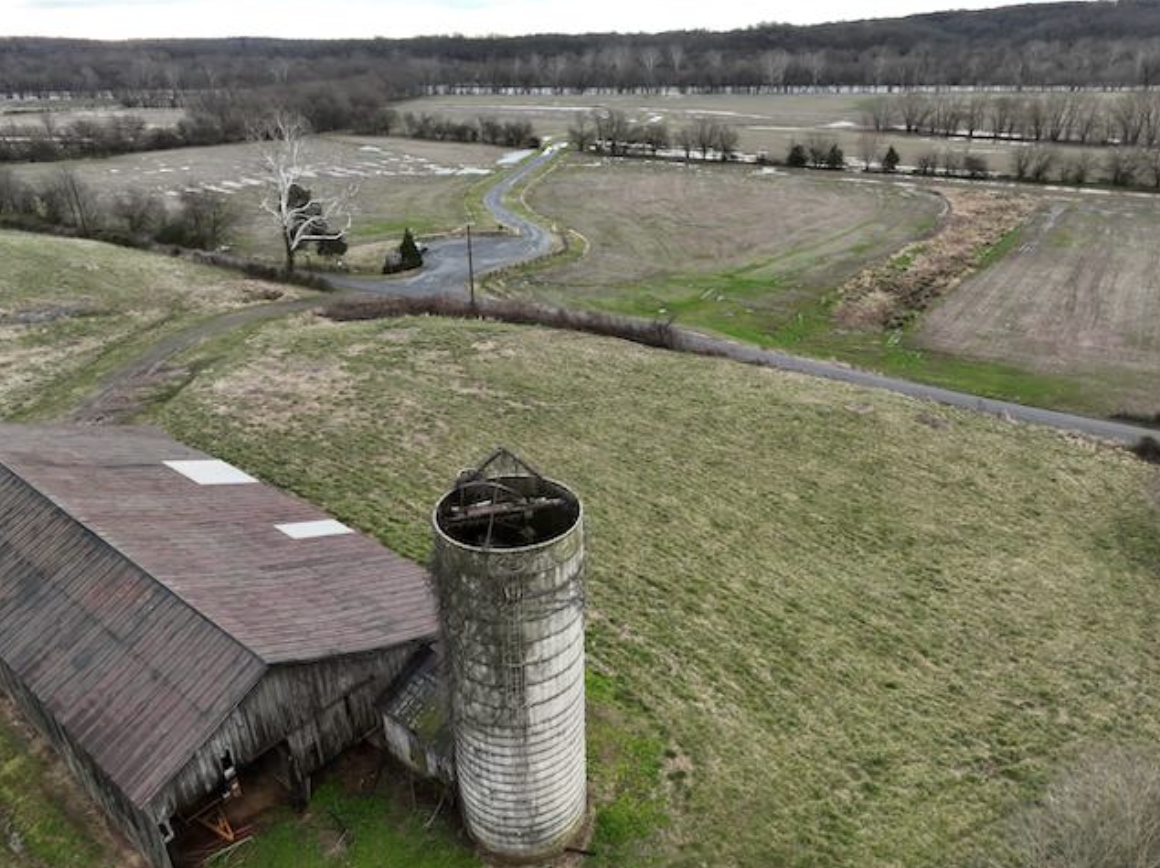
The chosen silo, Dave Cazenas
Liz explains why this location is ideal: “This silo in the park is perfect. The silo, despite missing a roof, is in good structural condition, which made installation safe. The surrounding area is perfect for hunting mice and voles. It’s quiet and away from people. And young barn owls will have plenty of sheltered places to roost as they master their flying and hunting skills. Without disturbing them, we will check for signs of the owls – owl pellets (bits of indigestible bone and fur regurgitated by the owls) and molted feathers.”
She also asks for public cooperation: “If anyone recognizes this place from the photos, please keep your distance from the silo and other structures. We want the owls to feel safe exploring the site and choosing it for their nest. It could take some time – or it could take just a few weeks. But I’m confident that a pair of barn owls will eventually make it their home.”
Many thanks to Liz and Dave, and to Emily Johnson from NOVA Parks, who suggested this location and coordinated with our volunteers who installed the nest box.
We hope to have good news of a nesting pair to report back soon!
If you know of a silo that might be suitable for another nesting box, you can contact us at info@audubonva.org with your suggestion.
We would not be able to do projects like this without the help of our donors. Thank you for your support. To contribute, you can make a donation online at https://www.audubonva.org/donate.

Want birds and butterflies? Plant native shrubs!
When it comes to the curb appeal of our houses and other buildings, the difference between starkly naked and softly clothed is the shrubs. What is a shrub, anyway?
Photo: Shrubby Saint John’s Wort, Margaret Fisher
Margaret Fisher
When it comes to the curb appeal of our houses and other buildings, the difference between starkly naked and softly clothed is the shrubs. What is a shrub, anyway? According to famous bird expert David Allen Sibley, “If you can walk under it, it’s a tree; if you have to walk around it, it’s a shrub.” Other than being multi-stemmed and relatively short, a shrub is pretty much the same as a tree and therefore provides the same environmental benefits, albeit to a smaller degree. And the difference between a native shrub and a non-native one is that the former will not only beautify a property but will turn it into a living landscape that supports the butterflies and birds.
Many people are looking at their yards and at public land and realizing that a lot of the space is being wasted. Turf grass has its advantages for certain purposes, such as providing a place to walk or play sports, but as a non-native plant, it does nothing for the ecosystem and requires a lot of input to maintain. Chipping away at the lawn with native shrubs can quickly cover the ground at a very low cost. Beyond the initial watering to get them established, they will require little or no maintenance from then on.
Shrubby St. John’s Wort, Margaret Fisher
For small spaces, there are some native shrubs that naturally stay short, such as Shrubby Saint John’s Wort (Hypericum prolificum) with its bright yellow flowers. There are also smaller cultivars of larger shrubs, such as Winterberry Holly (Ilex verticillata) with its red berries that persist into January until they finally soften up and become a food source for hungry birds. If you use shrubs whose ultimate height fits the space you have in mind, the yearly shearing task will be eliminated. These and many other native shrubs are described on the Plant NOVA Natives website, which also points to places to buy them.
Some native shrubs grow tall enough to provide shade and can be an alternative to a small flowering tree. Common Witch-hazel is an example of that. So named because of the cute bumps it gets on its leaves in the shape of a witch’s hat, this native shrub is also magical for flowers that are revealed in November after the leaves fall off. Those bumps, by the way, are caused by the reaction of the plant to a chemical injected by a tiny insect, the Witch-hazel Cone Gall Aphid. The cone-shaped bumps provide food and shelter to the female aphids as they lay their eggs.
Native shrubs can fill in the spaces between trees. From an environmental perspective, this arrangement is ideal, providing shelter and food at multiple heights, something we have lost in many of our woods to excessive browsing by deer. (In fact, although “Nature’s first green is gold,” if you look into the woods of Northern Virginia right now, there is a suspicious amount of green, much of which is due to invasive species such as Multiflora Rose and Asian Bush Honeysuckle. The leaves of invasive plants often emerge earlier and persist later than those of our native shrubs.) In our own yards, we can take steps to protect plants from deer and to swap out invasive shrubs for native ones and thus help support our local ecosystem.
The Virginia Department of Forestry (VDOF) is collecting data on how many trees are planted in Northern Virginia as it works toward the goal of 600,000 by 2025. For this purpose, shrubs count as trees, so VDOF is encouraging everyone to report plantings of both. A reporting form can be found on the Plant NOVA Trees website.

ASNV Citizen Science Needs YOU!
As an important part of our citizen science work, we’re looking to establish some baseline bird abundance data for a pair of parks, specifically for Upton Hill Park in Arlington and Four Mile Run Park in Alexandria.
Photo: Camilla Cerea/Audubon
Jerry Touval
As an important part of our citizen science work, we’re looking to establish some baseline bird abundance data for a pair of parks, specifically for Upton Hill Park in Arlington and Four Mile Run Park in Alexandria. We’d like to hold a number of bird walks in those two parks this spring, but we need walk leaders. For Upton Hill, we’d like to enlist bird walk leaders for each weekend in May, and for Four Mile Run we’re looking to have a minimum of one walk per month for April, May and June (and more than one would be better!).
If you’re interested and available to lead any of these walks, we’ve set up a Google sign-up sheet that you can access here, or send a message to Jerry Touval.
Please consider helping out with this important citizen science work!

ASNV Awards Hog Island Scholarship
ASNV’s Youth Education Committee has awarded Matthew Davidson of Lynbrook Elementary School in Springfield an all-expense scholarship to “Sharing Nature: An Educator’s Week” at Hog Island Audubon Camp in coastal Maine.
Photo: Hog Island, Kirk Treakle

“Mr. Matt” Davidson
ASNV’s Youth Education Committee has awarded Matthew Davidson of Lynbrook Elementary School in Springfield an all-expense scholarship to “Sharing Nature: An Educator’s Week” at Hog Island Audubon Camp in coastal Maine. ASNV awards this scholarship, covering tuition, room, board, and transportation, every year to a northern Virginia classroom teacher, specialist, or school administrator. Hog Island has offered environmental education programs for adults, teens, families, and conservation leaders since 1936. The camp takes a multidisciplinary approach to helping instructors develop effective techniques for teaching children and adults about nature.
“Mr. Matt,” as he is known to his students, is an Outdoor Education Coordinator who helps them learn about nature and the environment, and is passionate about birds. He is expected to use his Hog Island experience to develop a new conservation-themed educational program or enhance one that he is already using. Mr. Davidson will share his Hog Island experience in the September newsletter and submit a final report to ASNV next year. We look forward to hearing from Mr. Matt!

Welcome Spring Migration!
Every spring, warblers and other neotropical songbirds journey north from South and Central America and fly through Virginia via the Atlantic Flyway. Observing their spring migration presents an incredible opportunity to experience the colors and sounds of the season in northern Virginia.
Photo: Tree Swallow, David Boltz/Audubon Photography Awards
Deidra Bryant
Winter has a way of making you long for warm days, blooming flowers, cheery birdsongs, and colorful butterflies. We had a pretty snow-less winter this year, but it was still cold, wet, and dreary. Once spring (and the birds) finally arrive, I feel nothing but gratitude. Every spring, warblers and other neotropical songbirds journey north from South and Central America and fly through Virginia via the Atlantic Flyway. Observing their spring migration presents an incredible opportunity to experience the colors and sounds of the season in northern Virginia.
When looking for warblers, remember that they are very tiny birds, so look for quick movement in forest edges and between forest layers in wooded areas using a set of good binoculars or a scope. Also listen for a sweet quality with high and low pitches, or an insect-like trill or buzz around you. They are very colorful birds so a good tip to use is to listen first, pinpoint the sound, and then look for flashes of color in the trees.
Another bird to keep an eye out for is the Tree Swallow. They're long-distance migrants. To avoid northern winters, they will travel during the day along the Atlantic coast to Florida and Central America. During late March, these birds are among the first to fly north to return to their nesting grounds. You can track the relative abundance of the birds on their migration path using this eBird link. These swallows have beautiful, deep-blue, iridescent feathers that contrast against their white plumage that runs from just under their beaks and down along the chest. They are also master aerialists, as you’ll see them twist and turn very quickly in the air when chasing and feeding on flying insects.

Tree Swallows, Jerry Ende/Audubon Photography Awards
So, to celebrate spring, take more walks and visit a botanical garden or arboretum (or several of each!) to see more species of birds. Along with the National Arboretum and Virginia State Arboretum , I recommend NOVA Parks’ Meadowlark Botanical Gardens, Big Meadows in Shenandoah National Park, Manassas National Battlefield Park, Occoquan Bay National Wildlife Refuge, and Great Falls Park. These places are great because they not only provide good cover for migrating birds to rest, but also are abundant in insects, a critically nutritious food source for the birds’ journey north.
For the best chance to see the birds, wake up before sunrise and make the birding trip early in the morning. And don’t let the rain stop you from driving to your site, because post-rain, damp days are the best days to see birds. You’ll find them splashing around in puddles, or looking for insects and seeds that come to the surface after rainfall. You’ll also hear them singing very loudly in the trees. Bird walks are great exercise (especially for your arms if you’re holding up binoculars for long periods of time). Just remember to think small, look for movement, and check forest edges. If your job keeps you busy, try to take at least a few days off so you don’t miss the vibrant colors in the sky, in the trees and shrubs, and along the ground during this magical time of year.

If You Build It, They Will Come, Maybe
I am captivated by Eastern Screech Owls. They have the qualities noted above, and they come in two colors – gray and red. They are robin-sized with cute ear tufts. But most important for me, they love nest boxes, suburban areas, and mixed woods, so that creating an environment for them is doable. If you build it, they will come!
Photo: Eastern Screech Owl, Jen St. Louis/Audubon Photography Awards
Evelyn Novins
Owls have fascinated people in many cultures and over time. They appear in folklore representing wisdom to witchcraft. Variously despised and admired, people write about them often. The owl recently has even become a messenger to wizards! They fascinate because they are elusive, and their appearance is eye-catching and a bit eerie. The rounded body, enlarged eyes, and the 270-degree rotating head, coupled with nocturnal behavior and silent flight, make them mysterious creatures.

Eastern Screech Owl, Randy Streufert
I am captivated by Eastern Screech Owls. They have the qualities noted above, and they come in two colors – gray and red. They are robin-sized with cute ear tufts. But most important for me, they love nest boxes, suburban areas, and mixed woods, so that creating an environment for them is doable. If you build it, they will come!
The first step is the nest box. I purchased one from Owl Reach out of Texas – a place with many screech owls and screech owl studies. I followed the directions, but squatters entered the nest before the end of the season. In addition, I found a few things that may have deterred screech owls from moving in. More research gave me the parameters that I needed to try again.
In researching box design, I found several resources: Margaret Barker’s Audubon Birdhouse Book and Carol Henderson’s Woodworking for Wildlife: Homes for Birds and Animals. I decided to modify the Texas design and move toward a more universal one, following guidelines from National Audubon Society. That done, I made and followed this checklist of essentials:
Location - The box should be solidly anchored to a tree 10 to 30 feet above the ground, facing away from the prevailing winds and preferably toward the south, to keep them warm. The box should have an open flight path to its entrance. Although the box can be set up at any time, screech owls begin looking for a home early in the season, so up by January gives you an edge.
Perching Spot - A perching spot is necessary near the box and in near-by trees. Owls like to perch to rest, preen, save energy and watch for prey.
Large Bird Bath - Owls do not need much water, getting much of what they need from their prey; however, they do enjoy a bath. It’s suggested to have one made with a sloping edge so they can ease in.
Brush Pile - A brush pile nearby to help supply food is a must. The pile can include sticks, grass trimmings, root balls, and fallen branches. Small rodents and insects inhabit these piles providing abundant food for the owls. The screech owl eats many large insects such beetles and crickets and a variety of small mammals such as shrews, voles, moles and sometimes bats. In addition, lizards, frogs, earthworms, and crayfish are part of their natural diet.
Things To Avoid – Remove netting of any sort (such as a soccer goal or basketball hoop) from the nest-box area to prevent entanglement. Turn off or dim heavy outdoor lighting, particularly seasonal lighting. Do not use recorded screech owl calls to attract the birds. It creates stress on the listening owls and may attract predators, thus discouraging the owl you want to invite and alarming other birds unnecessarily.
Once you have attracted owls, there are some additional rules to follow:
Avoid helping them eat by putting out food or releasing caged mice – they will not survive. The owl must hunt live prey - so do not offer dead rodents.
Longer lawns provide an environment for small rodents, an essential food source - so mow less. Moles, mice, shrews, and voles thrive in longer grass providing a smorgasbord for the owl.
It’s critical to avoid rat poisons and pesticides. If owls eat poisoned prey they can suffer neurological damage leading to debilitation. This secondary poisoning or secondary toxicity is a problem for all wildlife.
I have satisfied all the items on my checklist, but no luck this year so far. Plus, it’s late to hope to attract a screech owl this year. I have not heard the signature whinny or other distinctive calls of the screech owl, but I am not giving up hope.
If you are interested in your own backyard project, here are a few links for materials that may help: