
NVBA NEWS BLOG
Welcome to the blog for Northern Virginia Bird Alliance, a wealth of resources about northern Virginia birds, wildlife, habitat conservation and restoration, native plants, wildlife-friendly gardening, advocacy and more.

Celebrate native trees in October!
This year, the entire month of October is Native Tree Month across Virginia!
Photo: Fall trees, Margaret Fisher
Cindy Speas
Chair, Fairfax County Tree Commission
Fall trees, Margaret Fisher
September may have given us a hot blast of 90-100-degree temperatures and little rain, but autumn is just around the corner, with its clear blue skies, sunny days and crisp temperatures! All of us will cheer the emerging fall color changes around us, with reds and golds and maroons permeating the tree canopy above and the shrubs and plants below. Many who have hibernated during the heat of the summer will come out to play, hike, and work in the yard—for it is now the best tree planting season of the year, lasting right through November or early December, frosty weather permitting.
This year, the entire month of October is Native Tree Month across Virginia! It is important to plant native trees, as well as other plants, because they are highly adapted to local soil and weather conditions, easy to maintain, and generally need less water and zero fertilizer to thrive. Local pollinators and other insects must have them for nutrition, so that they in turn can become food for birds and small animals. Critically, the food web is not supported by non-native plants. Sometimes you may see bees on a non-native plant or tree (think crape myrtle or butterfly bush), but the insect is getting only a quick sugar water drink, instead of the healthy, complex food it needs from the native plants it grew up with.
Why should we include shrubs and other smaller plants when October is a celebration of native trees? It’s because they partner to play a critical role in keeping our urban forest ecologically healthy. They work together like a family to provide a home and food for native insects, birds, and small animals. A healthy urban forest reduces stormwater run-off, lowers energy costs for residences and businesses, sequesters greenhouse gases in its wood, roots and surrounding soil, and improves the health of humans and other species by filtering airborne pollutants from nearby roads and industrial areas. For a summary of the ecological and other benefits of native landscaping, you’ll enjoy reading this article from the National Audubon Society.
Many local plant nurseries are joining in this October celebration to highlight native trees, shrubs and understory plants, and some are offering discounts as well! The Plant Nova Trees website has information about where to buy natives nearby this October as well how to find tree walks and tree planting events. If you need details or reminders about how to plant a tree or woody shrub, download the Fairfax Tree Commission’s popular Tree Basics booklet. Planting is not too onerous a task when fall weather conditions are usually so cheerful.
And finally, make sure the trees and woody stems you plant in October are counted! Go to this page to record your special efforts to enhance and expand our urban forest.

What You Need to Know About Bird Flu
The July 2023 Statement from the international Scientific Task Force on Avian Influenza and Wild Birds includes some alarming information about the effect of the current avian influenza or “bird flu,” H5N1, but it also includes some helpful recommendations on steps we can take to keep from exacerbating the spread of this deadly disease.
Photo: Mallard ducklings, Colleen Kerrigan/Audubon Photography Awards
Deidre Bryant
The July 2023 Statement from the international Scientific Task Force on Avian Influenza and Wild Birds includes some alarming information about the effect of the current avian influenza or “bird flu,” H5N1, but it also includes some helpful recommendations on steps we can take to keep from exacerbating the spread of this deadly disease.

Bantam Chickens in a coop, Putneypics, CC BY-SA 3.0 via Wikimedia Commons
Let’s start with some background. What is H5N1? It’s a strain of highly pathogenic avian influenza (HPAI), and it’s currently causing high mortality rates in farmed poultry, wild birds, and even mammals that feed on sick birds such as foxes, bears, opossums, and mustelids. According to the World Organization for Animal Health (WOAH), avian influenza is a complex strain of viruses that can evolve rapidly. It generally is seasonal, peaking in February and reaching its lowest in September. Because the viruses are resilient and can survive for long periods of low temperature, they can spread easily from farm to farm on equipment. The current form is particularly frightening because it spreads to free-ranging wildlife from poultry, which used to be rare. Health authorities expect it to continue spreading, especially in breeding colonies on oceanic islands. The disease occurs worldwide (except in Antarctica, Australasia, and the Pacific islands).
And, what free-ranging birds are being affected? The list is extensive with over 400 species dying, or reported to have the virus, worldwide. These include gannets, terns, gulls, herons, grebes, pelicans, penguins, cormorants, cranes, owls, corvids, vultures (and condors), parrots and some passerines. In North America, HPAI has killed hundreds of Bald Eagles, 5-15% of the nesting population of Common Eider Ducks on the St. Lawrence waterway, 58% of the breeding population of Northern Gannets in Canada, over 1,000 Caspian Terns on Lake Michigan, approximately 1,000 Snow Geese on Colorado waterways, and at least 20 critically endangered California Condors. The surviving population of California Condors is now being vaccinated. H5N1 is present in almost every state in the U.S., including Virginia.
So, what does WHOA recommend? Its standards for the poultry industry include mitigation measures, such as culling infected birds, improved hygiene standards and less crowding. For ailing wildlife, however, it does not recommend culling, spraying toxic products, or tampering with habitats, because a focus on wildlife would misdirect critical resources away from control methods closer to the source. Also, such responses to wild bird transmission can lead to loss of biodiversity. What is effective against HPAI risks is separating poultry operations from wetland habitats and possibly moving wildlife away from human-dominated areas, such as by creating new breeding sites.
But those measures are ones to be implemented by industry and governmental authorities. What can YOU do? There are steps you can take as hunters and fishers, as suburban owners of backyard hens, as backyard bird feeders, and as bird-watchers visiting areas near breeding colonies of birds. Remember that the virus can spread by water, soil (on clothing or airborne), and from exposure to diseased birds and their products.
Bird watchers approaching breeding colonies should ensure that their shoes and clothing are free of soil and debris. If they also raise poultry, they should ensure that none of their clothing or gear has come in contact with poultry, unless it is disinfected afterwards.
Backyard bird watchers should ensure that they regularly clean and disinfect feeders and bird baths, taking them down if they notice ailing birds visiting them.
Backyard birders who also keep a few hens or other domestic fowl should not put up feeders or birdbaths, or create water features for wild birds.
Fishers should not use poultry cuts or viscera as fishing bait.
Hunters should not use live decoy birds to attract wild birds during times of high risk, and at all other times should keep them in bio-secure areas away from poultry.
Fishers and waterfowl hunters should not allow poultry to come in contact with their fishing or hunting clothes, footwear, gear, dogs, or vehicles, which may be contaminated.
Anyone finding a dead or diseased animal should call local animal health authorities to take care of carcasses, so that they are not disposed of where scavengers can dig them up and spread infection.
Gardeners with or without backyard water features or ponds should not use poultry manure as fertilizer or fish food.
Suburban backyard “farmers” who keep chickens, ducks and geese have to take extra precautions to separate their livestock from wild animals. They need to be on the alert for signs of sickness, which often include respiratory distress or digestive ailments (extreme diarrhea), followed by a quick death. Chickens may have swelling around the head, neck, and eyes, and their heads and legs may also have purple discoloration. If you own poultry:
Follow the strict instructions and guidelines on your feed bags, which also provide information on HPAI.
Separate your flock from wildlife and wild birds with an enclosed shelter within a fenced outdoor area. Smaller mesh hardware cloth can keep out wild birds and allow your flock outdoor time.
Do not have contact with your birds if you have been near others’ flocks, and restrict access to your poultry if your visitors have birds of their own.
Keep different species of poultry and age groups separated because different traits and ages may be or less prone to disease.
Keep feeders and waterers clean and out of reach of wild birds, always cleaning up feed spills.
Change feeding practices if wild birds continue to be present.
Use dedicated or clean clothing and footwear when working with poultry.
Clean and disinfect equipment that comes in contact with your birds such as shovels and rakes.
Clean and disinfect poultry housing and equipment often to limit the birds’ contacting their waste.
Don't share equipment or reuse materials like egg cartons from neighbors and other bird owners.
Prevent any of your domestic ducks from grazing in wetlands.
There are more tips and guidelines available from the Virginia Department of Agriculture and Consumer Services and the Virginia Department of Wildlife Resources. With proper planning, surveillance, education, and the involvement of local health and wildlife organizations, everyone can help protect livestock, poultry farmers, and wild, free-ranging birds worldwide.

Thoreau Middle School Garden Produces Monarchs!
In 2021, Henry David Thoreau Middle School, in Vienna, applied for funds from ASNV to purchase native plants for its courtyard. We recently received an exciting update on its garden.
Photo: Native plants at Thoreau Middle School, Missy Galus
Tina Dudley
In 2021, Henry David Thoreau Middle School, in Vienna, applied for funds from ASNV to purchase native plants for its courtyard. We recently received an exciting update on its garden.
Thoreau Middle School opened on September 6, 1960, and was one of the very first intermediate schools opened by Fairfax County Public Schools. Thoreau Middle School now serves 1,230 students in grades 7 and 8. The school is named after Henry David Thoreau, the American naturalist, essayist, poet, and philosopher. So, it is fitting that the school has an active environmental club called the Green Eagles, co-directed by Missy Galus.
Green Eagles is an after-school club that meets a minimum of twice weekly for two hours (sometimes more often). Its members work to increase environmental awareness of the school’s staff and student body, as well as the larger community. They have charge of the school's two courtyards and are working directly with the Fairfax County Park Service Get2Green Department and with two Master Gardeners.

Some acquired native plants, Missy Galus
The school requested funds from ASNV to purchase native plants including Butterfly Weed (Asclepias tuberosa), New England Asters (Aster novae-angliae), New Jersey Tea (Ceanothus americanus), Eastern Redbud (Cercis canadensis), Field Thistle (Cirsium discolor), Lanceleaf Tickseed (Coreopsis lanceolata), Cockspur Hawthorn (Crataegus crus-galli), and Purple Coneflower (Echinacea purpurea).
Students and parents volunteered to put in the new native plants. Missy Gallus and the Green Eagles club maintain the project, watering and weeding the new plantings.

Maintaining the new plants, Missy Galus

Maintaining the new plants, Missy Galus
Science teachers at the school now incorporate the courtyard garden into their curriculum, teaching students how to identify native and non-native plants and animals. Those lessons expand into discussions of the Chesapeake Bay watershed, environmental sustainability, and how what we do today in our environment directly affects generations to come.

Monarch caterpillar on Milkweed, Missy Galus
The courtyards now include a pollinator garden, a milkweed garden, a vegetable garden, a pond, a composting box, rain barrels, and habitat for 5-6 Eastern Box Turtles that call the courtyard home. This Spring, the milkweed in the garden attracted Monarch Butterflies to lay eggs. Teachers were able to bring the resulting caterpillars into the classroom to raise into adult Monarchs. They then released the adults into the garden. It was a great teaching and conservation opportunity!
The project continues to grow. The next additions will be more birdhouses, more pollinator plants around the waterfall/pond feature and an insect house the students will be building themselves.
We’re proud to have contributed to this terrific effort.

ASNV Teams up with Faith Alliance for Climate Solutions and Loudoun Wildlife Conservancy for a Conservation Workshop
You can learn how to advocate on behalf of our environment by attending a free Advocacy Forum at the National Wildlife Federation building on Saturday, October 21.
Photo: Martin Kraft, CC BY-SA 3.0 via Wikimedia Commons
Tom Blackburn
Birds, wildlife, plants, and trees can’t speak for themselves, so we need to do it for them. If we don’t, our world will continue to deteriorate as habitat is destroyed for new development, invasive species take over our neighborhoods, pollution kills wildlife, and our parks deteriorate from a lack of funding.
You can learn how to advocate on behalf of our environment by attending a free Advocacy Forum at the National Wildlife Federation building, 11100 Wildlife Center Drive in Reston, from 1 to 4:30 PM on Saturday, October 21. It is co-sponsored by ASNV, Loudoun Wildlife Conservancy and Faith Alliance for Climate Solutions. Speakers include Ken Plum, member of the Virginia House of Delegates; Chris Miller, Executive Director of the Piedmont Environmental Council; Michal Myers, Executive Director of Loudoun Wildlife Conservancy; and Mary Rafferty, Executive Director of Virginia Conservation Network. You can read the agenda here. The event is free, but please register here so we know how many people will attend.

Biodiversity Starts at Home: Plant Native Plants!
Fall is for planting. When choosing what to plant, why not factor in the ecosystem while you are at it?
Photo: Landscape with native plants, Margaret Fisher
Margaret Fisher
Landscape with native plants, Margaret Fisher
Fall is for planting. When choosing what to plant, why not factor in the ecosystem while you are at it? Preserving biodiversity may sound like a job for scientists, but in fact the implementation is up to all of us. It is the decisions we make on a daily basis that determine how well our local ecosystem will weather the numerous stressors that come with climate change. We get to see this in action as we choose which plants to install on our properties.
Why should we care about biodiversity, a term that seems so remote to our own lives? Perhaps a better word would be “bio-resilience” or even “bio-survival,” to highlight the importance of genetic diversity in a changing world. In our yards, for example, planting a whole range of species means that whether they are hit by drought, deluge, or the next plague, at least some of them will make it. Better still is to use plants that themselves have genetic diversity, as opposed to ones that are produced by cloning, which is the case for most cultivars.
None of this has much meaning to the planet unless those plants are also native to the area and thus support the myriad critters that depend on them for food. Losing an entire hedge to boxwood blight or a row of crape myrtles to crape myrtle bark scale may be sad for us but makes no difference to the ecosystem. Replacing them with a mixed hedge of native trees and shrubs would provide insurance against stressors while supporting our birds and butterflies. Those critters very much need our support, because they are under threat from the non-native plants that have escaped from our gardens into the natural areas and are turning our parks into monocultures of tree-killing invasives. Finding appropriate substitutes for invasive plants is not a problem - the Native Plants for Northern Virginia guide lists 263 garden-worthy species
Professional landscapers all know that autumn is a great time to plant, even if home gardeners make the mistake of waiting until April to flock to the garden centers. Planting can even continue until the ground is frozen. Many plants, including trees and shrubs, continue to grow their roots after their leaves fall off, and even those that go dormant have a major head start in the spring before they have to face summer heat and drought. The wise gardeners who take advantage of the fall discounts are rewarded by lighter watering chores and healthier plants. In Northern Virginia, you can find native plants either by looking for the red stickers in participating conventional garden centers or by shopping at the native plant nurseries or at the local fall native plant sales.

Fight Light Pollution to Help Conserve Our Natural Resources
All migrating birds are at risk from excessive outdoor lighting each spring and fall. Some cities, including Washington DC, have established programs such as Lights Out DC, which works to convince building owners and managers to adopt light abatement procedures for the sake of migrating birds.
Photo: Hooded Warbler, Adam Brandemihl/Audubon Photography Awards
Tom Blackburn
It’s late summer, and a young Hooded Warbler leaves its breeding grounds in northern Ohio for the first time, headed toward a winter habitat in Cuba. Flying at night with other songbirds, it approaches Reston, Virginia. Many of the flock head for Monticello Park in Alexandria, where they will find food, water, and shelter and can rest before the next leg of their flight. However, some birds, including the Hooded Warbler, are confused by the bright lights of Reston’s newly-constructed, tall buildings and head toward them. Some crash into the buildings and die. The Hooded Warbler escapes this fate, but it flies aimlessly around the lights, squandering the energy that is critical to continue its migration.
Hooded Warbler, Adam Brandemihl/Audubon Photography Awards
The Hooded Warbler’s plight is not unique. All migrating birds are at risk from excessive outdoor lighting each spring and fall. Some cities, including Washington DC, have established programs such as Lights Out DC, which works to convince building owners and managers to adopt light abatement procedures for the sake of migrating birds. The DC program is patterned after similar programs in Chicago, Toronto, Boston, New York City, and Baltimore, among others. Areas such as Tysons and Reston don’t have any programs to reduce their lighting to protect migrating birds.
The harm caused by excessive lighting is not confined to migrating birds. The Artificial Light at Night (ALAN) database lists hundreds of scientific articles documenting the harm caused by light pollution on people, other mammals, birds, insects, and plants. Humans affected by light pollution suffer from sleep disorders, depression, anxiety, and other problems. Nocturnal birds’ and mammals’ sleep patterns are disrupted, leading to increased stress and lower rates of reproduction. Prey animals are less able to hide from predators when lights are bright at night. Sea turtles turn toward artificial light instead of heading to the sea, causing millions of them to die every year. Nocturnal pollinators are distracted from their normal activities. Even plants are harmed by nighttime lights, which affect when they leaf out and lose their leaves, disrupting photosynthesis.
Light pollution is a year-round and growing problem. The Globe at Night Community Science Project found that light pollution is doubling every ten years. At the current pace, many people in northern Virginia may not be able to see any stars at all within 20 years. So, take action now to fight light pollution, protecting your health, the health of your community, and our natural resources.
Here’s how you can help reduce the harm caused by light pollution:
Follow the Five Principles of Responsible Outdoor Lighting developed by DarkSky International and the Illuminating Engineering Society. Outdoor lights should have a clear purpose; be directed only where needed; be no brighter than necessary; be used only when they are useful; and use warmer color bulbs instead of blue-white bulbs wherever possible.
Let your elected representatives know that light pollution and light trespass are harming our environment. Most of northern Virginia’s jurisdictions issued proclamations for International Dark Sky Week last spring. It’s time to follow up with substantive actions to reduce light pollution. For instance, the Town of Vienna, Virginia, is considering a draft Zoning and Subdivision Ordinance that, among other things, establishes standards for outdoor lighting. ASNV submitted comments on the draft, which you can read here. Other jurisdictions should take similar measures.
Join DarkSky International, the leading organization working to reduce light pollution. DarkSky International has just announced the formation of its DarkSky NOVA chapter.
You can learn more about light pollution at Fairfax County Park Authority’s Dark Sky web page.
Stay alert for threats to dark skies. Light pollution can take many forms, from excessive lighting for local parks to all-night lighting on bike trails through our local woods. ASNV is working to help curb the harm from lighting our natural spaces. Contact us at advocacy@audubonva.org if you know of a light pollution issue we could address or if you’d like to help us.

Tree-of-Heaven is not heavenly!
Ailanthus (Tree of Heaven) was imported from China and widely distributed in the United States as an ornamental in the late 1700s and 1800s. Its behavior, though, is far from heavenly.
Photo: Tree of Heaven, Margaret Fisher
Cindy Speas, Chair
Fairfax County Tree Commission
In summer many folks travel to the Shenandoah Valley and beyond for recreational opportunities. Driving in any direction from northern Virginia in the growing season, you will see an attractive-looking tree everywhere along the highways and byways. The dramatic clusters of seeds are so large they look like giant flowers among the leaves. It’s not native walnut or native sumac—it is Ailanthus altissima, commonly called Tree-of-Heaven. Disturbed areas and rights-of-way along roads are perfect locations for this opportunistic pest to colonize. Ailanthus is popping up in suburbia as well, and even tree-loving experts are calling for us to remove these attractive and fast-growing specimens from our properties as soon as possible.
Tree of Heaven with Spotted Lanternfly inset, Margaret Fisher
Ailanthus was imported from China and widely distributed in the United States as an ornamental in the late 1700s and 1800s. Its behavior, though, is far from heavenly—it spreads aggressively through root sprouting and huge seed production; it grows to maturity rapidly with a very long taproot; it is characterized by its terrible odor; and it poisons the ground around its roots with chemicals, in a process called allelopathy. This prevents native trees and plants from growing nearby, allowing Ailanthus to spread quickly and dominate our landscape.
Even worse, Ailanthus is the preferred food source for a new invasive insect—the Spotted Lanternfly (SLF). In spite of state quarantines, this destructive pest has been found in Fairfax County. It is a major threat to some of Virginia’s agricultural areas, especially our vineyards, peach orchards, and hops fields. It also is a threat to native tree species like oaks and maples that thrive in our yards. Forest Pest Branch asks all residents to report Ailanthus following the instructions in this brochure and report Spotted Lanternfly sightings here.
Some may still ask why these non-native trees should be removed—don’t they at least provide shade and shelter in a warming world? They certainly can, but they crowd out our native oaks, beeches, hickories and maples, as well as fail to provide the critical food resources that native insects and other animals need to live and reproduce in a fully functioning, healthy ecosystem. If a plant like this is killing off or threatening major parts of our local natural food web, the entire system will eventually collapse. And we will lose our native tree canopy along the way.
How can we stop the spread of this nasty invasive? First, of course, do not purchase it! So be sure to learn how to identify it. You can become familiar with the iNaturalist app on your smartphone or use other online resources to name the plant. When in doubt, try crushing a leaf and smelling it: the odor is similar to rancid peanut butter. Second, remove the tree if it is growing on your land. This pest, however, thrives when simply cut down, so you will have to kill the root system right away. There are some very useful resources to help landowners eliminate this threat safely and efficiently. Blue Ridge Prism has excellent fact sheets with details about herbicide use for this and other invasive species.
Visit Plant Nova Natives for more information about invasives and their destructive roles in our native environment. It would be truly heavenly if we could eliminate a threat like the Tree-of-Heaven.

Local Teen Wins National Audubon Society Photo Award
James Fatemi, a junior at Mclean High School, won the Youth Honorable Mention Award in the National Audubon Society’s 2023 Photography Contest.
Photo: Green-winged Teals, James Fatemi/Audubon Photography Awards
Tom Blackburn
Green-winged Teals, James Fatemi/Audubon Photography Awards

James Fatemi
James Fatemi, a junior at McLean High School, won the Youth Honorable Mention Award in the National Audubon Society’s 2023 Photography Contest. James’s photograph of Green-winged Teals mating during a snowfall at Huntley Meadows Park impressed the judges, one of whom praised his decision to take the photo in adverse weather and stated, “The colors on the male pop beautifully against the overall muted color palette.”
James is no stranger to photo contests. His photo of an American Toad titled “King of His Domain” won first prize in both the Youth and Overall divisions in the 2021 Friends of Huntley Meadows Park photo contest when James was just 14. He also won first prize in the Youth category for the Friends’ 2020 contest.

“King of His Domain,” James Fatemi
James learned the basics of photography about four years ago from his father, Fredrik, who said, “It wasn’t long before James began teaching me things.” His first important photo was of a Scarlet Tanager that he took for his grandmother, who had only ever seen one. James recently has developed an interest in macro photography and enjoys taking pictures of insects as well as birds and other wildlife. You can see more of James’s photos here and here. You can see all of the National Audubon Society’s 2023 award winners here.
The corporate world embraces native plants
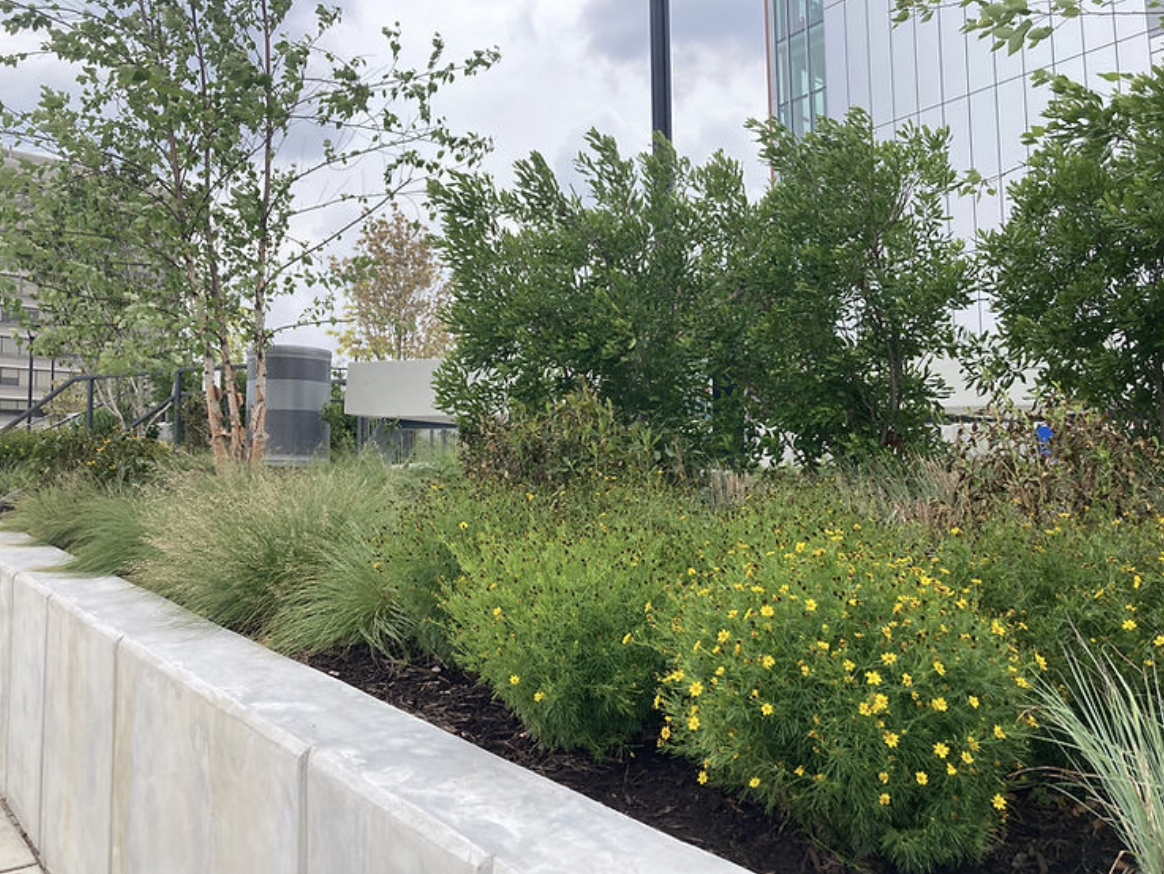
Most corporate properties have pretty “standard” landscaping, meaning the plants do very little if anything to support the local ecosystem. More and more, though, we are seeing innovative landscape designs on commercial properties that demonstrate the potential for corporations to be leaders in the effort to save the natural world, starting on their own land.
Photo: Corporate landscaping with native plants, Margaret Fisher
Margaret Fisher
Most corporate properties have pretty “standard” landscaping, meaning the plants do very little if anything to support the local ecosystem. More and more, though, we are seeing innovative landscape designs on commercial properties that demonstrate the potential for corporations to be leaders in the effort to save the natural world, starting on their own land. While they are at it, they are creating beautiful and welcoming spaces for their clients and employees.
One example of this approach is the work done at the recently-opened Kaiser Permanente medical centers in Springfield and Woodbridge (Caton Hill). Both properties are richly landscaped with trees, shrubs, grasses and perennials that are almost entirely native to Northern Virginia. The few exceptions are non-invasive.
Native plants at Kaiser Permanente. Photo: Margaret Fisher
Alton Millwood, Director of Planning, Design and Construction at Kaiser Permanente Mid-Atlantic, described the thinking behind the design:
The landscape design at Caton Hill Medical Center focused on allowing the natural environment to be a part of the community’s wellness plan. There is an abundance of research showing that exposure to nature can lower . . . [the] heart rate, alleviate mental distress, speed recovery rates, and even alleviate symptoms of mental disorders. This is why Kaiser Permanente felt it was important to keep natural woodland areas on the project site and invite people into those . . . [spaces] with trails and areas to sit and relax. Additionally, the native plants used on the site help to create a healthier environment by providing food and habitat for birds and other wildlife, conserving water, and reducing noise and pollution associated with mowing. It only made sense that if we were going to involve the natural environment for our own health that we would do what we could to improve the health of the environment.
Another goal of the project was to help the region meet its stormwater goals in order to protect the local streams and the Chesapeake Bay. The planting beds and the meadow roof decrease the amount of runoff from impervious surfaces. Design considerations included using a variety of native plant species to provide four-season interest, using low-maintenance plants that will not require long-term watering, and choosing species that will grow to the appropriate size for their locations so that important sight lines remain open and safe.
The reaction of employees and patients alike has been extremely positive. Millwood reports, “Many members and staff have taken advantage of the outside seating, walked through the Gardens and Health Park to immerse themselves in nature and its healing benefits, and observed the rooftop meadow flowers in full bloom, with birds and pollinators busy in their tasks.”
Asked what would be his advice to other corporations, Millwood replied, “Using sustainable design practices such as planting native plants is good for people and the environment – it is a win-win. For corporations, sustainable design can impact their bottom line, too. Native plants are more likely to live long and thrive in our environment. They require less maintenance, less fertilizer and pesticides, and less water. All this adds up to savings for the owner. Hiring . . . like-minded design professionals can help you create places like Caton Hill Medical Center that help benefit our community and the local ecosystem.”
More photos of this and other corporate or small business landscaping projects can be found on the Commercial Landscaping page on the Plant NOVA Natives website.

Observations from Meadowood: September 2023
Judy Gallagher is an ASNV board member and a regular surveyor of local wildlife who also captures photos of what she sees, in particular the less common species.
Photo: Hibiscus Turret Bee, Judy Gallagher
Judy Gallagher is an ASNV board member and a regular surveyor of local wildlife who also captures photos of what she sees, in particular the less common species.

Hibiscus Turret Bee (and a weevil) in Swamp Mallow, Judy Gallagher
Bumble Bees are tricky to identify, and I'm rarely sure that I have correctly determined the species for my photos. So, when I first saw large bees on Swamp Mallow, I thought they were Common Eastern Bumble Bees. I submitted my pictures to iNaturalist and was surprised to discover that the bees were Hibiscus Turret Bees, a specialist bee species that collects pollen from flowers in the Hibiscus family, including Swamp Mallow.
The Hibiscus Turret Bee does resemble a small bumble bee, but instead of having pollen baskets on its legs, it has dense thick black hairs on its legs for collecting pollen. The Hibiscus Turret Bee's head and thorax are larger relative to body size than a bumble bee's.

Hibiscus Turret Bee collecting water, Judy Gallagher
Hibiscus Turret Bees are solitary, ground-nesting bees, but they frequently nest close to other bees of the same species. They dig their nests in hard-packed dirt areas close to water sources. To make nest excavation easier, bees alight on the water’s surface to collect water to moisten the soil.

Hibiscus Turret Bee removing wet soil from nest , Judy Gallagher
As you can see in the picture above, the entrance to the nest is surrounded by a turret, which looks like a mud chimney. Each nest contains several chambers lined with a waterproof substance that the bee excretes.

Hibiscus Turret Bee with pollen, Judy Gallagher
The Hibiscus Turret Bee female puts a ball of pollen and nectar in each chamber and lays an egg on it. When the egg hatches, the larva eats pollen and nectar until it is ready to pupate. The larva then deposits a layer of fecal material covering the entire inside of the cell, and then covers itself in a cocoon. It overwinters this way, and emerges as an adult to coincide with the blooming of plants such as Swamp Mallow.
Hibiscus Turret Bee in Hibiscus , Judy Gallagher
Males sit inside Hibiscus flowers, waiting for females. Males defend their flowers aggressively, and studies show that this behavior contributes more to hibiscus pollination than female visitation to flowers. One study showed that males made only 5% of pollen visits to Hibiscus flowers, but contributed over 20% of the pollen grains deposited on other Hibiscus flowers. Interestingly, the male Hibiscus Turret Bee also will get nectar and pollen from plants besides Hibiscus, but the female pretty much only goes to plants in the Hibiscus family, and occasionally Morning Glories.

Green Metallic Sweat Bee and Hibiscus pollen, Judy Gallagher
Hibiscus pollen grains are relatively large, so aren't easily carried by small bees. Here's what happened when a small green metallic sweat bee tried to collect Hibiscus pollen. The pollen was heavy enough to flip the bee on its back. The bee righted itself with some difficulty, shook off most of the pollen, and took off to find pollen more suitable for its size.
Hibiscus Turret Bees, like other specialist bees, are vulnerable to climate change and habitat destruction. They rely on plants in the Hibiscus family as their primary food source. So, the next time you see a Swamp Mallow bloom, take a peek inside the blossom to see if you can find this gorgeous bee.
View more of Judy’s Observations from Meadowood articles here.
Monday Mystery - August 28, 2023
Monday Nature Mystery continues! Read on to learn who correctly identified our last mystery.
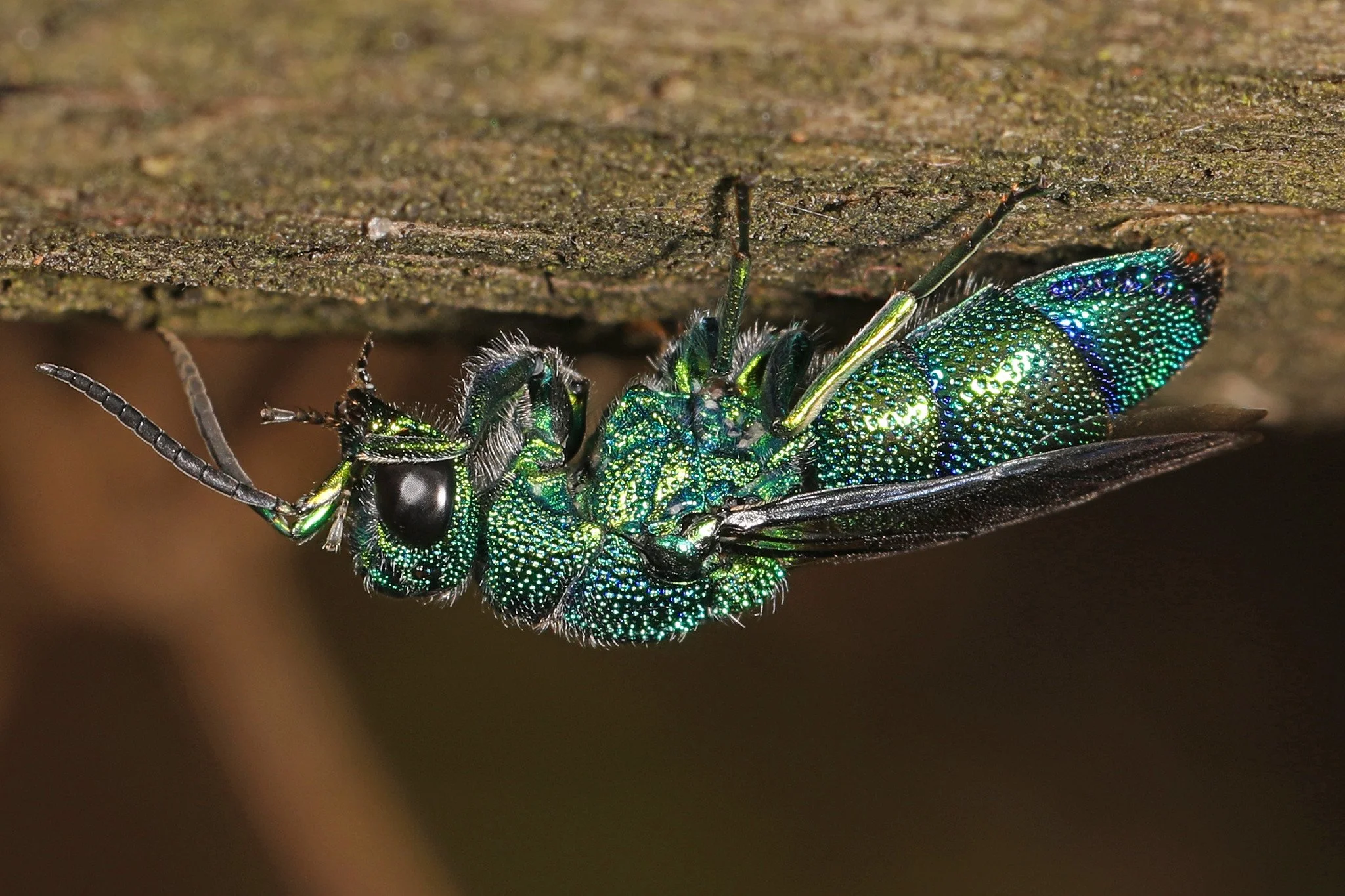
Photo: Cuckoo Wasp, Judy Gallagher
We are pleased to announce the winner of last week’s Monday Nature Mystery, Kaycee Durst Lichliter.
Congratulations to Kaycee for identifying the Cuckoo Wasp (Chrysis smaragdula).
Cuckoo Wasp (Chrysis smaragdula). Photo: Judy Gallagher
According to Insect Identification, Cuckoo Wasps get their name thanks to their parenting strategy. Similar to the Cuckoo bird, Cuckoo Wasps lay their eggs in the nests of other bees. When a Cuckoo Wasp larva hatches, it eats the other bee larvae and then consumes the stores of food left in the nest. Because of this behavior, the Cuckoo Wasp is a parasite to a variety of other bee and wasp species.
Each Monday we’ll post a new mystery and identify the previous week’s winner. They’ll receive an ASNV hat or tote bag.
Here is this week’s mystery:
Who is this?
Be sure to post your guess on our Facebook page under the latest Monday Nature Mystery post. Good Luck!
Please check our guidelines here.

Monday Nature Mystery: Who is this? Photo: Christopher Adler/Audubon Photography Awards

Attracting Pollinators to Upton Hill Park
Starting in 2020, I worked with volunteers to move some of the native plant bounty from my yard into Upton Hill Regional Park, in Arlington. What started as an isolated project has evolved into one element of a larger ASNV program, Stretch Our Parks.
Photo: Pollinator Garden, Musa Murawih
Musa Murawih
Starting in 2020, I worked with volunteers to move some of the native plant bounty from my yard into Upton Hill Regional Park, in Arlington. What started as an isolated project has evolved into one element of a larger ASNV program, Stretch Our Parks. The program brings ASNV together with parks, partners, volunteers, and the communities surrounding the parks to increase valuable native habitat. But let’s back up and review how I got here.
My first memory of connecting with birds was when I was 6 years old. My brother and I were walking among sunt trees (Prickly Acacia, Vachellia nilotica) on the edge of the Diwaimi wadi in the desert of North Kordofan, Sudan. A male of what was likely a Nile Valley Sunbird was feeding on nectar of the abundant yellow flowers, jumping from branch to branch as it sang. It flashed its wings and long tail feathers showing the stunning yellow, green, blue, and other iridescent colors. I was immediately enchanted. When my dad came back from work, I told him I wanted a shirt as pretty as the sunbird!
Birds enchant us for many reasons. It is not just their central role in supporting life on this planet. They are the very embodiment of some of the ideals we cherish most: beauty and freedom.
The sunt trees in the valley were sort of our backyard. I say that only figuratively because our home was a wool tent, and we only stayed there for the summer season, before moving to higher grounds in anticipation of the rain. The birds, the animals, and my community all shared the trees. Our tent was pitched under a group of them for extra shade. Their gum was our candy. We used their fruits to heal ailments or tan animal skins. For us to survive, they needed to survive.
Many years and places have passed since that childhood memory. My home is no longer North Kordofan, but northern Virginia. My camel is a Subaru Forester. The wool tent is a home in suburbia. Yet the basics remain: regardless of where we reside and what passport we carry, we need to share this planet with other creatures, and trees and other plants are front and center in this resource-sharing equation.

The author planting his pollinator garden, Houda Karrar
That is why ASNV, on whose Board I sit, is currently embarking on an exciting endeavor that is close to my heart. The Stretch Our Parks collaborative project is intended to link some of the existing area parks with the neighborhoods and backyards around them. Audubon is working with management, stewards, and neighbors of those parks to improve habitat so that birds and wildlife can also find refuge in our neighborhoods. As an immigrant who came to America seeking refuge, I can certainly relate.
We can all help in this effort, and no help is too small. We can hang a bird feeder in our property or put a birdbath in the yard. We can stop using harmful pesticides on our lawns. We can remove invasives at our homes. We can choose to plant a native tree next time we want to plant one.
My pollinator garden, Musa Murawih
On my end, I removed a three-foot wide strip of lawn along the wall of my townhouse and replaced it with a native pollinator garden. The project was so successful that I did not know what to do with my excess flowers. Then, as I was teaming up with other volunteers to remove invasives at Upton Hill Regional Park, I had a small eureka moment: why don’t I transplant some of my flowers to Upton Hill? So I did. With the help of Upton Hill’s manager Evan McGurrin, Park Steward Jill Barker, my fellow ASNV Board member Joan Haffey, and a team of park volunteers, we cleared three small areas where I began to transplant flowers starting in the fall of 2020.

Cleared area for plantings at Upton Hill Regional Park, Musa Murawih
The beds are now in their third season. My goal is to make these pollinator gardens self-sustaining, and I am hopeful they will be in the next couple of seasons.
The Stretch Our Parks work shows how important it is to see habitat and wildlife as one thing. When I think back about that sunbird childhood memory today, I don’t only see the sunbirds; I also see the row of sunt trees, the habitat that fed and supported them.

The author with Showy Goldenrod in its second season, Jill Barker

Inviting Fireflies to Your Yard
When fireflies start their early summer dance, will they pick your yard for their display? Like most insects (and like most vertebrate species except humans and farmed animals), firefly numbers are in a steep decline, but there are steps we can take to foster them on our properties.
Photo: Firefly, Margaret Fisher
Margaret Fisher
When fireflies start their early summer dance, will they pick your yard for their display? Like most insects (and like most vertebrate species except humans and farmed animals), firefly numbers are in a steep decline, but there are steps we can take to foster them on our properties. Taking those steps has far-reaching benefits even beyond the joy of having our own private light shows. What we do to create habitat for fireflies can go a long way toward restoring life to our yards in general.
Firefly, Margaret Fisher
The first step in creating usable habitat is to plant (and preserve) native plants and trees and to remove invasive non-native plants. This is because most plant-eating insects can only eat the plants with which they evolved. Fireflies don’t eat plants, though, so how does this apply? The answer lies in the food web concept. Predatory insects such as fireflies, dragonflies, ladybeetles, and others eat the critters that eat the native plants. Sources of native plants for your landscape can be found on the Plant NOVA Natives website.
The next step is to provide shelter and breeding sites. This translates into leaving the dead leaves in place and devoting as much of your yard as you can to natural landscaping. Dead leaves not only are home to many tiny critters, including butterfly larvae, but they also are a welcome addition to landscaped areas, because they protect and nourish the soil. Perennials poke right up between them in the spring.
The third step may seem less intuitive but is understandable once you think about it: reducing outdoor lighting. If fireflies can’t see potential mates blinking, they won’t be able to get together. Light pollution has negative impacts on many other beings as well. Moths exhaust themselves circling around lights. Migrating birds have trouble navigating. We can help by using warm-spectrum LED lights bulbs 3,000 K or less (which don’t attract moths) and by installing motion-detectors, assuming any outdoor lighting is needed at all. Lighting up our properties at night is as rude to our non-human neighbors as playing loud music outdoors is to our human ones, only with more lethal consequences.
The final step is the simplest of all to implement: do not use insecticides outdoors unless there is a dire need, such as a hornet’s nest over the front door. There are many better ways to deal with mosquitoes and ticks. What most people don’t realize is that insecticides (such as sprays for adult mosquitoes) kill all insects, including fireflies, bees, butterflies, crickets, and others, and totally upset the natural balance between predators and prey that is necessary for a healthy garden and ecosystem. Outdoor chemicals in general have many unfortunate consequences for the environment, but the indiscriminate use of insecticides is the most immediately destructive.
Because what is good for them is good for the other inhabitants of our properties, fireflies are the symbol chosen for the Homegrown National Park movement led by famous entomologist Doug Tallamy. His concept is that if we all give sanctuary to fireflies, butterflies, and birds in our yards, it will add up to far more habitat than even the largest of our national parks. If you have been planting native plants, you can add your property to the map and demonstrate your care for the planet, starting right at home: https://www.homegrownnationalpark.org/.

Don't Transport Invasive Plant Hitchhikers
Many of us have spent time in our yards and area parks battling invasive plants, but we need to add a few other measures in our continuing efforts to build and sustain healthy habitat for native wildlife. STOP HITCHHIKERS!
Photo: Multiflora Rose, Wikimedia Commons
Evelyn Novins
Many of us have spent time in our yards and area parks battling invasive plants. We dig, we pull, we plant native species to take over the cleared areas, and we continue to follow up with more vigilance to attack regrowth. This is all excellent, but we need to add a few other measures in our continuing efforts to build and sustain healthy habitat for native wildlife. STOP HITCHHIKERS!
First, a review of what invasives are and why we are finding them almost everywhere: They are plants that are not native to our area, that is, they were not present before European settlement. Second, they have a detrimental effect on the environment, economy or health—that is, they cause harm. They have common features: they reproduce quickly and aggressively, taking over the environment of the native species. Having no natural controls such as herbivores, parasites, or pathogens, they quickly harm or out-compete the natives. Their vigorous growth and the ability to change the soil to favor their spread add to their success. They are either no use or less useful to native wildlife that evolved with native plants. Permanent eradication of these invasives is unrealistic, but we can reduce and eliminate them in some areas.
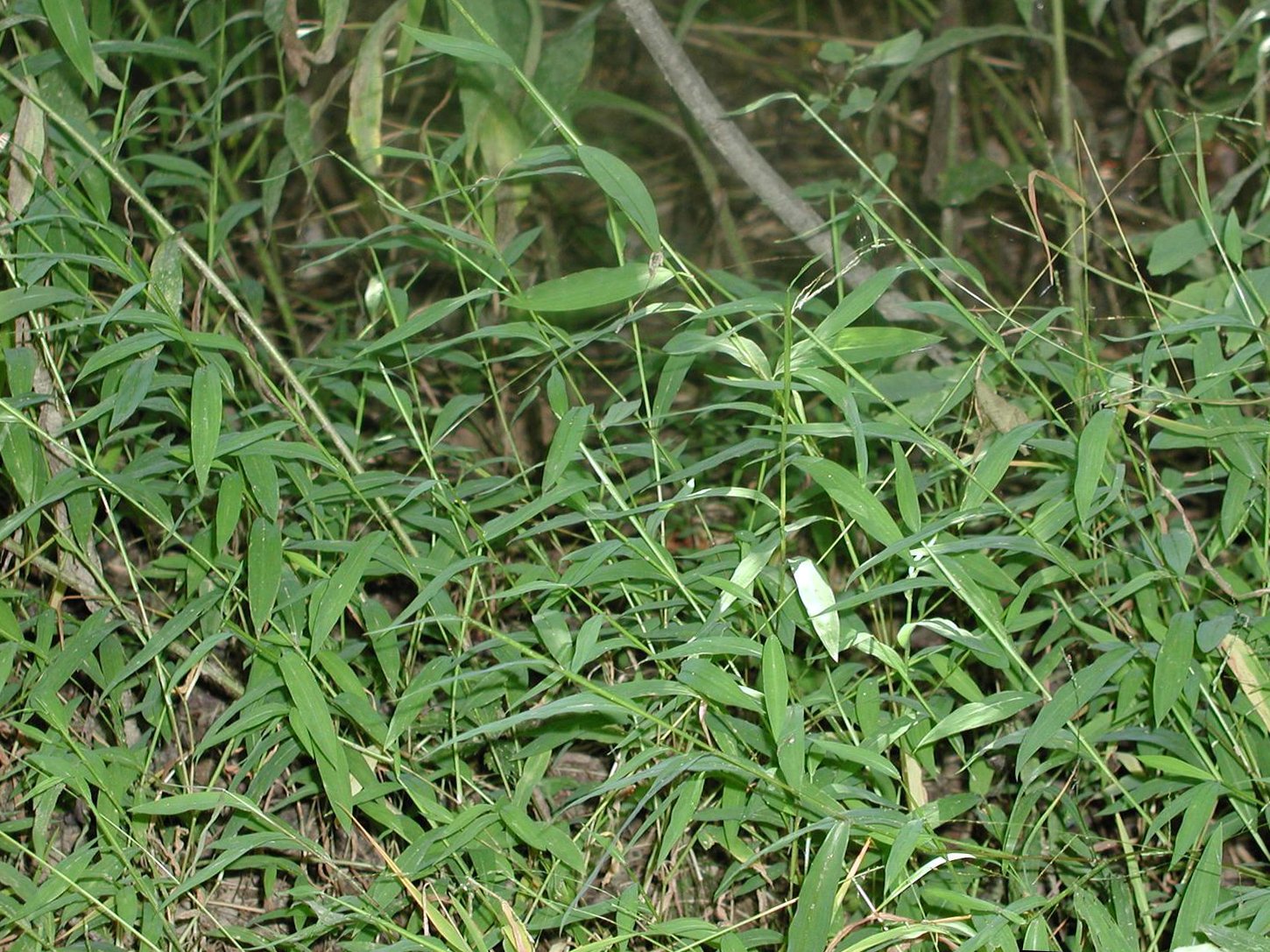
Japanese Stiltgrass, Wikimedia Commons
So, what are hitchhikers and why are they a problem? Plants spread through their seeds and invasives have strong seed production. For example, in late summer Japanese stiltgrass sends up a flower spike that can be self-fertilized, producing between 100 and 1,000 seeds. As the seeds mature, the plant dies. The plant’s tiny, sticky seeds can be dispersed by the wind, by splashes of rain, and by animals, including deer, our pets and people! The seeds attach as easily to your dog’s coat or your shoes and clothing as they do to the hooves of deer. Think about how many times you have returned from an invasive plant pulling project and found seeds and burrs sticking to your pantlegs. Our expanded use of the outdoors during Covid has accelerated the spread of invasive plants. We take the wily and adaptable seeds out of one environment to others.
To prevent adding invasive plants to our parks and yards we can take certain simple steps:
Learn to recognize local invasives.
Do not buy them or add them to our gardens.
Rid our properties of invasives that are there.
AND, avoid moving seeds or plant parts into new areas.
To avoid transporting invasives to and from our local parks, we need to clean our shoes, clothes, packs and pets before and after exploring outdoors. By staying on designated trails we are less likely to gather seeds on our clothing. In addition, gaiters as well as clothing made of new, smoother fabrics may inhibit transmission, but using them doesn’t mean we stop being aware and watchful. Many parks now provide boot brushing stations, and we should be sure to use them where they are available. More information on preventing hitchhikers is available from PlayCleanGo, an outreach campaign powered by the North American Invasive Species Management Association (NAISMA).
Multiflora Rose, Wikimedia Commons
To educate yourself about invasives, consult the Invasive Plant Atlas of the United States, a useful reference for identifying invaders anywhere you plan to travel. A Virginia Department of Forestry pamphlet identifies some of the worst offenders in Virginia such as Tree-of Heaven (ailanthus altissima), Japanese Stiltgrass (microsegium vimineum), and Multiflora Rose (Rosa multiflora), but the Virginia Department of Conservation & Recreation provides a complete list of Virginia’s plant invaders, classified by invasiveness: high, medium, and low. It also identifies some early detection species, not yet established in Virginia.
Let’s all do our part to keep invasives out of our yards and our beloved parklands.

eBird or Birda, or Both?
Most American birdwatchers are familiar with eBird and Merlin, products developed and managed by the Cornell Lab of Ornithology and launched in 2002 and 2021, respectively. But have you heard of Birda?
Photo: James Breeden/Audubon
Deidra Bryant
Most American birdwatchers are familiar with eBird and Merlin, products developed and managed by the Cornell Lab of Ornithology and launched in 2002 and 2021, respectively. But have you heard of Birda? It was developed in 2013 by a couple as a social media website and mobile application for sharing wildlife sightings in southern Africa, transitioned into a birdwatching community in 2018, and was launched as Birda in Europe and the US in 2022. It’s worth a look, even for dedicated eBird and Merlin users.
How does Birda work? Think of Facebook and Instagram, but for birders. Once you have downloaded the application you can create a profile, which requires only your name (or an alias), your location, and a species region. Then you are ready to use Birda to record and share your sightings with a selected group of friends or more globally. If you want to take a hike or walk and spot birds and record as you go, you tap the + symbol at the bottom of your screen and select “Birding Session.” If you simply want to record a one-off sighting, select “Add Sighting.” In that way, Birda is much like eBird.
In Birda’s “Birding Session” feature, simply tap “log bird,” and it will ask you what you saw. It will keep doing that until you choose to end your session. Once you are finished with your walk, you can post your experience on the app for friends and followers to see. You also can adjust privacy settings by tapping the “Profile” icon at the bottom of the screen. Birda uses a timer and GPS, so your post will display the date and time your session took place from start to finish along with bird species seen and number of sightings. You’ll be able to tag people, post notes, add photos, and even create titles for your session.
The “Add Sighting” option will ask you where you were, what you saw, and when you saw it. If you’re not sure what you saw, you can upload a picture and the Birda community will help you with identification if you choose to allow others to see your sighting. You also can help others ID birds they aren’t sure about on the “Unidentified” section of the “Feed” page. eBird users might turn to Merlin or iNaturalist for help with identification.
In Birda you can follow people overseas and see what birds they saw and where, and leave comments. You also can follow and see what your neighbors saw in your local area. That way you can try your luck spotting that same bird near you. You can create life lists and use the mapping location feature to see what birds have been recorded lately in an area. Birda also includes links to other information sources, displaying information on the natural history of the birds if you tap on the bird’s image. A species guide also is available in the “Discover” section seen at the bottom of the screen on the app.
Even if you are a committed eBird user, it’s worth your time to download and test drive Birda. Its Facebook-like features may attract more casual birders to participation in citizen science. And, although the application was not developed by a venerable institution like Cornell, it has been endorsed as a data publisher by the National Biodiversity Network, which has allowed it to contribute to the Global Biodiversity Information Facility, an international network and data infrastructure used to provide anyone and everyone open access to all types of information about life on earth. So, like eBird, the application can help scientists understand more about birds and climate change
So, give it a try! More information about Birda and its founders is available in a 2022 article by Matt Mendenhall in Birdwatching.

Observations from Meadowood: July-August 2023
Judy Gallagher is an ASNV board member and a regular surveyor of local wildlife who also captures photos of what she sees, in particular the less common species.
Photo: Eastern Velvet Ant female - Dasymutilla occidentalis, Judy Gallagher
Judy Gallagher is an ASNV board member and a regular surveyor of local wildlife who also captures photos of what she sees, in particular the less common species.

Eastern Velvet Ant female - Dasymutilla occidentalis, Judy Gallagher
I first saw a Velvet Ant on a nature field trip many years ago. This gorgeous insect had two common names: Velvet Ant, which made me think of something I'd like to pet, and Cow Killer, which made me realize that I didn't want to pet it after all.

Velvet Ant - Trogaspidia species, not a local species, Judy Gallagher
The name Velvet Ant is a misnomer, although I am going to use it throughout this article. They are solitary wasps in the Mutillidae family, not ants. There are more than 7,000 species worldwide, at least 20 of which are found in our area. They have velvety hair, often red or orange, but sometimes less bright colors like black, white or silver. The red and orange colors are a warning to predators that their sting packs a punch, which is the reason for their other common name, Cow Killer. Velvet Ants rank high on the pain index for stings, but their sting is probably not painful enough to kill a cow. They have one of the longest stingers relative to body size in the insect world. Fortunately, they aren't aggressive, and their venom isn't very toxic.
Velvet Ants are parasitic, mostly on mature larvae of other solitary wasps or bees. The female enters the underground nest of the bee or wasp and lays eggs there. The Velvet Ant egg hatches, and the larva then eats the pupa, eggs or larva of the bee or wasp. The adults' external skeletons are unusually tough for an insect, which is helpful protection when invading the homes of other stinging wasps or bees. It also helps them to retain moisture. When they are alarmed, they produce a squeaking sound by scraping two parts of their abdomen together, which also warns off predators.

Eastern Velvet Ant male - Dasymutilla occidentalis, Judy Gallagher
Female Velvet Ants don't have wings, but the males do. The females emit chemical signals called pheromones to attract the male, and the males also can find a female by sight. Males and females of a species frequently look very different, and there are some species for which the male has not yet been determined because they look so dissimilar to the female. In some species, the males carry the female into the air when mating.

Eastern Velvet Ant male - Dasymutilla occidentalis - drinking water, Judy Gallagher
Adult Velvet Ants mostly feed on nectar or water, but they occasionally feed on larvae or adult insects.

Velvet Ant male - Dasymutilla species - licking Aphid "honeydew" off a leaf, Judy Gallagher
Here is a male Velvet Ant licking sweet aphid honeydew off a plant (above).

Velvet Ant female - Pseudomethoca simillima, Judy Gallagher
Many of the other Velvet Ant species in our area are small and not quite as brightly colored and hairy as the Eastern Velvet Ant. But they have the same lifestyle. In addition to the defenses mentioned earlier, they have a rounded body style, which makes it challenging to attack them because stings or bites glance off the abdomen rather than piercing it, and they run quite fast for their size, up to .5 kilometers per hour, speedy for an organism with such short legs. This makes them very challenging to photograph! And they produce smelly chemicals that warn other predators to stay away.

Checkered Beetle - Enoclerus rosmarus, Judy Gallagher
It is unsurprising that Velvet Ants, so well protected against predation, have mimics. When I took a picture of this Checkered Beetle (above), I was sure it was a Velvet Ant. But it's just another insect trying to pretend that it is not good to eat.
I like seeing Velvet Ants. Their presence means that there are ground-nesting bees or wasps nearby, and the presence of both predators and prey implies that the ecosystem is functioning. Just remember, look but don't touch!
View more of Judy’s Observations from Meadowood articles here.

Monday Mystery - July 17, 2023
Monday Nature Mystery continues! Read on to learn who correctly identified our last mystery.
Photo: Pipevine Swallowtail Caterpillar, Judy Gallagher
We are pleased to announce the winner of last week’s Monday Nature Mystery, Seth Finkel.
Congratulations to Seth for identifying the Pipevine Swallowtail Caterpillar (Battus philenor).
Pipevine Swallowtail Caterpillar (Battus philenor). Photo: Judy Gallagher
According to Birds&Blooms, Pipevine swallowtail eggs are red-orange with small bumps, laid in clutches on their host plant pipevines. The caterpillars are gregarious in their early days, which means they hang out in groups feeding together. When they get a bit bigger, they tend to go their own way. As the pipevine caterpillar grows, its appearance starts to change as well. It slowly becomes darker and has more pronounced dots of color and longer black tubercles on the front of their heads, which look like antennae.
These caterpillars use their tubercles actively to feel out the world around them. These are some of the fastest caterpillars I know; they take off quickly when startled and move with surprising speed.
Each Monday we’ll post a new mystery and identify the previous week’s winner. They’ll receive an ASNV hat or tote bag.
Here is this week’s mystery:
Who is this?
Be sure to post your guess on our Facebook page under the latest Monday Nature Mystery post. Good Luck!
Please check our guidelines here.

Monday Nature Mystery: Who is this? Photo: Judy Gallagher

The Audubon Name
The National Audubon Society (NAS) was named after John James Audubon in recognition of his contribution to the natural history of North America.
Photo: Common American Swan, Courtesy of the John James Audubon Center at Mill Grove, Montgomery County Audubon Collection, and Zebra Publishing
The National Audubon Society (NAS) was named after John James Audubon in recognition of his contribution to the natural history of North America. Historical reviews of his legacy have in the past several years shown light on more troubling aspects of his life. What NAS has concluded following its own review of that history is that being a slave owner was only one of Audubon’s many transgressions, noting that he was "a complex and troubling character who did despicable things even by the standards of his day."
Out of concern that continuing the Audubon name could undermine the society’s mission, NAS undertook a year-long process to determine whether to remove Audubon from its name. In March 2023 NAS decided not to change its name but indicated that its chapters were free to do so. At its May meeting, ASNV’s board formed an ad hoc committee to develop and implement a process for making a decision about this important issue. We thank you for your patience as we set about this process.

Trails Can Harm Natural Resources
Trails through natural areas have undeniable benefits, including improving our mental well-being, providing access for outdoor education programs, and reducing air pollution and greenhouse gas emissions if people use them instead of driving cars.
Photo: Tomwsulcer, CC0, via Wikimedia Commons
Tom Blackburn
Trails through natural areas have undeniable benefits, including improving our mental well-being, providing access for outdoor education programs, and reducing air pollution and greenhouse gas emissions if people use them instead of driving cars. However, the environmental impacts of trails get minimal if any consideration when local, state and federal officials are planning and considering building or modifying trails.
In planning development projects like trails, the first question should be, “What’s there?” The federal National Environmental Policy Act is designed to answer that question and to evaluate environmental impacts, good and bad. That law could be a model for local and state governments for trails and other development projects.
Trails Can Have Adverse Impacts
The environmental harm caused by trails that are not properly designed or managed is not always obvious, but it can be substantial, particularly for paved and lighted trails. Trails through natural areas, including our urban forests and wetlands, can cause irreparable damage to delicate ecosystems. Construction often involves cutting down mature trees. Construction equipment damages the root systems of trees in the construction area and compacts soil, which can permanently alter the hydrology, the plant communities, and the wildlife that depends on them.
Trails also serve as a vector for the introduction of invasive species, further damaging habitat and resulting in loss of more native species. Lighted trails attract some wildlife to the lights, where they are preyed upon; they repel other wildlife, reducing the size of their habitat; and they disturb the daily rhythms of animals, resulting in loss of sleep, additional stress, and harm to their reproductive cycles.
Trails often fragment forests and other habitats. Many species need large, intact expanses of habitat. Edge habitats are “invitations” to invasive species and predators. Trail users through forests can mean more disturbance, noise and trash.
More pavement can mean more polluted runoff. A Clifton Institute Study found that if more than 30 percent of an area within 250 meters of the spotted salamander’s breeding pool is impervious, these salamanders are less likely to breed.
The lack of adequate evaluation of the environmental impact of trails through parks and natural areas before an alignment is selected has resulted in proposals to construct trails throughout northern Virginia that would cause significant environmental damage. Sometimes natural resource advocates have been able to deter construction. For instance, advocates succeeded in having Fairfax County remove from its plans a proposed bike trail through wetlands at Huntley Meadows Park that would have harmed critically important habitats and ecosystems. Some proposed trails in Arlington County would have damaged rare ecosystems. Other potentially damaging trails are still in the planning stages. A proposed segment of the Cinder Bed Road Bikeway in Fairfax County could harm rare habitat, and lights on the trail would disturb area wildlife. W&OD Trail expansions in Arlington County, still on the drawing board, threaten to destroy more habitat and potentially add lighting that can harm wildlife. Proposed trails through the remaining urban forest in Fairfax City would result in clearing 1,200 trees and cause other harm to the forest. Widening the paved trail that goes through the Dyke Marsh Wildlife Preserve could disrupt habitat, impair water quality, damage root systems, disturb nesting birds and migrating fish, and harm trees and other vegetation. ASNV has opposed each of these proposed paths as well as others whose environmental impact was not adequately evaluated.
Trails Need Stronger Environmental Requirements
A recent article in the Virginia Mercury, an independent nonprofit online news organization covering state government and policy, highlighted the need for more effective environmental oversight of recreational trails. The article, by Wally Smith, an Associate Professor of Biology at the University of Virginia’s College at Wise, pointed out that trails are often assumed to be exempt from environmental laws, and that Virginia has no requirements on how trails should be designed and managed to benefit the environment.
Virginia law and Federal regulations require environmental review of proposed bike paths that may cause significant environmental harm. The Virginia Administrative Code, 9VAC25-830-140, provides that development in Resource Protection Areas is exempt from environmental review only if it does not affect water quality, and it gives local governments authority to review exemptions from environmental review. However, the Virginia Department of Transportation appears to give bike trails a categorical exclusion from environmental oversight, even in the face of local opposition. VDOT’s policy is inconsistent with the National Environmental Policy Act and the Federal Highway Administration regulations on which VDOT apparently bases its policy. The FHWA’s regulations provide that actions that normally would qualify for exemption from environmental review but that would cause significant environmental impacts or result in substantial controversy on environmental grounds must be subjected to environmental review.
Virginia’s Wildlife Action Plan lists 883 species that are critically imperiled or in decline. “Habitat loss is the single greatest challenge impacting these species,” the plan states. More trails and fragmentation of habitat could mean more habitat loss.
ASNV will continue to weigh the benefits and environmental harms of proposed trails through natural areas, and we will oppose them if we conclude that the harms outweigh the benefits, or that redesign of the paths will reduce environmental harm. If you are aware of a proposed trail that would harm the environment, let us know.

Front Yard Landscaping, Reimagined
Originality has not been what springs to mind when looking at most front yards, but now people are starting to tweak the conventions by putting native plants front and center on their properties.
Photo: Reimagined front yard, Margaret Fisher
Margaret Fisher
Originality has not been what springs to mind when looking at most front yards, but now people are starting to tweak the conventions by putting native plants front and center on their properties. There are around two hundred species of native plants that are eminently suitable for the formal or semiformal areas of our homes or businesses. In those cases, there is no need to confine them to our back yards. They add curb appeal to any property while simultaneously supporting the songbirds, butterflies, and other critters that so desperately need our help to survive in a suburban or urban environment.
For anyone who prefers to keep their shrubs and flowers up against the house, there are plenty of neat-and-tidy native plants that do well in that setting. Recommendations can be found on the foundation plantings page on the Plant NOVA Natives website.
For those interested in rethinking the layout of their yard, there are many ways to do that.
Reimagined Front Yard, Margaret Fisher
Pictured here is a front yard in which half the space has been filled with native plants (as opposed to turf grass, which is non-native and therefore does not support our local fauna). The small number of species planted in large masses makes a strong impact while minimizing the expertise needed for maintenance. The tree has been protected from soil compaction and lawn mower damage, both of which are a risk to trees surrounded by turf grass.
A planting bed along the sidewalk would have the advantage of capturing stormwater runoff before it hits the street. Runoff from impervious surfaces and lawns causes degradation of our streams and the Chesapeake Bay. Taller plants along the sidewalk also can make the front yard another area where you can sit or play in privacy.
Mowing around a curved planting bed in the middle of the yard is easy. The bed could consist of flowers for those who like to garden or a small grove of native trees and shrubs for those who don’t.
The entire yard could be replaced by native plants along curved paths. The easiest design would consist of trees, shrubs, and groundcovers. Losing the lawn is seldom a problem, since most people don’t run around on their front lawn anyway.
At the other end of the effort spectrum, planting a single native shade tree in the lawn would confer the most benefit for the least amount of work.
Famous American ecologist E. O. Wilson urged us to set aside half of the Earth’s surface for nature, thus enabling us to preserve biodiversity and avert mass extinction (including our own extinction). That goal cannot be achieved by setting aside deserts and mountaintops and keeping the rich lands for ourselves. The set-aside land must include areas, such as our East Coast, that support the most biodiversity. Most of that land is privately owned, so it is up to each of us to contribute anything we can. Considering how much of our suburban/urban land is covered with built structures, any piece of land that isn’t occupied by a building or road would best be devoted to native trees and other native plants. Instead of adding to habitat loss, our front yards can be part of the solution while beautifying our properties and increasing home values. For details on designing a landscape using native plants, see the Plant NOVA Natives website.