
NVBA NEWS BLOG
Welcome to the blog for Northern Virginia Bird Alliance, a wealth of resources about northern Virginia birds, wildlife, habitat conservation and restoration, native plants, wildlife-friendly gardening, advocacy and more.

Some Ways to Donate to ASNV: Planned Giving
Many people review and plan their charitable giving at this time of year. Making a donation typically may involve writing a check or using a credit card, but there are other options for planned giving, some of which can provide tax advantages for the donor.
Photo: Barn Swallows, Alan Peterson/Audubon Photography Awards
Geraldine Shannon
Many people review and plan their charitable giving at this time of year. Making a donation typically may involve writing a check or using a credit card, but there are other options for planned giving, some of which can provide tax advantages for the donor. The options allow you to make a one-time gift or a recurring gift during your lifetime, or have the gift become effective after your death. Of course, any donation provides benefits to ASNV and its conservation mission!
Tax-Advantaged Donations
If you receive Required Minimum Distribution payments from your traditional Individual Retirement Account (IRA), you can make a donation directly from your IRA to ASNV. The donation (known as a Qualified Charitable Distribution), is excluded from federal income tax. The option is available whether or not you can claim a deduction for a charitable contribution.
Another form of donation that can have tax advantages, if you are eligible to deduct charitable contributions from your taxable income, is a donor advised fund (DAF). A DAF allows you to make a charitable contribution to the fund and then recommend grants from the fund to charitable organizations over time. A donor establishes a DAF by transferring cash or other assets to a sponsoring organization like a community foundation or financial services firm. You can contribute to the fund as frequently as you want and then schedule grants whenever you prefer. The donation is tax deductible when you transfer money to the fund, and not when you make a grant to a specific charity.
Bequests
Bequests are another form of planned giving. You can make a gift to ASNV in your will or revocable trust, making ASNV a beneficiary of a specific amount from your estate, as a recipient of a residual gift, or as a contingent beneficiary. You also can make ASNV a beneficiary of any funds you will receive in the future by designating ASNV as a beneficiary on any beneficiary designation form, such as for life insurance, IRA or 401k. This form of gift is easy to arrange, does not change your current lifestyle, and can be modified at any time to address any changing needs.
There is more information on planned giving on our website. Of course, before making any decisions on planned giving, consult your investment fund, financial advisor, retirement plan administrator, or estate lawyer. This article should not be considered legal or financial advice. Nevertheless, we hope that you will keep ASNV in mind as you consider your options. Bequests in the last five years of more than $70,000 from two generous donors have allowed ASNV to launch our Stretch Our Parks initiative and make other changes to increase our ability to conserve and protect habitat and wildlife in northern Virginia.

A Combined Effort to Stretch Monticello Park
On the Sunday before Thanksgiving more than 30 volunteers came together for a service project at Monticello Park in Alexandria.
Photo: Scouts rehabilitating the trail at Monticello Park, Deidra Bryant
Deidra Bryant
On the Sunday before Thanksgiving more than 30 volunteers came together for a service project at Monticello Park in Alexandria. The volunteers -- neighbors, members of the North Ridge Citizens’ Association, local Boy Scouts, Arlington and Fairfax Regional Master Naturalists, birdwatchers, and members and friends of ASNV -- rolled up their sleeves and went to work restoring trails damaged by erosion and removing invasive plant species from a property that abuts the park, all as part of ASNV’s Stretch Our Parks program. This was the second work project at Monticello Park this Fall, and for both events an essential partner has been the Alexandria Department of Recreation, Parks & Cultural Activities, which provided guidance on appropriate trail work, as well as supplies of mulch, tools, and, for the first event, native trees and shrubs to plant.
Before I describe the project itself, I want to provide some background information on the importance of the park to the local ecology. In addition to being a much-used neighborhood park for children, dog walkers, and nearby residents, Monticello Park is an important resource for resident and migrating birds. The park is roughly 7 acres of old growth forest and is a stopover site for migrating songbirds. The park provides a place where birds can rest, bathe, drink, and feed in the vegetation and along the small stream that goes through the park. It’s a green oasis located in a highly developed area, so it is a popular spot for birders to find warblers and grosbeaks easily, especially in the springtime. Bill Young, a writer and frequent lecturer for ASNV, and his friend Ashley Bradford, a naturalist and photographer, created the MPNature website in 2018 to help people know what to look for when preparing to visit, understand what they are seeing when in the park, and learn more about what they have seen once they return home. The site includes interesting and accessible natural history essays about the animals and plants that can be found at Monticello Park.
Scouts rehabilitating the trail, Deidra Bryant
So, the work on that Sunday: The trail restoration work, which required some heavy lifting, relied on the strong backs of Boy Scouts from Troop 129. They helped haul 50+ bags of shredded pine bark mulch to a trail with a lot of exposed roots. The erosion is caused by people walking on the path, which wears down the substrate and packs it down far enough to expose tree roots. The exposed roots are a tripping hazard but also endanger the trees’ health: they are easily damaged, exposing the tree to infection and limiting water uptake. The remedy is mulch, about 2-3 inches, spread evenly over the trail and exposed roots. It retains moisture and protects the roots while giving the path a clean look. Protecting tree health improves habitat for birds, insects, and small mammals like squirrels who make their homes in the canopy. Last year the Boy Scouts planted young trees by the park’s stream. Their troop leader, Andy Berlett, said the experience gives scouts an understanding of how to be good stewards of a park and the environment.

Volunteer attacking invasive vines, Deidra Bryant
On private property that is adjacent to Monticello Park and under a Northern Virginia Conservation Trust easement, ASNV board member Gary Shinners, with the landowner’s permission, led a group of volunteers in clearing a number of choking invasive plant species – thereby stretching the ecological benefits Monticello Park provides. The target plants included Wineberry, Amur Honeysuckle, English Ivy, Himalayan Blackberry, and Porcelain Berry. The volunteers helped clear thickets, uproot woody invasives, and properly dispose of them. It can be heavy work, employing shovels, hand saws, loppers, hedge shears, and heavy-duty landscaping gloves for pulling out thorny plants. To dispose of the plants, volunteers collected the debris in garbage bags for disposal. If the plants are composted, their seeds and roots can be transported to another property.
Clearing invasives gives native species a chance to thrive. When an invasive plant propagates in an area, it monopolizes a space and outcompetes natives for resources like sunlight, soil nutrients, and water absorption. The invasion decreases plant biodiversity, and ultimately degrades wildlife habitat. Some of the invasives, like Porcelain Berry, produce large amounts of seeds, which can be distributed by local wildlife, or Wineberry and Himalayan Blackberry, whose seeds can be carried great distances by the wind. Some invasives have aggressive root systems that will spread long distances and smother the root systems of surrounding vegetation.
Two of the most abundant invasives the volunteers worked on were Porcelain Berry and Amur Honeysuckle. Porcelain Berry is a deciduous woody vine that invades damp, shady areas and forms dense mats that crowd out native vegetation. It also climbs trees. Amur Honeysuckle is one of the most common and invasive bush honeysuckles found in the Mid-Atlantic region. It impedes reforestation of cut or disturbed areas, preventing reestablishment of native plants by leafing out earlier than most natives and forming dense thickets that shade out most native species. Information on the two invaders, along with control strategies, is available on the Blue Ridge PRISM website.
The Stretch Our Parks service project at Monticello Park was a great success. The project helped protect tree canopy and removed invasive species to allow the valuable habitat in the park to stretch beyond its boundaries. The activity tapped into neighborhood appreciation for the park and provided hands-on ways to care for the park and its surrounding areas. The cleanup also helped new volunteers learn to identify invasive plants and remove them. Watch our newsletter and website for more projects like this one.
And, we are hopeful it can serve as a model for other areas – by demonstrating how parks, neighbors and their neighborhood associations, and other community groups like scouts, can work together to conserve and expand our urban forests and support native wildlife.

Controlling English Ivy Saves Trees and Combats Climate Change
Unfortunately, many people think English Ivy is a benign plant that grows in the shade where nothing else grows.
Photo: English Ivy via Wikimedia Commons
Elaine Kolish
English Ivy is everywhere, in our neighborhoods, along our roads, and in our parks. It climbs over fences, covers sheds, and carpets forest floors. Unfortunately, many people think English Ivy is a benign plant that grows in the shade where nothing else grows.
The truth is English Ivy is harmful in many ways. Even if well-manicured and contained on the ground, English Ivy provides a resting spot for mosquitos on hot days or hides puddles where they can breed, and who wants that! More importantly, when it covers forest floors it displaces native plants and eliminates needed and productive biodiversity. When it climbs trees, it harms and eventually kills them. It eliminates the important environmental benefits trees provide as wildlife habitat as well as preventing stormwater from entering streams, cooling our environment, and combatting climate change.
Trees are one of our best tools for capturing carbon dioxide, which is necessary to fight global warming. According to the U.S. Forest Service, America’s forests sequester about 16% of the annual emissions from the United States. Because trees are such excellent carbon sinks, large-scale reforestation efforts are underway. President Biden’s Bipartisan Infrastructure Plan calls for more than one billion new trees to be planted over the next 10 years. In addition, the government’s experts know that controlling invasive species that kill trees is an important strategy for enhancing carbon capture.
We as individuals also have an important role to play in controlling English Ivy at home and in our natural areas. Otherwise, it covers everything in its path, and, when left unchecked, English Ivy grows vertically (by rootlets on the stem). On trees, the weight of the vine weakens and breaks limbs, which can make trees more susceptible to infections, and over time the vines cover trees so totally that they die. But that’s not all. When English Ivy goes vertical it matures. It then will flower and set fruit. Birds then eat and disperse the fruit, spreading the English Ivy invasion.

English Ivy cut to save trees, Margaret Fisher
Homeowners can protect their costly landscaping and help the environment by eliminating English Ivy from their gardens or, at a minimum, by keeping it from growing up trees. Wearing gloves, cut all the vines on a tree about two feet up and again at ground level. There is no need to pull the vines off the tree. Deprived of water and nutrients from the soil, the vines will wither. You will have to repeat this occasionally if you do not remove all the ivy. Hand pulling after a rain softens the soil is the best way to get rid of English Ivy. The debris should go in the trash. Do not compost it or put it out with the brush collection as it will continue to grow and spread in these locations.
The good news is that there are lots of alternative native ground covers that will support pollinators and our environment. You can find excellent suggestions in the Native Plants for Northern Virginia guide, such as Virginia Creeper and ferns. You also can consult Alyssa Morel’s column on replacing English Ivy.
Beyond work in your own yard, you can help our neighborhoods, forests, and parks by becoming a Tree Rescuer, or by working with organizations that do invasive management, including pulling ivy. Working together, we can ensure the health of our wonderful trees and improve our environment. The work also increases our personal well-being, by increasing the time we spend in nature.

Christmas Bird Count 2023
The 124th Audubon Christmas Bird Count (CBC) will take place between this December 14 and January 5, 2024.
Photo: Carolina Chickadee, Jeff Drake/Great Backyard Bird Count
The 124th Audubon Christmas Bird Count (CBC) will take place between this December 14 and January 5, 2024. General information about the CBC is available on the Audubon website.
ASNV sponsors the Manassas-Bull Run CBC, which will be held for the 42nd year on Sunday, December 17. Those who participated in our count last December will to be contacted no later than Thanksgiving. Anyone who would like to participate in this count but did not participate last year should contact the compiler, Phil Silas, at epsdcva@aol.com, or 703-987-0817, as soon as possible but not later than December 8.
Information on other local CBCs that you may be interested in is available in the November 2023 issue of The Siskin, the newsletter of the Northern Virginia Bird Club. Look for the list on page 3.
If you have any questions or concerns about participating in this fun and very useful annual event, you can email or call Phil Silas.

Observations from Meadowood: December 2023
Judy Gallagher is an ASNV board member and a regular surveyor of local wildlife who also captures photos of what she sees, in particular the less common species.
Photo: Wavy Mucksucker, Judy Gallagher
Judy Gallagher is an ASNV board member and a regular surveyor of local wildlife who also captures photos of what she sees, in particular the less common species.
One of my previous columns dealt with wasp mimics, which included several Flower Fly species. Flower Flies are members of the Syrphidae fly family. They are also called Hover Flies as they can hover motionless for long periods of time. But Flower Fly describes them most aptly. Flower Flies love flowers.

Flower Fly larva, Judy Gallagher
Flower Flies undergo complete metamorphosis, starting as an egg which the adult female lays close to soft-bodied insects that the larvae can then use as prey. The larvae are blind and legless, so find their prey by moving their head back and forth. Flower Fly larvae easily can be mistaken for caterpillars. Most are an important biological control of nuisance insects, especially aphids, but they also can eat small caterpillars. In cool weather, they are the most effective insect control against aphids. There are a few species that are parasites, feed on plants, scavenge debris, or feed on fungal spores. Predatory larvae have pointed mouthparts that they use to pierce or tear their prey, then suck out the contents, but plant-feeding larvae have mandibles suitable for tearing vegetation.

Flower Fly pupa amongst the aphids on which it preyed when it was a larva, Judy Gallagher
After 3 molts of their exoskeletons, the larvae transform to pupae and they pupate either in leaf litter or on plants. Adults, which are more common in spring and fall in cool weather, feed on nectar, pollen and insect honeydew, the sweet waste excreted by some insects.

Flower Fly eggs being eaten by stink bug nymphs, Judy Gallagher
Flower Flies are vulnerable to predation at all life stages, and Flower Fly larvae will even eat each other. Predatory Stink Bugs and other insects prey on eggs, and larvae are attacked by ants, spiders and other predatory insects.
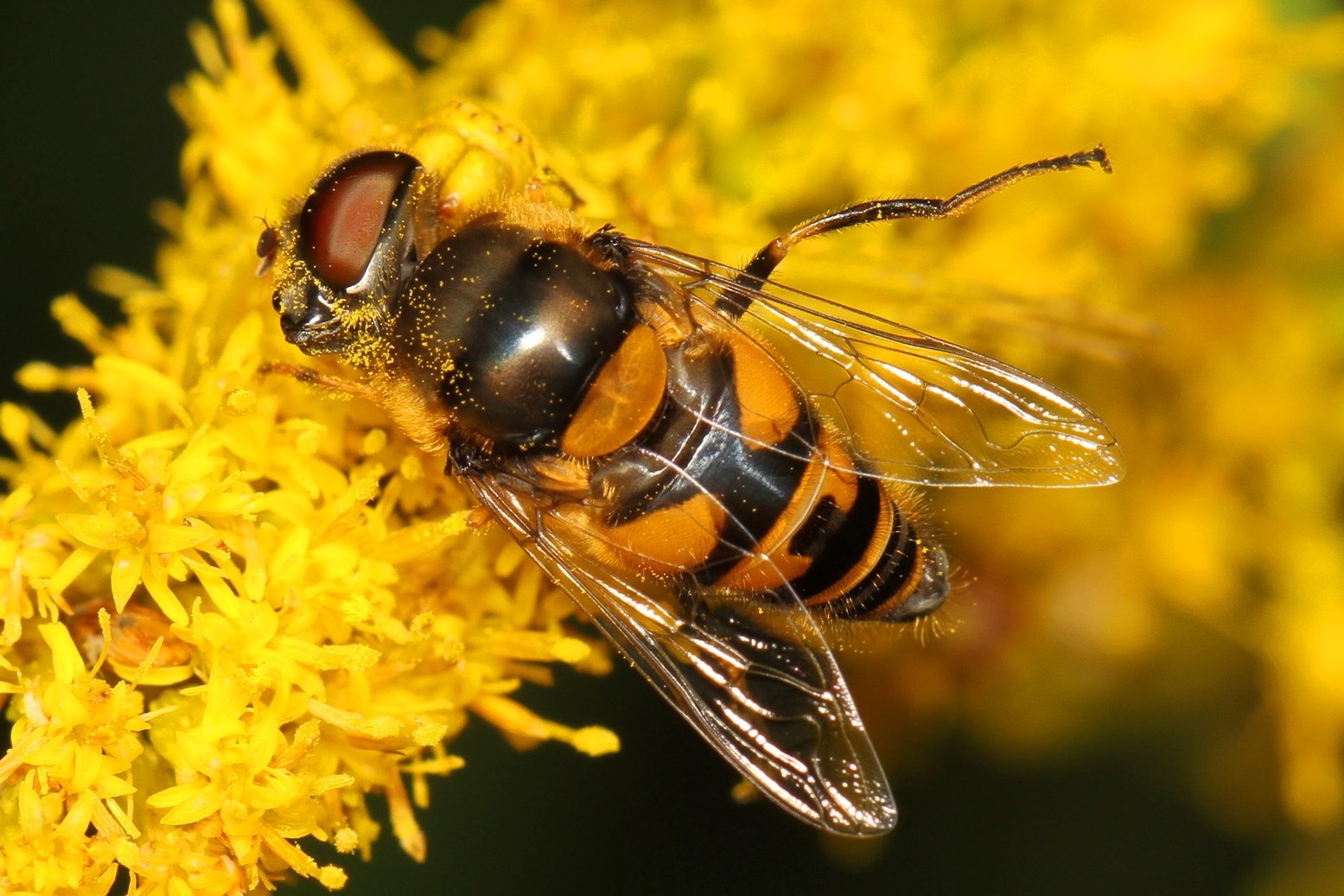
Transverse Flower Fly and Crab Spider, Judy Gallagher
Adults have lots of predators, including spiders, robber flies and other insects. Here (above) a very well-camouflaged Crab Spider has captured a Transverse Flower Fly.
Adults are pollinators, and under controlled conditions they can increase the pollination rate of crops such as onions, sweet peppers, pears, almonds and strawberries. They can travel up to a quarter of a mile to collect pollen. Many Flower Flies resemble bees, and some even have specialized pollen hairs like bees, but they eat the pollen off their legs rather than bringing it home for a brood. Flower Flies are fast fliers, reaching speeds of up to 8 miles per hour, quite remarkable for their size. There are a few accounts of species that migrate, but this is hard to track because they are so small.

American Snout Fly, Judy Gallagher
One of my favorite Flower Flies is the American Snout Fly. Its conspicuous snout helps it extract nectar from flowers.

Eastern Hornet Fly, Judy Gallagher
Several species have intricate eyes, including the Eastern Hornet Fly (above). It looks similar to our Yellowjacket Wasps. It puts its black front legs above its head to mimic wasp antennae, and when it is threatened, it bends its abdomen to look like a wasp that is stinging prey. It also makes a buzzing sound that is similar to that of some wasps.
Wavy Mucksucker , Judy Gallagher
But the local Flower Fly with the best eyes is the Wavy Mucksucker. It's only about 1/4 inch long, but it's a beauty.
There are over a hundred Flower Fly species found in our area. We have only seen 30 of them on our Wildlife Surveys. We have our work cut out for us!
View more of Judy’s Observations from Meadowood articles here.

Monday Mystery - November 27, 2023
Monday Nature Mystery continues! Read on to learn who correctly identified our last mystery.
Photo: Southern Red Oak tree (Quercus falcata). Photo: Wikimedia user Katja Schulz via CC BY 2.0
We are pleased to announce the winner of last week’s Monday Nature Mystery, Anne Brosnan!
Congratulations to Anne for identifying this Southern Red Oak tree (Quercus falcata).
Southern Red Oak tree (Quercus falcata). Photo: Wikimedia user Katja Schulz via CC BY 2.0
This is one of 27 species of oak trees native to Virginia. According to Wildflower.org, this tree is a larval host to the Banded Hairstreak and the White M Hairstreak butterflies. The Southern Red Oak is a medium-sized, straight-trunked oak which, in time, develops long, spreading branches, giving the top an even, well-formed appearance. Its smooth gray bark becomes dark and furrowed, eventually becoming black. Thin, papery, lobed, bristle-tipped deciduous leaves turn reddish-brown in fall. Click here to watch a video from the Mississippi Museum of Natural Science on how to identify a Southern Red Oak tree.
Each Monday we’ll post a new mystery and identify the previous week’s winner. They’ll receive an ASNV hat or tote bag.
Here is this week’s mystery:
Who is this?
Be sure to post your guess on our Facebook page under the latest Monday Nature Mystery post. Good Luck!
Please check our guidelines here.

Monday Nature Mystery: Who is this? Photo: Judy Gallagher
Echele un vistazo a nuestro nuevo sitio web en español
Note que tenemos una nueva sección en nuestra página web y es en español.
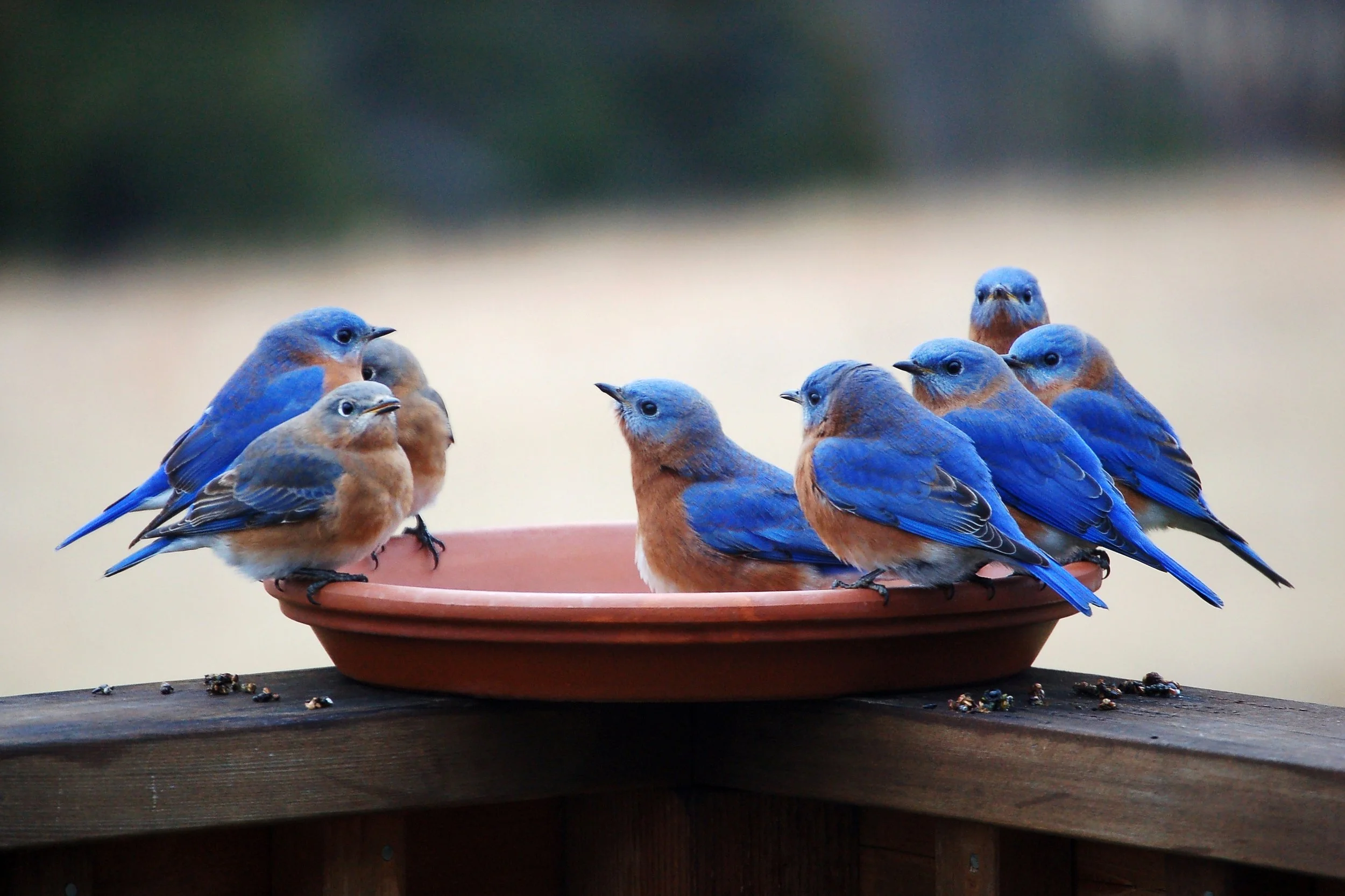
Foto: Pájaro Azul Oriental, Danny Brown/Premio de Fotografía Audubon
Note que tenemos una nueva sección en nuestra página web y es en español.
No hemos traducido todo nuestro sitio web del inglés al español, pero estamos incluyendo información general sobre ASNV y su misión, nuestro equipo de liderazgo, enlaces a recursos en español y algunos artículos e historias de interés. Planeamos publicar al menos un artículo del Potomac Flier cada mes.
Si hay materiales que le interesen especialmente, háganoslo saber, poniéndose en contacto con Josefina Doumbia.
Take a Look at Our New Spanish Language Pages
Take a look at the new Spanish section of our website!
Photo: Eastern Bluebirds, Danny Brown/Audubon Photography Awards
Please take a look at the new section on our website. It’s in Spanish. We have not duplicated our entire English-language website in Spanish but have included general information about ASNV and its mission, our leadership team, links to resources in Spanish, and some articles and stories of interest. We plan to post at least one article from the Potomac Flier each month.
If there are materials you are particularly interested in seeing, let us know, contacting Josefina Doumbia.

Christmas Bird Count
The 124th Audubon Christmas Bird Count (CBC) will take place between this December 14 and January 5, 2024.
Photo: Winter Wren, Therese Scheller/Audubon Photography Awards
The 124th Audubon Christmas Bird Count (CBC) will take place between this December 14 and January 5, 2024. General information about the CBC is available on the Audubon website.
ASNV sponsors the Manassas-Bull Run CBC, which will be held for the 42nd year on Sunday, December 17. Those who participated in our count last December will to be contacted no later than Thanksgiving. Anyone who would like to participate in this count but did not participate last year should email the compiler, Phil Silas, or call him at 703-987-0817, as soon as possible but not later than December 8.
Information on other local CBCs that you may be interested in is available in the November 2023 issue of The Siskin, the newsletter of the Northern Virginia Bird Club. Look for the list on page 3.
If you have any questions or concerns about participating in this fun and very useful annual event, you can email or call Phil Silas.

ASNV and Plant NOVA Natives Award Ten Mini-Grants for Invasive Removal
This year, the Fairfax County Tree Preservation and Planting Fund (TPPF) gave Audubon at Home and Plant NOVA Natives a grant to fund mini-grants for invasive plant removal on community association or faith community common open space.
Photo: Porcelain-berry, Olivier Vanpé via Wikimedia commons
Margaret Fisher (Plant NOVA Natives), Betsy Martin and Barbara Tuset (Audubon at Home)
This year, the Fairfax County Tree Preservation and Planting Fund (TPPF) gave Audubon at Home and Plant NOVA Natives a grant to fund mini-grants for invasive plant removal on community association or faith community common open space. In October we awarded mini-grants to 10 home owner associations (HOAs) and faith communities.
Each community will receive $3,000 on a reimbursement basis which it can use to pay for removal of invasive plants that are a threat to trees in landscaped or natural areas. The TPPF mini-grant requires a match of $1,500, which can be fulfilled either with money or volunteer labor. We encourage the use of volunteers, so that residents can gain first-hand experience of the difficulties posed by invasive plants and a sense of the value of paying people to do the work in the future. We also encouraged communities to engage their current landscaping companies in the work so as to increase the number of companies in our region that can offer invasive control services, especially of the invasive vines that threaten native trees.
Porcelain-berry, Olivier Vanpé via Wikimedia commons
We restricted mini-grants to projects focused on removal of the invasive vines and trees that most threaten native trees in Northern Virginia, namely Japanese Honeysuckle, Asian Wisteria, Asiatic Bittersweet, Wintercreeper, English Ivy, Multiflora Rose, Porcelain-berry, Kudzu, Callery Pear, Tree of Heaven, and Autumn Olive. These eleven vine and tree species overrun natural areas and overtop trees, killing and displacing native trees and plants, creating food deserts for wildlife and destroying their habitat, and creating hazards for humans. You can learn more about the threat posed by these plants, and how to control them, from the excellent fact sheets published by Blue Ridge PRISM. Mini-grant recipients will be required to educate their members about the problems caused by invasive plants and about native alternatives that residents could install on their own properties. Communities will display a sign that we will provide: “Invasive plant control area. Please don’t plant the non-native species that damage our ecosystem.” The sign will include a QR code linking to an information page on invasive plant control.
This project dovetails with the Plant NOVA Trees campaign in which volunteers count trees at risk from invasive vines and drop off literature for homeowners to warn them of the problem. This Tree Rescuer program has already increased awareness and led community associations to start looking for ways to save their trees.
A $3,000 mini-grant, when matched by a community with $1,500 in funds or volunteer labor, is sufficient to make a noticeable improvement in both the habitat value and appearance of a common area that has been overrun by invasive plants. Several companies specialize in invasive plant removal in Northern Virginia, should the job call for that level of experience and expertise. In common areas where a lower level of expertise will suffice, such as those that simply need cut stump treatment of invasive vines on trees or uprooting of easily identified plants such as Multiflora Rose, communities can handle it with a combination of volunteer labor to do the cutting or pulling and a certified pesticide applicator to apply the herbicide. Those communities will need to train the workers, whether paid or unpaid, in control techniques as well as in identification of the plants and how to distinguish them from native look-alikes.
Applicants were required to request pre-visits from Audubon at Home Ambassadors and Plant NOVA Natives volunteers who walked the property with the applicant, identified which invasives were present, and advised on developing a plan and method of control. The board of the HOA or faith community also had to approve the application.
We received 22 applications, most of them deserving of funding. We could fund only 10 of them and made the selections by weighing several criteria, including the efficacy of the plan, the degree of infestation and the habitat value of the area in question, the visibility of the property and potential to serve as a model to members and passersby, and any proximity to a disadvantaged neighborhood.
We thank all of the applicants for the hard work they put into applying. We are very happy to learn that this grant opportunity has prompted even some of those who did not win mini-grants to start working on a long-term plan for invasive plant control in their common areas. We also encourage them (and you) to go through the process of certifying their properties as Audubon-at-Home Wildlife Sanctuaries, which requires, among other things, that the residents spot at least 10 out of a list of 41 species of wildlife using the property.
We congratulate the mini-grant winners:
Antioch Baptist Church (Fairfax Station), Chesterfield Mews Community Association (Fairfax), Crest of Alexandria Homeowners’ Association (Fairfax), Fox Lake Property Owners Association (Oakton), Lakeford Community Association (Falls Church), Little River United Church of Christ (Annandale), McLean Greens HOA (Falls Church), Poplar Heights Recreation Association (Falls Church), Ridge Road Estates HOA (Springfield), The Timbers HOA (Springfield).

Meet Our Volunteer of the Year: Bill Young
At ASNV’s Volunteer Appreciation and Service Event on October 22, board member Judy Gallagher presented Bill Young with the Volunteer of the Year award.
Photo: Streambed cleanup, Tina Dudley
Tina Dudley

Professor Tom Wood and Bill Young, Tina Dudley
At ASNV’s Volunteer Appreciation and Service Event on October 22, board member Judy Gallagher presented Bill Young with the Volunteer of the Year award. Board member Tom Wood then presented Bill with a beautiful handmade shirt from Hawaii, featuring native honeycreepers. Proceeds from sale of the shirts go to conserving native Hawaiian flora and fauna. Bill has an amazing collection of bird-themed shirts that he wears for each program.
You may know Bill Young from participating in one of his many educational programs, such as his recent 6-part series on the climate crisis. Bill has donated hundreds of hours of his time to teach programs for ASNV members, refusing any compensation. Since 2020 his programs have brought in over $13,500 in revenue and reached over 550 participants!
Anyone who has taken a program with Bill knows that he does his research - often for months - and develops a program that is interesting, educational, and hopeful. His array of webinars and workshops goes beyond bird identification with courses such as “Birds and Words,” Birds and Culture,” and “Birds as Symbols,” all of which remind us about the immense power birds have for us.
Bill’s most recent program, “Understanding the Climate Crisis with Bill Young,” provided an in-depth look at the science behind the issue, covering topics such as greenhouse gases, the role of fossil fuels in the crisis, alternative energy sources, proposals for removing greenhouse gases from the atmosphere, effects on wildlife and biodiversity, sectors of the economy affecting the crisis, and the politics and economics of the crisis. The final session, which you can watch here for free, was open to all and featured a discussion of what each of us can do to combat climate change. If you missed the other sessions of the program you can purchase the Climate Change program, as well as Bill’s Sparrow Identification and Identifying Warblers programs from our online store.
In addition to teaching programs for us, Bill has a successful youtube channel (with over one million views!), he wrote a book called The Fascination of Birds, and he maintains an amazing website about Monticello Park.
Before the award ceremony, more than 25 ASNV volunteers picked up trash along the Four Mile Run and Long Branch streams in Glencarlyn Park, scrambling over rocks, descending steep embankments and climbing over trees to get at difficult-to-remove scraps of plastic and styrofoam. Volunteers from all of ASNV’s major initiatives attended, and one of our Audubon at Home volunteers even decided to tackle some offending invasive plants along the streambank.
After accepting his award, Bill remarked that his motivation for volunteering comes from a desire to protect nature - believing that when people understand it better, they will be moved to protect it. We believe all our volunteers share that same hope - that by working together we can educate people in our region about the environment and motivate our communities to enjoy, protect, and conserve our natural resources.
Picking up trash in the streambed, Tina Dudley
Our volunteers’ contributions are many and volunteering serves them in many ways. Some want to stay active as they age, others are looking to build more social connections, while others are motivated to give back locally after finishing careers abroad. Some volunteers want to learn more about birds and wildlife while others want to teach. Here at ASNV we are lucky to benefit from a great diversity of volunteers who come from all walks of life. Whether you donate an hour or two, or lead a whole project - your volunteering makes a difference.
The entire board and staff of ASNV would like to thank Bill Young for generously donating his time and intellect. Bill, your programs have made our community stronger. You are an inspiration.
Thank you to all of our volunteers - your work is how we implement our mission. We couldn’t do this without YOU! If you would like to become a part of our amazing community of volunteers, sign up here.

ASNV’s Trip to Cape May, New Jersey
On the weekend of October 7-8, 24 birders traveled with ASNV to Cape May, New Jersey, a prime spot for birders, for an adventure witnessing fall migration.
Photo: Sanderling, Ron Grimes
Andreana Lin
On the weekend of October 7-8, 24 birders traveled with ASNV to Cape May, New Jersey, a prime spot for birders, for an adventure witnessing fall migration. Board member and George Mason University Professor Tom Wood, Adult Education Committee member Larry Meade, and Northern Virginia Community College Professor Herlitz Davis led the trip.
Cape May is one of the best places in North America to witness fall migration. It is a world-renowned destination, and birders flock here to witness a natural history phenomenon of ancient origin. The first half of October is a good time to see a variety of species accumulate on the southern end of this New Jersey coastal peninsula, preparing to cross the Delaware Bay on their journey south. Hawks, passerines, shorebirds, and waterfowl all make the journey, and, under the right weather conditions, can be seen in abundance.

ASNV birders watching migrating birds from the hawkwatch platform, Andreana Lin.
Our group traveled together in vans from Fairfax to the ferry terminal in Lewes, Delaware, where the adventure began. We were able to sharpen our gull identification skills from the wharf and on the ferry as we crossed the Delaware Bay to Cape May. Upon landing in Cape May, we drove a short way to the Cape May Hawkwatch. The watch platform was full of birders, and together we observed Peregrine Falcons, Merlins, Sharp-shinned and Cooper’s Hawks, Bald Eagles, American Kestrels, White Ibises, and much, much more streaming south. We also walked the local trails and observed huge flocks of staging Tree Swallows fueling up on bayberries for their strenuous flight ahead. As happens most years, there was a displaced Eurasian Wigeon among a mixed group of waterfowl.
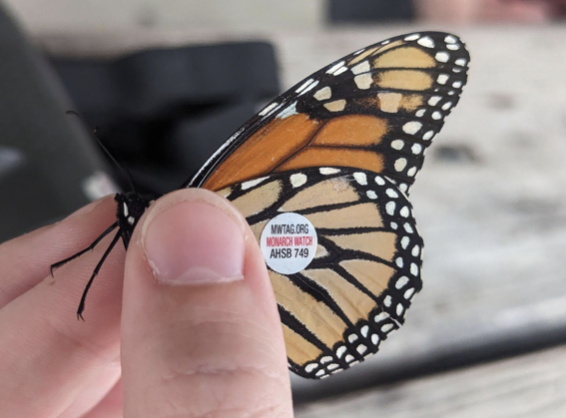
A tagged monarch butterfly ready for release, Scott Ableman
A public demonstration at the hawkwatch pavilion gave us the chance to observe New Jersey Audubon releasing tagged monarch butterflies as part of its Monarch Monitoring Project.
At the end of this successful day of observing nature at its best, we made a stop at the Cape May Bird Observatory Northwood Center, a must-stop-shop for birders and wildlife lovers alike with a wide variety of scopes, binocular accessories, bird feeders, pollinator hotels, field wear, and nature-themed books.
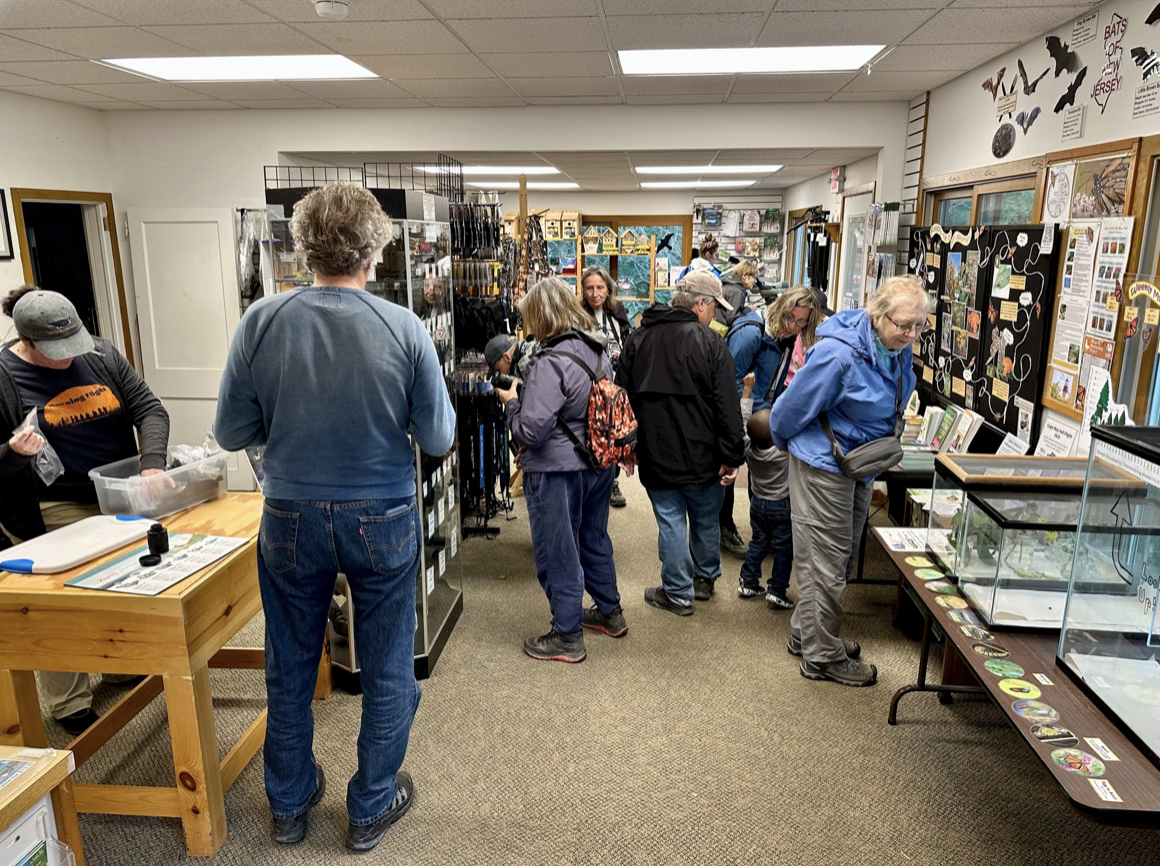
Inside the Northwood Center, Tom Wood

Bordering the North Atlantic Ocean, the Avalon Seawatch is famous for its spectacular migratory bird count, averaging nearly 800,000 seabirds each year. Photo: Andreana Lin
Day 2 of the trip brought us to the Avalon Seawatch bright and early in the morning. We walked around the beach to the official Seawatch observatory, spotting Laughing Gulls, Caspian Terns, Brown Pelicans, Double-crested Cormorants, a Parasitic Jaegar, Forster’s Terns, Green-winged Teal, and Semipalmated Sandpipers. Conspicuously late this year, we did not see any Surf or Black Scoters that are often counted in the thousands per day mid-October.

Dolphin calf swimming with its mother. Photo: Austin & Haocong Ren.
The Avalon Seawatch also is a good location for watching dolphins, and we were treated to the sight of a bottlenose dolphin with her calf.
Our morning on the beach passed quickly, and soon it was time to leave. We brushed the sand off our boots and headed back to Cape May. Back at the hawkwatch, we saw more Sharp-shinned and Cooper's Hawks and observed raptor banding at the pavilion.

The Nature Conservancy’s pollinator garden, Andreana Lin
Our final stop before returning home was at South Cape May Meadows. This was a special stop because of the tremendous conservation value of the land The Nature Conservancy has preserved. Its conservation projects there include stopover banding for passerines in the fall. This banding station provides data demonstrating the importance of intact natural habitat where birds can rest and refuel during migration. Skilled banders gave us a close look as they gently released Common Yellowthroats and a female Indigo Bunting caught toward the end of the day’s banding session.
After the songbird banding demonstration, we explored one of the meadow’s trails, adding a few more species to the record for our trip. You can see the complete list of sightings for the trip here.
Judy Gallagher, ASNV board member and regular contributor to the Potomac Flier, said it best: “The joy you get from discovering something new—that's the best part about trips like this.”

ASNV Cape May trip participants

ASNV Co-Hosts an Advocacy Forum
ASNV’s Advocacy Committee co-hosted an Advocacy Forum with the Loudoun Wildlife Conservancy and the Faith Alliance for Climate Solutions on October 21, an event that attracted close to 50 people.
Photo: Virginia State Capitol Building, Wikimedia user Skip Plitt via CC BY-SA 3.0

The Honorable Kenneth (“Ken”) Plum, Member Virginia House of Delegates, District 36. Photo: Trinity Mills
ASNV’s Advocacy Committee co-hosted an Advocacy Forum with the Loudoun Wildlife Conservancy and the Faith Alliance for Climate Solutions on October 21, an event that attracted close to 50 people. Delegate Ken Plum was the keynote speaker and urged all to help influence conservation policies at all levels of government. Other presenters included:
Mary Cortina, Fairfax County Planning Commissioner, and Kate Feingold, City of Fairfax Councilmember, on how a governing board makes policy;
Chris Miller, Piedmont Environmental Council, and Trinity Mills, Loudoun Wildlife Conservancy, on how to be an effective advocate;
Scott Peterson, Faith Alliance for Climate Solutions, Katy Johnson, Fairfax City Environmental Forum, and Michael Myers, Loudoun Wildlife Conservancy, on what we can learn from successful and unsuccessful advocacy efforts; and
Mary Rafferty, Executive Director of Virginia Conservation Network, on what’s ahead in the Virginia General Assembly.

Mary Rafferty, Executive Director, Virginia Conservation Network. Photo: Trinity Mills
Representatives of all of the sponsoring organizations were encouraged by the number of attendees who signed up to work on advocacy with their organizations. All left the sessions with a new appreciation for the importance of grass roots advocacy.

Fall cleanup in two easy steps
Here is an executive summary of eco-friendly yard maintenance recommendations for fall: 1: Watch the pretty leaves flutter down from above. 2: Do as little as possible to disturb those leaves or the flower stalks.
Photo: Fall color, Margaret Fisher
Margaret Fisher
Here is an executive summary of eco-friendly yard maintenance recommendations for fall:
Watch the pretty leaves flutter down from above.
Do as little as possible to disturb those leaves or the flower stalks.
Fall color, Margaret Fisher
In the days when gardening meant growing food for the table, cleaning out plant debris before winter was a routine practice to reduce the spread of diseases that affect vegetables. That routine carried over when suburbanites switched their yards to ornamental plants and turf grass, with the unfortunate consequence that we deprived our non-human neighbors of the shelter and food they need to survive. The tide is turning, though, as people are realizing that attractive gardens that support the ecosystem do better when their caretakers go easy on the autumn chores.
Some birds and nocturnal mammals are able to dig for grubs in a lawn, but you may have noticed that most friendly critters such as box turtles, frogs, and katydids do not spend a lot of time frolicking on your turf grass. It would leave them much too exposed, not to mention starving. Layers of leaves from native trees and shrubs, by contrast, provide a smorgasbord for them. Some of their meals consist of the caterpillars and other insects that feed on the leaves of native trees in spring and summer until they float down to the ground in the fall. Those that escape predation turn into adults the next spring and start the cycle over. Other insects such as fireflies spend their entire lives in the leaf litter, coming out briefly to find mates. All this assumes that their homes are not chopped up or raked up to be sent off to mulch factories.
Similarly, dead stalks provide shelter for many little critters, including certain species of native bees that burrow into the ends of broken stalks to lay their eggs. Plants left intact enliven our yards all winter with their interesting seed heads and waving stems, made even more lively as the songbirds perch on the stalks and scrabble in the leaves for the seeds of flowers and grasses.
As the plants emerge again in the spring, they have no trouble pushing past the dead leaves, which act as a natural mulch until they gradually decompose and feed the soil. Many of the dead flower stalks will have fallen down by spring, and those remaining are quickly hidden from sight by the growing plants. If those plants are native to our ecosystem, they continue to provide benefits the rest of the year by nourishing the caterpillars and providing nectar and pollen for the pollinators. Some of the thicker leaves such as oaks may smother turf grass under the trees, but that is just as well, since mowing around trees risks injuries to their bark, and walking under them compacts the soil and stresses the roots. Trees do best when their leaves are left in place out to the drip line. Mulching fallen leaves with the mower blade is better than sending them off in a truck or dumping smothering piles in the woods, but it may chop up the insect larvae and eggs.
Simple adjustments such as these to our landscaping practices will greatly improve the prospects of our local ecosystem. Other important steps to take include adding native plants, removing invasive non-native plants, minimizing the use of outdoor lighting, and eliminating mosquito spraying with its lethal consequences to the living world. Learn more on the Plant NOVA Natives website.

After a Long Hot Summer, It’s Time to Plant Trees!
Autumn is a perfect time for trees to go in the ground. Instead of facing a long, hot summer, trees have time to get acclimated to their new space, and then they cheerfully spend the winter in a dormant state.
Photo: Sweetgum Tree, Nancy Vehrs
Cindy Speas, Chair, Fairfax County Tree Commission
Preserving trees and planting new native trees are major goals of the Plant NOVA Trees campaign. In April I wrote about how to plan for spring and fall tree planting seasons, in the summer about the dangers of non-native trees, and last month about celebrating October as Native Tree Month in Virginia. You likely already realize I’m going to write now about planting trees.
Autumn is a perfect time for trees to go in the ground. Instead of facing a long, hot summer, trees have time to get acclimated to their new space, and then they cheerfully spend the winter in a dormant state. Those who plant in the fall not only find the temperatures invigorating for physical labor, but can also look forward to budding and blooming in the spring, when the days get longer. It’s a win-win!
Sweetgum Tree, Nancy Vehrs
Christina Hester recently described in Casey Trees’ blog “The Leaflet” all the reasons newly planted trees do so well in cooler temperatures. In Fall is for Planting, she says cool weather means less stress on the trees and higher rates of survival. There’s more water available for their roots, because water evaporates more quickly when it’s hot. Cooler air also reduces the threat of damage from pests or disease. Of course, there’s the same chance of rain or drought as in spring and summer, so in all seasons, newly installed trees need watering to thrive. Details on the watering schedule, which depends on the size of the tree, can be found on the Plant Nova Trees website. In the fall, other deciduous trees in your yard can provide lovely, free mulch when they shed their leaves. All the newly planted seedlings or young trees can benefit from the soil around them being enhanced with leaves. If you use leaves for mulch, just remember to leave space around the tree trunk to reduce damage to the young sapling’s sensitive outer bark.
Planting new, native trees is essential for our urban forest. Trees can be lost to development, disease, or invasive vines. Our urban forest needs other healthy trees of all sizes and ages coming along behind to take the place of dead or dying trees. Maintaining and preserving the saplings planted each season serves the goal of developing healthier ecosystems and a healthier planet.
Perhaps this autumn you might ask a child to help you—because every child that plants a tree is a part of that tree’s history, and the tree will surely find a place in that child’s heart. Searching for the right place to dig, gently spreading out a sapling’s roots in the ground, patting down the warm soil, smelling the earth after the first watering—this experience can turn a child into a plant and planet lover for life. And what we love can also become a part of an ethical journey towards caring for the whole earth that supports that one tree.
Autumn is not just a great time to plant trees, but also to reflect on the bigger picture. Doug Tallamy, famous for his research on oak trees, has started a Homegrown National Park project. The effort “has no political, religious, cultural or geographic boundaries because everyone—every human being on this planet—needs diverse, highly productive ecosystems to survive.” And, I might add, also to thrive. Tallamy says planting native trees and plants in our own backyards will increase the biodiversity of North America, one plant at a time. Such a grand ecological vision can take root in the one act of a child helping you to plant a tree.

Observations from Meadowood: November 2023
Judy Gallagher is an ASNV board member and a regular surveyor of local wildlife who also captures photos of what she sees, in particular the less common species.
Photo: Oak Treehopper, Platycotis vittata, Judy Gallagher
Judy Gallagher is an ASNV board member and a regular surveyor of local wildlife who also captures photos of what she sees, in particular the less common species.
One thing I really like about macro insect photography is how much is revealed when the insect is illuminated and expanded. A small dark spot becomes a colorful object with intricate patterns.
Oak Treehopper, Platycotis vittata, Judy Gallagher
This is particularly true for Treehoppers, true bugs (order Hemiptera) most closely related to Cicadas and Leafhoppers. Treehoppers are small, usually less than 1/2 inch long. They have short, bristle-like antennae, three-segmented feet, and a large thorax shield called a pronotum that extends backward to cover the abdomen, and sometimes also covers the head.

Poppea species, Mindo, Ecuador, with ant-shaped pronotum , Judy Gallagher
The pronotum can be humped or pointed to resemble a thorn, or have other unusual shapes. One that I saw a few years ago in Ecuador has a pronotum that resembles an ant. This presumably acts as a protection against predation because most predators don't want to deal with an angry ant. Recent studies suggest that the pronotum relies on wing genes to grow, curious because the pronotum would not normally be associated with flight.
Treehoppers create vibrational songs transmitted through their host plants. These songs communicate alarm, discovery, and courtship signals. They also can indicate that a treehopper has found a good place to feed, and the signal will attract others to that location. Each species has unique vibrational signals.
Treehoppers move around in a couple of ways. As the hopper name implies, they can hop from one location to another using their powerful hind legs. Studies suggest that the wings alone aren't sufficient to make the treehopper airborne, so they can also use the hop to propel them into flight.

Keeled Treehopper, Entylia carinata, mother protecting her eggs, Judy Gallagher
Treehoppers don't undergo complete metamorphosis. They have three life stages: egg, nymph and adult. Many treehopper species insert their eggs into the twigs of trees. This can damage the plant, but usually not badly. Adults of some species protect their eggs.
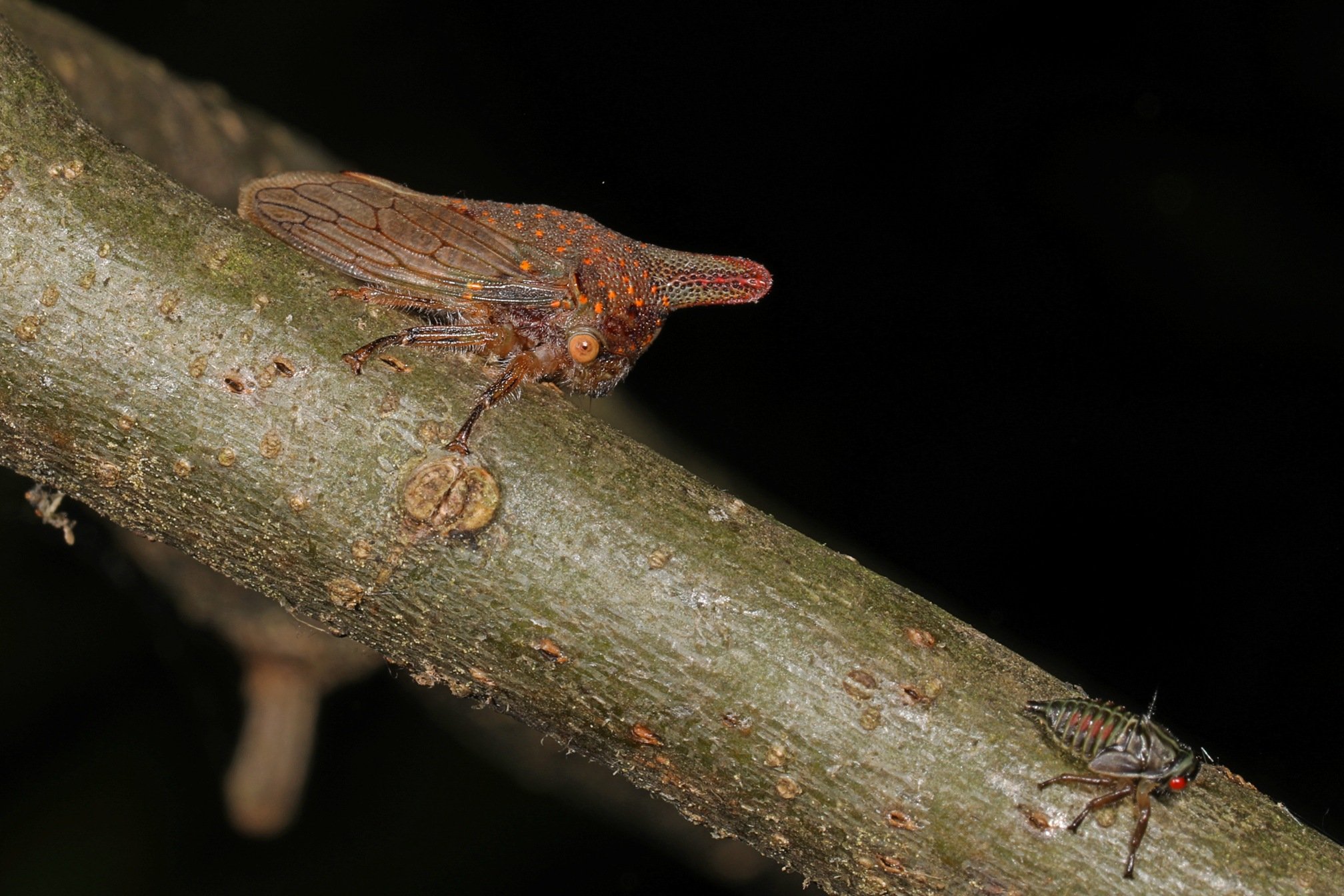
Oak Treehopper, Platycotis vittate, adult with nymph, Judy Gallagher
And some adults protect their nymph children as well, by waving their front limbs at or kicking at an attacker with their hind legs.

Ceresini tribe Treehopper nymph, Judy Gallagher
Nymphs shed their external skeleton several times before developing wing pads and turning into adults. The nymphs resemble what they will look like as adults, but without wings, and often with bristly hairs as seen above.
There are at least 260 species of treehoppers in North America. Some species feed on several different plants, but many treehoppers are found on a single host plant or family. Some plants, like the Black Locust, host more than one treehopper species. And although they usually feed on trees, some feed on non-woody plants. Treehopper mouthparts have two tubes. One injects saliva, which keeps the plant from closing up the hole, and the other tube sucks sap from the plant.

Ferruginous Carpenter Ant, Camponotus chromaiodes, and Black Locust Treehoppers, Vanduzea arquata, Judy Gallagher
Many treehopper species have a symbiotic relationship with ants. The ants stroke the treehoppers to get them to produce amino acid and carbohydrate-rich excretions which the ants drink, and in return, the ants protect the treehoppers from predators. Treehoppers are a food source for birds and larger insects, and so need protection.

Thornbug, Umbonia crassicornis, in Everglades National Park, Judy Gallagher
I mentioned previously that most treehoppers don't cause much damage to their host plant. One exception is the Thornbug, found only in frost-free areas like south Florida. The problem with them is that there can be so many individuals that they effectively defoliate a plant. They are colorful, and like many colorful insects, are distasteful to predators. Despite their color, they are hard to spot. The only reason I saw these was that I couldn't believe there were that many thorns on a branch, and so took a closer look.
View more of Judy’s Observations from Meadowood articles here.

Vote for Conservation This Month
All elections are important but Virginians will elect the entire Virginia General Assembly on November 7.
Photo: Wikimedia Commons
Wikimedia Commons
All elections are important but Virginians will elect the entire Virginia General Assembly on November 7. To learn how your state legislators voted on conservation issues, visit the conservation scorecard posted by the Virginia League of Conservation Voters.
Local officials in our area, including Fairfax and Arlington counties, also will be on the November 7 ballot.
You can find examples of issues of concern to Virginia’s conservation voters on the website of the Virginia Conservation Network, one of ASNV’s partners.
The League of Conservation Voters posts a scorecard for federal elected officials. You can consult it at https://scorecard.lcv.org/.

Monday Mystery - October 30, 2023
Monday Nature Mystery continues! Read on to learn who correctly identified our last mystery.
Photo: American Robin, Seth Honig
We are pleased to announce the winner of last week’s Monday Nature Mystery, Timothy Calkins!
Congratulations to Timothy for identifying this leucistic American Robin (Turdus migratorius).
Leucistic American Robin (Turdus migratorius). Photo: Seth Honig
According to All About Birds, leucism is not a genetic mutation, but rather describes defects in pigment cells that are caused during development. This may result in full leucism, where there is a reduction in all types of pigment. An animal with full leucism will appear paler than normal. Leucistic animals also may show irregular patches of white—this is referred to as partial leucism, and these animals are often referred to as “pied” or “piebald.” Because the development of the eyes occurs separately from other areas of the body, eye color in leucistic animals is not affected and will be normal in color.
Each Monday we’ll post a new mystery and identify the previous week’s winner. They’ll receive an ASNV hat or tote bag.
Here is this week’s mystery:
Who is this? Happy Halloween!
Be sure to post your guess on our Facebook page under the latest Monday Nature Mystery post. Good Luck!
Please check our guidelines here.

Monday Nature Mystery: Who is this? Photo: Judy Gallagher

Monday Mystery - October 2, 2023
Monday Nature Mystery continues! Read on to learn who correctly identified our last mystery.
Photo: American Golden Plover, Mary D’Agostino/Audubon Photography Awards
We are pleased to announce the winner of last week’s Monday Nature Mystery, Lyne Marie.
Congratulations to Lyne for identifying the American Golden Plover (Pluvialis dominica).
American Golden Plover (Pluvialis dominica). Photo: Mary D’Agostino/Audubon Photography Awards
Breeding birds are gold-spangled above, blackish below, with a white “scarf” extending from brow to breast sides. Juveniles and non-breeding birds still show some gold tones above but are dingy grayish below. According to All About Birds, adult American Golden-Plovers leave the Arctic in early summer, leaving their young behind. The juveniles (only a few months old) set off on migration in late summer or fall—finding their way to South America on their own.
Each Monday we’ll post a new mystery and identify the previous week’s winner. They’ll receive an ASNV hat or tote bag.
Here is this week’s mystery:
Who is this?
Be sure to post your guess on our Facebook page under the latest Monday Nature Mystery post. Good Luck!
Please check our guidelines here.


Monday Nature Mystery: Who is this? Photo: Judy Gallagher

Tell Us Your Thoughts (by October 15) on Keeping or Changing Our Name
ASNV, like many other Audubon chapters, has embarked on a process to decide whether to keep the Audubon name. The National Audubon Society in March of this year decided not to change its name, but is allowing its many chapters to decide for themselves.
Image: King Rails, John James Audubon
John James Audubon’s vast contributions to American ornithology are well known. In recent years, however, it has come to light that, like some others of his era, he was a slave owner and collected skulls for another’s eugenics research, practices that are now universally condemned. He also copied another artist’s drawing of a bird that did not exist, using it to promote his own publication -- scientific fraud by any era’s standards.
ASNV, like many other Audubon chapters, has embarked on a process to decide whether to keep the Audubon name. The National Audubon Society in March of this year decided not to change its name, but is allowing its many chapters to decide for themselves.
Our Board of Directors will make this decision – and it is a complex one. More background information is available in this essay on the Audubon Name, and in this series of Frequently Asked Questions. On the one hand, some feel that changing the name will help remove the taint of racism associated with Audubon. And as Christian Cooper wrote in the Washington Post, we can’t adequately protect birds and other wildlife from the immense challenges ahead without the participation of non-Whites, a large and growing part of the population. Having a name that honors Audubon could deter such participation; this is especially relevant for northern Virginia, a part of the country that has recently become a majority-minority region.
On the other hand, Audubon did make significant contributions to ornithology, art, and natural history. Changing our name could weaken the Audubon “brand recognition.” A name change could alienate some members and also would be expensive, draining funds away from important conservation work.
Because we are a membership organization and have long benefited from your generous involvement and support, we are now in a listening and learning phase. We ask for your input – please use this link to take our brief survey. We are keeping it open until October 15. We also will consult other groups in northern Virginia communities that are not well-represented in our membership and other Audubon chapters around the country.
We look forward to hearing from you – about the name change issue – and about other suggestions that you have to help us protect the birds and nature that we all treasure.