
NVBA NEWS BLOG
Welcome to the blog for Northern Virginia Bird Alliance, a wealth of resources about northern Virginia birds, wildlife, habitat conservation and restoration, native plants, wildlife-friendly gardening, advocacy and more.

Weigh In On Our New Name
After deciding to move forward with changing our organization’s name, we’re asking for your suggestions on a new name.
Image: Tundra Swans, John James Audubon
After deciding to move forward with changing our organization’s name, we’re asking for your suggestions on a new name. You still have time to send us your recommendation on a new name for ASNV. We continue to take suggestions through March 6. If you want to offer your idea for a new name, please leave your suggestion (and a brief explanation) here. We will consider all suggestions we receive.

Don’t Miss Our New Monthly Feature
We have added a new monthly feature to the Potomac Flier, the Wildlife Sanctuary Almanac.
Photo: Pinxter Azelea, David J. Stang, CC BY-SA 4.0, via Wikimedia Commons
We have added a new monthly feature to the Potomac Flier, the Wildlife Sanctuary Almanac. Each month we'll feature timely tips and observations about engaging with nature through the seasons in your own personal wildlife sanctuary.

Red-headed Woodpecker: A Species at the Tipping Point
The State of the Birds report identified five species of birds that breed in northern Virginia as at a tipping point. One of the birds at the tipping point is the Red-headed Woodpecker, a year-round resident of northern Virginia that is considered uncommon during every season.
Photo: Red-headed Woodpecker, Matt Felperin
Evelyn Novins
In 2022, the North American Bird Conservation Initiative, a forum of government agencies and private bird initiatives, compiled a State of the Birds Report, which shows a steep population decline of many bird populations. The report identifies 70 species as birds that have lost two-thirds of their population over the last 50 years and are projected to lose 50% of their population over the next 50 years. These birds are deemed at a “tipping point” for extinction. Without consequential intervention they are likely to become threatened or endangered or extinct. Like a canary in a coal mine, the birds are warning us that the environment cannot sustain life.
The State of the Birds report identified five species of birds that breed in northern Virginia as at a tipping point. One of the birds at the tipping point is the Red-headed Woodpecker, a year-round resident of northern Virginia that is considered uncommon during every season.
The Red-headed Woodpecker requires a habitat with open areas of trees, typically oak or beech trees, with little vegetation on the ground. They prefer areas with mature trees and minimal understory but can be found in woodlands and mixed forests, and along rivers and streams where there are plenty of snags. Good examples of supportive habitat are in Fairfax County at Huntley Meadows Park and Bull Run Regional Park, and in Prince William County at Conway Robinson State Forest.

Red-headed Woodpecker at Huntley Meadows, Seth Honig
So why are snags important? Snags are standing dead and dying trees. They occur because of natural disasters such as lightning strikes or animal damage, disease, too much shade, not enough rain, or even old age. In Huntley Meadows the snags are created by flooding from beavers. Red-headed Woodpeckers are cavity nesters and snags are the perfect medium for creating a nest. The woodpeckers use dead trees or dead parts of live trees where they drill a gourd-shaped cavity in the tree or natural cavity. The nest will measure about 3-6 inches across and 8-16 inches deep with an entrance of just 2 inches in diameter. Drilling out a nest cavity can take from 12 to 17 days, and the birds may use a cavity for more than one year. Smooth snags which have lost their bark can provide protection from snakes, a common predator. Snags and dead trees also provide abundant areas for food storage, foraging, roosting, and perching.
The Red-headed Woodpecker eats primarily nut cops such as acorns and beech nuts, caching extras in wood for later. But they also eat fruit and are adept at catching insects in the air, which is not true of all woodpeckers. They sometimes also visit feeders. In spite of its seemingly wide variety of food choices, its essential habitat has suffered in an urbanizing area like northern Virginia because of development and habitat fragmentation.
So, it’s essential to protect areas of intact woodlands like Huntley Meadows, Bull Run Regional Park and Conway Robinson State Forest. They are protected areas, but threatened encroachments occur from time to time. ASNV has had to respond at least twice in the last five years to threats to Huntley Meadows Park (a bike path and an adjacent development). So, let’s appreciate these areas and take steps to protect them whenever threats arise. And, if you live near a woodland that is so fortunate as to host these stunning birds, by all means consider welcoming them to a backyard bird feeder with seeds, corn or suet!

Moon gardens: A quiet oasis for pollinators working the night shift
When planting, most people take into consideration how plants will look in the daytime, but have you ever heard of moon gardens?
Photo: Woodland Phlox, David J. Stang, CC BY-SA 4.0, via Wikimedia Commons
Deidra Bryant
Spring is on its way, and like many of us you’re probably getting ready to prep your garden for flowers and veggies. When planting, most people take into consideration how plants will look in the daytime, but have you ever heard of moon gardens? They’re gardens best enjoyed from dusk to dark and are best appreciated at the end of a hot day, when the nicest time to sit outside is during the evening. If you spend your time at work in the daytime, these enchanting gardens can be quite lovely and relaxing to walk around in when you come home in the evening.
Moon gardens generally include white flowers and silvery foliage that glow in the moonlight, fragrant plants that add to the sensory experience, and grasses that bring pleasant sounds when rustling in the evening breeze. A trickling fountain is also a good idea if you want to provide a wonderful auditory and visual experience with the moonlight reflecting on the water’s surface. The best part is that these gardens not only help you relax when the moon is out, but also attract night pollinators like bats and moths, both highly successful pollinators. Here’s how to get started, along with a list of a few plant species that benefit both daytime and nighttime pollinators.
A moon garden does not have to be very large. It just needs to be in an area where people congregate and can enjoy the ghostly white and shimmery silver-colored blossoms and plants. You’ll also need to research the amount of sunlight and soil types for the area selected for the moon garden. Though the moon garden’s true beauty will be on display in the evening, night blooming plants still need some amount of sunlight and proper soil conditions.
May Breeze Woodland Phlox, David J. Stang, CC BY-SA 4.0, via Wikimedia Commons

Sweetbay Magnolia, (c)2008 Derek Ramsey (Ram-Man). Co-attribution must be given to the Chanticleer Garden., CC BY-SA 3.0 , via Wikimedia Commons
Choosing native plants for your moon garden is an invitation to see a different side of a flower’s beauty, as flowers that display in vibrant pale shades take on a new personality when viewed under moonlight. Your moon garden should have native plants with flowers that are shades of white, cream, silver, pale pink, and pale lavender. Examples include Flowering dogwood (Cornus florida), Obedient plant (Physostegia virginiana), May breeze woodland phlox (Phlox divaricata), Fleabane (Erigeron annuus), Evening primrose, Pinxterbloom azalea (Rhododendron periclymenoides), Common elderberry (Sambuca canadensis), White sagebrush (Artemisia ludoviciana), and Sweetbay magnolia (Magnolia virginiana). When planting, place flowers with the same shade of white in the same area. If you put two different shades together, one will appear dull compared to the other, making the garden less visually striking. Pale, decorative native grasses also can be lovely. Ideally, these grasses will be silver in color all year long, rather than evergreen. Sugarcane plumegrass (Saccharum giganteum) and Bushy bluestem (Andropogon glomeratus) are good examples, because their silvery color will gently shimmer in the pale moonlight.
Bats and moths are just as effective pollinators as birds and bees. Bats help control mosquitoes, as well as harmful beetles and other pests, and can carry a significant amount of pollen on their face and fur. Moths also work the night shift by collecting pollen on their legs. Mothing (viewing moths attracted with a draped white sheet and a light source) also can be a fun outdoor activity in the spring and summer, especially in your newly designed moon garden! So, help all your local pollinators out this year and create your own peaceful garden to enjoy at night.

Did You Know There is a Grass that has Evil Superpowers? It’s Called “Running Bamboo”
Running bamboo may not be able to leap tall buildings, but it can run underground as much as 15 feet a year, including going under a road and emerging on the other side. Running bamboo can even be found as far away as 100 feet from its parent plant.
Photo: Running bamboo, Margaret Fisher
By Elaine Kolish
Running bamboo may not be able to leap tall buildings, but it can run underground as much as 15 feet a year, including going under a road and emerging on the other side. Running bamboo can even be found as far away as 100 feet from its parent plant. Its horizontal rhizomes also can go through brickwork and weak spots in concrete. This means it can damage sidewalks, driveways, pool liners, decks and foundations. Unfortunately, it also suppresses native plant species, including our much-needed native trees. Although some may argue that bamboo at least provides some benefit in sequestering carbon, native plants that it can suppress provide the same climate change benefits while also serving as an essential food source for native wildlife.
How extensive is the Running Bamboo invasion?
Originally, non-native bamboo was imported from Asia for garden decoration and screening. But its aggressive growth habit did not respect private or public property lines. It now can be found in large groves in yards, and acres of it can be found in local parks. For example, the Fairfax County Park Authority (FCPA) has estimated that it has 250 acres of bamboo spread across more than 185 patches on its properties. Fortunately, FCPA has received $400,000 to start tackling this enormous problem. But it needs far more. It estimates it will take more than $9 million and 15 years to treat the affected acreage it has identified. Simply put, with no natural controls from insects, diseases or wildlife, this grass has become a nightmare. Our National Zoo doesn’t even have Giant Pandas any more that could at least eat a teeny-tiny portion of our available supply.
How can homeowners stop running bamboo in their yards?
Although there are no estimates of how extensive running bamboo is on private property, it is easy to spot throughout our neighborhoods. Consequently, homeowners have an important role to play in containing or eliminating this destructive grass. Running bamboo will start growing again in the spring, and this is a good time to start getting rid of it. But be aware, its growth pattern makes it difficult to remove, and a sustained, multi-year effort usually is necessary. Below are four methods you can try.
Barriers. One containment method involves installing vertical root barriers 30 inches below ground (and 6 inches above) to deflect rhizomes so they go towards the owner’s property and to make the rhizomes visible at the barrier. Strong materials, such as metal or high-density plastic, must be used for the barrier. Regular monitoring and cutting back rhizomes that have escaped also is necessary.
Mowing. Another containment method involves frequently mowing the bamboo so that the rhizomes eventually become depleted of nutrients and give up trying to grow. It could take two to three years to see any success.
Herbicides. The “hack and squirt” method involves cutting the bamboo close to the ground carefully and immediately (within five minutes) applying herbicide with a foam brush to the cut top. A high concentration of glyphosate or another herbicide that states on the label that it treats bamboo is necessary. Remember to always read and follow the directions on the herbicide container!
Digging. Alternatively, a homeowner might wish to remove the bamboo completely. Digging it out of larger groves may require heavy equipment. Don’t forget to call the official utility locator before you dig.
What can you do when bamboo from your neighbor’s yard invades your property?
Several local jurisdictions in Northern Virginia have addressed this situation: Fairfax, Stafford and Fauquier Counties. The Fairfax County Bamboo Ordinance went into effect on January 1, 2023. It is designed to help homeowners experiencing incursions of bamboo from their neighbors’ properties. The ordinance says that bamboo owners, whether or not they planted the bamboo, must not allow their bamboo to spread from their yards to any public right-of-way or any adjoining property. Although maintaining bamboo on one’s own property is legal, it is illegal to allow bamboo to spread beyond your property’s boundaries. Violators may incur a fine. In Fairfax County, you must dispose of all cut bamboo and roots in the TRASH, not in a compost pile or bin for lawn debris. If you want to dry the culms or canes for another use, such as stakes or crafts, do not do so on soil, which will risk the bamboo taking root.
What are alternatives to bamboo for screening?
There are many native plants and grasses that can provide screening and ecological benefits. Plant NOVA Natives, for example, has a whole section on hedges and screening options on its website. Similarly, Master Gardeners of Northern Virginia has a fact sheet on bamboo and native alternatives.
Don’t wait. Come spring, be a superhero: contain or eliminate that invasive bamboo in your yard. Your actions will make a difference!

ASNV and Partners Install a New Purple Martin Colony at Four Mile Run
As part of Stretch Our Parks, volunteers worked with the Four Mile Run Conservancy Foundation to install a Purple Martin colony at the end of February in Alexandria’s Four Mile Run Park.
Photo: Purple Martin house volunteer team, Tina Dudley
Tina Dudley
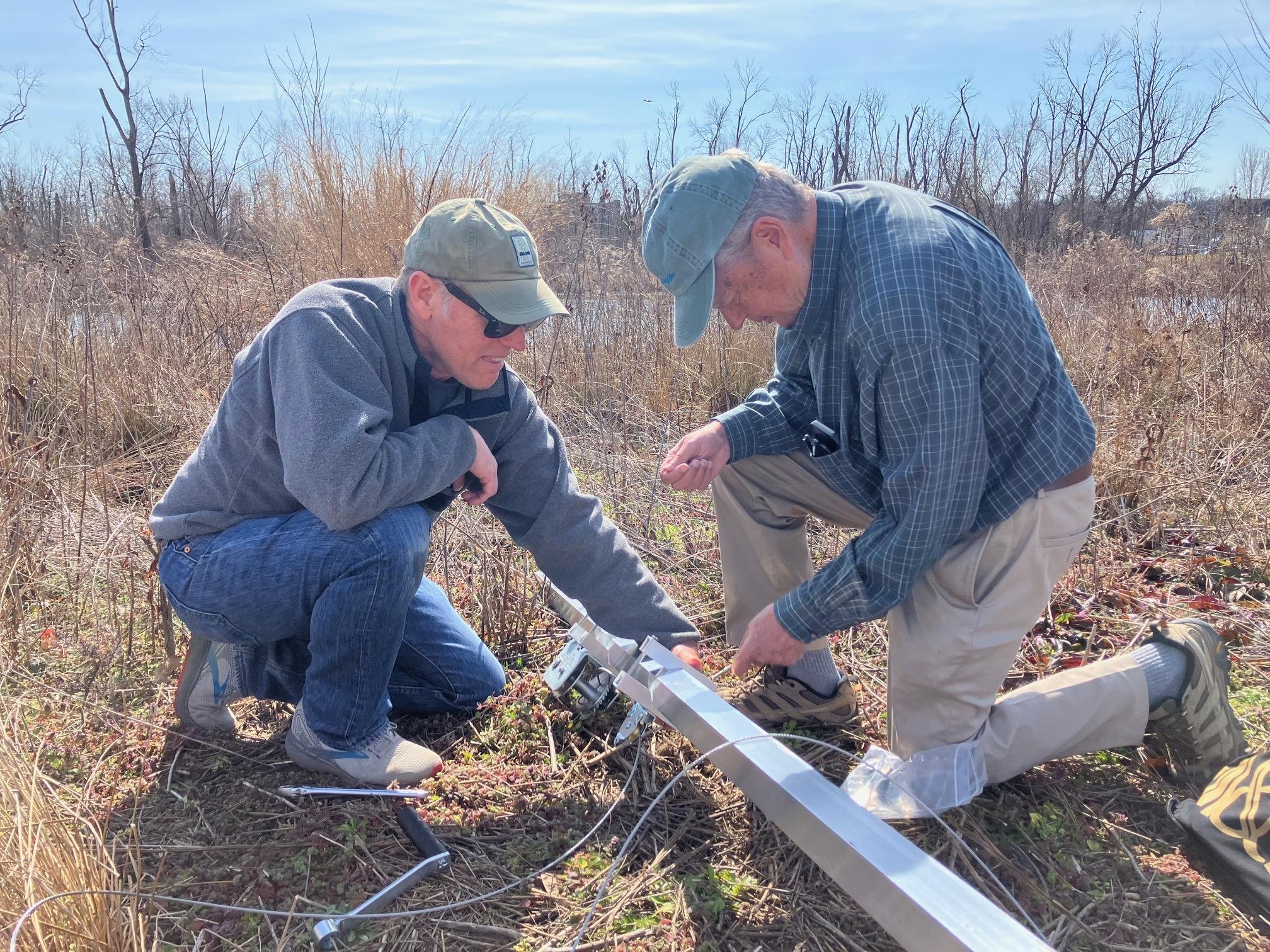
Kurt Moser and Greg Butcher working on the winch system for raising and lowering the gourds. Photo: Tina Dudley.
As part of Stretch Our Parks, volunteers worked with the Four Mile Run Conservatory Foundation to install a Purple Martin colony at the end of February in Alexandria’s Four Mile Run Park. ASNV purchased the needed equipment thanks to fundraising efforts by the Nextgen Birders for Conservation group, an initiative by ASNV to cultivate the next generation of birders and wildlife stewards.
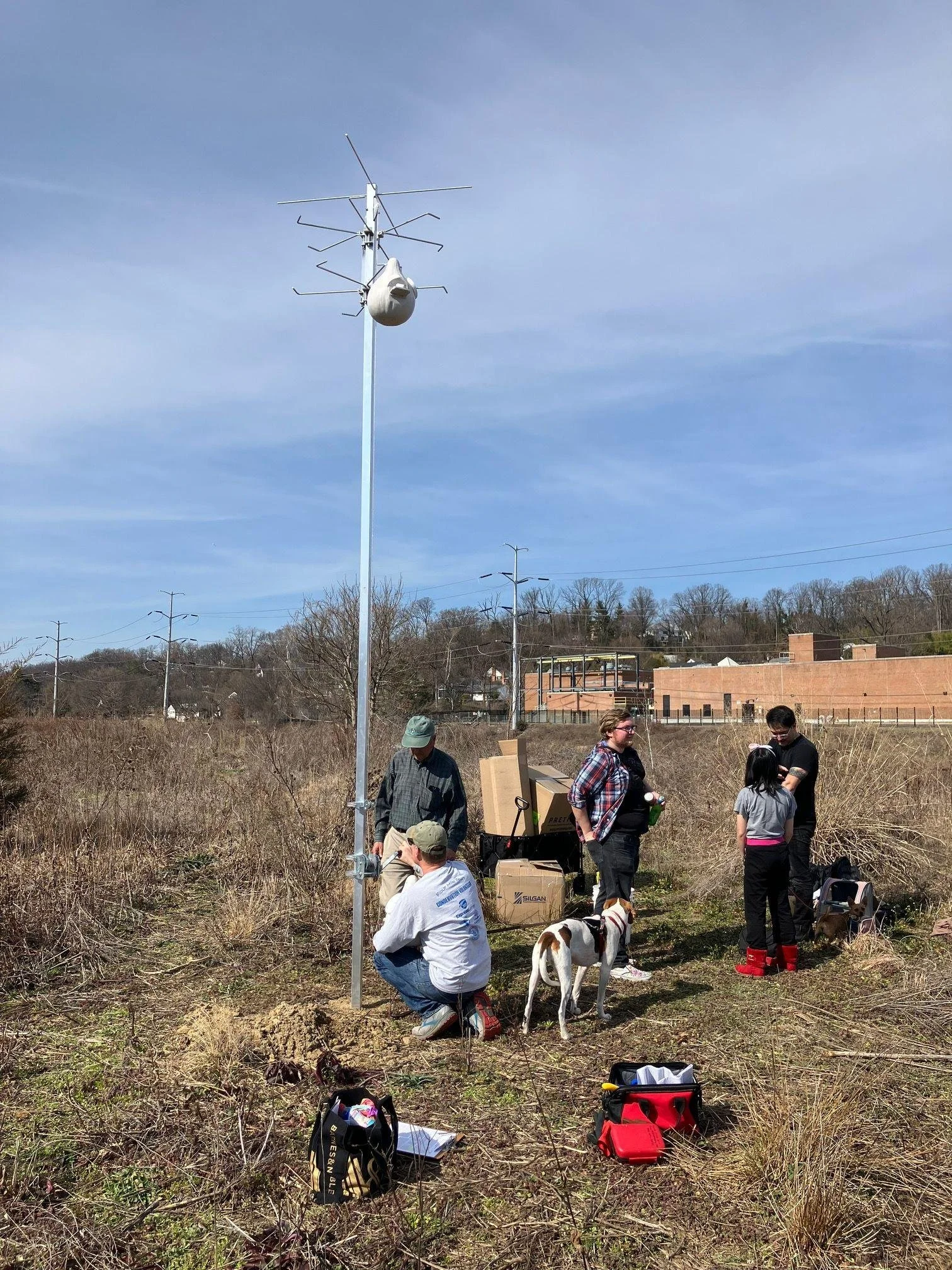
The raised structure, depicted above with only one gourd, is now finished and has all 12 gourds installed. Blockers are in place to discourage nest stealing before the Purple Martins return to Four Mile Run in the next month or so. Photo: Tina Dudley.
Purple martins are our largest swallows - beautiful, acrobatic birds that swoop and dive, eating flying insects that hover over the water. They are secondary cavity nesters—unlike woodpeckers, they do not excavate their own nest cavities. Instead, they use existing cavities, either naturally occurring or created by other animals. Traditionally they used old woodpecker holes or natural cavities in dead trees or on cliff or rock ledges. But thousands of years ago, people began providing man-made housing for the Purple Martins in the form of dried, hollow gourds. Over time, the birds nested successfully in these man-made homes. The availability of those hollow gourd nests, paired with the decline of natural cavities resulting from development, led to a complete behavior shift in the eastern species.
Andreana Lin, Kurt Moser, Greg Butcher, Jacob Roberts and Luke High pose with the gourds after assembling Purple Martin balconies on the gourds. Photo: Tina Dudley.
Four Mile Run is a 9.4-mile-long stream that starts near Interstate 66, at Gordon Avenue in Fairfax County, and proceeds southeast through Falls Church to Arlington County. Most of the stretch is parkland and is paralleled by two paved non-motorized multi-use trails, the Washington & Old Dominion Trail and the Four Mile Run Trail. You can find the new colony on a peninsula that juts out into the stream. It’s conveniently sited across from the observation deck on the Arlington side of Four Mile Run and is at least 40 feet from the nearby trees. See the location below if you’d like to visit to check it out in person.

Map showing the location of the new Purple Martin colony at Four Mile Run
A special thank you to Kurt Moser from Four Mile Run Conservancy Foundation who finished the installation of the gourds after additional drilling was needed off-site.
We are hopeful that Purple Martins will take up occupancy in the colony this year. If so, we will be looking for volunteers to help with weekly monitoring checks to collect citizen science data on the nests, in accordance with recommendations by the Purple Martin Conservation Association. This is a great opportunity for those interested in seeing young birds up close and learning about how to be a Purple Martin landlord. If you are interested in helping, please contact Meg Oakley for more information.

Observations from Meadowood: March 2024
Judy Gallagher is an ASNV board member and a regular surveyor of local wildlife who also captures photos of what she sees, in particular the less common species.
Photo: Asian Tiger Mosquito, Judy Gallagher
Judy Gallagher is an ASNV board member and a regular surveyor of local wildlife who also captures photos of what she sees, in particular the less common species.

Billboard, Judy Gallagher
Everyone loves to hate mosquitoes. Mosquitoes are associated with itchy bumps, annoying buzzing around your ears, and as vectors of diseases such as Malaria or West Nile Virus.
Asian Tiger Mosquito preparing to get a blood meal, Judy Gallagher
Years ago, you were more likely to be bitten by a mosquito after dusk, as most of our native mosquitoes were nocturnal. But the non-native Asian Tiger Mosquito, now one of the most widespread mosquitoes in Virginia, bites primarily during the day, and will usually only bite at night around outdoor lights. With both diurnal and nocturnal mosquitoes, it's pretty hard to avoid being bitten. Mosquitoes are attracted to our body heat and the carbon dioxide and substances found in our breath and sweat. Research suggests that mosquitoes have a preference for beer drinkers and people with type O blood.
While mosquito bites are annoying, the diseases that they can carry are far more serious. Malaria kills over a million people per year worldwide, and it was only officially eradicated in the U.S. in 1951. There are other mosquito-borne diseases, including Zika, West Nile Virus, Dengue, Yellow Fever, and Chikungunya. Scientists are working on solutions to the mosquito-borne disease problem. One such effort is introducing Wolbachia bacteria into mosquitoes. These bacteria inhibit the ability of viruses to live and replicate in other insects, and, if they also work in mosquitoes, could save many lives. Another way of eradicating mosquito-borne disease is to eradicate the mosquitoes.
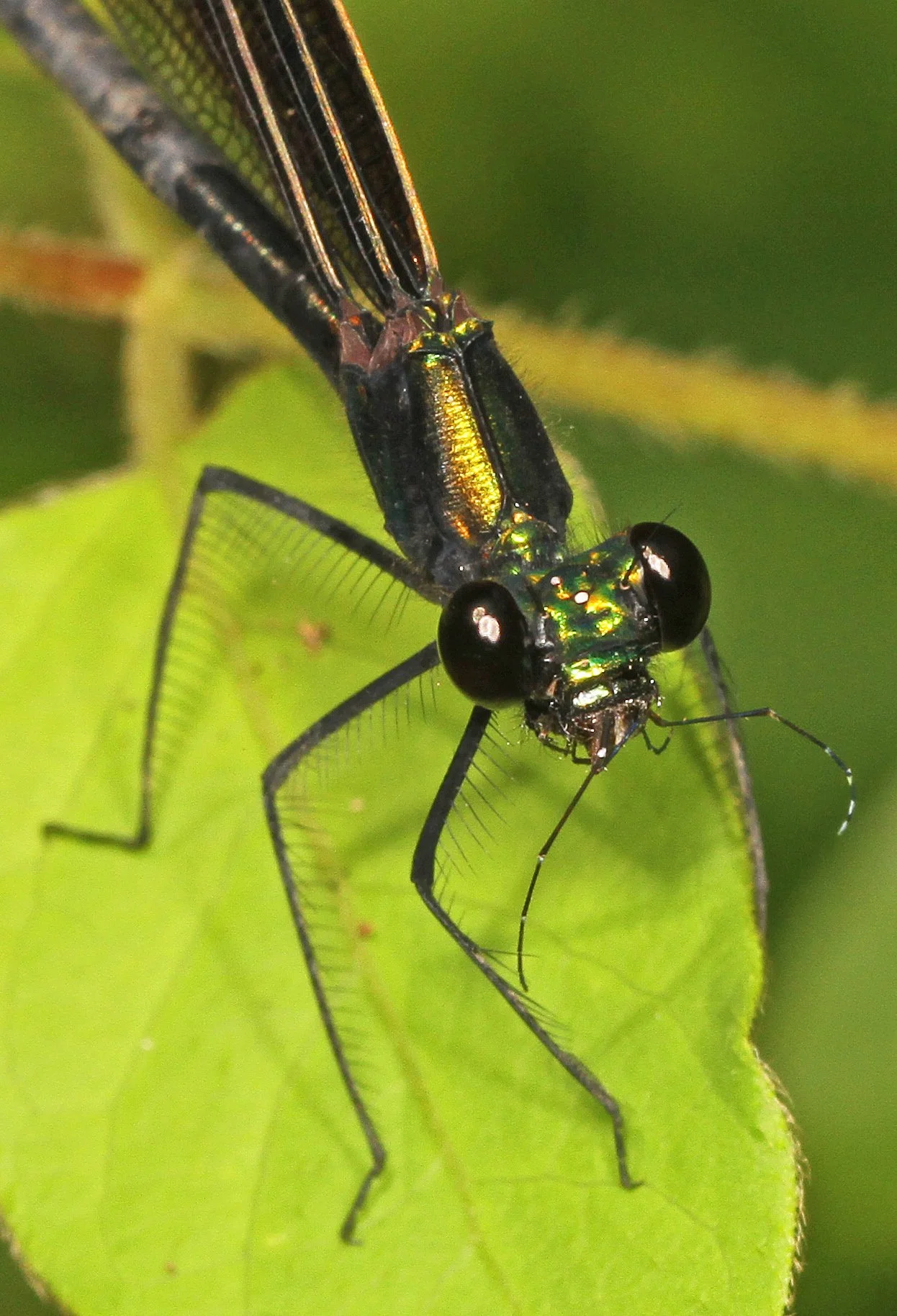
Ebony Jewelwing damselfly with mosquito, Judy Gallagher
But eradication has a huge down side - mosquitoes are an important part of our natural environment. Adults are a crucial food source for birds, dragonflies, bats, amphibians and so on, and the aquatic larvae support fish such as catfish, bass and bluegills. Bats, turtles, aquatic beetles, and dragonfly and damselfly larvae also eat mosquito larvae. There are even predatory mosquito species whose larvae eat other mosquito larvae.
There are more than 3,000 mosquito species worldwide, 58 of which are found in Virginia. Not all of them feed on humans. As its name suggests, the Northern Frog-biting Mosquito bites frogs and other cold-blooded animals. Male mosquitoes don't bite humans. Female mosquitoes only need protein from a blood meal when they are laying eggs. At other times, both males and females primarily eat nectar. Like other nectar-eating insects, mosquitoes are important pollinators.

Ragged Fringed Orchid with mosquito, Judy Gallagher
The Bluntleaf Orchid is pollinated primarily by mosquitoes. It attracts them by issuing an aroma remarkably similar to human body odor. The mosquito eats nectar from the orchid, and pollen sticks to the mosquito, who then inadvertently transfers the pollen when it visits another flower. We don't have the Bluntleaf Orchid in this area, but another orchid in the same genus, the Ragged Fringed Orchid, is fairly common here. I looked at my Ragged Fringed Orchid pictures and discovered that several of the pictures had mosquitoes in them, something that I had not noticed when I took the pictures or when I processed them.

Elephant Mosquito feeding on nectar. Note that pollen is clinging to its legs, Judy Gallagher
Our two largest local mosquito species are the Elephant Mosquito and the Gallinipper. The Elephant Mosquito doesn't feed on blood. Females use sugars from nectar to support egg development.

Gallinipper with a blood meal, Judy Gallagher
So how can you avoid those annoying bites? You could plan a trip to Iceland or Antarctica, both of which are mosquito-free. Locally, try removing sources of standing water around your home. This includes cleaning out gutters, replacing bird bath water at least once a week, and ensuring that outdoor potted plants don't have water standing in the pot bottoms. When you go outside in an area with mosquitoes, wear light-colored clothing that covers as much body surface as possible and use insect repellent, especially ones that contain natural ingredients like lemon eucalyptus oil. And reflect upon the value of mosquitoes. They are food for many of the birds you love, and pollinators of many of the plants you admire.
View more of Judy’s Observations from Meadowood articles here.

Wildlife Sanctuary Almanac: Invasive Vines
Today (March 1) is the last day of National Invasive Species Awareness Week! Appropriately, this is the perfect time of year to remove certain invasive vines from your own yard.
Photo: Fallen Sycamore, Betsy Martin
Betsy Martin
Today (March 1) is the last day of National Invasive Species Awareness Week!
Appropriately, this is the perfect time of year to remove certain invasive vines from your own yard. At this time of year, native plants have mostly died back for the winter, but evergreen invasive vines such as English ivy, Wintercreeper, Asiatic bittersweet, and Japanese honeysuckle are green and visible. They are busily growing up trees, which they will eventually overtop, shade out and kill.

Oriental Bittersweet and English Ivy on a tree, Margaret Fisher
The weight of these invasive vines can bring a tree down. In a storm, they act as a sail to uproot a tree, and the vines become even heavier with water trapped in the dense foliage. They trap moisture next to the tree’s trunk, causing disease. They create habitat conducive to rats, ticks, and the spread of Lyme disease and West Nile virus. They displace native plants, creating a food desert for birds—native insects cannot eat these exotic vines, and so birds cannot find caterpillars to feed their young in a forest smothered by exotic vines.
Why is this the perfect time to tackle these vines? No mosquitoes, for one thing. It’s cool and pleasant to work, not hot and humid. Any poison ivy vines are dormant. You still should be careful, though, because you can get poison ivy from its stems. Be sure to wear gloves and wash up frequently.
You can remove invasive vines from your trees in three easy steps.
First, use loppers or clippers to cut the stems growing up the tree trunk. Cut them near the ground. You may need a hand saw to cut very thick stems, but be careful not to damage the tree or its bark with the saw.
Second, cut the stems about three feet above the ground. Pull the vines off the tree between the two sets of cuts. An old screwdriver slipped behind the stems can help pry them off. Make sure you’ve cut all the stems—don’t leave any growing up between the ground and the second set of cuts you’ve made.
The third step is—wait. The vine will die, turn brown, and eventually fall from the tree. You do not need to try to pull the vines down—that is a lot of work and can be harmful to the tree and dangerous to you, especially if you’re dealing with a large mass of vine.
Eventually, you will want to pull the vines up by the roots in nearby areas, because they will grow back up your trees.
Excellent information about invasive plants and how to control them is provided by Plant Invaders of Mid-Atlantic Areas, Field Guide, on the Plant NOVA Natives website, and in Blue Ridge PRISM fact sheets for Asiatic bittersweet and Japanese honeysuckle.

Monday Mystery - February 26, 2024
Monday Nature Mystery continues! Read on to learn who correctly identified our last mystery.
Photo: Canada Goose Egg, Bryant Olsen via Flickr
No winner for this week’s mystery because while Maurice was correct, he has already won twice. Please submit your answer even if the correct answer is already listed, you may win a prize!
This is the egg of the Canada Goose (Branta canadensis)!
Canada Goose Egg, Bryant Olsen via Flickr
This species used to be migratory (nesting in Canada) but has increasingly become residential, resulting in overconsumption and depletion of aquatic vegetation that many other species depend on. You can help with this problem by preventing Canada Geese from nesting on your property. If you register with this federal program, you can legally addle (shake) eggs or destroy nests on your property. Wildlife management programs like this are a necessary part of preserving biodiversity.
Each Monday we’ll post a new mystery and identify the previous week’s winner. They’ll receive an ASNV hat or tote bag.
Here is this week’s mystery:
What is this?
Be sure to post your guess on our Facebook page under the latest Monday Nature Mystery post. Good Luck!
Please check our guidelines here.

Monday Nature Mystery: Who is this? Photo: Judy Gallagher
The Audubon Name, Our Board’s Decision
Over the past six months, ASNV has been exploring whether we should change our chapter's name , removing its reference to John James Audubon.
Image: Tundra Swans, John James Audubon
Over the past six months, ASNV has been exploring whether we should change our chapter's name, removing its reference to John James Audubon. We surveyed our members and people who participate in our activities to learn their views. We reached out to a dozen or so Audubon chapters that are considering a name change or that have already changed their name to gain their perspectives.
Throughout, we have been impressed by the passionate commitment to conserving birds and nature shown by ASNV members and other survey participants. Thank you to all who took the survey for caring and for helping the Board decide this complex issue.
A total of 481 of you responded to our survey. We learned that our community is evenly split on the question of whether to change ASNV’s name. Younger respondents had a much stronger preference for name change than older ones. Respondents from racial or ethnic minorities also tended to prefer a name change. We were gratified to learn that the plurality of respondents said their involvement in ASNV would not be affected one way or the other by a change in name.
We found the reasons respondents gave for favoring or opposing a name change to be heartfelt, thoughtful, and compelling. Many important concerns were raised by both supporters and opponents of a name change. These include the need for the organization to be inclusive and welcoming to all northern Virginians, the potential loss of name recognition and connection with the National Audubon Society and other Audubon chapters, and not erasing the many positive contributions that John James Audubon made to American ornithology, while also not honoring Audubon’s ownership of enslaved people, collaboration with eugenics research, and scientific dishonesty. While some respondents saw changing the name as a distraction, many saw it as an opportunity to look forward, redouble our conservation efforts, undertake new outreach, and build intergenerational and intercultural bridges to increase our impact and advance our mission.
The Board of Directors held a special meeting on January 21, 2024 to decide whether or not to move forward with changing our organization’s name. The organization’s mission to engage all northern Virginia communities in enjoying, conserving, and restoring nature for the benefit of birds, other wildlife, and people was paramount to all our deliberations. The question we came back to repeatedly was, “What action will most help us achieve our conservation mission, in the short term and in the long term?” Because conservation is by its nature a forward-looking endeavor and fighting the threats of development and climate change will require as many supporters as possible from all northern Virginia communities for many years to come, the Board was particularly moved by the strong support for name change voiced by younger and other underrepresented groups of survey respondents.
After discussing all that we learned and considering the implications of either action, the Board of Directors approved a measure to move forward with changing the name of the Audubon Society of Northern Virginia.
We recognize that as we move forward with this decision we must address the concerns raised by survey respondents. While our focus remains steadfastly on conservation of birds and nature, we also need to strengthen our efforts to bring younger and more diverse groups into our activities. We must, in a very visible way on our website, recognize Audubon’s many contributions to ornithology. We must find a new name and undertake a public awareness effort to build recognition of that name. We must find a way to convert our community’s resounding support and passion for conservation into greater protection of nature in northern Virginia.
What are the next steps? We must first identify a new name. More than 100 survey respondents made suggestions and gave us helpful guidance on this effort:
don’t name your organization after a person (which is also consistent with the American Ornithological Society’s decision to remove all human names from North American birds);
choose a name that makes our mission clearer, and include the word “bird”;
don’t use the word “society,” which seems elitist or old-fashioned to many; and
for increased brand recognition, adopt a name that is being used by other Audubon chapters (especially nearby ones) that are changing their names.
The Board will decide on a name, recommend that name to our members, and convene a meeting in which members vote on the adoption of that name. If you want to offer your idea for a new name, we will consider all suggestions we receive.
We welcome your help in the days, months and years ahead – as we choose a new name, as we engage our communities with this name, and as we move forward with renewed enthusiasm to conserve birds and nature in northern Virginia.

Results of the 2023 Manassas-Bull Run Christmas Bird Count
The conditions were not auspicious for the 42nd annual Manassas-Bull Run Christmas Bird Count, but the results still broke some records!
Photo: CBC participants in the morning fog, Deapesh Misra
Phil Silas, Compiler
The conditions were not auspicious for the 42nd annual Manassas-Bull Run Christmas Bird Count, but the results still broke some records! Ninety-eight birders counted 21,767 birds of 78 species in this 15-mile diameter circle on December 17, 2023. There were 34 parties of field observers led by experts. The teams included birders of all skill levels, and one feeder-watcher. A thick fog slowed bird sightings early in the day, and skies remained overcast all day with rain becoming steady in early afternoon.

White-throated Sparrow, Phillip Kenny

Red-headed Woodpecker, Seth Honig
The biggest surprise was that we observed 12 species in numbers that broke the record for the highest numbers set on any of the 41 previous counts. Species with new high totals, in taxonomic order, were Great Blue Heron (38), Yellow-bellied Sapsucker (91), Pileated Woodpecker (83), Northern Flicker (219), Carolina Wren (534), Gray Catbird (4), Brown Thrasher (4), Hermit Thrush (66), White-throated Sparrow (1,649), Swamp Sparrow (40), and Eastern Towhee (91). We observed no rare species, and we counted several species in just one sector. These included White-crowned Sparrow and Pine Warbler in Sector 1; American Black Duck and Common Merganser in Sector 3; Ring-necked Duck, Bufflehead, Ruddy Duck, and Eastern Phoebe in Sector 4; Double-crested Cormorant in Sector 5; and Wood Duck, Northern Harrier, American Tree Sparrow, and Eastern Meadowlark in Sector 6. Two of the record-breaking Brown Thrashers were sighted in Sector 2.
Some other notable numbers included, the 1,706 Cedar Waxwings that were just 30 short of the record set in 2007; 4,010 American Robins, which seemed to be everywhere; and 4 Barred Owls.
Of course, a big thank you goes to all who participated, especially my fellow sector leaders Robin Duska Huff, Greg Butcher, Dixie Sommers, Toby Hardwick, and Robert Mocko. Robert led Sector 6 for the first time and did very well thanks in part to Steve Johnson’s giving us plenty of notice and smoothing the transition. A special thanks goes to Dixie Sommers for leading Sector 4 for the past seven years. She’s handing Sector 4 off to a new leader for 2024. It’s not too early to mark your calendars for the 43rd count on Sunday, December 15, 2024.
The spreadsheet with all the data by sector is linked here.

The Magic of Winter Trees: Making a Deeper Connection
Dreams of warmer days are lovely, but if you have trees in your yard or if they are in a nearby park, winter might also be the time to learn how to appreciate and protect their incredible beauty.
Photo: Winter trees, Rusty Moran
Cindy Speas
Winter is a lovely time to get to know your trees better. Many folks spend some of the colder days of January and February planning their spring gardens, winter sowing, or putting in nursery orders for spring delivery of native plants. Dreams of warmer days are lovely, but if you have trees in your yard or if they are in a nearby park, winter might also be the time to learn how to appreciate and protect their incredible beauty.

Trees in winter, David Howell
When trees are bare of leaves, you can visualize more clearly their beautiful shapes, identify some species characteristics, and assess their health. There are several local organizations that provide educational winter hikes or webinars to examine and learn about our forests, including ASNV, Nature Forward, Virginia Native Plant Society, Potowmack Chapter, Capital Nature, Loudoun Wildlife Conservancy, Prince William Conservation Alliance, and others.
If you haven’t taken a long walk or hike in the winter before, it’s time to bundle up and head out on the trail. Even if you aren’t an experienced birder, it’s often easier at this time of year to observe hawks, owls, or other raptors at work. You can spot smaller birds searching tree bark or leaf litter for insects and berries, and mammals looking for food also may appear in the distance. Native evergreens or the lovely marcescent (persistent) leaves on oaks and beeches provide beautiful color among the gray tree trunks.
While you may not want to linger for contemplation, if you walk gently, there is a type of forest bathing you can experience surrounded by the still, silent trees in the chilly air. One of the loveliest things you can see in a winter forest is found by looking up to the sky. It is in this season that you can see how the tree canopy develops: the trees grow side-by-side leaving a path around each canopy’s branches so that sunlight may reach down to the forest floor. This is called canopy shyness. While more common in rain forests, you can sometimes see these fascinating patterns of sky and crown branching the same tree species, and they are spectacular.
If you love to undertake vigorous outdoor work in the winter, now is the time to protect your trees by starting to pull, dig, or hack and treat the invasives in your yard, or to volunteer for similar ongoing activities in your community. With the exception of a few native evergreens, almost all the large swaths of green you see in your neighborhood and along the roads are invasive, non-native plants: Wintergreen, Vinca, English Ivy, Privet, non-native Holly species, and Bamboo. You can find organizations with volunteer opportunities on the Plant NOVA Trees website. Invasive plants displace the tree seedlings that are essential for our future forests, and some of them directly kill the larger trees.
So, if you want to learn about trees, to more closely observe nature, to find quiet time for spiritual reflection, or to get rid of tree enemies, winter is a magical time to spend outside in the stillness and beauty of the forest.

Help Us Write Our Newsletter!
Do you like to write? Do you have ideas about bird and habitat conservation that would interest our readers? If so, we would love to have your help writing articles for the Potomac Flier.
Photo: Great Horned Owl, Wink Gaines/Audubon Photography Awards
Connie Ericson
Do you like to write? Do you have ideas about bird and habitat conservation that would interest our readers? If so, we would love to have your help writing articles for the Potomac Flier. We would welcome your help as an occasional or regular contributor.
If you are interested, or have questions about what contributing to our newsletter involves, please send me a note today!

Observations from Meadowood: February 2024
Judy Gallagher is an ASNV board member and a regular surveyor of local wildlife who also captures photos of what she sees, in particular the less common species.
Photo: Common Eastern Firefly, Judy Gallagher
Judy Gallagher is an ASNV board member and a regular surveyor of local wildlife who also captures photos of what she sees, in particular the less common species.

Pyractomena species firefly larva, Judy Gallagher
I don't particularly like winter. It tends to be dreary and there aren't many insects to distract me. But if I look hard enough, I can find a few signs of life. One of the earliest insects I see each year is the larva of the Spring Treetop Flasher, Pyractomena borealis, a firefly or lightning bug. Despite the names, fireflies are not flies and by entomologist definitions, they also are not bugs. They are beetles in the Lampyridae family. There are more than 100 North American firefly species, and more than 2,000 species world-wide.
The Spring Treetop Flasher larva eats slugs and earthworms, and sometimes cooperatively hunts its prey with other larvae. Like its adult version, the larva is bioluminescent.

Pyractomena species firefly pupa, Judy Gallagher
But at this time of year, the Spring Treetop Flasher larva creeps slowly along the trunks of tall trees, looking for a place to pupate.

Spring Treetop Flashers - Pyractomena borealis mating, Judy Gallagher
Adult males tend to emerge before females, and sometimes stand guard over the female pupa, mating with her as soon as she emerges. These are among the first fireflies to flash in our area, starting as early as late March. They usually display high in the trees from about 45 minutes to 90 minutes after sunset, but only on relatively warm dry nights.
The larva of all firefly species glow and some species have eggs that glow, but not all adult firefly species produce light. Those species that blink as adults do so to attract mates, but bioluminescence likely evolved as a warning to predators that fireflies are toxic. Firefly adult lights can be slightly different-colored based on species, with Photuris species being slightly green, Photinus species slightly yellow, and Pyractomena species ranging from a more deep yellow to orange or amber. The colors correspond to the time of night when the fireflies are out, with yellow being more visible near dusk, and green flashes being more easily seen later at night. Light pollution can negatively impact the effectiveness of the fireflies’ blinking.
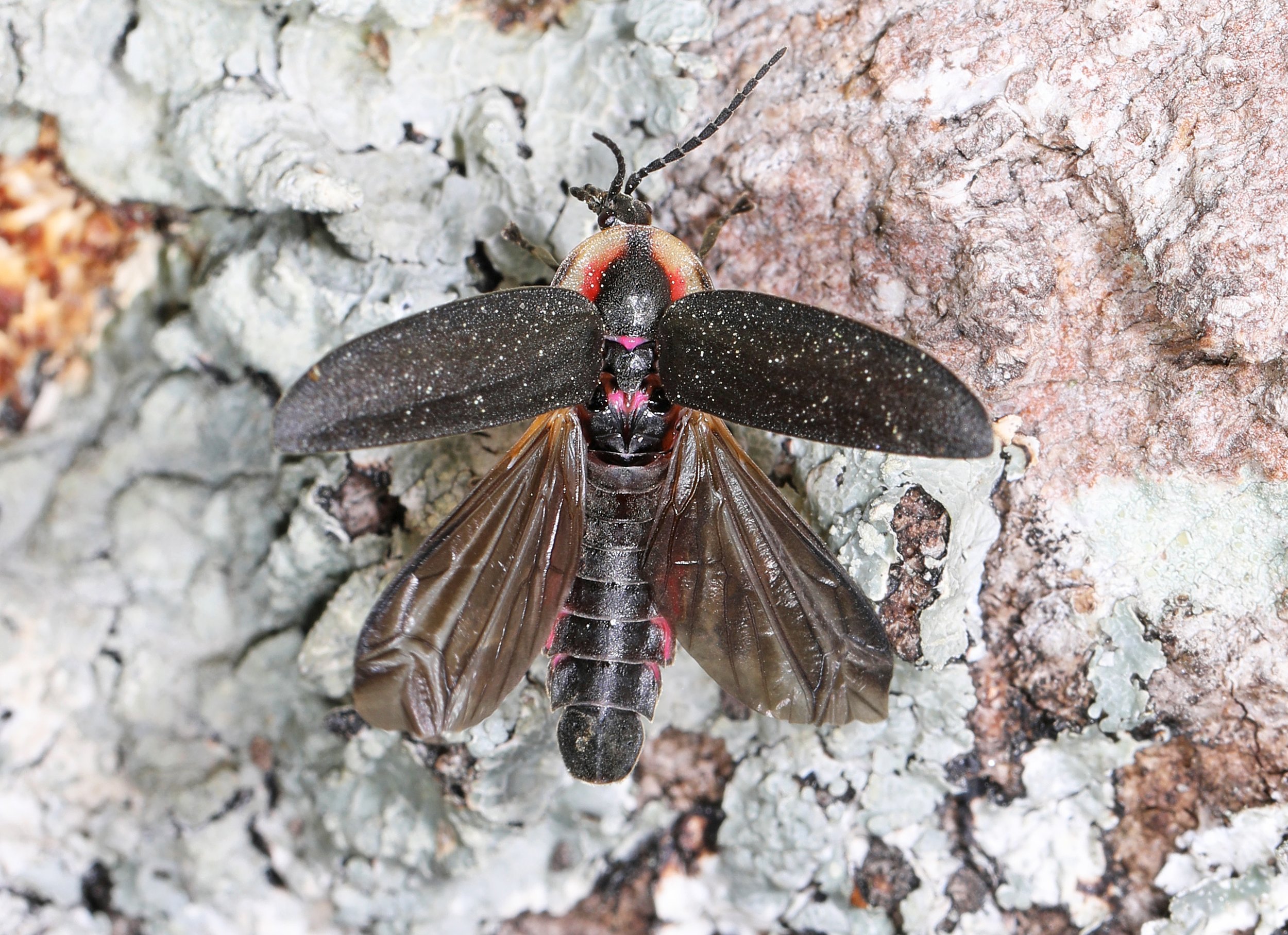
Winter Firefly - Ellychnia corrusca, Judy Gallagher
The Spring Treetop Flasher is not the only firefly species that can be seen now. The Winter Firefly, Ellychnia corrusca, is out even earlier in the year. Adults mature in the fall or winter and disperse and mate in mid-March to early April. They can survive freezing temperatures, but are only active when it is above freezing. They defend themselves with toxic chemicals that ooze from the edges of their wing covers. These fireflies don't flash.

Sneaky Elf - Pyropyga decipiens, Judy Gallagher
Another local species that doesn't flash is the Sneaky Elf, Pyropyga decipiens. It is active during the day and is usually found in tall grass, gardens, and waste areas. Like many other beetles, it pretends to be dead as a defense mechanism. Predators find dead insects to be uninteresting or unappetizing and leave them alone.
Common Eastern Firefly - Photinus pyralis, showing its "lantern", Judy Gallagher
The Common Eastern Firefly, also known as the Big Dipper, is the firefly that you would typically see flashing in your yard in mid-June through early July. The males usually fly at waist height around dusk and then fly higher up as it gets darker. Because they fly early in the evening, they are less susceptible to the effects of light pollution than most other firefly species that flash.

Photuris species , Judy Gallagher
Most firefly species have a unique flashing pattern that attracts others of the same species. But Photuris species females can mimic the flashing patterns of other species, luring them closer, and then eating them. Photuris species females are also known for eating their male counterparts. The females get defensive chemicals from their firefly prey, which they bequeath to their eggs to give them additional protection from predation. It is difficult to identify Photuris to species level.
Other firefly species adults eat nectar or pollen, and some species adults don't eat at all. Pollen feeders can be effective pollinators.
Fireflies were once collected for the chemicals that make them glow, luciferin and luciferase. These chemicals are used in medical applications such as cellular imaging and determining enzyme activity. Fortunately for the fireflies, synthetic chemicals can now be produced in laboratories.
Including the larvae that I mentioned earlier, it is possible to see fireflies here in every month of the year. I am making it a personal challenge in 2024 to see at least one firefly each month.
View more of Judy’s Observations from Meadowood articles here.

Monday Mystery - January 29, 2024
Monday Nature Mystery continues! Read on to learn who correctly identified our last mystery.
Photo: Wood Frog, Judy Gallagher
We are pleased to announce the winner of our last Monday Nature Mystery, Roland Thro!
Congratulations to Roland for identifying this Wood Frog (Lithobates sylvaticus).
Wood Frog, Judy Gallagher
According to The Chesapeake Bay Program, Wood Frogs are known for a characteristic black marking on their face that resembles a robber’s mask. During winter hibernation, the wood frog is able to freeze nearly half of its body. Ice crystals form within its skin, stopping its heartbeat, breathing and blood flow. This is the only frog species found north of the Arctic Circle!
Each Monday we’ll post a new mystery and identify the previous week’s winner. They’ll receive an ASNV hat or tote bag.
Here is this week’s mystery:
Who is this?
Be sure to post your guess on our Facebook page under the latest Monday Nature Mystery post. Good Luck!
Please check our guidelines here.
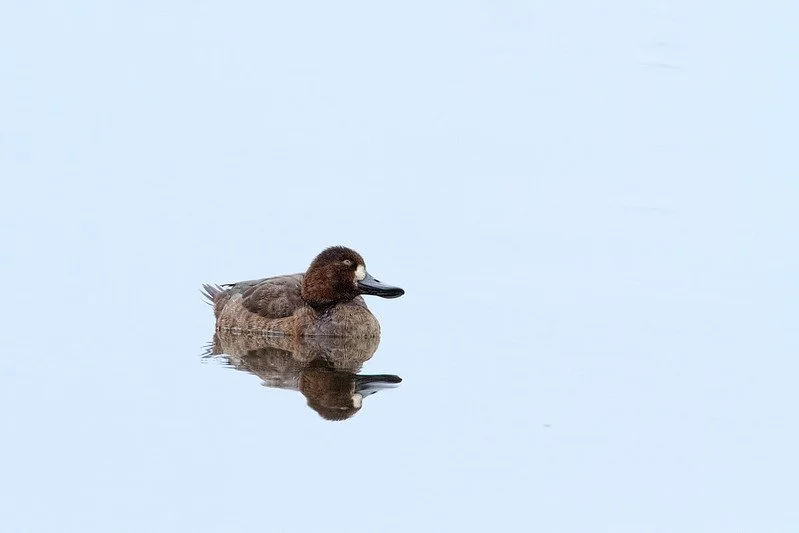
Monday Nature Mystery: Who is this? Photo: Rick Cameron via Flickr, CC BY-NC-ND 4.0 DEED

Help Trees Thrive: Tear Up Some Turf
It’s fairly common in residential neighborhoods to see trees surrounded by grass or by small mulch beds, often heaped high like a volcano. But did you know that your trees would be healthier and grow faster if you replaced that turf and those mulch volcanos with a 2-4” deep ring of mulch that extends out to the tree’s drip line or even beyond?
Photo: Tree surrounded by native shade plants, courtesy of Plant NOVA Natives
Elaine Kolish
It’s fairly common in residential neighborhoods to see trees surrounded by grass or by small mulch beds, often heaped high like a volcano. But did you know that your trees would be healthier and grow faster if you replaced that turf and those mulch volcanos with a 2-4” deep ring of mulch that extends out to the tree’s drip line or even beyond? Let’s look at why this is.
Tree roots are not as deep underground as you might think. Instead, they generally are fairly shallow, in the upper six inches of the soil, which is where turf grass roots grow. This means trees and turf are competing for the same water and nutrients in the soil. The grass generally wins. And of course, as trees become more established, the shade they cast doesn’t do the turf any favors. Turf grass does best with lots of sunlight, and dense shade significantly affects grass growth and quality. Another factor to consider is that exposed tree roots in your lawn can be a tripping hazard that you can avoid if the root area is part of a mulched bed. In addition, when you mow over the grass that is around tree roots, you could be damaging the tree roots, both with the mower blades and by compacting the soil.
If you wonder how much difference turf under trees can make, one study reported that trees in turf grow at half the rate of trees that are not dealing with that competition. So, if you want vigorous tree growth, no turf or less turf under them is best.
Tree surrounded by native shade plants, courtesy of Plant NOVA Natives
Another wonderful benefit from eliminating or reducing turf is the improvement in the survival rate of the caterpillars that turn into butterflies and moths that in turn bring beauty into our lives and environmental benefits. According to Doug Tallamy, a famous professor of entomology and wildlife ecology, a hard-packed lawn underneath a tree does not provide adequate pupation sites for caterpillars that may have been feeding on your native tree, such as an oak. The caterpillar may find no leaf litter (because the lawn has been cleaned up) in which to spin a cocoon, or if it is a species that burrows into the soil, it won’t find any loose soil if there is only turf under the tree. And we need these insects, not just for their beauty, but for their roles as pollinators and as food for other wildlife. As E.O. Wilson, the eminent ecologist, famously said, insects are “the little things that run the world.”
So, consider eliminating the turf under your trees or combining various smaller mulched areas into a bigger area. Your trees will be happier (and you will have less lawn to mow and maintain)! But, remember, don’t let the mulch touch the trees—stay one to two inches away from the trunk to avoid bark rot. Too deep a mulch layer will keep water from reaching the soil – two to four inches is ideal. Best of all is to use arborist wood chips (which you can get for free from Chip Drop or from any tree company that needs to dispose of the chips after felling a tree), as they don’t mat down the way standard bagged mulch may.
Once you have wider rings around the trees, you will have the opportunity to create more biodiversity and habitat by under-planting with native plants including shrubs, flowers and ground covers that thrive in shade or part shade. Think ferns and wild ginger. Native plants have different root depths compared to turf grass, so you won’t have the same unhealthy competition for water and nutrients that you did with turf. You can find details about these plants on the Plant NOVA Natives website.
Pushing back the turf is a project you can do before the ground freezes, or you can start planning your beds now, while other garden tasks are on hold, for spring.

Resolve to Help the Birds in 2024!
New year’s resolutions about more exercise and a better diet are traditional for this time of year, because those actions can help us live better, happier lives. But another way to improve your quality of life is by helping the birds.
Photo: Tufted Titmouse, Jocelyn Anderson/Audubon Photography Awards
Connie Ericson
New year’s resolutions about more exercise and a better diet are traditional for this time of year, because those actions can help us live better, happier lives. But another way to improve your quality of life is by helping the birds. If the pandemic taught us nothing else, it is that spending time in the natural environment is healthy for both our bodies and our minds. So, let’s resolve to help our local wildlife in 2024. Consider undertaking either or both of these home improvement projects in the coming year:
switching outdoor lighting fixtures to comply with dark sky guidelines
modifying windows to protect from bird strikes
There’s some work involved, and at least some moderate costs, but both can help our local wildlife.
Outdoor Lights
I have to confess that I took steps to change out my outdoor lighting fixtures (one on the front porch and one in the back), not out of a sense of mission and virtue, but because the fixture in the back yard stopped working. I kept yellow bug lights in both fixtures for many years, but that satisfies only one of the five basic principles for responsible outdoor lighting:
Do your lights have a clear purpose?
Is the light directed to where it is needed and not at the sky or a neighbor’s property?
Are the lights generating more light than you really need, or would a lower-wattage bulb or a dimmer serve the needed purpose?
Are your lights on all night long or would timers or sensors limit unnecessary light?
Are you using warmer colored lighting where possible?
Both of my fixtures are security lights that allow me to check who is at the door, and I choose to keep them on all night. The old fixtures had sensors so they came on only at dusk; however, neither was adequately shielded to direct light downward only to the porch. So, I began my hunt. I wanted lights that were shielded and designed to switch on and off from light sensors. But I also wanted the lights to dim or brighten, relying on a motion sensor. I found fixtures to order through a big-box building supply only after MANY internet searches. I have since learned that DarkSky International certifies light fixtures. You can search for compliant fixtures for various uses on its website. It would have sped up my process to use that website, but I did get the job done!
The total cost for the fixtures and the dimmable, yellow LED bulbs was around $200. But, if you’re not yet ready to invest in new fixtures, check your outdoor lights to see if some of them can be eliminated (or just turned off). Switch out bright bulbs for yellow bug lights, and consider whether you can modify them with motion detectors so they are not on all the time. One other action I am taking, although this is a gradual process, is installing room-darkening shades, blinds, or curtains on the windows to reduce light spill at night. I haven’t done them all, but I can already see a difference when I step outside at night.
Windows
Over the years I noticed that birds flew into some of my windows, particularly the windows off the back patio where I had some bird feeders, and the two large picture windows on the front of my house. Although taller buildings may present some higher risks for bird strikes (Threats to Birds: Collisions, Fish & Wildlife Service), there are a lot more low-profile structures (like my two-story house) than tall buildings, and they both can cause bird deaths. So, I decided I needed to take action.
What I learned is that I had to make my windows visible to the birds, and that meant creating an image on the outside of the windows. Indoor window coverings, or decals applied to windows indoors, do not eliminate the danger: birds can be confused by reflections, which are not changed by anything covering or marking the window inside. Fortunately, I found there were many ways I could retrofit my windows to make the birds turn back. The American Bird Conservancy website provides links to a variety of do-it-yourself products. ASNV also makes available a how-to video written and filmed by a local Eagle Scout.
I decided to try out several products on my back patio storm door, which I could reach easily and which had experienced bird strikes. I found the easiest product for me to apply was the small, square decals on a two-inch grid. I was able to see the decals from inside the house, but after a day or so I found I did not notice them. I next considered whether to treat some or all of my windows. I knew at least some of the windows where strikes had occurred, but was not certain about the others. I finally decided to treat them all. Because I’m leery of ladders, I had to hire a handyman for the second-story windows, and I decided not to risk having him treat just some of the windows, only to have to arrange for a return visit.
And, I’m happy with the results. I have not needed to replace the decals in the three years since I installed them, and they were not affected by professional window washers. I am only aware of two window strikes since I completed the project, and they occurred at night at a window directly over the previously unshielded front porch light. I’m hopeful that having changed the light fixture changes the risk at that window.
Of course, there many other ways you can improve life for our local birds. Keep your cats indoors, or build them a “catio,” from which they can safely (for the birds) experience the outdoors. There are volunteer projects in local parks for removing invasive plants and planting native plants that nurture local insects and birds. And you can create some bird-friendly habitat in your yard with native plants, natural mulch from fallen leaves, and brush piles that can bring back fireflies. You can advocate for policies that promote conservation at the local, state and national levels. Resolving to take any of those actions in 2024 provides benefits to native wildlife.

Monday Mystery - January 1, 2024
Monday Nature Mystery continues! Read on to learn who correctly identified our last mystery.
Photo: American Wigeon, Judy Gallagher
We are pleased to announce the winner of last week’s Monday Nature Mystery, Judy Dority!
Congratulations to Judy for identifying this American Wigeon (Mareca americana).
American Wigeon, Judy Gallagher
According to All About Birds, breeding males have a green eye patch and a conspicuous white crown, earning them the nickname "baldpate." Females are brushed in warm browns with a gray-brown head and a smudge around the eye. Noisy groups congregate during fall and winter, plucking plants with their short gooselike bill from wetlands and fields or nibbling plants from the water's surface. Despite being common their populations are declining. Learn more about how to identify ducks in our free webinar this month.
Each Monday we’ll post a new mystery and identify the previous week’s winner. They’ll receive an ASNV hat or tote bag.
Here is this week’s mystery:
Who is this?
Be sure to post your guess on our Facebook page under the latest Monday Nature Mystery post. Good Luck!
Please check our guidelines here.

Monday Nature Mystery: Who is this? Photo: Judy Gallagher

2024 Educator Scholarship Application Now Open
Each year ASNV offers a full scholarship to Sharing Nature: An Educator's Week at Hog Island Audubon Camp in coastal Maine. Applications are open now!
Photo: Atlantic Puffins, Walker Golder
Bill Burton
Each year ASNV offers a full scholarship to Sharing Nature: An Educator's Week at Hog Island Audubon Camp in coastal Maine. Hog Island Audubon Camp has offered environmental education programs for adults, teens, families and conservation leaders since 1936. While there, educators learn interdisciplinary hands-on methods and approaches to environmental education while immersed in the natural world--read about the 2022 recipients' experience here.
The applicant must be a public classroom teacher, specialist or school administrator in the ASNV chapter territory, which encompasses all of Arlington, Fairfax, Prince William and Stafford Counties (excluding Dulles Airport in Fairfax County), and portions of Fauquier, Loudoun, Rappahannock and Spotsylvania Counties. Independent cities in that area include Alexandria, Fairfax, Falls Church, Fredericksburg, Leesburg, Manassas and Manassas Park. The maps on our website provide additional detail.
Educator’s Week in the coming year is July 14-19, 2024. To apply, please complete the online application and submit two letters of recommendation no later than February 28, 2024. Please see the application for additional details, including post-camp requirements.
The Audubon Name: An Update on Our Survey
Earlier this fall, we conducted a survey to learn how our members and friends feel about the possibility of changing the name of the Audubon Society of Northern Virginia. If you participated, thank you!
Image: Tundra Swan, John James Audubon
Earlier this fall, we conducted a survey to learn how our members and friends feel about the possibility of changing the name of the Audubon Society of Northern Virginia. If you participated, thank you!
We want to provide you with a high-level summary of what we learned from the survey and let you know the next steps in our decision-making process. From the 481 responses to the survey, we learned that our community is almost evenly split on the question of dropping “Audubon” from the name. People younger than 60 showed a significant preference for a name change. However, given how even the overall preferences were, we are now focusing on understanding and addressing the concerns behind the preferences.
Respondents gave thoughtful comments to explain their views. Whether they oppose or support a name change, many respondents recognize both Audubon’s major contributions to ornithology and the public’s appreciation of birds and nature, as well as the troubling aspects of his legacy, including his ownership of enslaved people and his scientific dishonesty. Those supporting a name change give more weight to the negative aspects of his legacy and see them as a barrier to involving young people and people of color in the organization and in the larger cause of conserving birds and nature. Those opposing a name change give more weight to Audubon’s positive contributions, and see a name change as costly in terms of the time, effort, and money to make the change, and are concerned with the loss of brand recognition and the association of the Audubon name with birds and conservation.
We thank all of you who took the time to respond to the survey and share your views. We have learned a lot from your passionate and thoughtful responses. We also have been in touch with Audubon chapters across the country, including some that have decided to change their name and others that decided not to change. Their experience has provided considerable insight into the costs and benefits of this choice.
The next step is for the ASNV Board of Directors to meet early in 2024 to decide whether to change the name of the organization. Then, no matter what we decide, we will communicate clearly the outcome and use the understanding we have gained to strengthen our organization’s ability to carry out its conservation and community engagement missions. And if we decide to change our name, we’ll need to come up with a new name. Stay tuned, and we will keep you posted.