
NVBA NEWS BLOG
Welcome to the blog for Northern Virginia Bird Alliance, a wealth of resources about northern Virginia birds, wildlife, habitat conservation and restoration, native plants, wildlife-friendly gardening, advocacy and more.

Observations from Meadowood: June 2024
Judy Gallagher is an ASNV board member and a regular surveyor of local wildlife who also captures photos of what she sees, in particular the less common species.
Photo: Phidippus species Jumping Spider, Judy Gallagher
Judy Gallagher is an ASNV board member and a regular surveyor of local wildlife who also captures photos of what she sees, in particular the less common species.
Insects protect themselves from predation in a variety of ways, but one of the more unusual techniques is to resemble the predator that they want to avoid. Several insects mimic the appearance of jumping spiders, formidable predators for their size. As the mimicry patterns are only in certain parts of the imitators’ bodies, this is called partial mimicry.

Peacock Brenthia metalmark moth, Judy Gallagher
Metalmark moths in the genus Brenthia mimic jumping spiders. Their posture and wing markings make the moth look a little like a head with jumping spider-like eyes, and the moth moves with short bursts of movement, just like a jumping spider would. The jumping spider resemblance is not terribly obvious to me, and even if it were, it’s more important that the spider sees the resemblance. So, scientists conducted experiments with the moths, placing them with jumping spiders in an enclosed space. The spiders displayed territorial behaviors, implying that they thought the moths were jumping spiders. They did not do this with other similarly sized moths that lacked jumping spider markings. While the spiders were busy displaying territorial behavior, the moths flew away. In the study, most metalmark moths survived, and most other moths did not.

Red-banded Hairstreak, Judy Gallagher
Some butterflies also mimic jumping spiders. The Red-banded Hairstreak has spots and tails on its wings that look like a jumping spider’s head, and the way it moves its wings mimics jumping spider movements. In an experiment, a Red-banded Hairstreak was placed in an enclosed space with a jumping spider. The spider attacked what it thought was the head of its prey and directed its venom there to paralyze it. The Red-banded Hairstreak flew away every time, although it sometimes incurred minor wing damage. Eleven other butterfly and moth species without jumping spider markings were exposed to the jumping spider, and many of them succumbed to the spider’s attack.
The jumping spider grew tired when attacking prey that it could not capture. That could potentially lead it to not attack the butterfly at all.

Red-banded Hairstreak with wing damage, Judy Gallagher
There are other Hairstreaks with spider-like markings, and an examination of museum specimens shows that the more deceptive-looking the markings are, the more frequently they are found to be damaged. If the Jumping Spider does attack the butterfly, it targets the false head markings on the wings. The butterfly incurs wing damage, but it escapes without damage to its vital organs.

Gemmed Satyr, Judy Gallagher
The Gemmed Satyr butterfly has a perfect picture of a jumping spider on its hindwings, but I was unable to find any studies that documented interactions between the species.

Pepper Maggot showing "spider leg" wing markings, and “spider eye” thoracic markings, Judy Gallagher
Some flies mimic jumping spiders. The Pepper Maggot (Isn’t that a great name!?) has a leg-like pattern on its wings. It waves its wings in a way that mimics the territorial displays of jumping spiders, and the thoracic markings look a little like a spider’s head with eyes. When faced with this fly, jumping spiders display territorially and then retreat. In a gruesome experiment, scientists transplanted house fly wings onto the Pepper Maggot, who was then successfully attacked by the jumping spiders. House flies with Pepper Maggot wings were also attacked, showing that the fly needs both the wing markings and the wing waving behavior to avoid jumping spiders.

Rhagoletis species Fruit Fly, Judy Gallagher
Scientists originally thought that Rhagoletis species Fruit Fly markings were species-recognition marks, but it turns out that these also mimic jumping spiders. When a jumping spider approaches the fly, the fly spreads its wing and wobbles from side to side. This looks similar to jumping spider movements. The spider is intimidated and it leaves the fly alone. Scientists experimented by painting the fly’s wings black so that the spider pattern was no longer there, and the jumping spider then attacked the fly.
Phidippus species Jumping Spider, the model, Judy Gallagher
It's hard for me to decide whether I am more impressed by how moths, butterflies and flies have evolved to outwit jumping spider predators, or by the experiments that scientists have come up with to test this. In either case, it is clear to me that sometimes the best defense is a good offense.
View more of Judy’s Observations from Meadowood articles here.

Monday Mystery - May 27, 2024
Monday Nature Mystery continues! Read on to learn who correctly identified our last mystery.
Photo: Eastern Fence Lizard, Judy Gallagher
We are pleased to announce the winner of our most recent Monday Nature Mystery, Mike Molnar.
Congratulations to Mike for identifying the Eastern Fence Lizard (Sceloporus undulatus).
Eastern Fence Lizard, Judy Gallagher
According to the National Wildlife Federation, this species of lizard is native to Virginia and can be found across the Eastern US. To claim territory, male fence lizards will flash the blue scales on their underbelly. They have also been observed doing push-ups and head-bobs to deter other males from infiltrating their territories. This behavior is correlated with the availability of food in the area.
Each Monday we’ll post a new mystery and identify the previous week’s winner. They’ll receive an ASNV hat or tote bag.
Here is this week’s mystery:
Who is this?
Be sure to post your guess on our Facebook page under the latest Monday Nature Mystery post, and make sure you receive our emails to find out the winner and mystery answer each week. Good Luck!
Please check our guidelines here.
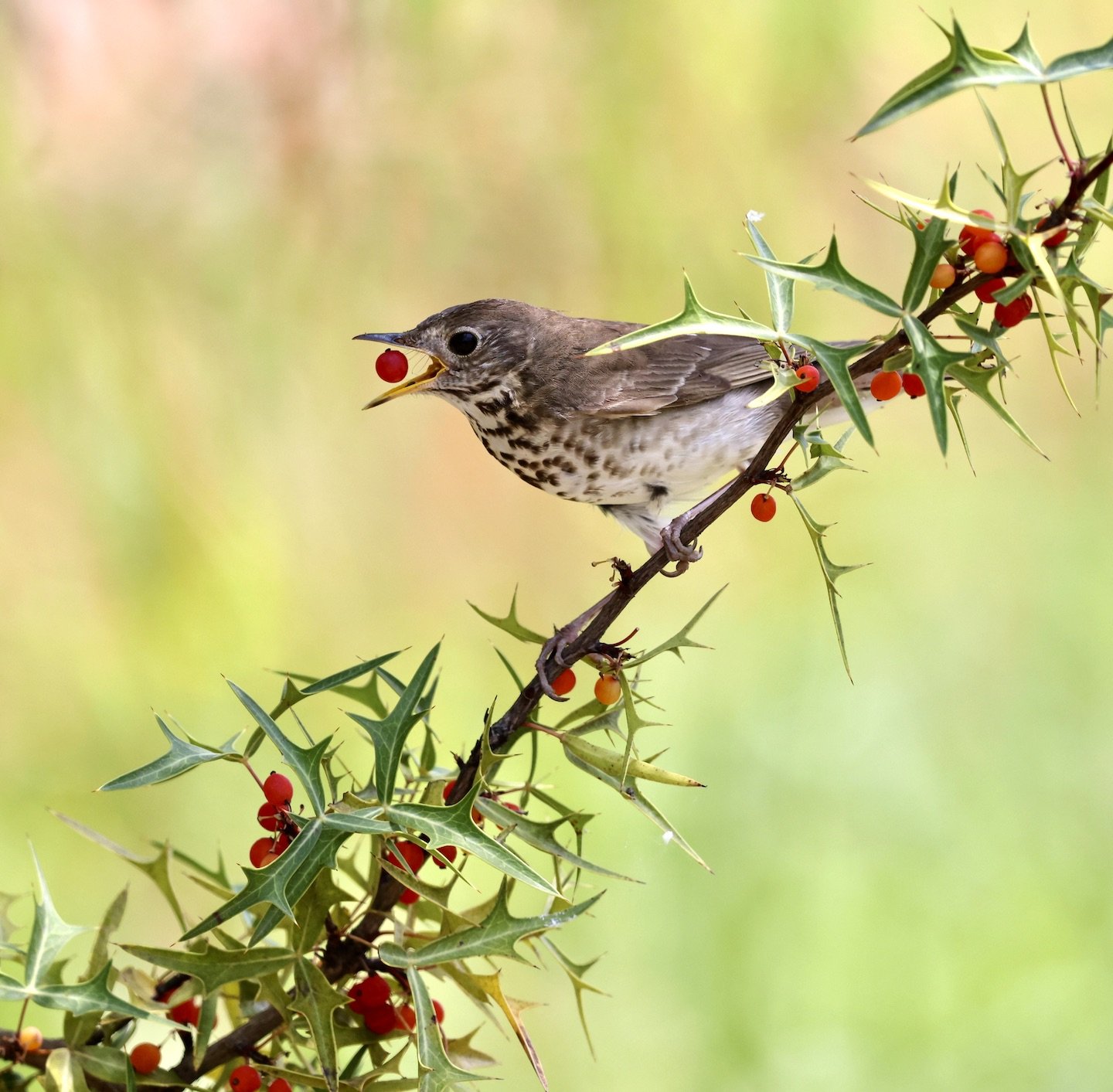
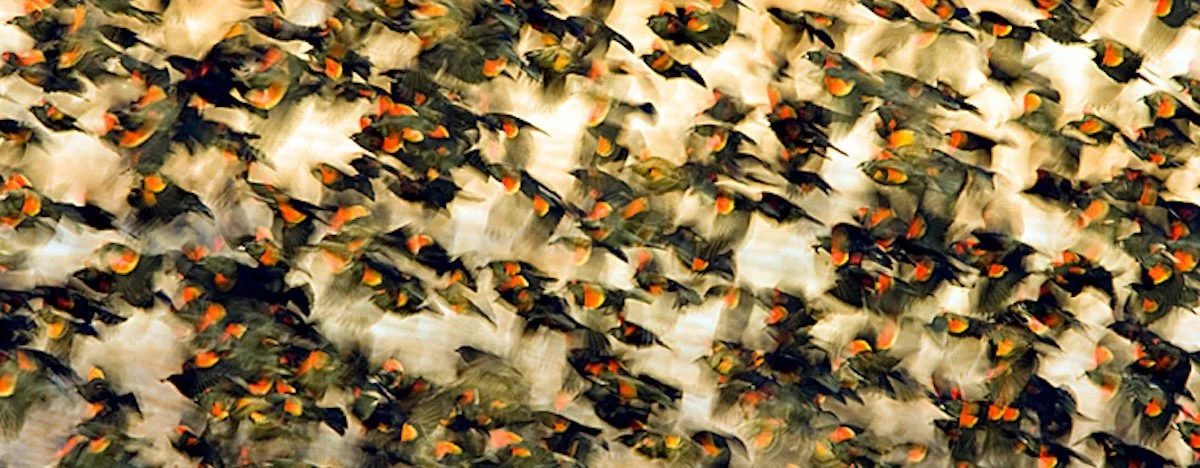
Monday Nature Mystery: Who is this? Photo: Jim Gilmore/Audubon Photography Awards

Helping the Lovely Wood Thrush
One of the most anticipated sounds of spring in northern Virginia is the exquisite song of the returning Wood Thrush.
Photo: Wood Thrush, Linnet Tse/Audubon Photography Awards
Evelyn Novins
One of the most anticipated sounds of spring in northern Virginia is the exquisite song of the returning Wood Thrush. Unfortunately, this small, migratory songbird has been added to the list of birds at a tipping point by the North American Bird Conservation Initiative in its 2022 State of the Birds report. The report identifies 70 species of birds that have lost two-thirds of their population over the last 50 years and are projected to lose 50% of their population over the next 50 years. These birds are deemed at a “tipping point” for extinction. Without consequential intervention they are likely to become threatened, endangered or extinct. So, we have work to do if we are to continue to hear the lovely Wood Thrush in our area.

Wood Thrush, Lance Leonhardt/Audubon Photography Awards
Recognizing the Wood Thrush
But first, if you are not yet familiar with this lovely singer, a little introduction.
Click here to listen to the beautiful song of the Wood Thrush.
The Wood Thrush, Hylocichla mustelina, can be mistaken easily for a number of other brown thrushes, or even Ovenbirds. But close examination shows a reddish-brown head, back, and wings and a well-rounded white belly spotted with black dots, characteristics that help distinguish it from other brown thrushes. In addition, the Wood Thrush has a bold, white eye-ring and pinkish legs! As a thrush, it has the stance of our familiar American Robin and the mesmerizing song of a thrush. The male can actually sing pairs of notes together, the pit-pit-pit call before roosting, as well as nearly 50 other songs.
The Wood Thrush’s nest is built by the female in a young tree or shrub. It is similar to a robin’s nest with a layer of mud set into a cup-shaped nest. The outside is made of dead grasses and maybe even some cloth, cellophane or paper. The male helps with feeding the young, giving the female time to start another nest and brood. Nearly half of mated pairs raise two broods.
How You Can Help
The primary cause of the decline in population is loss of habitat and habitat fragmentation, both in its breeding grounds (which include northern Virginia), and in Central and South America where it spends the winter. So, helping requires preserving habitat both here and on the birds’ wintering ground.
The Wood Thrush prefers mixed forests where there are large trees with a well-shaded understory and abundant leaves where the bird can forage for insects. While many of our northern Virginia parks provide more fractured habitat, the bird does breed in some wooded suburban areas. It feeds on many insects, including ants, crickets, moths, beetles, and spiders as well as snails and snail shells. Snail shell is particularly necessary for the breeding female. Reports indicate that declining calcium in the shells due to acid rain (which leeches the necessary calcium) may also contribute to the decline of the Wood Thrush population.
Not all of the threats are easy to address on a local level, but there are some actions we can take. Minimizing pesticide use at our homes reduces the overall loss of insect life that the thrushes need to survive in our wooded parklands. Educating our neighbors about the need for effective deer management to prevent loss of forest understory that Wood Thrushes need for foraging is also important. And, while acid rain is a problem not easily addressed at the local level, we can continue to advocate for sensible energy policies that reduce acid rain.
We also can help the Wood Thrush on its wintering grounds by supporting certain agricultural choices. The birds’ wintering grounds in Central and South America suffer from habitat loss just like our northern forests. The tropical rainforests in Central America have been compromised by extreme habitat loss as forests are replaced by agricultural landscapes. But some growers are helping. Shade-grown coffee and hardwood plantations offer good habitat that can substitute for tropical rainforest. Studies are showing that these environments can provide sufficient fuel to build the fat reserves necessary for these birds to migrate back here to breed.
We can support the farmers of shade-grown coffee by purchasing their products. Their agricultural choice increases habitats for migratory birds such as the Wood Thrush as well as many other songbirds. To ensure that the coffee you buy helps songbirds, make sure that the brand meets the criteria set by the Smithsonian Institute, which operates a certification program to identify which coffee growers provide these beneficial environments. You can buy certified bird-friendly coffee from National Audubon or visit the Smithsonian Institute website to find other vendors who offer a plentiful variety of blends and roasts.
Where to Find Wood Thrush
This is the perfect month to hear and spot Wood Thrush returning from their winter home. The participants in the Monday morning bird walk run by the Friends of Huntley Meadows Park have already heard the thrush’s lovely song. Other local sites where you can hear or see them include Elizabeth Hartwell Mason Neck National Wildlife Refuge, Pohick Bay Regional Park, and Mason Neck State Park.
I’m going out to take a look!

Humans and Trees Share a Common Enemy: Stress!
We all know that chronic stress affects our health and well-being, causing us to go into “fight or flight” mode. Ongoing stress also affects the health of trees.
Photo: Stressed tree, Sara Holtz
Elaine Kolish
Stressed tree, Sara Holtz
We all know that chronic stress affects our health and well-being, causing us to go into “fight or flight” mode. That, in turn, can lead to a variety of health effects ranging from depression to high blood pressure, which itself can increase our risk for stroke or heart attack. Ongoing stress also affects the health of trees. But unlike us, they have limited options for reducing their stress. They can use internally produced chemicals and scents to deter predators and warn other trees of threats, as well as help stressed neighbors by sharing water and nutrients through an underground fungal network. But they can’t pick up and move to avoid stressful conditions. We need to step in and alleviate tree stressors to the extent we can, particularly those caused by human activity. The good news is that caring for trees and spending time in nature can reduce our own stress. A win-win.
Although there are some stressors - such as early spring frosts, extreme heat, and heavy snow and ice - where we are mostly powerless to help, there are many others where we can make a difference. And it is important to do so, because trees can die from exposure to long-term stress, such as multi-year droughts, which can cause them to become more susceptible to insect pests or to diseases that kill them. Let’s look at some human-caused stressors - ones that we can control - and at environmental tree stressors such as drought, where we might be able to help.
Use the right plant in the right spot. Right off the bat, you will stress a tree if you plant it in the wrong spot. For example, a shade loving, understory tree such as Flowering Dogwood is going to be highly stressed if planted in full sun in dry soil. Consult plantnovatrees.org for help in choosing the right trees for your site.
Use proper planting and staking techniques. These include not planting the tree too deeply and not burying the trunk flare. Think about whether you need stakes and guy wires, because preventing a tree from swaying in the wind will weaken it. If you do use them, always remove them in a timely fashion and not later than a year after planting. When left on too long, stakes can girdle and kill a tree. For information on how to plant a tree properly, consult Fairfax CountyTree Basics.
Use proper mulching techniques. Mulch should be applied in a donut shape, not a volcano, and should not touch the tree. When piled high against the tree, mulch can cause decay and ultimately death. The mulch should not be more than two or three inches deep to allow the rain to penetrate. If for some reason you want to add more every year, you should remove the old mulch first.
Avoid competition for water. Trees and turf are not friends. Since both have shallow roots, they compete for water and nutrients, and turf wins the battle in the tree’s early life. Also, if there is grass under trees, we run the risk when mowing of damaging the bark, nicking shallow tree roots, or compacting the soil. Any of those will stress our trees. Mulch and/or dead leaves under trees is best, and the larger the ring, the better. A large turf-free ring also provides the opportunity for underplanting with native shrubs and ground-layer plants, creating a mini productive habitat for insects and wildlife.
Avoid everyday activities that can hurt trees. Chaining bikes or other items to trees can damage their bark, as does allowing car doors or bumpers to hit them. Repeatedly wounding their bark makes trees vulnerable to decay and disease. Parking under trees also causes soil compaction that can suffocate tree roots.
Use proper pruning methods. Don’t top trees! That is a sure way to weaken a tree, make it structurally less sound, and in the most extreme situations eventually kill it. It is useful to take out broken, diseased and dead branches. For example, a clean cut to remove a broken branch helps a tree recover from a wound better, and pruning out a dead branch keeps it from falling unexpectedly and damaging something or someone. If you don’t know how to prune trees properly, hire a certified arborist to do so or consult one of the many how-to-prune books you can find at the library. A good reference book can show you how to prune trees so they are free from structural weakness and are as healthy and vigorous as possible.
Water during droughts. We may not think to water our native trees and shrubs, because a key characteristic of native plants is that once they are established, they no longer need to be watered. But, when there is a drought, even natives may need to be watered, and that is especially true if they have limited soil space from which to draw water, such as in a small tree box next to a street. Without sufficient water, trees will lose their fine absorbing roots and leaves and move to a dormant state. Years of drought and/or other stressors eventually can cause the tree to die.
Protect young trees from deer browse. Unfortunately, an overabundance of deer can stress and threaten the survival of our woodies. Consult Plant NOVA Natives for strategies to deal with deer.
Although human actions as well as environmental factors can stress trees, we can avoid causing harm and can take actions that keep trees healthy and vigorous. Trees provide us so many benefits, including a profound sense of well-being, that it is well worth it for all of us to do all we can to reduce tree stresses and promote tree health.

Take This Survey on Invasive Plants!
This survey will allow us to demonstrate how important the issue of invasive plants is to Virginians and allow us to collect contact information from people who can help reach out to their legislators.
Photo: English Ivy on trees, N. Chadwick, CC BY-SA 2.0, via Wikimedia Commons
Please take this survey and share it as widely across Virginia as you possibly can.
We scored some modest environmental wins in the 2024 Virginia General Assembly, but we lost on some important initiatives. Governor Youngkin vetoed a bill allowing local governments to prohibit the sale of English Ivy after it had passed the Virginia House and Senate. Governor Youngkin also vetoed a bill passed by the House and Senate that would have allowed local governments to require plant retailers to post warning signs next to plants on Virginia’s invasive plant list.
If we are going to succeed in having legislation adopted that will help to rein in the devastating impact of invasive plants on our ecosystems, we need to do much more work to convince legislators and Governor Youngkin’s office of the importance of passing invasive plant legislation.
This survey, from Blue Ridge PRISM, is Phase One of planning for next year’s legislative session. It will allow us to demonstrate how important the issue of invasive plants is to Virginians and allow us to collect contact information from people who can help reach out to their legislators.
Here's the link to the survey: Virginia Invasive Plant Survey. Please complete it today!

Observations from Meadowood: May 2024
Judy Gallagher is an ASNV board member and a regular surveyor of local wildlife who also captures photos of what she sees, in particular the less common species.
Photo: Eastern Carpenter Bee female showing mandibles , Judy Gallagher
Judy Gallagher is an ASNV board member and a regular surveyor of local wildlife who also captures photos of what she sees, in particular the less common species.
Most of us appreciate bees, especially for their role in pollination. But there is one bee that homeowners love to hate, the carpenter bee. They make nests by tunneling into wood, and this is not good if the wood is part of your house or deck. The entrance is a circular hole, frequently on the underside of a beam, bench, or tree limb. The bee makes a tunnel with various chambers, one for each of its larvae. The nest may have several adjacent tunnels. There are about 500 carpenter bee species worldwide, including large and small varieties, but the most commonly seen carpenter bee in our area is the Eastern Carpenter Bee, which is about 3/4 inch long.
The Eastern Carpenter Bee is visually similar to a bumble bee, but the carpenter bee’s abdomen is black, bare, and shiny. Bumble bee abdomens are fuzzy, usually with yellow markings.
Eastern Carpenter Bee female showing mandibles, Judy Gallagher
Carpenter bees have particularly strong mandibles (jaws) and they vibrate their bodies while rasping their mandibles against the wood. They don't eat wood, but they often use wood shavings to create walls between the chambers. A carpenter bee can excavate about one inch of tunnel in a day, so it takes a while to create a large nest.

Eastern Carpenter Bee female going into nest with a lot of pollen, Judy Gallagher
When the nest is complete, the bee provisions each chamber with a ball of pollen and nectar, and lays an egg in each chamber. Carpenter bee eggs are known for their size, larger relative to the size of the female than for most insects.

Eastern Carpenter Bee male guarding its nest, Judy Gallagher
Female carpenter bees can sting, but it's unlikely that they would sting you unless you picked one up. So don't try that! Male bees can be a bit aggressive when protecting their nest. They dive bomb, which is intimidating because of the size of the bee and the buzzing, but they don't have stingers so they can't hurt you. You can tell the difference between a female and a male Eastern Carpenter Bee by the face. Males have a white face, and females do not.

Male Eastern Carpenter Bee guarding a flower, Judy Gallagher
Male carpenter bees find mates visually while flying, and also by guarding flowers, hoping that a female will appear. Eastern Carpenter Bees are solitary bees, but females sometimes make tunnels close to other females. They tolerate each other but aren't social like Bumble Bees or Honey Bees, and they don't have worker bees to help with pollen collection.

Eastern Carpenter Bee nectar-robbing Virginia Bluebells, Judy Gallagher
Carpenter bees are good pollinators, so they play an important role in the ecosystem. They employ a technique called buzz pollination, where the bee grasps the flower with its legs or mouthparts and vibrates its flight muscles to make the pollen fall from the flower's anthers. The tongues of carpenter bees are of medium length, so they can't easily get nectar from flowers with long tubes. But they've found a way around that. The bee drills a hole near the base of the flower and gets nectar through that hole, bypassing the pollen. This is called nectar robbing.

Tiger Bee Fly, Judy Gallagher
Eastern Carpenter Bees have some natural predators, including woodpeckers. Sadly, the woodpeckers can do further damage to your house or deck by drilling into the wood to get at the bees. Large mantises and robber flies also eat carpenter bees. The Tiger Bee Fly will lay eggs in or near the bee's nest, and its larvae will eat the bee larvae.

Bedraggled Eastern Carpenter Bee, Judy Gallagher
You may be wondering how you can make your house and deck less attractive to carpenter bees. First, treat or paint the wood. Carpenter bees usually won't drill in treated or painted wood. Spraying citrus fruit spray (water with citrus or citrus essential oils) or almond oil around bee nests usually repels the bees. Finally, scientists have discovered that playing loud music, especially music with vibration, disturbs the bees. So, crank up the heavy metal and enjoy a home free of carpenter bees!
View more of Judy’s Observations from Meadowood articles here.

Can you help advocate for your local government to adopt new environment-friendly legislation?
Conservation advocates lost several battles in the 2024 General Assembly, but did score a couple of wins that allow local governments to adopt some environment-friendly requirements. We can use your help in lobbying your local governments to adopt these measures.
Photo: Virginia State Capitol Building, Wikimedia user Skip Plitt via CC BY-SA 3.0
Tom Blackburn
Conservation advocates lost several battles in the 2024 General Assembly, but did score a couple of wins that allow local governments to adopt some environment-friendly requirements. We can use your help in lobbying your local governments to adopt these measures.
Tree canopy funds
Governor Youngkin signed into law HB459 and SB121, identical bills that allow local governments in northern Virginia to broaden the use of dollars that developers pay to restore the tree canopy. Localities can adopt an ordinance to allow the tree canopy fund to maintain trees on public property and plant and maintain trees on private property. Before the enactment, those funds were limited to planting trees on public property. The new law also allows a locality to remove provisions that required that any funds not spent within five years be returned to the original contributor, although it maintains the five-year spending requirement. The bill also allows for expanding the canopy credit.
Herbicide application by volunteers
Governor Youngkin also signed into law HB320, which allows local governments to permit supervised volunteers to apply herbicides, a provision that can assist local programs working to push back on invasive plants. The law allows localities to authorize unpaid volunteers to use any nonrestricted herbicide to control invasive plants or noxious weeds on properties owned by the political subdivision. The unpaid volunteer would have to operate under the direct supervision of and following instruction by a certified commercial applicator. The instruction would cover
(i) the risks associated with the herbicide utilized, (ii) the proper use of equipment used to apply the herbicide, (iii) the proper use of personal protective equipment, (iv) other information to prevent an unreasonable adverse effect on the environment, and (v) any other information relevant to the specific herbicide utilized.
Localities will have to adopt ordinances to make these new provisions effective in their jurisdictions. If you are interested in advocating for your locality to adopt the new provision, please email Tom Blackburn, ASNV’s Advocacy Chair, at advocacy@audubonva.org.

Wildlife Sanctuary Almanac: Create a Mini-meadow
Springtime is for planting! If you’re looking for ideas for a sunny spot, think about creating a mini-meadow to bring pollinators to your yard
Photo: Mini-meadow, Margaret Fisher
Margaret Fisher and Eileen Ellsworth
Springtime is for planting! If you’re looking for ideas for a sunny spot, think about creating a mini-meadow to bring pollinators to your yard. If you’re not sure what to plant, request a free visit from an Audubon at Home Ambassador, who can advise you.
When they aren’t being bulldozed over, the natural state of most meadows in northern Virginia is gradually to revert to forest, but that fact does not lessen their importance to the ecosystem. Although there are many threats to our woods, it is the meadows that are disappearing the fastest, which is a big problem for birds and other critters that depend on sizable meadows for habitat. When was the last time you saw a meadowlark or a quail, for example? So, if you own land with a natural meadow, you do a great service by preventing it from reforesting or from being developed.
Of course, most of us don’t have natural meadows on our properties, but we, too, can help repair some of the damage by adding meadow plant species to our yards. In most cases, that translates to creating pollinator gardens that can serve as mini-meadows or small-scale meadow analogs that attract hummingbirds, butterflies, and other pollinating insects. Even relatively small spaces can foster meadow habitats, especially because much of the ecological value of a meadow comes from common, easy to find, easy to grow species.
Start with just two or three sturdy and meadow-loving natives that produce beautiful flowers and attract pollinators as well, such as Butterfly weed (Asclepias tuberosa), Goldenrod (Solidago rugosa or Solidago caesia), Mountain mint (Pycnanthemum tenuifolium), and Hollow Joe-pye-weed (Eutrochium fistulosum). Plants like to grow in communities near other plants. It’s a good idea to put three to five of them together, an arrangement that mimics the way plants grow naturally in meadows. You can always increase the types and number of native flowering plants in your mini-meadow, expanding it over time as your space and interest allows. See the lovely example below of the front yard where half of the yard was planned as a mini-meadow with a mix of grasses and herbaceous plants blooming in succession throughout the growing season.
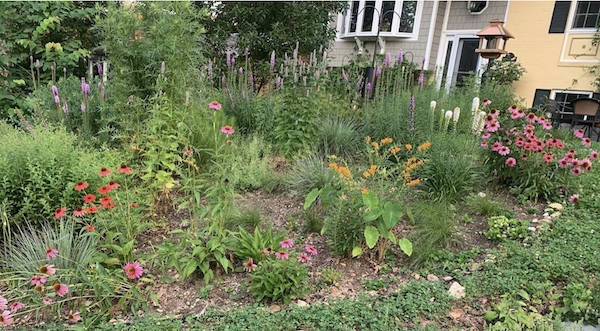
South Arlington front yard, Alyssa Morel
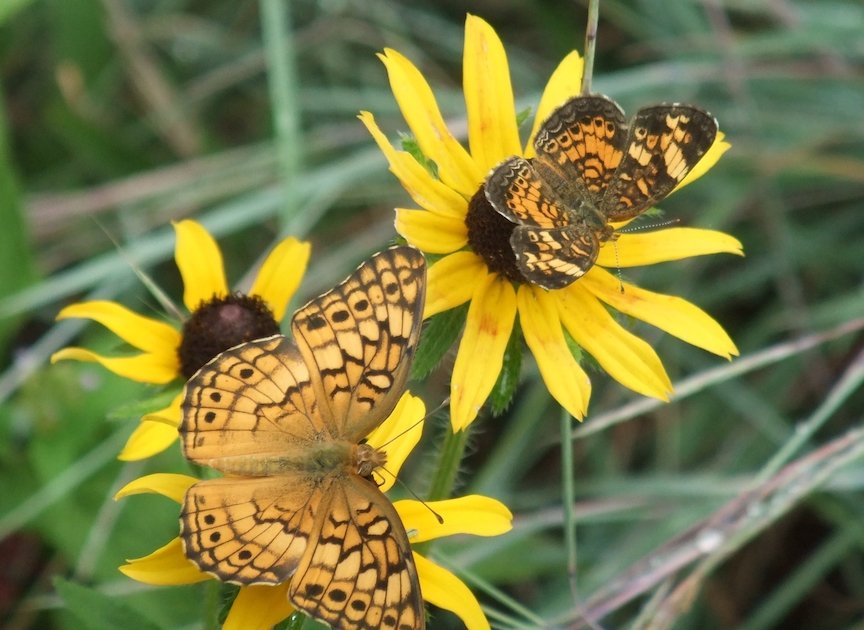
Butterflies on Rudbeckia fulgida, Betsy Martin
Pollinator turnout on flowering natives is high. Dozens if not hundreds of hummingbirds, bumblebees, flies, beetles, and hummingbird moths, along with many other kinds of pollinators, will show up. The more varied your mini-meadow offerings, the more diverse the pollinator population it will attract. It is sure to delight and amaze you, especially when compared to the dearth of pollinator activity on non-native landscapes. Don’t be surprised if you start seeing more insect-eating birds such as warblers, Eastern Phoebes, and Eastern Wood-Pewees. They will certainly notice and take advantage of the opportunity you provide.
When planning your mini-meadow, don’t forget grasses. Somewhere between 40% and 70% of meadow plant species are some sort of grass, a term used here to include sedges, rushes, and grasses. All grasses are wind pollinated, so you won’t see the same level of pollinator interaction as with the native flowers listed above. But grasses are nevertheless essential to the wildlife of a healthy meadow. Their dense roots, which you will only fully appreciate the first time you try to dig up a native grass plant and move it, help stabilize the soil, prevent erosion, corral assertive native flower species, and tamp down weeds. Birds use grasses for nesting materials, Monarch butterfly larva can use grass stems for cocooning, and grasses are host plants for skipper butterflies. The list goes on. They provide support and protection for many birds, insects, and other small meadow critters living in, on, or close to the ground.
You can find out more about garden-worthy grasses on the Plant NOVA Natives website. Good bets for your mini-meadow include Broomsedge, Eastern narrow-leaved sedge, and Little Bluestem. If you really want a sunny meadow as opposed to just a flower garden, the best approach is to establish the matrix of grasses first and add in flowers later. Native species can be found from several seed sources - they are less expensive when purchased in bulk - for when you are starting with bare soil. Otherwise, buying trays of small plugs is cost-effective.
An added benefit of meadows in general and grasses in particular is the winter interest they bring to your yard. To support the entire life cycle of the critters that depend on them, don’t mulch beyond the first year. Leave the plants standing all winter, and enjoy the interesting stalks and seed heads. The next year’s plants will poke up through the dead leaves and stalks without difficulty. Minimizing outdoor lighting allows for the nocturnal activities by moths and others that are essential to the ecosystem. And of course, spraying for ticks and mosquitoes in your yard should be strictly avoided, as it will kill the little neighbors that you invited in.
You won’t have to go far to find native meadow flowers and grasses for sale. Many sellers are close to where you live. Northern Virginia is fortunate to have several native only garden centers. In addition, one-day native plant sales are held across the region in the spring and fall. Also, conventional garden centers now supply more native plant options than ever given the growing consumer demand.
No matter how modest or ambitious your plans may be, taking the first step to build a mini-meadow habitat is what matters. Your new native plantings will expand meadow-like habitats, increase meadow-loving life, and ultimately improve the biodiversity of the region.

Monday Mystery - April 29 2024
Monday Nature Mystery continues! Read on to learn who correctly identified our last mystery.
Photo: Louisiana Waterthrush, Darla J. Outhaut/Audubon Photography Awards
We are pleased to announce the winner of our most recent Monday Nature Mystery, Natalie Brenan.
Congratulations to Natalie for identifying the Louisiana Waterthrush (Parkesia motacilla).
Louisiana Waterthrush, Darla J. Outhaut/Audubon Photography Awards
According to All About Birds, this species stays close to moving water—especially forested streams and creeks—and bobs its rear end almost constantly. In both spring and fall, Louisiana Waterthrush is among the earliest migrant warblers. Because Louisiana Waterthrush feeds on streambed (“benthic”) invertebrates, the species is an excellent indicator of the quality and health of a stream—or “stream ecosystem integrity” as a scientist might say.
Each Monday we’ll post a new mystery and identify the previous week’s winner. They’ll receive an ASNV hat or tote bag.
Here is this week’s mystery:
Who is this?
Be sure to post your guess on our Facebook page under the latest Monday Nature Mystery post. Good Luck!
Please check our guidelines here.

Monday Nature Mystery: Who is this? Photo: Mathew Markowitz/Audubon Photography Awards

A New View of the Landfill
A landfill can be more than a garbage dump. It can be a place of ecological renewal. The latest example at Fairfax County’s I-95 landfill is a plan to protect some of the landfill’s grassland habitat for ground-nesting birds and other wildlife.
Photo: Dickcissel, Russel Smith/Audubon Photography Awards
Grassland at the I-95 landfill provides habitat for ground-nesting birds and other wildlife.
Glenda C. Booth, Connection Newspapers
A landfill can be more than a garbage dump. It can be a place of ecological renewal. The latest example at Fairfax County’s I-95 landfill is a plan to protect some of the landfill’s grassland habitat for ground-nesting birds and other wildlife.
On February 20, the Board of Supervisors directed the county staff to identify a no-mow area and develop a plan to avoid mowing during grassland birds’ ground-nesting season, generally between April 1 and mid-July. Supervisors Dan Storck, James Walkinshaw and Jeff McKay proposed the initiative or “board matter,” recommended by the Audubon Society of Northern Virginia. Supervisor Storck offered, “I was pleased to bring this Board matter to my colleagues and received unanimous support. The County continues to lead on environmental and climate issues, and becoming a leader in landfill grassland management to protect ground-nesting birds is just another example.”
The directive recognizes that some mowing is needed for inspecting the landfill cap, accessing gas wells and accommodating stormwater drainage. The Virginia Department of Environmental Quality requires mowing at least once a year. Managers seek to discourage trees from taking root and disrupting landfill caps.
“We are looking forward to developing a mowing schedule that helps protect nesting habitat for grassland species at the I-95 landfill complex,” explained Eric Forbes, deputy director, Department of Public Works and Environmental Services. “For the mowing schedule change, we will be doing a pilot to see how we can manage the landfill functions at the site and evaluate any potential operational issues.”
Grasslands Are Rare
Of the United States’ historical 550 million acres of grasslands, fewer than 40 percent exist today. Justin Folks, with the Natural Resources Conservation Service, has noted that much of today’s Virginia croplands were grasslands before European colonization and now grassland acreage in the state may be less than .0001 percent.
Part of Fairfax County’s 250-acre-closed, I-95 landfill, though created by people, is in effect a grassland, a rare habitat in Fairfax County. The landfill’s meadow and grassland and other habitats support over 126 bird species according to ebird.org, including grassland specialists like bobolinks, dickcissels and grasshopper sparrows, plus other wildlife species found nowhere else in Northern Virginia. In Virginia, over 50 bird species rely on grasslands.
Grassland Birds Declining
Grassland birds are among the most imperiled group of birds, reports the National Audubon Society. Their population has dropped by 53 percent since 1970, according to the Virginia Grassland Bird Initiative.
Local bird watchers have especially delighted in seeing bobolinks and dickcissels, two ground-nesting birds, among others, at the landfill.

Male (left) and female Bobolink, Ruhikanta Meetei/Audubon Photography Awards
Bobolinks fly up to 12,500 miles roundtrip to and from South America every year and seek out fields of tall grasses. Sporting a bright yellow “cap,” the male perches on the grasses, flutters and sings. The female bobolink makes a depression in the soil and builds a nest on the ground.
Dickcissels also come north in the spring from the tropics and find grassy fields. These sparrow-like birds also build nests on or near the ground, well concealed in dense vegetation. “Male dickcissels are aggressive defenders of their primary territory, keeping a close eye on their immediate neighbors by confronting each other at territorial boundaries,” reports All about Birds.
Dickcissel, Russel Smith/Audubon Photography Awards
Auduboner Greg Butcher, an ornithologist, commented, “The I-95 landfill provides the biggest patch of grass in eastern Fairfax County. The birds have found it and breed there in good numbers. By mowing less, we can keep grassland birds in eastern Fairfax County.”
More “Greening” of the Landfill
Toward the end of 2024, the county will install a five-megawatt solar field with pollinator-friendly, native vegetation under the panels and energy production beginning mid-2025.
The county started a honeybee and pollinator habitat project in 2017, converting five acres of turf into native meadow habitat. George Mason University installed 24 European honeybee hives at the landfill, led by Director Germán Perilla. The project’s website cites as the purpose “to assess the connections between honeybees and their local environment, specifically with regard to the pollen resources they use and contaminants that they might introduce to and accumulate within their hives.”
More Information

It’s time to get ready for Birdathon 2024!
Birdathon, ASNV’s annual birding competition and fundraiser, is coming soon.
Photo: Camila Cerea, Audubon
Birdathon, ASNV’s annual birding competition and fundraiser, is coming soon. Birdathon teams record how many species they can identify during any 24-hour period between April 20 and May 19. They line up sponsors who make pledges to support their effort, just as in a walk-a-thon.
All birding levels are welcome. Participants can bird alone or form teams of up to five. All team members donate and/or secure pledges. Read more about how this fun and friendly event works here.
We’ll tell you more if you join us on Saturday, April 6 from 2:00 - 3:30 PM for our ASNV Spring Social. See an Eastern Screech Owl up close and personal, enjoy light refreshments and mingle with your competition. You might even find another person to add to your team!

Mary Frase, Star Volunteer!
Mary Frase, who comes from several generations of family gardeners, tells anyone who asks her about her volunteering, “I grew up playing in the dirt and I still like to play there.” She turned this love into an extraordinary commitment to native habitat.
Photo: Mary Frase, star volunteer, Bill Browning
Joan Haffey
Mary Frase, who comes from several generations of family gardeners, tells anyone who asks her about her volunteering, “I grew up playing in the dirt and I still like to play there.” She turned this love into an extraordinary commitment to native habitat. Walking in the National Arboretum in 2012, she discovered the native plant garden and has volunteered there since. An Arlington Master Gardener (certified in 2012) and a Fairfax Master Naturalist (2013) with over 2,500 hours of service, she tried various community education and native planting programs before gravitating to what she loves: getting her hands in the dirt.
Mary Frase, photo by Bill Browning
She has educated home owners as an Audubon at Home ambassador and worked on Plant NOVA Natives projects and in several school gardens. Volunteering now includes multiple community support efforts with her church, monitoring bluebird trails, kayak river cleanups, and regular work in two demonstration gardens and the Earth Sangha plant nursery. She rescues native plants from areas immediately threatened by habitat loss and replants them, with permission, in suitable habitat. She regularly supports invasives removal at multiple parks, including the Nature Conservancy’s Fraser Preserve in Great Falls, and plants natives with Earth Sangha and Arlington County. “It is satisfying to pull weeds and invasives and to teach others to do the same.”
For over eight years, Mary has teamed with Bill Browning, the Arlington Regional Master Naturalists’ Park Steward at Powhatan Springs Skate Park, to restore that park’s natural areas. Mary both digs in herself and helps Bill guide efforts through her deep knowledge of plants. As Powhatan Springs moved towards a maintenance level, Bill and Mary expanded to creek-side habitat connecting Powhatan Springs Skate Park and Upton Hill Regional Park, which has a similar successful restoration effort led by ARMN Park Steward Jill Barker.

Stretch Our Parks yard sign
ASNV is helping expand this long-term habitat restoration project as its first Stretch Our Parks collaboration. The project embodies ASNV’s aims to extend park ecological benefits and healthy habitats into surrounding neighborhoods while engaging communities in support of their parks. The project has already added two private properties, the Dominion Hills Area Recreation Association east of Powhatan Springs and the Lockwood/Elmwood affordable senior housing complex adjacent to Upton Hill.
Mary, no surprise, is now a mainstay in these efforts, and she was glad to share with me (and you), some lessons she has learned as a volunteer gardener and habitat restorer:
“You don’t need to have special skills or be a member of any group to join habitat restoration efforts.” If you join a volunteer session for an invasive removal or native planting session, you will get guidance. Mary learned about native plants by doing field work over the past 12 years and by researching what she didn’t know.
“If you want to choose this as a regular volunteer effort, you can opt for one project, or you can try a variety and see what appeals most to you.” Over time, Mary found that she preferred “hands on” restoration and understood that management positions did not appeal to her.
“Restoration is a long-term commitment.” Even restored properties require maintenance to avoid resurgence of invasives. For long-term success, a program, not just the project leader, can adopt the park, to ensure continuing support. We also need to use our imagination to engage the next generation in supporting our projects—young people in the 30s and 40s, at the apex of family and work responsibilities.
So, if you can volunteer a lot, or only a little, Mary and the other naturalist volunteers in northern Virginia will welcome you and help you find out what your interests are. As Mary says, “Do what you can do. Everyone can help and every little bit helps. I turned 81 this month and as long as I can do this, I will. I encourage others to do the same.”
View upcoming volunteer opportunities here.

Help Your Local Parks!
If you haven’t yet taken the time to study the variety of nature in your local park, but you still appreciate it, you may also ask yourself how you, as a park user and community member can help protect the park’s resources.
Photo: Virginia Bluebells, Cbaile19, CC0, via Wikimedia Commons
Hanna Tudor
What are you thinking when you walk through your local park? Are you listening to the birds and wondering what they are? Are you observing how the local plants and wildlife change through the seasons? Are you wondering what the trees around you are and if they are native to the area? Do you feel connected to the nature around you? If you haven’t yet taken the time to study the variety of nature in your local park, but you still appreciate it, you may also ask yourself how you, as a park user and community member can help protect the park’s resources.
While park advocates, naturalists, and conservationists play important roles in preserving our parks’ beauty for the community, there are very important ways that we, as community members and park visitors, can contribute to the parks’ well-being. The reality is that parks in northern Virginia are high-use areas, and preserving their natural spaces takes care and effort. By adopting park-friendly habits you can help make our local parks more friendly to wildlife and a sustainable resource for all to enjoy. Rita Peralta, a naturalist, member of the ASNV board, and local park advocate, helped me outline a few best practices for park visitors, helping them become a part of the natural system instead of just tourists.
First, Do No Harm
Our local parks have signs that point out interesting features, including plant names and information about local wildlife. They can help you learn about the park’s resources but also are a reminder that you are sharing the park space with resident plants and animals. Parks are places where people love to feel free and connected to nature, but different people have different ideas about what that connection means. For that reason, some park signs are there to remind park users that there are regulations in place to keep the space wild and natural.
A few examples are worth talking about.
It’s spring, and parks may post signs reminding visitors not to pick the wildflowers. The wildflowers bloom there from year to year because they are allowed to complete a life cycle that includes setting seed for future years. Park visitors who want to grow wildflowers in their own yards can find local plant and seed sales every spring by subscribing to local park bulletins. Leaving the flowers in the park AND growing them at home preserves local plant life and expands its range, a double bonus. ASNV’s Audubon at Home can help you create beneficial wildlife habitat where you live.

Dog chasing a duck, Marian Okal via Pixabay
Another example of important park signs are the reminders to keep dogs on a leash outside of designated dog parks. Because people love their dogs and want them to enjoy themselves, they often ignore this important rule. Peralta emphasizes that pets are an extension of you, the owner, and pets’ behaviors are the owner’s responsibility. Dogs, when off-leash in natural areas, may act on instinct and chase wildlife, disrupt living habitats such as bird nests, and trample over critical plants. Off-leash in a natural area a dog may poop where an owner has a hard time picking it up, spreading e-coli and other contaminants. They also can spread seeds of invasive plants that the park has to control to protect native plants important to local wildlife.
Parks also post signs asking users to keep on marked trails. Just as off-leash dogs can unwittingly harm local resources, off-trail hikers can accidentally disturb local wildlife and spread non-native invasive plants in areas the park naturalists make efforts to preserve. Pay attention always to the posted signs indicating where you can and can’t walk and ride bikes.
So, the signs aren’t there to nag or keep you from enjoying the park, but to remind you what you need to do to preserve the space you are enjoying. Taking time to learn about the local ecosystems and the effects your acts can have on these spaces can make a huge difference to local efforts to restore and preserve natural areas in our parks. The small changes even one individual makes are important to the overall health of the park, particularly when that individual then goes on to help others understand the importance that each person’s decisions can have on our valuable natural resources.
Then, Take Positive Steps to Help Out and Be a Part of Your Local Communities!
Of course, if you want to do more, there are lots of opportunities to have an even greater positive effect. Many local projects to restore and preserve natural areas are available to all. Peralta cited as examples ASNV’s Stretch Our Parks initiatives as a great place to start getting involved while also learning more about the many wildlife habitats that exist in our public parks that need protection. Activities include monthly park clean ups, educational events, and monitoring threats to habitat loss. This program blends conservation and community and is a great resource for getting first-hand experience in conservation. Younger community members may want to investigate Nextgen Birders for Conservation, which connects younger generations for birdwatching, education, and conservation projects.
According to Peralta, one of the most important steps to being a sustainable park goer is taking the time you spend in parks and the knowledge you get from those park visits beyond the parks, extending conservation into your own homes and neighborhoods. The first step in changing from a “tourist” that is apart from nature to being a part of nature, is education. Then take that knowledge into your community, and act on it in the parks and your neighborhood, encouraging others to follow your example. You can start with ASNV’s website which lists a broad array of classes and events to help you learn about nature, as well as information on creating natural habitat at your home, preventing birds from colliding with your windows, and protecting yourself from mosquitos and ticks without killing all the local insects.
The more you do for nature, the more nature will do for you. Let’s all help our local parks.

Hog Island Scholarship Winner
ASNV’s Youth Education Committee has selected Jeanne Lukas-Ross of Clearview Elementary School in Herndon as the 2024 recipient of the ASNV scholarship to “Sharing Nature: An Educator’s Week” at National Audubon’s Hog Island nature camp in Maine.
Photo: Hog Island coastline, Kirk Treakle
ASNV’s Youth Education Committee has selected Jeanne Lukas-Ross of Clearview Elementary School in Herndon as the 2024 recipient of the ASNV scholarship to “Sharing Nature: An Educator’s Week” at National Audubon’s Hog Island nature camp in Maine. While there she will learn methods and activities for engaging children and adults with nature, attend workshops, and go on field trips including a boat excursion around the restored Atlantic Puffin and Tern colony on Eastern Egg Rock.

Jeanne Lukas-Ross of Clearview Elementary School
Jeanne Lukas-Ross has been sharing nature with children for over 20 years. While her children were in elementary school, she volunteered as a habitat steward and led an after-school gardening program. Following that she spent 13 years as a teacher creating many outdoor learning opportunities for her kindergarten class and led the school green team and Eco Club. This year, Jeanne moved into her dream position as the Outdoor Learning Teacher and Fairfax County Public Schools Get2Green Coordinator for Clearview. She is also a Virginia Master Naturalist.
ASNV looks forward to hearing about Jeanne’s experiences at Hog Island!

The Tree Trimming Scammers
We often hear about telephone or online financial scams, but what about the “woodchucks” or tree scammers that arrive at your door? These are seasonal workers, usually untrained, uncertified, and unlicensed. Beware! They come bearing disaster for your trees, as well as your wallets.
Photo: Tree victim, Pixabay
Cindy Speas
The doorbell rings, and at your door is a young man who says, “Hello, I was driving by and noticed your trees need some pruning. I’ve been working at your neighbor’s house, and thought I’d stop and offer you the same deal!”
It must be spring. We often hear about telephone or online financial scams, but what about the “woodchucks” or tree scammers that arrive at your door? These are seasonal workers, usually untrained, uncertified, and unlicensed. Beware! They come bearing disaster for your trees, as well as your wallets.
Last spring Fairfax County posted a great article about the tree trimming scam. One police officer is quoted as saying this is “one of the most pervasive criminal problems this county is facing right now.” It happens in all seasons, of course, when trucks drive by looking for accessibility ramps or seniors working in their yards, or in spring seeking “unkempt” yards. So, if you have a yard full of native plants and little lawn, and you wait for just the right time after winter to clean up your beds, you could be a target.
Tree victim, Pixabay
These folks are not arborists and may remove living wood or, at worst, “top” your healthy tree. When the growing end of every tree limb or branch is lopped off, the tree can lose as much as 75% of its leaves, which provide a majority of the tree’s food. When a tree is weakened by less food and water, it becomes vulnerable to insect, sun and wind damage. These stresses mean that the tree may not survive the butchering. When you see a lot of fast-growing shoots where major limbs were cut, that is a major sign of stress and poor health. Many municipalities and counties have great resources for resisting this fraudulent behavior. Here’s one from Fairfax County. It's one thing to spend, or even overspend, on taking out a dead limb, but quite another to fall for the “just let us prune your trees and everything will be fine” pitch. And don’t forget, untrained workers may use spikes on their boots because they are not taught the best practices of a reputable tree care specialist. This is highly damaging to the health of your trees.
Our trees are critical to our quality of life, and to the economic value of our homes, but they are threatened by “woodchucks.” Become informed about tree care—a good arborist can be as valuable to the life of your tree as a good electrician or plumber is to the life of your home. It is worth taking the time to find out if these solicitors are licensed and insured, certified in their area of expertise, and have good recommendations. Compare and weigh the costs and benefits of particular work that you know you need—don’t take the cheapest and easiest course of action. Be a good consumer and do the research. Just say NO to the door-to-door solicitor and yes only to the company YOU call that has good reviews, an arborist on staff, and free initial consultations.
Beware! Your beautiful trees are counting on you to speak for them and protect them.

Observations from Meadowood: April 2024
Judy Gallagher is an ASNV board member and a regular surveyor of local wildlife who also captures photos of what she sees, in particular the less common species.
Photo: Six-spotted Fishing Spider (Dolomedes triton), Judy Gallagher
Judy Gallagher is an ASNV board member and a regular surveyor of local wildlife who also captures photos of what she sees, in particular the less common species.

Six-spotted Fishing Spider (Dolomedes triton) on water, Judy Gallagher
I will never forget the first time I saw a large spider sprint across the surface of a pond. At the time I thought that I was seeing amazing yet aberrant behavior, but I later learned that this is normal for fishing spiders.

Banded Fishing Spider (Dolomedes vittatus) mother with nursery web and egg sac (white blob behind the spider), Judy Gallagher
Fishing spiders are members of the Pisauridae family, the Nursery Web Spiders. As the name suggests, when spider eggs are close to hatching, the female builds a tent-like "nursery" web, puts her egg sac inside, and stands guard to protect her young.

Banded Fishing Spider spiderlings, Judy Gallagher
Here's a picture of the "children" in their nursery (above). Aren't they cute?
Fishing spiders use spider silk to build their egg sacs and nursery webs and for lines to keep from being carried downstream. They do not use webs for prey capture however. They are roaming predators, hunting down their prey. Local fishing spiders are members of genus Dolomedes. There are about a hundred species worldwide, and we have five species here in Virginia.

Dark Fishing Spider (Dolomedes tenebrosus), well camouflaged against a streamside log, Judy Gallagher

White-banded Fishing Spider (Dolomedes albineus), Judy Gallagher
As their common name suggests, most fishing spiders are found in and around ponds, streams, lakes and wetlands. There is a local exception. White-banded Fishing Spiders are found on tree trunks, not by the water.
Fishing Spiders usually have long legs and a fairly flattened body which helps them to move across the water's surface. They are typically well camouflaged for their natural habitat. They occupy an ecological niche that is unusual for spiders.
Six-spotted Fishing Spider (Dolomedes triton), Judy Gallagher
They often hunt at the edge of a pond with some of their legs in the water as shown above. They detect ripples when insects land on or fall into the water, and run across the water to inject venom into their prey. Sensing the ripples in the water is similar to a web-building spider detecting vibrations when an insect lands on its web. Fishing spiders also can catch aquatic insects, small fish or tadpoles. They eat up to 5 times their weight in a day, so they have to be good predators.
Fishing spiders also can be prey and are eaten by fish, frogs, snakes, birds and even some large aquatic dragonfly larvae. There is a spider wasp that specializes in fishing spiders, capturing them, paralyzing them with a sting, and caching them alive to serve as food for the wasp's young. The wasp also can walk on water, something that I hope I am fortunate enough to see one day.
Fishing spiders' hairy bodies are hydrophobic, meaning that they repel water. This helps keep the spider from sinking, and it can also go beneath the water. Air trapped within its hairs allows it to stay under water for up to half an hour.
Fishing spiders have three speeds of locomotion. They can "skate," with each leg moving in its own small indentation, never breaking the water tension. They can move faster by using their second pair of legs like paddles, or even faster by lifting each leg and pushing it into the water. The opposing force of the water propels it forward quickly.

Dark Fishing Spider, Judy Gallagher
Most fishing spiders live for two years. They hibernate during their first winter, and I sometimes find them when turning over logs in the winter. Seeing a spider that is 3-4 inches long including the legs can be rather startling, but they are not aggressive to humans.
When the female is mature, she lays a pheromone-infused silk line to attract males. The male spider must carefully make vibrations different from those insects make, lest he be eaten before mating, but the female frequently eats the male after mating anyway. As I mentioned previously, females lay their eggs inside a silk sac, and they carry the sac with them. Unlike wolf spiders, which carry their sac with their hind legs, fishing spiders carry their egg sac with their jaws. This allows the mother to keep her head above water, but she can't eat during this time, as her jaws are otherwise occupied. The egg sac is waterproof.
Fishing spiders rarely bite, and their venom isn't strong enough to pose a threat to humans. But it would be wise to avoid harassing a female spider with an egg sac. They usually avoid humans, and they play an important role in controlling aquatic insects.
View more of Judy’s Observations from Meadowood articles here.

Wildlife Sanctuary Almanac: Violets
Common Blue Violets (Viola sororia) are blooming. You may think of them as pesky weeds growing unwanted in your lawn and pull them up, as I used to do, but they are native and of value to wildlife.
Photo: Blue Violets, Bernt Fransson, CC BY-SA 4.0 , via Wikimedia Commons
Betsy Martin
Such an early spring this year! With spring, a gardener’s thoughts turn to FLOWERS.
Already, native spring ephemerals, such as Virginia Bluebells (Mertensia virginiana), are coming up, and by the time you read this they will begin blooming. In some places, such as Bull Run Regional Park, Merrimac Farm Wildlife Management Area, and Riverbend Park, Bluebells carpet the floodplain forest floor in spring, creating a spectacular show and providing an early nectar source for bees, butterflies, and hummingbirds. Ephemeral wildflowers bloom early in spring to capture the early season sun before the trees get their leaves and shade them out. Then they set seed and go dormant in the summer, only to grow back next spring. You can easily grow bluebells in your own yard, by sowing seeds in moist fertile soil in the fall.

Great Spangled Frittilary, Judy Gallagher
Common Blue Violets (Viola sororia) are blooming. You may think of them as pesky weeds growing unwanted in your lawn and pull them up, as I used to do, but they are native and of value to wildlife. Mourning Doves and Dark-eyed Juncos eat violet seeds. Violets rely mostly on solitary bees for pollination. They are a host plant for Fritillary butterflies (such as Great Spangled Fritillary, Meadow Fritillary, and Variegated Fritillary), among other insect species. The dark, spiny Fritillary caterpillars feed only at night, leaving irregular holes in the leaves. Look beneath the fed-upon plant, where the caterpillars hide in the leaf litter in the daytime.
You probably already have violets growing in your yard (who doesn’t?). So, consider leaving a patch of this humble native wildflower for the bees and the butterflies—violets like to grow, and spread, in moist, shady areas.
You might want to add additional flowers to your patch of violets, or elsewhere. If so, think about planting species suited to the moisture and shade conditions you’ve got. You can use Plant NOVA Natives’ Plantfinder to find appropriate species. By planting species that bloom at different times, you’ll support a greater number and diversity of pollinators. This table shows native flowering species that support pollinators from March to December.
You may be thinking, “That’s nice, but I don’t really care about insects and pollinators: I want to bring birds to my yard.” Ah, there’s the rub—most bird species require insects, especially caterpillars, to feed their nestlings. You must have insects to support the birds, and you must have native plants to support the insects. The native plants are not only, or even primarily, a nectar source, but also are host food for caterpillars.
Think about that the next time you’re tempted to pull up those weedy Violets (or Asters, or Goldenrods).

We’ve Made Your Search Easier!
Have you struggled in the past to find that great article we ran about making a mosquito larva trap? Or the Eagle Scout video showing you how to apply bird-safe protection to your home’s windows? We’ve fixed the problem with our new search feature!
Photo: Osprey, LeRoy VanHee/Audubon Photography Awards
Connie Ericson
Have you struggled in the past to find that great article we ran about making a mosquito larva trap? Or the Eagle Scout video showing you how to apply bird-safe protection to your home’s windows? I know that I have, defaulting to a Google search that included our organization’s name and whatever I was looking for. But we’ve fixed the problem! Check out the “Search” widget on our News page and I think you’ll be pleasantly surprised by how well the search is working now.

Monday Mystery - March 25, 2024
Monday Nature Mystery continues! Read on to learn who correctly identified our last mystery.
Photo: Osprey nest, Dan Brekke via Flickr
We are pleased to announce the winner of our most recent Monday Nature Mystery, Bruce Slater.
Congratulations to Bruce for identifying the Osprey nest (Pandion haliaetus).
Osprey nest, Dan Brekke via Flickr
According to All About Birds, an Osprey may log more than 160,000 migration miles during its 15-to-20-year lifetime. Scientists track Ospreys by strapping lightweight satellite transmitters to the birds’ backs. The devices pinpoint an Osprey's location to within a few hundred yards and last for 2-3 years. During 13 days in 2008, one Osprey flew 2,700 miles—from Martha's Vineyard, Massachusetts, to French Guiana, South America. (Pandion haliaetus)
Each Monday we’ll post a new mystery and identify the previous week’s winner. They’ll receive an ASNV hat or tote bag.
Here is this week’s mystery:
What is this?
Be sure to post your guess on our Facebook page under the latest Monday Nature Mystery post. Good Luck!
Please check our guidelines here.

Monday Nature Mystery: Who is this? Photo: Judy Gallagher

A Birdathon Story of Endurance: The Board Birders
Read this account of a 2023 Birdathon team’s long but rewarding day of birding through some of northern Virginia’s best birding locations.
Tom Blackburn
Our 2023 Birdathon was a big success. Our team included Libby Lyons, ASNV President; Gerry Abbott and me, both ASNV Board members; and Dixie Sommers, a former Board member of ASNV and current Board member of the Virginia Society for Ornithology. Dixie meticulously planned our itinerary, and Gerry drove.
In 14 hours of birding we found 94 species – a record for our team, which has participated in ASNV’s Birdathon for four years. We began our day at Dyke Marsh Wildlife Preserve at 6 AM, where we started off strong with 40 species. We were pleased to see Tree, Barn, and Northern Rough-winged Swallows, and we found both the Barred Owl and the Wild Turkey that have been seen there recently. We also found the first of many Great crested Flycatchers, whose distinctive “breep-breep” calls greeted us at nearly every birding site.
Baltimore Oriole, Deborah Bifulco/Audubon Photography Awards
We next headed to Monticello Park, a renowned spot for warblers. This site was a little disappointing; we found only 7 warbler species, and couldn’t find the Louisiana Waterthrush, Northern Waterthrush, or Ovenbird, which are sighted there fairly frequently. The lack of warblers made me doubtful that we would be able to reach my ambitious target of finding 100 species. A quick 30-minute stop at Four Mile Run was productive, as we found a beautiful male Wood Duck, Least and Spotted Sandpipers, a Killdeer; and a gorgeous Baltimore Oriole perched for us in the bright sun.
We next birded Huntley Meadows Park, whose wide variety of species makes it a mandatory stop. The highlight was seeing the resident Hooded Merganser with its 6 young. We stopped there for lunch, with 65 species under our belts in the first 6 hours. However, because we’d already knocked off most of the common species, we knew it would get harder as we went along.
Our next stop was the Fairfax County Landfill. To people who don’t birdwatch, landfills seem an odd place to find birds. But this landfill has one of the largest areas of undisturbed grassland in the area, and we included it in the hope of finding grassland birds. Our efforts were rewarded, as almost immediately we heard the buzzing call of a Grasshopper Sparrow, got a brief glimpse of an American Kestrel, and heard an Eastern Meadowlark. A few minutes later we were astonished to find a huge flock of at least 100 Bobolinks. All four species are in decline in our area due to the loss of extensive grassland habitat. We also found both the Turkey Vulture and the Black Vulture. Although both birds are common, it was a relief to see them. The Black Vulture was our nemesis in bird last year’s Birdathon – it was the last species we saw that day.

Bobolink, Caroline Samson/Audubon Photography Awards
We were all getting a little tired at this point, but we headed to Occoquan Bay National Wildlife Refuge, where we found our two target birds, the Yellow-breasted Chat and the Prairie Warbler, as well as a few others. Dixie suggested that we next try the road into Mason Neck State Park where she had heard Wood Thrushes. Sure enough, we hadn’t even stopped the car when we heard their beautiful flute-like songs. As an extra bonus, we also heard an Ovenbird’s “Tea-cher, tea-cher, tea-cher” and a Scarlet Tanager – two birds we hadn’t found yet. A stop at Meadowood Recreation Area resulted in several birds, but only one new one – a Chipping Sparrow.

Scarlet Tanager, Charles Vickers/Audubon Photography Awards
It was getting late, but we were still trying to increase our total for the day. We headed to Burke Lake Park, where we knew would find Purple Martins at the collection of Martin houses. At that point, it was 7:30 and we debated calling it a day. Instead, we drove another 20 minutes to get a “sure thing” bird – Cliff Swallows nesting under a bridge at Bull Run Marina. There was not much light left, and the birds’ colors were fading to black, but we found 8 of them flying in and out of their nests.
We headed back to Dyke Marsh to get our cars. Earlier in the day we had talked about walking a trail in the dark in hopes of hearing a Great Horned Owl there. But after 14 hours of birding, no one seemed all that interested in the possibility of adding another species to the 94 we had found that day. We headed home, tired but happy with our day. Perhaps we’ll find 100 species next year.
Learn more about this year’s Birdathon here.