
NVBA NEWS BLOG
Welcome to the blog for Northern Virginia Bird Alliance, a wealth of resources about northern Virginia birds, wildlife, habitat conservation and restoration, native plants, wildlife-friendly gardening, advocacy and more.

Birdability Week: Celebrating Accessible Birding. Join Us for a Special Bird Walk!
As part of our ongoing commitment to inclusivity and making birding accessible to everyone, the Northern Virginia Bird Alliance is excited to celebrate Birdability Week!
Photo: Part of the Five Beaks Birdathon team
Tina Dudley
As part of our ongoing commitment to inclusivity and making birding accessible to everyone, the Northern Virginia Bird Alliance is excited to celebrate Birdability Week! This week is dedicated to raising awareness about the importance of accessible birding experiences and ensuring that bird watching is a welcoming activity for all individuals, regardless of mobility challenges or disabilities.
Why Accessibility Matters
Birding should be an activity enjoyed by everyone, and accessibility is a key factor in making this happen. For many, enjoying nature and birdwatching can be difficult if trails and facilities are not designed with accessibility in mind. By promoting accessible birding, we not only open up opportunities for more people to experience the joy of birdwatching, but we also foster a more inclusive community that values everyone’s ability to connect with nature.
Part of the Five Beaks Birdathon team
Accessibility features like level trails, clear signage, and accessible restrooms make a significant difference in allowing people with different abilities to enjoy birding. These features ensure that nature experiences are enjoyable, stress-free, and available to all, enhancing the sense of community and belonging.
Accessibility improvements benefit not only individuals with disabilities but also the broader community. Features such as smooth, well-maintained paths, clear signage, and accessible restrooms enhance the overall usability of spaces for everyone, including those with temporary injuries, parents with strollers, and older adults who may have mobility challenges. Birding is an activity particularly popular with our seniors. By designing and maintaining accessible trails, we ensure that the joy of birding can remain a part of people's lives well into their later years, preserving their connection to nature and their sense of independence.
Join Us for the Birdability Bird Walk
To celebrate Birdability Week and highlight accessible birding opportunities, we invite you to join us for a special Birdability Bird Walk on Sunday, October 27th. Here are the details:
Time: 8:00 AM
Meeting Location: Great Marsh Trailhead, Mason Neck National Wildlife Refuge
Directions: Located on Gunston Road, the parking lot is on the right 1.25 miles past High Point Road (which leads to Mason Neck State Park). Look for the 25 mph Speed Limit sign just before the parking lot.
The Great Marsh Trail is an excellent example of an accessible trail, featuring a level and wide asphalt surface for about 0.85 miles, leading to a scenic overlook of the Great Marsh. The trail is wheelchair accessible, ensuring a comfortable birding experience for all participants. For more details on the trail, you can check the Birdability review on the Birdability Location Explorer by searching for "Great Marsh Trail."
We plan to return to the parking lot by 10:00 AM. After the walk, participants may want to tour the Visitor Center, look for birds on Belmont Bay from the concrete pad behind the Visitor Center, and take a short stroll on the Osprey Trail overlooking Belmont Bay at Mason Neck State Park. Accessible restrooms are available at the Visitor Center for your convenience.
The Friends of Mason Neck State Park are committed to improving accessibility in the park. You can learn more about their Accessibility Program here.
Why You Should Attend
This bird walk is a great opportunity for anyone who has a mobility restriction such as a wheelchair, a walker, or someone who would benefit from a more level walking surface, but all are welcome to attend!
It's also a chance to meet like-minded bird enthusiasts and engage with our community in celebrating Birdability Week. Whether you're a seasoned birder or new to the hobby, this event promises to be a rewarding experience.
For any questions or additional information, please feel free to reach out to us. Let’s make birding accessible and enjoyable for everyone!
Happy birding!

The Conservation Voter in Virginia: Know the Voting Records of Those You Elect
The news reports are filled with coverage about the major party conventions for the upcoming Presidential race. It’s important, but don’t let it distract you from keeping track of what’s going on in Virginia.
Photo: Huntley Meadows Boardwalk, Dixie Sommers
The news reports are filled with coverage about the major party conventions for the upcoming Presidential race. It’s important, but don’t let it distract you from keeping track of what’s going on in Virginia. Decisions made at the local and state level also have significant consequences for our environment and natural resources.
So, take a moment to review the voting record of your Virginia legislators. Virginia’s League of Conservation Voters (LCV) has published its 2024 General Assembly Conservation Scorecard, available here. Each year, the LCV ranks all 140 Virginia lawmakers based on their votes for or against the environment and a healthy democracy. This is the 25th edition of LCV’s Scorecard, published every year since 2000. Advocates look to it as a valuable tool to determine whether their lawmakers are standing up for Virginia’s environment at the General Assembly.
At NVBA we are already preparing for the next General Assembly. We’re assessing past wins and losses, including the large number of bills that passed the General Assembly but were vetoed by Governor Youngkin, and discussing how to strengthen conservation policies. If you would like to help—and we can always use help of volunteers from across northern Virginia—please contact advocacy@nvbirdalliance.org. It always helps if you let us know who represents you at the local, state and federal level.
On the Virginia Conservation Network (VCN) website, you can learn about the full range of conservation issues that this coalition typically works on during the General Assembly’s annual session, generally held in January and February. NVBA works with VCN during every session.
Let’s work together to help the birds and other wildlife in Virginia!

Observations from Meadowood: September 2024
Judy Gallagher is an ASNV board member and a regular surveyor of local wildlife who also captures photos of what she sees, in particular the less common species.
Photo: Eastern Amberwing, Judy Gallagher
Judy Gallagher is an ASNV board member and a regular surveyor of local wildlife who also captures photos of what she sees, in particular the less common species.
I'm often asked to name my favorite insect. There are so many interesting insects and spiders that it's hard to choose just one, but when pressed, I usually select dragonflies. They are impressive aerial acrobats, rotating each of their wings independently. This allows them to hover, fly backwards, and so on. Some dragonflies can fly as fast as 34 miles per hour. And they eat mosquitoes. What's not to love?
One of my favorite dragonflies is the tiny Eastern Amberwing. At about 0.9 inches long, it's not the smallest dragonfly in our area. That honor belongs to the Elfin Skimmer, but the Eastern Amberwing is the littlest commonly seen local dragonfly. It is descriptively called Eastern Amberwing as it is amber colored, and it is most common in the eastern United States, although it is sometimes found as far west as Arizona.

Eastern Amberwing caught in spider web, Judy Gallagher
The Eastern Amberwing looks rather like a wasp. It has yellow and brown stripes on its abdomen, and when perched, it wiggles its wings and abdomen like a wasp to deter predation. This is an effective defense plan but it doesn't always work. This Eastern Amberwing female has been captured by a Yellow and Black Garden Spider. Note the eggs on the end of her abdomen. Dragonflies sometimes spontaneously release their eggs when threatened, a helpful strategy when captured over water, but not so useful in this circumstance.

Male Eastern Amberwing, Judy Gallagher
Male Eastern Amberwings have orange or amber wings with red pterostigmas (pigmented spots on the leading edge of the wing).

Female Eastern Amberwing, Judy Gallagher
Females have clear wings with black and amber patches. They also have red pterostigmas.
Adults eat a variety of small insects, including tiny bees, flower flies, mosquitoes and midges. You're most likely to see one at a pond or lake, perching on low vegetation along the shore or flying and hovering close to the water's surface.
Eastern Amberwing female perching on a flower, Judy Gallagher
But you also can find them, especially females, some distance away from water, sometimes resting on tall flowers. Females often stay away from water until they are ready to mate.

Eastern Amberwing courtship , Judy Gallagher
Eastern Amberwings have unusual courtship rituals. The male selects several sites suitable for egg-laying. He defends them from other males, even grabbing them to drag them away. He ignores bigger dragonflies, but will attack other insects that are about his size. Having defended his territory, he then flies off to find a female and escorts her back to his preferred spot. He sways back and forth over the potential site, sometimes hovering with his abdomen raised.

Eastern Amberwings mating, Judy Gallagher
If the female approves, they mate, usually on a perch as shown here. This is one of the few dragonflies where the female chooses the male. For those of you that aren't familiar with dragonfly mating, this position is called the "wheel" position, but I romantically think the union of their bodies looks like a heart.

Eastern Amberwing female laying eggs while male guards her, Judy Gallagher

The female then lays her eggs, releasing 10 or more eggs each time she dips her abdomen into the water. As seen here, the male often guards her to prevent another unscrupulous male Amberwing from scooping out the first Amberwing's sperm and then mating with the female.
The eggs disperse in the water, and the aquatic larvae hatch, spending their larval lives underwater feeding on aquatic invertebrates. Unlike many other dragonfly larvae, which are more specialized, Amberwing larvae hunt at any depth in their aquatic habitat. They molt several times and eventually leave the water and molt into a winged adult.
On warm days, Eastern Amberwings will "obelisk," pointing their abdomen toward the sun. This minimizes the amount of surface area exposed to the sun.
These lovely creatures only live for about a year, and the majority of that is as an aquatic nymph. By late September, the adults will mostly be gone from our area. So please go out and find one of these lovely jewels while you still can.
View more of Judy’s Observations from Meadowood articles here.

Wildlife Sanctuary Almanac
Watch this space for an almanac entry in October!
Photo: Pinxter Azelea, David J. Stang, CC BY-SA 4.0 via Wikimedia Commons
Watch this space for an almanac entry in October!
Catch up on past Wildlife Sanctuary Almanac articles here.

To Spray, or Not to Spray?
Recently, we were confronted by the question of whether a yard where the homeowner has taken many steps to improve habitat can be certified as a Wildlife Sanctuary when the homeowner also employs a regular mosquito spraying service. We reviewed the evidence and decided that the answer is no: broadcast spraying for mosquitoes is not consistent with creating a functioning wildlife sanctuary in one’s yard.
Photo: Carolina Chickadee, Randy Streufert/Audubon Photography Awards
Elizabeth Train, Elizabeth Martin, Sarah Mayhew, and Barbara Tuset
Northern Virginia Bird Alliance’s Wildlife Sanctuary Program certifies yards and other properties as Wildlife Sanctuaries when property owners take steps to improve habitat and create a healthy yard that supports wildlife, and then observe 10 Sanctuary Species nesting, foraging, sheltering, or otherwise using the property. To qualify their yards, property owners are must adopt the Healthy Yard Pledge, including pledges to “Reduce pesticide and fertilizer use – No broad-spectrum spraying for mosquitoes” and to “Conserve water and protect water quality.”
Recently, we were confronted by the question of whether a yard where the homeowner has taken many steps to improve habitat can be certified as a Wildlife Sanctuary when the homeowner also employs a regular mosquito spraying service.
We reviewed the evidence and decided that the answer is no: broadcast spraying for mosquitoes is not consistent with creating a functioning wildlife sanctuary in one’s yard.
To qualify as a wildlife sanctuary, a residential yard should benefit wildlife species living in or visiting it at all stages of their lifecycles. Because insects are so critical to a healthy ecosystem and such a vital foundation for the food web, they should be protected along with other wildlife. Birds (as well as amphibians, reptiles, mammals, and virtually all native wildlife) depend on insects as prey. Nesting birds require an ample supply of caterpillars and other insects to support their nestlings.
A functioning wildlife sanctuary also should benefit the larger environment. Residential yards significantly affect water quality and aquatic ecosystems via streams that run through or adjacent to them, or stormwater runoff that is transported to streams by storm drains.
We conclude that the effects of mosquito spraying on insects and on the larger environment are too harmful to be approved in a Wildlife Sanctuary. Therefore, we will not certify a property as a Wildlife Sanctuary if the owner is spraying for mosquitoes.
Below we summarize our major concerns with mosquito spraying; our more detailed and fully documented discussion is in a longer paper available here.
Mosquito sprays kill pollinators and other insects essential to a functioning wildlife sanctuary.
Pyrethroids, the main chemicals that mosquito services use to kill mosquitoes in residential yards, are a class of broad-spectrum insecticides that are acutely toxic to terrestrial invertebrates, including pollinators such as bees and butterflies. Mosquito sprays kill all insects, including the caterpillars that birds rely on to feed their young throughout the breeding season. Nearly all terrestrial birds (96%), even seed eaters, feed their nestlings insects.
Pyrethroids used in mosquito sprays contaminate surface waters and kill aquatic organisms.
Spray drift can carry the chemicals directly to water, or residue can be carried to a stream through storm drains. Applying the chemicals to impervious surfaces, such as sidewalks and driveways, increases runoff into streams. If an applicator uses ultra-low volume spraying, which sprays fine or very fine droplets, the risk of drifting spray is greater, because droplets remain airborne longer.
Pyrethroids do not volatilize, are not soluble in water, and bind tightly to soil. They build up in sediments and affect benthic (sediment-dwelling) communities. There is some risk to fish, but the risks are much greater for aquatic invertebrates, because they live in the sediment where pyrethroids accumulate.
EPA reports that pyrethroid detections are widespread in surface waters across the United States, including effluent from sewage treatment plants, urban streams, and downstream of agricultural areas. Insecticide contamination is greater after storm events and near sites where the chemicals have been applied.
Following pesticide label instructions does not prevent harm to non-target species and the larger environment.
Following label instructions reduces but does not eliminate harms. When EPA approves use of a pesticide, it balances its environmental risks against its benefits. For example, pesticide use may control disease-carrying insects that pose a public health threat or control insects that threaten crops or structures, such as termites. In striking that balance, EPA attempts to impose limits on use and application that reduce the harm the chemical can cause. The limits EPA imposes appear on the product label and have the force of law.
When a pesticide is registered by the EPA for use in agriculture or horticulture, that does not mean that it is safe for non-target insects or aquatic organisms, even when applied according to label instructions. It means that there is an economic benefit to using it even though there also are known risks.
You can control mosquitoes without spraying.
The most effective, least harmful mosquito control strategy relies on habitat management and controlling the immature stages before the mosquitoes emerge as adults.
The first imperative is to minimize standing water. Common mosquito larval habitats include corrugated extension pipes coming off downspouts, rain barrels and landscape features such as ponds without fish, containers, bird baths, toys, garden and sports equipment, folds on tarps—anything that holds even a small amount of water for at least 7 days.
Larvicides
Effective mosquito management relies on killing them before they become adults. Bacillus thuringiensis israelensis (BTI) is an effective biological control, widely available at lawn and garden stores in a product called Mosquito Dunks™. The dunks are safe for birdbaths, rain barrels, ponds, ditches, tree holes, roof gutters, and anywhere water collects. One way to manage mosquitoes is to entice them to breed in a bucket filled with water, some straw, and a BTI dunk. The females are attracted to the scent of the straw and water and lay their eggs on the surface. When the larvae hatch, the BTI kills them. See how to set up a mosquito larvae trap. Jill Spohn developed a small, more aesthetically-pleasing trap, for convenience she now has them available on the Mosquito Jill Etsy site.
Lethal adult mosquito traps
Once larval habitats have been eliminated by removing or treating all sources of standing water, using a lethal trap that mimics a good oviposition site (larval habitat) such as the Gravid Aedes Trap can eliminate female mosquitoes and significantly reduce populations. GAT traps can be purchased or inexpensively constructed. Dumping all sources of water weekly helps ensure maximum draw of egg-laying female mosquitoes to the trap.
Personal protection
People can protect themselves directly by wearing long sleeves and long pants, applying insect repellent (such as DEET or picaridin or OLE) to exposed skin, and, when seated outside, deploying a fan to discourage mosquitoes.
So, while taking steps to protect our families from mosquitoes, let’s do all we can to protect all the creatures who share our environment!

Stretch Our Parks Is Working with Occoquan Bay National Wildlife Refuge
The Northern Virginia Bird Alliance (NVBA, formerly Audubon Society of Northern Virginia) has been associated with Occoquan Bay for over 30 years, conducting regular bird, insect, and plant surveys on the Refuge grounds and providing the U.S. Fish and Wildlife Service (USFWS) staff with valuable data for making decisions about Refuge management.
Photo: Volunteers pull invasive plants at OBNWR, Tina Dudley
Occoquan Bay National Wildlife Refuge is the DC area’s only National Wildlife Refuge and offers residents of Northern Virginia a unique opportunity for birding, wildlife viewing, and escape from the hustle and bustle of city and suburban life. The diverse upland and wetland habitats of the Refuge support a wide variety of resident and migratory wildlife, including over 200 species of birds, 79 species of butterflies, and 77 species of dragonflies and damselflies.
The Northern Virginia Bird Alliance (NVBA, formerly Audubon Society of Northern Virginia) has been associated with Occoquan Bay for over 30 years, conducting regular bird, insect, and plant surveys on the Refuge grounds and providing the U.S. Fish and Wildlife Service (USFWS) staff with valuable data for making decisions about Refuge management.
In 2023, we invited the Refuge to become the third site supported by our Stretch Our Parks program. We met with USFWS staff to determine how we could best provide support for the Refuge. Working with Refuge staff we agreed to focus our first efforts in three areas: (1) establishing a series of bird and nature walks and talks, open to the general public but also targeted to local communities neighboring the Refuge, (2) developing a schedule for enlisting volunteers to participate in the eradication of invasive plants within the Refuge, and (3) developing a broader program for outreach to neighboring communities.
And we’re already hard at work. This past April, dedicated volunteers pulled out ten bags of Garlic Mustard (Alliaria petiolata), and on June 15th, a dozen volunteers came out to help clear up Mile-a-Minute (Persicaria perfoliata), another fast-growing invasive plant species. Thanks to the volunteers’ hard work, that day we filled twenty bags with invasive vegetation. The invasive plant pulls are important to the Refuge, because clearing invasive plants gives native plant species an opportunity to grow. To further assist in the battle, NVBA donated a hedge trimmer to the Refuge to help with maintenance of the grounds. The staff will use it to help rid the Refuge of thick and prickly invasive plant material.
Volunteers pull invasive plants at OBNWR, Tina Dudley
And the battle against invasive plants will continue. The Refuge recently benefited from a grant that paid interns to map invasive plant species using a tablet and ArcGIS mapping software. So, the Refuge has a roadmap we can help it follow. “Our partnership with [NVBA] has worked out quite well,” says Refuge Visitor Services Specialist Gabby Youngken.
Invasive plant pulls further conservation at the Refuge, but they are not the limit of NVBA’s involvement, which include education and community outreach. Recent events include:
an introduction to birding class taught by Larry Meade in October 2023
a tree ID walk with Jim McGlone in November 2023
a hummingbird talk with NVBA Board member Josefina Doumbia in May 2024
an art class for Asian Pacific American Heritage month held in May 2024
Through Stretch Our Parks, NVBA provided volunteers to work as interpreters at the Refuge’s bird banding station this past spring in order to explain to onlookers what the banders were doing in measuring and banding birds captured in mist nets. We have hosted 9 bird walks at the Refuge since last fall. And if you stop by the Refuge Visitor Center, you will find our fliers in the guest classroom that provide a guided bird walk once you scan a QR code with a smartphone.
If you’re looking for something fun to do this summer, come to beautiful Occoquan Bay National Wildlife Refuge. You can enjoy the scenery and the wildlife and learn more about resident and migratory birds in their natural environment. If you want a more hands-on experience or want to make a difference in the community, come join a class or volunteer to help preserve the Refuge’s plant and animal biodiversity. The Refuge loves volunteers! If you would like to get involved this summer, or help plan events at the Refuge for the fall, please contact Gabriela Youngkin, Tina Dudley or Jerry Touval.

Good News for Stafford County Wildlife
The Virginia Department of Conservation and Recreation (DCR) announced on July 10 that it has added more than 200 acres of ecologically significant upland forest and forested wetlands along Accokeek Creek in Stafford County to Crow’s Nest Natural Area Preserve, ensuring their protection for biodiversity conservation.
Photo: Overlook at Accokeek Bottomlands at Crow’s Nest Natural Area Preserve, courtesy of VDCR
The Virginia Department of Conservation and Recreation (DCR) announced on July 10 that it has added more than 200 acres of ecologically significant upland forest and forested wetlands along Accokeek Creek in Stafford County to Crow’s Nest Natural Area Preserve, ensuring their protection for biodiversity conservation. DCR acquired a 228-acre Accokeek Bottomlands parcel, which is adjacent to another freshwater tidal marsh tract added in 2022. Funding for the expansion came from a grant awarded by the Virginia Land Conservation Foundation. The acquisition brings the total acreage of the preserve, located in a rapidly developing area in northern Virginia, to 3,343.
Dedicated in 2008 as the state’s 54th preserve, Crow’s Nest offers public outdoor recreation amenities and regularly hosts fieldtrips for local schools and community groups. DCR, Stafford County, and the Northern Virginia Conservation Trust own and manage the preserve in a joint partnership.
Jason Bulluck, director of DCR’s Virginia Natural Heritage Program, said of the acquisition: “This is an especially important addition to Crow’s Nest Natural Area Preserve. It expands the preserve for future resiliency, and includes habitat for rare plants and native wildlife. . . . We’ve been working with community partners on long-term efforts to monitor breeding bird and amphibian populations at Crow’s Nest, which are within the Lower Potomac Important Bird Area as designated by the National Audubon Society. As recently as last year, our natural areas stewardship staff documented least bittern, one of the rare animal species we track, in the marshes along Accokeek Creek.”
Crow’s Nest is a peaceful place for visitors to hike through mature hardwood forests, observe birds and wildlife and take in views of creeks and dramatic ravines. The preserve is located on a peninsula between two tidal creeks, the Accokeek and Potomac, and amenities are available for kayaking and canoeing.
Crow’s Nest is one of 21 natural area preserves that currently provides public access for low-impact recreation activities. The limited parking spots – available on a first-come, first-served basis – are intended to prevent overcrowding that would detract from a quiet and relaxing visitor experience and would harm the sensitive natural resources the preserve must protect. Visitors are welcome, and encouraged to check the preserve web page before planning a visit.

Good hedges make good neighbors
A mixed hedge consisting of native plant species has the added value of supporting the songbirds in our communities. Privacy screens don’t always work out as planned, though, so here are a few considerations for creating and maintaining them.
Photo: Plantings as a boundary, Margaret Fisher
Margaret Fisher
Dense plantings between properties are a valuable amenity, so much so that they are mandated for many building projects. A mixed hedge consisting of native plant species has the added value of supporting the songbirds in our communities. Privacy screens don’t always work out as planned, though, so here are a few considerations for creating and maintaining them.
Rows of identical evergreen trees or shrubs have been the conventional choice for screening. A strong case can be made, however, for mixing it up a bit. Ten plants of the same species may look symmetrical initially, but nature has a way of laughing at symmetry. Small variations in sunlight and moisture can cause the plants to grow at different rates. In the case of shrubs, this problem can be countered for a while by shearing them all to the same height. But it’s not a lot of fun to be standing on a ladder to shear plants, and eventually plants tend to rebel at being chopped back and start to look tired or leggy. A more serious problem occurs when one of them dies, leaving a hole in the screening, or worse, when a disease spreads from plant to plant, as can easily happen to a monoculture.
Plantings as a boundary, Margaret Fisher
By contrast, a screen that consists of a variety of native plants - chosen because their natural sizes are appropriate for the situation - can do the job while reducing maintenance needs. As an important bonus, native trees and shrubs provide not only nesting sites for songbirds but also food for both the adults and the nestlings, unlike plants that evolved elsewhere and do little to support the local ecosystem. A list of native plants that are suitable for screening can be found on the Plant NOVA Natives website.
Sometimes people find themselves in a hurry to screen off an undesirable view and are facing the problem of having to wait for trees and shrubs to grow high enough. A better solution may be to block the view right away with a lattice and cover it with Coral Honeysuckle or Crossvine. Both of these evergreen native vines have colorful blooms that attract hummingbirds.
Unfortunately, our buffer areas between properties have become a prime target for invasive plant species, which can seriously degrade a site before the landowner realizes something is wrong. If screening was mandated in the development process, local ordinances require that the plants be maintained in good health and replaced if they die. The most immediate threat is posed by invasive vines such as Japanese Honeysuckle or Asian Wisteria which strangle and smother trees and shrubs. A nice screening that was an amenity is now a derelict eyesore and an invitation to dumping. Invasive trees such as Callery Pear crowd out the native trees, and invasive shrubs such as Japanese Barberry, Nandina, and Burning Bush prevent tree seedlings from growing. The sooner these plants are recognized and dealt with, the easier and less expensive it will be to preserve the beauty of our homes and communities. You can learn more about that on the invasives management page of the Plant NOVA Natives website.

Local Volunteers Boost Bluebirds, Monitor Nestboxes
Amid what seems like never-ending doom-and-gloom reports about climate change, biodiversity loss, deforestation and species declines and extinctions, the Eastern Bluebird is a comeback story and some Northern Virginians are helping tell the story.
Photo: Eastern Bluebirds, Michael Thomas/Audubon Photography Awards
Glenda C. Booth
Connection Newspapers
A little one-ounce blue, orange and white bird is a good news environmental story, for a change. Amid what seems like never-ending doom-and-gloom reports about climate change, biodiversity loss, deforestation and species declines and extinctions, the Eastern Bluebird is a comeback story and some Northern Virginians are helping tell the story.
In the early 20th century, Eastern Bluebird populations fell in North America, but since 1966, they have been rising, according to the North American Breeding Bird Survey. Experts credit human-installed nest boxes as a major factor in the birds’ rebound.
Eastern Bluebirds are cavity nesters. Females typically build nests in natural cavities like old woodpecker tree holes. Pairs raise two to three broods in the spring and early summer.
Local Volunteers
Since 1982, volunteers have maintained and monitored around 25 bluebird boxes at Huntley Meadows Park. The park’s most recent nestbox data show that in 2022 the bluebirds there laid 42 eggs and the success rate was 79 percent, meaning 79 percent of the young birds born fledged, grew up to leave the nest. This year, ten volunteers check the boxes weekly.
“The bluebirds are not having a problem around here. It’s certainly working well at Huntley Meadows,” said Brooks Long, the park’s Natural Resources Assistant.
AHS’s New Bluebird Trail

Eastern Bluebird, Hazel Erikson/Audubon Photography Awards
The American Horticultural Society (AHS) this year created its first bluebird trail at its Mount Vernon headquarters with eight boxes. Nestbox volunteers were encouraged when on April 9 in one nest box they found five bluebird eggs and the next week, three eggs and two young. On May 3, Donna Stauffer and Jerry Nissley with the Fairfax County Master Naturalists, in doing their weekly check, found one side of that box unscrewed and open and nothing inside. “It looks like a human predator,” said a dejected Nissley.
No one is certain what happened or when. On May 11, volunteers found four bluebird eggs in one box and are hopeful the bluebird will lay a fifth in this nest.
AHS and volunteers are trying to prevent non-native house sparrows and European starlings from using the boxes so before nest-building begins again, they are stuffing a cloth plug in the boxes’ openings. The house sparrow was introduced to New York, in 1850, according to the Sibley Guide to Birds. People brought the European starling in 1890. Both have spread all over North America, sometimes displacing native cavity nesting birds like bluebirds.
Raccoons, snakes and opossums are also threats if they can get into or reach inside the boxes. Metal stovepipe and skirt baffles can block access by many animal predators. A wire mesh device around the box entrance called a “noel guard” also stops some predators from reaching inside.
“We are trying to restore native plants and wildlife, to help key species lost from our area recover,” said Stauffer. “This helps the whole ecosystem.” For her, helping bluebirds is an extension of Care for Creation, a program of Good Shepherd Catholic Church.
Regrouping
Since this is AHS’s first year managing bluebird boxes, some trial and error is inevitable, says Nissley. Virginia Bluebird Society (VBS) experts have helped volunteers reposition some of the boxes. Cornell University’s NestWatch website says that boxes should face east toward open habitat, be four to six feet high and 300 feet apart. VBS donated the boxes to AHS and staff installed them over the winter.
“Environmental stewardship stands as one of the American Horticultural Society’s four pillars” explained Katie Tukey, AHS Director of Development and Engagement. “The thriving wildlife at River Farm serves as a testament to our commitment to responsibly care for the land.”
Bluebird Facts
Eastern Bluebirds like open fields with scattered trees and sparse ground cover, like pastures, agricultural fields, suburban parks and golf courses. They often perch on wires and fence posts.
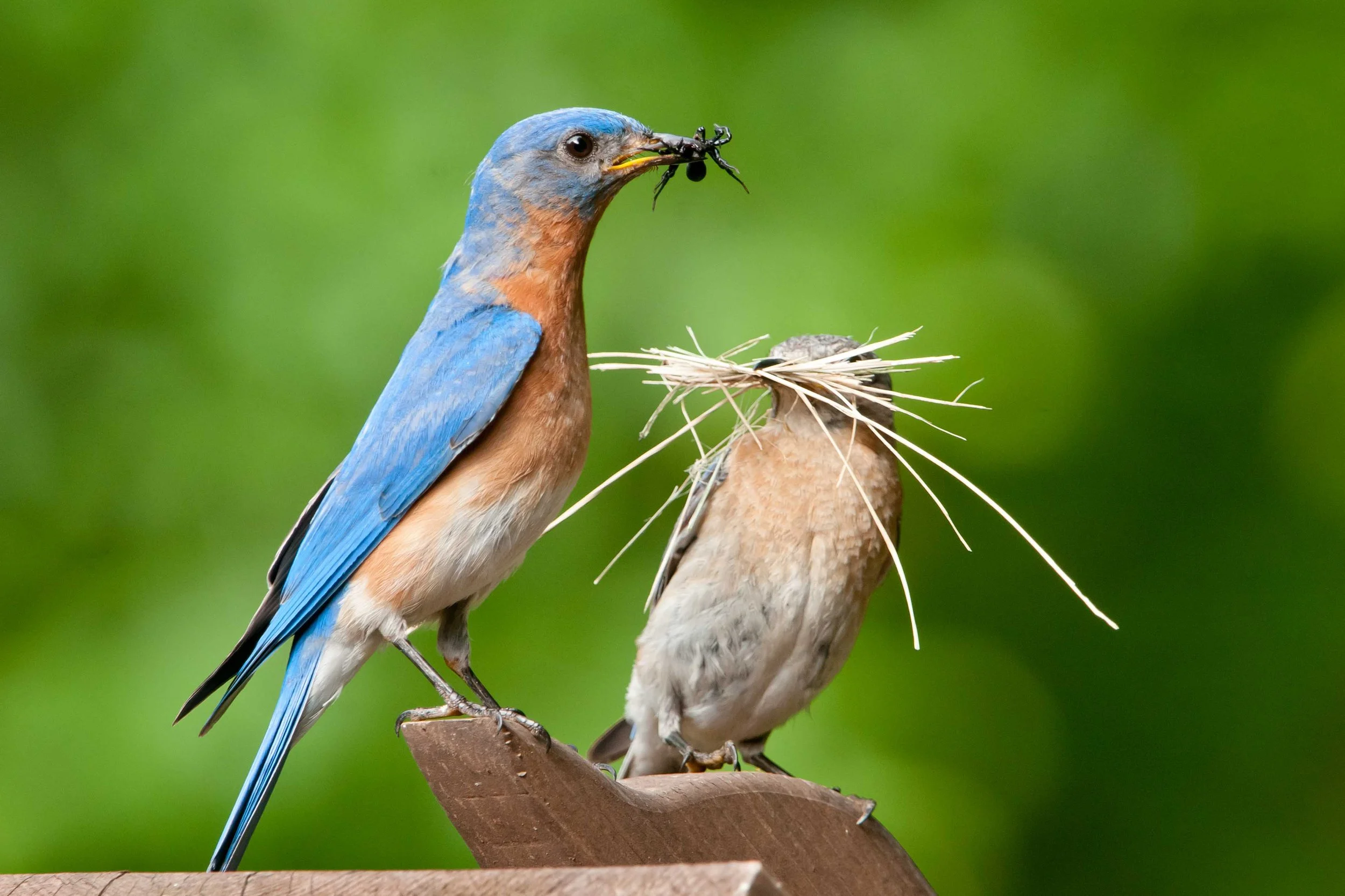
Eastern Bluebird pair, Mark Boyd/Audubon Photography Awards
Female bluebirds build the nests and lay two to seven blue eggs. The incubation period is 11 to 19 days and the young usually fledge within 21 days.
Bluebirds eat insects and in fall and in winter eat fruit, including the berries of mistletoe, black cherry, dogwoods, pokeweed, juniper and other plants.
North America also has two other species of bluebird, a western and a mountain bluebird.
More Information
Bluebird Conservation, https://www.nabluebirdsociety.org/
Bluebird nestbox basics, https://nestwatch.org/ and https://www.audubon.org/news/how-build-bluebird-nest-box
Northern Virginia Bird Alliance Partners with Fairfax Invasive Removal Alliance
Our organization, Northern Virginia Bird Alliance (NVBA), has entered into a partnership with the recently-formed Fairfax Invasive Removal Alliance (FIRA).
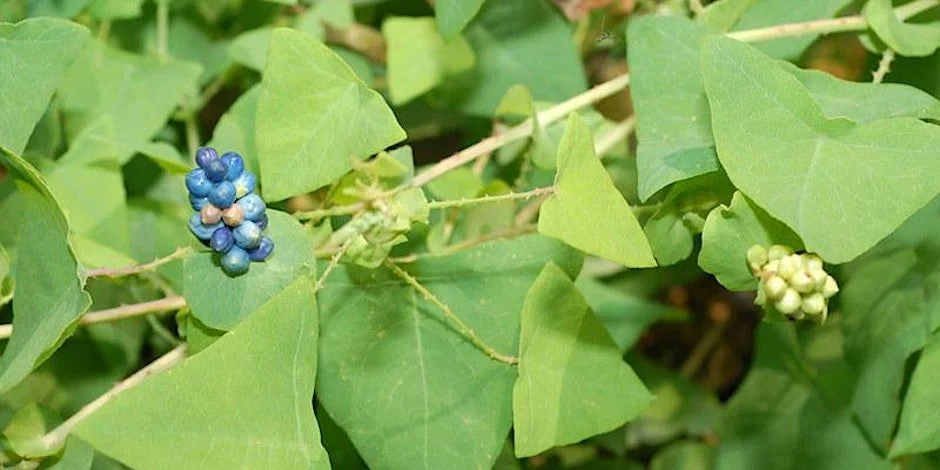
Photo: Mile-a-minute
Tom Blackburn
Our organization, Northern Virginia Bird Alliance (NVBA), has entered into a partnership with the recently-formed Fairfax Invasive Removal Alliance (FIRA). FIRA is an all-volunteer nonprofit organization that advocates for the removal of invasive plants and the planting of natives. FIRA consists of 34 homeowner, civic, and condo associations with over 18,000 households representing about 54,000 residents.
Invasive plants are one of the most serious threats to our ecosystem. They compete with native plants for nutrients, moisture, light and space, and reduce the number and diversity of native plants on which native wildlife – pollinators, other insects, birds, and mammals – rely. According to the U.S. Forest Service, invasive plants are the major cause of the decline of 18% of endangered or threatened species and contribute to the decline of another 24% of endangered or threatened species.
FIRA has adopted an ambitious set of objectives, including educating the public to avoid planting invasives, encouraging nurseries to sell native plants instead of invasives, and advocating for legislation that would result in fewer sales of invasive plants.
NVBA’s objectives align with those of FIRA. Our organization’s mission is to conserve and restore nature for the benefit of birds, other wildlife, and people. We worked hard during the last session of the Virginia General Assembly to support legislation that would have required signage in retail nurseries advising customers about which plants are invasive and encouraging them to buy natives instead. Through our Stretch Our Parks program, we also conduct workdays at which volunteers remove invasive plants from public parks. Our Wildlife Sanctuary program brings trained naturalists together with property owners and managers, offering information, on-site consultation and recommendations to help establish and nurture sustainable natural habitat in backyards, neighborhoods, schools, churches, parks and businesses. Our occasional newsletter articles and email notices titled “Plant This Not That” encourage residents to choose native plants instead of invasives for their yards.
We look forward to a productive and rewarding partnership with FIRA, as we work together to reduce the threat of invasive plants to our ecosystem. You can learn more about FIRA at its website.

Wildlife Sanctuary Almanac: Water in Your Home Habitat
There are several ways to “harvest” the rain that falls on our property and stretch out its usefulness.
Photo: Gray Catbird, Steven Biegler/Audubon Photography Awards
Alyssa Ford Morel
Hot and humid have long been a hallmark for Virginia’s summer months. With the inexorable progress of climate change, our weather gets hotter, and, frankly, wackier. We used to be able to count on regular rain that would perk up plants and cool down temperatures, but now the storms are more sporadic and dramatic. We’ve had “heat domes” and “flash droughts.” The impact on landscapes and the creatures with whom we share our environment can be devastating.
When the rain doesn’t fall and temperatures are high, the living members of our environment react. Plants open their stomata (tiny openings in their stems and leaves) to increase transpiration and cool down. But when there is no moisture for their roots to take in, they close their stoma, and leaf temperatures rise. If the heat and drought continue, plants die.
One way to help plants thrive during stressful periods is to start with optimal conditions. Nature has designed plants to drop leaves, which then decompose, providing a rich organic layer that holds moisture and insulates roots from changing temperatures. That organic layer in turn is home to many small creatures that create the web of local biodiversity. “Leave the leaves” is a practice reflecting a modern understanding of how nature works.

Rain garden, USEPA, Public domain, via Wikimedia Commons
There are several ways to “harvest” the rain that falls on our property and stretch out its usefulness. Rain barrels and cisterns collect and hold water for later use. Simple systems rely on gravity to distribute the water via hoses or watering cans, but more complex systems use pumps. Rain gardens are specially designed depressions that collect excess water, using permeable soil and native plants to recharge the ground water and avoid mosquito breeding.
During the ever more frequent gaps between rain events, there are also ways to be more conscientious when watering conventionally. We reap long-term benefits by placing plants with similar water needs together. Grouping moisture-loving plants together, particularly in an area that tends to be moist, means supplemental water will go further and not be wasted. The time of day during which we water also makes a difference, with early morning being the best time since plants can absorb the water and be ready for a hot day, as well as avoiding the moisture-loving funguses and mildews that establish in the damp overnight. Watering less frequently but more deeply is also best practice. Water that penetrates deeply will encourage deeper roots on plants. The further under the ground-layer water goes, the less likely it is to evaporate in the heat of the sun.
Even established trees are not immune to the challenge of heat and drought. They may not show the stress quickly, but can become weakened by the ordeal. A slow drip for a few hours on a venerable tree can keep it viable for the years to come.
Wildlife also will benefit from supplemental water. Birds use water to lower their body temperature, either by swimming or bathing, and of course, they drink water to stay hydrated. Birdbaths and fountains can be extremely popular and are sometimes life savers in hot weather.
Depending on birdbath placement, various mammals, amphibians, even reptiles and insects may also visit. It is important that bird baths be kept clean and the water changed regularly to avoid disease transmission and mosquito breeding.

Observations from Meadowood: July-August 2024
Judy Gallagher is an ASNV board member and a regular surveyor of local wildlife who also captures photos of what she sees, in particular the less common species.
Photo: White-lined Sphinx Moth, Judy Gallagher
Judy Gallagher is an ASNV board member and a regular surveyor of local wildlife who also captures photos of what she sees, in particular the less common species.
White-lined Sphinx Moth hovering while nectaring on a flower, Judy Gallagher
Sphinx Moths, also known as Hawk Moths, are a moth family whose members are known for their amazing flying ability. They have narrow wings and aerodynamically efficient abdomens, great adaptations for rapid flight. They can hover while nectaring on flowers, and some sphinx moths can fly at more than 10 miles per hour. There are over 1,400 world-wide species, of which more than 100 live in North America.

Pawpaw Sphinx caterpillar munching on Pawpaw, Judy Gallagher
Many Sphinx Moth caterpillars are host-specific, meaning that they only eat one plant or plants in one family. For instance, Pawpaw Sphinx caterpillars eat Pawpaw, Virginia Creeper Sphinx caterpillars eat Virginia Creeper, etc. Note the Sphinx-like pose, which is what gives this moth family its common name. The yellow thing at the bottom left of the caterpillar in the photograph is the old “skin” of the caterpillar, which has molted recently.
Almost anyone who has grown tomatoes knows about tobacco hornworms, huge caterpillars that can decimate tomato (and tobacco) foliage. These caterpillars are the larva of the Carolina Sphinx Moth, Manduca sexta. They are called hornworms because they have a horn-like protuberance on their rear end. One could be forgiven for wondering why these destructive organisms exist, but they have some helpful uses. Hornworms often are bred in captivity. Some are used as an artificial diet for captive reptiles, and in captivity the hornworms are fed on plants that do not contain toxins. So, a wild reptile might not be able to eat a caterpillar because it has accumulated toxins from a plant, but it could eat the same caterpillar species in captivity if the caterpillar was raised on non-toxic plants. Because of their large size, hornworms also are used as animal models for testing medical imaging.
Adult moths mostly feed on nectar, although a couple of tropical species feed on eye secretions, and one species feeds on bee honey.

Gaudy Sphinx caterpillar, pretending to be a snake Judy Gallagher
Caterpillars have interesting defenses against predation. The Tomato Hornworm sequesters toxins from the tomato plant, which makes it unappetizing to birds. The Gaudy Sphinx caterpillar, which you'd be more likely to see in Florida than here, looks more like a snake than a caterpillar. Walnut Sphinx and Nessus Sphinx caterpillars make weird hissing noises to repel predators. Caterpillars sometimes regurgitate sticky substances on ants and parasitoids to fight them off.

Catalpa Sphinx caterpillar with wasp cocoons, Judy Gallagher
But there are some predators that are hard for a caterpillar to escape. Parasitic wasps and flies lay eggs on caterpillars, and the caterpillar serves as live food for the wasp or fly larvae. The caterpillar ultimately dies. Some parasitic wasp species only parasitize one moth species. That leads to an interesting balancing act, as the wasp obviously wants food for its young, but if it lays eggs on all available caterpillars, then the parasite also would die out because there would be no more caterpillars for the wasps to parasitize.

Snowberry Clearwing Moth rolling up its proboscis , Judy Gallagher
While many sphinx moth caterpillars are destructive, the adults are important pollinators. They aren't as good pollinators as bees, who deliberately collect pollen, but sphinx moths pick up and transport pollen on their long proboscises or tongues. When not in use, the proboscis rolls up. Sphinx moths have the longest tongues in the moth and butterfly world. They like tubular flowers that are not easily pollinated by other insects. And most sphinx moths are nocturnal, so they feed from and pollinate flowers that are not visited by bees and other day-flying pollinators.

Pawpaw Sphinx, not blending in well against the white background, but imagine how hard it would be to see against bark, Judy Gallagher
Adult moths also have some defenses against predation. The Snowberry and Hummingbird Clearwings, both day-flying moths, look a bit like a large bee or a small hummingbird. Many sphinx moth adults are drab or cryptic looking to avoid detection. Some tropical sphinx moths make sounds by rubbing their genitals against their abdomens to confuse bats.
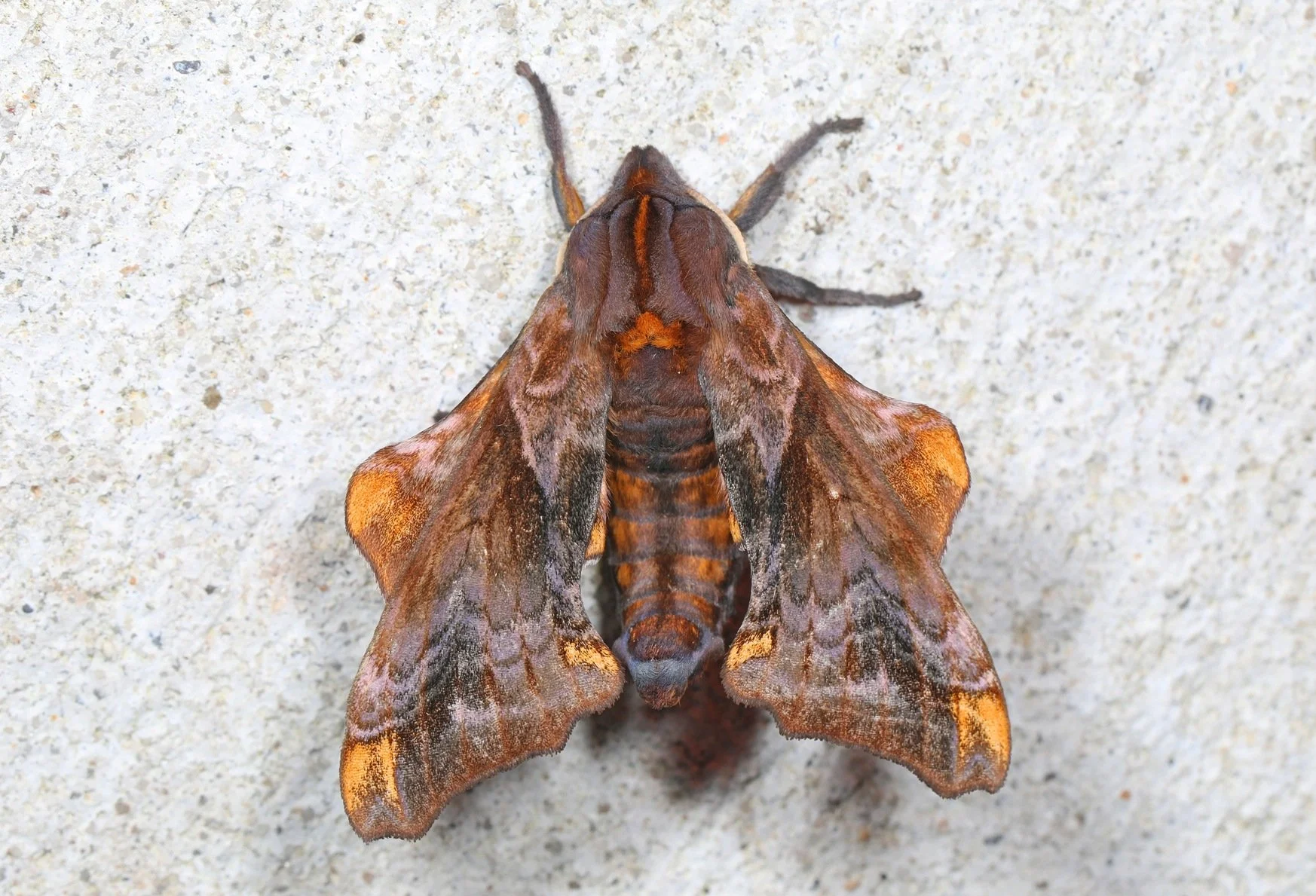
Small-eyed Sphinx, Judy Gallagher
Even cryptic moths can be beautiful. From a distance, it looks drab and unexciting. But take a closer look at the Small-eyed Sphinx. It has a pleasing shape, and the colors are extraordinary.
So please plant night-blooming flowers, especially flowers with long tubes, so you can enjoy these wonderful moths in your garden.
View more of Judy’s Observations from Meadowood articles here.

Monday Mystery - July 29, 2024
Monday Nature Mystery continues! Read on to learn who correctly identified our last mystery.
Photo: Red-backed Salamander, Judy Gallagher
We are pleased to announce the winner of our most recent Monday Nature Mystery, Noah Ramsey.
Congratulations to Noah for identifying the Red-backed Salamander (Plethodon cinereus).
Red-backed Salamander, Judy Gallagher
According to the National Zoo, due to their lack of lungs, eastern red-backed salamanders need to live in damp or moist habitats in order to breathe. They are often found in or under logs, leaf-litter and burrows of deciduous forests. In colder months, these salamanders go under the frozen ground. With a low tolerance for acidic soil, they cannot live in areas with high acidity. In the wild, eastern red-backed salamanders eat a wide variety of small invertebrates, including arachnids, worms, snails, larvae and insects. Since they only inhabit damp habitats, their foraging range is dependent on the seasons, expanding in the wet seasons and retracting in the dry seasons.
Each Monday we’ll post a new mystery and identify the previous week’s winner. They’ll receive an ASNV hat or tote bag.
Here is this week’s mystery:
Who is this?
Be sure to post your guess on our Facebook page under the latest Monday Nature Mystery post, and make sure you receive our emails to find out the winner and mystery answer each week. Good Luck!
Please check our guidelines here.

Monday Nature Mystery: Who is this? Photo: Judy Gallagher

Tree Stewards of Arlington and Alexandria: Partners in Stretching Our Parks
Stretch Our Parks is both a conservation and a social initiative, aimed at improving and creating wildlife habitat while building a greater commitment by a broader northern Virginia community in saving wildlife.
Photo: BETTY from MEMPHIS, TN, USA, CC BY 2.0, via Wikimedia Commons
Joan Haffey
Stretch Our Parks is a flagship ASNV program that relies on partnerships among ASNV, parks, conservation groups, and neighborhood and community groups to achieve the daunting goal of reversing habitat loss in our rapidly urbanizing area. As such, Stretch Our Parks is both a conservation and a social initiative, aimed at improving and creating wildlife habitat while building a greater commitment by a broader northern Virginia community in saving wildlife.

Tree Stewards Arlington Alexandria
One important partner in this effort is the Tree Stewards of Arlington and Alexandria, active in Stretch Our Parks programs in both communities. Tree Stewards are northern Virginia volunteers who enhance a sustainable urban forest through volunteer activities and public education programs. In Stretch Our Parks, they mobilize members to participate in conservation events and provide valued advice about removing invasive ivies and vines choking trees without damaging trees in the process. Tree Stewards have expertise in native saplings appropriate for replanting efforts in various habitats and provide oversight and educational messages to other volunteers working on or around trees. Check out their website for information on tree-related events and classes!
Nora Palmatier, retiring this year as the organization’s president, is optimistic about the future. She writes, “How thrilled I am to see so many younger people getting involved and working to make a change. . . . I love seeing how many high school and college students and recently retired people are stepping up.”
Marion Ennis, who coordinates the Tree Stewards’ Stretch Our Parks activities in Arlington, is a member of the management team for the habitat restoration project reaching from Upton Hill Regional Park including and beyond Powhatan Springs Skate Park eastward toward Bluemont Park. That team includes representatives from ASNV, Arlington Regional Master Naturalists, and the Tree Stewards. She mobilizes her colleagues and participates herself in key habitat restoration work. “Working on such projects reveals how many people from multiple groups have the same purpose to conserve nature to create a better and healthier community with wildlife.”
Restoring habitat for birds and other wildlife requires an “all hands on deck” effort. Partnering with sister organizations with specialized contributions as well as park authorities and community groups and homeowners will help us all achieve true progress together.

Nuisance Birds
It’s a conundrum. We want birds to visit us, but only certain species, and even under those conditions we want to see them on our terms.
Photo: European Starling with American Persimmon, Rick Derevan/Audubon Photography Awards
Deidra Bryant
This spring I’ve been growing herbs, cut flowers, fruit, and vegetables on my deck. It’s not a large space, but I use it since the area gets A LOT of sun. Last year I wasn’t so successful, because the birds living in the trees next to my house, as well as in my neighbors’ dryer chute and window shutters, frequented my deck to eat the seeds and fruit I planted. It was frustrating because strawberries start fruiting the year after you plant them, and when they started producing fruit European Starlings, House Sparrows, and House Finches ate nearly all of them! Sometimes my indoor cats would scratch from the other side of the glass door that leads to the deck, because birds would perch right on my railing or even in my planters, eating, scratching, and defecating on my hard work.

Mesh over tomatoes, Deidra Bryant

Mesh over railing planter, Deidra Bryant
This year I did something different to protect my seeds, sprouts, and vegetables. Mesh netting! For 20 days I protected my seeds and Roma tomatoes from curious birds with an ultra-fine 0.04-inch mesh. I still see bird droppings on my deck, so I know they still come, but with the netting they had no way of pulling out tender sprouts, disturbing my seeds, or pecking my unripe tomatoes. That strategy, along with the cool, wet, and sunny weather we had late April and throughout May, allowed my seeds to thrive, and I’m quite proud of their growth in such a short time.

Cosmos successfully sprouted in railing planter, Deidra Bryant
My journey through this process made me think about how birds can be enjoyable to view but can also cause issues for someone growing crops, or owning or renting property, whether a home or office. Often sparrows, starlings, bluebirds, swallows, ravens, pigeons, and even crows will make nests in very inconvenient spots, at least for us humans. They’ll get into roofs, attics, window shutters, walls, ceilings, porches, vents, ducts, chimneys, decks, and crawl spaces, and some birds will annihilate your budding garden if you’re not careful. Birds also can be vectors for spreading diseases such as psittacosis, salmonellosis, avian tuberculosis, avian influenza (bird flu), giardiasis, cryptococcis, histoplasmosis, and cryptosporidiosis. When birds enter a building or structure, they contaminate it with waste and bird mites. If you are trying to grow fruit such as blueberries, strawberries, blackberries, raspberries, cherries, oranges, apples, grapes, plums, oranges, or pears, a concentration of birds (especially non-native starlings or House Sparrows) can really get out of hand.
It’s a conundrum. We want birds to visit us, but only certain species, and even under those conditions we want to see them on our terms. When they get too destructive, some people will try to find ways to get rid of them. They will use outdoor cats to stress them out and chase them away (a VERY bad idea) or remove their nests, either themselves or using a professional.
Instead, I recommend the following practices. If you want native birds such as orioles, grossbeaks, catbirds, robins, thrushes, thrashers, tanagers, woodpeckers, waxwings, kinglets, titmice and warblers to enjoy the fruits of your labor, I suggest creating a space exclusively for feeding wildlife. You can grow some shrubs for wildlife, or take fallen fruit and put it on a plate or table for them to enjoy. Do this while also creating a space for your own harvest. You can use netting to protect the plants you want to grow, or, if you have space and money for it, grow them in a greenhouse. Remember that other animals and insects like fruit, too, so keep that in mind as a part of your planning. You might attract insectivores by growing fruit for your use!
Growing food can be a gratifying experience. Additionally, allowing native birds to have a place to rest and eat fruit, seeds, and insects on your property is good not only for the birds, but also for your soul. On the other hand, it would be a shame if all your work was destroyed or damaged due to lack of planning. If you do find non-natives (starlings or House Sparrows) making a nest on your property in a location that might be hazardous to you or your family’s health, consuming your seeds and fruits, or even causing aesthetic issues to your house or property, call a reputable company and have professionals remove them and the nest. However, if you see native birds perched or nesting on your property, consider helping them out by leaving a plate of seeds and fresh berries out for them.

Birdathon 2024
We’ll have a full report on the results of this year’s Birdathon at our June 2 Audubon Afternoon and Annual Meeting.
Photo: Birders, Laura McDonald
We’ll have a full report on the results of this year’s Birdathon at our June 2 Audubon Afternoon and Annual Meeting. The prize for the most contributions is based on the funds received at our office by May 31, but you can still submit donations now. Your donations recognize the hard work of our 40 Birdathon participants, who identified at least 126 species in our northern Virginia service area. Here’s a link to their team pages. No matter when your donation reaches our office, it goes to good causes: supporting a teacher at Hog Island, citizen science and habitat conservation projects, and our efforts to promote native plants to help the birds.

Shrink the lawn
If you grew up in suburbia, a pristine lawn was a welcome herald of spring. Everyone enjoys the smell of freshly mowed grass and the look of a well-kept, manicured lawn. So what, you might wonder, is the problem with turfgrass?
Photo: Reduced lawn, Jim Creevy
Margaret Fisher and Eileen Ellsworth
If you grew up in suburbia, a pristine lawn was a welcome herald of spring. Everyone enjoys the smell of freshly mowed grass and the look of a well-kept, manicured lawn. So what, you might wonder, is the problem with turfgrass? After all, it is a green, living plant, busily photosynthesizing carbon dioxide and water into oxygen and glucose, while providing an even surface to walk and play on. But not all is as it seems.
No one has taught us more in recent years about the negative impact on biodiversity of sterile suburban and urban landscapes than Dr. Douglas Tallamy, an ecologist, conservationist, and Professor of Entomology at the University of Delaware. Experimenting for decades on his own ten-acre home in Oxford, Pennsylvania, he eliminated turfgrass and planted native flowers, shrubs, and trees, which vastly increased the kinds and number of caterpillars, birds, frogs, and other critters living there. From this experience, he formed and shared a new understanding of how turfgrass, a staple feature of American suburbia, diminishes biodiversity.
The grasses we use for turf, even varieties with names like “Kentucky Bluegrass,” are not native to America. Lawn grass has a long history in Europe that extends back to the Middle Ages. To this day, the species of turfgrass planted in the U.S. are native to Europe, and like all non-native plant species, they do next to nothing to support our local wildlife.
Turfgrass now covers an estimated 40 million acres in America, acting like corn or other farmed monocultures that have replaced the more diverse habitats that supported far more local wildlife. To add insult to injury, we keep it alive using fossil fuels for mowers and leaf blowers and by adding toxic chemicals that harm plants and animals. Attractive as it may be, turfgrass impoverishes the environment. In addition, turfgrass absorbs far less run-off than one would think. Rain washes over it but doesn’t penetrate to any significant depth. It therefore contributes to an abnormal volume of stormwater runoff that pollutes and erodes our streams and rivers and ultimately damages the Chesapeake Bay.
Converting even some of the 40 million acres of turfgrass to more natural habitats would benefit the environment while also supporting a host of pollinators and other wildlife. Dr. Tallamy is optimistic that if we reduce the acreage by half we will essentially reestablish our country’s biodiversity.
Reduced lawn, Jim Creevy
One strategy to reduce turfgrass, or at least to make it more habitable for local insects, has recently attracted a lot of interest: No Mow May. The movement began in 2019 as the brainchild of Plantlife, a United Kingdom conservation charity. The idea was to refrain from mowing the lawn for the entire month of May to promote the growth of more flowering weeds and thereby induce more pollinators and other wildlife to stop and stay a while. As the idea spread to America and gained popularity, researchers at Lawrence University conducted a study that supported Plantlife’s theory that more bee species were visiting the un-mowed lawns when compared to nearby public lands that were being mowed throughout the month. The study gained national attention and resulted in the adoption of No Mow May across America in several jurisdictions.
However, the majority of our common weed species are non-native and therefore provide minimal benefit beyond nectar. The Lawrence University study was later retracted due to “several potential inconsistencies in data handling and reporting.” In addition, some critics of No Mow May, including Dr. Tallamy, raised concerns that providing a safe haven that is so temporary might actually be harmful. For the moment, it is unclear if there is any boost to biodiversity from a No Mow May strategy alone.
What is clear is that planting a permanent pollinator sanctuary with native species, especially in place of existing turfgrass, is effective. Such an endeavor will benefit many pollinators and caterpillars over the entire growing season while also chipping away at the amount of turfgrass in our suburban and urban settings. It’s a win-win for all.
The task of creating a healthier environment seems big, but small efforts by many people can add up. If we shrink the lawn by converting even a modest patch of existing turfgrass to native plantings, we will have improved the food web and biodiversity of our yard -- and that is no small matter! For ideas on how to go about it, see the Plant NOVA Natives website.

South Arlington’s Ravens
South Arlington birders were thrilled last year when Common Ravens, which had been haunting the Long Branch Nature Center area, built a nest on a Route 50 abutment where the roadway crosses the W&OD Trail. So, they were doubly pleased when the Ravens returned this year to the same nest.
Photo: Common Raven, Wendy Davis/Audubon Photography Awards
South Arlington birders were thrilled last year when Common Ravens, which had been haunting the Long Branch Nature Center area, built a nest on a Route 50 abutment where the roadway crosses the W&OD Trail. Even better, they raised two chicks successfully. See last year’s story.
So, they were doubly pleased when the Ravens returned this year to the same nest. They refurbished it a little, adding Red Fox fur from a nearby carcass, and raised four chicks. It’s a pretty big nest but looked awfully small when it held four young birds on the verge of fledging, particularly when one of the adults returned with food.

Adult Raven and four demanding youngsters, David Howell
Although some birders were surprised to see the Ravens move into such an urbanized area, Cornell’s All About Birds reports that Ravens are doing well in many urban environments. They are omnivores, and can take advantage of the food careless humans leave behind. They have certainly succeeded so far in South Arlington. Cornell reports that clutch size for Common Ravens is 3-7 eggs, so we’ll have to wait to see whether the pair expands its family further.

Does Your Tree Company Speak for the Trees? Getting Help from the Pros
Some tree care companies do provide a free arborist consultation—but you still must analyze the wide range of recommendations you will get.
Photo: Tree with “mulch volcano,” Sara Holtz
Cindy Speas
I am frequently asked “What service do you use for advice about the health of your trees?” I’m glad to get the question, because often the expertise needed for lawn and landscape care is not the same service needed to evaluate the health of trees, which is a whole science unto itself. My response is always that you need a good arborist, and not every tree service has one on staff. Some tree care companies do provide a free arborist consultation—but you still must analyze the wide range of recommendations you will get. One strategy would be to hire an independent arborist first, followed by free arborist consultations from reputable tree service companies.
How can you find a qualified professional to care for your trees? Go to PlantNOVATrees for information on choosing someone to work with. Call several services, ask if they have an ISA certified arborist on staff and what the fee is for a consultation (if any). Get recommendations from those you know whose trees are healthy and well-maintained. For more details read Virginia Cooperative Extension’s excellent publication on hiring an arborist.
You will be in a better position to evaluate the arborist’s advice if you know some of the best management practices in tree maintenance and care before you have a consultation. Here are some telltale recommendations that a good arborist would NEVER MAKE:
That you should top your tree (take off the ends of most or all of the branches)
That you should preventatively spray your tree canopy with herbicides to kill any bugs (“pests”) that might be there
That you should trim out all the dead wood that can be seen
That you should trim living branches in a way that leaves a part of the branch (spur) on the tree
That you should build up mulch in a “volcano” shape around the base of the tree trunk to hold in water or discourage pests
That you should frequently irrigate your trees using a sprinkler.
In fact:
Mulch volcano, Sara Holtz
You should NEVER top your trees—this will hasten their death.
You should ONLY use foliar herbicidal spray on your tree if there is clear evidence of a killer pest, and not just one that chews on the leaves a bit. A “preventative” spray will kill pollinators and the other beneficial insects that live in your trees and that attract songbirds to your yard. Spraying can also be harmful to overall tree and soil health.
You should ONLY remove dead wood that is hazardous to humans or property. Removing all the observed dead wood does not improve the health of any tree.
You should NEVER leave a branch spur (nor cut a branch flush to the trunk), because the tree cannot heal those wounds. Always remove branches right between the collar and the tree trunk so the wound can heal. It is preferable not to trim living branches if at all possible.
You should NEVER allow mulch to be “volcanoed” around the base of any tree—volcanoing encourages roots to grow above ground into the mulch and invites fungi and tree pests.
You should NEVER overwater your trees—if drought conditions suggest an occasional thorough watering, you should place a hose at various points around the root zone for a long, slow drink.
Ask the arborist for the science behind his or her recommendations—if you are told you have pests, ask how the arborist diagnosed that. If you are told the trees need fertilizing, ask how and why the arborist believes that is a good strategy. If the responses aren’t based on good scientific evidence, then you might not have the best arborist for your trees. If an answer doesn’t seem exactly right, is too costly, or requires a signed annual contract including all their recommendations before doing the work that you actually want, get a second or third arborist’s opinion. You’d do that for your health and that of your family, so why not also do that for the health of your trees?

Wildlife Sanctuary Almanac: Fireflies
Is there a more magical sight than fireflies flashing on a June evening?
Photo: Common Eastern Firefly, Judy Gallagher
Cliff Fairweather, Judy Gallagher, and Betsy Martin
Is there a more magical sight than fireflies flashing on a June evening? Who can forget the childhood delight of catching fireflies, cupped gently in hands to peek at the flash close up? It’s no wonder the collective noun for fireflies is a “sparkle.” Read on to learn more about our local fireflies and how to attract them to your yard.
If fireflies are flashing, you can be sure mating is going on, because flashing is all about signaling potential mates. Males often make elaborate flash displays in flight, while receptive females make simpler response flashes from the ground or a low perch.

Photuris species, the femme fatales of fireflies, Judy Gallagher
Some fireflies are deceivers, though, and their flashing is not about mating at all. Adult females of the genus Photuris eat the males of other species, which they lure and capture by imitating the flash pattern of receptive females of that species. These femme fatales obtain a defensive chemical from their victims, a steroid called lucibufagins, that makes the Photuris females and their offspring distasteful.
Fireflies or, if you prefer, lightning bugs, are neither flies nor bugs -- they are beetles in the family Lampyridae. Most are bioluminescent, meaning they produce light in special organs (called lanterns) that use chemical energy to produce light in a process that is nearly 100% efficient, as compared to the 10% or less efficiency of an incandescent light bulb. Not all species produce light in their adult stage, and these darkflies are active in daytime.
According to the Loudoun Wildlife Conservancy, about 20 firefly species are found in Northern Virginia. Adults of three common genera in our region (Photinus, Photuris, and Pyractomena) are distinguishable by the color and timing of their lights: yellowish flashes earlier in the evening for Photinus, greenish for Photuris, and deep yellow to orange later in the evening for Pyractomena.

Pyractomena species firefly larva, Judy Gallagher
All firefly larvae are bioluminescent, but they cannot control their light to create distinct flash patterns like adults. You might see their intermittent glow on the ground in spring or fall. Some firefly pupae and eggs also glow.
Fireflies spend most of their lives in the larval stage, during which they hunt and consume soft-bodied invertebrates, such as earthworms, snails, and slugs. They pupate underground, in rotting logs, or sometimes in the furrows of tree bark, where they spend the winter, emerging the following spring or summer.
Fireflies are more numerous in undisturbed habitats, but by paying attention to their habitat needs, you may bring them to your yard, even in an urban setting.
Most fireflies prefer moist habitats, such as wet meadows and other wetlands, stream sides, and pond edges. Let native vegetation grow up along ponds and creeks to provide cover. Leave areas of leaf litter, rotting logs, and undisturbed soil on your property to provide shelter for all life stages of fireflies: eggs, larvae, pupae, and adults – and for their invertebrate prey. By planting a diversity of native plant species and layers (from low growing herbaceous plants to trees), you will provide sites for courtship, mating, egg laying, hunting, and pupation, and preserve soil moisture, which is essential for fireflies.
Avoid using pesticides, and avoid fertilizers, especially those containing ammonia, which kill the slugs, snails, and worms that firefly larvae eat. Avoid using tree bands to trap pest insects on trees with deeply furrowed bark favored by fireflies (such as oaks and hickories), as these can also trap fireflies.
Fireflies need darkness so their flashes can be seen by potential mates. Outdoor lighting can significantly interfere with firefly courtship. Turn off the lights when possible, and consider following the International Dark Skies Association Principles for Responsible Outdoor Lighting.
And your kids and grandkids may delight in the old pleasure of collecting fireflies in a jar—just be sure to let them go right away so they can get on with making new fireflies!
Fireflies are one of several dozen Sanctuary Species at the heart of the Wildlife Sanctuary program. Learn more about the habitat needs of fireflies and other Sanctuary Species here. If you create habitat that brings 10 Sanctuary Species to your yard, your property can be certified as a Wildlife Sanctuary. Our motto is, “Let the critters decide.”