
NVBA NEWS BLOG
Welcome to the blog for Northern Virginia Bird Alliance, a wealth of resources about northern Virginia birds, wildlife, habitat conservation and restoration, native plants, wildlife-friendly gardening, advocacy and more.

Join NVBA for a trip to Panama in March!
Enrollment is open for NVBA’s March 12-22 trip to Panama, Birding the Central and Darien Regions!
Photo: Red-legged Honeycreeper, courtesy of Holbrook Travel
Enrollment is open for NVBA’s March 12-22 trip to Panama, Birding the Central and Darien Regions. As it has done before, NVBA has enlisted Holbrook Travel to make the arrangements. The price, based on 8-12 participants, will be $3,615 per person, which is all-inclusive except for international airfare to and from Panama, gratuities, and expenses of a personal nature.
Panama boasts the highest diversity of bird species in Central America. The country’s advantageous location at the convergence of two continents makes it the prime respite for migratory birds from both North and South America.
The itinerary takes us across several regions of Panama, including the country’s easternmost province of Darién. We’ll visit well-known birding trails, tropical rainforests, wetlands, mudflats, and much more. We’ll explore both public and private reserves, as well as witnessing the Panama Canal’s Miraflores Locks in action, visiting historical sites and learning about Panama’s role as an international trade center. Trip highlights include:
Darién Province’s many birding hotspots, with the possibility of seeing a Harpy Eagle
Hiking the world-famous Pipeline Road, where target species include Black Hawk-Eagle, Purple-throated Fruitcrow, Masked Tityra, and the coveted Blue Cotinga
Two of Panama City’s stunning natural areas, the Metropolitan Natural Park and the Panama Bay Mudflats
A visit to a sloth rescue center, to meet animal ambassadors and learn about wildlife rescue, rehabilitation, and release during canal expansion
Please visit Holbrook Travel to register!

Glass and Light Pollution Threaten Birds
NVBA has launched a campaign to prevent bird deaths, citing a National Audubon Society study that found a 30 percent drop in bird populations in North America since 1970, which means more than one in four birds or three billion birds have been lost since then.
Photo: The glass windows of the Martha Washington Library reflect trees and vegetation, Glenda Booth.
By Glenda C. Booth
Originally published in the Connection Newspapers, Oct. 24, 2024
On the Saturday overnight of Oct. 19-20, 352,400 birds crossed Fairfax County, most migrating to their wintering grounds. Every fall, around four billion birds fly from Canada into the United States and another 4.7 billion fly over the U.S. southern border, according to Cornell University experts. But birds face multiple hazards, including collisions into windows and human-caused light pollution, three speakers told 75 attendees at an Oct. 9 online program sponsored by the Northern Virginia Bird Alliance.
NVBA has launched a campaign to prevent bird deaths, citing a National Audubon Society study that found a 30 percent drop in bird populations in North America since 1970, which means more than one in four birds or three billion birds have been lost since then.
Most birds migrate in the fall to find food, explained Greg Butcher, retired Migratory Species Coordinator for U.S. Forest Service. While some birds like swallows and finches migrate during the day to feed on the wing, 80 percent migrate at night, he said.
Collisions with Glass
Over one billion birds die by colliding with glass in buildings in the U.S., Christine Sheppard of the American Bird Conservancy, told the group. A few bounce off, but “scavengers are good at snatching up carcasses,” she added.
“We are getting collisions everywhere because the birds are sucked into the built environment, not just high up in skyscrapers,” Sheppard explained. A Smithsonian Institution analysis estimated that houses and other buildings one-to-three stories tall account for 253 million bird fatalities; low-rise buildings four-to-11 stories high account for 339 million bird deaths; and high-rise buildings 11 floors and higher cause the deaths of 508,000 birds a year. Taller structures like skyscrapers have higher per building mortality rates, but residences are responsible for most because of their numbers.
Birds crash into windows because they perceive glass reflections of vegetation, landscapes or sky to be real and they try to reach the area. Last October, in one night, nearly 1,000 birds collided into Chicago’s mostly-glass McCormick Place Lakeside Center, the highest number on record then. American Bird Conservancy reports that once New York City’s Javits Convention Center was renovated and bird-friendly glass installed, collisions dropped by 90 percent.
NVBA is promoting bird-friendly designs for buildings and bird-friendly glass, for homes, for example, screens, decals and tape on windows’ exteriors.

Paracord hung in front of a window to warn birds not to fly into it. Photo: Powell Hutton
Some localities have adopted bird-friendly building requirements, Sheppard said, including Washington, D.C.; Howard County, Maryland; New York City; and Portland, Oregon.
Light Pollution
Laura Greenleaf from Dark Sky Virginia began by saying, “In the last 100 years, we’ve turned night into day … natural darkness is fundamental for all of us.” She contends that on the east coast, light pollution is increasing ten percent every year. The NVBA campaign brochure defines light pollution as “lights that are too bright, too white, mis-aligned or on all night,” like lit parking lots.
“We’re lighting up so much more than we need to, especially landscaping lighting,” she argued. “You can light sport fields without lighting the sky.”
Artificial night light affects birds’ foraging, predator-prey balances, emergence from shelter, communication, navigation and migration, Greenleaf maintained. “Insects are the foundation of the food web, but lights suck them out of the environment.”
Lights Out D.C. volunteers walk Washington’s streets before sunrise during the migration season and collect dead and stunned birds.
Advocates are urging government officials to enact policies to “adopt lighting, construction and other measures to protect birds and other wildlife from the worst impacts of our built-up environment,” explained Tom Blackburn, NVBA Advocacy Chair. He added, “Revisions to lighting ordinances could be very effective in reducing light pollution. Rapidly-developing areas such as Tysons, Reston and Leesburg could require new construction to include bird-safe windows and incorporate Dark Sky International’s Principles for Responsible Outdoor Lighting into building design.”
The campaign also seeks to “convince business owners to adopt ‘Lights Out for Birds’ practices during spring and fall migration seasons, as many other towns and cities have done and to convince developers and architects to incorporate bird-safe windows into building designs.”
Fairfax County
Government policies vary widely. Kelly M. Atkinson, with Fairfax County’s Planning and Development Department, said, “Fairfax County is committed to safeguarding local wildlife and has implemented measures to mitigate the effects of outdoor lighting on birds and other wildlife. In 2020, the county amended its Zoning Ordinance to adhere to updated lighting industry standards that prioritize energy efficiency and restrict outdoor lighting to a maximum color temperature of 3,000 K.
“During the review of commercial and multi-family proposals going through the public hearing process, we ask applicants to provide information on bird-friendly design strategies which could include window glazing, lighting practices to reduce light emitted during evening hours and incorporation of natural landscaping around the building. Additionally, the Fairfax County Park Authority actively advocates for dark sky-friendly initiatives, urging residents and businesses to adopt measures that reduce light pollution and protect local ecosystems.”
Blackburn responded, “I am very pleased that Fairfax County has taken steps to reduce the adverse impacts of our built-up environment on birds and other wildlife. I am hopeful that we can work with county officials to promote additional measures, including supporting a ‘Lights Out’ policy during migration and reducing the recommended color temperature for lighting to 2,500 K.”
Find out more:
Reducing collisions: https://abcbirds.org/glass-collisions/; www.Birdsmartglass.org.
Lights out: http://www.darkvirginiasky.org/
Bird migration: https://birdcast.info/
View the Oct. 9 NVBA webinar

Where There’s Wildfire, There’s Smoke: How Does it Affect Birds? Looking Back at the 2023 Canadian Wildfires
We humans can find some refuge from the toxic particles by entering an office building, or staying at home, but what do birds do?
Photo: NYC wildfire smoke, Metropolitan Transportation Authority, CC BY 2.0, via Wikimedia Commons
Deidra Bryant

NYC wildfire smoke, Deidra Bryant
I remember how orange the skies were at my parents’ home in New York, as well as the numerous environmental health and air quality advisories issued in the Washington, DC area due to the intense Canadian wildfires in spring and summer 2023. Did you know that about 60% of wildfire smoke in the Northeast in recent years came from fires outside the United States (Burke, et al., 2021)? We humans can find some refuge from the toxic particles by entering an office building, or staying at home, but what do birds do? Do they fly away? Do they stay? How does the smoke damage their bodies and how does this affect their ability to survive in the seasons afterward? These questions need answers: they are concerns raised for many years but not studied nearly enough.
Of course, wildfires aren’t inherently bad. In fact, wildfire has been part of the ecology of forests for millions of years. Certain trees and their pods, like the lodgepole pine (Pinus contorta) or the jack pine (Pinus banksiana) in the north and northwest, need fire to “unlock” their seeds. The longleaf pine (Pinus palustris) in the southeast also requires wildfire for forest regeneration, because fire clears out the undergrowth that can block seeds from getting to the soil. Fires also make more habitat for early successional species and for specialist species such as the Black-backed Woodpecker (Picoides arcticus) and the Red-cockaded Woodpecker (Dryobates borealis). But recently wildfires are occurring earlier in the year, covering a larger area, becoming more intense, and occurring more frequently. The increase in lethality of these wildfires is due to climate change, making habitats unsuitable for species dependent on mature forests, causing damage to bird nests and their eggs, and creating risks from noxious gas inhalation.
In the past, coal miners would bring canaries, a sentinel species, down with them in cages to the mines to act as living alarms to signal danger from harmful gas exposure. Because canaries were more sensitive to the dangerous gasses found in the mine shafts and were quicker to succumb to the effects of exposure than humans, a display of erratic activity from the birds gave miners a chance to escape or put on protective gear. Although evidence existed for canaries responding to hazardous gasses for centuries, very little research has been done on how smoke affects wild birds.
A recent study performed in California’s Bay Area, published this year, found consistent evidence that acute and chronic exposure to smoke can affect avian body mass in passerines. Results suggested that the tiny bodies of songbirds may expend more energy in order to mitigate the sublethal health effects associated with prolonged or frequent smoke exposure, causing weight loss (Nihei, et al., 2024). A decrease in the body mass of a songbird is a very significant concern considering their ability to migrate successfully depends on whether they are able to consume enough calories to make the long trip. Additionally, if songbirds become ill or stressed due to the presence of smoke, they may reduce their movements altogether. This inactivity is NOT good if migration, or simply relocating locally, is necessary to reach a habitat rich in food as well as a habitat that provides a suitable climate for regulating body temperature. Results also suggested that once air quality improves, affected birds may become active again in order to make up for lost time foraging.
One must also keep in mind that although wildfires may affect a variety of birds in an area, the physiology and necessary habitat of each bird species varies, too, and their response to smoke inhalation is likely species-specific. For instance, avian responses to smoke may depend on their ability and willingness to seek new shelter. Birds with larger home ranges or less site fidelity may be more inclined to leave an area affected by smoke compared to birds that are restricted to smaller home ranges or highly specific locations (Sanderfoot and Gardner, 2021). This is a concern for shorebirds and even certain owls in northern Virginia, such as Barred Owls, that have high site fidelity. Another concern is the release of corticosterone (a primary stress hormone) as a metric for determining bird behavior when exposed to smoke. Species that release a little of the hormone might have a more active behavioral response to the stressor, whereas a bird that produces a lot of the hormone might have a more passive response to the wildfire and smoke stressors (Cockren, 2013).
Large-scale wildfire smoke events are happening more frequently and across increasingly broad areas of the world (Jolly, et al., 2015), posing increased risks to birds as an environmental stressor. However, birds (like people) can have different responses to both acute and chronic smoke exposure. This complexity of avian responses to smoke requires researchers to develop meaningful exposure metrics for wildlife studies. It is crucial to understand how the duration, extent and intensity of smoke exposure affects the health and behavior of wild birds. Northern Virginia, or the Washington, DC area for that matter, has not experienced wildfires like Hawaii, California, or Oregon, because Virginia has an Eastern deciduous forest biome with a humid subtropical climate that is more prone to flooding than forest fires. However, the smoke blowing down from places that DO have frequent fires (such as the boreal forests of Canada) are a recurring issue. Taking advantage of this phenomena by performing more experiments not only on the west coast, but also in the New England/mid-Atlantic area of the U.S. will greatly help in understanding how highly stressful wildfires, caused by climate change, affect migratory and resident birds alike.

“Keystone” Plants for Fall Gardens
It’s fall, and most healthy plants are looking rather spent as they go dormant for the winter. But some natives are happily blooming away for the first time this growing season, catching your eye with their intense colors and soothing away year-end gardening blues
Photo: Aromatic Aster and Wrinkle-leaf Goldenrod ‘Fireworks’ at Longwood Gardens, courtesy of Plant NoVA Natives
Plant NoVA Natives
It’s fall, and most healthy plants are looking rather spent as they go dormant for the winter. But some natives are happily blooming away for the first time this growing season, catching your eye with their intense colors and soothing away year-end gardening blues.
Asters and goldenrods are the stars of this show, providing a beautiful color contrast with each other when planted together. Aside from their lovely, long-lasting blooms, they are “keystone” native plants, so named because they feed the most species of insects, butterflies, birds, and other animals in our area. Along with several other keystone plants and trees, asters and goldenrods are wildlife engines that support many local ecosystems. They are obvious choices for fall gardens.
It is encouraging if not inspiring to know that if you have access to an empty outdoor potting container or a bit of open ground, you can plant a keystone species and help reinstitute the biodiversity of the continent! Spend ten minutes on a sunny afternoon watching what visits the blooms on your aster or goldenrod, and you will absolutely believe your efforts have made a difference.
Here are some suggestions for asters and goldenrods to add to your garden.
Asters
Aromatic Aster (Symphyotrichum oblongifolium)
Aromatic Aster has emerged in recent years as a fall gardening favorite and a great substitute for non-native mums. In the wild, aromatic aster likes dry rocky outcroppings and is considered uncommon if not rare in the Piedmont. But it has become very popular among growers these days and is rather easy to find. It is a vigorous, drought-tolerant plant that does as well in a pot as it does in the ground. Aromatic Aster gets its name from its leaves, which release a balsam-like smell when crushed. The smell is pleasant to us and repulsive to deer. As such, the plant is very deer resistant. The plant is naturally mounded in shape and rather well behaved, especially if pruned. It is recommended not to prune an aster during its first year, but older plants respond well to a trim of approximately 1/3 of the stem length in June or July to help maximize flower production in the fall and reduce floppiness.
New England Aster (Symphyotrichum novae-angliae)
New England aster has a sturdy appearance and can grow up to six feet or more. After the first year, it can be pruned down to ½ of its stem length in June. You can also pinch back stem tips every few weeks during the winter and prune its outer stems a bit more than its inner stems to create more of a mounded shape. Monarch butterflies are particularly attracted to it as they stock up for their migration to Mexico for the winter. New England Aster is a host plant for the Pearl Crescent butterfly, one of the most common butterflies across America.
Calico Aster (Symphyotrichum laterifolium)
There are several species of asters that are covered in the fall with small, daisy-like flowers that range from white to light purple and tend to self-seed enthusiastically. They are delicate and airy in appearance when blooming but can be mistaken for weeds in mid-summer. Calico Aster is an example. The center of the flowers starts out yellow and gradually turns to purplish red. Flowers on one plant include both colors at the same time, which is how the plant gets its name. The blooms attract many bees, while the leaves host the larvae of the Silvery Checkerspot and Pearl Crescent butterflies. Plant Calico Aster near New England Aster or Aromatic Aster for a nice structural contrast.
Goldenrods
There are over 40 species of goldenrod native to Virginia, most of them producing very long-lasting blooms from late summer to fall which are of special value to native bees and many other little pollinators.
Wrinkle-leaf Goldenrod (Solidago rugosa)
Wrinkle-leaf Goldenrod, also known as Rough-leaved Goldenrod or Rough-stemmed Goldenrod, is a garden favorite and rather easy to find in native plant and commercial garden centers. It features 2-5 feet long graceful arching stems that are densely loaded with small yellow flowers. In nature you will see the plant growing in large masses in open fields, but it also thrives in gardens that get plenty of sunlight. Plant it near some blue asters for color contrast, and enjoy the result.
Zigzag Goldenrod (Solidago flexicaulis)
Zigzag Goldenrod, also known as Broadleaf Goldenrod, does not require as much sun as Wrinkle-leaf Goldenrod. It is common in local woodland settings and easy to spot with its characteristic erect, somewhat zig-zag stems that can grow from 1-3 feet tall. In addition, many backyard birds such as sparrows, goldfinches, chickadees, and wrens love to eat its seeds. Zigzag Goldenrod is an easy-care, beautiful, and beneficial choice for your fall garden, requiring little attention once it is established.
Goldenrods have been saddled with a bad reputation by people who mistakenly blame them for their allergy symptoms. It is actually ragweed species that cause the fall sneezing. As garden plants, some species of Goldenrod such as Tall Goldenrod (Solidago altissima) can be overexuberant in the garden or look weedy. Others, though, are the perfect plant to wrap up the season, both for their color and for their contribution to our struggling local ecosystem. For more information about these and other native plants, see the Plant NOVA Natives website.
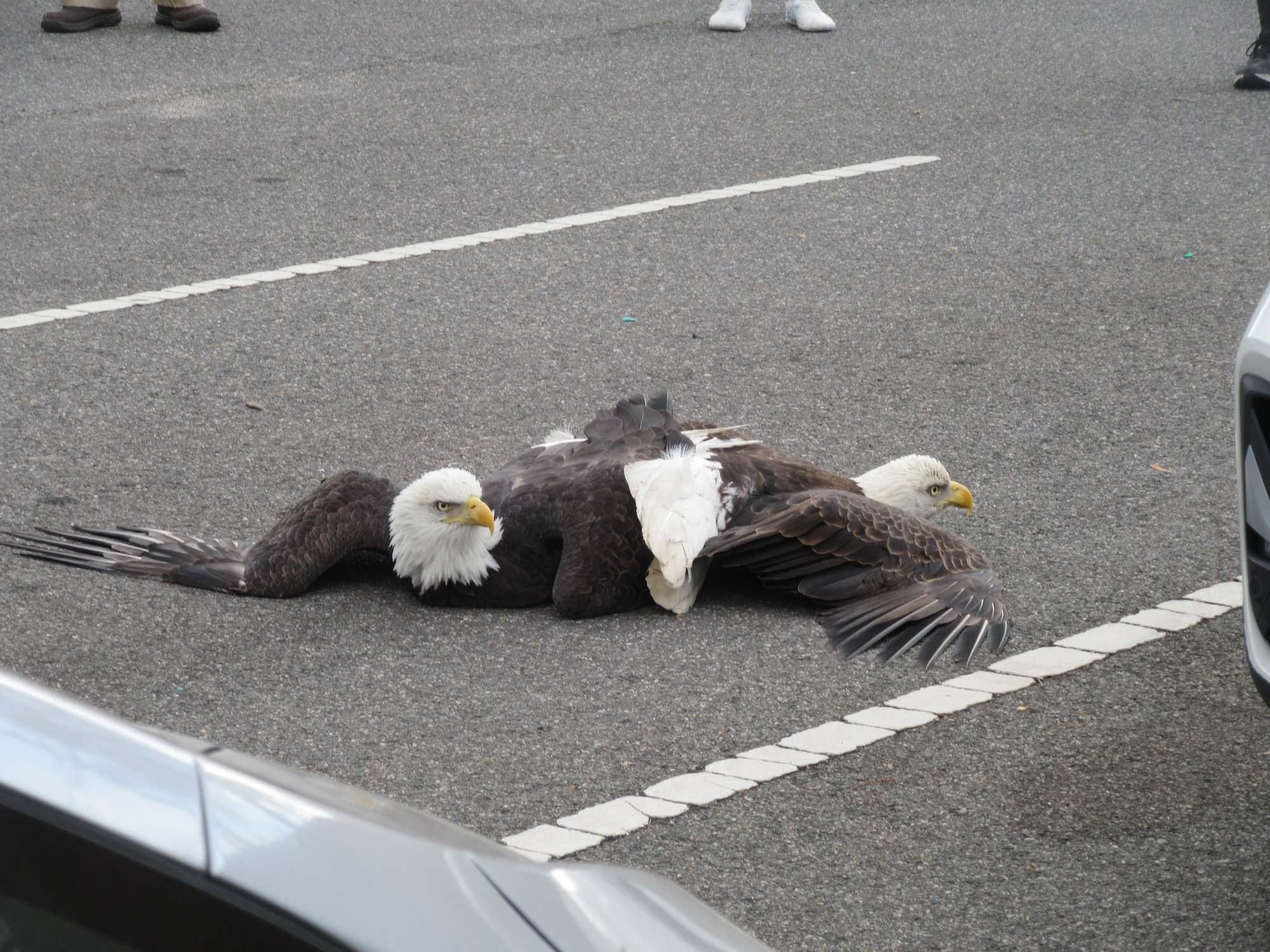
Two Entangled Bald Eagles Fell from the Sky
When Janet Challender was walking from the Hollin Hall Senior Center to her car around 2 p.m. on October 15, as she rounded the corner, suddenly, out of the sky, two bald eagles intertwined with each other “crashed into the parking lot like a meteor,” she said.
Photo: Entangled Bald Eagles, Glenda C. Booth
By Glenda C. Booth
First published in the Connection Newspapers
When Janet Challender was walking from the Hollin Hall Senior Center to her car around 2 p.m. on October 15, as she rounded the corner, suddenly, out of the sky, two bald eagles intertwined with each other “crashed into the parking lot like a meteor,” she said.
Entangled Bald Eagles, Glenda C. Booth
The birds, wide-eyed and alert, then seemed to quietly rest on the pavement. As the 15 or so bewildered onlookers watched, amazed to see two eagles up close, to their great relief, they observed that the eagles were breathing. The birds’ “audience” was eager to find a solution.
The center’s director, Alexa Fuerth, asked everyone to keep their distance to help protect the birds. About 10 seniors and center staffers made a loose circle of vehicles and bodies around the birds to keep the curious at a distance, especially since they expected parents to be arriving soon to pick up their children from A Child’s Place, the child care center there.
The eagles watched their fans intently, but they barely moved.
Fuerth made several calls to government officials and wildlife rescue organizations. Around 4 p.m., Mitchell Mansfield from the Fairfax County Police Department’s Animal Protection Unit arrived in a white van. He said he came immediately from a training in the Dulles Airport area when they got the call.
Mansfield said he would try to capture the eagles and take them to a wildlife rehabilitator. After discussing the challenge with Fuerth and others, Mansfield threw a red towel toward the birds to cover them and instantly, they separated and flew up and away in a startling “whoosh.” They did not appear to be injured.

Disentangled Bald Eagle, Glenda C. Booth
“Fighting is common among bald eagles and occasionally they will trap each other when their feet lock together during combat,” said Jeff Cooper, Wildlife Biologist with the Nongame Bird Program, Virginia Department of Wildlife Resources. “Eagles fight over territory and food resources.”
Fuerth said, “I am very grateful to all our members and staff who were so compassionate. It was heartfelt to see how many people stepped up and helped. It was really emotional to see the birds fly away.
“We send a special thanks to the Fairfax County police for coming and to the Owl Moon Raptor Center that was working to find a rehabilitation center for them in case they were injured,” she said.
Excitement at the senior center usually centers around bus trips to Wegmans, Railroad Club talks or bingo. Bald eagles suddenly plummeting from the sky no doubt topped the usual thrills at this popular senior hangout.
On Bald Eagles
Mature bald eagles have a white head and tail, a yellow hooked bill, yellow talons and a chocolate-brown body. Adults can weigh from 10 to 14 pounds and have an eight-foot wingspan.
They are raptors, powerful flyers that grasp their prey with their sharp talons. They eat mostly fish, but also other birds, small mammals and snakes. Bald eagles build nests five to six feet in diameter and two to four feet tall, usually near water, in Northern Virginia typically on the Potomac and Occoquan Rivers.
In the lower 48 states, by 1963, bald eagle numbers had plunged to 417 known nesting pairs from around 100,000 nesting bald eagles in the 1700s. Scientists determined that DDT and other pesticides’ compounds moved up the food chain and thinned eggshells so severely that the shells broke and chicks did not hatch. In 1967, the U.S. Fish and Wildlife Service (FWS) listed the bald eagle as endangered. After Congress banned DDT in 1972, the numbers began to rise and by 2007, FWS officials announced the bald eagle’s recovery and removed it from the endangered species list. Bald eagles are protected under other laws. The bald eagle is the United States’ national bird.

Come help plant our generous wild plant donation from Earth Sangha!
Earth Sangha, a key partner in the Stretch Our Parks habitat restoration corridor, made a sizable donation of wild plants to the project and we need to get these youngsters in the ground!
Photo: Donated plants, Bill Browning
Earth Sangha is a key partner in the Stretch Our Parks habitat restoration corridor currently active between Upton Hill Regional Park and the Dominion Hills Area Recreation Association. They made a sizable donation of wild plants to the project and we need to get these youngsters in the ground! Please come help build deer exclosure cages and plant these gifts. Sign up, and get more details, via the links below.
Lockwood/Elmwood Senior Housing Complex (Wednesday, November 20, Meet at 8:50 AM)
https://www.signupgenius.com/go/8050D48AFAC23A6F85-46970234-invasive#/
Dominion Hills Area Recreation Association (Saturday, November 23, Meet at 9:00 AM)
https://www.signupgenius.com/go/9040A4BA9A92CA31-powhatan1#/

Observations from Meadowood: November 2024
Judy Gallagher is an ASNV board member and a regular surveyor of local wildlife who also captures photos of what she sees, in particular the less common species.
Photo: Feather-legged Fly, Judy Gallagher
Judy Gallagher is an ASNV board member and a regular surveyor of local wildlife who also captures photos of what she sees, in particular the less common species.
As I slap at mosquitoes on a warm summer night, it can seem as if there are limitless numbers of insects. In reality, insect numbers are limited by physical factors like temperature or pesticides, or biological factors like lack of food, competitors for resources, or natural enemies like predators, diseases and parasitoids.
Parasitoids are small insects that develop in or on another organism, called the host. The parasitoid eventually kills the host, but typically not until the parasitoid is fully grown when it is usually capable of living on its own, eating pollen, honeydew or nectar. Parasitoids are different from parasites like fleas and ticks, which feed on other organisms without killing them.
Parasitoids can develop inside the host, or outside the host sucking bodily fluids through holes in the victim's skin. They tend to specialize on one particular host species. Most parasitoids are wasps or flies, but there are also parasitoid beetles, moths and other insects.

Trissolcus species wasp on Stink Bug eggs, Judy Gallagher
Some parasitoids lay eggs directly on or in a host. Trissolcus species wasps, only about 1/16 inch long, are parasitoids of stink bugs and lay their eggs on stink bug eggs. The female wasp scent marks the eggs to indicate to other wasps that the eggs are already parasitized. She also guards the eggs until her larvae are well developed to prevent other wasps from getting in there. Male wasps sometimes guard stink bug eggs, but, in that case, they are waiting for a female parasitoid adult wasp to emerge, and will then mate with her.
Stink bugs infest many commercial crops including beans, squash and some fruits and nuts, and Trissolcus wasps are an important biological control of the stink bugs.

Modest Masked Bee with Blister Beetle larvae (the reddish stuff around the bee's thorax), Judy Gallagher
Blister beetles lay eggs on vegetation. Once the larvae hatch, they climb to flowers and wait for a solitary bee to come along. Some blister beetle larvae even emit fake pheromones to attract a male bee. They grab onto the bee, and when the bee finds a mate, they transfer to the female, riding her back to her nest where they eat pollen, nectar and bee larvae. Note that the blister beetle larva can survive on just pollen and nectar, so it does not always act as a parasitoid.

Catalpa Sphinx caterpillar with translucent wasp larva and white wasp cocoons, Judy Gallagher
As their name suggests, Catalpa Sphinx caterpillars eat the leaves of the Catalpa Tree. Fortunately, the tree can produce multiple sets of leaves in a year and is rarely seriously damaged by the caterpillars. The Catalpa Sphinx caterpillars only feed on Catalpa, so it's not in their best interest to have the tree die.
But if the tree senses that it is being harmed too much, it produces extra-floral nectaries on its leaves. This is just like having a flower with nectar, minus the flower. The nectar from the extra-floral nectaries attracts wasps and other insects. In this case, a parasitoid Braconid Wasp, attracted by the nectar, has laid eggs beneath the skin of the Catalpa Sphinx Moth caterpillar, and the developing wasp larvae feed inside the caterpillar. This will eventually kill the caterpillar, but not until the wasps are ready to pupate and emerge from inside the caterpillar. So, the tree attracts wasps, which parasitize some caterpillars, keeping the caterpillar population enough under control that the tree is not damaged too much.

Tachinid Fly egg on a Leaf-footed Bug (the egg is the white thing between the insect's eyes), Judy Gallagher
Tachinid or Bristle Flies are a large fly family. Their larvae are endoparasitoids, developing inside their hosts.
Feather-legged Fly , Judy Gallagher
The Feather-legged Fly, one of many Tachinid Fly species, selects a large nymph or an adult true bug from the Leaf-footed Bug or Stink Bug family to lay eggs on. It can find a host by following the pheromones secreted by its prey. The fly can lay many eggs on one host, but only one parasitoid larva will survive. The larva uses the host's respiratory system to breathe and eats the host's body tissues. The larva then emerges from the host and pupates in soil.

Perilampus hyalinus, a hyperparasitoid, Judy Gallagher
But one of the most bizarre examples of a parasitoid is a Chalcid Wasp in the family Perilampinae. The female wasp scatters her eggs on leaves, bark, buds, etc., anywhere that a host might be found. The hatched larvae wander around in search of any living thing. If one finds an appropriate host, it penetrates the host's cuticle. Then it looks for an organism that has already parasitized the host, and enters that larva, parasitizing it. It eventually pupates inside the host cocoon. This is a hyperparasitoid, or a parasitoid of another parasitoid. Interestingly, this particular hyperparasitoid can also complete its life cycle as a parasitoid of sawfly larva, so depending on conditions, it can be a parasitoid or a hyperparasitoid.
There are other local hyperparasitoids, but I personally have only seen a couple. Nature is fascinating and complex!
View more of Judy’s Observations from Meadowood articles here.

Wildlife Sanctuary Almanac: Grow your own bird feeder for migrating birds
Fall-fruiting native shrubs and trees not only provide nutritious, fatty berries for birds, but also display beautiful fall color. That’s not for our benefit: what’s called foliar fruit flagging is the way the plants signal to birds that fruits are ripe and ready for plucking—just in time for migration.
Photo: Blackpoll Warbler, Kevin Sim/Audubon Photography Awards
Betsy Martin
Hurricanes Helene and Milton posed special challenges during this fall’s migration. Migration ecologist Andrew Farnsworth of the Cornell Lab of Ornithology estimated that 150 to 275 species were in the midst of migration during the hurricanes, which interrupted the migration of more than 100 million birds crossing over Alabama, according to the Washington Post.
Even without hurricanes, migration poses challenges that defy imagination. Take, for example, the Blackpoll Warbler (Setophaga striata). The Blackpoll Warbler does not breed in northern Virginia, and only shows up here while migrating to and from its breeding grounds in conifer forests far north in Alaska and Canada and its wintering grounds in South America.
This small bird weighs less than half an ounce, about as much as two quarters. Yet, it undertakes the longest migration of any North American warbler. Some individuals travel almost 5,000 miles from Alaska to Brazil. In fall, they travel south and southeast through Canada and the northeast U.S., and collect along the coastal plain between Nova Scotia and Cape Hatteras, NC. Then, it’s believed (the experts aren’t really sure), they head south and southeast over the Atlantic, and fly nearly 2,000 miles to Puerto Rico, the Lesser Antilles, or northern South America. This may involve an 88-hour nonstop flight over the open ocean! They ride northeast trade winds to direct their flight toward South America.

Sassafras drupes are a favorite of early fall migrants, such as Eastern kingbirds. The red pedicels signal the fruit is ripe. Photo: Betsy Washington
To accomplish this amazing feat, Blackpoll Warblers nearly double their weight before setting out. They add fatty fruits to their diet of bugs and caterpillars. They eat any late summer or fall fruits, but it’s the native ones that have the high fat content they need to sustain them on their long journey.

Blackhaw. Photo: Courtesy of Dyck Arboretum of the Plains
Migrating birds make periodic stopovers to eat and replenish their energy reserves. Make your yard a wildlife sanctuary for them by planting native fruiting shrubs, trees, and vines. Good choices for migrants that also make nice landscape plants in northern Virginia include Arrowwood, Blackhaw, or Possomhaw viburnums (Viburnum dentatum, V. prunifolium, V. nudum), Virginia creeper (Parthenocissus quinquefolia), Silky, Gray, or Flowering Dogwood (Swida amomum, S. racemosum, Benthmidia florida), Spicebush (Lindera benzoin), American beautyberry (Callicarpa americana), and Sassafras (Sassafras albidum). Bayberry’s (Myrica cerifera) wax-coated fruits can only be digested by a few migrant species (Yellow-rumped warbler and Tree swallow) so this plant is not useful to most migrants. Fruits of other native fruiting trees, such as American holly (Ilex opaca) and Hackberry (Celtis occidentalis) ripen too late to be useful to fall migrants, but are good food sources for wintering species. All of these shrubs and trees set more fruit if planted where they get sun. You can find out more about their characteristics, requirements, and eventual size here.
Fall-fruiting native shrubs and trees not only provide nutritious, fatty berries for birds, but also display beautiful fall color. That’s not for our benefit: what’s called foliar fruit flagging is the way the plants signal to birds that fruits are ripe and ready for plucking—just in time for migration.
Catch up on past Wildlife Sanctuary Almanac articles here.

Monday Mystery - October 28, 2024
Monday Nature Mystery continues! Read on to learn who correctly identified our last mystery.
Photo: Hemlock Woolly Adelgig (Adelges tsugae), Open Source
We are pleased to announce the winner of our most recent Monday Nature Mystery, Seth Sweigard!
Congratulations to Seth for identifying the Hemlock Woolly Adelgig (Adelges tsugae).
Hemlock Wooly Adelgig (Adelges tsugae). Photo: Open Source
According to the Virginia Department of Forestry, the hemlock woolly adelgid (HWA), Adelges tsugae, is a non-native insect that feeds on sap and stored nutrients of eastern hemlock trees. This species, originally from Asia, has infested hemlocks in the eastern United States since its accidental introduction in the 1950s. The insects are small and settle at the base of hemlock needles where they insert piercing, sucking mouthparts to feed. They cover themselves with a white, waxy secretion giving them the characteristic “cotton ball” appearance on the underside of the needles. Since its introduction, HWA has spread throughout the native range of eastern hemlocks and has altered hemlock ecosystems in the eastern United States. VDF has a cost-share program available to treat affected trees.
Each Monday we’ll post a new mystery and identify the previous week’s winner. They’ll receive an ASNV hat or tote bag.
Here is this week’s mystery:
Who is this?
Be sure to post your guess on our Facebook page under the latest Monday Nature Mystery post, and make sure you receive our emails to find out the winner and mystery answer each week. Good Luck!
Please check our guidelines here.

Monday Nature Mystery: Who is this? Photo: Flickr user Matthew

The American Kestrel
American Kestrels are often seen perching on utility wires alongside farm fields, or hovering with rapid wingbeats, until dropping to snatch prey from the ground or mid-air. This robin-sized falcon is speedy and fun to watch.
Photo: American Kestrel, Mick Thompson/Audubon Photography Awards
Evelyn Novins
The American Kestrel, Falco sparverius, sometimes erroneously called a sparrowhawk, is found throughout North America. The misnomer likely arises from confusion with the Eurasian Sparrowhawk, another bird that likes open hunting grounds with high perches from which to spot prey. But the sparrowhawk is an Accipitor, and the kestrel is not a hawk but a falcon, as evidenced by its flight profile, with its characteristic pointed wings and long, narrow tail. American Kestrels are often seen perching on utility wires alongside farm fields, or hovering with rapid wingbeats, until dropping to snatch prey from the ground or mid-air. This robin-sized falcon is speedy and fun to watch.

American Kestrel female, Christopher Ciccone/Audubon Phtography Awards

American Kestrel male, Mick Thompson/Audubon Photography Awards
The Audubon Field Guide identifies black, blue, gray, red, brown, white and yellow on the body of the American Kestrel. The male’s blue/gray-colored wings distinguish it from the slightly larger female, which has red/brown wings. Both sexes have brownish backs and buffy-white, or off-white, undersides with a black flecking, as well as two dramatic, black slashes running down from the eye. The female has black barring on the wings and back with a red/brown cap. The male’s cap is dark grey. It is a colorful bird with noticeably yellow feet.
The American Kestrel generally inhabits any kind of open area from farmland and forest clearings to deserts -- wherever it can find abundant prey and some raised perches. In breeding season, it must be near places with appropriate nesting sites. The kestrel is a cavity nester; however, it does not make its own cavity, relying on abandoned woodpecker holes, natural cavities in trees, or rock cervices. The good news is that these secondary cavity nesters will readily nest in man-made boxes with unobstructed entrances.
Fairfax County has maintained several capped mounds at the I-95 Landfill Complex as grasslands and meadows, attracting Eastern Meadowlarks, Bobolinks, and other grassland-loving birds and insects to the area. The American Kestrel, which favors this kind of open space for hunting, is frequently seen in this area. To further conservation efforts, landfill managers also recently set aside a portion of the 500-acre landfill as a “no mow” area, with the aim of increasing high-quality meadow habitat that should attract a variety of grassland birds. To encourage American Kestrels to nest in the area, NVBA has contributed several nest boxes, which the County has erected at the landfill.
The last 10 years have seen a steady decline in the numbers of this species. Habitat alteration, pesticides, and predation by Cooper’s Hawks all have been cited as contributors to the decline. But there is increasing recognition that to understand the decline in population of the American Kestrel and other birds over the last decade scientists must look at the species’ total life cycle. The growth of information on species’ migration, available through the free, interactive, online Bird Migration Explorer, is evidence of that focus.
The Kestrel is a migratory bird, but with only a short, southern migration. Breeding birds from Canada and some northern states migrate to southern states during the winter season. Scientists are now paying attention to its migration stops and wintering habitat in addition to its breeding habitat to understand its population decline. The Clifton Institute's research gathers this whole life cycle information. Together with the Smithsonian Conservation Biology Institute, the Clifton Institute has tagged 19 kestrels with GPS transmitters to assess what type of grassland areas the birds prefer while breeding and while migrating. This project produces results which landowners, land managers, and conservationists can use to support declining species.
So, despite the decline in Kestrel numbers in the past decade, there is some hope that both local and global conservation initiatives will allow our continued enjoyment in observing the lovely and lively American Kestrel.

Life at the Landfill: Much More than Trash
As multi-ton garbage trucks roll in and out 24 hours a day to unload the never-ending detritus of modern life and mammoth forklifts rumble over the I-95 landfill at Lorton, just over the hill, a very different kind of life abounds.
Photo: The landfill’s “no mow” area, Glenda C. Booth
Glenda C. Booth
Originally printed in Connection Newspapers, September 11, 2024
As multi-ton garbage trucks roll in and out 24 hours a day to unload the never-ending detritus of modern life and mammoth forklifts rumble over the I-95 landfill at Lorton, just over the hill, a very different kind of life abounds.
Amid the crickets’ constant chirping, keen listeners may hear the tinkling call of a bobolink. Their fall call is “a repeated ink,” says the National Geographic Field Guide to the Birds of North America. Bobolinks are seven-inch-long birds that live and forage in tall grasses and winter in South America.
Bobolinks migrate through Northern Virginia in the spring and fall and are “very rare in the eastern United States,” says Greg Butcher, retired U.S. Forest Service wildlife biologist. Why are these birds at the landfill? Bobolinks prefer grasslands, a rare and diminishing habitat. Grassland acreage in Virginia may be less than .0001 percent what it was pre-colonization, according to Justin Folks, Natural Resources Conservation Service. “The eastern United States has lost 99 percent of its grassland since European settlement,” notes Butcher.
The landfill’s “no mow” area, Glenda C. Booth
No Mow
This year, managers designated 50 acres of the 500-acre landfill as a “no-mow” zone, as directed in February by the Board of Supervisors and recommended by the Northern Virginia Bird Alliance. The goal is to avoid mowing during grassland birds’ spring and early summer nesting season. This area has not been mowed since September 2023. By letting the grasses grow, managers have in effect created a grassland. Butcher comments, “I’ve spent a lot of time and energy working with the people at the landfill because it has the largest patch of grassland in eastern Fairfax County.”
Grassland birds are “among the fastest-declining bird species in the U.S., with a 34 percent loss since 1970,” a National Audubon Society 2022 report concluded. “The landfill supports populations of five key eastern grassland bird species,” Butcher reports.
Preparing a Plan
Blair Evancho, a May college graduate and county intern, and Carlos Leiva, a county employee, are conducting bird surveys, especially identifying birds that are “regionally rare and specialize in grasslands,” explains Evancho. “This habitat supports species that are not supported elsewhere.”
In other words, the point is not just the total number of birds or species, but documenting birds not typically found in other area habitats. Other grassland birds they have seen include Eastern meadowlarks, grasshopper sparrows and dickcissels. Butcher calls the dickcissel “a Midwestern bird.”
The landfill is in fact an Ebird hotspot, with at least 126 species identified over the last 15 years, most not grassland birds. On September 5, vultures soared and crows called. Observers spotted Eastern phoebes and American kestrels. On July 31, Butcher confirmed 13 species, including wild turkeys, common ravens and chimney swifts.
On September 5, the no-mow area was alive with insects, including butterflies (monarchs, cloudless sulfur, cabbage and tiger and black swallowtail), beetles, bees and dragonflies. “There are grasshoppers everywhere,” Evancho observed.

Grassland flowers, Glenda C. Booth
The area has a mix of wildflowers, native grasses and lespedeza. Bright yellow bearded beggar tick and Queen Anne’s lace plants punctuated the landscape as fox tail grasses swayed in the breeze. Bull thistles were shedding their seeds. Goldfinches use these seeds for building nests in August, said Butcher. “This is when seeds are available.”
Fairfax County official Eric Forbes touts the county’s “sustainability-minded management.”
“We planted our first native meadows at the site in 2016 for pollinators and wildlife, now we are managing traditionally mowed turf areas to allow for grassland bird nesting,” Forbes says. “Hopefully we can show that altering our mowing schedule will allow native birds to breed, setting an example that helps our department’s sustainable community goal and meets our environmental compliance requirements for landfill management. This project can change how landfill operators and regulators manage mowed turf areas to allow for harmony with native bird species and other critical wildlife.” Forbes is Deputy Director, Solid Waste Management Program of the Department of Public Works and Environmental Services.
Evancho will analyze his data and prepare management protocols for the 50 acres. The Smithsonian’s Virginia Working Landscapes recommends February 15 to April 1 as the “optimal time for field management” to protect breeding and nesting grassland birds.
Meanwhile, this part of the landfill is becoming a rare and rich grassland.

Plant Native Vines for Hummingbirds and Beauty
Native vines can be terrific additions to your landscape. The most popular one, Coral Honeysuckle, is a hummingbird magnet! Unlike the non-native invasive vines that we see everywhere killing trees, our native vines seldom hurt them.
Photo: Ruby-throated Hummingbird, David Shipper/Audubon Photography Awards
Plant NoVA Natives
Native vines can be terrific additions to your landscape. The most popular one, Coral Honeysuckle, is a hummingbird magnet!
Unlike the non-native invasive vines that we see everywhere killing trees, our native vines seldom hurt them. They co-evolved with our trees and are important members of the ecosystem, attracting numerous and diverse populations of pollinators with their plentiful nectar, feeding many birds from late summer into the winter with their fruit, and hosting the caterpillar larvae of several butterflies and moths.
Their flowers are long-blooming, showy, profuse, and often fragrant and remarkably complex. It is their nature to reach for a climbing surface and grow upon it rapidly, which puts their flowering and foliage beauty on full and glorious display.
Native vines grow well in average soil and in dry or moist conditions and are generally easy to cultivate. Some can be a nuisance due to their exuberant growth, but they all can be trained to climb walls, arches, fences, arbors, or trellises, or pruned or sheared for containment. Once trained, they add coverage, privacy, and striking beauty to any space.
Here are five native vines you can plant and enjoy for years to come.
Coral Honeysuckle (Lonicera sempervirens)
Coral Honeysuckle, whose botanical name refers to its evergreen habit, is the hands-down favorite of the native vines for garden spaces and is the official wildflower of Fairfax County. It blooms profusely in the spring, and then continues to bloom all the way up to November. The hummingbirds in your neighborhood will visit it repeatedly throughout the day.
Crossvine (Bignonia capreolata)
Crossvine is semi-evergreen with stunning abundant blooms and claws at the end of its tendrils allowing it to cling to stone, brick, pergolas, and fences without support. Its green leaves turn purple in the fall. Hummingbirds also visit this plant during its May bloom time.
Virgin’s Bower (Clematis virginiana)
Virgin’s Bower is a fast grower and late bloomer with flowers turning to showy sprays of silky seeds in late summer. It climbs via twisted stems so needs something to wrap itself around to grow, such as shrubs, trees, a fence or a trellis. Be careful to distinguish this from Sweet Autumn Clematis (Clematis ternifolia), a highly invasive plant that is sold in conventional garden centers.
Yellow Passionflower (Passiflora lutea)
Yellow Passionflower has interesting leaves and delicate, fragrant flowers that bloom in mid-summer. It is considered easy to control, train, and contain.
Virginia Creeper (Parthenocissus quinquefolia)
While it is primarily prized in the landscape for its brilliant red-burgundy fall foliage, Virgina Creeper is a generous provider of abundant food for hundreds of insects, birds, and other animals and a meaningful addition to the landscape.
Some native vines are a little too exuberant for most people’s gardens but are great additions to more naturalized areas. Purple Passionflower, Maypop (Passiflora incarnata), for example, is a beautiful nuisance when it pops up everywhere. The name Maypop comes from the loud “pop” the fruit makes when crushed. Trumpet Creeper (Campsis radicans) is another example. Its flowers are flamboyant and a magnet for hummingbirds, but it is a famously vigorous grower that scrambles over anything it can reach, with aerial rootlets that will damage any wood, brick or stone it touches. It is also considered a nuisance.
Finally, there is one notable vine that is native in Virginia but not Northern Virginia -- American Wisteria (Wisteria frutescens). Widely sold in conventional garden centers, it has become the substitute for the highly invasive Asian wisterias which are wreaking havoc on our ecosystem, smothering trees and tearing them limb from limb.
For more information on all of these native vines, you can visit the Plant NoVA Natives vine page or visit our native plant guide.

Observations from Meadowood: October 2024
Judy Gallagher is an ASNV board member and a regular surveyor of local wildlife who also captures photos of what she sees, in particular the less common species.
Photo: Long-horned Slug caterpillar, Judy Gallagher
Judy Gallagher is an ASNV board member and a regular surveyor of local wildlife who also captures photos of what she sees, in particular the less common species.
Near the end of August each year, I get together with several nature photographer friends for our annual caterpillar safari. No caterpillar is too small or plain for our group to photograph, but we particularly love finding slug moth caterpillars. With their bizarre shapes and variety in almost every imaginable color, they are the jewels of the caterpillar world.

Abbreviated Button Slug with abdomen up, Judy Gallagher
Slug moths are members of moth family Limacodidae. There are at least 1,800 species worldwide, with approximately 20 species found in Virginia. Adult slug moths are often nondescript. They are hairy, and hold their wings tent-like above their abdomen. Many, but not all, hold their abdomen tips up.

Parasa species caterpillar, showing the slug-like appendages for which the family is named, Judy Gallagher
Unlike most other moths, slug caterpillars lack prolegs, the tiny legs that allow caterpillars to move around. They have sucker-like appendages on their underside and secrete a mucus-like fluid over the appendages, much like a slug, which is why they're called slug moths. Another unusual feature of slug caterpillars is that they withdraw their heads into their thoraxes when at rest.
Some slug caterpillars have spines, and the first instar or growth stage doesn't eat, molting almost immediately into the second instar, which does eat. As with most other caterpillars, first instars of non-spiny slug caterpillars eat. Slug caterpillars feed on deciduous trees, including oaks, hickories, cherry, hornbeam, maples, hackberry, birches and willows. It's rare for them to cause serious injury to their host plant.

Saddleback Caterpillar, Judy Gallagher
The Saddleback caterpillar is the most common local spiny slug caterpillar. As the name implies, it looks like a colorful saddle. Poisonous spines surround the saddle, and those who have encountered these spines liken it to having hand sanitizer on an open wound, except the pain lasts a long time. The brown marking in the middle of the saddle looks like a large eye, repelling some predators.

Saddleback Caterpillar with wasp cocoons, Judy Gallagher
The Saddleback caterpillar’s poisonous spines deter most vertebrate predators, but they don't discourage wasps. A species of braconid wasp uses its ovipositor to lay eggs in the caterpillar. The parasitic wasp larvae feed on the inside of the caterpillar, emerging from the caterpillar to form cocoons.

Spun-glass Slug, Judy Gallagher
The Spun-glass Slug is another captivating spiny caterpillar. Each of the spun-glass arms can break off, depositing painful spines in the unsuspecting victim. This does not harm the caterpillar, and it sheds all its glassy arms before it pupates.

Monkey Slug, Judy Gallagher
The Monkey Slug caterpillar or Hag Moth is another caterpillar with arms. Some scientists think that it mimics a large hairy spider to avoid predation. This may be true for related tropical species that live in an environment where there are large hairy tarantulas, but it seems unlikely for our local species. Like the Spun-glass Slug, the Monkey Slug can lose its spiny arms without real injury. The name Hag Moth comes from the arm appendages that look like a hag's disheveled hair.

Skiff Moth caterpillar, Judy Gallagher
The Skiff Moth caterpillar doesn't have spines, but it blends in well with its surroundings. The brown markings resemble leaf imperfections. The caterpillar secretes droplets when attacked, and this deters some predators. Some Skiff Moth caterpillars have pairs of white spots that mimic the eggs of parasitic flies. This may dissuade a parasitic fly from laying eggs on a caterpillar that looks like it has already been parasitized.
Long-horned Slug caterpillar, Judy Gallagher
And now for a colorful one. The Long-horned Slug caterpillar is resplendent in orange, purple, yellow, and blue-green. Its spines aren't as impressive as those of the Saddleback caterpillar, but its warning coloration tells predators to keep away.
Most slug caterpillars are less than an inch long and several are under 1/2 inch, so searching for slug caterpillars can be challenging. But turn over leaves and you may discover hidden treasure. Be careful though -- some of the jewels sting!
View more of Judy’s Observations from Meadowood articles here.

Wildlife Sanctuary Almanac: October is the Time to Leave the Leaves
There are many good reasons for leaving the leaves. By keeping fallen leaves on our properties rather than having them hauled away by landscapers or local governments, we can reduce our production of greenhouse gases and more.
Photo: http://www.ForestWander.com, CC BY-SA 3.0 US , via Wikimedia Commons
Alda Krinsman
A key component of the NVBA Wildlife Sanctuary Program is the Healthy Yard Pledge. There are seven elements to the Pledge, but, because it is October, the focus of this article is on the seventh element of the Pledge: Leave the leaves on non-lawn areas. You may have already heard of the leave the leaves movement. In the past few years, many entities, including the Xerces Society and the USDA, have been conducting leave the leaves campaigns. The National Wildlife Federation has named October as leave the leaves month.
There are many good reasons for leaving the leaves. By keeping fallen leaves on our properties rather than having them hauled away by landscapers or local governments, we can reduce our production of greenhouse gases. No leaf blowers or trucks are needed. Keeping fallen leaves on your property saves you time and money. There is no need to spend time filling leaf bags and dragging them to the curb or hiring someone to do it for you.

Fall leaves, Alda Krinsman
However, as a NVBA Wildlife Sanctuary Program Ambassador, I believe that the most compelling reason for leaving the leaves is that those leaves provide badly needed habitat and food for wildlife. Many of our native moths and butterflies overwinter in fallen leaves either in the form of caterpillars or chrysalises. Spiders, snails, worms, and many insects live or hibernate in the fallen leaves and all are food for birds, chipmunks, box turtles, and salamanders. Some butterflies and fireflies lay their eggs in leaf litter. If we haul away all those leaves, we are destroying habitat and throwing out key components of the food web, not to mention next summer’s butterflies and fireflies.
So, what to do when the leaves fall? Although another element of the Healthy Yard Pledge is reducing lawn coverage area, we are not asking Wildlife Sanctuary clients to damage or kill their lawns by smothering them with thick layers of leaves all winter. However, if you have perennial or shrub borders, simply rake the leaves into the borders to serve as mulch. If you have bare earth or some plantings under your trees, just let the leaves fall and let them be. Those leaves are the tree’s gift to itself. They help retain moisture in the soil around the tree’s roots, and, when they break down, they provide organic matter to the soil around the tree, also to the tree’s benefit. The fallen leaves also provide a soft landing for the caterpillars and chrysalises that fall out of the tree in autumn to look for a warm safe place to overwinter.
If you don’t like the idea of a layer of leaf litter as the sole coverage under your tree, you might consider adding some native plants that support wildlife under the tree. Heather Holm, a bee and pollinator expert, has created a great guide to installing soft landings under trees. If you are concerned that fallen leaves will harm the plants under the tree, don’t be. A walk through a healthy forest will show you that plants coexist and thrive under trees all the time, and no one is raking the leaves in the forest!
Catch up on past Wildlife Sanctuary Almanac articles here.

Monday Mystery - September, 2024
Monday Nature Mystery continues! Read on to learn who correctly identified our last mystery.
Photo: American Lady Butterfly, Judy Gallagher
We are pleased to announce the winner of our most recent Monday Nature Mystery, Ben Jessup!
Congratulations to Ben for identifying the American Lady butterfly (Vanessa cardui).
American Lady Butterfly, Judy Gallagher
According to Bug Guide, the American Lady is the brightest/darkest orange of the three North American "Ladies". Fresh individuals of Painted Lady often show a pinkish suffusion above that is absent or less developed in American Lady and absent in West Coast Lady (it tends to vanish as the insect ages). The black markings on the upper surface of American Lady average narrower than Painted Lady. The large pale bar near the middle of the upper front wing is white in Painted Lady, orange in West Coast Lady, but can be either color in American Lady. Two of the submarginal dark "eyespots" on the upper hind wings are filled with blue in the American Lady (usually little or no blue on same spots in Painted Lady; usually four with blue on West Coast Lady). The under hind wing has two prominent large submarginal eyespots, unlike the much smaller four or five in the other two lady species.
Each Monday we’ll post a new mystery and identify the previous week’s winner. They’ll receive an ASNV hat or tote bag.
Here is this week’s mystery:
Who is this?
Be sure to post your guess on our Facebook page under the latest Monday Nature Mystery post, and make sure you receive our emails to find out the winner and mystery answer each week. Good Luck!
Please check our guidelines here.

Monday Nature Mystery: Who is this? Photo: Judy Gallagher

Monday Mystery - July 26, 2024
Monday Nature Mystery continues! Read on to learn who correctly identified our last mystery.
Photo: Least Bittern, ©Todd Kiraly
Our most recent Monday Nature Mystery was a tough one…we had no winner but a few close guesses!
This week’s mystery was the Least Bittern (Ixobrychus exilis).
Least Bittern, ©Todd Kiraly
According to All About Birds, the Least Bittern is about half the size of the American Bittern. (So Seth was closest, nice job Seth!) It’s a lighter brown overall and less streaky than the American Bittern. Least Bittern tend to cling to stalks while American Bittern tend to stand in the water. The furtive Least Bittern is often little more than a voice in the reeds that is frustratingly difficult to locate. But these diminutive herons reward patience and will charm birders persistent enough to discover them in their wetland haunts. They’re smartly clad in chestnut, buff, and black, with the male more richly colored than the female. Although drainage and development of wetlands has reduced their populations, Least Bitterns persist over much of their historical range, and are most readily seen during the breeding season.
Each Monday we’ll post a new mystery and identify the previous week’s winner. They’ll receive an ASNV hat or tote bag.
Here is this week’s mystery:
Who is this?
Be sure to post your guess on our Facebook page under the latest Monday Nature Mystery post, and make sure you receive our emails to find out the winner and mystery answer each week. Good Luck!
Please check our guidelines here.

Monday Nature Mystery: Who is this? Photo: Seth Honig

The Report from Hog Island Educator’s Camp 2024
Each summer, NVBA offers a full scholarship and transportation to “Sharing Nature: An Educator’s Week” at National Audubon Society’s Hog Island Camp in Maine. Here is what our 2024 scholarship winner shared with us.
Photo: View of Muscongus Bay, Jeanne Lukas-Ross
Each summer, NVBA offers a full scholarship and transportation to “Sharing Nature: An Educator’s Week” at National Audubon Society’s Hog Island Camp in Maine. While there, educators learn interdisciplinary hands-on methods and approaches to environmental education while immersed in the natural world. This year, NVBA enabled Jeanne Lukas-Ross, Outdoor Learning Resource Teacher at Clearview Elementary in Herndon, to attend. She sent us the following report:
When I think of all the amazing experiences I have had during my life, my week at Audubon’s Hog Island camp is definitely one of the best! The camp was not only at a beautiful location, but the other campers and staff and the activities and learning we did together have added much inspiration to my life.
Campers from all over the US, who held varying roles in their organizations, brought a diversity of knowledge and experiences to share. Together we learned about the island and the plants and wildlife we observed as we hiked, boated, tide pooled and sat quietly. We discussed and collaborated on some larger global issues like climate change and bringing nature to diverse communities. There also was a focus on mindfulness and finding ways to bring peace to problems that seem insurmountable. I have come back with many things to incorporate into my teaching that I could not have obtained without this experience.

Osprey on nest, Jeanne Lukas-Ross
I like to photograph wildlife, though I am just learning, but I got some good practice taking pictures of osprey, ducks, eagles, seals, puffins, and other birds at Eastern Egg Rock. I also took photos of insects and the beautiful rocky geology.
My favorite activities were those led by a knowledgeable, veteran staffer who modeled ways to work with students that made nature accessible so that everyone felt successful and engaged. Though I am a Virginia Master Naturalist, the week at Hog Island made me realize how much more I have to learn and gave me great ideas to share with my students.
I really appreciate the opportunity that the Northern Virginia Bird Alliance made possible, and I will use everything I learned at Hog Island camp going forward. Thank you again for the amazing experience!

King Rails at the Tipping Point in Northern Virginia
King Rail populations have declined over the last ten years primarily due to habitat loss. King Rails are among northern Virginia birds that BirdLife International’s State of the Birds 2022 identified as at a tipping point for extinction, having lost half of their population in the last 50 years, and on a trajectory to lose another 50% in the next 50 years if nothing changes.
Photo: King Rail, Joshua Galicki/Audubon Photography Awards
Evelyn Novins
The King Rail, also sometimes called the marsh hen because of its habitat, is a slender chicken-sized bird with a long, slightly downcurved bill and a short tail. It is mostly brown with the upper feathers being mixed with brown and rust. The sides are barred distinctively with white, while its neck and breast are a soft uniform rusty/cinnamon color. Its feet are large with exceptionally long toes.
King Rails live in the shallow freshwater marshes along the Atlantic coast from southern Canada to the Gulf Coast. They also inhabit inland marshes along rivers such as the Mississippi. The birds from Canada and Maine migrate south while the southern birds remain in their general area year round.
King Rail populations have declined over the last ten years primarily due to habitat loss. King Rails are among northern Virginia birds that BirdLife International’s State of the Birds 2022 identified as at a tipping point for extinction, having lost half of their population in the last 50 years, and on a trajectory to lose another 50% in the next 50 years if nothing changes. I did not find a conservation plan in force for the bird in our area; however, projects to protect and restore area wetlands, such as the expansion of the Crow's Nest Natural Area, are helpful and should be encouraged and supported.
Habitat is important to the King Rail’s survival, because it is particular about the water level of its breeding area, often changing areas when the water levels shift, suggesting that climate change may also influence its dwindling population. The male King Rail constructs the nest in marsh vegetation, generally seeking areas with nearby plants such as sturdy bulrush, cattails, maiden cane, giant cutgrass, sawgrass, or black needlerush, which offer cover. The male often builds a sample nest as well as other nests to shelter the chicks once they have hatched. The simple round platforms sit above the water, made from wet, decaying vegetation and dead, dry grasses, sedges, or rushes. The nest often has a leaf canopy that hides it, protecting the eggs and chicks from flying predators.
The King Rail is omnivorous, eating crayfish, fiddler crabs, small clams, fish, and frogs, as well as aquatic insects, fruits, acorns, and seeds of aquatic plants, including rice. Rails typically wade though the shallow marsh looking for prey and capturing them with their long bill. If they find food on land they often will go to the water and dunk their prey before eating. They swallow most food whole, but some they will dismember first, such as large crawfish. King Rails regurgitate indigestible parts of their food in pellets, like owls and some other birds.

Clapper Rail, Shayna Marchese/Audubon Photography Awards

King Rail, Seth Honig
I was surprised, given its vulnerability, that King Rail hunting is not prohibited in Virginia, as it is in Pennsylvania, although it is very limited. The King Rail is not officially considered a migratory game bird due to its limited migration behavior, but the Virginia Department of Wildlife Resources sets a one per day bag limit on the King Rail. Fairfax County’s migratory gamebird biologist suggests that low limit is meant to protect those hunting for Clapper Rails from a violation from an accidental take of a King Rail. Clapper Rails and King Rails are similar in size and shape (see photo), but they generally prefer different habitat.
The King Rail has been spotted in the following local parks: Occoquan Bay National Wildlife Refuge, Woodbridge Veterans Memorial Park, Aquia Landing Park, Crow’s Nest Natural Area, and Dyke Marsh Wildlife Preserve. Spotting this elusive bird is challenging for the novice. Your best chance may be to look for them foraging along the edge of the marsh in the early morning or at dusk.

NVBA Initiates a Bird Safe NOVA Campaign
Billions of birds die each year from human-made causes. NVBA, Loudoun Wildlife Conservancy, Nature Forward, DarkSky NOVA, DarkSky Virginia, Friends of Dyke Marsh, and Friends of Little Hunting Creek have formed a partnership, Bird Safe NOVA, in an effort to reduce the devastating toll on birds from excess light and window collisions.
Photo: Purple Martins, Keith Kingdon/Audubon Photography Awards
By Tom Blackburn
Billions of birds die each year from human-made causes. NVBA, Loudoun Wildlife Conservancy, Nature Forward, DarkSky NOVA, DarkSky Virginia, Friends of Dyke Marsh, and Friends of Little Hunting Creek have formed a partnership, Bird Safe NOVA, in an effort to reduce the devastating toll on birds from excess light and window collisions.
Lights Out for Birds
More than 100 million birds migrate north through northern Virginia each spring, and 160 million birds, their numbers swelled by a successful breeding season, migrate south through northern Virginia in the fall. Most birds migrate at night to take advantage of calmer winds and lower temperatures, relying on the moon and the stars to help them navigate. The birds can be disoriented by bright lights from tall buildings and sky glow from light pollution and crash into the buildings or fly around the lights, squandering the energy needed to make their demanding journeys.
Bird Safe NOVA’s Lights Out campaign is a voluntary program that involves turning off and/or blocking as many external and internal building lights at workplaces as possible at night to help prevent the death or injury of birds migrating through our area. The key times to reduce lighting to protect migratory birds are during peak migration, which in northern Virginia is from 11 PM to sunrise, March 15 through May 31 and September 1 through November 15. Bird Safe NOVA joins Lights Out programs throughout the United States that focus on turning off excess lights during the spring and fall bird migrations.
Restore the Night

2012 composite image published in Science News, June 10, 2016
Artificial lighting is increasing globally by about 10% per year. Light pollution -- unshielded, misaimed, too bright, too white, and on-all-night lights – causes birds to lose sleep, show signs of increased stress, and have less successful breeding seasons. It also disrupts the lives of other wildlife, from insects to mammals, as well as humans. The Bird Safe NOVA partnership will work to publicize the importance of reducing lighting and work with local organizations and governments to help reclaim the night sky.
Bird-Safe Buildings
More than one billion birds die from collisions with buildings in the United States each year. The birds mistake the reflection of trees and vegetation in a window for open space and fly into it. Among the human-made causes of bird deaths, only habitat loss and outdoor cats are responsible for killing more birds.

Building in Reston, VA. Photo: Tom Blackburn
Houses and other buildings up to 3 stories high cause slightly less than half of the deaths, and buildings 4 to 11 stories high account for the rest.
Bird Safe NOVA will publicize the ways homeowners can reduce the number of bird collisions with their windows and advocate for retrofitting commercial buildings and constructing new buildings with bird-friendly glass.
Bird Safe NOVA Program
Join us at 7:30 PM on October 9 for an online kick-off program. Our speakers include Greg Butcher, the recently retired Migratory Species Coordinator for U.S. Forest Service’s International Programs; Christine Shepherd, the American Bird Conservancy’s Bird Collisions Campaign Director; and Laura Greenleaf, the volunteer leader of DarkSky Virginia. The program is free. You can register for the program here.

Supporting your garden through heat and drought
We all know the climate is getting hotter. The week of July 22 included the world’s two hottest days in recorded history. We can only anticipate more heat and more drought in the future. How can you help your garden thrive?
Photo: Thriving native plant garden, Mona Enquist-Johnson
Margaret Fisher and Eileen Ellsworth
We all know the climate is getting hotter. The week of July 22 included the world’s two hottest days in recorded history. At the same time, the average annual rainfall in Virginia has risen, as a warmer atmosphere tends to hold more moisture. Since it also creates more violent storms, the water runs off faster, a problem compounded by periods of drought, which still occur despite the increase in total rain. We can only anticipate more heat and more drought in the future.
These changes have not gone unnoticed by local gardeners. Some plants which had always seemed hardy are now struggling in the heat. We see some so-called “sun loving” plants wilting in the heat of direct sun and never fully recovering. We are not sure what “sun loving” really means at this point. How much direct sun do plants “love” when it’s 95 degrees?
Most plants require supplemental watering when newly planted, but this year even well-established and well-sited plants are struggling in the heat and drought. Native plants have the advantage of being adapted to our local conditions, but what happens when those conditions change? We asked our native plant gardeners to share observations about plants that normally tolerate full sun conditions. Here are some of their answers.
Some redbuds in full sun that were fine in previous years are now turning brown, which makes sense as it is an understory species accustomed to at least some shade.
Coral Honeysuckle is doing fine in full sun if the roots are shaded, which also mimics how the vine behaves in nature as it climbs up trees.
Some Virgina Sweetspire shrubs are wilting under the full force of the afternoon sun.
Green-and-gold seems to tolerate full sun or dry soil but not both. The same is true of Golden Ragwort.
The shrubs Arrowwood and Black-haw viburnums, Spicebush, and Bladdernut seem unfazed.
Examples of perennials and grasses that are holding up well despite the stress include asters, goldenrods, Tickseed Coreopsis, Butterfly Weed, Black-eyed Susan, Wild Petunia and Switchgrass. The plants may not grow as tall, though, when stressed.
Going forward, here are some gardening strategies to consider.
Shop for Drought-Resistant Plants: We can’t control the climate, but if we don’t want to spend the rest of our lives watering, we will shop more carefully for plants that tolerate heat and drought. A bit more research on the plant than the information provided by the plant label can pay off.
Consider Nature’s Place: Where plants are found in nature is a clue to where we should plant them. If they naturally grow in cooler, shadier, or wetter wild settings, they are likely to require more supplemental watering in a dryer, hotter garden. There are exceptions, though: some plants that grow in marshes, such as Buttonbush and Swamp Rose Mallow, do surprisingly well in compacted, clay soil.
Monitor Ground Moisture: Too much water can kill a plant as effectively as too little, so it is important to estimate the moisture level before watering. If sticking your finger into the ground doesn’t appeal, a moisture meter can be very handy and occasionally deliver some big surprises, since water moves down into even slight depressions.
Use Mulch: Two or three inches of hardwood or leaf mulch will cool the soil and reduce evaporation. However, too thick a layer can become a water barrier and actually dry out the bed. Wood chip mulch is the preferred choice under trees because water flows through it more easily. Fallen leaves are nature’s solution and can do the job in a garden bed with the additional benefit of providing habitat for fireflies and amphibians.
Plant Green Mulch: If you use living plants as a kind of green mulch, that can also cool and moisten the soil, though competition for water between plants needs to be considered.
Plant More Trees: With temperatures rising, shade gardens are the gardens of the future. Just remember that you should always pull turf grass away from tree trunks out to the drip line, since the roots of trees are quite shallow and have trouble competing with turf for water and nutrients.
Many answers to your questions can be found in the Plant NOVA Natives online search app, which we constantly update as more information comes in. If you have additional observations or strategies to contribute, please send them to plantnovanatives@gmail.com.