
Back for the Holidays: The White-throated Sparrow
Photo: White-throated Sparrow, Ashrith Kandula/Audubon Photography Awards
Summer Delehanty
“Oh-sweet-Canada-Canada” or “Old-Sam-Peabody-Peabody” – no matter which phrase you associate with the song of the White-throated Sparrow, northern Virginia residents can expect to hear it throughout the coming months as these little birds sing of their return from breeding grounds in Canada. As winter encroaches, White-throated Sparrows fly south into the Midwest, Mid-Atlantic, and Southeast of the United States, with some also staying in coastal California. Although they are present year-round in the Northeast, that region’s summer residents head south and are replaced by northern populations.
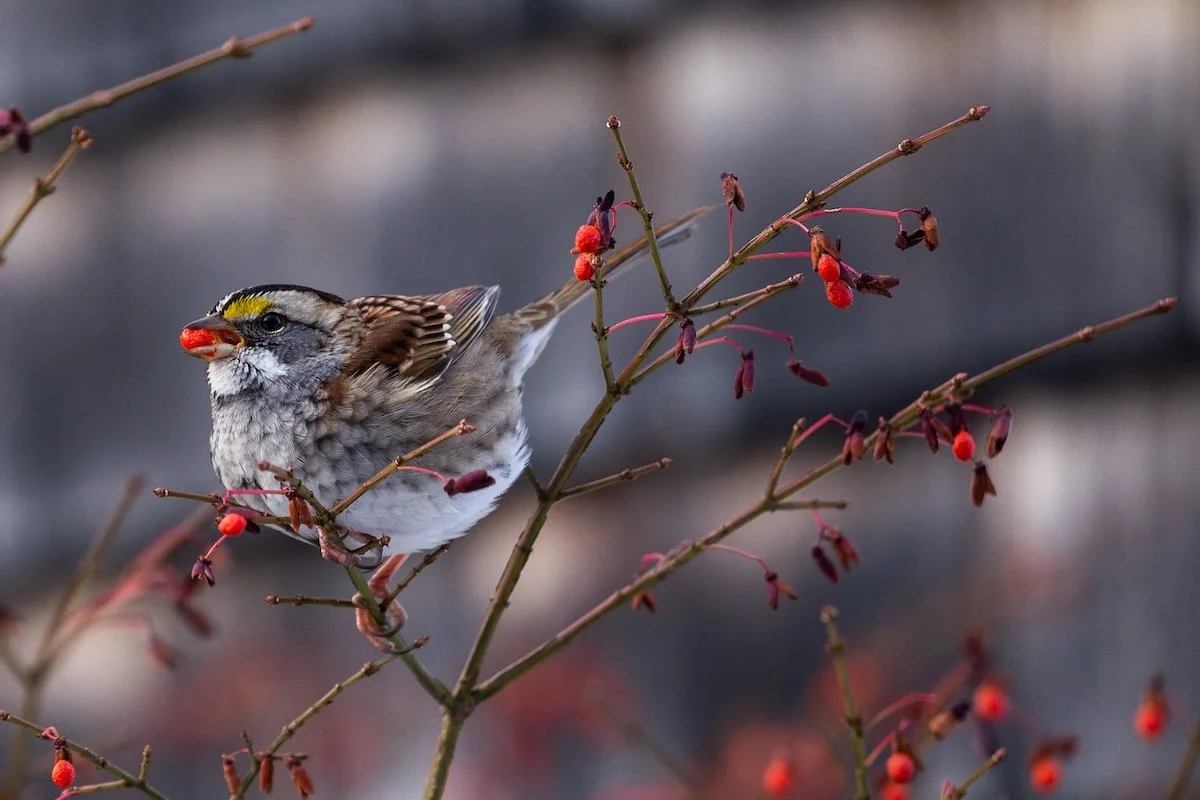
White-throated Sparrow, Charles Carlow/Audubon Photography Awards
While most birds only sing during the breeding season, relying on chirps and other short calls to communicate the rest of the year, White-throated Sparrows sing year-round, at any time of day. Their whistled song is roughly four seconds long with even notes that can either rise or fall in pitch. Though commonly ending in three syllables, a different two-syllable “dialect” first appeared in British Columbia in 2002. See How a White-Throated Sparrow's New Tune Went Viral. The Rocky Mountains were initially predicted to confine this dialect to the West Coast. However, miraculously, the song had traveled clear to Quebec in less than 20 years, an unusually quick uptake of a new singing pattern for a bird. Biologists used geolocators to track the wintering behavior of different White-throated Sparrows, finding that an overlap in Western and Eastern populations in Texas allowed the song to spread to impressionable baby sparrows of the East. Any doublet-ending singers in Virginia can be traced back to this first variation in British Columbia.
Though both sexes of White-throated Sparrow sing, some individuals are more likely to sing than others, and it depends on the color of their eyebrow stripe. In fact, other behavioral differences are observed not only between sexes, but between individuals with different color stripes. The classification is subtle: all White-throated Sparrows sport the same general appearance, with the tell-tale white throat, yellow lores, and black-and-pale facial markings. The difference is in the color of the pale stripes on the face. “White-striped” birds have white markings, the same color as their throat, while “tan-striped” birds are noticeably drabber. White-striped males are more aggressive and sing the most, while tan-striped females will rarely sing. Regardless of sex, tan-striped individuals are more likely to engage in parental care of their young. Interestingly, White-throated Sparrow individuals almost always mate with a bird of the opposite color morph. Their courtship patterns are complicated, with both types of males preferring white-striped females, and both types of females preferring tan-striped males. This mismatched pairing allows both stripe types to persist.
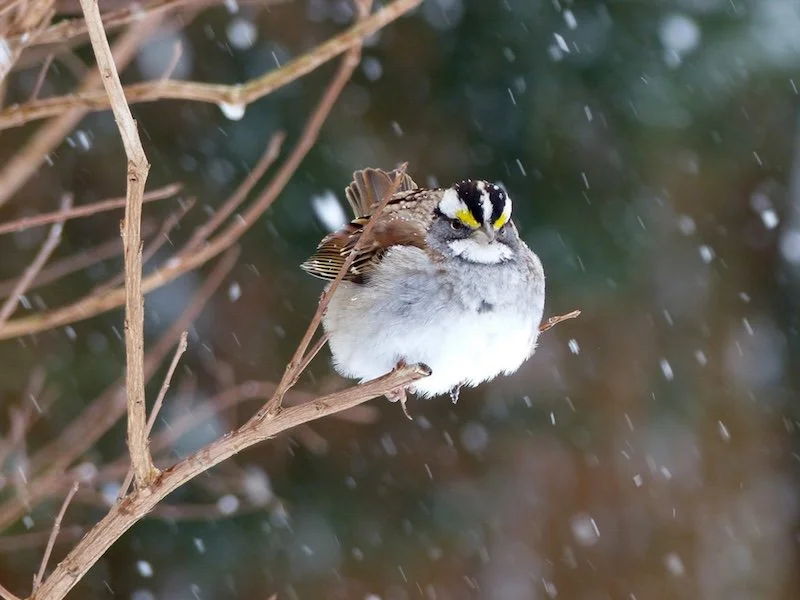
White-throated Sparrow, Dawn Phillips/Audubon Photography Awards
With such interesting songs and color variations, it’s no wonder that White-throated Sparrows are a fan-favorite, declared “one of the continent's best-studied and most familiar songbirds” by Cornell’s Birds of the World. Even if you’ve never seen one, they shouldn’t be hard to find. White-throated Sparrows congregate in most woods and brushy areas, including neighborhoods and tree-lined sidewalks. When in flocks, like other sparrows, they will often emit high-pitched “seep” calls, though their bold black-and-white facial patterns are hard to mistake for anything else. These birds aren’t picky with their friends; pay attention to the flocks they congregate in and you may also find a Song Sparrow, Swamp Sparrow, Carolina Wren or other small passerine.
Though widespread and abundant, White-throated Sparrows are especially vulnerable to window collisions as they migrate through urban and suburban areas. This species has been dubbed a "super-collider," with Chicago Bird Collision Monitors recording over 4,000 individuals in a 5-year period, nearly two times as many birds as the second most common species. Because they migrate at night and rely on stars to navigate, light pollution in cities can cause them to become disoriented. It’s been suggested that their tendency to call to one another while migrating actually causes more collisions, as one confused White-throated Sparrow can lead others astray.
Collisions don’t only happen with skyscrapers during peak migration. Studies on college campuses, like the University of Washington, have found collisions around mid-sized buildings year-round, with an uptick during winter months in that region. Reducing unnecessary light pollution at night, keeping shrubbery away from windows and treating large and reflective window facades with vinyl patterns are all effective ways to reduce collisions for birds like the White-throated Sparrow.
In cold weather and dark evenings, this bird’s cheery song makes it a welcome winter resident in Virginia. Listen for their whistled tune this holiday season. By the time they’re heading back north, the canopy will be alive with spring birdsong again.
Summer Delehanty is a product designer with a passion for birdwatching.