
How Birds Survive Winter
Photo: Mourning Dove, Danny Brown/Audubon Photography Awards
Jessica Pavlick
How do our feathered friends survive winter? They have two options: migrate to warmer temperatures or adapt to the winter weather. Some birds fly south to warmer temperatures and more plentiful food. Those that live in mountains can move to lower elevations. Those who choose to stay adapt to winter months through behavioral and physical changes, showing how extraordinary they are!
Winter adaptations include:
Fluffing up to increase body heat. Birds can fluff up their feathers to keep warm air near their bodies (like a warm down coat). Fluffing up creates hundreds of air pockets between their feathers that trap heat, increasing natural insulation. (Andrew del-Colle, "How Do Birds Cope With Cold Winter Weather," Jan. 24, 2024) Birds also can grow extra feathers for thicker insulation. (Laura Carberry, "Let's Go Birding -- Brrr . . . Birding Behavior in Winter," Dec. 9, 2020)
Huddling up. During cold nights, birds huddle up together to increase warmth through community. According to Carberry, “Golden-crowned Kinglets will roost together with 4 or more of their friends to survive the cold winter nights. Other birds like Black-capped Chickadees and Eastern Bluebirds will find cavities or nest boxes to huddle together at night.”
Slowing metabolism. Similar to a short-term hibernation, torpor is when a bird at rest slows its metabolism below its normal level, sometimes well below. They can do this for a few hours at a time, usually at night. (Ivan Phillipsen, "How Birds Get Through the Winter," Jan. 24, 2021)
Storing Food. During the fall, it’s typical for birds to store food from feeders. They carry food to hide for later when resources are scarce. According to Del-Colle, “a single chickadee can store up to 80,000 seeds—and remember where they all are.”
Sharing Food. A high bird body temperature (typically 105 degrees) means a high metabolism. Birds need high protein energy sources and they work together when they spot one! Birds look for insects, berries and seeds, and if they see a neighbor has found food, they will join in.
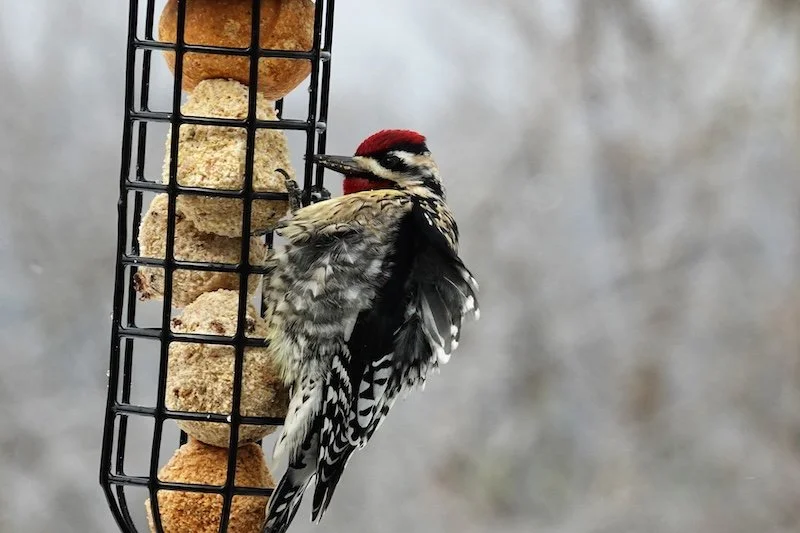
Yellow-bellied Sapsucker, Pamela Brown/Audubon Photography Awards
Birds’ adaptations are impressive, but we can still take action to help them in winter:
Help with warm housing: Clean nest boxes so birds can huddle together. Check them for mice periodically. If you do not have natural nesting spots in your yard, consider purchasing a nest box or roosting box.
Put up a bird feeder up and keep it clean and well stocked. Carberry’s article reports that birds watch each other and communicate where food sources are.
Consider feeding birds high-protein food.
Suet cakes are a high-protein food that you can provide for woodpeckers, nuthatches, Pine Warblers, chickadees and Tufted Titmice.
Birds love peanuts, seeds, insects or berries.
Attract bluebirds by offering mealworms.
Finches love thistle feeders and Nyger seeds.
Doves, sparrows and cardinals can enjoy millet and cracked corn.
Use a platform feeder to keep birds safe from predators and cats.
Provide a bird bath and keep it heated and clean. Birds need a water source in the winter.
Jessica Pavlick is a licensed psychologist and beginning birder who enjoys learning from nature.