
Perspective on the Dreaded Spotted Lanternfly
Photo: Adult Spotted Lanternfly, Cbaile19, CC0, via Wikimedia Commons
Nicole Patrick
Since the spotted lanternfly first made its presence known in Virginia in 2018, we have been faithfully stomping, squashing and squishing the invaders, which the Virginia Department of Wildlife Resources describes as a “vampire in a black tuxedo, white shirt, and red bowtie.” The now infamous invasive species has made its home throughout the northeast and mid-Atlantic and is present in at least 19 U.S. states.
The damage spotted lanternflies can do to native plants is well-documented; they feed on a wide variety of our native species, including grapevines, fruit trees and hardwood trees, and they have few natural predators. To date, Fairfax County has spent hundreds of thousands of dollars attempting to control the spread of the spotted lanternfly by targeting its preferred host, the invasive Tree of Heaven. But is the thinking around how to approach this widely-decried pest beginning to shift?
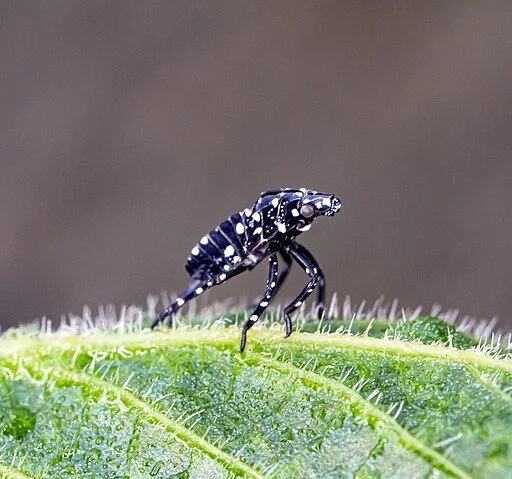
Spotted Lanternfly nymph. Photo: WanderingMogwai, CC BY-SA 4.0, via Wikimedia Commons
Smithsonian Entomologist Greg Ose reports that he and his team receive a high volume of reports and questions related to spotted lanternfly activity and their ongoing presence in our area – but, he says, they are no longer a cause for alarm. In November 2025, Ose wrote in an article in the Smithsonian Gardens newsletter that he expects the spotted lanternfly to “drift into obscurity,” hopefully becoming simply another garden “nuisance.”
Further, while “not easily containable, [spotted lanternflies] are treatable and in severe cases, select treatments are warranted.” Ose’s recommendations? Regular inspection and prevention (e.g., removal of Tree of Heaven), destroying egg masses, and yes – squishing and swatting adults when they appear in your garden. To destroy egg masses, Ose recommends using a stiff card to scrape egg cases into a plastic bag filled with a little hand sanitizer or rubbing alcohol, then throwing the bag in the trash.
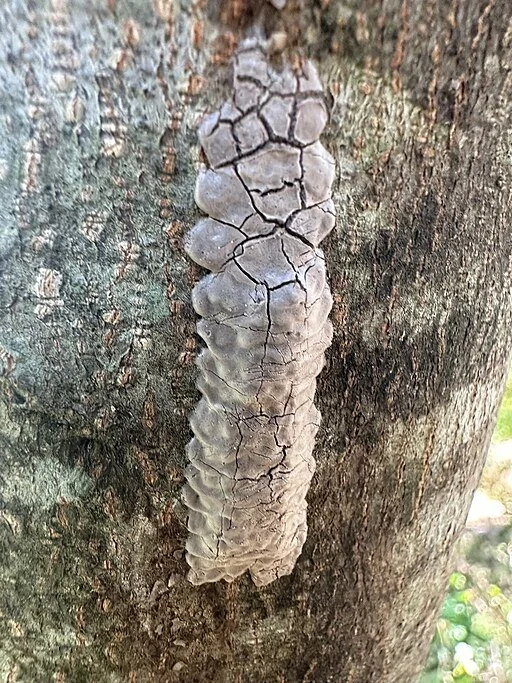
Spotted Lanternfly egg sac. Photo: aberkov, CC BY 4.0, via Wikimedia Commons
Importantly, he notes that pesticides available to treat spotted lanternflies also will kill other insects, including pollinators and would-be predators. According to Ose, the risk of harming these beneficial species is not worth it. And you should never, ever use sticky glue traps, which may unintentionally ensnare birds and other wildlife. There are other ongoing control efforts available to monitor and manage the presence of the lanternfly, including public education campaigns and non-chemical removal.
Even more promising, potential new natural predators, such as bats, are emerging. Birds also can play a critical role in helping us control the spread of spotted lanternfly populations going forward. Evidence suggests that birds could become a significant natural predator – with a little encouragement. Using iNaturalist, community scientists have logged observations of more than 33 different species eating the lanternfly. Some of the best ways to help birds along are well-known to us: provide water for drinking and bathing, nesting sites and native plant species.
Invasive plant removal also has a part to play in ongoing management of the lanternfly. The aforementioned Tree of Heaven is known to make the lanternflies taste bitter to birds; removing the invasive tree may make the lanternfly a more appealing food source to birds and other native predators.
Perhaps, then, the best thing we can do going forward as stewards of our native environment is to educate ourselves and others. While spotted lanternflies are not to be ignored, it is time to stop panicking and start directing our efforts toward supporting the native species that can have a meaningful impact on lanternfly populations.
Learn More:
Spotted Lanternfly, Fairfax County Public Works and Environmental Services, available at https://www.fairfaxcounty.gov/publicworks/trees/spotted-lanternfly
Greg Ose, “Garden Foe: The Spotted Lanternfly,” Smithsonian Gardens, Nov. 24, 2025, available at https://gardens.si.edu/learn/blog/garden-foe-the-spotted-lanternfly/
Carlyn Kranking, “Birds Are One Line of Defense Against Dreaded Spotted Lanternflies,” Audubon Magazine, Sept. 17, 2021, available at https://www.audubon.org/magazine/birds-are-one-line-of-defense-against-dreaded-spotted-lanternflies
Tree of Heaven, Blue Ridge Prism Fact Sheet, available at https://blueridgeprism.org/factsheets
Nicole Patrick, an enthusiastic birder and writer, is a lifetime northern Virginia resident.