
Winter Irruptions
Photo: Snowy Owl, Bernard Friel/Audubon Photography Awards
Summer Delehanty
If you didn’t know any better, you could mistake her for a plastic takeout bag, washed up on the Reagan National Airport (DCA) boat ramp alongside other bits of garbage. But this splash of white was no piece of trash. At the start of the new year, a Snowy Owl caught a flight to the north side of DCA, where she lingered for about a week. Birders could glimpse her from Gravelly Point, where often only her head was visible above the dirt, or attempt to see her from across the Potomac at Hains Point using a spotting scope. Though she’s since moved on, this winter is what’s known as an “irruption year” for Snowy Owls – so you can expect the occasional sighting much further south of their typical range.
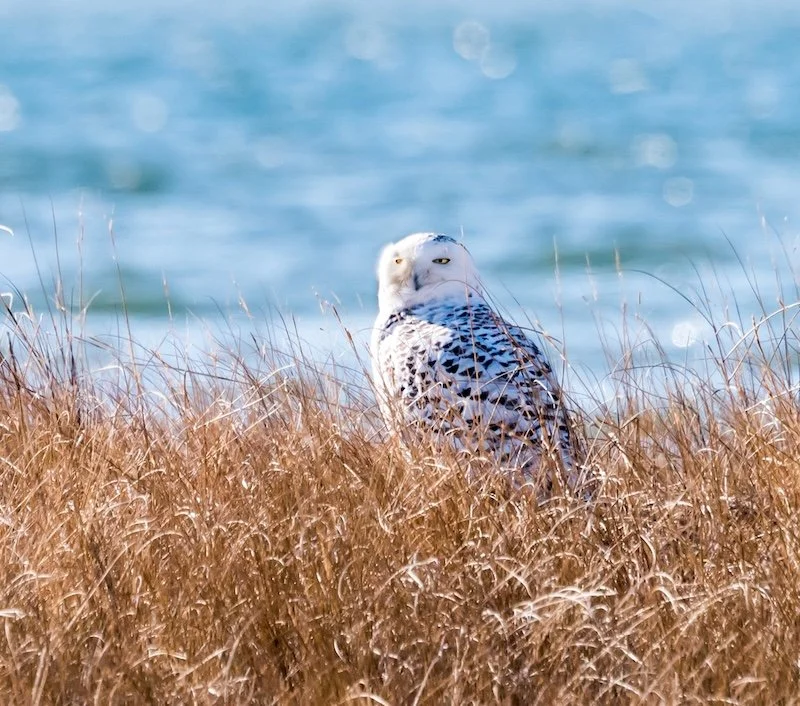
Snowy Owl, Peter Agnes/Audubon Photography Awards
An “irruption” is a large-scale movement of birds to a new area, somewhat similar to migration. However, unlike regular fall and spring migrations, irruptions are typically driven by resource availability (such as food scarcity) and thus occur more randomly, with some winters seeing big irruptions and others seeing none at all. In the case of Snowy Owls, recent research cited in Audubon Magazine reports that these influxes occur after baby booms in the Arctic, spurred by increases in prey. These young, healthy owls head south the following winter in search of a place to stay, while many adults remain in their preferred Arctic habitat. Snowy Owls favor wide, open landscapes that resemble the tundra, such as agricultural fields, beaches, and even airports, which is how one ended up at DCA in northern Virginia.
Because irruptions are irregular, they’re often hard to track and predict. Thanks to Project SNOWstorm, a long-running research project tracking Snowy Owls across North America via solar-powered GPS transmitters, we now know how extensively a single owl can travel. The same individual might spend one winter in Virginia and end up in Montreal the next, so there’s no telling where any singular owl might be. In what might be the world’s largest dataset on Snowy Owl movement, this project has tracked more than 115 birds across 17 states and provinces. Interactive maps and tagging stories are available on the Project SNOWstorm website.
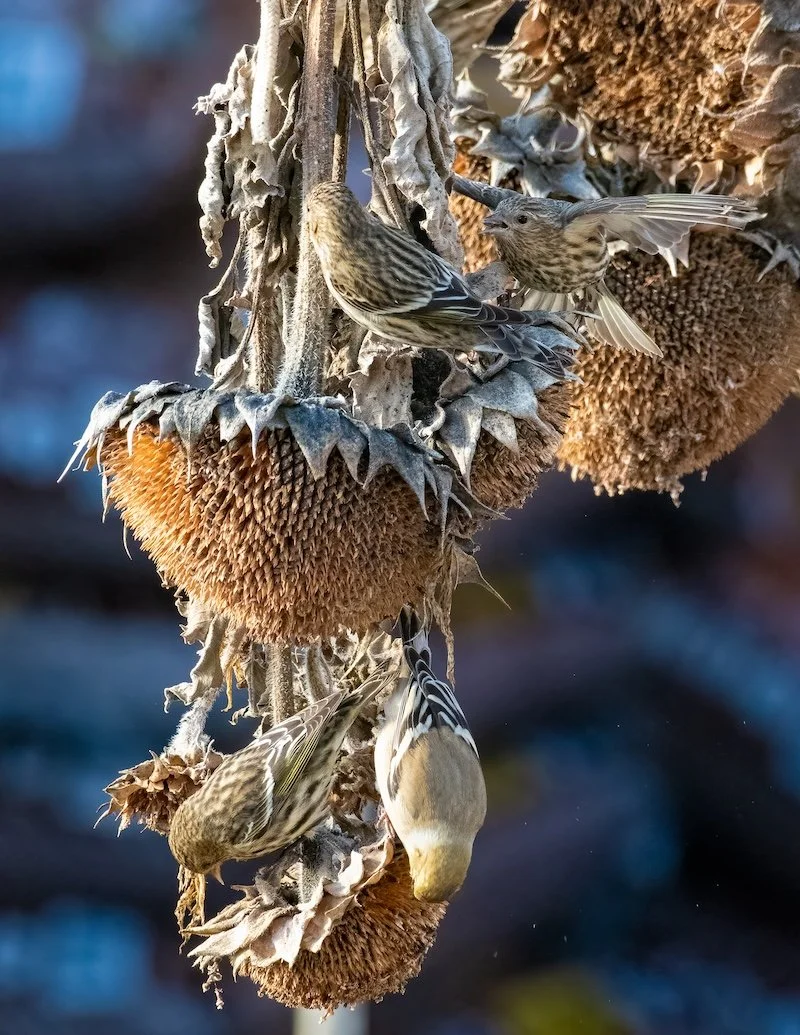
Pine Siskins and American Goldfinch, Joanie Christian/Audubon Photography Awards
Though perhaps the most popular, Snowy Owls aren’t the only species to irrupt. Other birds, especially those that depend on cone-bearing trees in northern forests, follow similar boom-and-bust patterns tied to food supply. Evening Grosbeaks, Pine Siskins, and Common Redpolls move south en masse when food is scarce in boreal forests, and Cornell's All About Birds predicted this winter to be a big one for all three on the East Coast. Early sightings in fall found them as far south as West Virginia, Georgia, and Pennsylvania, respectively. Forecasters estimated this past winter would be the biggest flight year since 2020-2021. Winter finches are easily enticed by a full bird feeder, but you can also keep an eye on nearby sightings with an eBird account.
Even familiar backyard birds like chickadees, Blue Jays, and Red-breasted Nuthatches show irruptive behavior, moving south after poor breeding seasons or food shortages. The moving northern populations often intermingle with resident flocks and can appear at feeders in higher numbers. Though more subtle than a Snowy Owl perched at an airport, these movements reflect shifting resources and serve as a reminder of how interconnected different regions are. A changing climate can alter snow cover, prey adaptability, and forest productivity in increasingly unpredictable ways, affecting the intensity and frequency of irruptions. Suitable habitat and food sources don’t only support regular winter residents – they also offer refuge for species displaced from the North.
For birders, irruption years offer rare opportunities to see species far from home, often in unexpected places. However, it’s important to remember these journeys are driven by necessity, and these visitors can be especially vulnerable if they’re young or hungry. The warmest welcome we can give them is to maintain a respectful viewing distance and protect the landscapes where they temporarily reside.
Summer Delehanty is a product designer with a passion for birdwatching.