
Updating the Virginia Breeding Bird Atlas
Photo: Baltimore Oriole, Mark Boyd/Audubon Photography Awards
Glenda C. Booth
Reprinted from DWR’s Virginia Wildlife, January/February 2025
Breeding bird atlases have a long history in the United States, where they are typically conducted at the state level. Like road atlases, at their core they are centered around maps, but the maps relate to the geographic distribution and abundance of breeding bird species—that is, where they are found on the landscape and in what numbers. Last fall, a website was published describing the results of the Second Virginia Breeding Bird Atlas (Atlas), a five-year survey that served as a follow-up to the First Atlas (1985-1989). This Second Atlas was a product of a partnership among the Virginia Department of Wildlife Resources (DWR), the Virginia Society of Ornithology (VSO), and the Conservation Management Institute (CMI) at Virginia Tech.
Ashley Peele, PhD, an avian ecologist now working for the Appalachian Mountains Joint Venture, served as the Atlas Coordinator, recruiting, training, and guiding volunteers to collect bird data according to Atlas guidelines. Nearly 1,500 volunteers contributed to the Atlas between 2016 and 2020, making it one of the largest citizen-science projects in the state. This effort involved groups like bird clubs, Audubon chapters, Master Naturalists, outdoor organizations, wildlife biologists, college students, and others. “Without the volunteer component, this project is one that could never have been carried out by Virginia’s natural resource professionals alone,” said Sergio Harding, a DWR nongame bird conservation biologist.
How They Did It
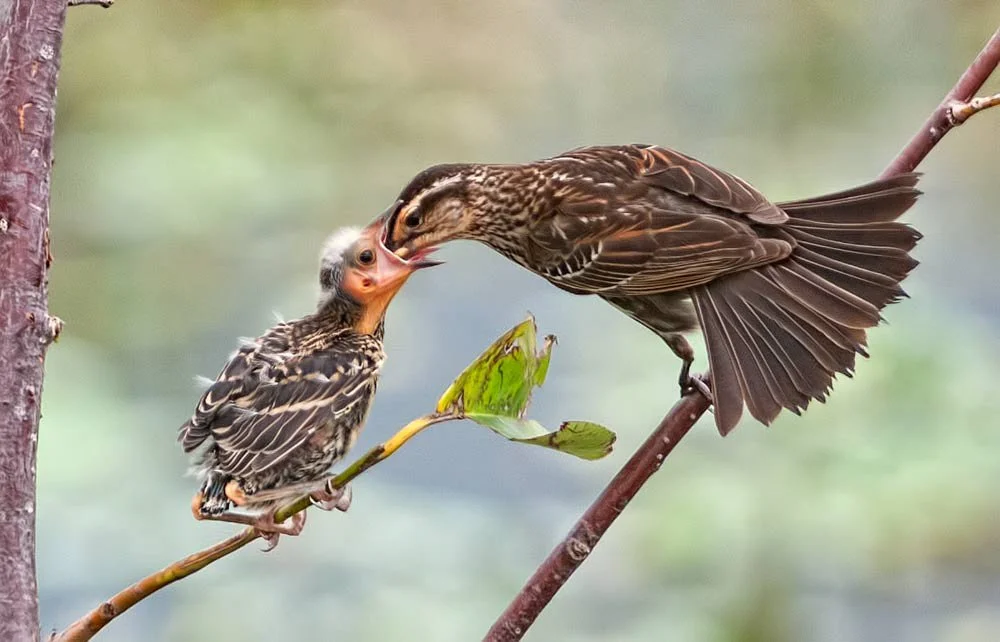
Red-winged Blackbirds, Ken Lassman/Audubon Photography Awards
Atlas surveys took place within Atlas blocks, using the same statewide block grid as the First Atlas. Each quadrangle within the U.S. Geological Survey’s topographic map series for Virginia was subdivided into six blocks of approximately 10 square miles in area. Volunteers recorded as many species as possible within a block, entering their observations into a customized Virginia Atlas portal of the popular online eBird application.
While the peak breeding season for many migrant birds is typically May to July, volunteers surveyed for breeding birds throughout the year. In the late winter and early spring, for example, birds like owls, hawks, and falcons begin breeding activity. Bald Eagle (Haliaeetus leucocephalus) courtship can start as early as December in Virginia. Great Blue Herons (Ardea herodias) typically start nest building in rookeries in February in the state.
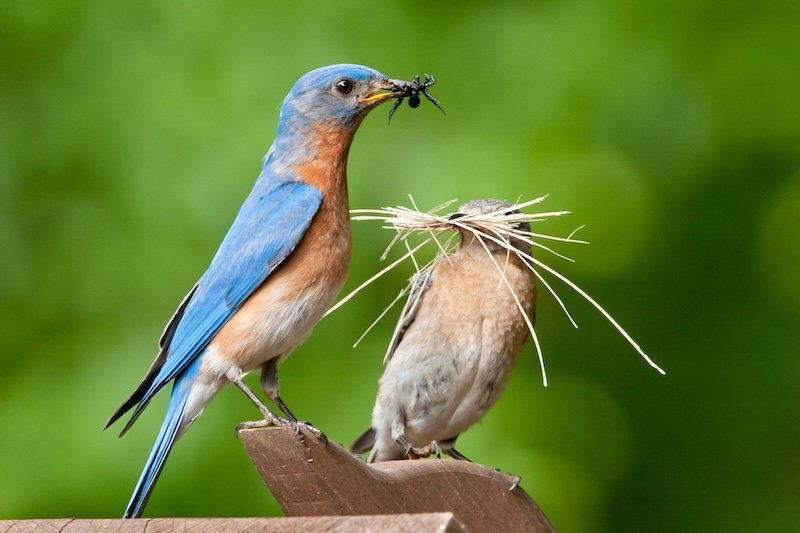
Eastern Bluebirds, Mark Boyd/Audubon Photography Awards
“Breeding bird atlas surveys collect behavioral information, unlike other bird surveys that typically only identify and count numbers of species,” remarked Peele. This helps to distinguish birds that are breeding from those that are migrating through or finishing their winter stay. Volunteers reported evidence of breeding, using standardized breeding codes, based on behaviors they observed for each species within a block. Individual observations of birds were then categorized as representing possible, probable, or confirmed breeding. Examples of breeding behaviors include singing, copulation, carrying nesting material, incubating eggs, and feeding young.
Atlas Highlights
The total number of species with breeding evidence was 205 for the Second Atlas and 203 for the First. For confirmed breeders only, the totals were 196 for each Atlas. Austin Kane, the Managing Editor of the Second Atlas, who works with Virginia Tech’s Conservation Management Institute, cautioned, “It is important to note that although the number of confirmed breeders stayed the same, their composition changed slightly between Atlases.” These changes reflect changes to Virginia’s avifauna over the past 30 years, with some breeding species having been gained and others lost:
Eight species were confirmed as breeding that were not detected during the First Atlas: the introduced Trumpeter Swan (Cygnus buccinator) and Eurasian Collared Dove (Streptopelia decaocto), as well as Black-necked Stilt (Himantopus mexicanus), Anhinga (Anhinga anhinga), Mississippi Kite (Ictinia mississippiensis), Merlin (Falco columbarius), Yellow-rumped Warbler (Setophaga coronata) and Painted Bunting (Passerina ciris).
Two species that bred during the First Atlas were not detected at all during the Second Atlas. Bewick’s Wren (Thryomanes bewickii) is believed to be extirpated across the eastern United States. Bachman’s Sparrow (Peucaea aestivalis) breeds more regularly south of Virginia and has not been documented in the state since 2003.
Five additional breeders during the First Atlas were reported without breeding evidence during the Second Atlas. They include Blue-winged Teal (Spatula discors), Green-winged Teal (Anas crecca), Ring-necked Pheasant (Phasianus colchicus), Upland Sandpiper (Bartramia longicauda) and Sedge Wren (Cistothorus stellaris).
Certain species saw their distribution diminish within the state. This includes Kentucky Warbler (Geothlypis formosa), American Barn Owl (Tyto furcata) in the Coastal Plain and Northern Bobwhite (Colinus virginianus) and Yellow-breasted Chat (Icteria virens) west of the Blue Ridge Mountains.
“The second Atlas gives us a more detailed picture of where breeding birds are distributed across Virginia and how that has changed since the mid-1980s,” said Peele, who coordinated the data collection and analysis component for the second Atlas. “These data provide a quantitative way to evaluate how bird populations have shifted over the last 40 years.”
The Atlas website features over 200 individual Species Accounts of game and nongame birds. For species with sufficient data, they provide maps of breeding distribution and of changes in distribution between Atlases, based on predictive models; breeding evidence maps based on data collected by volunteers; maps of predicted abundance; population estimates and population trends; and a summary of relevant conservation efforts. The maps are complemented by interactive maps and by a narrative providing interpretation.
The website also includes a guide to reading the Species Accounts and sections on Atlas methodology and results. The website will be expanded in early 2026 with additional results, content on analytical methodology, information on Virginia’s geography and habitats, and a section on the role of the Atlas in bird conservation.
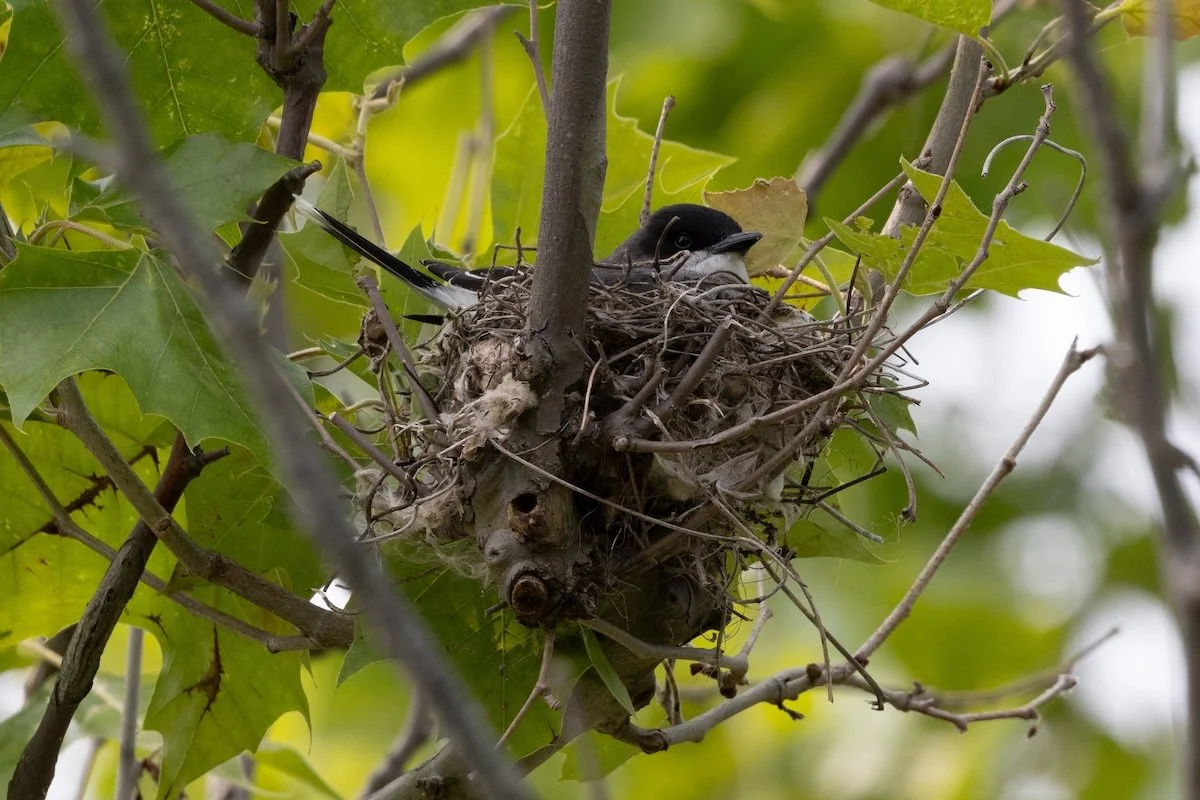
Eastern Kingbird on nest, Dixie Sommers
Why is the Atlas Important?
As a centralized source of information, the Atlas website is an educational resource for people to learn where breeding birds in Virginia are found and in what numbers. But most importantly it is a conservation tool. As Kane noted, “[The Atlas] is a statewide effort that, when paired with the results of the First Atlas, shows where our birds occur on the landscape and how that has changed over time, helping us understand the health and status of their populations and providing an important tool for conservation. When we know where they are, we can better protect them.”
Atlas data can inform decision-making by policy makers, land planners and natural resource professionals. For example, DWR used Atlas results to fill in data gaps during its update of the list of avian Species of Greatest Conservation Need in the 2025 Virginia Wildlife Action Plan. Distribution data can help target potential new habitat projects, and abundance maps can aid in identifying areas with larger or smaller concentrations of priority bird species for conservation work. For landowners, Atlas information on the timing of breeding activities by different species can help guide land management. For example, knowing when to avoid tree work and field mowing can minimize impacts to nesting birds.
Changes in the distribution of species reflect habitat changes, climate change impacts, and many other factors. Ultimately, having a good grasp of changes in bird populations and on their underlying causes is key to being able to conserve them. As Peele noted, “Some population declines happen quietly and we learn too late.”
Glenda C. Booth, a freelance writer, grew up in southwest Virginia and has lived in northern Virginia more than 30 years, where she is active in conservation efforts.