
NVBA NEWS BLOG
Welcome to the blog for Northern Virginia Bird Alliance, a wealth of resources about northern Virginia birds, wildlife, habitat conservation and restoration, native plants, wildlife-friendly gardening, advocacy and more.
Wildlife Sanctuary Almanac: Winter Bird Feeders and Bird Baths
When it’s a snowy, icy and cold winter, there’s little gardening you can or want to do in the yard. But there are a few steps you can take to supplement the work you have already done by providing natural food sources and shelter.
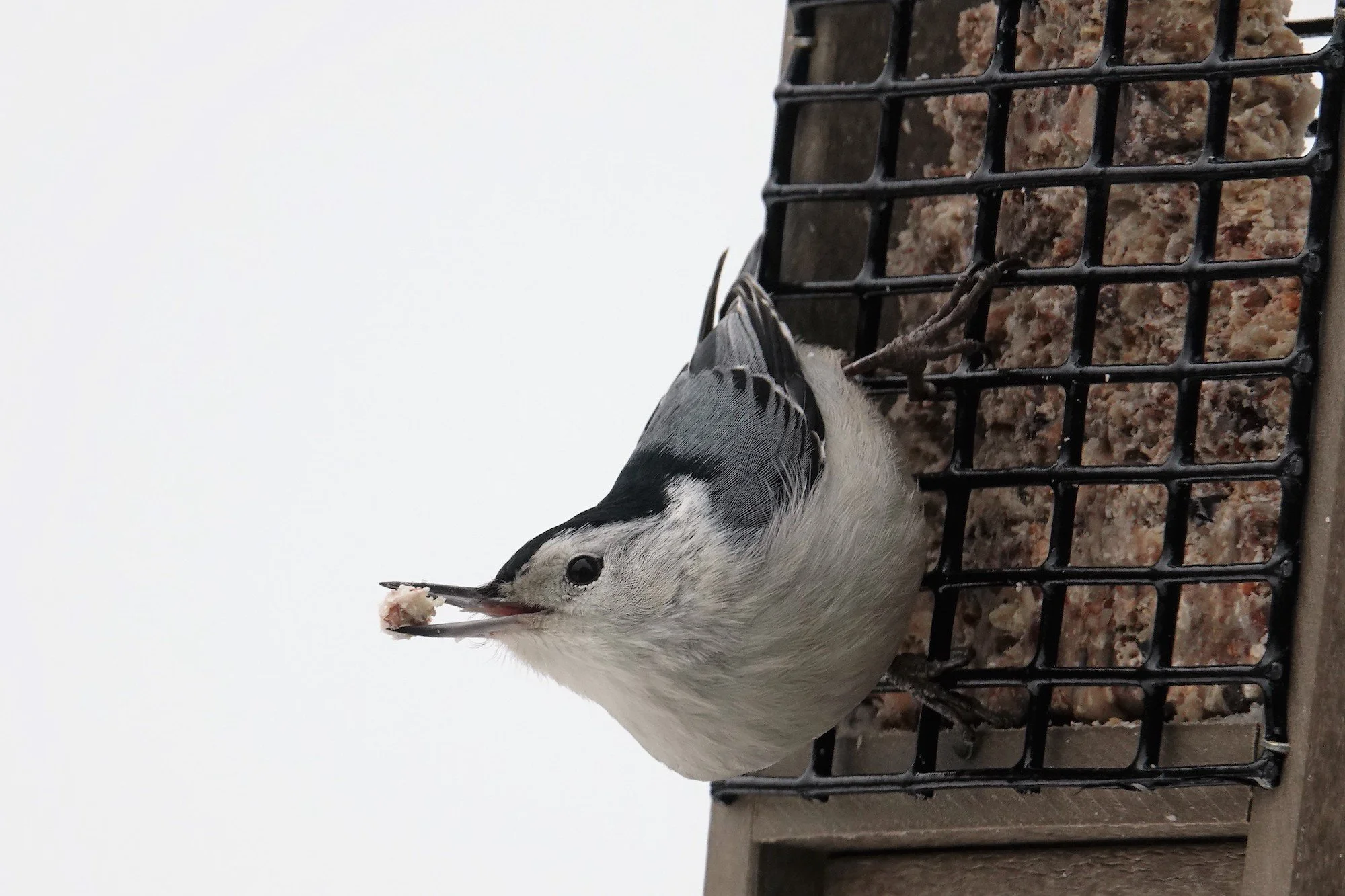
Photo: White-breasted Nuthatch, Pamela Brown/Audubon Photography Awards
When it’s a snowy, icy and cold winter, there’s little gardening you can or want to do in the yard. But there are a few steps you can take to supplement the work you have already done by providing natural food sources and shelter. You can offer and maintain bird feeders and can provide an unfrozen source of water for drinking and bathing. Both will help local birds and provide a reliable source of entertainment as you watch from the warmth of your home.

Northern Flicker and Red-bellied Woodpecker, Wilson C Po/Audubon Photography Awards
Bird Feeders
There are some basic rules for bird feeders.
Make sure that the food you offer is nutritious, providing needed fat and carbohydrates. Favorites include black-oil sunflower, hulled sunflower, Nyjer (thistle), whole peanuts, and suet. You may also want to offer some dried mealworms on a small plate on a patio table.
Clean the feeders well and often. Clean feeders weekly, especially during wet weather. Take them apart and scrub off debris and either scrub them with soap and water or run them through the dishwasher. To disinfect them, soak them for 10 minutes in a bleach/water solution or a weak vinegar solution, but make sure to rinse them well afterwards and dry them thoroughly before reusing them.
Keep the area under feeders clean. Using hulled seed helps prevent potentially moldy buildup under feeders, but a good raking now and then is still necessary.
Prevent predation from outdoor cats and raptors. If you notice neighborhood cats stalking the birds you have attracted, chase them away. If that doesn’t work, you should take the feeders down for a while, or even permanently. And, although predation by raptors is natural, you should remove feeders for a while if raptors such as Cooper’s or Sharp-shinned Hawks make daily visits.
Prevent window collisions. If birds swarming your feeders are colliding with your windows, remove the feeders until you can take steps to prevent those collisions. Information on making buildings safe from window collisions is available on NVBA’s Bird Safe NOVA site.

Red-bellied Woodpecker, Marie Schmidt/Audubon Photography Awards
Bird Baths
If you have a water feature such as a natural or constructed stream or pond, chances are it’s frozen, drained or, in the case of a feature with a pump, turned off for the time being. Because nearby natural streams and ponds also may be frozen in very cold winter months, you can help the birds by providing a bird bath with a water heater that keeps it ice-free. This will be an option only if you have a grounded outdoor outlet where you can plug in the heater. There are a variety of models you can find either online or at a local bird feeding or hardware store.
Maintaining a clean bird bath is very important, particularly if it attracts mobs of birds, which it may do when other sources of water freeze. Change the water daily, and disinfect it weekly. For the weekly cleaning, rinse and scrub it with nine parts water, one part vinegar. Although you should avoid synthetic soaps and cleansers because they can strip the essential oils off of feathers, running the bird bath through the dishwasher on the disinfect cycle and adding an additional rinse with running water afterwards is an easy way to do the weekly cleaning.
Keep warm and enjoy the view from your windows.
Catch up on past Wildlife Sanctuary Almanac articles here.

Monday Mystery - January 27, 2025
Monday Nature Mystery continues! Read on to learn who correctly identified our last mystery.
Photo: Green-winged Teal, Ashrith Kandula/Audubon Photography Awards
We are pleased to announce the winner of our most recent Monday Nature Mystery, Cathy Jett!
Congratulations to Cathy for identifying the female Green-winged Teal (Anas carolinensis).
Green-winged Teal (Anas carolinensis). Photo: Ashrith Kandula/Audubon Photography Awards
According to All About Birds, this species sometimes switches wintering sites from year to year. One banding study found that individuals wintering in Texas one year went as far away as California in subsequent years. This lack of philopatry, or “faithfulness” to a particular site, may reflect the tendency of males that did not breed the year before to try to find mates among a different set of wintering females.
Each Monday we’ll post a new mystery and identify the previous week’s winner. They’ll receive an ASNV hat or tote bag.
Here is this week’s mystery:
Who is this?
Be sure to post your guess on our Facebook page under the latest Monday Nature Mystery post, and make sure you receive our emails to find out the winner and mystery answer each week. Good Luck!
Please check our guidelines here.

Monday Nature Mystery: Who is this? Photo: Claudio Contreras Koob/Audubon Photography Awards

It’s Official: The Bald Eagle Is Our National Bird
On December 24 President Joe Biden signed S. 4610, making it official that the Bald Eagle is the national bird of the United States.
Photo: Bald Eagle, Cynthia Hansen/Audubon Photography Awards
On December 24 President Joe Biden signed S. 4610, making it official that the Bald Eagle is the national bird of the United States. Many did not know that it was not already our national bird, because it is a pervasive symbol throughout our government, as the bill’s findings make clear.
Since 1782 it has been the Coat of Arms for the United States Great Seal; it’s the leading insignia for all branches of the military; its image is on thousands of government branches, department and agencies; it’s integral to the spiritual lives and sacred belief systems of most Indigenous peoples and Tribal communities; and it’s on hundreds of stamps and many coins and currencies.
For those of us working actively to conserve threatened bird species, it’s also a symbol of how focused efforts can return an endangered bird from near extinction.

Native Americans and Birds
U.S. laws to protect eagles and migratory birds include exceptions from bans on possessing bird feathers for Native Americans for cultural and religious activities. The exceptions strike a balance between protection of birds and protection of the cultural heritage of Native Americans.
Photo: Whooping Cranes, Kristine Colburn/Audubon Photography Awards
Jo Doumbia, Diversity and Inclusion Chair
To protect birds, both the Migratory Bird Treaty Act and the Bald and Golden Eagle Protection Act prohibit possession of parts of or feathers of eagles and other wild birds of North America. There are MBTA exceptions for legally hunted waterfowl or other migratory gamebirds, and both acts include exceptions for uses by Native Americans for cultural and religious activities. The exceptions strike a balance between protection of birds and protection of the cultural heritage of Native Americans.
Various ceremonies among more than 900 tribes across the country may require feathers from canaries, hawks, woodpeckers, or other birds. Some might need to be from a male or female. Others call for birds of a certain age. Risling Baldy, a Native American associate professor and department chair of Native American Studies at Cal Poly Humbolt in Arcata, CA said that, for the Hoopa Valley Tribe, the use of feathers in ceremony is a way to stay connected to the K’ixinay or “First Peoples.”
The feathers of certain birds also are believed to possess powers and must be treated with respect. Eagle feathers often are used in spiritual ceremonies, such as naming ceremonies, honoring ceremonies and the sun dance. Rosa Little Thunder, a Lakota linguist, artist and environmental activist states, “The spotted eagle flies high and therefore reaches places that we don’t know about. . . . [T]he spirit of the spotted eagle is considered to be very powerful. It brings really good advice from elsewhere, places that other things don’t go.”

Whooping Cranes, Debra Strothman/Audubon Photography Awards
The Yuchi people, who reside in northeastern Oklahoma, wear the feathers of the Whooping Crane before performing their annual ceremonies. Their agreement with the nation of cranes is simple: when they sing the Whooping Crane’s songs, they must wear his feathers. As populations of the crane declined, and the bird approached extinction, the Yuchi people had a harder time obtaining crane feathers; however, by 2011, Scott Stafford, second chief at the Yuchi ceremonial ground Duck Creek, was able to provide for ceremonial use crane feathers from the molted plumage of a Whooping Crane being rehabilitated by the International Crane Foundation, a wildlife center dedicated to the birds. “If we don’t have them, it is extremely detrimental to our annual ceremonies and what we observe,” Stafford said. “It is extremely important to maintain that connection.”
Birds, as winged messengers, have a special place in spirituality and ceremonies. In some Native American traditions, when a person dreams or has a vision about a certain animal, the person may then wear attire related to that animal. As Jace DeCory and Rosalie Little Thunder indicate, a person wearing the emblems of an animal is mimicking the desired characteristics of that animal. For example, in the eagle dance, a dancer is mimicking the eagle and hoping to gain characteristics associated with the eagle, such as intelligence.
Kwihnai Mahkweetsoi Okweetuni, co-director and cofounder of the Comanche Nation Ethno-Ornithological Initiative, states that the Comanche send prayers to the Almighty through eagles by using whistles made from their wing bones and fans made from their feathers. To the Comanche community, Golden Eagles are the only animals that can fly “high enough and far enough to see the face of God,” and that when “we pray, the eagle is what takes our petitions to the Almighty.” She also writes, “We’re too humble to go directly to God so we use animals as intermediaries. . . . We pray through all the eagles in the world, and when we’re in ceremony and prayer, we can feel where there are imbalances.”
Some Native American leaders have spiritual bird helpers. For the Lakota warrior, Crazy Horse (Tȟašúŋke Witkó, literally, “His horse is crazy”), it was the hawk. Crazy Horse is reported to have shown modesty by wearing hawk feathers in his hair rather than eagle feathers. The owl also can serve as a spiritual guide. Educator and Standing Rock tribal member Jace DeCory indicated that the great white owl was a spirit helper for her grandfather.
Of course, different cultures may interpret the significance of certain birds in different ways, and one person’s spiritual guide may be a signifier of evil to another. Shepard Krech, an anthropology professor at Brown University, writes, “Owls were without doubt the most dreaded and dangerous birds in the South,” noting that they were not only ill omens but also were perceived “as witches and spirits bent on malevolence.” Among some Pueblos in the Southwest, possession of owl feathers is an indicator that one is a witch or at least intent on doing evil. To ward off witches, some place owl effigies above their doors, on roofs, or in crooks of trees.
Certain ceremonies may not use bird parts or feathers but call upon bird spirits. During the Lakota healing ceremony (Yuwipi), the healer is tied up with a special blanket and rope while praying for healing. The healer may pray to different birds, including eagles, hawks, owls, robins or blackbirds, depending on the healer and the goals of the ceremony. After the spirits are summoned and communicate with the healer, they are said to untie the healer before leaving.
Birds also may provide insight into future events. According to Northern Plains teachings, the power of birds is to be respected and held in high esteem. When asked about the role of birds, Rosalie Little Thunder simply replied, “Wakan,” a term often translated as “sacred.”
The importance of birds to Native American culture is also clear even without reference to specific ceremonies. Shepard Krech notes that Native Americans from the south and elsewhere appear in historical “images in feather capes, crowns, sashes and headdresses.” And many clans among the Pueblos are named for birds (Eagle, Turkey, Parrot, Macaw, and Roadrunner). And images of eagles, ospreys, thunderbird and raven, are prevalent in the art of Native Americans from the northwest coast. The raven is commonly at the top of totem poles, because many northwest coast tribes associate the raven with the beginning of life. And stories about what Native Americans can learn from birds are common. For example, the Mariposa Mewuk, who lived in the Yosemite Valley, relate that Kah-kool, the raven who blackened himself with ashes to make himself less visible when hunting, was the first to learn how to use deer meat for food.
The history of Europeans’ relationship with Native Americans is one of losses for Native Americans, and the relationship among the U.S. government and the tribes often is still contentious. President Biden’s historic apology in October 2024 to Native Americans for the government’s boarding schools, which separated children from their families with the aim of erasing tribal identities, is a step towards further recognition of the importance of Native American traditions and spiritual practices. It is heartening to consider that, at least in this one area, ceremonial use of bird feathers and parts, the laws already acknowledge the importance of their heritage.

Let Dead Plant Material Lie
Dead native plant material is integral to a healthy ecosystem. An essential support for the populations of pollinators and other animals upon which we all depend, nothing comes close to replacing its role in the health of a diverse ecosystem.
Photo: Ilex verticallata and Monarda in the snow, Margaret Fisher
Plant NOVA Natives
Our splendid native plants are going dormant for the winter and leaving behind their seed heads and dead stalks as a reminder of growing season glory. Many of us are inclined to perceive these remnants as unsightly “garden debris” that should be cut and cleared sooner rather than later. Better now than in the spring, right?
Wrong! Dead native plant material is integral to a healthy ecosystem. An essential support for the populations of pollinators and other animals upon which we all depend, nothing comes close to replacing its role in the health of a diverse ecosystem. Before trotting out the clippers and rakes, consider this:
Dead stalks: Many dead stalks of native plants contain hollow spaces that are like 5-star winter resorts for the insect world. We may frown at their appearance, but native bees, among others, are industriously and ingeniously taking advantage of them in surprising ways. Adorable little bees that are so tiny you may never have noticed them are laying eggs, hibernating, and otherwise snuggling down for the harsh winter in the stem shelter of the native plants we installed. Insects aren’t the only critters who profit. Dead plant material provides shelter and nesting resources for birds and many others.
Dead leaves: Butterflies can spend the winter in leaf litter as caterpillars and chrysalises. The Mourning Cloak, Question Mark, and Comma butterflies, for example, overwinter in dead leaves as adults after entering a dormant phase called "diapause." Moth species such as Luna Moth and Isabella Tiger Moth also pupate in leaf litter. Salamanders, some turtles and other creatures find shelter there as well.
Seeds and berries: Seeds on flowerheads and winter berries are an important source of nourishment for both resident and migrating birds and are consumed throughout the fall and winter. Living or dead, native plant material has immense value for wildlife.
Living soil: Dead and decomposing plant materials are valuable components of soil. Gardeners and landscapers spend considerable time and money on store-bought organic material to condition the clay soil often encountered in northern Virginia. But the decomposing plant material already present helps build humus, a dark organic material comprised of approximately 60% carbon, 6% nitrogen, and small amounts of phosphorus and sulfur. Humus-rich soil encourages a proliferation of beneficial soil organisms and microorganisms. It also holds moisture and retains soil structure for better air and water circulation. The decomposition process creates very fertile ground indeed for native plant gardening.
Armed with this expanded understanding, it seems that the best fall cleanup strategy is to not have one: leave the stalks, stems and leaves alone and let them lie right where they are over the winter. A light cleanup or pruning in early spring to encourage new growth can be done with little or no harm to local wildlife. More information on garden and landscape maintenance can be found on the Plant NOVA Natives website.
We would be remiss not to include a word here about gardening aesthetics. We humans care about how things look. In daily life, surrounded by people, garden beauty and aesthetics will always be a consideration. Our definition of “garden beauty,” however, can certainly evolve. Are not waving seedheads more interesting than bare ground? And is it not beautiful that all kinds of animals need our pollinator gardens for more than just pollen? That our efforts not only attract pollinators but enable their very survival? That it takes just a bit of forbearance to advance and strengthen the biodiversity of the region?
Let’s pause the garden cleanup until spring, and then be gentle on the emerging life.

Snowy Owl, An Occasional Winter Visitor
Although the Snowy Owl (Bubo scandiacus) is no longer classified as in a separate genus (Nyctea) from typical owls, like the Great Horned Owl, there’s a lot about it that is unique.
Photo: Snowy Owls, Grant Eldridge/Audubon Photography Awards
If you mention the Snowy Owl, many D.C. area residents will think immediately of Hedwig, Harry Potter’s companion owl. Birders, of course, will think about winters when they have been lucky enough to see a Snowy Owl visiting our area, at Reagan National Airport, or D.C. locations like the National Mall, McPherson Square or Union Station. As of this writing, e-Bird shows 2024 Snowy Owl sightings only in far western Virginia and on the eastern shore of Maryland, but we may yet get a visitor or two.

Snowy Owl at Union Station, Matt Felperin
Although the Snowy Owl (Bubo scandiacus) is no longer classified as in a separate genus (Nyctea) from typical owls, like the Great Horned Owl, there’s a lot about it that is unique. It has striking white plumage, all white in males and with brown barring in females. It is one of the few bird species that can survive Arctic winters. It is a circumpolar species, breeding all across the far northern hemisphere and nesting on Arctic tundra. It has the greatest body weight of North American owls, a feature which helps it to survive in the cold.
The primary food source to support Snowy Owl breeding is lemmings, but during other times they will eat a variety of prey. Lemmings are small, each weighing around two to three ounces, but Snowy Owls are large and powerful and are known to prey on larger animals, including snowshoe hares, ptarmigan, and common eiders. In winter they may range widely, hunting in both coastal and inland areas. Outside of their breeding range they are most commonly seen in fields and meadows, including during the day, because they are diurnal hunters.
Birders in the lower 48 states may see Snowy Owls in winter in the northern-most states, but sometimes the birds will range more widely, including into the D.C. area. In a big breeding year, when the lemming population is booming and the breeding adults raise a large number of young, birds will move south in large numbers. At one time it was thought that the Snowy Owls, like Boreal Owls and Great Gray Owls, moved south when prey sources were depleted, but current research suggests the opposite, that it is prey abundance that causes the irruption. In the winter of 2011/2012, Snowy Owls appeared in all Canadian provinces and 31 states.
The 2022 State of the Birds Report identifies Snowy Owl as a species that has lost half of its population in the past 50 years. Partners in Flight includes the Snowy Owl on its Yellow Watch List of species facing moderate to high threats. One of the biggest threats may be climate change, which could lead to loss of breeding habitat and a decline in prey. When migrating outside of their breeding areas, they face threats from collisions with vehicles, communication towers, wind turbines and airplanes. In an urban area like D.C., even though they typically eat live prey instead of carrion, they can ingest poison in rodents that have been poisoned but have not yet died.
The primary focus of conservation efforts to protect Snowy Owls is combatting climate change, reducing carbon emissions wherever possible, and offsetting what we cannot eliminate by maintaining healthy forests, supporting sustainable agricultural practices, and more. In addition to taking action on energy use in the home and advocating for healthy practices in northern Virginia communities, you can help the Snowy Owl by signing National Audubon’s petition urging action on climate change.

Help Us Write the Potomac Flier
Are you interested in writing about conservation and northern Virginia’s birds? We could use your help.
Photo: American Crows, Marian Bodart/Audubon Photography Awards
Are you interested in writing about conservation and northern Virginia’s birds? We could use your help. We’d be happy to hear your suggestions or to suggest topics for articles.
If you would like to help, please contact our volunteer coordinator, McKenzie Ingram, or complete the volunteer form here.

Observations from Meadowood: January 2025
Judy Gallagher is an NVBA board member and a regular surveyor of local wildlife who also captures photos of what she sees, in particular the less common species.
Photo: Aphids and Acrobat Ants on Black Locust, Judy Gallagher
Judy Gallagher is an NVBA board member and a regular surveyor of local wildlife who also captures photos of what she sees, in particular the less common species.
When I'm out in nature, the one thing I can pretty much count on is seeing ants. This isn't surprising given that a study in 2022 estimated that there are more than 20 quadrillion ants in the world. It's also not surprising that, with that many ants in the world, there are numerous other organisms that have evolved to interact with ants. Organisms that are dependent on ants for at least part of their lifecycle are called myrmecophiles, from the Greek "myrmex" (ant) and "philos" (loving).

Acrobat Ants and Eastern Ant Cricket (the brown blob at the upper right), Judy Gallagher
The Eastern Ant Cricket is an obligate kleptoparasite living in nests of at least 11 different ant species. An obligate kleptoparasite is totally dependent on stealing food from its host, meaning that this cricket could not survive outside of the ants' nests. Unlike most other crickets, it lacks wings and hearing organs, and its eyesight is not well developed. It's about 1/4 inch long, small for a cricket, but perfectly sized to live alongside ants. When an Eastern Ant Cricket enters an ant colony that is new to it, it sneaks up on the ants and rubs its body against the ants to acquire the scent of the ants. This chemically camouflages the ant cricket, fooling the ants into accepting it as a member of the ant colony.

Summer Azure caterpillars being groomed by ants, Judy Gallagher
Caterpillars of Gossamer-winged Butterflies (family Lycaenidae) often are tended by ants. The caterpillars have special organs that secrete a sugary substance that attracts ants. The ants groom the caterpillars to get them to secrete the sugary liquid. The ants then eat the sugary treat and protect the caterpillars from predation. The Summer Azure is not very picky about its ant companion, but some Gossamer-winged Butterflies like the Edwards Hairstreak interact with one ant species, in this case the Allegheny Mound Ant. Allegheny Mound Ants carry Edwards Hairstreak larvae back to the ant nest, and the caterpillars pupate underground. When the butterfly hatches, it has to leave the ant nest quickly, as it is no longer chemically camouflaged.
Treehoppers often are tended by ants, and some tropical Gossamer-winged butterflies lay their eggs near aggregations of ant-tended Treehoppers, as the butterflies know that ants are nearby, and will provide protection for their caterpillars.

Black Locust Treehoppers (adults and nymphs) and Ferruginous Carpenter Ants, Judy Gallagher
As I just mentioned, many treehopper species have a symbiotic relationship with ants. The ants stroke the treehoppers to get them to produce amino acid and carbohydrate-rich excretions which the ants drink, and, in return, the ants protect the treehoppers from predators. Treehoppers are a food source for birds and larger insects and benefit from the protection that ants provide.
Aphids and Acrobat Ants on Black Locust, Judy Gallagher
Many aphid species also have an association with ants. Aphid honeydew (the sugary substance excreted by the aphids) is collected by ants. Ants return to their nests and regurgitate the honeydew for their nestmates. Aphids can produce an amazing amount of honeydew, in some cases more than their body weight in a day, and this can be the primary source of food for some ant species. But sometimes the protection afforded by the ants causes the aphid population to explode, and in that situation the ants sometimes eat some of the aphids.

American Winter Ants at Vetch extrafloral nectaries, Judy Gallagher
Ants also can also provide protection to plants. A number of plant families have structures called extra-floral nectaries. As the name implies, these are structures that provide nectar, but that aren't flowers. A plant that produces nectar from extra-floral nectaries will attract ants, and the ants will help protect the plant from being eaten by other insects. Many plants can control the amount of nectar produced, and will produce more nectar to attract ants when they need to gain more protection from being eaten by herbivores.

Harvester Ant with seed, Judy Gallagher
Ants spread seeds of spring wildflowers such as Bloodroot, Dutchman's Breeches and Trilliums. Typically, the seeds have an elaisome, or fleshy coating that the ants eat. The ants transport the seed to their nest, depositing the seed minus the elaisome there, effectively dispersing the plants' seeds. Plus, ants aerate the soil, also helpful to plants.
Ants are really useful. Aren't you glad there are so many ants?
View more of Judy’s Observations from Meadowood articles here.

Wildlife Sanctuary Almanac: Sanctuary for Chickadees
Chickadees need a yard full of native plants. How can that be? Chickadees eat seeds, so why do they need native plants?
Photo: Carolina Chickadee, Gary Robinette/Audubon Photography Awards
The Wildlife Sanctuary program helps homeowners create habitat in their own yards, with the aim of attracting and supporting beneficial wildlife that breed and live in our area. There are 42 Sanctuary Species, and you can learn more about them here. A yard that attracts 10 Sanctuary Species that nest, breed, forage, shelter, or hunt in the yard can be certified as a Wildlife Sanctuary our motto is, “Let the animals decide.”

Carolina Chickadee, Maxine Okazaki/Audubon Photography Awards
One Sanctuary Species is the Carolina Chickadee (Poecile carolinensis), that common, cheery visitor to backyard bird feeders. Chickadees are winter residents, and this small bird must contend with cold and consequent heat loss. About half survive the winter. Homeowners can help them survive by planting an evergreen shrub or tree to provide shelter from cold winds, and by providing a bird feeder. Hang feeders a short distance (maybe 6 to 10 feet) from tree and shrub cover, so birds can quickly seek cover when they spot predators, like hawks or stray cats. Chickadees are sentinels and warn other wildlife of approaching predators with their Chick-a-dee-dee-dee alarm call. They are cavity-nesters, so preserve trees with cavities, dead or alive, to provide roosting and nesting sites. Chickadees will use nest boxes, too.
More than anything, though, Chickadees need a yard full of native plants. How can that be? Chickadees eat seeds, so why do they need native plants?
Native plants are required to support the insects on which Chickadees depend for over half their diet. Caterpillars and other insects are especially critical when Chickadees are raising young in spring. Because nestlings need protein to grow, they must eat insects. Most native insects are specialists: they eat only the host plants with which they co-evolved. Without the native plants, there are fewer native insects, and without the insects, the birds cannot thrive, no matter how many bird feeders are available to them.

Carolina Chickadee, Minnie Lucas/Audubon Photography Awards
An ingenious study conducted by Douglas Tallamy and his colleagues in yards right here in the DC area confirms the effect. The scientists measured the amount of native plant material in each yard, and they observed whether Chickadees nested in it, and how successful their nesting efforts were.
Yards in which less than 70% of the plant material (trees, shrubs) was native were “food deserts” that could not support enough insects to sustain chickadee families. Chickadees were less likely to nest in such yards, and those that did, had less reproductive success. The result was declines in Chickadee populations.
So, as you watch the Chickadees visit the bird feeder through your window in this cold winter weather, think ahead to spring and plan to fill your yard with native trees and shrubs to support next year’s Chickadee families.
Catch up on past Wildlife Sanctuary Almanac articles here.
Monday Mystery - December 30, 2024
Monday Nature Mystery continues! Read on to learn who correctly identified our last mystery.
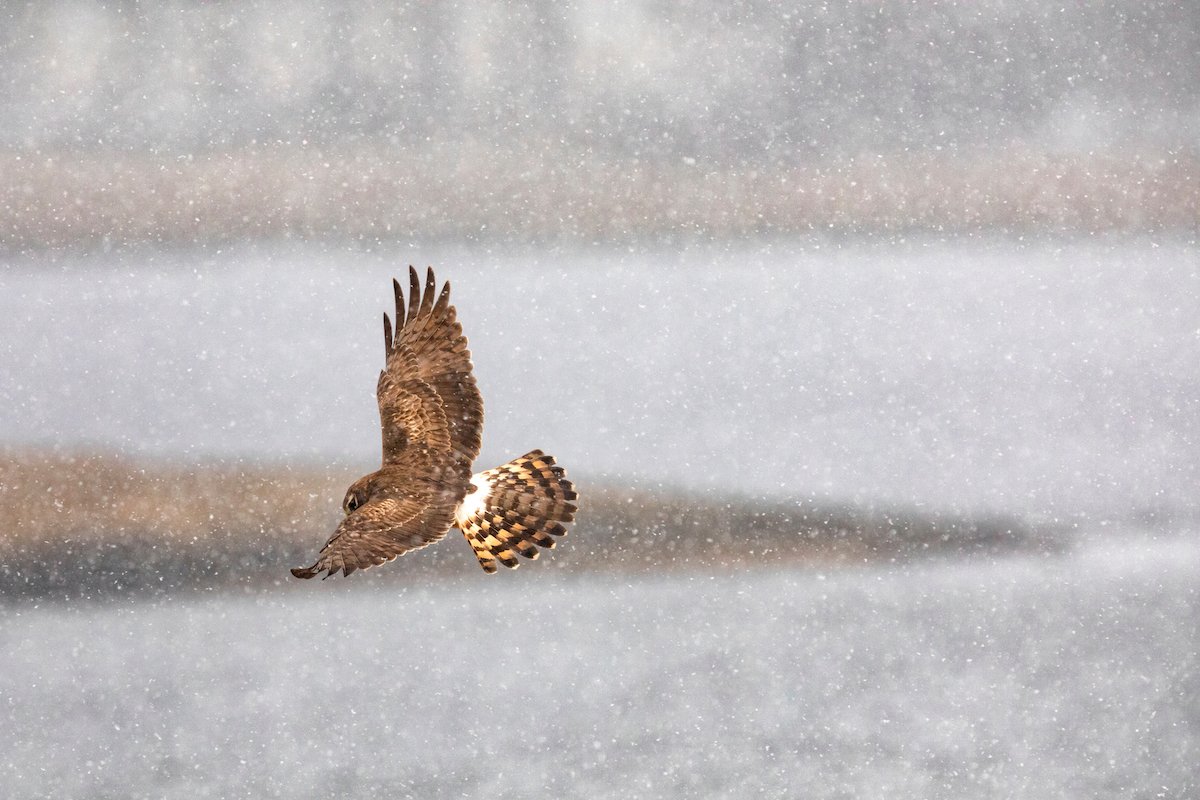
Photo: Northern Harrier, Aleksandar Baba-Vulic/Audubon Photography Awards
We are pleased to announce the winner of our most recent Monday Nature Mystery, John Moyle!
Congratulations to John for identifying the Northern Harrier (Circus hudsonius).
Northern Harrier, Aleksandar Baba-Vulic/Audubon Photography Awards
All About Birds suggests you look for harriers in wide-open grasslands, marshes, or fields. You’re most likely to notice Northern Harriers when they are flying. Note the low, slow, coursing flight style, the bird’s V-shaped wing posture, and its white rump. During migration in the fall and spring, you also can see harriers high in the sky over mountain ridges and coastlines. Northern Harriers are the most owl-like of hawks (though they’re not related to owls). They rely on hearing as well as vision to capture prey.
Each Monday we’ll post a new mystery and identify the previous week’s winner. They’ll receive an ASNV hat or tote bag.
Here is this week’s mystery:
Who is this?
Be sure to post your guess on our Facebook page under the latest Monday Nature Mystery post, and make sure you receive our emails to find out the winner and mystery answer each week. Good Luck!
Please check our guidelines here.

Monday Nature Mystery: Who is this? Photo: Judy Gallagher
Please DONATE TODAY to help northern Virginia's birds: A Note from Our President
Birds are under increasing threat from continued habitat loss and changing climate. Please help us protect them, other wildlife, and the natural habitat they need.
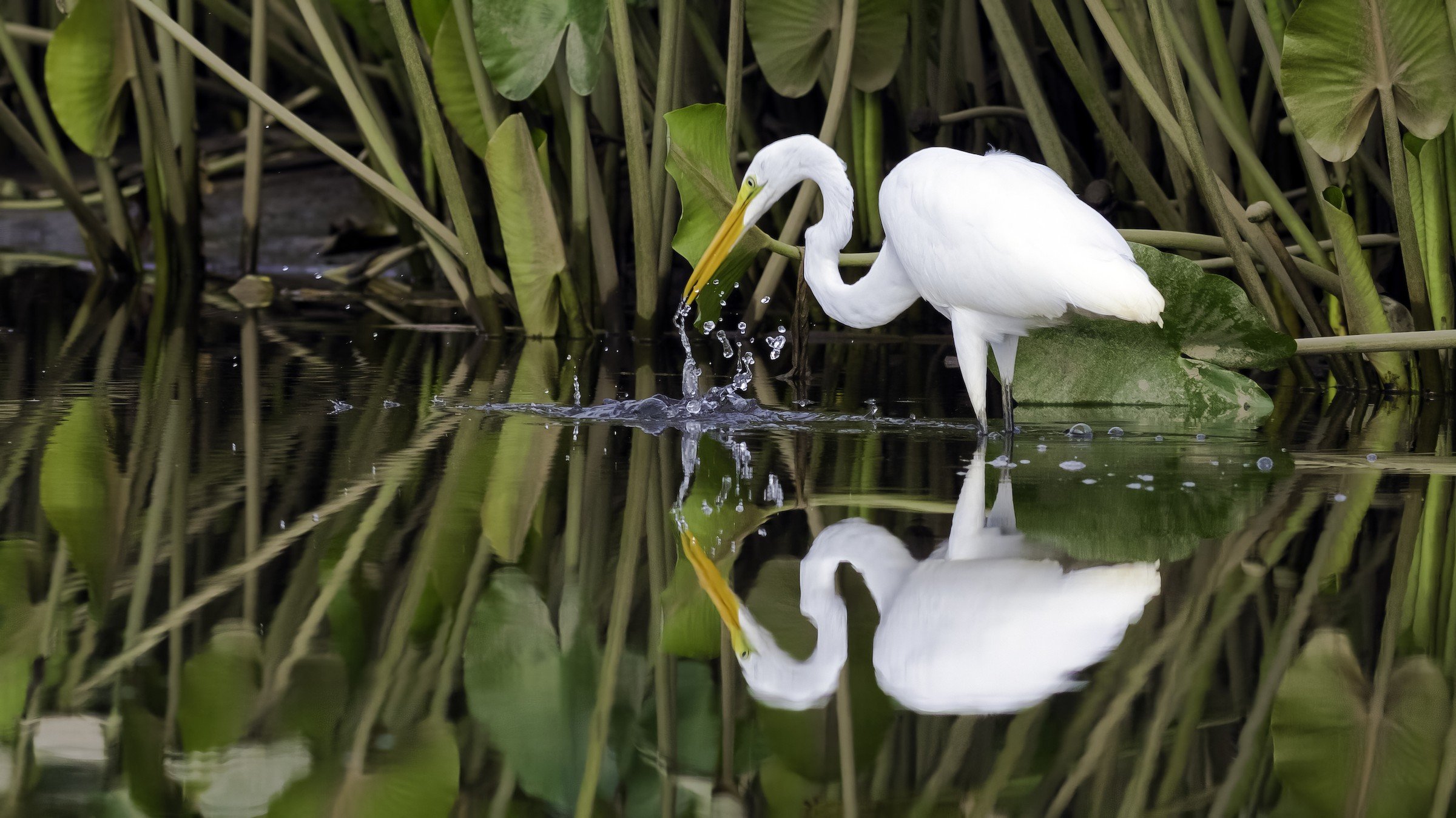
Photo: Great Egret, Todd Kiraly/Dyke Marsh, Alexandria
Dear Members and Friends,
Our mission is to engage all northern Virginia communities in enjoying, conserving, and restoring nature for the benefit of birds, other wildlife, and people.
Our new name reflects that we cannot accomplish our mission alone. We are the Northern Virginia Bird Alliance and we need your help. Be an ally to birds - invest in conservation here at home and abroad.
Birds are under increasing threat from continued habitat loss and changing climate. Please help us protect them, other wildlife, and the natural habitat they need.
Last year we expanded our Stretch Our Parks initiative, welcomed new and younger perspectives onto our board, and set the foundation to hire a new Executive Director in FY2025. See our FY2024 Annual Report for more information.
Looking ahead, we are faced with uncertain times. National policies and funding that directly impact conservation efforts, environmental protections, and wildlife habitats are threatened. We will continue providing our volunteers and communities with positive and hope-affirming ways that they can make a difference in saving local biodiversity. We are Looking Forward to what we can accomplish in FY 2025, using the themes below to guide us, especially as we implement our new Stretch Our Parks initiative.
We are exploring ways of keeping birds safe in Northern Virginia. Our new campaign Birds Safe NOVA will promote bird safe windows and educate the public about light pollution to reduce collision fatalities.
We are committed to catalyzing our impact through partnerships, building the Bird Alliance through our Stretch Our Parks community of practice, working with faith communities and HOAs, and providing bird-friendly advising to stakeholders throughout the region.
We aim to engage our region’s many communities in conservation. Just as biodiversity strengthens natural systems, we believe the diversity of human experience strengthens our conservation efforts for the benefit of nature and all human beings.
Our need to grow has never been more urgent. As threats accelerate, so must our response. To meet this moment, we need to expand our programs, increase habitat restoration projects, and strengthen our advocacy for policies that protect bird habitats. Our birds are counting on us, and we simply cannot afford to wait. Every dollar you contribute will go toward ensuring that future generations can experience the same joy of spotting a rare songbird or witnessing the seasonal migrations that inspire us.
Please DONATE TODAY!
Thank you in advance for your generous support. Together we can make a positive difference for the local birds and natural environments that we all cherish!
Sincerely,
Libby Lyons
NVBA President
Apply Now for the 2025 Educator Scholarship
Each year NVBA offers a full scholarship and transportation to “Sharing Nature: An Educator’s Week” at National Audubon Society's Hog Island Camp in Maine.
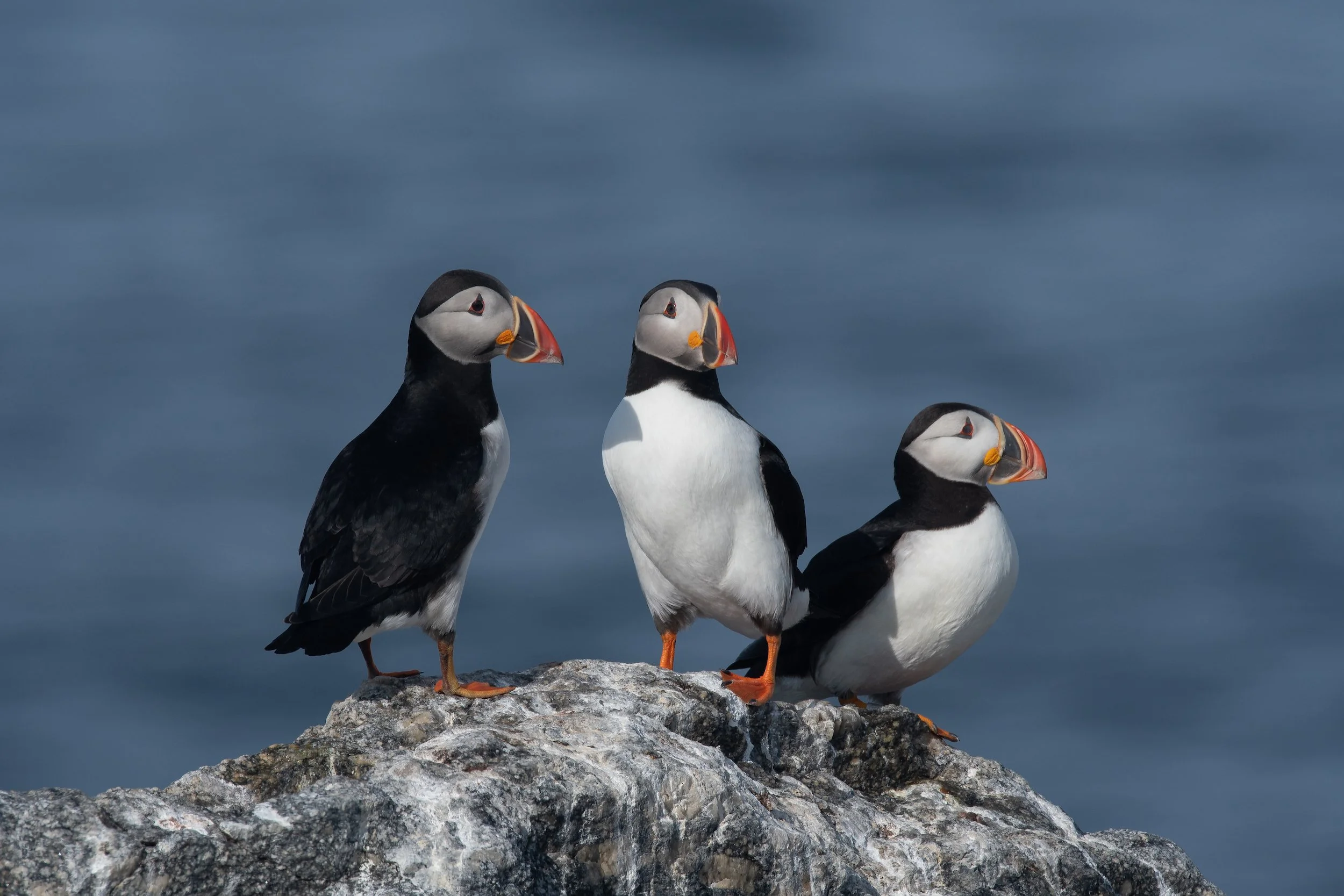
Photo: Atlantic Puffins, Walker Golder/Audubon Photography Awards
Bill Burton
Each year NVBA offers a full scholarship and transportation to “Sharing Nature: An Educator’s Week” at National Audubon Society's Hog Island Camp in Maine. Hog Island Audubon Camp has offered environmental education programs for adults, teens, families and conservation leaders since 1936. While there, educators learn interdisciplinary hands-on methods and approaches to environmental education while immersed in the natural world. Of its program, National Audubon writes,
Learn practical approaches and add inspiration to your environmental education curriculum during this action-packed program. Our experienced and enthusiastic instructors share their favorite approaches, methods, and activities for engaging both children and adults with nature.
You can read about the experience of the 2024 recipient here.
The applicant must be a public classroom teacher, specialist or school administrator in the NVBA chapter territory, which encompasses all of Arlington, Fairfax, Prince William and Stafford Counties, and portions of Loudoun, Fauquier, Culpeper, Rappahannock and Spotsylvania Counties. Independent cities in that area include Alexandria, Fairfax, Falls Church, Fredericksburg, Leesburg, Manassas and Manassas Park. The maps on our website provide additional detail.
Educator’s Week in the coming year is August 10-15. To apply, please complete the online application and submit two letters of recommendation no later than February 21, 2025. Please see the application for additional details, including post-camp requirements.

Swanfall
The Tundra Swans are back in town! Between 200 and 400 of these magnificent birds are spending the winter in the Great Marsh of Belmont Bay and will leave in mid-March for their breeding grounds in the tundra of far northern Canada near the Arctic Ocean.
Photo: Tundra Swans, Randy Streufert
Tom Blackburn
The Tundra Swans are back in town! Between 200 and 400 of these magnificent birds are spending the winter in the Great Marsh of Belmont Bay and will leave in mid-March for their breeding grounds in the tundra of far northern Canada near the Arctic Ocean.
“Swanfall” is the term used to describe the annual return of swans to their winter home. In years gone by, the residents of Mason Neck maintained a Swanfall telephone tree to alert each other when the beloved swans returned. Their haunting “oo, oo, oo” calls are nothing like the calls of the similar-looking Trumpeter Swans, which sound like the first attempts of a fourth grader to play the trumpet.
Members of Lewis and Clark’s 1804 Corps of Discovery were the first Europeans to see and hear Tundra Swans, which they called Whistling Swans. Of course, the swans were well-known to the Inuit, Athabascans and other Native Americans of the far north, who hunted the swans for their meat, eggs, and feathers.

Tundra Swans, Randy Streufert
Tundra Swans breed in widely-spaced nests, about one for each ¾ square mile, but they stay fairly close together on their wintering grounds. They lay 3 to 5 eggs which hatch in about 30 days. The young, or cygnets, fledge about 65 days after hatching. The adults molt and are flightless for about a month while the young are at the nest. The adults and cygnets leave the breeding grounds in late September. They fly in flocks of up to 100 birds in a V formation, as high as 26,000 feet, and often reach air speeds of 100 miles per hour. After resting and regaining weight in North Dakota and along the northern Mississippi River, they fly nonstop to the Chesapeake Bay, eastern Noth Carolina and the tidal Potomac River – a total trip of about 4,000 miles each way. The cygnets accompany the parents for their first year, then disperse when they arrive back in northern Canada.
The best spot to see the Tundra Swans is from the Woodmarsh Trail, a mile-long trail in the Elizabeth Hartwell Mason Neck National Wildlife Refuge. Turn right off Gunston Road onto High Point Road. The trail is 0.7 miles down High Point Road, on the left. The trail is level but may be muddy and bumpy in spots. The next-best place to see the swans is from the Great Marsh Trail, which is on Gunston Road, 1.5 miles after the intersection of High Point Road. This trail is 1.3 miles long, paved and fully accessible. Regardless of which trail you take, try to time your visit near high tide, when the swans are closer to the viewing area. You can get tide information here. Bring binoculars or a viewing scope if you have them. There are fixed binoculars at both viewing sites.
Mason Neck State Park is offering nine free guided walks to see the Tundra Swans in December and January. For more information and registration, see the park’s website.

Mini-grants for Invasive Removal Completed
We selected applications with the most effective and reasonable plans to address threats from invasives and involving property containing habitat of value where invasive removal efforts would provide a visible demonstration of educational value to congregants, residents, and passersby.
Image: Invasive Plant Control Area Sign for Mini-grants Program
Elizabeth Martin, Margaret Fisher, and Barb Tuset
A year ago, Fairfax County awarded NVBA’s Wildlife Sanctuary Program and Plant NOVA Natives a $32,500 grant from its Tree Preservation and Planting Fund to provide mini-grants for invasive removal on common open space owned by community associations or faith communities. We received 22 applications and funded 11 of them. We selected applications with the most effective and reasonable plans to address threats from invasives and involving property containing habitat of value where invasive removal efforts would provide a visible demonstration of educational value to congregants, residents, and passersby.
We selected three faith communities and eight neighborhood associations, although one neighborhood association dropped out when it could not muster sufficient volunteers. The final awards went to Antioch Baptist Church (Fairfax Station), Crest of Alexandria Homeowners’ Association (Fairfax), Fox Lake Property Owners Association (Oakton), Good Shepherd Catholic Church (Mount Vernon), Lakeford Community Association (Falls Church), Little River United Church of Christ (Annandale), McLean Greens HOA (Falls Church), Poplar Heights Recreation Association (Falls Church), Ridge Road Estates HOA (Springfield), and The Timbers HOA (Springfield).
We restricted mini-grants to projects focused on removal of the invasive vines and trees that most threaten native canopy trees in Northern Virginia, namely Japanese Honeysuckle, Asian Wisteria, Asiatic Bittersweet, Wintercreeper, English Ivy, Multiflora Rose, Porcelainberry, Kudzu, Callery Pear, Tree of Heaven, and Autumn Olive. These 11 vine and tree species overrun natural areas, overtop and kill trees, displace native plants, create food deserts for wildlife, and create hazards for humans. For more information about invasive plants and how to control them, see the excellent fact sheets published by Blue Ridge PRISM.
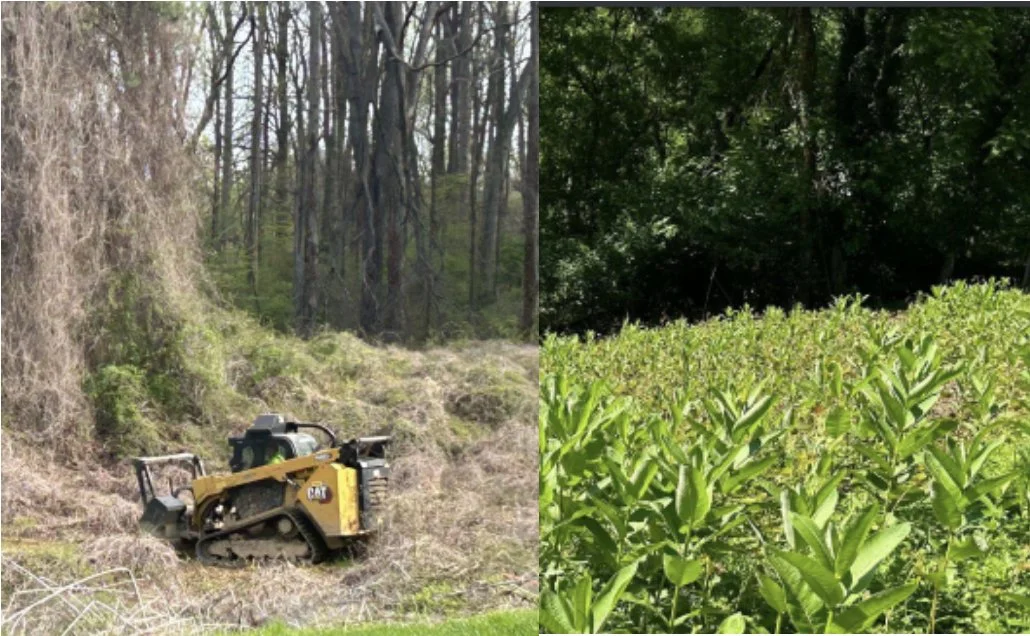
Clearing with a forestry grinder and growth of native milkweed, Photos courtesy of McLean Greens HOA
Each community received $3,000, and each mini-grant required a match of $1,500, fulfilled either with money or volunteer labor. Although the grants were modest, they enabled the grantees to effectively treat substantial invasive infestations on large areas of common property. These projects would have been impossible to tackle without the funding that the mini-grants provided to pay contractors; volunteers alone could not have done it. All told, almost 10 acres of invasives were treated.
The benefits from the mini-grants go beyond the acreage directly treated. Many of the common areas border parks, so the treated acres help buffer and protect Fairfax County parkland from invasions by harmful exotic plants. In addition, the success of their projects motivated several HOAs to embark on further projects to build on the work accomplished with mini-grant funds. For example, one grantee obtained additional funding from another source to replant a cleared area near a stream with 640 native plants. Another grantee reports its HOA has decided to use its own funds to contract for removal of Autumn Olive and English Ivy from another area of common property. Success is motivating, and one thing leads to another!
An example is the Fox Lake Property Owners’ Association, which owns 26 acres of common property. They treated two acres heavily infested by Autumn Olive, Multiflora Rose, English Ivy, Japanese Honeysuckle, Asiatic Bittersweet, and Porcelainberry. They began with forest mulching, hiring contractors who used a machine to cut, grind, and clear invasive vegetation. They experimented with three different invasive removal approaches in three different areas: sheet mulching with cardboard covered by mulch; hand pulling (near a stream), and herbicide (on a steep slope). Very soon after treatment, they found regrowth of native Milkweed, Sassafras, and Devil’s Walkingstick in treated areas. They observed wildlife returning, too, including wild turkeys and a female fox who raised a den of kits in the just-cleared area. After clearing what was once a solid wall of invasives, residents can now “see” who inhabits their woods, which has increased interest in their wild areas, even among teenagers!
About half the mini-grants were for projects in riparian areas, and applicants were required to obtain waivers from Fairfax County to work in Resource Protection Areas along Accotink Creek, Piney Branch, Tripps Run, Difficult Run, and Holmes Run. Careful removal of invasives will improve the quality of wildlife habitat in these environmentally sensitive areas.
Invasive Plant Control Area Sign for Mini-grants Program
Mini-grant recipients were also required to educate their members about the problems caused by invasive plants and about native alternatives that residents could install on their own properties. Communities received a sign to display. Some communities embarked on ambitious activities to involve their residents, congregations, and neighbors, including:
distributing brochures and doorhangers about the Tree Rescuers and Wildlife Sanctuary programs;
creating and distributing their own stewardship flyers and project descriptions to residents and Master Naturalists;
publishing newsletter articles;
making presentations or distributing information at annual meetings and other events;
conducting site tours and community hikes; and
providing an opportunity for an ecological restoration stewardship internship for a high school student as part of the project.
We thank Fairfax County for the initial grant and we especially thank all of the grantees for the hard work they put into volunteering on invasive removal, and on managing these projects. We hope this project starts them, and their neighbors and fellow congregants, on a rewarding journey of rediscovering and restoring their own nearby wild places. We have applied for renewed funding for a new round of mini-grants to community associations and faith communities in Fairfax County for next year.

Protect The Wildlife You Attract
Elements of the landscape may pose serious hazards to the very wildlife that we’ve attracted. Are we drawing them closer, only to have them harmed by an avoidable threat to their health and wellbeing?
Photo: Northern Cardinals, Donald Wuori/Audubon Photography Awards
By Plant NOVA Natives
Market demand for native plants in our region has clearly risen in the past ten years. This is a very positive trend, fueled by an increased awareness of the benefits that native plants offer. It is also a sheer delight to see wildlife respond to our efforts, enjoying the food and shelter that a healthier environment offers.
However, a word of caution is in order. Elements of the landscape may pose serious hazards to the very wildlife that we’ve attracted. Are we drawing them closer, only to have them harmed by an avoidable threat to their health and wellbeing? In some cases, the answer is clearly yes. Here are some suggestions for identifying and addressing some of the more common threats.
Cats: The biggest threat to birds is habitat loss, but the second biggest is domestic cats. When allowed outdoors, they devastate populations of birds - an estimated 2.4 billion are killed by cats every year in the United States alone. But they also kill other small critters such as frogs, voles, and lizards. Domestic cats are an introduced species that have no place in our landscape.
Window strikes: The American Bird Conservancy estimates that window collisions kill up to 1 billion birds each year. The victims are not limited to migratory species striking large glass buildings in cities. They include our local backyard birds as they fly back and forth. The American Bird Conservancy has tested some inexpensive deterrents and discusses them on their website. One featured example is “Feather Friendly”® decals, adhesive dots that make the glass more visible to birds. Note that whatever product you choose, it is better to apply it to the exterior of the window. Internally-installed products are less effective when reflections on the glass are strong.
Outdoor lighting: Bright outdoor lighting is a life-threatening hazard to birds that migrate at night, disorienting them and disrupting their sense of direction to the point of exhaustion and death. Outdoor lighting also devastates fireflies, moths, and other nocturnal animals. As much as possible, turn off outdoor lighting, especially during peak migration periods (March 1 to June 15 and August 15 to November 30). Before 11 pm, turn off any lighting that may be directed upward, or at least consider adding a down-shield. Swap out light bulbs for warm spectrum LED (3000 K or less) to make them less attractive to insects.
Mosquito spraying: It is impossible to spray for mosquitoes without killing other insects as well, including bees, butterflies, caterpillars, ladybugs, and dragonflies. The residual effects of the pesticide will last for weeks, yet the intended effect is rather short lived, as mosquitoes can fly up to 2 miles and quickly repopulate the treated areas. Several less harmful tactics can keep them at bay. Mosquitoes are weak fliers, so turn on an electric fan on your deck to blow them away. Use mosquito repellents such as DEET. Most importantly, search your property for places that accumulate water where mosquitoes can breed, such as buckets, toys, downspouts, or the saucers under plant pots.
Rat poison: Rat poison is designed to smell and taste good to mice and rats, but it can be just as appealing to other mammals as well. Even if placed inside, the poison can be carried outside by the mice and rats to where other wild animals can find it. But most cases of wildlife poisoning do not occur from direct consumption. Rather, poisoning occurs secondarily when a raptor eats a poisoned animal. The poison then accumulates in the raptor’s body, leading to the same kind of slow and agonizing death for the bird as it does for the mammal. More environmentally-friendly ways to keep rats and mice out of your home include sealing all entry points, securing food resources such as birdseed, pet food, and trash, making sure rodent nesting materials such as shredded paper or fabric are not available, or adding nest boxes for raptors to attract them to your yard. One barn owl can consume a thousand mice in a year, and that is a conservative estimate.
Nandina berries: Nandina is native to eastern Asia but has been a landscaping favorite across our region for a long time, mostly due to the profuse red berries it produces in late fall that persist through winter. Nandina berries, however, contain cyanide and other alkaloids that are deadly to birds when consumed in large volumes. There are many beautiful native substitutes for the invasive nandina, such as Winterberry and Red Chokeberry.
The NVBA website has more details on avoiding these and other human-made hazards.
As always, awareness is everything. When viewed more holistically, native plants are one piece in the larger puzzle of ecosystem restoration. Other factors complete the picture, including soil health, animals, favorable climate conditions, and fewer environmental risks, with each piece interdependent upon the other.

A Bird’s Holiday Gift Guide
Although many people make charitable donations during the holidays instead of giving presents to adult friends and family, some of us still like to exchange physical presents. So, how about making some gift selections that will help the birds!
Photo: Tufted Titmouse, Katherine McEntee/Audubon Photography Awards
Although many people make charitable donations during the holidays instead of giving presents to adult friends and family, some of us still like to exchange physical presents. So, how about making some gift selections that will help the birds! Here are a few suggestions, but we’re sure you can think of others.
Helping Birds on their Wintering Grounds
Many of our most colorful and spell-binding birds spend the winter in Central and South America. Not all coffee-lovers are aware that coffee plantations can have a devastating effect on the birds’ wintering habitat. So, consider making holiday gifts that spread the word of bird-friendly coffee and help those migratory birds at the same time. Make a gift of bird-friendly coffee that carries the Smithsonian Migratory Bird Center certification. You can buy it from National Audubon Society, a local retailer, or an online vendor. Or, if the person you are buying for isn’t a coffee drinker, how about bird-friendly chocolate? It’s a great gift idea for the holidays or any time during the coming year!
Learning What Birds Are Nearby
To encourage conservation-minded behavior, help someone in your family or neighborhood gain a new awareness of the birds around them. A field guide, even a simple-foldout guide to common North American birds, is a good start. If your budget is a little more flexible, consider a gift of binoculars. There is a wide range to choose from, including some for under $150. Check out this online guide for options in all price ranges. You also can point your gift recipient to NBVA’s free online course, Introduction to Birding, available for download from our website. Or, to provide an “ear-opening experience,” consider a gift of NVBA’s “Birding by Ear” program, also available from our website for only $20.
For those technologically-minded, and if there’s a lot of flexibility in your gift-giving budget, consider a gift of a smart device, like a “Bird Buddy,” which photographs birds that land on a backyard feeder, or a “Haiku Box,” which identifies visitors to an area by sound.
Supporting Birds in a Back Yard
Creating habitat for birds and other wildlife in a back yard supports conservation while at the same time creating enjoyment. So, how about giving family or friends a habitat boost. Plant NOVA Natives provides a list of local native plant vendors. A gift of native plants from one of those vendors, especially if it comes with a commitment to help with the planting, would be a welcome gift that would keep giving throughout the year.
Of course, a gift of bird-feeding supplies, a bird bath, or a bird bath heater can be welcome for someone interested in supporting back yard birds during the cold winter months. Although many local vendors provide a wide selection of feeders and other supplies, we suggest you start your search for a gift by consulting some guides on practices that attract birds but also keep them safe. Here’s a National Audubon guide.
If you are concerned that a gift of bird-feeding supplies could put visiting birds at risk, such as from predation by an outdoor cat, or window collisions, consider a gift that mitigates the risk, such as a generous offer to build your gift recipient an outdoor “catio,” an enclosure from which the cat can watch birds without endangering them, or install of one of the collision prevention devices cited by the American Bird Conservancy on its website.
Whether you limit your gifts to charitable donations, or mix donations with more tangible gifts, keep the birds in mind. Whatever you do to help them provides you, your family, and your friends, enjoyment throughout the year.

Observations from Meadowood: December 2024
Judy Gallagher is an NVBA board member and a regular surveyor of local wildlife who also captures photos of what she sees, in particular the less common species.
Photo: Pale Green Assassin Bug nymph, Judy Gallagher
Judy Gallagher is an ASNV board member and a regular surveyor of local wildlife who also captures photos of what she sees, in particular the less common species.
Pale Green Assassin Bug nymph. Note the large piercing mouthpart, Judy Gallagher
Alfred Lord Tennyson famously described nature as being red in tooth and claw. So, you may not be surprised to hear that there is a family of insects called assassin bugs. There are around 7,000 species worldwide, with at least 50 species found locally. Most assassin bugs have a relatively narrow neck, sturdy build, and a long piercing mouthpart called a proboscis or rostrum.

Sinea species Spined Assassin Bug with Spotted Cucumber Beetle prey, Judy Gallagher
Predatory assassin bugs use their piercing mouthpart to inject saliva into their victim. The saliva contains proteins and other chemicals that liquify the prey's insides, and the assassin bug sucks out the liquid and feeds on it. Assassin bug saliva components vary by species. One species' saliva contains a protein that is toxic to E. coli, a bacterium that can be harmful to humans, and scientists are studying assassin bug saliva to determine if it contains other substances that could be useful to humans.
Some assassin bugs, including Spined Assassin Bug males, females and nymphs, can make sounds by drawing their proboscis back and forth through a ridged groove in the underside of their thorax. This seems to startle predators.

Pale Green Assassin Bug with prey, showing its sticky front legs, Judy Gallagher
Assassin bugs typically sit motionless waiting for prey to come to them. But some species like the Pale Green Assassin Bug have hairs called sundew setae on their front legs. The bug secretes a sticky substance onto the hairs and insects become trapped on the legs. It then pierces the hapless prey with its proboscis.

Newly hatched assassin bugs (Wheel Bug), Judy Gallagher
Newly hatched Pale Green Assassin Bugs can't yet manufacture the sticky substance needed to coat their hairs. But when the mother lays eggs, she coats each egg with viscous fluid, and the newly hatched nymphs spread the sticky substance on their legs.

Black Corsair , Judy Gallagher
Many assassin bugs lack the hairy legs that can be coated with sticky substances. The Black Corsair has protuberances on its legs to help grasp prey or grip its mate. Female Black Corsairs don't have fully developed wings, but the males can fly. They feed on insects such as caterpillars, crickets and beetles, and also sometimes eat earthworms.

Thread-legged Assassin Bug (Emesaya sp.), Judy Gallagher
Although most assassin bugs are a bit chunky, thread-legged assassin bugs are slim. They resemble walking-sticks, but are not closely related to them. They are usually nocturnal, and often steal prey from spider webs or feed on the spiders themselves.

Bee Assassin Bug with bee prey. Note the flies that are also waiting for a meal, Judy Gallagher
Many assassin bugs are generalist predators, taking any prey they can capture. They are useful biological controls in the garden. But Bee Assassin Bugs specialize in capturing bees, and there are other assassin bug species that specialize in millipedes, termites, ants or spiders.

Wheel Bug on Goldenrod, Judy Gallagher
The Wheel Bug, as its name implies, has a wheel-like structure on the top of its pronotum. It is a generalist predator, but is one of the main predators of the invasive Brown Marmorated Stink Bug. Note the pollen on its head. While Assassin Bugs are not important pollinators, it is possible!

Bloodsucking Conenose - Triatoma lecticularia, Judy Gallagher
You may have painful aftereffects for months if you are unlucky enough to be stabbed by an Assassin Bug, but they are unlikely to stab you unless you handle them. But there is one Assassin Bug subfamily that you should avoid, the Kissing bugs or Bloodsucking Conenoses. They feed on blood, including human blood, typically biting their victim on the face near the mouth or eyes. Bloodsucking Conenoses can be a vector for Chagas Disease, but thankfully we don't have that illness in our area.
Assassin bugs help keep your nuisance insects under control. Don't handle assassin bugs, but rejoice if you see them in your garden.
View more of Judy’s Observations from Meadowood articles here.

Wildlife Sanctuary Almanac: Where Do They Go?
We know now that migration on earth accounts for the disappearance and reappearance of birds. But what about other creatures?
Photo: Wood Frog, VA Herpetological Society
Betsy Martin
Where do animals go in the winter, when many seem to just disappear?
The ancients puzzled over the disappearance and reappearance of birds. Aristotle thought they transformed into other species in winter, which explained why robins appeared just as redstarts disappeared in Greece. In the 16th century, Olaus Magnus theorized that swallows buried themselves in clay at the bottom of rivers in wintertime. In the 17th century, Charles Morton offered the most fantastic theory of all, that birds flew to the moon and back every year.
We know now that migration on earth accounts for the disappearance and reappearance of birds. But what about other creatures? Learning their whereabouts give us the chance to help many of them overwinter and reappear in the spring.
Butterflies and other insects
We know that some butterfly species migrate, just like the birds, although often we do not know their destination. We can see thousands of Cloudless Sulphurs, Mourning Cloaks and Monarchs move south, but we don’t always know exactly where they go. Most Monarchs from west of the Rocky Mountains winter along the California coast, while those from central North America winter in roosts in the mountains of central Mexico. Some Monarchs from the Atlantic seaboard may migrate to the same Mexican overwintering sites, but others may travel to Florida, possibly joining up with resident, non-migratory populations. Or they may migrate beyond to undiscovered sites in the Caribbean or the Yucatan Peninsula.
Still other summer butterflies do not survive the winter. But each year, as the weather warms, butterflies from Mexico and the southern United States fly north to repopulate Virginia. Examples include Common Buckeye, Cloudless Sulphur, Painted Lady, and Red Admiral.
But many insects don’t leave at all--they shelter in micro-habitats under the soil, inside rotting logs, in tree holes, inside plant galls, in leaf litter, or under rocks. Insects can enter a dormant state, called diapause, with a metabolic rate barely high enough to keep them alive. Some larvae replace the water in their bodies with glycerol, a type of antifreeze. Still other insects lay eggs that survive winter.
Wood Frog, VA Herpetological Society
Frogs and toads
We know that frogs and toads hibernate. After finding or making a living space (hibernaculum) that protects it from winter weather and predators, its metabolism slows and it "sleeps away" the winter, then "wakes up" when spring arrives.
Terrestrial toads such as American Toads (Bufo americanus) and other good diggers burrow deep into soil to hibernate below the frost line. Wood Frogs (Rana sylvatica), Spring Peepers (Hyla crucifer) and other less-adept diggers seek out deep cracks and crevices in logs or rocks, or just dig down as far as they can in the leaf litter. Their living spaces or hibernacula are not well protected from frigid weather and may freeze, along with their inhabitants.
And yet, the frogs do not die. A high concentration of glucose in the frog's vital organs prevents freezing, even though ice crystals form in its body. A partially frozen frog stops breathing, its heart stops beating and it appears dead. But when the hibernaculum warms up, the frog's frozen portions thaw, its heart and lungs resume activity and it comes back to life.
Various species have amazing and diverse strategies for surviving winter. You can help them thrive by gardening with awareness of their seasonal needs.
To help the creatures that remain survive the winter:

Wooly Bear Caterpillar, Sheila Sund from Salem, United States, CC BY 2.0 , via Wikimedia Commons
Leave the leaves. Leaf litter is key to many species’ winter survival, both insects and foraging birds that live here year-round.
Don’t be too tidy about cutting and cleaning up dead flower stems and stalks. Many insect pupae attach themselves to dead stalks, and adults lay eggs or burrow into stems for winter protection. Don’t throw away next spring’s crop of butterflies and insects by chopping up all the dead stems.
Leave woody debris. Some animals find or create their winter homes in woody debris like logs and large branches.
Be careful about digging or raking in winter. You may be digging up somebody’s winter home. If you do accidentally uncover or dig up an apparently lifeless frog or woolly bear, or firefly larvae, gently cover it up again and leave it to its winter sleep.
Winter is a good time for any tree work or removal you need to do. Doing such work in spring or summer risks destroying bird nests and nestlings.
To help migrating birds:
Plant fall-fruiting native shrubs to help migratory birds survive their fall migration south.
Avoid using insecticides that kill the insects that birds depend on to feed their young when they return to breed in the spring.
Learn more about creating your own Wildlife Sanctuary here. You can request a visit by a Wildlife Sanctuary Ambassador who will advise on habitat improvements you can make on your property. Winter is our slow season, and a good time for a visit to start planning for spring.
Catch up on past Wildlife Sanctuary Almanac articles here.

Monday Mystery - November 25, 2024
Monday Nature Mystery continues! Read on to learn who correctly identified our last mystery.
Photo: Shagbark Hickory, Plant Image Library, CC BY-SA 2.0
We are pleased to announce the winner of our most recent Monday Nature Mystery, Judith Fulton!
Congratulations to Judith for identifying the Shagbark Hickory (Carya ovata).
Shagbark Hickory (Carya ovata). Photo: Flickr user Plant Image Library, CC BY-SA 2.0
According to Plant Nova Natives, the Shagbark Hickory is a shade tree with bright yellow fall foliage. It has wonderful shaggy brown bark. This species is only native in our area to Prince William County but is a very nice choice for a yard. It grows very slowly and can live up to 300 years. The seedlings (but not the adult trees) have very deep tap roots, which makes it hard to find them for sale, but also makes them unlikely to be blown over in a storm. Visit Plant Nova Natives to learn about the many types of native trees you can add to your yard to attract birds.
Each Monday we’ll post a new mystery and identify the previous week’s winner. They’ll receive an ASNV hat or tote bag.
Here is this week’s mystery:
Who is this?
Be sure to post your guess on our Facebook page under the latest Monday Nature Mystery post, and make sure you receive our emails to find out the winner and mystery answer each week. Good Luck!
Please check our guidelines here.

Monday Nature Mystery: Who is this? Photo: Darlene Friedman/Audubon Photography Awards

Upcoming Workshops and Classes
Join us for a class, workshop or event! Here are some of our upcoming offerings.
Photo: Planting native herbaceous plants together in a deer exclosure
Join us for a workshop or class! Here are a few of our upcoming offerings. Check our calendar often for updates.
Alliance Afternoon: Glaciers to the Open Ocean, Using eBird to Study Rare Bird Behavior

Antarctic Shag, Sunil Singh/Audubon Photography Awards
Join us Sunday, January 12, for our quarterly Alliance Afternoon. We will gather informally starting at 2:30 PM in the cafeteria of the National Wildlife Federation Building, 11100 Wildlife Center Drive, in Reston. We welcome you to bring snacks and drinks to share. All are welcome! At 3:00 PM our guest speaker, Will Brooks, will describe how he used eBird data to study birds on glaciers, an enigmatic ecosystem, and birds lost offshore, a rarely observed event. He also will provide tips on how you can make your eBirding more useful for science.
When: Sunday, January 12, 2:30 PM - 4:00 PM
Where: National Wildlife Federation Building, 11100 Wildlife Center Drive, Reston, VA 20190
Fee: FREE
Vernal Pool Wildlife with Michael Hayslett
Join this talk with Michael Hayslett to learn about vernal pools, a form of temporary, freshwater wetland that contains water for a portion of the year, but is vital habitat for a fantastic array of wildlife and plants, some specially adapted for these habitats and rare in Virginia.
When: Thursday, January 23, 7:00 PM - 8:00 PM
Where: Virtual
Fee: $15 member; $25 non-member
You can also join us for a Bird Walk, Natural Resource Survey or Butterfly and Dragonfly survey.
Online Programs
Many of our programs are offered online, and we will provide recordings of as many of these events as possible and make them available here. Check back often, as we will add videos and resources as we receive them. Please enjoy!